
ASTA 267 - GLITTICA
-
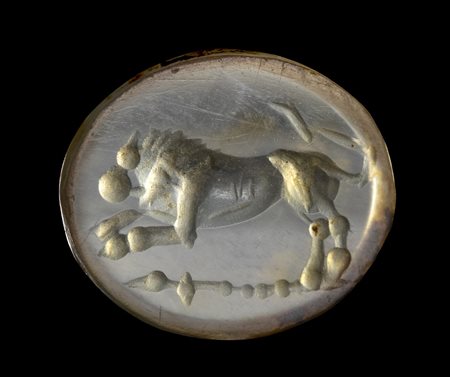
Lot 97 AN ITALIC AGATE INTAGLIO. LION RUNNING ON A TYRSUS.
2nd century B.C.
11 x 14 x 2 mm
The running animal is facing left, as a groundline, the thyrsus. Use of globular elements. Wear marks.
Provenance: From the collection of an European gentleman, acquired on the art market -
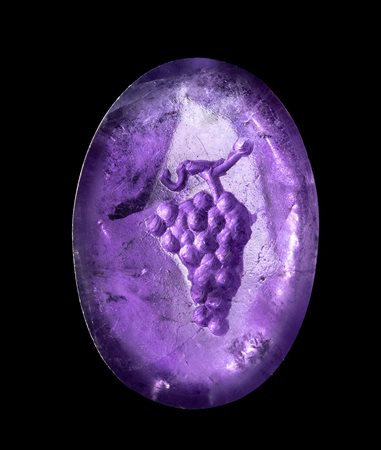
Lot 98 A ROMAN AMETHYST INTAGLIO. GRAPE.
1st century B.C - 1st century A.D.
11 x 16 x 4 mm.
Beautiful naturalistic depiction of a bunch of grapes in an almost Greek late Hellenistic taste. The subject and the variety of stone match perfectly, alluding to the wine and to the Bacchic processions. Nice vivid colour. Wear marks.
Provenance: U.K. private collection acquired in the british art market. -
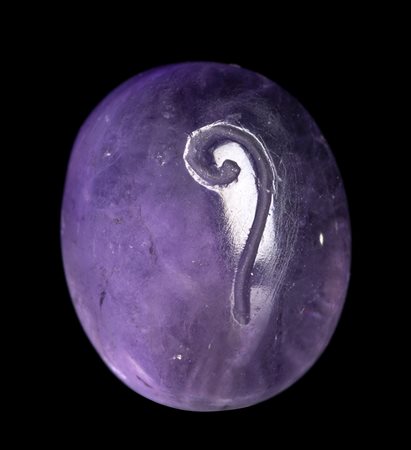
Lot 99 A ROMAN AMETHYST INTAGLIO. LITUUS.
1st century B.C.
9 x 11 x 5,5 mm.
Stone with a very convex surface, light purple in colour. Slight wear marks.
Provenance: U.K. private collection acquired in the british art market. -
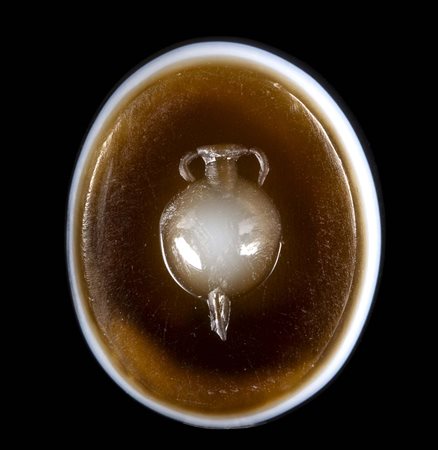
Lot 100 A FINE ROMAN THREE-LAYERED AGATE INTAGLIO. AMPHORA.
1st century B.C. - 1 st century A.D.
16 x 20 x 5 mm.
In the center, an amphora with a rounded body, with an elongated tip at the bottom and rounded handles. The body is perfectly spherical and mirror polished. Beautiful variety of three-layered agate, characterized by an elegant gradient between the upper honey brown layer and the intermediate white one; the last one is dark brown. The back of this large gem, with a truncated cone profile, is deeply concave in the center, probably to lighten its weight and increase its brightness in transparency. In fact, the thickness between the excavation of the belly of the amphora and the back seems minimal. The model and the execution style seem to be of Greek hand. Light wear marks.
Provenance: U.K. private collection acquired in the british art market. -
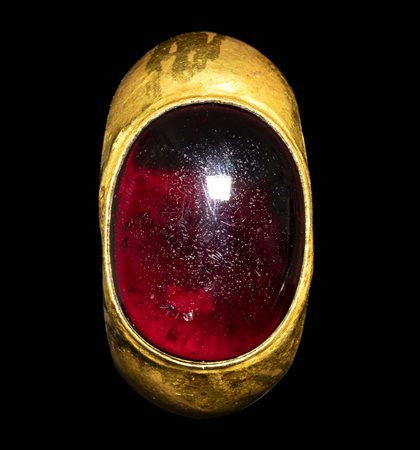
Lot 101 AN EXTRAORDINARY LARGE ROMAN GOLD RING WITH A BIG CABOCHON GARNET.
1st century A.D.
Stone 17x23,5 mm; int. Size 19x20 mm; 17,93 gr
With large rounded hoop expanding strongly upwards onton an oval bezel set with a very high cabochon garnet. Wear marks.
Provenance: From a private collection, France, acquired on the art market in the early 2000s -
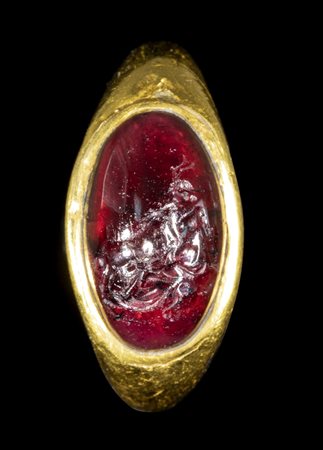
Lot 102 A FINE ROMAN GOLD RING WITH A GARNET INTAGLIO. SCENE OF METAMORPHOSIS.
1st century B.C. - 1st century A.D.
Stone 9x14 mm; int. Size 14,5x16 mm; 5,04 gr
With hollowed rounded hoop, flatten within, expanding upwards and set with a large oval cabochon garnet.To the right, a seated female figure with uncovered bust and draped legs, probably a nymph. Deer antlers appear on her head. In front of her, on the left, a doe kisses her on the mouth. Unusual and rare scene. According to the myth, the transformation into a deer can be referred to a male figure (Actaeon). Fine execution. Wear marks.
Provenance: From a private collection, France, acquired on the art market in the early 2000s -
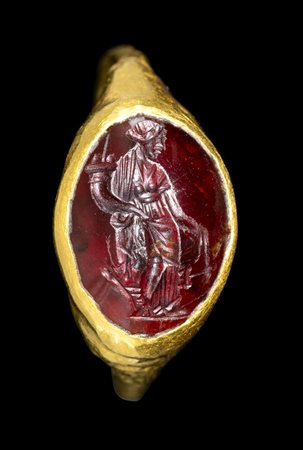
Lot 103 A KUSHAN GOLD RING WITH A GARNET INTAGLIO. FORTUNA TYCHE.
2nd - 3rd century A.D.
Stone 8x11 mm; int. diam. 16 mm; 2,69 gr
With hollowed rounded hoop expanding upwards in a high raised box-setting set with a garnet intaglio; Fortuna Tyche standing in three-quarters, her face facing right. She is tunicated and holds the cornucopia. Groundline. Wear marks.
Provenance: From a private collection, France, acquired on the art market in the early 2000s -
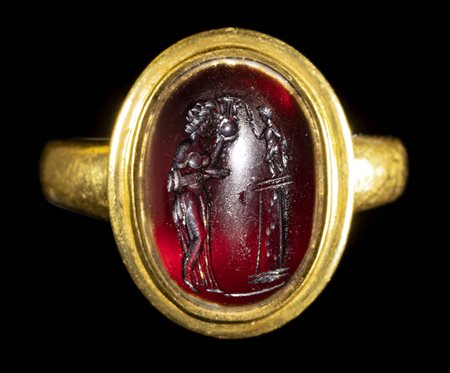
Lot 104 A LARGE ROMAN GARNET CABOCHON INTAGLIO SET IN A MODERN GOLD RING. FEMALE FIGURE OFFERING TO EROS.
1st century B.C.
Stone 12,5x18 mm; int. Size 18x21 mm; 21,95 gr
Large and very convex stone characterized by an attractive vivid red color. A tunicated offerer is facing left in front of an altar with the simulcarus of Eros. The woman holds a jug and a patera. Groundline. Slight wear marks.
Provenance: From a private collection, France, acquired from D.C. collection, London. -

Lot 105 A FINE ROMAN CHALCEDONY INTAGLIO SET IN A MODERN GOLD RING. ITHYPHALLIC SATYR HOLDING ATTRIBUTES.
1st century A.D.
Stone 10x14 mm; int. size 16x18 mm; 18,92 gr
A unusual apotropaic and pantheistic representation, composed of a satyr advancing to the right, raising his left hand above a cornucopia (attribute of Fortuna Tyche); with his right arm he holds a winged caduceus (attribute of Mercury) and a lion skin (attribute of Hercules). The character is characterized by sharp goat horns, a sculpted torso with extraordinary anatomical details, goat legs covered in hair and an erected phallus (reference to the Dionysian sphere and fertility). Groundline. Wear marks.
Provenance: From a private collection, France, acquired on the art market in the early 2000s -
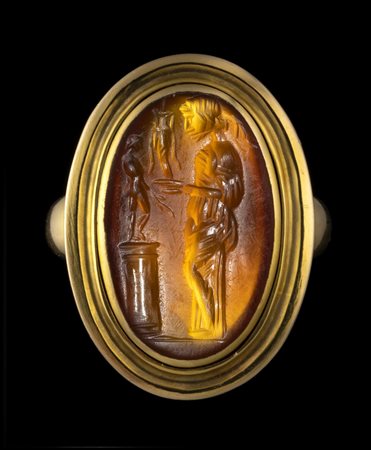
Lot 106 A LARGE ROMAN CARNELIAN INTAGLIO SET IN A GOLD RING. OFFERER IN FRONT OF AN IDOL.
1st - 2nd century A.D.
Stone 13x21 mm; int. Size 17x19 mm; 13,33 gr
A standing female figure faces left, making offerings to an idol on a column (probably Apollo holding a branch). The draped offerer holds a small amphora in her right hand and a small dish, probably a patera, in her left. Groundline. Wear marks.
Provenance: U.K. private collection -

Lot 107 A LARGE ROMAN CARNELIAN INTAGLIO SET IN A MODERN GOLD RING. VENUS MAKING OFFERS TO PRIAPUS.
1st century B.C. - 1st century A.D.
Stone 15x22 mm; int. Size 18x22 mm; 27,53 gr
Venus before an aedicula, with a mantle wrapped around her hips and legs, leaving her upper torso naked. She is holding a dove by the wings, the aedicula on top a tall garlanded pedestal, enclosing a figure of Priapus: near, a draped girl in between offering a bowl to the goddess, a tree arching over the scene from the left. Groundline. Fine execution and large size. The gem is set in a later gold collector gold ring.
Provenance: Christie's, 5/12/2012, NY. Said to have been found near Chartres, France, circa 1900. With S.H. Chapman, Philadelphia, 1911. Mr L.S. Gans. Private Collector, Malibu Lake, California, prior to 1970, thence by descent. Than, F.M. french collection. -
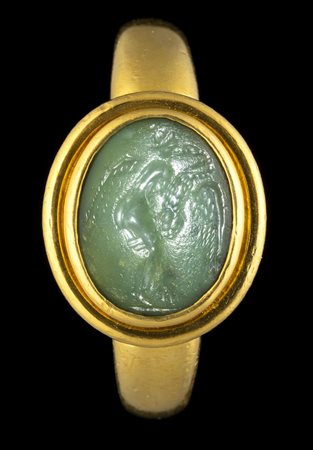
Lot 108 A ROMAN GREEN CHALCEDONY INTAGLIO SET IN A MODERN GOLD RING. LEDA AND THE SWAN.
2nd century A.D.
Stone 10x13 mm; int. size 18x21,5 mm; 17,74 gr
Beautiful and passionate erotic depiction of the sexual act between Leda and Zeus transformed into a swan, a celebrated episode from Ovid's Metamorphoses. The gem is slightly convex and vivid green in colour. Wear marks.
Provenance: From a private collection, France, acquired from D.C. collection, London.