
ASTA 267 - GLITTICA
-
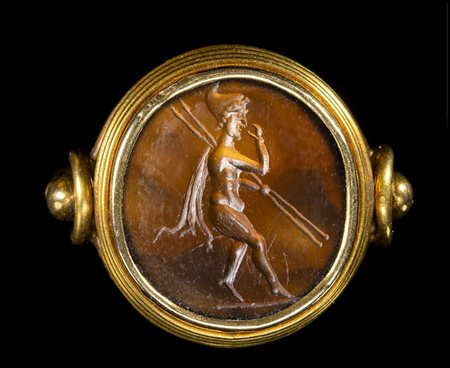
Lot 85 A FINE LATE ROMAN REPUBLICAN SARD INTAGLIO SET IN A GOLD RING. ATTIS WITH TWO SPEARS.
1st century B.C.
Stone diam. 15 mm; int. Size 18x20 mm; 5,35 gr
A male character advances to the right, walking on tiptoe. With his left hand he holds two spears, while bringing his right hand towards his face. He wears a cloak on his back and a Phrygian cap on his head, which is characterized by small curls. Use of globular elements. The subject is to be identified. The attributes may be referrable to Attis, while the pose and gait to a theater actor in the act of impersonating a mythological hero. Rare. Wear marks.
Provenance: U.K. private collection -
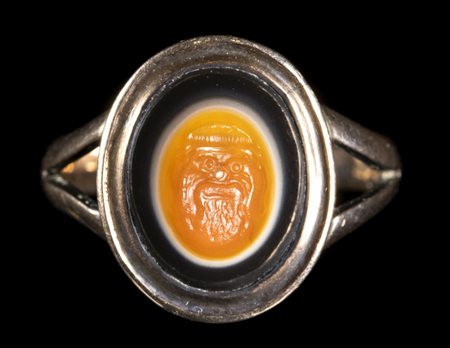
Lot 86 A ROMAN AGATE INTAGLIO SET IN A GOLD RING. THEATRICAL MASK.
1st century B.C. - 1st century A.D.
Stone 10x13 mm; int. size 17x18 mm; 3,92 gr
The hoop expanding upwards in two sections and surmounting an oval grooved box-setting with a two-layered agate intaglio. Frontal theatrical mask. The face characterized by strong features, a long beard and hair and bulging eyes engraved with a circular line. Interesting type. Wear marks.
Provenance: U.K. private collection -
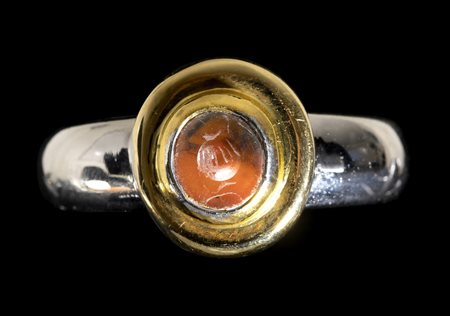
Lot 87 AN ITALIC CARNELIAN INTAGLIO SET IN A MODERN BICOLOR GOLD RING. POMEGRENATE.
2nd - 1st century B.C.
Stone 5,5x6,5 mm; int. diam 18 mm; 9,92 gr.
A stylized pomegrenate, depicted with a globular element and engraved details. Wear marks.
Provenance: European collection, acquired on the market, early 2000's. -
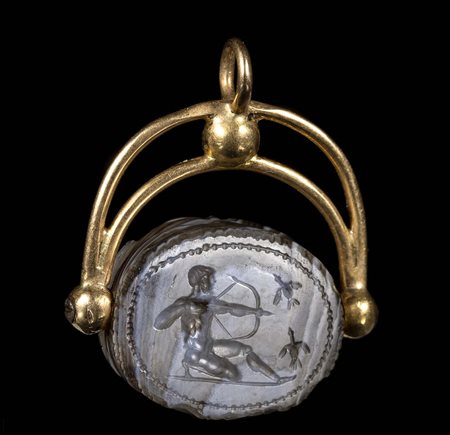
Lot 88 AN ITALIC BANDED AGATE SCARAB INTAGLIO. HERCULES KILLING THE STYMPHALIAN BIRDS.
2nd century B.C.
Scarab 15 x 19 x 11 mm; 7,6 grs
With stylized design in the back, the flat is engraved with the mythical hero bowing at two birds of the Stymphalian lake. Groundline. Dotted frame. Edge slightly chipped. Nice mirror polishing and wear marks. The scarab pierced lenghtwise is mounted on a 19th century gold swivel seal with suspension hole.
P. Zazoff, Etruskische Skarabaen, n. 216 ss for the style and 278 for the subject.
Provenance: From the collection of an European gentleman, acquired on the art market -
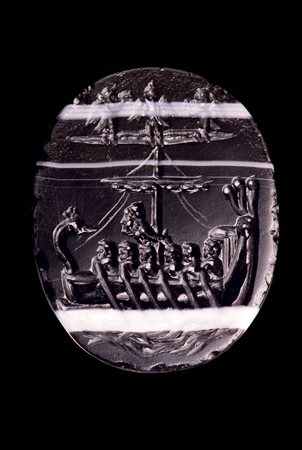
Lot 89 A LARGE ROMAN ITALIC BANDED AGATE INTAGLIO. ULYSSES ON THE BOAT.
2nd - 1st century B.C.
16 x 19 x 4 mm
Ulysses bond to the mast of his ship with a monster prow and aplustre, with five rowers and a steersman. Three Sirenes stand on the top sail. It depicts the scene from Homer's Odyssey in which Odysseus (Odysseus) resists the haunting song of the sirens by being tied up by the crew of his ship, while they are ordered to plug their ears so as not to hear them. The mythical scene is masterfully depicted here in a well composed and detailed manner. Large stone. Use of globular elements. Interesting use of the white band following the composition of the scene. Great subject. Wear marks.
For Parallels: J. Boardman, J. Kagan, C. Wagner, Natter's Museum Britannicum, p. 201 n. 478: L. P. B. Stefanelli, La Collezione Paoletti, vol.I, tomo II n. 97 ( carnelian intaglio, Berlin, Staatliche Museum, coll. Stosch, Furtwangler 1896 p. 255 n. 6880. Impronte Cades 31, III F, 22. Tassie 9550.
Provenance: U.K collection acquired on the art market, 1990s-2000s. -
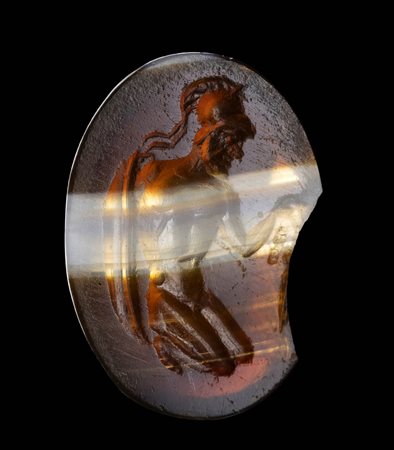
Lot 90 A LATE ITALIC BANDED AGATE INTAGLIO. WARRIOR.
2nd - 1st century B.C.
7 x 10 x 2 mm
Shown kneeled to the right with crested helmet and shield in the act of making a devotion (probably). Chip on the edge. Military votive scene. Wear marks.
Provenance: From the collection of an European gentleman, acquired on the art market -
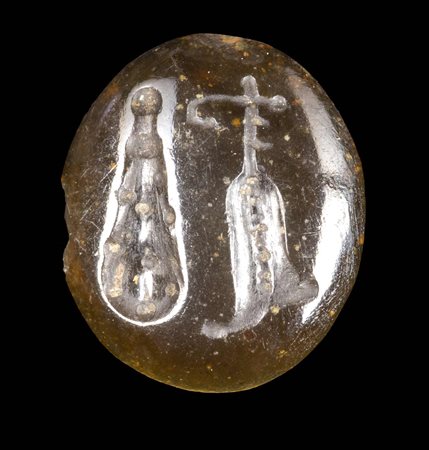
Lot 91 AN ITALIC AGATE INTAGLIO. RUDDER AND CLUB.
2nd century B.C.
8 x 9 x 1 mm
On the right the rudder, on the left the club. Use of globular elements. Wear marks.
Provenance: From the collection of an European gentleman, acquired on the art market -
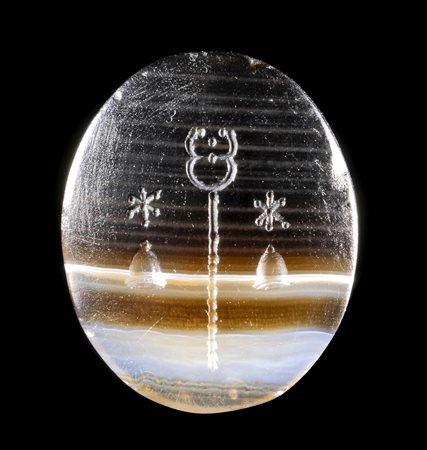
Lot 92 A ROMAN BANDED AGATE INTAGLIO. DIOSCURI EMBLEMA.
1st century B.C. - 1st century A.D.
15 x 19 x 3 mm
In the center a caduceus, on the sides two pileus caps with a star above them, referring to the Dioscuri. Beautiful emblema, elegant in composition and refined in execution. Use of globular elements. Fine variety of the stone. Wear marks.
Provenance: U.K. private collection acquired in the British art market. -
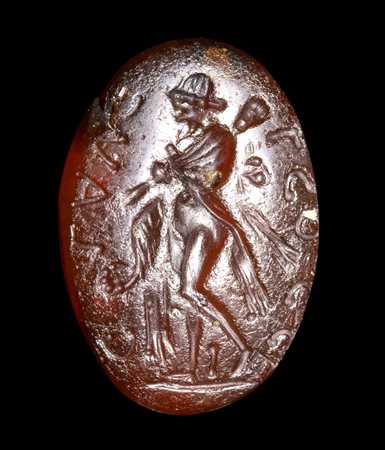
Lot 93 AN ITALIC CARNELIAN INTAGLIO. OMPHALE WITH INSCRIPTION.
2nd - 1st century B.C.
10x14x3 mm
The female figure is standing left, naked and partially covered with Hercules lion skin. His mace behind her shoulders. In the field, an inscription in latin letters (to be identified). Wear marks.
Provenance: The Gustave Mustaki collection, exported from Egypt under licence c.1950 and gifted to Elsa MacLellan, his daughter, thence by descent. -
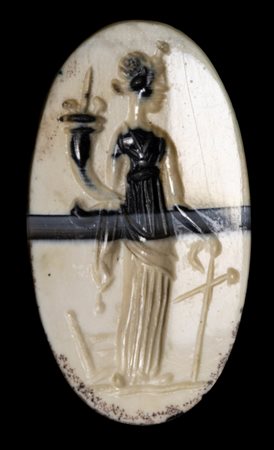
Lot 94 A ROMAN BURNT AGATE INTAGLIO. FORTUNA TYCHE.
1st century B.C. - 1st century A.D.
7x13x2 mm
The standing goddess is facing right. She wears a modius and dressed with a peplos and an himation. On her right arm, she holds the cornucopia, and the rudder on her left hand. Groundline. Use of globular elements. Attractive color of the burnt stone.
Provenance: U.K private collection -
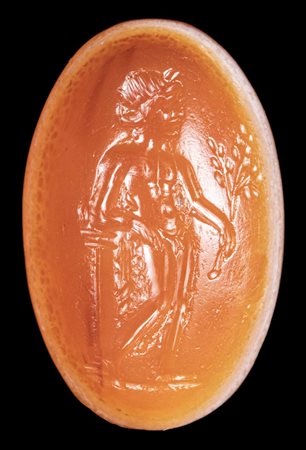
Lot 95 A FINE ROMAN AGATE INTAGLIO. APOLLO.
1st century B.C. - 1st century A.D.
9x14x7 mm
The deity leans against a column, with the body in three-quarters view and the head in profile to the right. With the left hand he is holding a laurel branch. Groundline. Slight wear marks.
Provenance: U.K private collection -
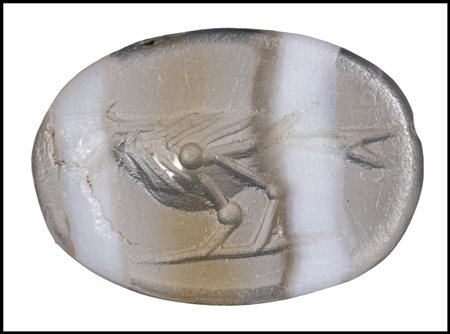
Lot 96 AN ITALIC BANDED AGATE INTAGLIO. BIRD.
2nd - 1st century B.C.
8x11x2 mm
The bird is facing left, with a small worm in its beak. Globular elements. Groundline. Wear marks.
Provenance: U.K private collection