
ASTA 267 - GLITTICA
-
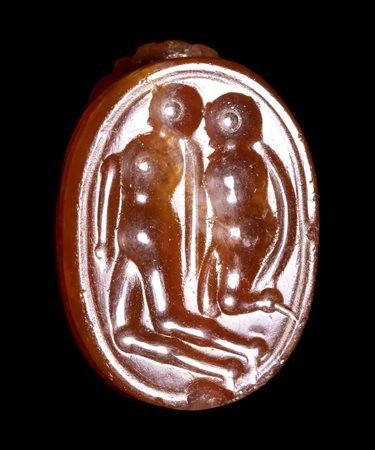
Lot 49 AN ETRUSCAN CARNELIAN SCARAB. TWO WARRIORS.
4th - 3rd century B.C.
10,5x15x7 mm
Two kneeling warriors with shields facing left. Engraved linear frame. Wear marks. Small chips on the edge.
Provenance: From a private collection, France, acquired on the art market in the early 2000s -
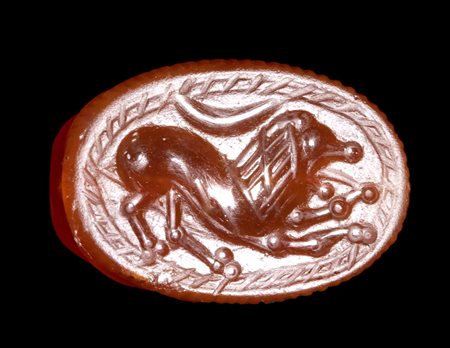
Lot 50 AN ETRUSCAN CARNELIAN SCARAB. LION WITH CRESCENT MOON.
3rd century B.C.
9x14x6,5 mm
The animal is facing right, with open mouth and tongue out, in a pose reminiscent of the Chimera. Moon crescent above. Globular elements. Hatched frame. Wear marks.
P. Zazoff, Die Etruskische Sskarabaen, tafel 49 n. 260 (probably same workshop).
Provenance: From a private collection, France, acquired on the art market in the early 2000s -
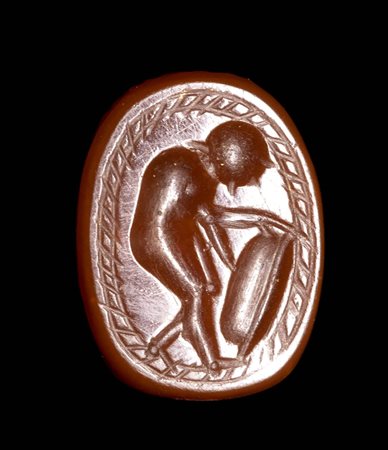
Lot 51 AN ETRUSCAN CARNELIAN SCARAB. WARRIOR.
3rd century B.C.
8x11x5 mm
The warrior is facing right, holding a shield. Globular elements. Hatched frame. Light wear marks.
Provenance: From a private collection, France, acquired on the art market in the early 2000s -
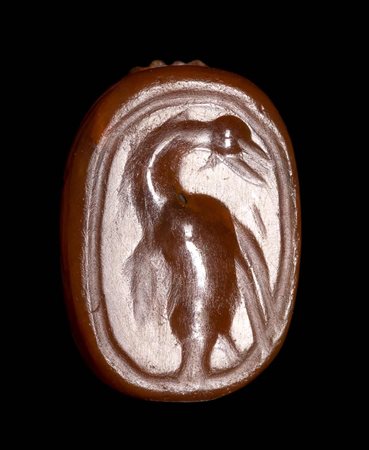
Lot 52 AN ETRUSCAN CARNELIAN SCARAB. GOOSE.
3rd century B.C.
8x11x6 mm
The bird stands upright, with its neck stretched forward. Engraved linear frame. Slight wear marks.
Provenance: From a private collection, France, acquired on the art market in the early 2000s -
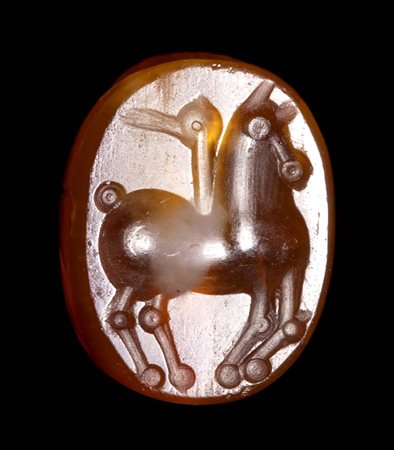
Lot 53 AN ETRUSCAN CARNELIAN SCARAB. HORSE.
3rd - 2nd century B.C.
9x11x6 mm
The mighty animal is facing right. On the back, an object to be identified, probably a weapon or an idol. Globular style. The back engraved in a stylized manner. Slight wear marks.
Provenance: From a private collection, France, acquired on the art market in the early 2000s -
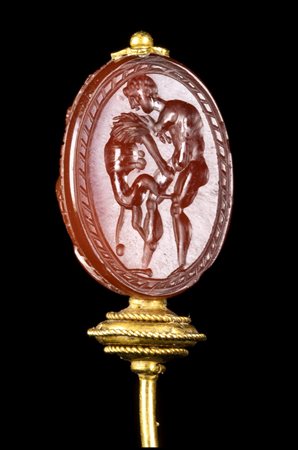
Lot 54 AN ETRUSCAN CARNELIAN SCARAB SET IN A GOLD STICK PIN. HERCULES FIGHTING THE NEMEAN LION.
4th - 3rd century B.C.
Stone 12x16x8 mm; H max 86 mm; 4,10 gr.
The scarab is pierced and finely detailed. It is characterized by the influence of the Italic style,close to the so called “Etruscan Italic style”. The stone is set in a gold archelogical revival style stick pin. Slight wear marks.
References: Gothenburg, City Museum 21934-8 (unpublished); Hannover, AGD IV no. 45; Getty Mus. 81.AN.76.172 (Boardman 1975 no. 172); Getty Mus. 81.AN.76.171 (Boardman 1975 no. 171); Naples 27086/1241 (Pannuti 1994 no. 25); Taranto 40.178 (Alessio 1984 no. 257); Rome, Pal. Massimo 107978 (Facchini 1973 no. 2); Paris BnF 1762; Rome, Villa Giulia; Florence, Mus. Arch (reference: Nancy de Grummond's article in Rasenna 2010). mm 22 x 12 x 9; gr. 4,09
Provenance: U.K. private collection -
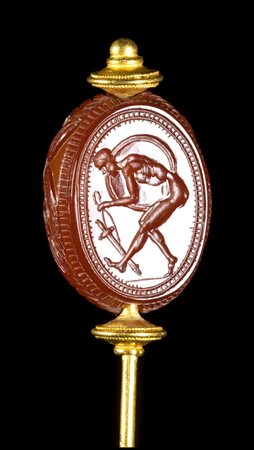
Lot 55 A GRAND TOUR CARNELIAN ENGRAVED SCARAB SET IN A GOLD STICK PIN. WARRIOR.
19th century
Stone 15x19x11 mm; H max 92 mm; 7,00 gr
The warrior faces left. With his right arm he holds the shield, with the left hand the sword with scabbard. The figure is leaning forward. Hatched border. The scarab is mounted in an elegant archaeological revival style gold stick pin.
Provenance: U.K private collection -
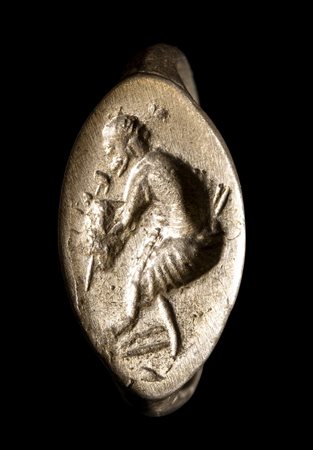
Lot 56 A GREEK HELLENISTIC SILVER RING. SILENUS.
4th century B.C.
Bezel 10x19 mm; int, size 16x18 mm; 4,34 gr
With rounded hoop, flatten within, and expanding onto an almond-shaped bezel with engraved design. A bold man facing left, the upper body uncovered and the lower body covered of hair. In his hands he holds the flute. Possibly a representation of a Silenus. Wear marks.
Provenance: U.K. private collection -
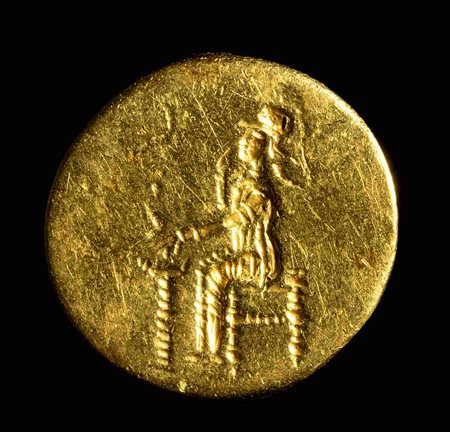
Lot 57 A RARE LATE CLASSICAL GREEK GOLD RING WITH THE ENGRAVED BEZEL. ATHENA SEATED IN FRONT OF A THYMATERION.
4th century B.C.
Bezel diam. 20 mm; int. Size 15x17,5 mm; 7,24 gr
Hoop flat within, rounded without; large rounded bezel with engraved design; the helmeted goddess is seated on a chair facing left. She wears a long chiton and himation, her right hand near a face, meanwhile her left arm is strechted toward a thymiaterion with incense burning. Wear marks.
For similar iconography and typology see: J. Boardman,D. Scarisbrick, the Ralph Harari collection of Finger Ringers, n° 11
Provenance: From a private collection, France, acquired on the art market in the early 2000s -
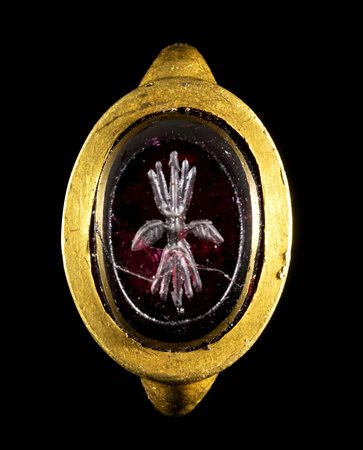
Lot 58 A LATE GREEK HELLENISTIC GOLD RING WITH A GARNET INTAGLIO. THUNDERBOLT.
3rd - 2nd century B.C.
Stone 10x14 mm; int. size 13x18 mm; 7,13 gr
With rounded hoop expanding upwards on the shoulders and surmounting a large oval bezel with thick edges, containg a high raised garnet intaglio; thunderbolt. Crack on the stone and wear marks. Good overall conservation.
Provenance: From a private collection, France, acquired on the art market in the early 2000s -
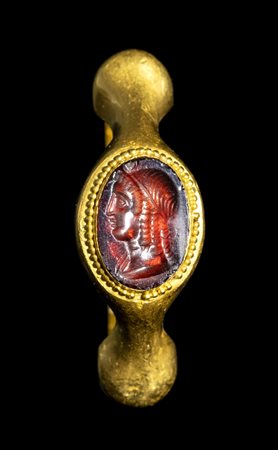
Lot 59 A FINE GREEK PTOLEMAIC GARNET INTAGLIO SET IN A LATER GOLD RING. BUST OF ISIS.
Stone 3rd - 2nd century B.C. Ring 3rd century A.D.
Stone 7x9,5 mm; int. diam. 18 mm; 9,13 gr
With a flatten hoop within and rounded without, the shoulders project strongly in angular shaped, decreasing upwards onto an oval box-setting with gold globules on the frame and containing a ptolemaic garnet intaglio; head of Isis facing left characterized by calamistrate hair adorned with a band. The face features are young, with a large almond eye, straight nose and small semi-opened mouth. Wear marks. Beautiful conservation.
D. Plantzos, Hellenistic Engraved Gems, pl. 11 n. 64,65, 66. M-L Vollenweider, Camees et intailles, Les portraits grecs du Cabinet des Medailles, Tome I, p. 55 n. 91-92.
Provenance: From a private collection, France, acquired on the art market in the early 2000s -
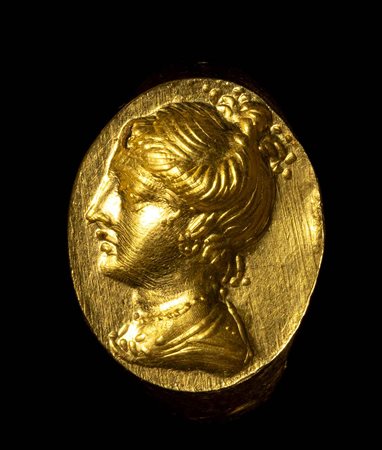
Lot 60 A RARE GREEK GOLD RING. LATE PTOLEMAIC FEMALE BUST PORTRAIT.
3rd - 2nd century B.C.
Bezel 15x20 mm; int. Size 16x18 mm; 5,72 gr.
Of hollow gold, inside rounded hoop, flatten outside, expanding at the shoulders to the flat oval bezel; engraved with a profile portrait of a bust of a woman facing left, wearng a chiton. Her hair arranged in a chignon at the top of the head. She wears earrings and necklace. The face is charcaterized by the typical late ptolemaic profile; with straight nose, large almond-shaped eye, slighlty open mouth and small chin. The gold surface presents micro-scratches as tools traces and wear marks. The subject can be identified as a high private portrait, probably a princess with idealized features.
For a very similar ring: J. Boardman, C. Wagner, Masteroieces in Miniature. Engraved gems from Prehistory to the present, p. 265 n. 249. 'Said to be from Egypt. Bust of a woman. Her hair dressed in a lock from the front to the topknot, long over the shoulders, wearing pointed earrings and a floreal necklet. The hairstyle is seen on Republican Roman coins of around 100 BC for Victoria or Diana. Probably intended for a goddess. Hellenistic. 3rd/2nd BC. ".
Provenance: Formerly Pr. Timmers collection, 1948-1977; U.K. private collection acquired on the art market in the early 2000s.