
ASTA 267 - GLITTICA
-
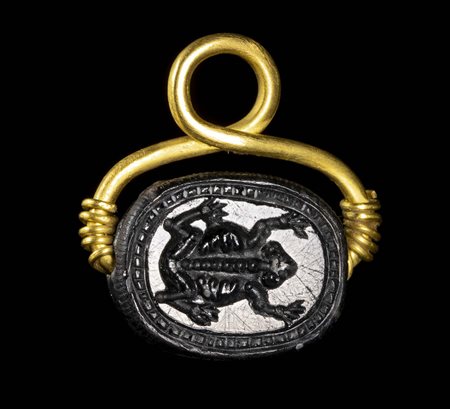
Lot 37 A FINE GREEK BLACK OBSIDIAN ENGRAVED SCARAB SET IN A GOLD SWIVEL SEAL PENDANT. FROG.
5th - 4th - century B.C.
13 x 17 x 9 mm; 5,40 gr.
A Frog, seen from the top, with its forelegs placed forward and the hindlegs bent, as if about to jump. Hatched border. Wear marks. Rare.
G.M.A. Richter,The engraved gems of the Greeks and the Etruscans. A History of Greek art in miniature, p. 122 n. 471.
Provenance: From the collection of an European gentleman, acquired on the art market -
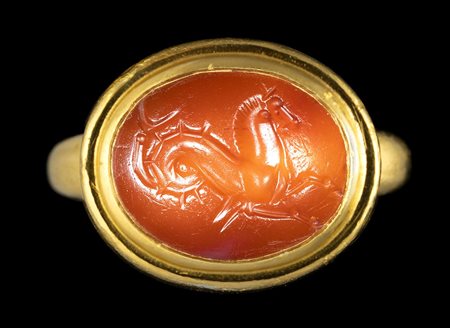
Lot 38 A GREEK CARNELIAN INTAGLIO SET IN A MODERN GOLD RING. SEAHORSE.
5th - 4th century B.C.
Stone 14x18 mm; int. size 18x22 mm; 22,59 gr
The hybrid creature is facing right and is characterized by an horse protome ending in a long fish tail with sharp fins on the back. Use of globular elements. Rare type. Wear marks. The stone is set in a modern massive gold ring.
Provenance: From a private collection, France, acquired on the art market in the early 2000s -
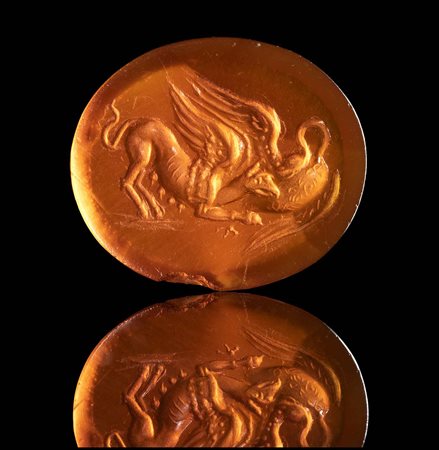
Lot 39 A GREEK CARNELIAN INTAGLIO. GRIFFIN FIGHTING A SWAN.
4th century B.C.
10x12x2 mm
The griffin is attacking the swan toward the right side. The fantastic creature posture is tense and reflects her rapid attack meanwhile the position of the swan shows his surprise. Presence of globular elements and very fine details for the anatomical depiction. Great sense of composition. Wear marks and small chip on the edge.
Provenance: U.K. private collection -
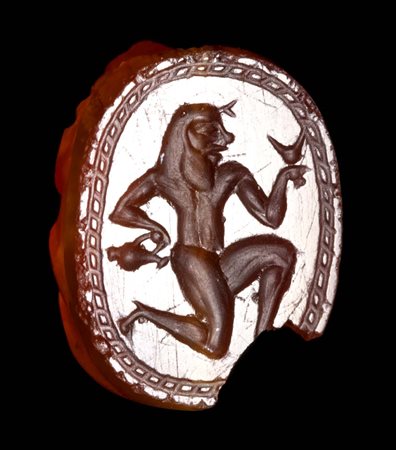
Lot 40 A GREEK CARNELIAN SCARAB. RUNNING SATYR.
5th century B.C.
10x12,5x6,5 mm
The bearded Silenus with no tail is depicted in the typical "knielauf position" facing right: with his right hand he holds a jug, with his left a kantharos for drinking. Refined execution with traces of globular elements. Hatched frame. In the category of the so called "Robust style". Fragmentary edge with missing part. Wear marks.
J. Boardman, Greek Gems and Finger Rings, p. 181 n.300
Provenance: From a private collection, France, acquired on the art market in the early 2000s -
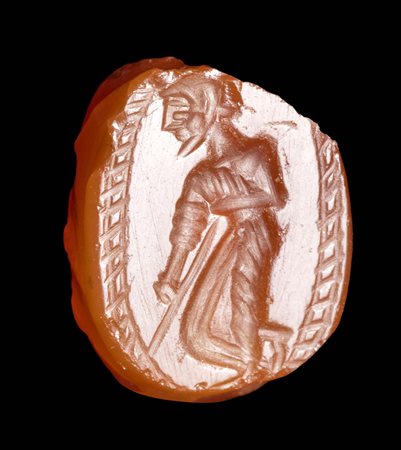
Lot 41 A GREEK CARNELIAN FRAGMENTARY SCARAB. MALE FIGURE.
5th - 4th century B.C.
8x10x6 mm
A bearded man in a tunic leans on a stick in a resting position. Hatched frame. The scarab is fragmentary and missing both in the upper and lower part of the engraved scene. Rare.
Provenance: From a private collection, France, acquired on the art market in the early 2000s -
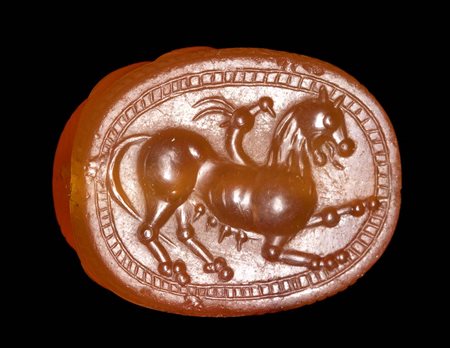
Lot 42 A LARGE ETRUSCAN CARNELIAN SCARAB. CHIMERA.
4th - 3rd century B.C.
12,5x16x9 mm
Beautiful and refined representation of the chimera facing right, with the open mouth and the tongue out. The fantastic creature is characterized by the body of a lioness, protome of a goat on the back, tail of a snake. Massive use of globular elements, Hatched frame. Slight wear marks. Small chips on the edge. Beautiful execution.
Provenance: From a private collection, France, acquired on the art market in the early 2000s -
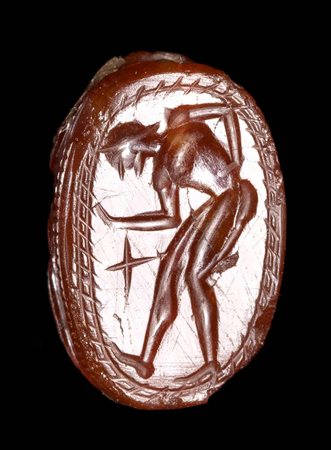
Lot 43 AN ETRUSCAN CARNELIAN SCARAB. MALE FIGURE WITH A STAR.
4th - 3rd century B.C.
8,5x13x6,5 mm
A male character is facing left, with his back bent forward, his left arm by his side and his right extended forward. A star in the field. Hatched frame. Wear marks. Chips on the edge.
Provenance: From a private collection, France, acquired on the art market in the early 2000s -
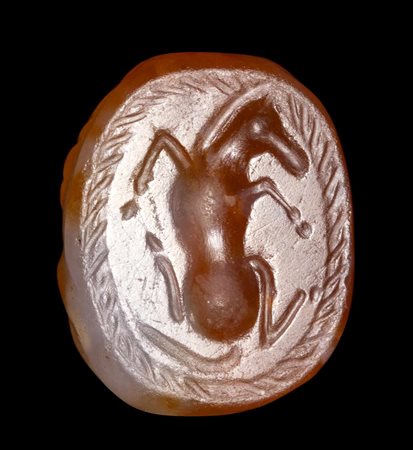
Lot 44 AN ETRUSCAN CARNELIAN SCARAB. A ROLLING HORSE.
5th - 4th century B.C.
10x13x7 mm
Horses, mules and donkeys rolling on the ground are not uncommon on Greek and Etruscan gems. As Furtwangler suggests, they may have had a connotation of good luck; or the subject appealed as lending itself to an interesting composition in the elongated field of the gems. In that stone, the body is seen from beneath, the head with the neck in profile turned to the right, the legs are open in different directions. Hatched border. Wear marks. As Boardman said, the subject is surprising. Fallen horses are seen on Archaic vases, but then generally as part of a chariot team that has come to grief. It appears as an isolated motif in major art a little later, however in Polygnotos'wall painting of the Sack of Troy in a building at Delphi: Pausanias describes "a horse who seems about to roll in the dust" .
J. Boardman, D. Scarisbrick, The Ralph Harari collection of finger rings, p. 13 n. 3; G.M. Richter, The engraved gems of the greek, Etruscans and Romans p. 71 n. 207-209.
Provenance: From a private collection, France, acquired on the art market in the early 2000s -
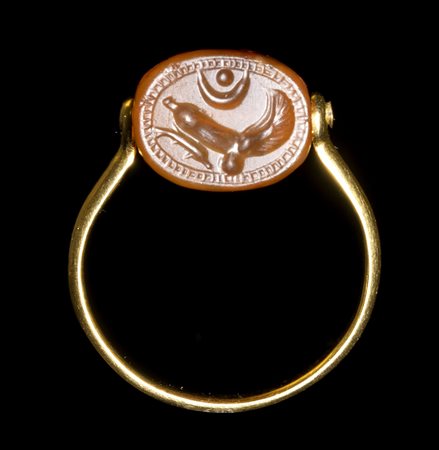
Lot 45 AN ETRUSCAN CARNELIAN SCARAB INTAGLIO SET IN A GOLD SWIVEL RING. WINGED PHALLUS WITH A DOLPHIN.
5th-4th century B.C.
Stone 9,5x12x8 mm; int. Size 15x18,5 mm; 3,40 gr.
Winged phallus to the left. Below, a dolphin, to the right. Above, a crescent with a stylized star. Use of globular elements. Dotted frame. Wear marks. Interesting composition, apparently unique. Allegory of fertility under the good astral and marine auspices. Rare.
Provenance: U.K. private collection acquired on the art market. -
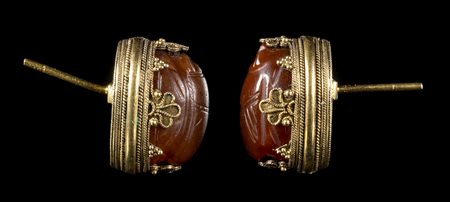
Lot 46 A PAIR OF CARNELIAN ETRUSCAN SCARABS SET IN GOLD EARRINGS. VARIOUS SUBJECTS.
Scarabs: 4th-3rd century B.C.; mounting 19th century.
Stone 11x15 mm; total weight 8,9 gr
Both scarabs are characterized by the same certainly ancient globular style and wear marks. The subjects are to be identified, but for one specimen it should be a warrior, for the other one probably horses. The stones are mounted in Castellani-type archaeological revival gold settings. The closures are missing.
Provenance: U.K private collection -
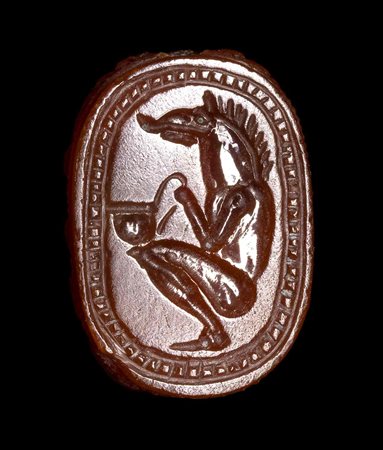
Lot 47 AN ETRUSCAN CARNELIAN ENGRAVED SCARAB. SEATED HYBRID FIGURE WITH A WILD BOAR'S HEAD.
5th - 4th century B.C.
12 x 18 x 8 mm
Hybrid figure sitting on his own legs composed of a human body and a boar's head. The creature is facing left and holds a kantharos. Use of globular elements. Dotted frame. Through hole. Slight wear marks. Interesting rare subject.
P. Zazoff, Die Etruskische Sskarabaen, tafel 35 n. 169 (probably same workshop). Furtwangler. AG, Taf. 18,44.
Provenance: From the collection of an European gentleman, acquired on the art market -
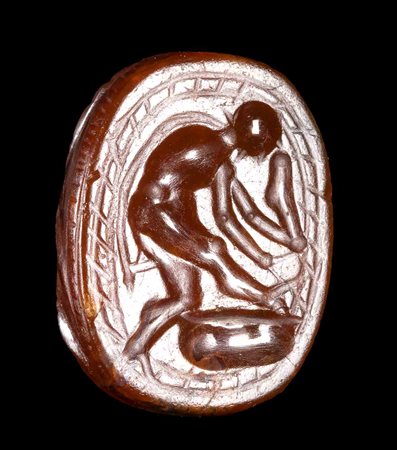
Lot 48 AN ETRUSCAN CARNELIAN SCARAB. MALE FIGURE AT THE FOUNTAIN.
4th - 3rd century B.C.
11x5x7,5 mm
A man with a cloak is in the act of putting his foot into a basin, with his hands he holds a container probably for pouring a liquid and washing himself. Hatched border. Wear marks.
Provenance: From a private collection, France, acquired on the art market in the early 2000s