
ASTA 267 - GLITTICA
-
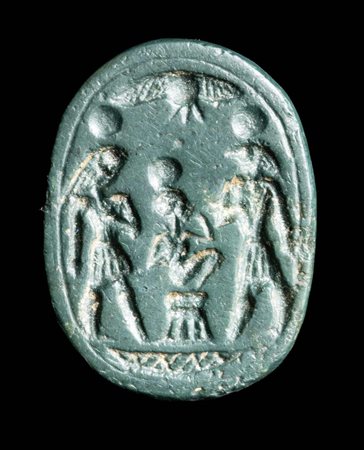
Lot 25 A CLASSICAL PHOENICIAN GREEN JASPER ENGRAVED CUTTED SCARAB. GODS SURROUNDING HORUS AS A CHILD.
5th century B.C.
12x16x3 mm
The standing gods with lunar discs are surrounding Horus as a child, seated on a djed pillar (?). Beneath the sign « nb » meaning Master. On top, winged solar disc. The back of the stone has been cutted in half leaving visible the trace of tubular hole.
For a similar iconography see Beazley 12/X15 Carthage no. 656.
Provenance: U.K. private collection -
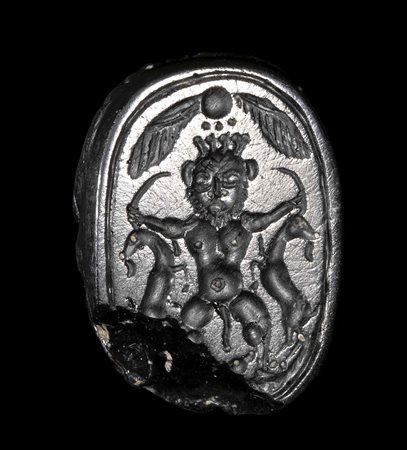
Lot 26 A LARGE PHOENICIAN BLACK JASPER ENGRAVED SCARAB. BES WITH ANIMALS.
5th century B.C.
17 x 19 x 13 mm
The back engraved in a stylized manner for the anatomical details. The reverse shows Bes encrowned standing front, holding ibex on each hand (as Master of the Animals),on top the winged solar disc. Under his feet, crocodiles (partially missing). The stone is damaged with a missing part. Wear marks. Rare.
J. Boardman, Classical Phoenician scarabs, "Bes holding animals", type E, 22/X27 ; for a similar iconography of Bes holding ibex see British Museum, EA20845
Provenance: From the collection of an European gentleman, acquired on the art market -
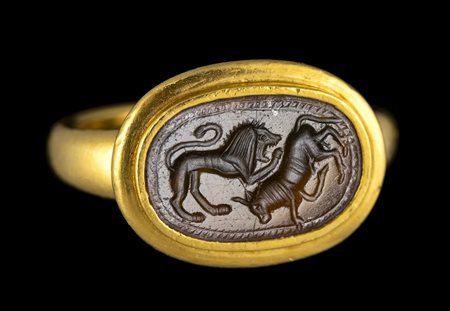
Lot 27 A RARE PHOENICIAN DARK CARNELIAN INTAGLIO SET IN A MODERN GOLD RING. LION ATTACKING A BULL.
6th - 5th century B.C.
Stone 12x17 mm; int. Size 17x22 mm; 20,43 gr
The lion, on the left, attacks the bull on the right of the scene, according to a stylized composition referable to the Phoenician production of the Classical Era. This production is inspired by archaic Greek models. Hatched border. Slight crack in the center of the stone, set in a heavy modern gold ring. This long popular oriental motif is well represented in a series of gems like this one. The Greek adopted the subject for their archaic scarabs. They also had some Eastern art influence (Persian empire).
J. Boardman, Classical Phoenician scarabs, plate 42 n. 39/20 for the same scene and see also plate 43.
Provenance: From a private collection, France, acquired from D.C. collection, London. -
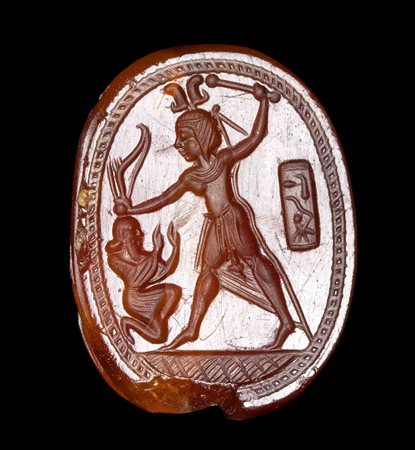
Lot 28 AN EXTRAORDINARY PHOENICIAN - EGYPTIAN CARNELIAN SCARAB. SUBMISSION SCENE WITH A CARTOUCHE.
5th century B.C.
13x17x9 mm
The beetle well-detailed, the underside engraved with an Egyptian king attacking a supplicating eastern character, the king wearing a belted kilt, a broad collar and a filleted wig topped with a plumed crown, a mace in his upraised hand, a bow and arrows in the other, the oriental subdued man bearded, wearing a pleated garment, an inscribed cartouche behind the king, the crosshatched exergue (an Egyptian nb sign) as the groundline, enclosed within a hatched border.Wear marks. Chip, internal crack and missing on the edge.
For a carnelian scarab with the same subject but different inscription within the cartouche see no. 18/X4, pl. 54, in Boardman, Classical Phoenician Scarabs.
Provenance: Formerly in an American Private Collection, 1950s ; Ex Christie's NY, December 2009, lot 378. -
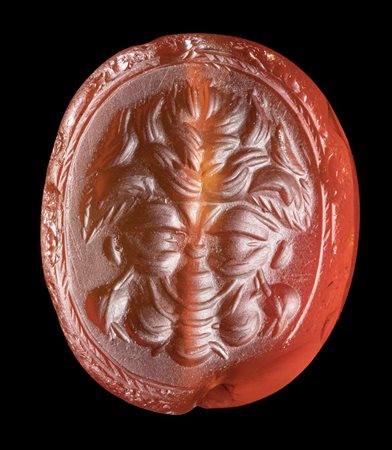
Lot 29 A GREEK EARLY CLASSICAL CARNELIAN SCARABOID ENGRAVED SEAL. LION HEAD.
late 5th century B.C.
13x16x7 mm
Pierced lenghtwise. The back engraved with lion head. The high angle view and the iconographical features remind the Greek coinage production of Bruttium and Samos. Cable border. The edge is consumed, partially chipped. Wear marks.
Provenance: U.K. private collection acquired on the british art market. -
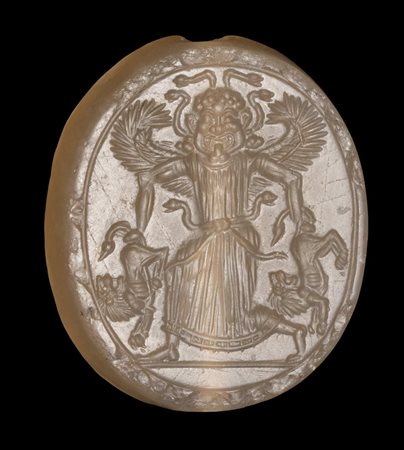
Lot 30 AN EASTERN GREEK LATE ARCHAIC-EARLY CLASSICAL CHALCEDONY SCULPTED AND ENGRAVED SCARABOID SEAL. HEAD OF A GORGONE / GORGONE HOLDING TWO LIONS.
Late 6th-Early 5th century B.C.
20x23x7,5 mm
Of scaraboid shape, pierced lenghtwise. The backside carved in relief with a Medusa mask, with archaic features. The reverse is engraved with a standing Gorgone going left with large wings. Face and upper body are represented in a frontal view meanwhile the legs are in profile.In her hands, she holds lions. She wears a long chiton, with a belt made of a two snakes. On both sides, the Gorgone shows her typical apotropaic features; eyes wide, tongue sticking out, with her hair full of snakes. Groundline. Use of globular elements for anatomical details. Cable border. Small chips and wear marks on the stone. Rare.
For a similar typology and iconography see: Antique Intaglios in the Hermitage Collection, n°16; BOARDMAN, J., Greek Gems and Fingers rings, n°378 and 406-407
Provenance: U.K. private collection acquired on the british art market. -
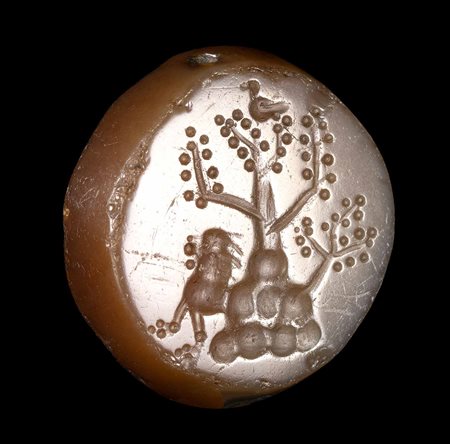
Lot 31 A GRAECO-PERSIAN/CENTRAL ASIA CHALCEDONY ENGRAVED SEAL. LION WITH A TREE.
4th century B.C.
Diam. 21x9 mm
Pierced longitudinally. A lion advances to the left from behind a large tree engraved in the center of the seal. The plant appears to be placed on top of a pile of rocks. A bird at the top of the tree, always facing left. Naturalistic scene. Signs of wear and small chips on the edge. Pleasant milky orange tone of the chalcedony. Use of globular elements.The style is very close to the "Bern Group". This group presents the most distinctive of the late style, and approaching far later Sasanian globolo style forms.
J. Boardman, Greek Gems and Finger Rings, p. 356 n. 981 - 988 (Bern Group).
Provenance: From a private collection, France, acquired on the art market in the early 2000s -
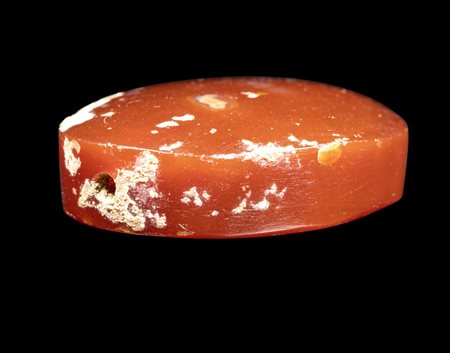
Lot 32 A GREEK RED AGATE SCARABOID SEAL.
4th-3rd century B.C. ?
20x26x8 mm
With polished surface and pierced lenghtwise. Presence of deposits. Probably unfinished (not engraved).
Provenance: This lot is sold under temporary import status. -
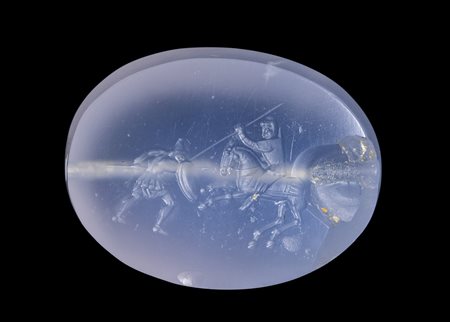
Lot 33 A LARGE GRAECO-PERSIAN BLUE CHALCEDONY SEAL. FIGHTING SCENE.
5th century B.C.
23x30x13 mm
The Bolsena Group. A Persian horseman attacks a Greek in armour with spear and shield and pilos. Use of globular elements for the anatomical details. Pierced lengthwise, missing on the edge.
For a similar engraved seal see: J. Boardman, Greek Gems and Finger Rings, 1970, Pl. 881
Provenance: Private European collection, collected between the 1960s - 1990s. This lot is sold under temporary import status. -
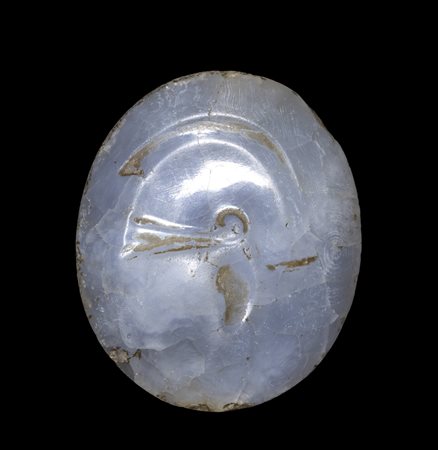
Lot 34 A LARGE GREEK BLUE CHALCEDONY ENGRAVED SEAL. HELMET.
5th - 4th century B.C.
21x25x10 mm
Pierced lengthwise. In the centre, a soldier's helmet facing left, characterized by a crest and cheek guards. The seal is slightly convex in front (engraved side) and flat behind. The stone shows signs of ancient burning with internal and superficial cracks and fissures. Small missing on the edge and signs of wear. Interesting and refined work. Rare type.
Provenance: The Gustave Mustaki collection, exported from Egypt under licence c.1950 and gifted to Elsa MacLellan, his daughter, thence by descent. -
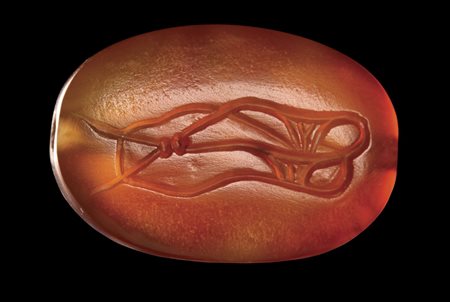
Lot 35 A GREEK CARNELIAN SCARABOID SEAL INTAGLIO. A SANDAL SEEN IN PROFILE AND FROM BELOW.
5th century B.C.
14 x 21 x 6 mm
On the front side of the seal: sandal to the left, characterized by two long laces that cross in two spherical loops in the front. On the back of the stone: a variant of the sandal appears to be seen from underneath (from the sole with the laterals protruding open). The object is depicted with great realism and technical perfection. Through hole. Beautiful color of the stone. Wear marks. Of great rarity.
J. Boardman, Greek Gems and Finger Rings, p. 289 n. 513 ( Cornelian scaraboid, A sandal, as a footprint, Greek classical) and p. 290 n. 524 (Boston, agate sliced barrel, a sandal).
Provenance: English private collection S.B., London, acquired on the London art market in the 1900s. -
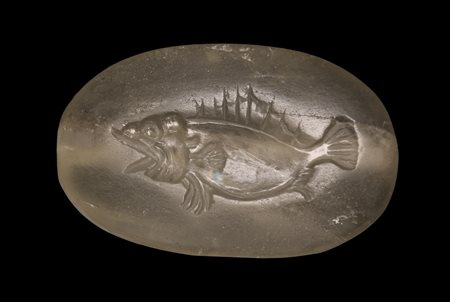
Lot 36 A RARE GREEK CITRINE QUARTZ DOUBLE SIDE SEAL INTAGLIO. FISH.
End of 5th century B.C.
17 x 27 x 7 mm
Large fish swimming to the left, characterized by a wide open mouth, sharp dorsal fins, bulbous eye. Probably a Mero or Grouper, Epinephelus marginatus - formerly guaza - rather than the Wreckfish or Stone Bass Polyprion - the previous name, polyprium cernium is now obsolete, as which it is usually identified. The animal is engraved with great realism and technical perfection, on the model of the coins of magna greece (probably by the same engraver). The stone is large, pierced lenghtwise and elongated; there are small internal cracks but the stone is perfectly solid. Nice rainbow reflections in some angles for refraction. Yellowish aqueous color that goes well with marine theme. Wear marks. Minor chips or missing near the holes. Of great rarity.
For a close paralle, see the Greek coinage: silver tetradrachm from Sicily, Akragas. Circa 420-415 BC. Tetradrachm (Silver, 28 mm, 16.94 g, 4 h). ΑΚΡΑΓ - ΑΝΤΙΝ - Ο - Ν Eagle with spread wings to left, perched on dead hare lying on a rock and tearing at it with its beak; on rock, scallop shell and murex. Rev. Crab; to left, cockle shell; to right, sea snail; below, a large fish with open jaws swimming to left (probably a Mero or Grouper, Epinephelus marginatus - formerly guaza - see F.E. Zeuner, Fish on Ancient Coins, NCirc LXXI, 1963, pp. 142-143, rather than the Wreckfish or Stone Bass Polyprion - the previous name, polyprium cernium is now obsolete, as which it is usually identified). Buceti 70, Gulbenkian 163-164, Kunstfreund 78 (= SNG Lloyd 822), Rizzo pl. I, 16, and Seltman pl. I, 1 (all struck from the same die pair).
Provenance: English private collection S.B., London, acquired on the London art market in the 90s.