
ASTA 267 - GLITTICA
-
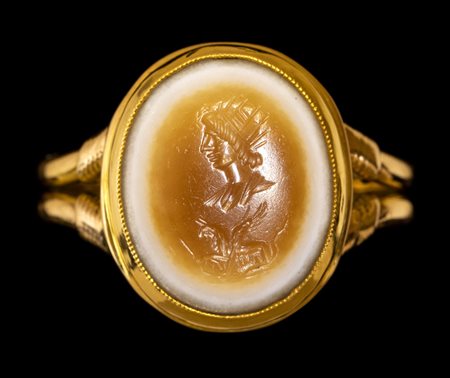
Lot 253 A ROMAN AGATE INTAGLIO SET IN A GEORGIAN GOLD RING. ALLEGORY OF THE NEMESIS.
1st century A.D.
Stone 12x15 mm; int. diam 19 mm; 7,13 gr
Composed of to joinded rounded hoops surmounted an oval box setting. The junction with intertwined gold wires. The intaglio set is depicting the bust of Helios facing left with a radiated crown. Beneath, the griffin with the wheel. Groundline. Wear marks.
Provenance: U.K. private collection -
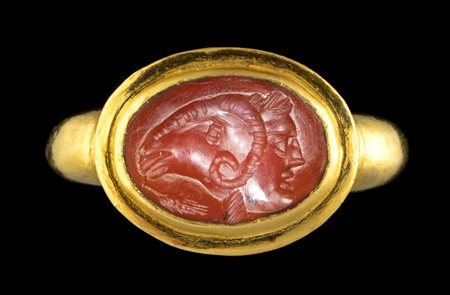
Lot 254 A ROMAN CARNELIAN INTAGLIO SET IN A MODERN GOLD RING. GRYLLOS.
1st - 2nd century A.D.
Stone 9x12 mm; int. size 16x18 mm; 10,24 gr
A ram's head facing left is conjoined to a youthful face to the right, probably a faun mask; in the field, an ear of corn. Beautiful apotropaic hybrid depiction. Slight wear marks.
Provenance: From a private collection, France, acquired from Galerie Mariaud de Serres, Paris, in the early 2000s -
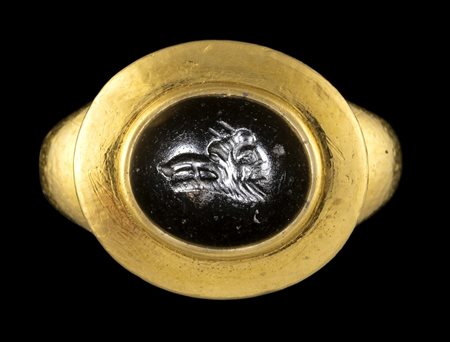
Lot 255 A ROMAN ONYX INTAGLIO SET IN A MODERN GOLD RING. GRYLLOS.
1st century B.C.
Stone 10x13 mm; int. size 16x19 mm; 19,16 gr
Gryllos composed of a wild boar's head and a satyr's head. Apotropaic subject. Slight wear marks.
Provenance: From a private collection, France, acquired on the art market in the early 2000s -
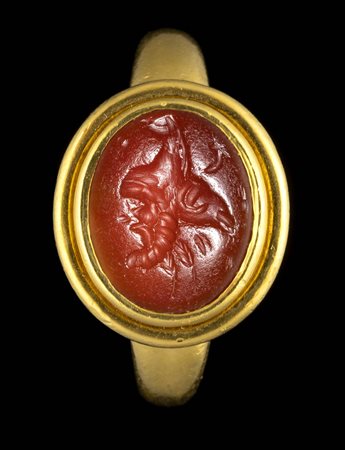
Lot 256 A ROMAN CARNELIAN INTAGLIO SET IN A MODERN SOLID GOLD RING. GRYLLOS.
1st - 2nd century A.D.
Stone 10x12 mm; int. size 15x18 mm; 16,4 gr
Composed of a heads of Silenus and goat on rooster legs with horse protome on the top with ear of corn. In the field, a cornucopia. Apotropaic depiction. Wear marks.
Provenance: From a private collection, France, acquired on the art market in the early 2000s -
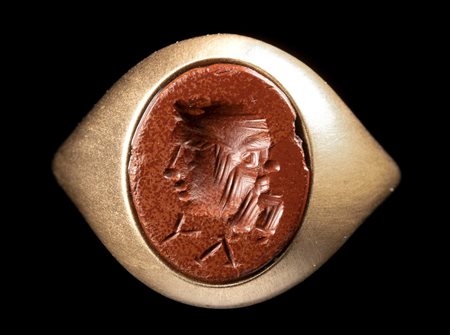
Lot 257 A ROMAN RED JASPER INTAGLIO SET IN A MODERN GOLD RING. GRYLLOS.
2nd century A.D.
Stone 10x12 mm; int. diam 16 mm; 6,71 gr.
Apotropaic effigy composed of a juvenile mask and a bearded mask of silenus. Below, two Greek letters ΛΥ. Small missing on the edge. Wear marks.
Provenance: European collection, acquired on the market, early 2000's. -
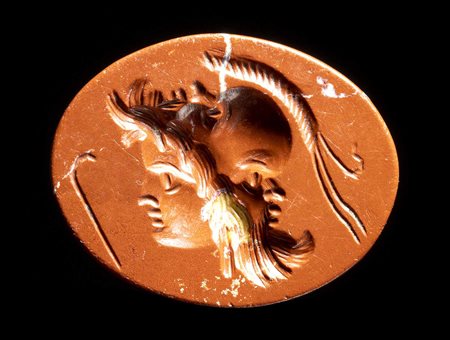
Lot 258 A ROMAN RED JASPER INTAGLIO. GRYLLOS.
1st century B.C. - 1st century A.D.
14x18x3 mm
The hybrid effigy is composed by a mask of a youth conjoined with two masks of bearded Silenus. The bald skull forming by them and forming a crested helmet. In the field, a pedum. Slight wear marks.
Provenance: Ex Sangiorgi collection, acquired in the late 19th-early 20th century ; Ex Christie's NY, 06/12/200, lot 335. This lot is sold under temporary import status. -

Lot 259 A ROMAN CARNELIAN AGATE INTAGLIO. BIRD ON A LYRE WITH A MOUSE ON ITS BEACK.
1st century A.D.
14 x 18 x 4 mm.
A raven to the right above a lyre holds a mouse by the tail in its beak. The bird and the musical instrument refer to Apollo. Interesting allegorical scene. Refined execution and beautiful variety of stone characterized by a darker red band in the center, horizontally. Wear marks.
Provenance: From the collection of an European gentleman, acquired on the art market -
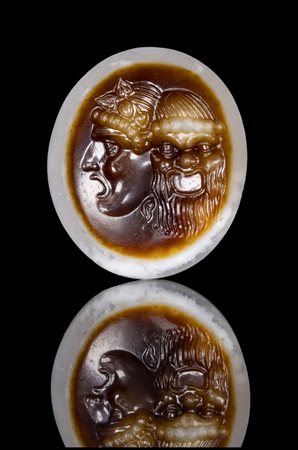
Lot 260 A FINE ROMAN SARDONYX INTAGLIO. TWO CONJOINED THEATRICAL MASKS.
1st century A.D.
16x18x5 mm;
A comic bearded mask, in front view, is joined to a female tragic one, in profile to the left. The female mask has an ivy wreath. The comic mask features an open mouth, rounded nose and long, smooth beard. Even the tragic mask opens its mouth wide but in a dramatic grimace. The work is engraved with great skill with fine details. The depth of the carving reveals the clear layer under the caramelized front one. The choice of stone also alludes to his use as magical eye. Slight wear marks. Excellent state of conservation.
For a similar model: G.M.A. Richter, Catalogue of the engraved gems - MET NY, p. 119 n. 583. Slightly convex sard intaglio. For such combinations of masks cf. Furtwangler, Berl. Kat. Nos. 7023 ss.
Provenance: U.K. private, acquired on the art market 1980s-1990s -
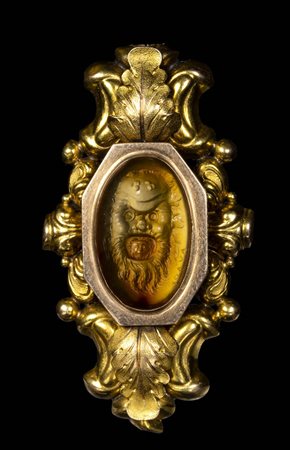
Lot 261 A FINE ANCIENT CARNELIAN INTAGLIO SIGNED AYLOY SET IN A GOLD BROOCH. A DIONYSIAC MASK WITH A GORGONA MASK INSIDE THE MOUTH.
End of 1st century B.C. - Early 1st century A.D.
Stone 13x20 mm; Brooch 28x51 mm; 9.18 gr
This large intaglio is convex on both sides showing wear marks and light superficial scratches of ancient aspect. The mask of Silenus is deeply carved with a small frontal Medusa face inside the open mouth. The dionysiac mask is bearded, frontal, with the head adorned with a crown of ivy; it can be considered a comic mask. The eyes are rendered with a very clear circular engraved lines, the nose is large with globular elements, the thick and long beard engraved with fine and wavy lines to the right. This mask finds its best comparison both for the style, the iconography and the material with a Roman sard intaglio (always convex on both sides) depicting a double theatrical mask, Metropolitan Museum, New York. The eyes, brows, facial look, gaping mouth, beard, and in general the style, match. The intaglio is signed AVΛOY for Aulos on the bottom right. Aulos is considered to have been one of greatest gem engravers reported in ancient references to be in the employ of Augustus during the late 1st Century B.C. along with Dioscorides, Hyllos, and Solon. The Aulos signature can be found in several forms across a number of both ancient and neo-classical engraved gems.
Although it is difficult to know for certain, it is suspected that some of the Aulos signatures on ancient engraved gems may have also been added in the Renaissance or Neo-Classical period. However, The signature best compares to a convex amethyst intaglio with a Nereid on a seahorse, from the Sangiorgi Collection sold at Christies . It does not appear that this signature in particular has been excluded completely as a forgery, however, it has been subject to some debate in the scholarship (Boardman and Wagner (Masterpieces in miniature, p. 190) thought possibly original.“). Another close parallel for the style of the signature, see also the Marlborough gem n. 617 (n. 138), a rock crystal intaglio with an Erote holding a giant cornucopia, 1st century B.C. (Tassie 6607). This convex rock crystal from the Marlborough coll. was identified as possibly a genuine work of the engraver Aulos. The style and the model of that dyonisiac mask finds interesting others matches on gems and cast impressions with a similar subject, like from Paoletti, Cades and Tassie. For the signature style, see the comparisons. A further research is necessary. The gem is set in a beautiful gold brooch. The frame around the stone, octagonal in shape and pinkish in tone, seems to belong to an older and earlier setting than the addition of the ornamental part with leaves, in a different metal. Wear marks.
For parallels, see: G.M. A. Richter, Catalogue of the engraved gems. Greek-Etruscan-Roman. p. 119 n. 583. J. Boardman, C. Wagner, Masterpieces in miniature, p. 190. See also. L.P.B. Stefanelli, La Collezione Paoletti, vol. I, tomo Tomo II, n. 650 and 654; tomo IV, n 387; British Museum database for "masks"; KHM, red jasper intaglio with an erote putting is face on a large mask of Silenus ( Antikensammlung, IXb 526). Than, William Tassie red sulphur impression 1281 with a Beared Mask, Face (?) visible in the open mouth: Tassie 3884 - Lippert II 967 (Baron the Stain). Beazley Archive for the Marlborough gem 617 (138). See also the burnt intaglio set in a gold ring with Venus and Eros, British Museum with Tassie 6320; The Beverly gem n. 90 with a bust of young Hercules set in a gold ring; five intaglios identified in Philippe von Stosche's - Pierres Antiques Gravees published in 1724 which documented the known signed Aulos gems belived to be ancient at the time. Paralles can be do with Cades- Piombino Boncompagni e Tassie- Strozzi casts (Tassie 2119, 4083, 7896, 7614. Others interesting parallel for the style of the signature must be done with the intaglio showing a bull on a thyrsus signed by Hyllos, Paris, Cabinet des Medailles. G. Richter documents a group of gems by Aulos in the catalogue of the MET. Some others gems, but to be dated as Neoclassical, show an Aulos signature, but usually done with a different manner, like in a carthouche ( Tassie 4084 with the bust of Asclepius, attribuited to Antonio Pichler).
Provenance: Brooch setting suggests that the intaglio was mounted in Britain during the late 18th to early 19th century; U.S. private collection, acquired on the art market. This lot is sold under temporary import status. -

Lot 262 A FINE ROMAN CARNELIAN CAMEO SET IN A GEORGIAN GOLD RING. FRONTAL HEAD OF EROS.
1st - 2nd century A.D.
Stone 9x11 mm; Int. Size 16,5x17,5 mm; 2,84 gr
With a thin rounded hoop, flatten within and worked on the outside ending in broader openworked shoulders surmounting an oval bezel set with a carnelian cameo. The high relief carved head of Eros is frontal and characterized by his typical childish features; plain chicks and rounded eyes. The fronthead surmounted by a wide braid separating the hair in two. Wear marks.
Provenance: U.K. private collection -
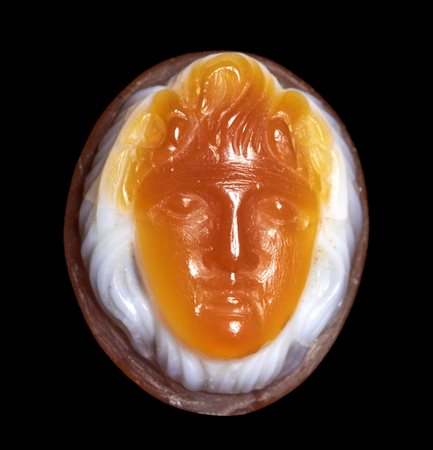
Lot 263 A ROMAN PROVINCIAL SARDONYX CAMEO. FRONTAL HEAD OF GORGONA.
2nd - 3rd century A.D.
10,5x12x6,5 mm
Frontal head of Medusa, characterized by flowing and elaborate hair and facial features inspired by classical Greek models. The prominent part of the face (face, forehead hair and wings) are engraved on the red layer; other hair on the white layer; the field is again a reddish layer. Wear marks.
Provenance: From a private collection, France, acquired from Antiquarium ltd, NY, in the 1990s-early 2000s -
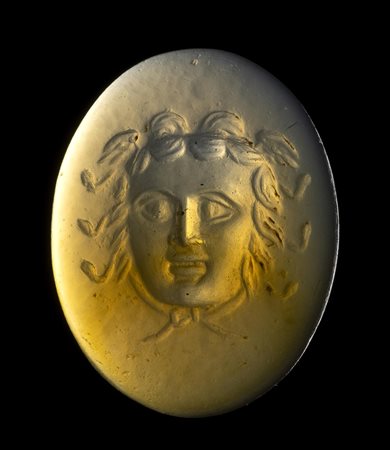
Lot 264 A ROMAN AGATE INTAGLIO. MASK OF GORGONA.
1st - 2nd century A.D.
10 x 14 x 2 mm
In a frontal view and characterized by her typical features, a rounded face famed by hair made of snakes with tails knotted under the chin. Wear marks.
Provenance: From the collection of an European gentleman, acquired on the art market