
ASTA 267 - GLITTICA
-

Lot 241 A ROMAN NICOLO INTAGLIO. VASE.
2nd century A.D.
9 x 12 x 3 mm.
Two-handled vase with rounded body resting on a three-legged support. Wear marks.
Provenance: U.K. private collection acquired in the british art market. -
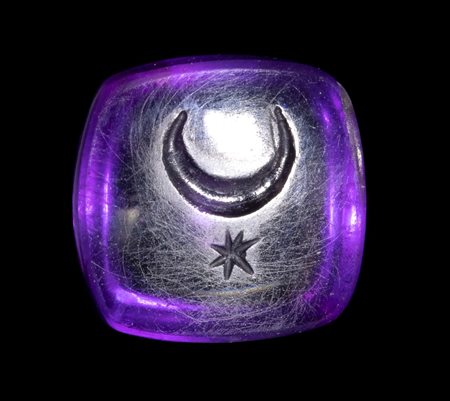
Lot 242 A ROMAN AMETHYST INTAGLIO. CRESCENT MOON WITH A STAR.
1st century B.C - 1st century A.D.
12 x 12 x 6 mm.
Above a crescent sun, below a star, according to a less common variant. Square-shaped intaglio with convex back, for greater the brightness of the stone. Beautiful deep purple vivid color. Slight wear marks.
Provenance: U.K. private collection acquired in the british art market. -
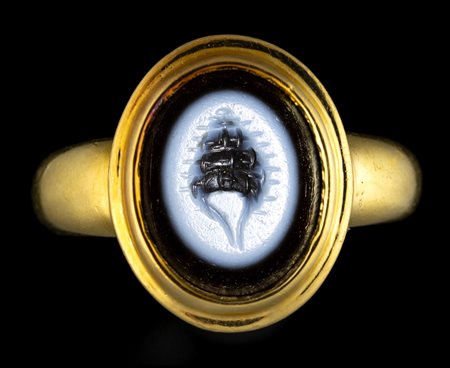
Lot 243 A ROMAN NICOLO INTAGLIO SET IN A MODERN SOLID GOLD RING. MUREX SHELL.
1st - 2nd century A.D.
Stone 13x15 mm; int. size 18x21 mm; 23,71 gr
A fine and interesting representation of a spiny murex shell. Wear marks. Mucus from the hypobrachial gland of the murex was used to make purple dye, referred to as Tyrian purple or royal purple, as it was primarly used for dying royal garments. Tyre was the main production centre for purble dye in the Mediterranean.
For a similar iconography see: British Museum, 1987,0212.467; Musée du Louvre, Gy 3945;
Provenance: From a private collection, France, acquired from Christie's Sale 07/12/2006 (with a different gold ring), with Ariadne Gallery NY, 1980s. -
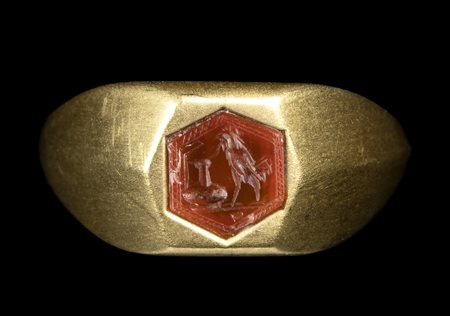
Lot 244 A ROMAN CARNELIAN INTAGLIO SET IN A MODERN GOLD RING. ROOSTER HUNTING A SNAKE ON A VASE.
1st-2nd century A.D.
Stone 6x7 mm; int. diam 16 mm; 4.82 gr.
The bird is facing left and takes a small snake out of a jug. Dotted frame. Hexagonal shape of the gem. Rare subject. Wear marks.
Provenance: European collection, acquired on the market, early 2000's. -
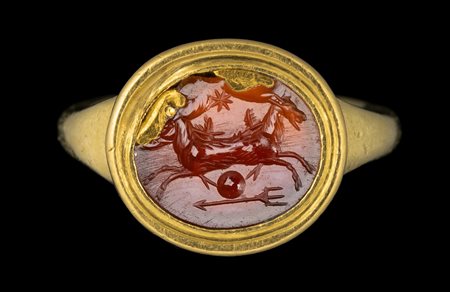
Lot 245 A ROMAN CARNELIAN INTAGLIO SET IN A MODERN GOLD RING. ALLEGORICAL EMBLEMA WITH TWO SEAGOATS.
1st century A.D.
Stone 10x12 mm; int. size 16,5x17,5 mm; 8,76 gr.
Two seagoats conjoined as in an emblema, with tails superimposed and crossed, facing to the opposite side from each other. Above, a star. Below, a globe and a trident. Great Augustean allegory of the supreme dominion of the Empire between sky, earth and sea. The gem is damaged, chipped with a lack partially covered by a gold integration. Wear marks.
Provenance: U.K. private collection -
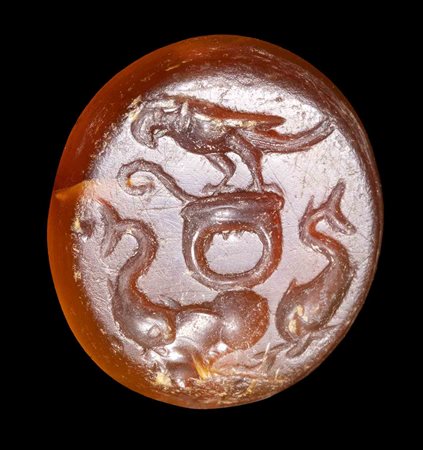
Lot 246 A ROMAN CARNELIAN INTAGLIO. ALLEGORICAL EMBLEMA.
1st century B.C. - 1st century A.D.
11x12x2,5 mm
In the center, a ring with a lituus surmounted by a parrot. Beneath, two dolphins towards a globe. Allegorical emblema. Wear marks and chip on the edge.
Provenance: The Gustave Mustaki collection, exported from Egypt under licence c.1950 and gifted to Elsa MacLellan, his daughter, thence by descent. -
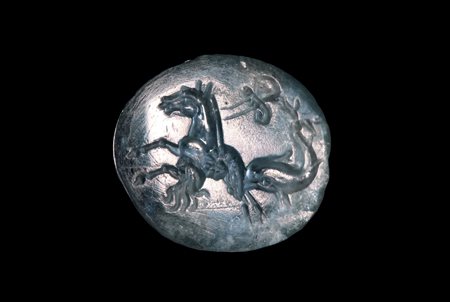
Lot 247 A RARE ROMAN BLUE SAPPHIRE INTAGLIO. GRYLLOS.
1st century B.C - 1st century A.D.
13 x 15 x 3 mm
The hybrid creature is composed of a horse protome with a silenus mask on its chest, a ram's head with an ear of corn as its body and a dolphin as an ending. The fantastic creature is guided by a butterfly using reins. The scene is engraved on a natural sapphire which is characterized by thin thickness, almost sharp edges, slightly convex surfaces, beautiful color and polish. The marine subject matches perfectly with the color of the stone. Rare. Minor lacks on the edge and signs of wear.
For a similar subject, see The Cornwell plaster cast gems impressions database, n. 3170 ("Sea monster with a head for a chest"). L. P. Biroli Stefanelli, la collezione Paoletti, Tomo IV, n. 563 (Kunsthistorisches Museum, Wien, inv. IXB,1158.
Provenance: U.K private collection from the british art market, 1990s-2000s. -
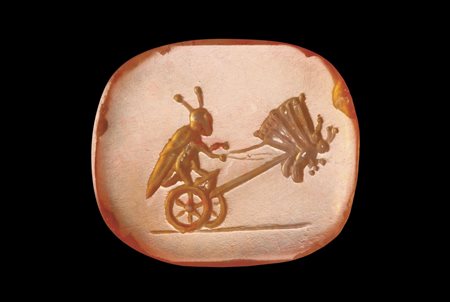
Lot 248 A ROMAN CARNELIAN INTAGLIO. GRASSHOPPER DRIVING A CHARIOT DRAWN BY TWO BUTTERFLYES.
1st century B.C - 1st century A.D.
14 x 17 x 3 mm
A small chariot is pulled by two butterflies and driven by a grasshopper who holds the reins. Groundline. Interesting subject referable to that category where insects, especially grasshoppers, perform human actions. The gem is rectangular with rounded edges. Small chips and wear marks. Rare.
For a very similar iconography see British Museum, gem n. 2549 inv. 1814,0704.1446 (carnelian set in a gold ring) and nd drawings n. 2010,5006.1094: 2010,5006.1015.
Provenance: U.K private collection from the british art market, 1990s-2000s. -
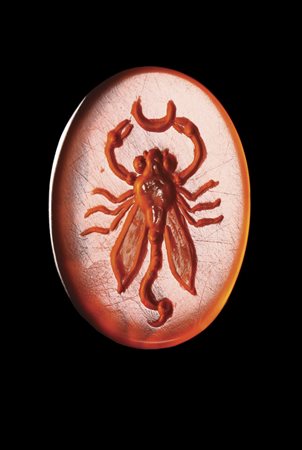
Lot 249 A ROMAN CARNELIAN INTAGLIO. GRYLLOS.
1st century B.C - 1st century A.D.
12,5 x 17,5 x 2 mm
Fantastic hybrid creature, composed by the union of a fly with a scorpion. Between the claws, a lunar crescent, with magical astrological reference. Beautiful vivid red color of the stone. Slight wear marks. Rare subject.
For a similar iconography see British Museum, inv. n. 1814,0704.1451and 1814,0704.1453.
Provenance: U.K private collection from the british art market, 1990s-2000s. -
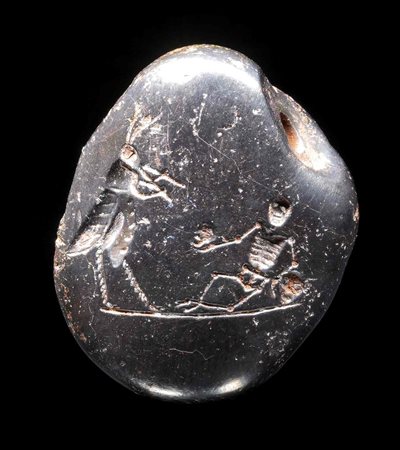
Lot 250 A RARE ROMAN HEMATITE ENGRAVED BEAD. GRASSHOPPER AND SKELETON.
2nd - 3rd century A.D.
H max 27 mm;
Irregular in shape and pierced lengthwise this bead is engraved with a particular design; a grasshopper standing right playing the double flute to a skeleton leaning on the ground with a skull in his right hand and another one beneath his left elbow. Groundline. The playing grasshopper representing life is thus confronted with the Death symbolized by the skeleton. This engraved bead is an allegory of the fleetingness of life.
The bead is possibly more ancient and reused in roman times for its magical properties.
Wear marks.
Christopher A. Faraone, Inscribed Greek Thunderstones as House- and Body-Amulets in Roman Imperial Times, p. 257-284
Provenance: U.K. private, acquired on the art market 1980s-1990s -
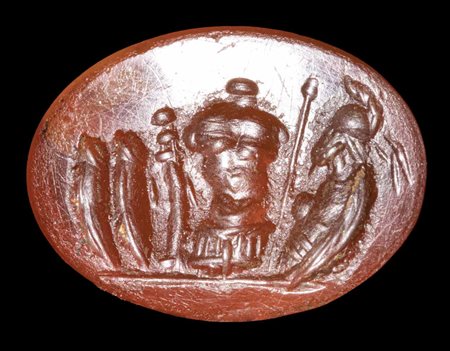
Lot 251 A ROMAN CARNELIAN INTAGLIO. PANOPLIA.
2nd century A.D.
9x12x3 mm
This depiction symbolizes the weapons of a soldier. From left to right: the greaves, the sword in its scabbard, the cuirass, the spear, the helmet over the shield. Groundline. Wear marks.
Provenance: U.K private collection -
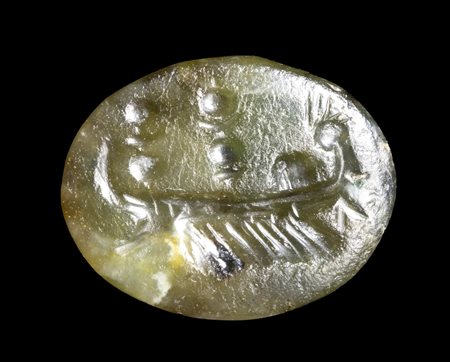
Lot 252 A ROMAN GREEN CHALCEDONY INTAGLIO. WARSHIP.
1st-2nd century A.D.
8,5x10,5x3,5 mm
Roman military galley with the rostrum facing left. Above, two "insigna". The "aplustre" is also visible. Wear marks.
Provenance: From a private collection, France, acquired on the London art market 1990s-early 2000s