
ASTA 267 - GLITTICA
-
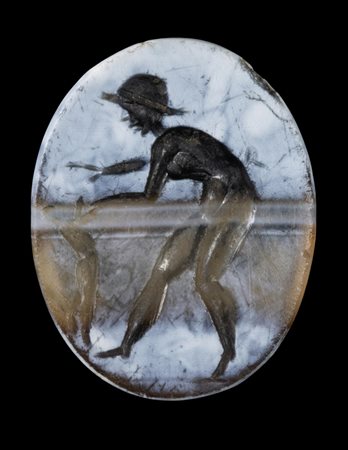
Lot 145 A ROMAN BURNT BANDED AGATE INTAGLIO. YOUNG SHEPHERD PLAYING WITH A HARE.
1st-2nd century A.D.
10x12x3 mm
The male figure is facing left, playing with a hare. Slighlty burnt surface.Wear marks.
Provenance: U.K. private collection -
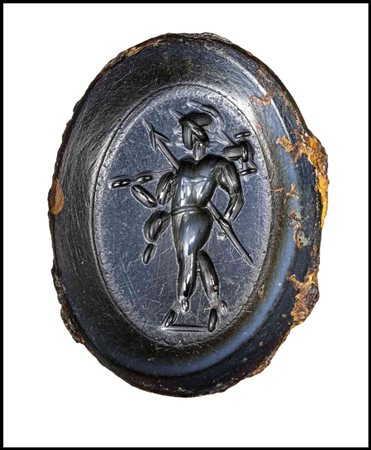
Lot 146 A ROMAN NICOLO INTAGLIO. MARS GRADIVUS.
2nd century A.D.
14x19x4,5 mm
The helmeted god is standing left, wearing spear and trophy. Wear marks and traces of the iron mounting.
Provenance: U.K. private collection -
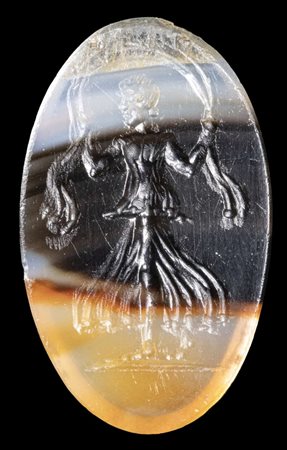
Lot 147 A ROMAN BANDED AGATE INTAGLIO. AURORA.
1st century A.D.
9x14x2 mm
Beautiful depiction of Aurora advancing to the left, holding her cloak raised by the wind with both hands. Interesting choice of banded agate. Wear marks.
Provenance: From the Sangiorgi collection (1886-1965). Private coll., Monaco, 1970's13/05/202; thance by descent. Christies sale December 2017, lot n.3 ; U.K. private collection. -
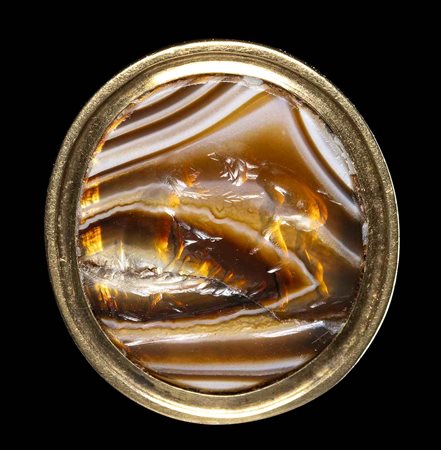
Lot 148 A ROMAN BANDED AGATE INTAGLIO SET IN A GOLD BOX-SETTING. MYTHOLOGICAL SCENE.
1st - 2nd century A.D.
15 x 16 x 3 mm ; 1,7 grs
A young man is discussing with an old one seated on the ground. Probably a dialogue between Socrates and a young male figure. Stone is brocken in two parts but well fix in the frame. Beautiful variety of banded agate. Wear marks.
Provenance: From the collection of an European gentleman, acquired on the art market -
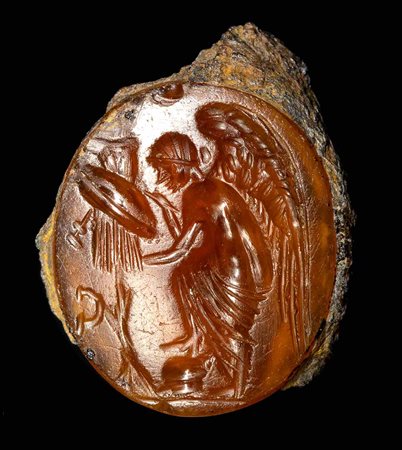
Lot 149 A ROMAN CARNELIAN INTAGLIO. NIKE WITH A TROPHY.
1st - 2nd century A.D.
14 x 16 x 5 mm
Still on its fragmentary iron mounting, the intaglio depicts Nike with a military trophy writing on a shield. Her right foot on a rock. In the field the latin letter "C" . Wear marks.
Provenance: U.K collection acquired on the art market -
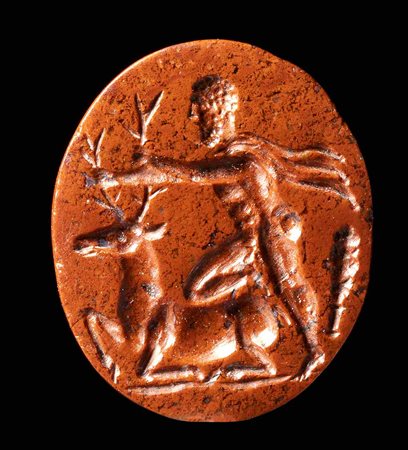
Lot 150 A ROMAN RED JASPER INTAGLIO. HERCULES CAPTURES THE DOE OF CERINEA.
1st - 2nd century A.D.
12 x 14 x 2 mm.
The doe of Cerinea was, in Greek mythology, a doe with golden horns, silver and bronze legs that have been dedicated to Artemis by the nymph Taygete when the goddess had saved her from being pursued by Zeus. Cerinea's doe fled without ever stopping, bewitching those who pursued her, thus dragging them to a country from which they would never return; since she was a sacred doe, her blood could not be shed. When Heracles was commissioned by Eurystheus to capture it, initially he limited himself to chasing it: the doe took refuge by climbing a mountain called Artemisio and tried to cross the Ladon river, but during the crossing Heracles managed to capture it by hitting it with an arrow in one point of the cartilaginous paw, therefore devoid of blood vessels; then loading it on his shoulders he carried it to Arcadia. The doe was finally taken to Mycenae and released there. The subject rarely appears on the gems. In this stone the hero faces left and stands over the sacred doe, holding it by the horns and pressing his right knee on his back to block it. Hercules' body is in muscular tension showing off all its legendary strength. A club behind him. Probably inspired by a Greek model. Fine detailed execution for the size. The physiognomic features of the hero recall the Antonine portraits. Signs of wear.
Provenance: U.K. private collection acquired in the british art market. -
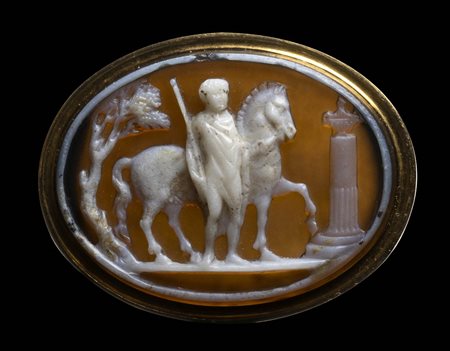
Lot 151 A FINE ROMAN TWO LAYERED CAMEO SET IN A GEORGIAN RING. VOTIVE SCENE.
1st century A.D.
Stone 16x21 mm; int. Size 16,5x22 mm; 4,57 gr.
A male character is standing, three-quarters facing right. With his right hand he holds a rod (or scepter), with his left hand he holds the bridle of his horse which is behind him, facing right in profile. The man is wearing a traveling cloak with his legs uncovered. On the left, a tree; to the right, a half-column with a cinerary urn above it. The scene probably requires more research for its full identification. Paoletti, in his glass impression collection, identified the subject (but without landscape and urn on the column) as one of the Dioscuri. The scene seems inspired by bas-reliefs. The male figure is characterized by physiognomic features that can probably be referred to the Augustan age. The horse is inspired by classical Greek models. The man seems to arrive in a bucolic place to contemplate or visit the incinerated remains of a family member or a comrade in arms.Very fine style and beautiful execution. Wear marks. Little missing on the edge and frame.
For a very similar scene and style, see: L.P.Biroli Stefanelli, La Collezione Paoletti, vol. I, p. 41 n. 150 ("Polluce uno delli Dioscuri" from a sardonyx intaglio).
Provenance: U.K. private collection acquired on the art market. -
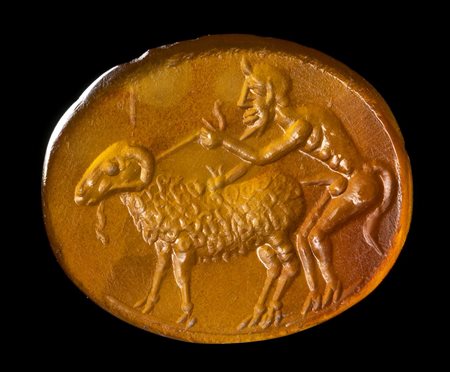
Lot 152 A LARGE ROMAN CARNELIAN INTAGLIO. EROTIC SCENE WITH A SATYR AND A RAM.
1st - 2nd century A.D.
17 x 20 x 3 mm.
A satyr with an erected phallus threatens to rape from behind a ram, holding its fur on its back and a ribbon which the animal holds in its mouth. Groundline. Large size. Fine execution. Great subject. Wear marks
For a similar scene: J. Boardman, C. Wagner, Masterpieces in miniature. Engraved gems from Prehistory to the present, p. 181 n. 167.
Provenance: From the collection of an European gentleman, acquired on the art market -
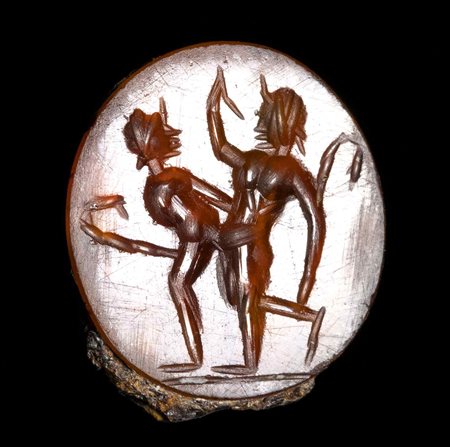
Lot 153 A ROMAN CARNELIAN INTAGLIO. EROTIC SCENE.
1st century A.D.
10x12x4,5 mm
Erotic scene of two standing satyrs, each with a pedum. The older satyr appears to enter from behind the younger one, who looks back at him. Traces of the ancient iron mounting. Wear marks.
Provenance: From a private collection, France, acquired on the London art market 1990s-early 2000s -
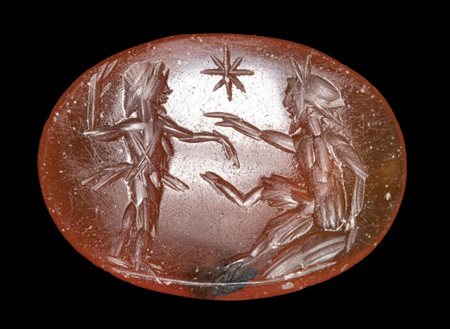
Lot 154 A ROMAN CARNELIAN INTAGLIO. MYTHOLOGICAL SCENE.
2nd century A.D.
15x22x6 mm
On the left, a dancing male character facing on the right a seated Pan on a rock. On top, a star. Probably an erotic scene. Large stone and wear marks.
Provenance: U.K. private collection -
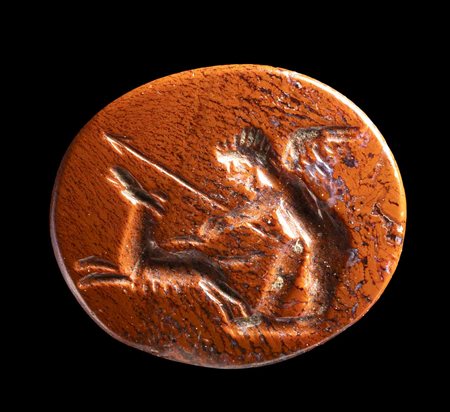
Lot 155 A ROMAN RED JASPER INTAGLIO. EROS HUNTING WITH A DOG.
2nd century A.D.
8 x 10 x 2 mm
The winged god is facing left holding a spear with his dog. Groundline. Wear marks.
Provenance: From the collection of an European gentleman, acquired on the art market -
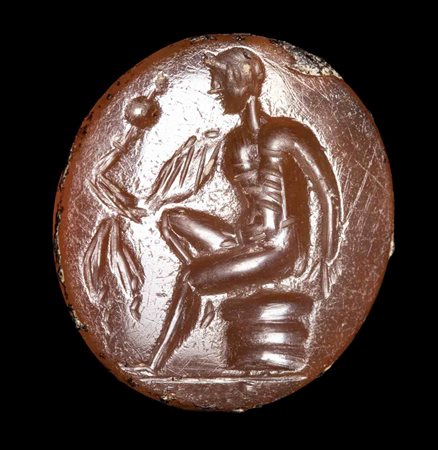
Lot 156 A ROMAN CARNELIAN INTAGLIO. DIOMEDES WITH PALLADIUM.
1st-2nd century A.D.
16x18x6 mm
The seated hero is facing left, holding with his right hand the palladium. Groundline.Wear marks and traces of the iron mounting.
For a similar iconography see: MORET, J.M., Les pierres gravées antiques représentant le rapt du Palladion, 1997
Provenance: U.K. private collection