
WEB AUCTION 106: Glittica
-
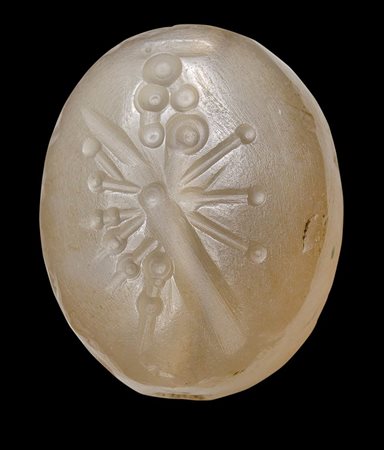
Lot 1 A late Babylonian chalcedony stamp seal.
700-500 B.C.
17x21x11 mm
Oval face, convex bezel, pierced. A scepter crossed by rays and a torch (?). Drilled style.
"
U.K. private collection -
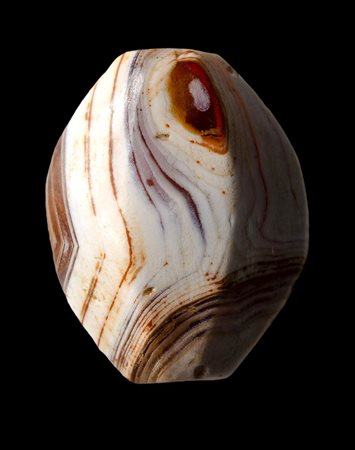
Lot 2 A near-eastern agate lentoide bead.
Indus Valley, 2nd millenium B.C.
14x17x7 mm
With flattish tabular oval shape. Slightly burnt.
"
U.K. private collection -
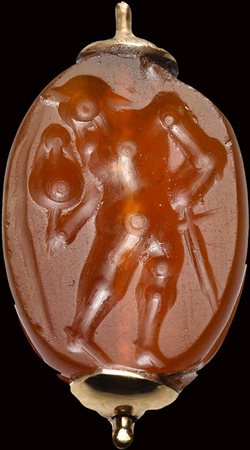
Lot 3 An etruscan carnelian scarab intaglio. Diomede with palladium.
4th-3rd century BC.
11 x 17 x 8 mm
The Greek hero holds in his right hand the palladium, the sacred simulacrum of the goddess Athena, with the left a sword. Known episode of the Trojan war, referring to cunning and intelligence. Use of globular elements. Attractive stone color. Slight signs of wear. Through hole, crossed by a gold ornamental frame with disk-shaped closure. Rare.
"
U.K. private collection -
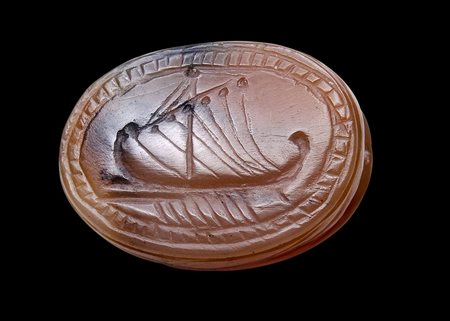
Lot 4 An etruscan agate scarab. Boat.
4th-3rd century B.C.
13x17x10 mm
Warship facing left, and characterized by a rostrum and closed sail; six long ropes tie the crossera attached to the main mast up. Dotted frame on the edge. Summary executed. Very consumed stone with ancient use. Natural dark inclusions inside the agate. Rare iconography.
"
U.K. private collection -
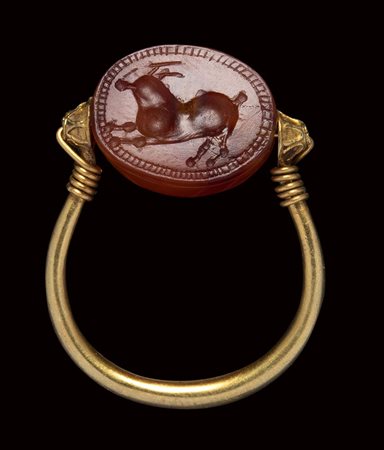
Lot 5 An etruscan carnelian scarab mounted on an ancient gold ring. Antelope.
4th century B.C.
12x16x9 mm ; ring 20x18 mm ; 7grs
The animal is running to the left side. Globular style. Cable border. The mounting is a plain rounded hoop ending with convex terminals. The carnelian scarab revolved on a visible gold pin which passed through the terminals ending and twisted around the ends of the hoop.
Parallels : Museo Archeologico Nazionale di Napoli, inv. 27073/1228
"
U.K. private collection -
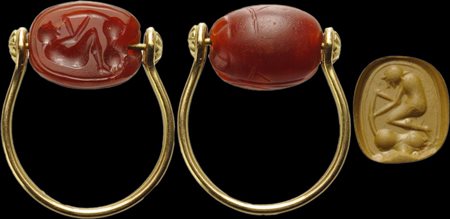
Lot 6 An etruscan carnelian scarab intaglio set on a modern gold ring. Male figure and animal.
4th-3rd century B.C.
Intaglio 18x11x8 mm ; ring diam. 19 mm ; 5,28 grs
A man kneeling on an animal, to immobilize it. A small chipping in the lower section of the stone.
One similar specimen is preserved to the Metropolitan Museum (Inv. n. 41.160.504), and it is depicted Herakles with a deer. Gisela M.A. Richter, Catalogue of the engraved gems. Greek-Etruscan-Roman, p. 52 n. 217, pl. XXXIII.
"
U.K. private collection -
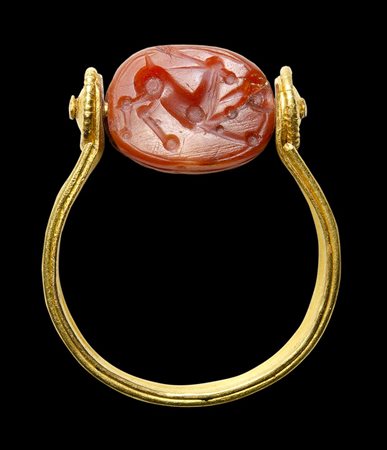
Lot 7 An etruscan agate scarab intaglio set in a postclassical swivel gold ring. Antelope.
Scarab 4th century B.C.
scarab 10x12x7 mm ; US size ring 7.5 ; 5,7 grs
The ring made decorated with platted twisted wires on either ends of the swiveling parts. Scarab with a flat oval base engraved in intaglio and pierced lenghtwise ; depicting a riding antelope. The animal anatomy presents globular elements.
"
U.K. private collection -
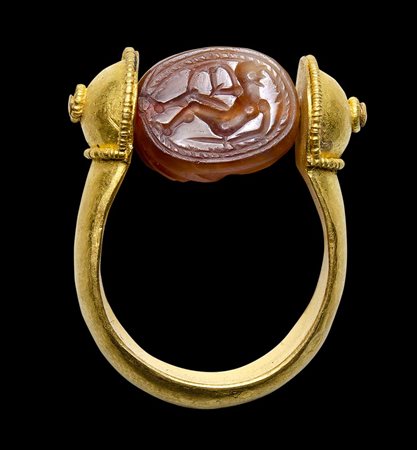
Lot 8 An etruscan agate scarab intaglio set in a gold swivel postclassical ring.Warrior.
4th century B.C.
Scarab 10x12x7 mm ; US size ring 8 ; 9 grs
The hoop rounded without and flatten within with spherical terminals decorated with « faux » twisted wire. Scarab with a flat base engraved in intaglio and pierced lenghtwise ; depicting a warrior inside a dotted framing. Use of globular elements.
"
U.K. private collection -
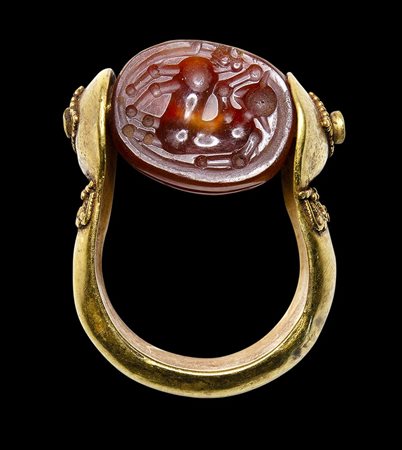
Lot 9 An etruscan agate scarab intaglio set in a gold swivel ring. Centaur.
4th century B.C.
Scarab 11x15x8 mm ; US size ring 4 ; 7,6 grs
Hollow hoop with ring-shape rounded without and flatten within. Shoulders and terminals decorated with platted gold beads and egg-an-dart frieze. Scarab with oval flat base engraved in intaglio and pierced lenghtwise ; the scene depicts a centaur, his body facing right meanwhile his head is turned on the opposite site. Very fine condition.
"
U.K. private collection -
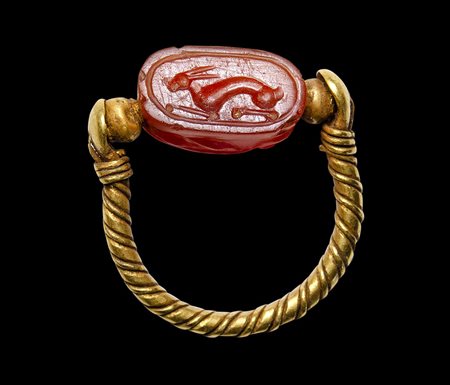
Lot 10 An etruscan agate scarab intaglio set in a swivel gold ring. Hare.
4th century B.C.
Scarab 8x13x8 mm ; US size ring 4 ; 5,75 grs
The hoop made by interweaving of two thread-like elements of different thickness and ends near the scarab with a spiral twisted pattern. Scarab with a flat oval base engraved in intaglio and pierced lenghtwise ; depicting an hare facing left inside an engraved lign-framing. Use of globular elements. rare subject and very fine condition.
"
U.K. private collection -
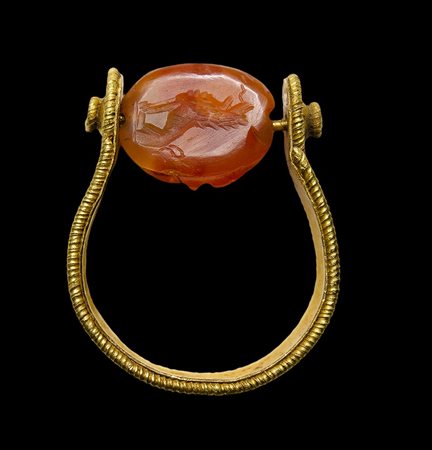
Lot 11 A late archaic etruscan gold swivel ring with a roman carnelian engraved scarab. Lion.
Swivel ring ; 6th-5th century B.C. ; scarab 2nd century A.D.
scarab 9x11x6 mm ; US size ring 6 ; 6 grs
The ring is decorated with platted twisted wire. Scarab with a flat oval base engraved in intaglio and pierced lenghtwise, depicting a roaring lion. The engraving style defers from the typical etruscan engraved scarab which shows that this scarab is a later addition to the mounting.
For the mounting see: Museum of Fine Arts Boston, inv. 21.1201.
"
U.K. private collection -
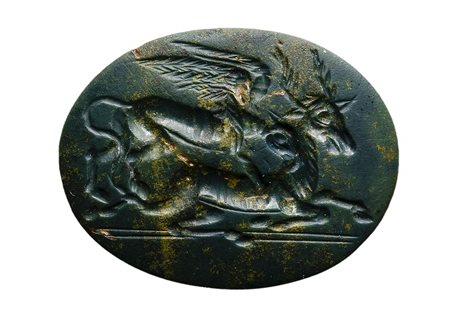
Lot 12 An eastern Greek green jasper intaglio. Hunting scene.
4th century B.C.
17,5x22x3 mm
Facing left, a griffon attacking a deer. The iconography and style are typical from the graeco-persian repertoire. Double groundline. Use of globular elements. Subject inspired from the Classic greek models. Large size and Wear marks. Rare.
G.M.A., Richter, Catalogue des gemmes gravées grecs, étrusques et romains, p.29 n.110
Furtwangler, Berlin, KAt. n.359,363, tav. XIII n.38-39
Boardman, Pierres précieuses et bagues, n.511, 578, 617, 867, 868, 957, 958.
"
U.K. private collection -
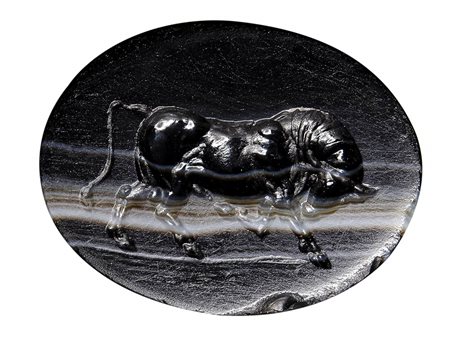
Lot 13 A fine late classical greek agate intaglio. Bull.
Late 5th - early 4th century B.C.
13x17x4 mm
The powerful animal is facing right, charging. This iconography is typical from the classical greek period coinage. The bull, symbol of strength and power, is engraved with great skill and shows a well-marked musculature. In addition to the anatomical rendering, the pose and some details such as the tail are also well rendered in the typical late classical style. The shape of the bezel probably derives from a scaraboid seal subsequently cut out, again in antiquity and perhaps in Roman times, given the marked signs of ancient wear on the entire stone. The choice of stone reflects the artist's engraving artistic sensitivity, in which the white band follows the base line of the ground where the powerful paws of the animal rest. War marks. Rare.
J. Boardman, Intaglios and Rings. Greek, Etruscan and Eastern from a private collection, n. 47 p. 91 (A plunging bull. Late fifth - fourth century BC). J. Boardman, Greek gems and finger rings. Early bronze age to Late classical, n. 498-499 p. 289. For this and the walking bull types on coins of Thurium and Philius.
"
U.K. private collection -
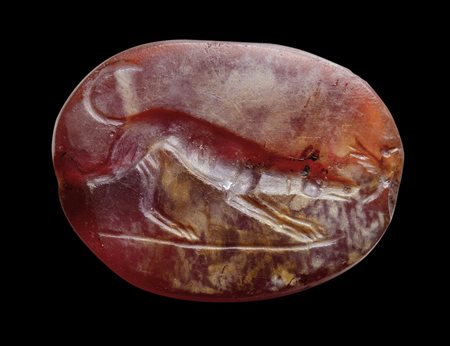
Lot 14 A rare classical greek agate scaraboide seal. Hunting scene.
5th century B.C.
11x14x4 mm
The dog is depicted hunting a bird, which takes off while the quadruped tries to grab it after an ambush. The dog lowers with its two hind legs, in its typical predatory pose ready to jump over the victim, with the tail up and the muzzle extended forward. The bird is identifiable with a dove, an animal equally represented in the classical greek glyptic. In this carving there is the presence of the typical globular element (dog's eye) and of precise engraved details to outline the musculature of the animal, always typical of classical Greek glyptic production. Groundline. This iconography was also used in the greco-persian glyptics. A very similar representation is present on a scarab in blue chalcedony (Paris, BN), while this carving is performed on a beautiful bright red carnelian partially burned on the surface. Through hole and lacks on the back near the passage of the hole. Missing on the edge. Very rare specimen.
J. Boardman, Greek gems and finger rings. Early bronze age to Late classical, n. 572 p. 292; Paris, BN M5749. Blue Chalcedony scaraboid (A) - L.23. A dog and insect (?). Rev. Num. IX, pl. 8.4:
"
U.K. private collection -
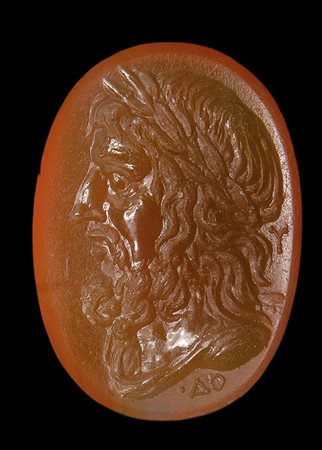
Lot 15 An important greek agate intaglio. Bust of Zeus with letters.
2nd century B.C.
13,5x19x4 mm
Beautiful and refined effigy of the ruler of the gods, facing left and with the laureated head, a symbol of power and victory. This gem, clearly engraved by a greek artist, shows a powerful portrait of Zeus, characterized by an aquiline nose, a slightly open mouth, globular eye. The hair is thick and falls flowing with long locks on the draped shoulder; the beard is also very thick and skilfully engraved. The carving is mirror polished, while the bottom shows signs of ancient wear. There are four greek letters in the field, around the portrait: Γ- ΔO-Y. Probably a dedication of the ancient owner, a fervent devotee of the cult of Zeus: Γ- as the initial of his name and ΔOY- for "Doulos", that is slave in the sense of faithful devotee. The back of the stone is slightly cabochon. The portrait is close to the iconography of some hellenistic dynasties of Pergamum of the Attalide dynasty. Very fine execution. Slight wear marks. Rare.
"
U.K. private collection -
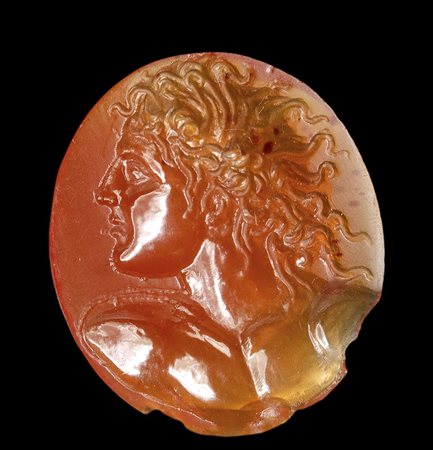
Lot 16 A fine late hellenistic carnelian intaglio. Leandro.
2nd - 1st century B.C.
15x17,5x3 mm
Leandro is facing left with the frontal bust and the head in profile. The face is characterized by beautiful young idealized fetaures, a slightly open mouth, a protruding eye and rounded chin. The hair is long and elegantly scattered in the field, according to one of Leandro’s typical iconographies. This subject is sometimes interpreted as Hero or Galene, especially when the character is portrayed from behind while swimming in the waves, according to the most recurring variant. According to the myth, the young Leandro crossed the dangerous strait of the Dardanelles every night to reach his beloved Hero, who was waiting for him on a tower with a lighted torch; but one night, due to the strong wind and the rough sea, it happened that the light of the torch went out, and Leandro, losing the reference, drowned, becoming the symbol of a courageous, eternal and always ardent love. The engraving is performed with great technical and artistic mastery, on a very thin stone with very delicate edges. The carving is higly polished and shows signs of wear with small lacks on the edge. Rare subject.
Cfr.: J. Kagan, Oleg Neverov, 500 Pierres Gravées du Cabinet du Duc d'Orléans- Le destin d'une collection, 2001 p. 44 n. 5/3L.; Pirzio Biroli Stefanelli, La collezione Paoletti. Stampi in vetro per impronte di intagli e cammei, vol. II, p. 243 n. 512, 549. AAA.VVV. I Cammei della collezione Medicea, n. 130-131.
"
U.K. private collection -
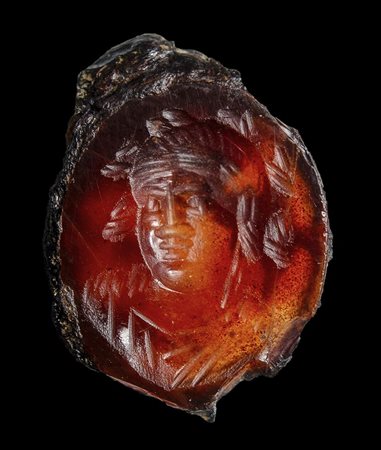
Lot 17 A late hellenistic agate intaglio. Bust of a Bacchus.
3rd - 2nd century B.C.
11x15x2 mm
The god is presented in three-quarters with a wreath of ivy leaves. His features are characterized by a rounded face and chin, plain cheekbones, smiling; his bust is draped. This depiction refers to the late hellenistic greek glyptic production. Traces of an iron mounting on the edge of the stone. Rare.
"
U.K. private collection -
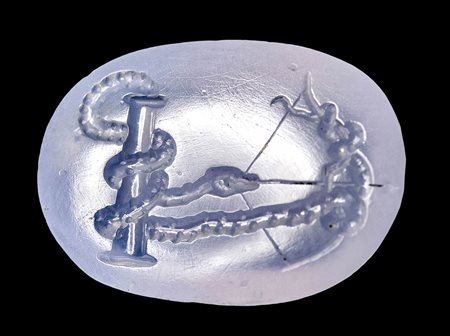
Lot 18 A large roman chalcedony intaglio. Snake with bow.
1st century B.C. - 1st century A.D.
15x21x5 mm
The intaglio is inspired by the classical greek iconography, showing a snake holding bow in tension. In this later adaptation, the snake is intertwined to a column. With his tail he hold the bow, wrapped in its coils, while with its jaws it holds the arrow hooked to the bowstring, pulling it to strike. The subject is allegorically referable to Apollo and can be considered particularly rare. Large gem in beautiful quality "sapphirene chalcedony", characterized by a very fine transparency and brightness. Presence of globular elements. Wear marks.
J. Boardman, Greek gems and finger rings. Early bronze age to Late classical, Pl. 699 p. 297, from the "Pontic Group".
"
U.K. private collection -
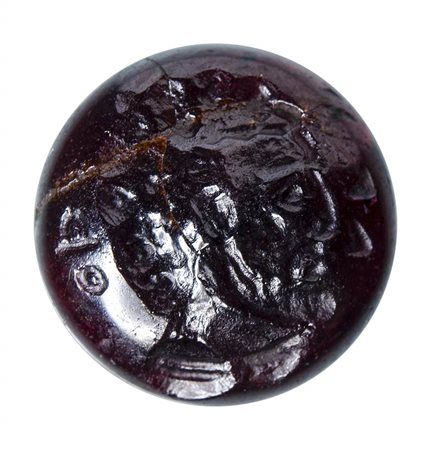
Lot 19 A greek-iberian garnet intaglio. Bearded male head.
150-100 B.C.
13x13x4 mm
Facing right, the male figure is characterized by a trick beard and voluminous hair rendered with rounded drills. On each sides presence of greek letters (?). Cabochon stone, small cracks and slight wear marks.
See the iberian coinage silver denarii from Barskunes
"
U.K. private collection -
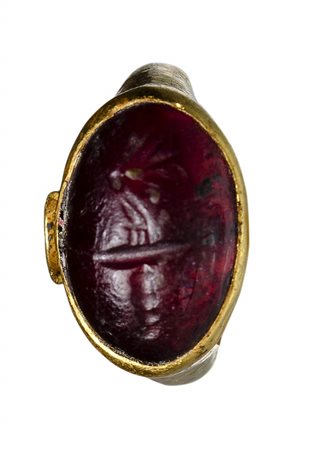
Lot 20 A late hellenistic gold ring with garnet intaglio. Butterfly with a torch.
3rd - 2nd century B.C.
Intaglio 7,5x11 mm ; int. diam 12 mm ; 2,28 grs
The allegorical depiction is engraved on a cabochon garnet, with a butterfly flying above a burning torch. This subject allegorically refers to the shortness of life. Use of globular elements. Signs of wear. The stone, very prominent, is mounted on a gold ring with a smooth rod and equipped with a small ring welded to the case of the bezel. Fine state of conservation.
"
U.K. private collection -
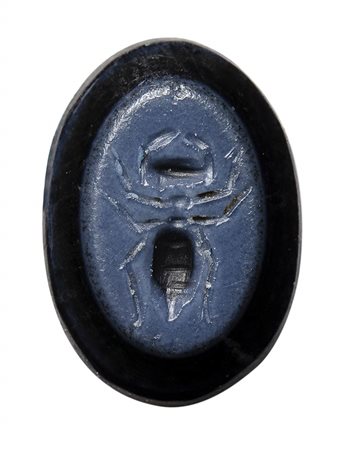
Lot 21 A roman nicolo intaglio. Ant.
2nd century A.D.
6x8x3 mm
The insect is seen from above. An auspicious symbol of industriousness and wealth.
"
U.K. private collection -
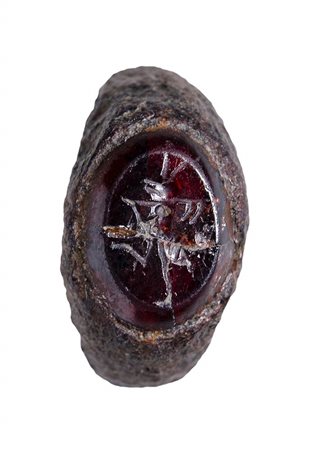
Lot 22 A rare roman garnet intaglio mounted on a iron ring. Working ant.
1st-2nd Century A.D.
Intaglio 7,5x10 mm ;
Ring rounded without and flatten within, the oval bezel set with a high relief intaglio depicting a working ant, turned to the left. Vertical crack on the stone missing on the mounting.
"
U.K. private collection -
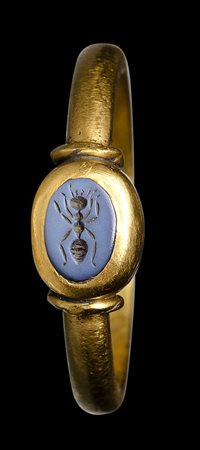
Lot 23 A roman nicolo intaglio set in a postclassical gold ring. Ant.
1st-2nd century A.D.
Intaglio 4x6 mm ; US size ring 5.5 ; 5,9 grs
Hoop rounded without and flatten within, the oval bezel with two gold ring attached at each terminal and set with an intaglio showing an ant: The insect is characterized by fine naturalistic details.
"
U.K. private collection -
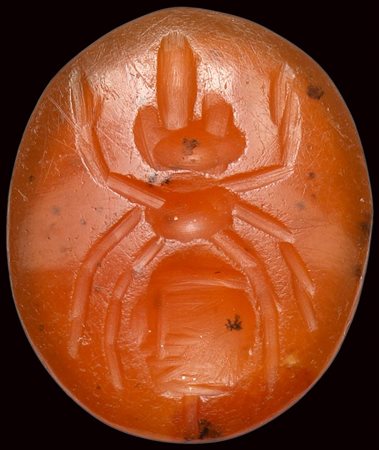
Lot 24 A roman carnelian intaglio. Ant.
2nd-3rd century A.D.
11x13x3 mm
The insect is holding a wheat seed. Slight wear marks.
"
U.K. private collection -
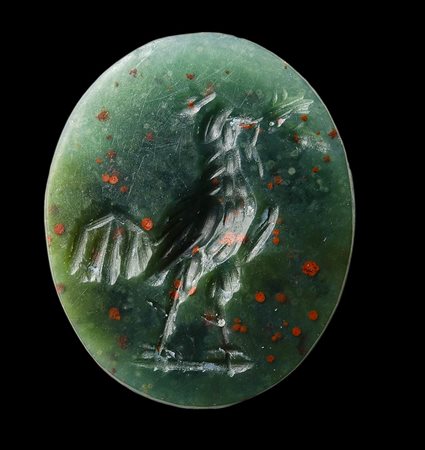
Lot 25 A roman eliotrope intaglio. Cock.
2nd century A.D.
9x10x2 mm
The animal, associated with the god Mercury, is facing right, holding two ears of wheat in its beak. Groundline. Vivid color of the stone.
"
U.K. private collection -
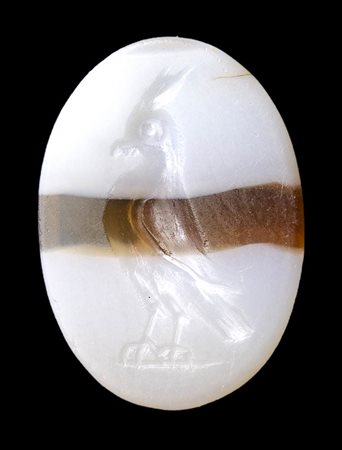
Lot 26 A roman banded agate. Falcon.
1st century B.C. - 1st century A.D.
9x13x2 mm
Facing left, his head surmounted with the Egyptian double-crown (?). These characteristics are references to Horus. Groundline.
"
U.K. private collection -
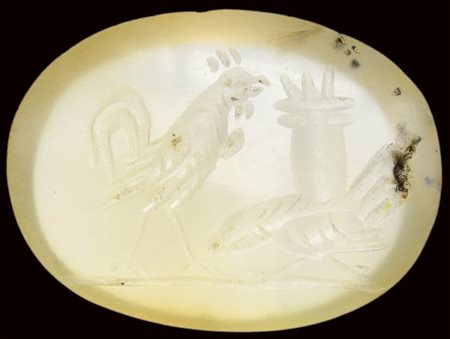
Lot 27 A roman chalcedony intaglio. Two cocks.
2nd century A.D.
11x15x3 mm
One cock, facing left pecking on the ground, while the other next, facing right, keeping the head raised; in the background, an altar. Groundline. Interesting votive scene, well composed. Nice size of the stone.
"
U.K. private collection -
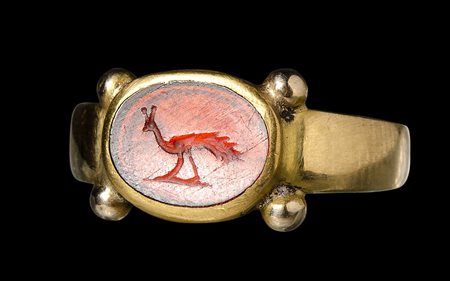
Lot 28 A roman garnet intaglio set in a postclassical gold ring. Peacock.
1st century B.C.
Intaglio 7x10 mm ; US size ring 4.5 ; 6,08 grs
Hoop rounded without and flatten within, each terminal with two gold spherical beads framing the oval bezel set with an intaglio. The peacock is facing left. Groundline. Slight wear marks on the surface of the stone.
"
U.K. private collection -
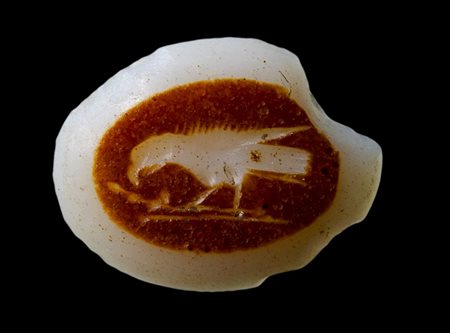
Lot 29 A roman double-layered agate intaglio. Bird (crow) with a leafy branch.
2nd century A.D.
7x9x1,5 mm
The bird is turned to the left, holding a branch and bending his head toward the leaves to eat. Groundline. Chip on the edge.
"
U.K. private collection -
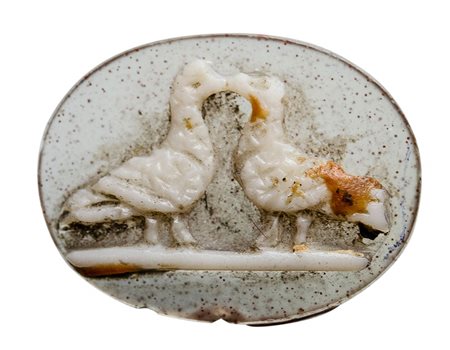
Lot 30 A late roman two-layered agate cameo. Two doves.
2nd - 3rd century A.D.
9x11x2 mm
The birds kissing each other are characterized by a rendering crossed pattern body (representing their feathers). Groundline also in relief. The use of the white layer of the stone to represents the purity and the peace in union, . Small chips on the edge.
"
U.K. private collection -
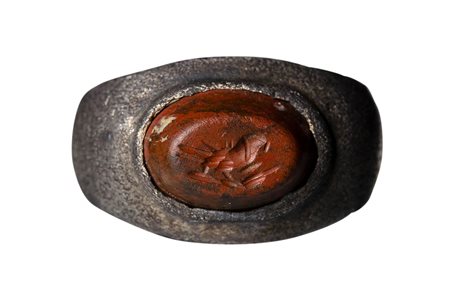
Lot 31 A roman silver ring with red jasper intaglio. Parrot.
2nd - 3rd century A.D.
Intaglio 8x10 mm ; US size ring 4 ; 6 grs
Hoop rounded without and flatten within with oval bezel set with an intaglio. Parrot facing right with a cherry.
"
U.K. private collection -
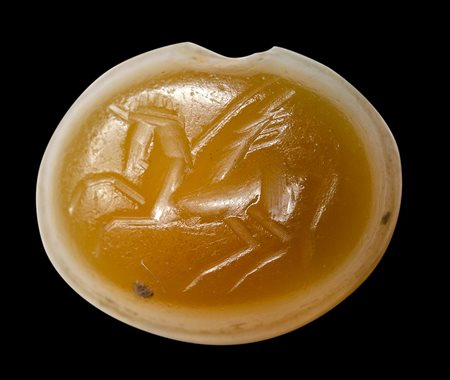
Lot 32 A roman agate intaglio. Pegasus.
2nd century A.D.
9x11x4 mm
The mythological creature is facing left, flying. Chipped at the top of the edge.
"
U.K. private collection -
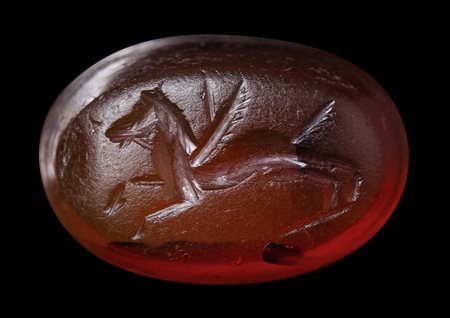
Lot 33 A roman carnelian intaglio. Pegasus.
2nd - 3rd century A.D.
10x15x6 mm
The mythological animal is facing left, with spread wings. Groundline inclined suggesting the movement of the scene. Slight wear marks.
"
U.K. private collection -
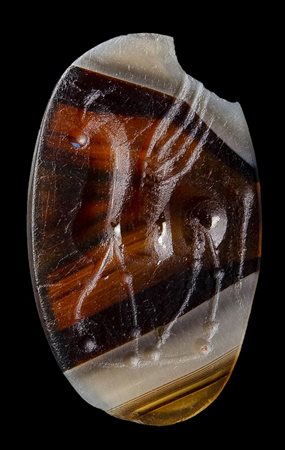
Lot 34 A roman italic banded agate intaglio. Pegasus.
2nd - 1st century B.C.
10x17x2 mm
The winged horse is facing left. Groundline. Use of globular elements. Chip on the edge. Slight wear marks.
"
U.K. private collection -
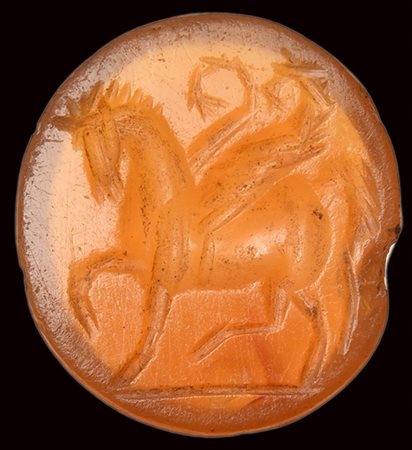
Lot 35 A roman carnelian intaglio. Pegasus.
2nd century A.D.
9x10,5x2 mm
The winged creature is turned to the left side, raising the front right leg. Groundline. Slight wear marks. Light chipping on the edge.
"
U.K. private collection -
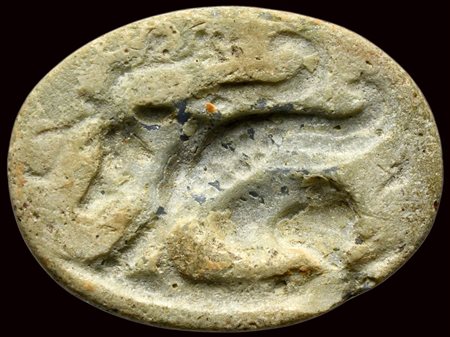
Lot 36 A roman glass paste intaglio. Winged sow.
1st-2nd century A.D.
11x15x3 mm
The winged animal is turned on the left, near a tree. The long wings have curved endings. Groundline. Rare subject.
"
U.K. private collection -
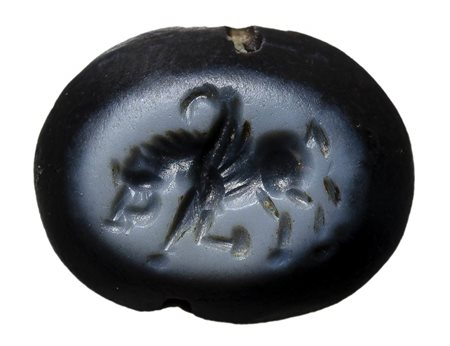
Lot 37 A roman nicolo intaglio. Pegasus.
2nd-3rd century A.D.
9x13x3 mm
The winged creature is facing left, towards the ground, rising the right leg. Small chips on the edge.
"
U.K. private collection -
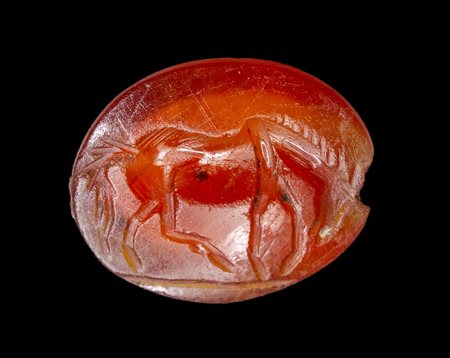
Lot 38 A roman carnelian intaglio. Horse.
2nd - 3rd century A.D.
8x9x3 mm
The animal is facing right. Groundline. Chip on the edge. Slight wear marks.
"
U.K. private collection -
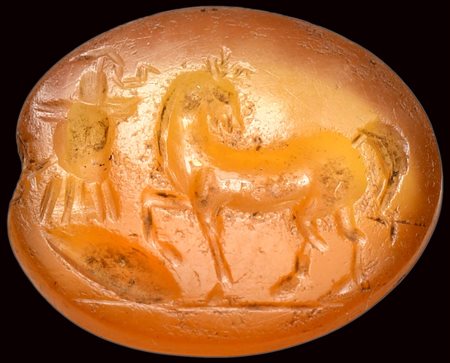
Lot 39 A roman carnelian intaglio. Horse with military trophy.
2nd-3rd century A.D.
11x13x4 mm
The mighty animal heads to the left, turning its head back; in front of him a military trophy composed by a lorica surmounted by a helmet and below a shield. Groundline. Wear marks. Chipping on the edge.
"
U.K. private collection -
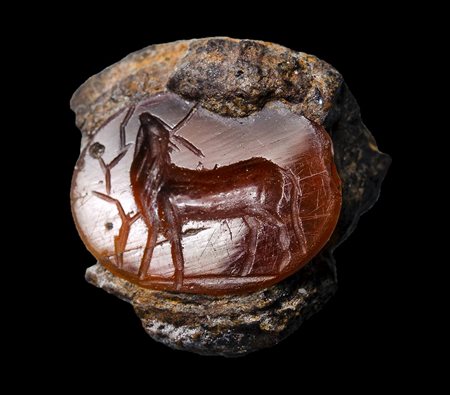
Lot 40 A roman agate intaglio. Antelope.
2nd - 3rd century A.D.
11x9x4 mm
The horned animal is facing left in front of a branch, his head raised up. Groundline. Traces of iron mounting on the edge. Wear marks on the surface of the stone and nice polishing of the engraving.
"
U.K. private collection -
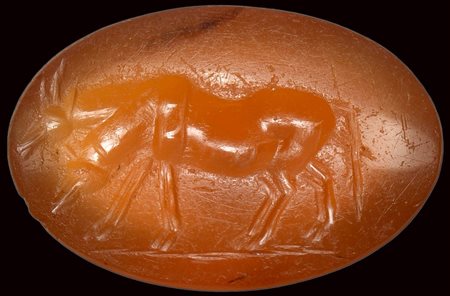
Lot 41 A roman carnelian intaglio. Two heifers.
2nd century A.D.
8x13x4 mm
The two quadrupeds, grazing and sticked to each other (one on the first ground, the other in background). Groundline. Slight wear marks.
"
U.K. private collection -
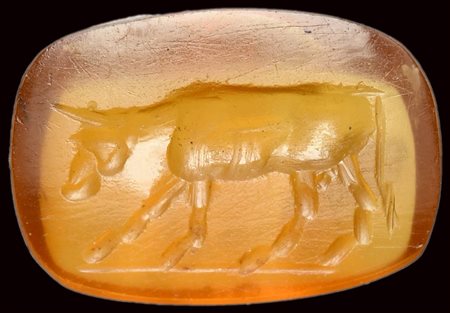
Lot 42 A roman carnelian intaglio. Bull.
2nd-3rd century A.D.
8x11x12 mm
The animal is turned on the left. Groundline. Slight wear marks.
"
U.K. private collection -
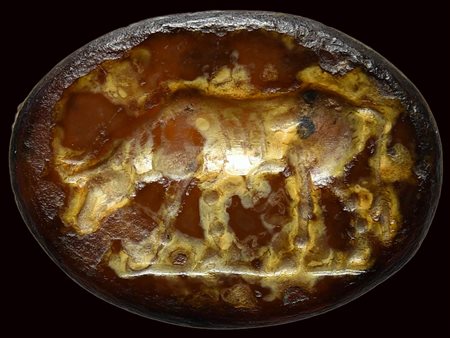
Lot 43 A roman italic burnt sard intaglio. Bull.
2nd century A.D.
9x12x2 mm
The animal is turned on the left. Anatomical details engraved with globular elements. Groundline. The stone is partially burnt with missing material on the surface.
"
U.K. private collection -
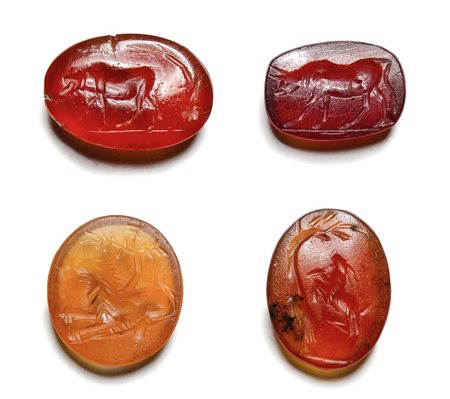
Lot 44 A group of 4 roman carnelian intaglios. Animals.
2nd - 3rd century A.D.
7,5x11,5x3 mm; 7x10x2,5 mm; 9x10x2 mm; 8x11x3 mm
A bull facing left with a tree. Groundline; Bull facing left. Groundline ; Crouched lion facing left, under a palm tree (?); Goat grabbing fruits on a tree. Groundline. Slight wear marks.
"
U.K. private collection -
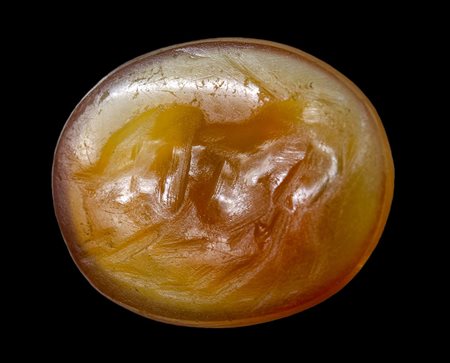
Lot 45 A roman carnelian intaglio. Bull.
2nd - 3rd century A.D.
9x10x2 mm
The animal is charging facing left. Groundline. Slight wear marks.
"
U.K. private collection -
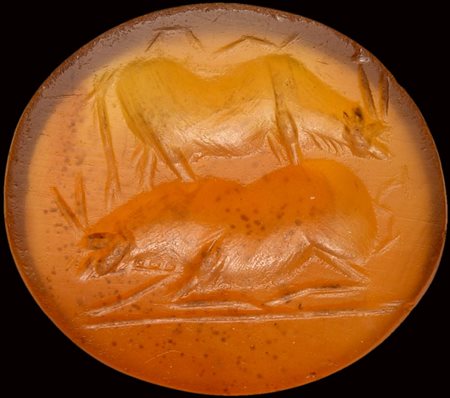
Lot 46 A roman carnelian intaglio. Two antelopes.
2nd century A.D.
10x11x2mm
In the foreground, an animal is crouched on the ground in a resting position, facing left; in the background the other animal is standing and facing to the right. Interesting composition. Wear marks.
"
U.K. private collection -
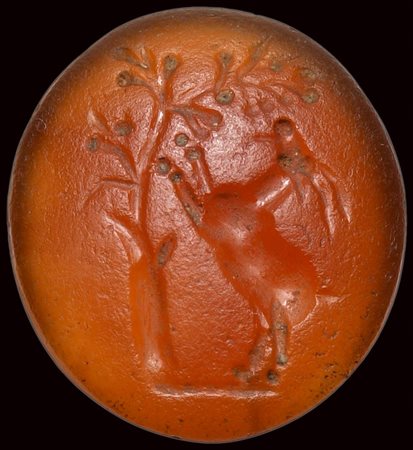
Lot 47 A roman carnelian intaglio. A goat under a tree.
1st century B.C.
12x13x4 mm
The animal lifts its front legs to lean on a trunk of a tree and eats its leaves. Groundline. Bucolic scene. Use of globular elements. Wear marks.
"
U.K. private collection -
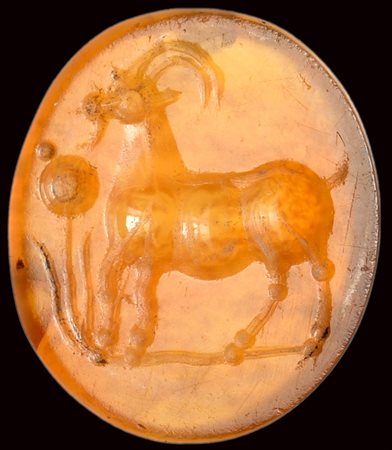
Lot 48 A roman italic carnelian intaglio. Antelope with poppy flower.
2nd-1st century B.C.
11x12x2 mm
The quadruped is facing left, near a large poppy flower. Groundline. Use of globular elements. Slight wear marks.
"
U.K. private collection