
DIPINTI E SCULTURE ANTICHI E DEL XIX SECOLO - LIBRI ANTICHI - STAMPE E DISEGNI
-
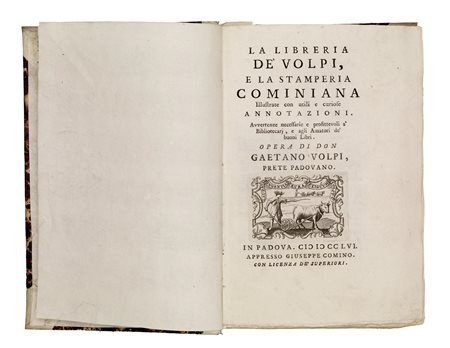
Lotto 1 Gaetano Volpi
La libreria de' Volpi e la Stamperia Cominiana illustrate con utili e curiose Annotazioni. Avvertenze necessarie e profittevoli à Bibliotecarj, e agli Amatori de' buoni Libri. Opera di Don Gaetano Volpi, prete padovano.
Padova, Appresso Giuseppe Comino, 1756
(UNITO:) Catalogo de' libri Cominiani ancora vendibili co' legittimi loro prezzi. Padova, Comino, 1744.
In 8°, bella legatura coeva in m. pelle con angoli, tassello con titolo in oro al dorso; pag. XIV, (2), 592, (2); XXIV. Insegna tipografica incisa in rame al frontespizio e stemma della famiglia Volpi in fine. Bell'esemplare. "Io vi presento un libro incominciato da me con un disegno, proseguito poscia, e terminato con un altro. Il primo fu di pubblicare il semplice e succinto catalogo della nostra Domestica Libreria, per conservare in tal guisa la memoria de' Libri in tanti anni, con non poca spesa e sollecitudine ragunati, e con particolar cura ed affetto conservati. Grande adunque si è l'utilità de' Cataloghi delle Pubbliche e delle Private Librerie: ed essendo questa stata conosciuta e avvertita meglio finora dagli Eruditi Oltramontani, che da' nostri Italiani, benché al par di essi studiosi, perciò e dell'une, e dell'altre moltissime ne' lor paesi li han pubblicati, a potabilissima comodità degli applicati alle buone lettere". Rarissimo catalogo e bibliografia della stamperia Volpi-Cominiana, pubblicato in soli 200 esemplari.
In 8 °, beautiful coeval binding in m. leather with corners, piece with gold title on the back; XIV, (2), 592, (2); XXIV pp. Typographical sign engraved in copper on the titlepage and coat of arms of the Volpi family at the end. Fine example. 'I present to you a book that started with a drawing, continued afterwards, and ended with another. The first was to publish the simple and succinct catalog of our Domestica Libreria, in order to keep the memory of the Books in such a way over many years, with no little expense and thoughtfulness, and with particular care and affection preserved. Great therefore is the usefulness of the Catalogs of the Public and Private Libraries: and having been better known and perceived thus far by the Oltramontane Erudites, than by our Italians, although in their opinion scholars, therefore and of the one, and of the many others in their countries have published them, for the most comfortable convenience of those applied to good letters ". Very rare catalog and bibliography of the Volpi-Cominiana printing house, published in only 200 copies. -
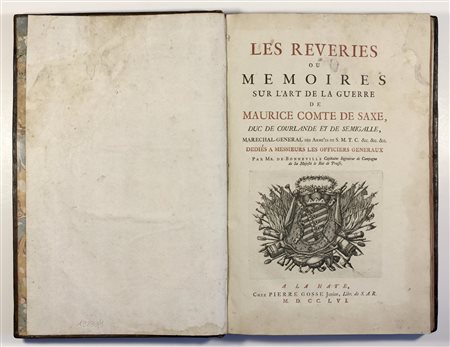
Lotto 2 Maurice Comte de De Saxe (1696 - 1750)
Les Reveries ou Memoires sur l'Art de la Guerre. Dediés a Messieurs les Officiers Generaux par M. de Bonneville, Capitaine Ingenieur de Campagne de sa Majesté le Roi de Prusse.
The Hague, Pierre Gosse, Junior, 1756
In-folio (mm 370x235). Pagine (12), 228, (4). Con 40 tavole fuori testo piω volte ripiegate incise in rame. Frontespizio in rosso e nero con grande stemma nobiliare calcografico; testatine, capilettera e finalini incisi in rame. Bell'esemplare in carta grave ad ampi margini. Legatura coeva in tutta pelle, con titoli su tassello applicato al dorso a 6 nervi, fregi floreali ai comparti; tagli spruzzati.
Condition: Prime due carte restaurate e gore d'umido nel margine superiore destro delle pagine.
Rara edizione originale in-folio, da non confondersi con la meno importante edizione coeva in-8° in 2 volumi; manca a Graesse.
Folio (370x235 mm). Contemporary sprinkled calf, raised bands, gilt sun-in-splendour tools within palm branches to the compartments, red morocco label, red sprinkled edges. Lightly browned and damp staining on upper right margin, but overall a very handsome copy. Fine large engraved trophy vignette to the title page, similar head and tailpieces throughout, 40 engraved plates, 18 of them double-page, 4 double-page, folding. Ancient ex-libris with coat of arms. First edition, surprisingly uncommon, three copies only on COPAC. "De Saxe's work is a comprehensive treatise on war. He puts forward his ideal military model, his "legion", and taking issue with the views and practices of his age, he advances many original ideas. However, rather than discussing his military doctrines, the aim of this book is to elucidate the intellectual premises that dominated his mind: he saw a need to subject military affairs to reasoned criticism and intellectual treatment, and the ensuing military doctrines were perceived as forming a definitive system" (Gat, The Origins of Military Thought, p.33). Carlyle described it as a "strange military farrago, dictated, as I should think, under opium", which is perhaps not entirely as unfair as it may seem, a note on the original MS at Dresden reads, "I composed this work in Thirteen nights: I was ill, therefore, it may perhaps bear marks of the fever which I had. This ought to excuse the regularity of the arrangement, as also the elegance of style. I wrote in a military manner and to kill time." Whatever the oddness of its style the Reveries was immensely influential, reprinted three times in 1757 and again in 1761 and 1763, German editions of 1757 and 1767 and English of 1757, 1759 and 1776. -
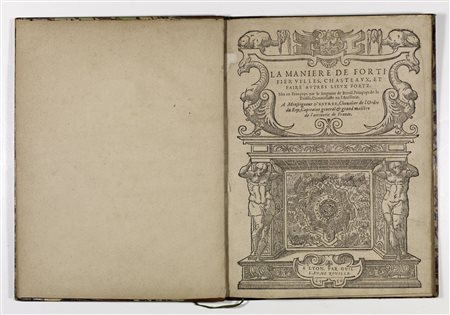
Lotto 3 Francois de Seigneur de Beroil La Treille
La maniere de fortifier Villes, Chasteaux, et faire autres Lieux Fortz, (...) A Lyon, par Guillaume Roville 1556.
In 4 ° (mm 210x156). 74, (2). Alcune tavole con fortificazioni all'interno del testo e della pagina intera. Testo in francese. Pagine in buone condizioni leggermente brunite, angoli in buone condizioni. Legatura in mezza pelle del'900.
In 4° (210x156 mm). 74, (2). Some plates with fortifications inside the text and full-page. Text in French. Pages in good conditions. Slight yellowing, angles in good conditions.
20th century half calf binding, gilded title on spine. -
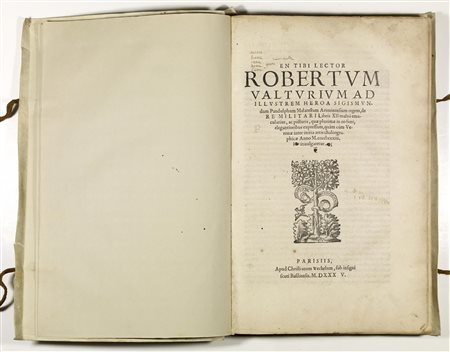
Lotto 4 Robertus Valturius (1405 - 1475)
En tibi lector Robertum Valturium Ad Illustrem Heroa Sigismundum Pandulphum Malatestam (...) DE RE MILITARI Libri XII (...). Parisiis; Apud Christianum Wechelum, sub insigni scuti Basiliensis 1535 (settembre 1534)
In folio (mm 328x212). Pag. (12), 383, (1). Pergamena del 20° secolo. Con numerose magnifiche illustrazioni xilografiche nel testo molte a piena pagina. Qualche nota manoscritta ai margini, fori di tarlo in molte pagine. Pagine leggermente brunite e con gore di umidità. Le ultime trenta pagine hanno il bordo superiore ricostruito alcune con parziale perdita del testo. L'ultima pagina ha il margine esterno e l'angolo inferiore esterno ricostruito con parziale perdita del testo.
Le affascinanti illustrazioni "rappresentano le macchine da guerra usate dagli antichi, con modifiche medievali, e sono straordinariamente pittoresche e istruttive". Le magnifiche xilografie sono "copie in controparte" (Mortimer) dei blocchi usati per illustrare la seconda edizione (Verona, 1483) che furono a loro volta copiati dalla prima edizione (Verona: Johannes, 1472). Cockle nota che queste illustrazioni "si dice che provenissero dai disegni di Leonardo da Vinci". (Cockle p. 134). Il De Re Militari è essenzialmente un compendio delle ultime tecniche e dispositivi per scalare muri, catapultare missili, fortificare le fortificazioni. Il lavoro segna la transizione tra la guerra medievale e rinascimentale con l'applicazione di cannoni e polvere da sparo. Poco dopo la sua prima apparizione nel 1472, l'opera divenne un manuale principale per principi e capi militari del Rinascimento: Leonardo da Vinci ne fece uso mentre agiva come ingegnere capo di Cesare Borgia e anche prima della sua prima stampa il trattato era molto apprezzato e distribuito in manoscritto Il lavoro continuò a essere ristampato piω volte e le date suggeriscono che continuò ad avere un valore piω che antico: l'edizione del 1484 apparve poco dopo l'accensione del militante Carlo VIII e l'attuale edizione venne presa sulla scia dell'importante riorganizzazione di Francesco I Esercito francese. "L'importanza storica del De Re Militari sta nel fatto che è il primo libro stampato con illustrazioni di carattere tecnico o scientifico che raffigurano le idee di ingegneria progressiva del tempo dell'autore. Le xilografie illustrano l'equipaggiamento necessario per i militari e la marina ingegnere; comprendono torrette a pistola rotanti, piattaforme e scale per assedi, ruote a pale, tuta da sub, cintura di salvataggio, qualcosa che ricorda un carro armato, un pontone e altri ponti, una barca completamente chiusa che potrebbe essere sommersa per metà, ecc. (.) Il Valturius di Verona e le sue ristampe erano i manuali dei leader militari del Rinascimento, e Leonardo da Vinci, quando fungeva da ingegnere capo di Cesare Borgia, possedeva una copia e ne prese in prestito alcuni dei suoi disegni. "- Printing & the Mind of Man 10 - (1 ° ed. Del 1472). "La prima edizione stampata dell'opera di Valturio (1472) fu un capolavoro di tipografia e xilografia.
In folio (328x212 mm). Valturius (Robertus) De re militari libris xii, second Wechel edition. 20th century vellum. Title with woodcut device (repeated on verso of final leaf), woodcut initials, numerous fine woodcut illustrations, many full-page, and some marginalia, slight marginal worming to upper outer corner and a few other small marginal tears (repaired), lightly browned, some spotting, some light water-staining, mostly marginal. The last 30 pages with outer upper corner reconstructed with some loss of text. Last page with outer edge and lower corner reconstructed with loss of text. The charming illustrations "represent the machines of war used by the ancients, with mediaeval modifications, and are remarkably quaint and instructive." Cockle. The magnificent woodcuts are 'reversed free copies' (Mortimer) of the blocks used to illustrate the second edition (Verona, 1483) which were in turn copied from the first edition (Verona: Johannes, 1472). Cockle notes that these illustrations were 'said to be from da Vinci's drawings'. (Cockle p. 134). The De Re Militari is essentially a compendium of the latest techniques and devices for scaling walls, catapulting missiles, ramming fortifications, and torturing enemies and the work marks the transition between Medieval and Renaissance warfare with the application of cannons and gunpowder. Soon after it's first appearance in 1472 The work became a primary handbook for Renaissance princes and military leaders: Leonardo da Vinci made use of it while acting as chief engineer to Cesare Borgia and even before its first printing the treatise was highly regarded and circulated in manuscript.The work kept being reprinted several times and the dates suggests it continued to be of more than antiquarian value: The 1484 edition appeared shortly after the accension of the militant Charles VIII and the present edition came on the heels of Francis I's important reorganization of the French army. "The historical importance of the De Re Militari lies in the fact that it is the first book printed with illustrations of a technical or scientific character depicting the progressive engineering ideas of the author's own time. The woodcuts illustrate the equipment necessary for the military and naval engineer; they include revolving gun turrets, platforms and ladders for sieges, paddle-wheels, a diver's suit, a lifebelt, something resembling a tank, pontoon and other bridges, a completely closed boat that could be half submerged, etc. (.)The Verona Valturius and its reprints were the handbooks of the military leaders of the Renaissance, and Leonardo da Vinci, when acting as chief engineer to Cesare Borgia, possessed a copy and borrowed some of its designs."-Printing & the Mind of Man 10-(1st ed. of 1472)."The first printed edition of Valturio's work (1472) was a masterpiece of typography and woodcut. The woodcuts (or at least the drawings) were formerly attributed to Matteo de' Pasti; but they may have been done, as E. Rodakiewicz has proposed, by Fra Giovanni Giocondo Veronese. Military leaders of the period held the book in high esteem, and Leonardo da Vinci copied passages of the text and commented on them. Some of the manuscripts, such as those at Dresden and Munich, which contain very fine drawings, may have been produced after the first printed edition and in fact were based upon it."
Cf. Adams V225; Harvard French 536; Cockle 501; Not in Bib. Mech. Cat.) -
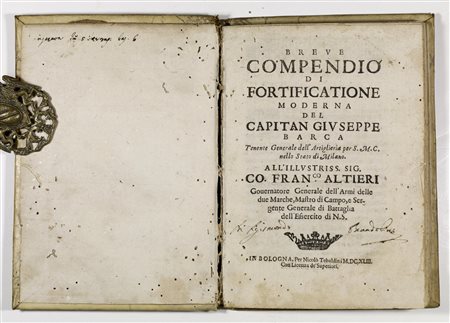
Lotto 5 Giuseppe Barca (1595 - 1639)
Breve compendio di fortificazione moderna del Capitan Giuseppe Barca Tenente Generale dell'Artiglieria per S.M.C. (Sua Maestà Cattolica) dello Stato di Milano (...). In Bologna, Per Nicolò Tebaldini 1643.
In-8° (mm 198x140), pp. (8), 71, (5), 23, (1) Legatura in piena pergamena coeva con tassello e dorature al dorso. Testatine, iniziali e finalini xilografici. Numerose figure intercalate nel testo e tavole dei logaritmi. Bell'esemplare purtroppo con numerosi fori di tarlo. Seconda edizione. Si tratta di un'opera tecnica, nella quale l'autore si dichiara seguace dei Francesi e degli Olandesi per l'uso delle tavole logaritmiche neperiane da lui per primo introdotte in Italia. Il Barca esplicò anche una modesta attività d'architetto; è infatti ricordato come esecutore a Milano di una cappella di San Romano, ora demolita, che era attigua alla chiesa di San Babila." (Rossana Bossaglia, in DBI, VI, 1964). Bibliografia (per la prima edizione): Marini, p. 86. Cockle, 829. Vinciana, 1410: "Opera postuma, rara e rinomata". D'Ayala, 84. Riccardi, I, 79. Maggiorotti, Breve dizionario degli architetti ed ingegneri militari italiani p. 7 (seconda edizione del 1643). Guarnieri, pp. 6-7. Promis, XIV, 831. Sticca, p. 151.
In-8 ° (198x140 mm.). (8), 71, (5), 23, (1) pp. Bound in full contemporay parchment with gusset and gilding on the spine. Several woodcut initials and ends. Numerous figures interspersed in the text and tables of logarithms. Unfortunately, nice specimen with numerous worm holes. Second edition. It is a technical work, in which the author declares himself a follower of the French and Dutch for the use of the Neperian logarithmic tables which he first introduced in Italy. Il Barca also carried out a modest architectural activity; in fact he is remembered as the performer in Milan of a chapel of San Romano, now demolished, which was adjacent to the church of San Babila. "(Rossana Bossaglia, in DBI, VI, 1964). Bibliography (for the first edition): Marini, p 86. Cockle, 829. Vinciana, 1410: "Posthumous, rare and renowned work." D'Ayala, 84. Riccardi, I, 79. Maggiorotti, Short dictionary of Italian military architects and engineers p. 7 (second edition of 1643 Guarnieri, pp. 6-7. Promis, XIV, 831. Sticca, p. 151. -
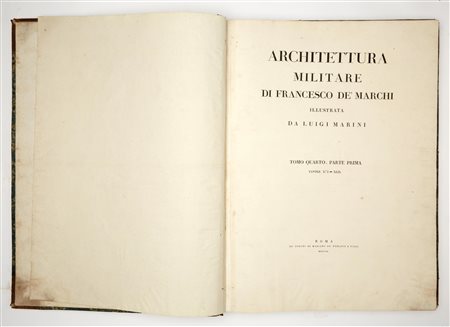
Lotto 6 Francesco De Marchi (1504 - 1577)
Architettura militare (...) illustrata da Luigi Marini. Roma, da' torchi di Mariano de Romanis e figli, 1810.
2 volumi in-folio massimo, 778 x 540 mm. Mancano i primi 3 volumi di testo. I volumi in vendita sono gli ultimi 2 volumi della pubblicazione contenenti le tavole incise in rame con un formato disteso di 778x1080 mm. Nel tomo IV, tavole numerate I-XLIX, nel tomo V tavole numerate L-CIV. Sono tutte incise da Pietro Ruga e Giovanni Battista Cipriani, con date varianti dal 1805 al 1809.Legature in mezza pelle e vitello spugnato, con difetti e mancanze ai dorsi e ai piatti.Lotto non passibile di restituzione. Ad un anno dalla morte del De Marchi (1575) uscμ a Venezia dalla tipografia di Francesco Franceschi l'Architettura militare di Francesco Marchi capitano (tutti i commentatori concordano nel definirla senza data né luogo). Successive ristampe vennero eseguite per tutto il XVII e XVIII sec. circolanti anche sotto diversa paternità; a testimonianza di una crescente fortuna a fine Settecento, e per porre rimedio a una presunta carenza di copie, nel 1810 l'architetto L. Marini curò la presente ristampa del trattato, in cinque volumi in folio reale dal formato gigante, che furono naturalmente dedicati "alla Maestà di Napoleone I".
L'opera del De Marchi fu innovativa sotto diversi aspetti, ma probabilmente il piω importante si dimostrò il connubio tra fortificazione e tessuto urbano, studiato sui diversi tipi di territorio, monti, piano, marina, isola, perché per l'autore l'arte di fortificare "procede dalla natura", e deve quindi sfruttare le risorse orografiche del terreno, senza prevaricare l'aspetto estetico dell'insieme. Diede grande importanza allo studio dei materiali da costruzione ma soprattutto al disegno ed ai modelli in scala, da seguire scrupolosamente, per l'ottenimento del miglior risultato. 'L'importanza scientifica di questa opera, e delle aggiunte fattevi dal Marini, la splendidezza della edizione, la rendono rara, ricercata ed assai apprezzata dai bibliografi' (Riccardi). Per uno studio esaustivo dell'opera, si consulti Carlo Promis, in Misc. di storia italiana 4 (1863) 632-68. Cockle, 798 p.207; Fara, Il sistema e la città, 159-161; Riccardi, II, 111. (5)
Architettura militare (...) illustrata da Luigi Marini. Roma, da' torchi di Mariano de Romanis e figli, 1810.
2 volumes in grand folio, 778 x 540 mm. The first 3 volumes of text are missing. The volumes on sale are the last 2 volumes of the publication containing the engraved copper plates with an extended format of 778x1080 mm. In volume IV, numbered plates I-XLIX, in volume V numbered plates L-CIV. They are all engraved by Pietro Ruga and Giovanni Battista Cipriani, with dates varying from 1805 to 1809. Binding in half leather and sponged calfskin, with defects and shortcomings in the spines and boards. Lot not liable to be returned. One year after the death of De Marchi (1575), a Francesco Marchi 'Architettura Militare' was printed in Venice from the typography of Francesco Franceschi (all commentators agree in defining it without date or place). Subsequent reprints were made throughout the seventeenth and eighteenth centuries. also circulating under different authorship; testifying a growing fortune in the late eighteenth century, and to remedy an alleged shortage of copies, in 1810 the architect L. Marini edited the present reprint of the treatise, in five volumes in real folio with a giant format, which were naturally dedicated "to the Majesty of Napoleon I".
De Marchi's work was innovative in several respects, but probably the most important proved to be the combination of fortification and urban fabric, studied on the different types of territory, mountains, plain, marina, island, because for the author the art to fortify "proceeds from nature", and must therefore exploit the orographic resources of the land, without overriding the aesthetic aspect of the whole. He gave great importance to the study of building materials but above all to the design and scale models, to be followed scrupulously, to obtain the best result. "The scientific importance of this work, and the additions made by Marini, the splendor of the edition, make it rare, sought after and highly appreciated by bibliographers" (Riccardi). For an exhaustive study of the work, consult Carlo Promis, in Misc. Of Italian history 4 (1863) 632-68. Cockle, 798 p.207; Fara, The system and the city, 159-161; Riccardi, II, 111. (5) -
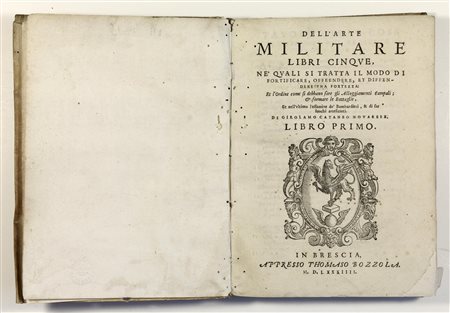
Lotto 7 Girolamo Cattaneo (1540 - 1584)
Dell'Arte Militare libri cinque, ne' quali si tratta il modo di fortificare, offendere, et diffendere una fortezza. Et l'Ordine come si debbano fare gli Alloggiamenti Campali; e formare le Battaglie, et nell'ultimo l'essamine de Bombardieri, & di far fuochi arteficiati. In Brescia Appresso Thomaso Bozzola 1584
In 4° (mm 205x150). Marca tipografica xilografica. Ogni libro con proprio frontespizio e numerazione autonomo. cc. (4), 81; 35; 30, (1); 29; (2), 39, (1). Piena pergamena coeva. Fori di tarlo in alcune pagine. Diverse carte ripiegate con incisioni raffiguranti la disposizione dei soldati nei campi di battaglia e numerosi incisioni nel testo con diversi schemi e modelli di fortificazioni e di oggetti per la difesa e l'offesa delle postazioni.
Legatura in piena pergamena coeva con titolo calligrafato in tassello al dorso (moderno). Difetti e mancane al dorso. Impresa editoriale incisa su legno ai frontespizi con àncora con delfino entro cornice istoriata. Dedica a stampa a Girolamo Martinengo. Fregi tipografici incisi in xilografia, numerosissime incisioni xilografiche n.t. e f.t., di cui 23 doppia pag. e 8 su tavv. ripiegate. Le pp. 4-17 del libro IV sono di tabelle. Fori di tarlo in alcune carte sparse. Timbro a secco di proprietà al foglio di guardia anteriore. Piω che discreto esemplare nell'insieme. Seconda edizione dopo l'originale bresciana del 1571 di questa significativa trattazione rinascimentale di tattica e di fortificazione militare. Il Cattaneo, nato a Novara nel primo quarto del XVI secolo e morto a Brescia dopo il 1584, fu matematico e architetto militare e fortificò Sabbioneta per conto di Vespasiano Gonzaga. Cfr. STC Italian, p. 158 (ed. di Brescia, 1584).
In 4°. Binding in full contemporary vellum. Modern title on spine. Small loss on spine. Each vol. has its own title page and is signed and foliated separately. Bozzola's device appears on all title page's (griffin). Foliation: leaves (4), 81; 35; 30, (1); 29; (2), 39, (1).
Second and partly original edition of this rare book on military art and science. Expanded version of Cataneo's Dell'arte militare libri tre (Brescia, T. Bozzola, 1571).
Numerous woodcut illustrations including many double-page and some on folded leaves. Some plates included in foliation and some leaves of folded plates with no number.
Conditions: Complete. Some wormholes through the pages. -
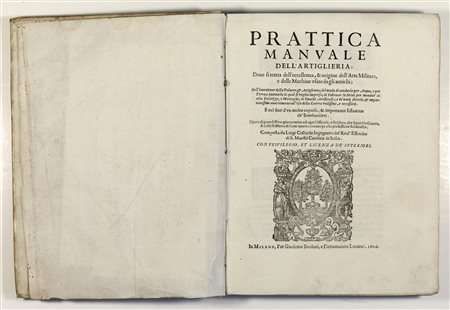
Lotto 8 Luis Collado (1586 - 0)
Prattica manuale dell'Artiglieria, dove si tratta dell'eccellenza and origine dell'Arte Militare, e delle Machine usate da gli antichi; dell'invenzione della Polvere, & Artiglieria; del modo di condurla per Acqua, e per Terra (...) Fabricar le Mine per mandare in aria Fortezze, e Montagne; di Fuochi Artificiali; (...) Composta da Luigi Colliado (...).
In Milano, Per Girolamo Bordoni e Pietromartire Locarni, 1606.
In 4° (mm 265x202). Pag. (22), 387, (1). Legatura in piena pergamena coeva con titolo manoscritto al dorso. Tassello moderno con note di collocazione al dorso. Impresa tipografica sul titolo, testatine, iniziale e fregi xilografici. Dedica degli stampatori al nobile Federico Landi. E' corredato di 16 tavole xilografiche fuori testo e numerose figure nel testo. Prima traduzione italiana, basata sull'edizione in spagnolo del 1592. In effetti, l'opera era già stata pubblicata in italiano a Venezia nel 1586, ma venne poi completamente rimaneggiata dall'autore. Il Colliado tratta estesamente dell'invenzione della polvere da sparo, della fabbricazione delle mine, dei fuochi artificiali e di alcune tecniche di offesa. L'autore, il capitano spagnolo Luys Collado, offre quindi un panorama completo dell'artiglieria nel XVI secolo ponendosi, grazie anche alle belle illustrazioni, tra gli scrittori piω interessanti per la storia delle scienze militari.
Cfr. Cockle, 668, nota. D'Ayala, p. 142. Palau, III, 57575, nota. Michel-Michel, II, p. 115.
In 4° (265x202 mm). (22), 387, (1) pp. Full contemporary vellum. Manuscript title on spine. Modern sticker on spine. 16 full page woodcut plates "fuori testo" and several other woodcuts included in the pagination. "The Pratica Manuale, in its second form, is sufficiently different to be considered a distinct work. Collado, dissatisfied, probably, with the first attempt, rewrote the book in his native tongue" (Cockle).
Extremely fresh and well inked.
Cf. Cockle, 668, nota. D'Ayala, p. 142. Palau, III, 57575, nota. Michel-Michel, II, p. 115. -
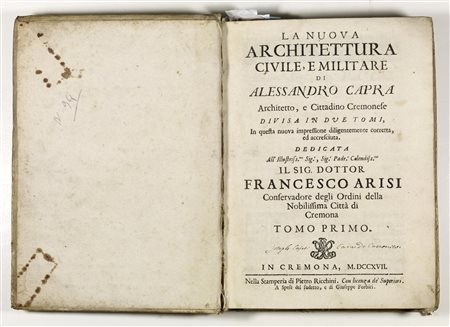
Lotto 9 Alessandro Capra (1620 - 1685)
La nuova architettura civile e militare di Alessandro Capra Architetto, e Cittadino Cremonese divisa in due tomi, In questa nuova impressione diligentemente corretta, ed accresciuta. (...) In Cremona, Nella Stamperia di Pietro Ricchini, 1717.
In 4° (mm 222x160). Tomo I° pag. (28), 356 - Tomo II° pag. (12), 184. Due tomi legati in uno. Piena pergamena coeva. Dorso con 5 nervature e tassello in pelle con titolo. Con 6 di 7 tavole xilografiche ripiegate fuori testo e 44 tavole numerate incise in legno nel primo tomo e 39 nel secondo (nel testo), molte delle quali a piena pagina. Con 2 ritratto xilografici dell'autore (uno ogni tomo). Bell'esemplare. Edizione definitiva, che rifonde insieme le due opere principali del celebre architetto e ingegnere militare Capra (1610 ca.-1683), " La nuova Architettura Famigliare" (Bologna, 1678) e "La nuova Architettura Militare" (Bologna, 1683). Particolare rilievo hanno le osservazioni del Capra relative alle macchine, da quelle idrauliche a quelle per il sollevamento, dai mulini alle macchine di utilizzo domestico, per giungere sino agli strumenti scientifici come il "baculo mensorio", la "verga astronomica" e la "bussola". Cfr Fowler, nn. 79-80. Berlin Catalog, 2752 e 3534. Riccardi, I, 234. Michel &/ Michel, II, p. 38. Cicognara, 461. Millard, Italian and Spanish books. n. 27, pp. 99-102. Comolli, IV, p. 203.
In 4° (222x160 mm). Volume I (28), 356 pp. - Volume II ° (12), 184 pp. Two Volumes bounded in one. Full coeval parchment. 5 ribs and leather gusset with title on spine. With 6 (of 7) woodcut plates folded out of the text and 44 numbered plates engraved in wood in the first volume and 39 in the second (in the text), many of them with full page illustrations. Woodcut portrait of the author on each volume. Fine example. Definitive edition, which recast together the two main works of the famous architect and military engineer Capra (c. 1610-1683), "The new Family Architecture" (Bologna, 1678) and "The new Military Architecture" (Bologna, 1683). Capra's observations on machines, from hydraulic to lifting, from mills to machines for domestic use, to reach scientific instruments such as the "baculo mensorio", the "astronomical rod" and the "compass" are particularly important. ". See Fowler, nos. 79-80. Berlin Catalog, 2752 and 3534. Riccardi, I, 234. Michel & / Michel, II, p. 38. Cicognara, 461. Millard, Italian and Spanish books. n. 27, pp. 99-102. Comolli, IV, p. 203. -
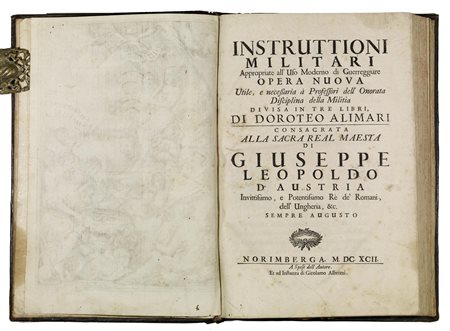
Lotto 10 Doroteo Alimari (1650 - 1727)
Instruttioni Militari appropriate all'Uso Moderno di Guerreggiare. Opera nuova, utile, e necessaria à Professori dell'Onorata Disciplina della Militia. Divisa in tre libri. Norimberga (Venezia), 1692 A spese dell'Autore et ad Istanza di Girolamo Albrizzi.
In-folio (mm 330x220), pp. (8), 266, (14), 16, (2). 25 tavole calcografiche fuori testo. Legatura coeva in piena pelle con 5 nervi e dorature al dorso. Antiporta allegorica incisa su rame da Alessandro Dalla Via da invenzione di Antonio Zanchi. Capilettera riccamente ornati in xilografia. Dedica a stampa all'Imperatore Giuseppe Leopoldo d'Austria. Ottimo esemplare. Prima edizione, assai rara, pubblicata a Venezia con il falso luogo di Norimberga. La prima parte tratta della matematica applicata alla scienza militare, la seconda della fortificazione, la terza dell'offesa e della difesa delle piazzeforti. L'Alimari, veneziano, vissuto a cavallo tra XVII e XVIII secolo, fu matematico alla corte di Moscovia. Egli scrisse anche un Longitudinis aut terra aut mari investigandae methodus.
Cfr. Marini, p. 177. BLC to 1975, V, 304. Manca alla Vinciana e allo Sticca.
In-folio (330x220 mm), pp. (8), 266, (14), 16, (2). 25 chalcographic plates out of text. Contemporary binding in full leather with gilded spine. Allegorical engraved plate on copper by Alessandro Dalla Via from the drawing of Antonio Zanchi before titlepage. Richly decorated letter caps in woodcut. Dedication to the Emperor Giuseppe Leopoldo of Austria in print. Excellent copy. Very rare first edition, published in Venice with the fake Nuremberg location. The first part deals with mathematics applied to military science, the second with fortification, the third with offense and defense of strongholds. The Alimari, Venetian, who lived between the seventeenth and eighteenth centuries, was a mathematician at the court of Moscovia. He also wrote a Longitudinis aut terra aut mari investigandae methodus.
Cf. Marini, p. 177. BLC to 1975, V, 304. Missing to the Vinciana and Sticca. -
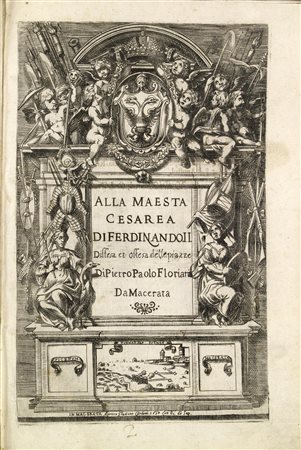
Lotto 11 Pietro Paolo Floriani (1585 - 1638)
Diffesa et offesa delle piazze. In Macerata: apresso Giuliano Carboni, 1630.
In-folio (mm 310x216). Pag. 8, 213 (i.e. 218), (32). Legatura in mezza pergamena del 20° secolo. Bellissimo frontespizio inciso in rame alle armi del Dedicatario Ferdinando II, 1 ritratto dell'Autore a piena pagina entro elaborata cornice architettonica inciso da Franciscus Pellegrinus Anconitanus (datato 1628) e 52 tavole numerate 1-50 di cui 43 a piena pagina fuori testo e 1 piω volte ripiegata in fine. Errori nella numerazione e nella segnatura dei fascicoli, indicati al colophon, ma esemplare ben completo e in ottimo stato di conservazione.
Rara prima edizione di una delle poche opere standard italiane del 17 ° secolo sulla costruzione di fortezze. L'architetto militare PP Floriani (1584-1638), originario di Macerata, fu inviato a Malta da papa Urbano VIII nel 1634 dopo aver lavorato in Spagna, Algeria, Austria, Ungheria, Praga e Bratislava come ufficiale e ingegnere militare Sono state coinvolte fortificazioni. Da questo libro di fortificazioni riccamente illustrato, una seconda edizione (molto piω frequente) fu pubblicata a Venezia nel 1654 e infine una terza a Londra nel 1725. - (Pochi piatti dorati, foxing minimo in alcuni punti). - Nel complesso una copia molto buona e completa di questa rarità. Prima edizione molto scarsa di questa enciclopedia illustrata di tutte le parti e gli strumenti di fortificazione, una delle poche opere standard italiane sull'argomento pubblicata nel 17 ° secolo. P. P. Floriani (1584-1638) di Macerata era un ingegnere impiegato da papa Urabnus VIII. Quando Floriani ispezionò il fronte di La Valletta, scrisse che questi non potevano essere adattati alla guerra di artiglieria prevalente a quel tempo. La guerra stava cambiando e l'artiglieria veniva sempre piω utilizzata. Una seconda edizione di questo importante libro fu pubblicata a Venezia nel 1654, una terza a Londra nel 1725.
Cfr. Cockle 825a. - Graesse II, 602; Pohler III, 695; Solo 1 copia nella NUC (Newberry Library, Chicago).
In-folio (mm 310x216). 8, 213 (i.e. 218), (32) pp. Half parchment binding of the 20th century. Beautiful copper titlepage engraved in the arms of Dedicatario Ferdinando II, 1 full-page portrait of the author within elaborate architectural frame engraved by Franciscus Pellegrinus Anconitanus (dated 1628) and 52 numbered plates 1-50 of which 43 full-page out of text and 1 folded several times at the end. Mistakes in the numbering and in the signature of the files, indicated in the colophon, but a very complete and in excellent condition copy.
Rare first edition of one of the few standard Italian works of the 17th century on the construction of fortresses. The military architect PP Floriani (1584-1638), originally from Macerata, was sent to Malta by Pope Urban VIII in 1634 after working in Spain, Algeria, Austria, Hungary, Prague and Bratislava as an officer and military engineer. Fortifications were involved . From this richly illustrated book of fortifications, a second (much more frequent) edition was published in Venice in 1654 and finally a third in London in 1725. - (Few golden plates, minimal foxing in some places). - Overall a very good and complete copy of this rarity. Very poor first edition of this illustrated encyclopedia of all parts and fortification tools, one of the few standard Italian works on the subject published in the 17th century. P. P. Floriani (1584-1638) from Macerata was an engineer employed by Pope Urabnus VIII. When Floriani inspected the Valletta front, he wrote that these could not be adapted to the artillery war prevailing at the time. The war was changing and artillery was being used more and more. A second edition of this important book was published in Venice in 1654, a third in London in 1725.
Cf. Cockle 825a. - Graesse II, 602; Pohler III, 695; Solo 1 copia nella NUC (Newberry Library, Chicago). -
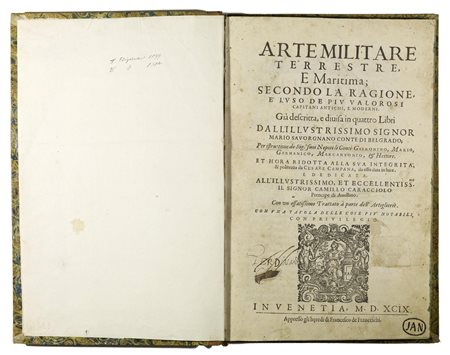
Lotto 12 Mario Savorgnano (1513 - 1574)
Arte Militare terrestre e Maritima secondo la ragione e l'uso de piω valorosi Capitani Antichi e Moderni (..) In Venetia Appresso gli heredi di Francesco de Franceschi. 1599
In folio (mm 306x198). Pag. (20), 266. 2 tabelle e 23 tavole xilografiche a doppia pagina. Legatura in mezza pelle del XIX°, tagli colorati. Antico restauro sulla parte bianca del frontespizio e piccolo restauro nell'ultima carta con perdita di qualche lettera, ma nel complesso un bell'esemplare.
Cfr. Adams S 526; Cockle 587; D'Ayala p.58
In folio (306x198 mm). (20), 266 pp. 2 plates and 23 double page woodcut plates. Half leather binding of the 19th century. Ancient restoration on the white part of the title page and small restoration on the last paper with loss of a few letters, but overall a good copy.
Cfr. Adams S 526; Cockle 587; D'Ayala p.58