
ASTA 107 - Glittica
-
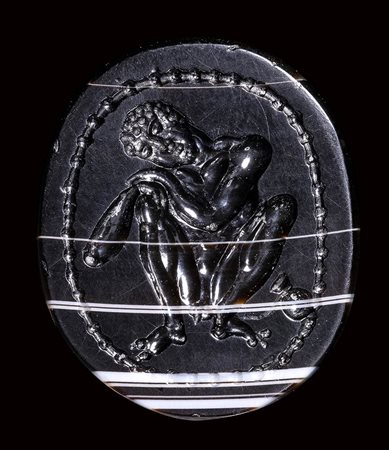
Lotto 13 A fine greek banded agate intaglio. Sleeping slave.
Second half of the 5th century B.C.
Negro boy, sleeping, shown in front view, his head inclined to the left, both hands clasped on his right knee. He is nude, and has short curly hair. The legs are foreshortened; the right foot is in three quarter, the left one in profile. A small unguentarium is tied to his left foot, probably so as not to lose it or forget it when he wakes up, making this scene almost intimate. Dotted border. Use of globular elements. Extraordinary and rare depiction executed with fine style on a beautiful banded agate. Mirror polishing. Wear marks. As Richter described in the Metropolitan Museum catalogue a very similar gem, “A masterly rendering of a difficult pose. To appreciate the advance in naturalistic representation since archaic times, one must compare this design with that on the ring in the Cabinet des Médailles, my n. 85”.
Parallels: J. Boardman, GGFR, n. 442 for the pose. For the subject in the same position: AGDS, Berlin, n. 92 and 160 (very close); J. Boardman, Engraved Gems from the Ionide Collection, n. 5 ("a squatting negro boy, with oil bottle and strigil, on a ground line and in a hatched border; Lippold pl. 66.8. G. M.A. Richter, Engraved gems of the greeks and etruscans. A history of greek art in miniature, n. 204. L.P.B. Stefanelli, La collezione Paoletti, n°61, T. IV, cassetto 1, p. 291.
15x18x2 mm
Provenance: UK private collection 80's, London. -
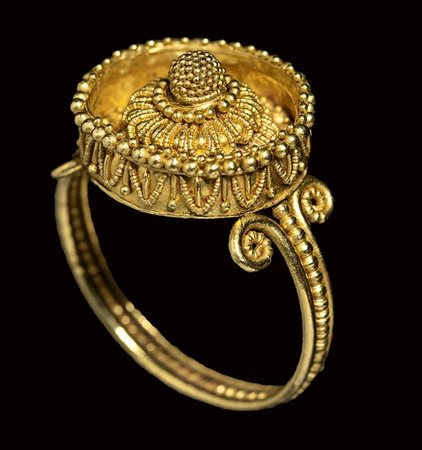
Lotto 14 An extraordinary greek gold filigree ring.
4th century B.C.
The rounded hoop is made from a beaded wire soldered between two plain wires: the ends of the latter are bent round into decorative spiral at the shoulders. The box-setting in flower shape is decorated on the edge with an oves frieze in filigree. In the center, is a spherical flower head made of granules, the petals with beaded wires.
This typology is referring to the graeco-scythian productions discovered in the funerary tumuli of Kurgane in Ukrania and Crimea.
Parallels: Williams-ogden.J., greek gold, jewellery of the Classical world, p.233; Platz-Horster, G., antiken goldschmuck, Altes Museum, Berlin, 2001
int diam 19 mm; bezel 8x20 mm; 5,42 gr.
Provenance:
Former collection of General Alexandre Berthier Delagarde, formed before 1914 and spreaded between 1920-1925 (a part of his archaeological collection sold at the British Museum in 1923). Former collection of Colonel Ribatchenkoff, before 1950’s. Former private collection of Colonel R., 1950’s acquired from Colonel Ribatchenkoff. Private french collection. -
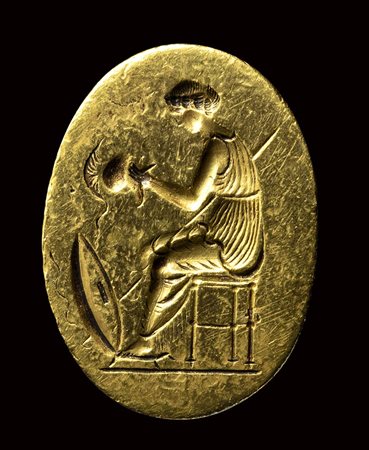
Lotto 15 A fine classical greek engraved gold ring. Seated Athena with weapons.
Late 5th - early 4th century B.C.
The hoop is rounded without, flatten within, ending on a flat large oval bezel. The bezel is engraved with a seated Athena. The goddess is seated on a stool, depicted in perspective. The figure is tunicated, with uncovered arms. The head is slightly tilted forward, in contemplation of the corinthian helmet that she holds in her left hand. With the right hand she holds the spear, which can be seen behind in the background, diagonally. Her feet rest on a small raised pedestal. In front, a shield seen in three-quarters from behind. Next to it, a small snake. Groundline. Work performed with great refinement, with very fine engraved lines. The pose is elegant and well balanced in the oval. The scene is an emblem of virtue and wisdom. Solid gold. Wear marks on the surface, especially on the backside of the bezel. Otherwise, fine condition. Very large size. Rare.
Parallels for the style and typology: J. Boardman, Greek Gems and Finger Rings, n. 688, 690, 687, 713, 759, 763, 768, 778.
19 x 26 mm; ring size 16 x 21,5 mm; 19,30 gr.
Provenance: english private collection B.C., London, acquired on the London art market in 1975.
-
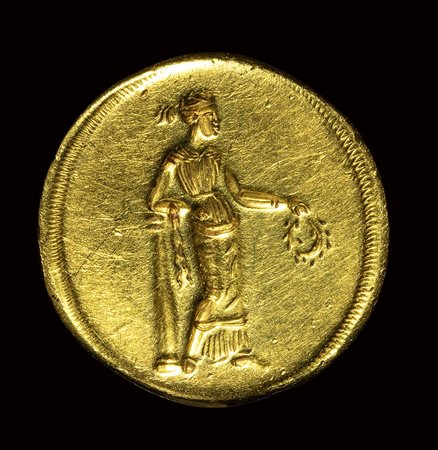
Lotto 16 A greek hellenistic gold engraved ring. Allegorical female figure with a laurel wreath.
4th century B.C.
Kindred type. Plain hoop, rounded without and flatten within expending with broader shoulders into a thin circular bezel with engraved design; allegorical female figure standing right and wearing a folded chiton wrapped under the hips with a vaporous coat held by her right forearm. She is leaning on a column and holding in her left hand a laurel wreath. The edge of the bezel is marked like a coinage mint. Very good state of conservation.
Parallels: for a similar typology and iconography see Marshall, F.H., 1968, pl. III, 85-86
J. Boardman, Greek Gems and Finger Rings, p. 301 n. 778; J. Boardman and D. Scarisbrick, The Ralph harari Collection of Finger Rings, plate 15, p. 18.
Diam. 20mm; ring size 14 x 19 mm; 6,70 gr.
Provenance: english private collection; previously from the Forbes family of Pitsligo, tastemakers rooted in 18th century, Edinburgh.
-
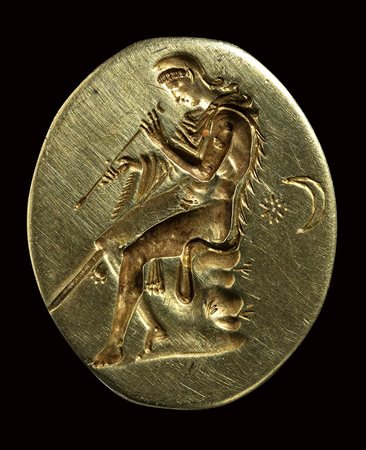
Lotto 17 A fine electrum greek ring. Paris seated with an harrow.
Late 4th century B.C.
The young character is facing left, sitting on a rock on which small plants grow. The figure is naked and partially covered only by a leontea; on the head the Phrygian hat. The head is facing slightly downwards, examining a long arrow that he holds, observing it carefully. Near the right leg a long object can be seen, probably a spear. Behind his back, on the field, a star and crescent moon. These attributes identify the ring as an Asia Minor production. A similar scene is featured on another gold ring, in which a seated Persian controls an arrow (J. Boardman, Greek Gems and Finger Rings, p. 297 n. 681). The very typical pose will recur on some later greek coins (for example, Seleucid Kingdom, Antiochos II Theos, 261-246 BC, AR tetradrachm reverse: Apollo seated left on omphalos, examining arrow & resting hand on grounded bow). The identification of the character, who can be considered Paris, is not entirely certain. According to the myth, Paris killed Achilles with an arrow, under the leadership of Apollo during the Trojan War. The Leontea would be an addition to his military virtus and his triumph, as in a syncretic consecration. The oriental connotation is however predominant, both for the style and for the presence of crescent and star (Asia Minor). Slight signs of wear. Small deformation on the hoop of the ring, not perfectly straight when viewed in profile. Pleasant patina and deposits, with intact surface. On the back, there are some micro craters, probably due to the metal fusion of the ring before being engraved. Extremely rare.
19 x 22 mm; ring size 16 x 19 mm circa; 9,72 gr.
Provenance: english private collection B.C., London, acquired on the London art market in 1975.
-
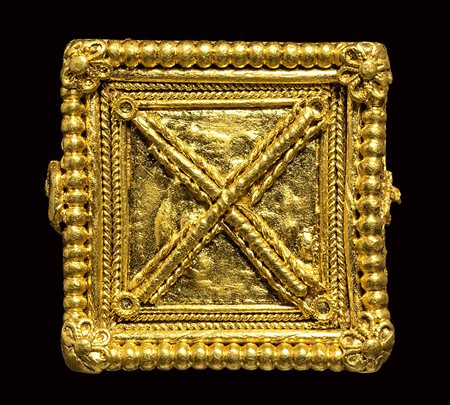
Lotto 18 A greek gold ornamental plaque.
4th century B.C.
Probably part of a jewelry judging by the structure of the element; composed of two gold plaques saldered together. Traces of hinge on each side. The principal gold plaque decorated on the edge with beaded wire adorned on each angle with a flower made of gold wires and a plated spherical bead. Inside, a serie of frames and braided wires. In the center, a cross pattern made of twisted filigree. Fragmentary.
19 x 20 x 0,3 mm; 7,68 gr. -
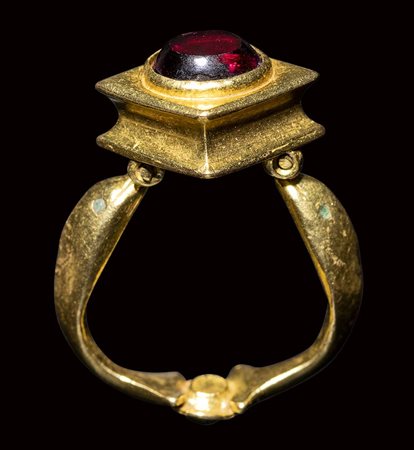
Lotto 19 A fine architectural late hellenistic gold ring.
100 - 50 B.C.
In two parts hinged together. Below, a hoop in dolphins-shaped; furnished with an oval setting underneath, in which is inserted a small circular convex emerald; the hoop’s shoulders set with small green glass beads. The upper part consists of an hexagon box-setting with a large faceted-garnet. The hoop is attached with the box-setting by two suspension holes. Nearly twenty other similar rings are known. Although the rings display variations in shape and details, all the examples are very close in style and technique. The quality of both the gold work and the stones themselves is very high. Garnet is the most popular stone of the Hellenistic period, but rings of this group are also set with amethyst, emeralds, and citrines.
Parallel: Marshall, F.H., Catalogue of the singer rings, British Museum, 1968, Pl.XXI, 843-844
Spier, J. - Ogden, J., rings of the ancient world, 2015, n°28, p.77, 78.
int diam 20x22 mm; high 34 mm; bezel 9x15x18 mm; 15,31 gr.
Provenance: private collection acquired in the english market. -
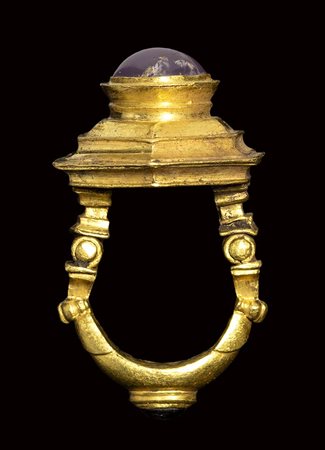
Lotto 20 A late hellenistic architectural gold ring with stepped bezel set with amethyst and garnet.
2nd century B.C.
The complex construction is composed of an hollowed bezel with a series of sharply molded hexagonal steps set with a large cabochon amethyst. The hoop is solid and boat-shaped, terminating in architectural form (top of a column and capital). A small oval cabochon garnet is set in the center of the hoop at the bottom. The hoop attaches to the bezel by means of hinged elements held by pegs. Nearly twenty other similar rings are known. Although the rings display variations in shape and details, all the examples are very close in style and technique. The quality of both the gold work and the stones themselves is very high. Garnet is the most popular stone of the hellenistic period, but rings of this group are also set with amethyst, emeralds, and citrines.
Parallel: Marshall, F.H., Catalogue of the singer rings, British Museum, 1968, Pl.XXI, 843-844
Spier, J. - Ogden, J., rings of the ancient world, 2015, n°28, p.77, 78.
Stone diam. 11 mm (amethyst) and 4x6 mm (garnet); ring size 15 x 21 mm; H. 43 mm; 22,21 gr.
Provenance: english private collection B.C., London, acquired on the London art market in 1975. -
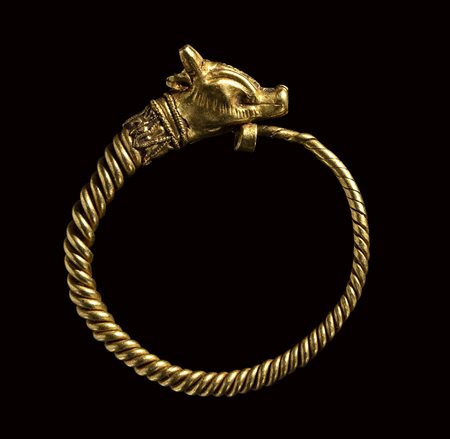
Lotto 21 An hellenistic gold earring with animal protome.
3rd century B.C.
The hoop made with a large intertwined gold wire, extending on a ram protome. The neck decorated with filigree.
Under the chin, suspension hoop (for clasp). Terminal of the horns missing (?).
Parallels: Marshall, F.H., Catalogue of the jewellery, Greek, Etruscan, and Roman, in the department of antiquities, British Museum, 1911, n°1803-1808.
Int diam 20 mm; high 26 mm; 2,51 grs
-
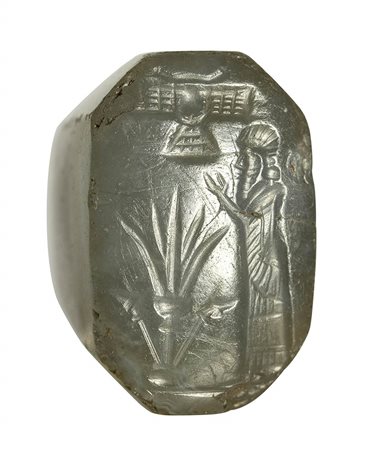
Lotto 22 An assyro-babylonian bluish-grey chalcedony stamp seal. Ritual scene,
8th - 7th century B.C.
In octogonal pyramide shape. The main surface depicts a standing figure before a lotus flower. The figure, bearded and wearing a diadem, raises his hands in a gesture of prayer and invocation (?). Above, a winged disc. Wear marks.
14 x 22 x 28 mm
Provenance: english art market. -
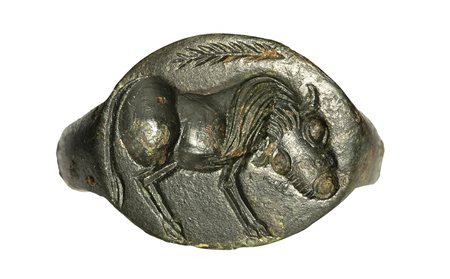
Lotto 23 An eastern greek bronze engraved ring. Bull.
5th century B.C.
Plain hoop, rounded without and flatten within, extending in broader shoulders rising into flat oval bezel with engraved design; a bull facing right. His body characterized by stylized features and globular eyes and snout. On top, a palm branch. Dark green patina and presence of deposit on the surface of the ring. Probably Cypriot.
Parallel: for a similar typology see Marshall, Finger Rings, 1968, pl. XXX, 1247.
15 x 20 mm; ring size 17 x 19 mm; 6,04 gr.
Provenance: english art market. -
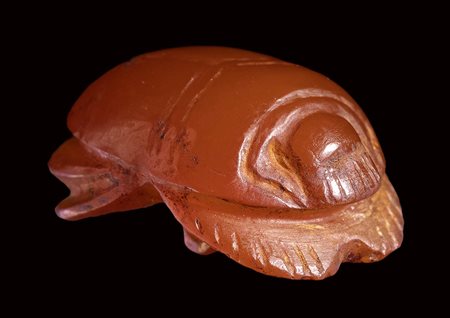
Lotto 24 An egyptian late period carnelian scarab amulet.
664 - 332 B.C.
Well detailed. The underside naturalistically modelled and long tubular hoop. Wear marks.
13x17x9 mm
Provenance: english art market.