 Il Ponte Casa d'Aste - Palazzo Crivelli - Via Pontaccio 12, 20121 Milano
Pre-Asta ASTA 801: ARREDI E DIPINTI ANTICHI I tornata : dal lotto 377 al lotto 489
mercoledì 28 ottobre 2026 ore 15:00 (UTC +01:00)
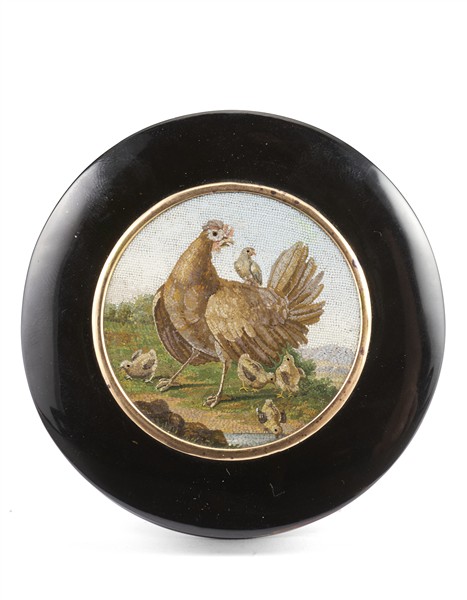
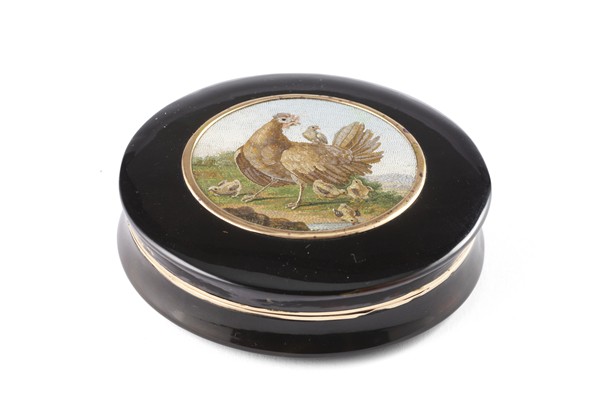
Antonio Aguatti (1790-1846) (attr.) Micromosaico circolare raffigurante una gal
Antonio Aguatti (1790-1846) (attr.) Micromosaico circolare raffigurante una gallina con pulcini montato su una scatola in tartaruga incernierata e rivestita internamente in oro. Roma, inizio secolo XIX (micromosaico d. cm 5; scatola d. cm 8, h. cm 2) (lievi difetti)
Accompagnato da certificato di autenticità rilasciato da CESAR - Centro Studi Archeometrici. Rif. CERT 2023 - 122 - 16/01/2023
Per confronto con un micromosaico simile attribuito all'Aguatti si veda Lotto 37 - Asta 14226 di Christie's, Londra, 6 giugno 2017 - Le finissime tessere utilizzate in questo esempio suggeriscono che l'artista possa essere Antonio Aguatti, considerato uno dei più illustri artisti di micromosaico della sua epoca. Al suo studio, situato al numero 96 di Piazza di Spagna, si attribuisce anche l'invenzione della tecnica di fusione di diversi colori di micromosaico, che conferiva all'opera una qualità più pittorica. Nel 1810 le sue opere furono esposte alla Mostra Capitolina delle 'Opere d'arte e industria romane', tenutasi al Campidoglio, e dal 1832 fino alla sua morte nel 1846 fu professore di mosaico presso i laboratori vaticani dove, tra gli altri, formò il celebre mosaicista Michelangelo Barberi (1783-1857).
-EN
Antonio Aguatti (1790–1846) (attributed) Circular micromosaic depicting a hen with chicks, mounted on a hinged tortoiseshell box lined with gold on the inside. Rome, early 19th century (micromosaic: diameter 5 cm; box: diameter 8 cm, height 2 cm) (minor flaws)
For a comparison with a similar micromosaic attributed to Aguatti, see Lot 37 – Christie’s Auction 14226, London, 6 June 2017 – The extremely fine tesserae used in this example suggest that the artist may be Antonio Aguatti, considered one of the most distinguished micromosaic artists of his time. His studio, located at number 96 Piazza di Spagna, is also credited with inventing the technique of fusing different colours of micromosaic, which gave the work a more painterly quality. In 1810, his works were exhibited at the Capitoline Exhibition of ‘Roman Works of Art and Industry’, held at the Capitoline Hill, and from 1832 until his death in 1846 he was professor of mosaic at the Vatican workshops, where, amongst others, he trained the famous mosaicist Michelangelo Barberi (1783–1857)