 Il Ponte Casa d'Aste - Palazzo Crivelli - Via Pontaccio 12, 20121 Milano
Pre-Asta ASTA 801: ARREDI E DIPINTI ANTICHI I tornata : dal lotto 377 al lotto 489
mercoledì 28 ottobre 2026 ore 15:00 (UTC +01:00)
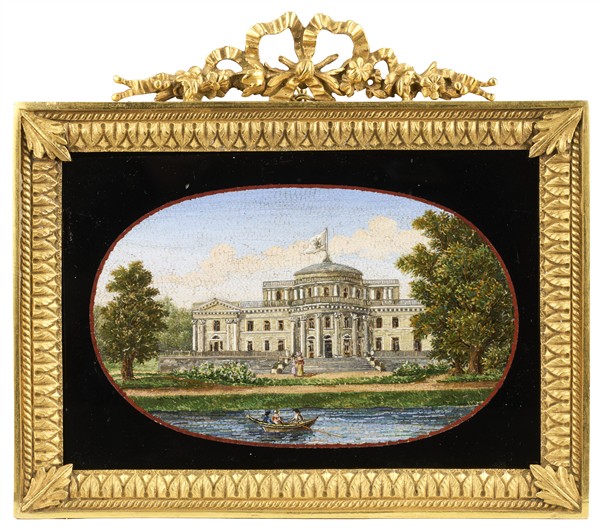
Georg Ferdinand Wekler (Riga, 1800 - San Pietroburgo, 1861) Veduta del palazzo
Georg Ferdinand Wekler (Riga, 1800 - San Pietroburgo, 1861)
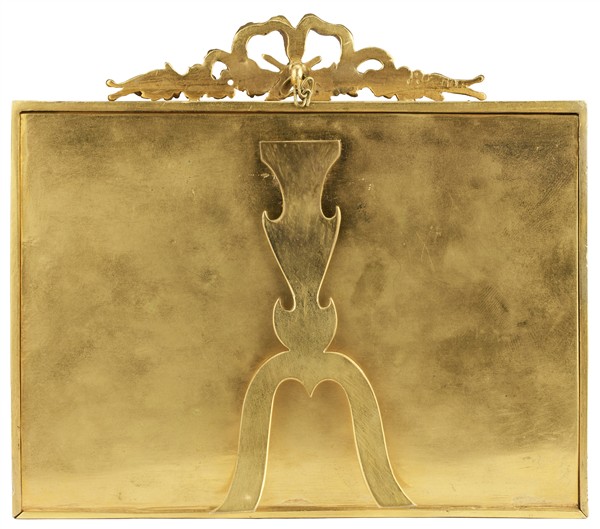
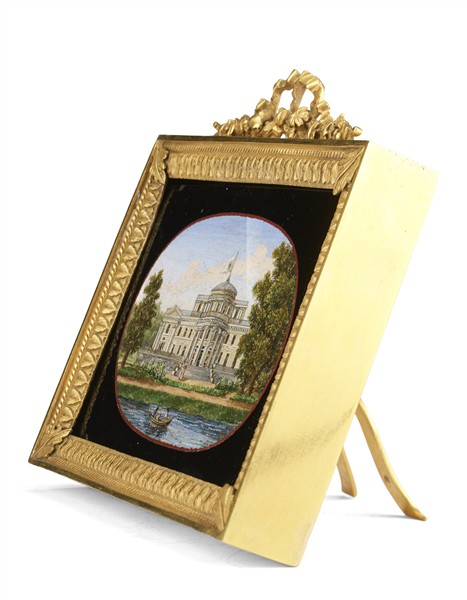
Veduta del palazzo di Elagin, micromosaico su pasta vitrea nera. San Pietroburgo, 1825 circa. Montato in cornice in bronzo dorato con profilo a palmette e cimasa traforata a nastro (cm 8x13; cm tot 15x13) (difetti)
Bibliografia:
F. Leone (a cura di), Pittura in Mosaico, Rome, Alessandra Di Castro, 2023, cat. 26, pag. 92
Il nostro micromosaico raffigura la residenza imperiale di Elagin, sul delta della Neva nei pressi di San Pietroburgo, costruita nel 1822 dall'architetto italiano naturalizzato russo Carlo Rossi e utilizzata come palazzo d'estate durante il regno di Alessandro I. Di questo stesso soggetto esistono all'Ermitage due versioni attribuite a Wekler (figg. I, III), basate su una litografia di Karl Beggrow (1799-1875) rispetto alla quale presentano alcune differenze. In confronto alle altre due versioni note, realizzate a partire dal 1822 su commissione diretta dello zar, quella che si presenta qui reca una significativa variante: lo stendardo con l'aquila bicipite in campo bianco, segno distintivo della presenza del sovrano.
Formatosi artisticamente a San Pietroburgo, Wekler fu allievo di Domenico Moglia (1780-1851), che si trovava in Russia dal 1812. Con questi si trasferì a Mosca e compì il primo viaggio a Roma, ma è tra il 1834 e il 1837 che si colloca la sua esperienza formativa forse più significativa: il secondo viaggio a Roma che gli valse il contatto con lo Studio del Mosaico Vaticano e con Michelangelo Barberi (1787-1867), già ben conosciuto in Russia dove si era recato a più riprese. In questa occasione Wekler eseguì una copia musiva dalla Trasfigurazione di Raffaello, mosaico oggi rintracciato che gli valse la consegna di una medaglia da parte del papa e che fu poi acquistato dallo zar. Nel 1838, al ritorno in patria, fu insignito della carica di Mosaicista di Sua Maestà Imperiale con un salario di 3.000 rubli annui, posizione che gli permise di lavorare per la corte e per commissioni private e allo stesso tempo di contribuire all'istituzione del dipartimento dei mosaici presso l'Accademia Imperiale, creato nel 1845 per il completamento della decorazione della cattedrale di Sant'Isacco sull'esempio romano della basilica di San Pietro.
Il lavoro di Wekler può essere considerato l'anello di congiunzione tra l'istituzione accademica che vide la nascita nel 1845 presso Sant'Isacco e l'opera di Mikhail Vasilyevic Lomonosov (1711-1765). Il celebre scienziato, linguista e artista è infatti considerato una sorta di Leonardo da Vinci russo per l'apporto che diede all'avanzamento della cultura nel suo paese, e fu anche iniziatore della produzione di mosaici nella Russia moderna, avendo impiantato dal 1763 una fabbrica che fu la prima di questo genere fuori dall'Italia.
Per confronto si veda:
J. Hanisee Gabriel, et al. Micromosaics. London: Philip Wilson in association with The Gilbert Collection, 2000, pag. 42R.
Grieco, Micromosaici Romani, Roma: Gangemi, 2008, pag. 314
D. Lazarevskaya, Micromosaics by George Ferdinand Wekler from the collection of the State Hermitage Museum, "Reviews on Glass - ICOM Glass'', 8, 2020, pagg. 13-21 (con bibliografia precedente)
-EN
View of the Yelagin Palace, micromosaic on black glass paste. Saint Petersburg, circa 1822–1825. Mounted in a gilded bronze frame with a palmette profile and an openwork ribbon finial (8x13 cm; overall dimensions 15x13 cm) (defects).
Literature
F. Leone (ed.), Pittura in Mosaico, Rome, Alessandra Di Castro, 2023, cat. 26, p. 92.
Our micromosaic depicts the imperial residence of Yelagin on the Neva delta near Saint Petersburg, built in 1822 by the Italian-born Russian architect Carlo Rossi and used as a summer palace during the reign of Alexander I. Two versions of this same subject attributed to Wekler are housed in the Hermitage (figs. I, III), based on a lithograph by Karl Beggrow (1799–1875), with respect to which they present some variations. Compared to the other two known versions, executed from 1822 onwards by direct commission of the Tsar, the present lot features a significant variant: the standard bearing the double-headed eagle on a white field, a distinctive mark indicating the presence of the Sovereign.
Artistically trained in Saint Petersburg, Wekler was a pupil of Domenico Moglia (1780–1851), who had been in Russia since 1812. He moved to Moscow with Moglia and made his first journey to Rome, but his most significant formative experience occurred between 1834 and 1837 during his second trip to Rome. This trip brought him into contact with the Vatican Mosaic Studio and with Michelangelo Barberi (1787–1867), who was already well known in Russia due to several visits. On this occasion, Wekler executed a mosaic copy of Raphael’s Transfiguration, a now-rediscovered mosaic that earned him a medal from the Pope and was later purchased by the Tsar. Upon his return to Russia in 1838, he was awarded the title of Mosaicist to His Imperial Majesty with a salary of 3,000 rubles per year, a position that enabled him to work for both the court and private commissions, while simultaneously contributing to the establishment of the mosaic department at the Imperial Academy. Created in 1845, this department was tasked with completing the decoration of Saint Isaac’s Cathedral, modeled after Saint Peter’s Basilica in Rome.
Wekler's oeuvre can be considered the connecting link between the academic institution established in 1845 at Saint Isaac’s and the work of Mikhail Vasilyevich Lomonosov (1711–1765). The celebrated scientist, linguist, and artist is considered a sort of Russian Leonardo da Vinci for his contribution to the advancement of culture in his country, and was also the pioneer of modern Russian mosaic production, having founded a factory in 1763 that was the first of its kind outside Italy.
Comparative Literature
J. Hanisee Gabriel, et al. Micromosaics. London: Philip Wilson in association with The Gilbert Collection, 2000, p. 42
R. Grieco, Micromosaici Romani, Rome: Gangemi, 2008, p. 314
D. Lazarevskaya, 'Micromosaics by George Ferdinand Wekler from the collection of the State Hermitage Museum', Reviews on Glass - ICOM Glass, 8, 2020, pp. 13–21 (with previous bibliography)