
Medieval Notary Manuscripts & Law Books
-
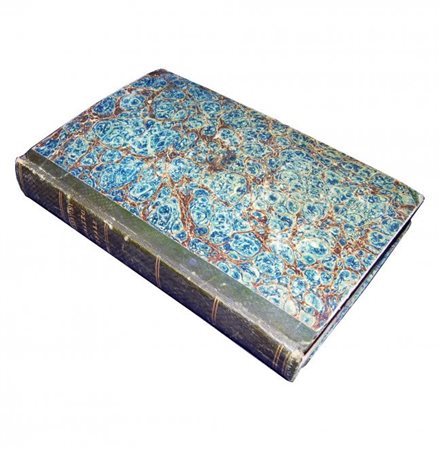
Lotto 145 AN ESSAY ON CRIMINAL LAW IN THE PROVINCES OF THE LOMBARD-VENETIAN KINGDOM
Albertini, Antonio Costantino. Del diritto penale vigente nelle provincie lombardo venete. Libri tre del consigliere Antonio Albertini. Venezia: a spese degli editori Milesi-Antonelli co' torchi della tipografia di Alvisopoli, 1824.
8vo (228x142 mm), half leather binding; pp. 479, [1].
The Kingdom of Lombardy-Venetia (1815-1866) (Italian: Regno Lombardo-Veneto, German: Königreich Lombardo–Venetien), commonly called the Lombardo-Venetian Kingdom, was a constituent land (crown land) of the Austrian Empire. It was created in 1815 by resolution of the Congress of Vienna in recognition of the Austrian House of Habsburg-Lorraine's rights to Lombardy and the former Republic of Venice after the Napoleonic Kingdom of Italy, proclaimed in 1805, had collapsed.
Administratively the Kingdom of Lombardy-Venetia comprised two independent governments (Gubernien) in its two parts (Lombardy and Venetia), which officially were declared separate crown lands in 1851. Lombardy was annexed to Sardinia in 1859 and the kingdom ceased to exist when the rest of its territory was annexed to the Kingdom of Italy in 1866.
The Kingdom of Lombardy–Venetia was first ruled by Emperor Francis I from 1815 to his death in 1835. His son Ferdinand I ruled from 1835 to 1848. In Milan on 6 September 1838 he became the last king to be crowned with the Iron Crown of Lombardy. The crown was subsequently brought to Vienna after the loss of Lombardy in 1859, but was restored to Italy after the loss of Venetia in 1866.
Provenance: Private library of a Verona noble family, whose roots are in Mantua and in which there were distinguished lawyers and jurists.
References: IT\ICCU\MILE\011780 (9 copies). OCLC, 860603111, 883746469 and 756365503 (one copy in Germany). -
![[1.]: IMPERIAL DECREE ON STAMP DUTY OF PLAYING CARDS, CALENDARS, NOTICES AND...](/Upl/Auctions/Cache/828/1657/178257/146-0.jpg/s1_450.jpg)
Lotto 146 [1.]: IMPERIAL DECREE ON STAMP DUTY OF PLAYING CARDS, CALENDARS, NOTICES AND GAZETTES
[2. - 3.]: COLLECTION OF SUPERIOR DECLARATORIES OF THE LAW DATED 1840 ON STAMP DUTY AND ON TAXES
NO COPY OF THESE WORKS OUT OF ITALY
[1.]: Ghisotti, Giuseppe. Sovrana patente 27 gennajo 1840 sul bollo delle carte da giuoco, dei calendarj, degli avvisi e delle gazzette colle relative rischiarazioni: appendice alla Raccolta compendiata delle superiori disposizioni a schiarimento della legge 27 gennajo 1840 sul bollo e sulle tasse compilata da Giuseppe Ghisotti [...]. Brescia: tipografia della Minerva, 1846.
[together with:]
[2.]: Ghisotti, Giuseppe. Raccolta compendiata delle superiori declaratorie conosciutesi a tutto ottobre 1846 state emanate in seguito ed a schiarimento della legge 27 gennaio 1840 sul bollo e sulle tasse [...] compilata da Giuseppe Ghisotti [...]. Brescia: tipografia della Minerva, 1846.
[together with:]
[3.]: Ghisotti, Giuseppe. Raccolta delle declaratorie intorno alla legge sul bollo di Giuseppe Ghisotti [...]. Continuazione a tutto l'anno 1847. Brescia: Speranza, 1848.
[1.]: 8vo (240x164 mm), editorial paper binding; pp. 23. Title at front board: Sul bollo delle carte da giuoco, dei calendarj, degli avvisi e delle gazzette.
[2.]: 8vo (240x170 mm), editorial paper binding; pp. XLVI, [2], 296.
[3.]: 8vo (246x164 mm), editorial paper binding; pp. 297-328.
The Kingdom of Lombardy-Venetia (1815-1866) (Italian: Regno Lombardo-Veneto, German: Königreich Lombardo–Venetien), commonly called the Lombardo-Venetian Kingdom, was a constituent land (crown land) of the Austrian Empire. It was created in 1815 by resolution of the Congress of Vienna in recognition of the Austrian House of Habsburg-Lorraine's rights to Lombardy and the former Republic of Venice after the Napoleonic Kingdom of Italy, proclaimed in 1805, had collapsed.
Administratively the Kingdom of Lombardy-Venetia comprised two independent governments (Gubernien) in its two parts (Lombardy and Venetia), which officially were declared separate crown lands in 1851. Lombardy was annexed to Sardinia in 1859 and the kingdom ceased to exist when the rest of its territory was annexed to the Kingdom of Italy in 1866.
The Kingdom of Lombardy–Venetia was first ruled by Emperor Francis I from 1815 to his death in 1835. His son Ferdinand I ruled from 1835 to 1848. In Milan on 6 September 1838 he became the last king to be crowned with the Iron Crown of Lombardy. The crown was subsequently brought to Vienna after the loss of Lombardy in 1859, but was restored to Italy after the loss of Venetia in 1866.
Provenance: Private library of a Verona noble family, whose roots are in Mantua and in which there were distinguished lawyers and jurists. -
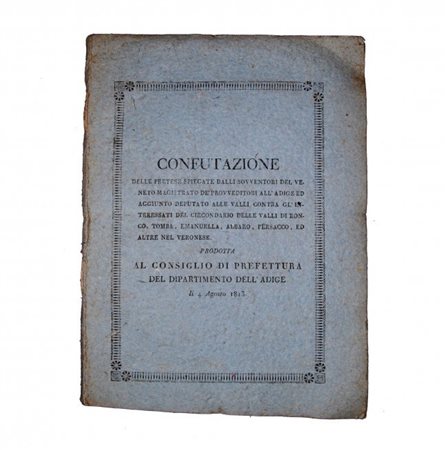
Lotto 147 RARE EDITION OF LEGAL CLAIMS REGARDING THE TERRITORY OF ADIGE VALLEY
NO COPY OUT OF ITALY
Confutazione delle pretese spiegate dalli sovventori del Veneto Magistrato de' Provveditori all'Adige ed aggiunto deputato alle valli contra gl'interessati del circondario delle valli di Ronco, Tomba, Emanuella, Albaro, Persacco, ed altre nel Veronese. Prodotta al Consiglio di Prefettura del Dipartimento dell'Adige. Lì 4 Agosto 1813. Verona: Dalla Tipografia Mainardi sul Corso, n.y. [1813].
4to (280x106 mm), contemporary paperboard binding, title of the work written in black types in a frame at front board; pp. 102. No title-page.
The work starts with the following text: Replica dei possessori del circondario delle valli di Ronco, Tomba, Emanuella, Albaro, Persacco, ed altre in risposta alle domande delli signori [...].
RARE EDITION OF LEGAL CLAIMS REGARDING THE TERRITORY OF ADIGE VALLEY, ESPECIALLY RONCO, TOMBA, ALBARO AND PERSACCO.
Provenance: Private library of a Verona noble family, whose roots are in Mantua and in which there were distinguished lawyers and jurists.
References: IT\ICCU\LO1E\022199 (only one copy at the Biblioteca comunale centrale, Milano). OCLC, 4950465236 (one electronic copy at the Museo Galileo, Firenze). -

Lotto 148 RARE TEXTBOOK ON ROMAN LAW IN ORIGINAL GERMAN LANGUAGE
Mackeldey, Ferdinand. Lehrbuch des heutigen Romischen Rechts von Dr. Ferdinand Mackeldey, [...] von Dr. Konrad Franz Rokhirt, [...]. Erster- [Zweiter-] Band. Giessen: Druck und Verlag von Georg Friedrich Heyer, 1838.
8vo (226x136 mm), editorial paper binding; pp. IV, 292; XIV, 740.
The Austrian Empire (or simply: Austria) (in Austrian - German: Kaiserthum Oesterreich) was created out of the realms of the Habsburgs by proclamation in 1804. It was a multinational empire and one of the world's great powers. Proclaimed in response to the First French Empire, it overlapped with the Holy Roman Empire until the latter's dissolution in 1806. It included in its territory the Kingdom of Lombardy–Venetia. The Austro-Hungarian Compromise of 1867 elevated Hungary's status within the Austrian Empire, creating a new dual monarchy of Austria-Hungary.
Ferdinand Mackeldey (1784-1834), Professor of Law at the University of Bonn, became famous for this textbook, which was first published in 1814, the most popular text on Roman Law in the first half of the 19th century. Its clarity and vividness ensured for a Europe-wide distribution, almost in all languages.
Provenance: Private library of a Verona noble family, whose roots are in Mantua and in which there were distinguished lawyers and jurists.
References: IT\ICCU\UBO\3323319 (only one copy at the Biblioteca d'arte e di storia di San Giorgio in Poggiale - Bologna). OCLC, 65107830 (2 copies in USA and 1 copy in the Netherlands). -
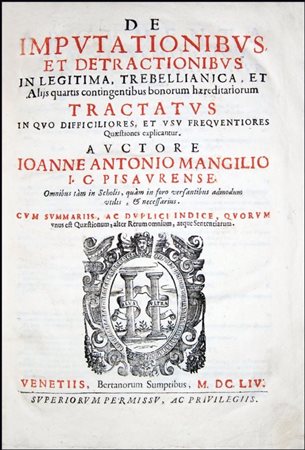
Lotto 149 IMPORTANT AND PONDEROUS ESSAY ON THE LEGITIMATE INHERITANCE
Mangili, Giovanni Antonio. De imputationibus, et detractionibus in legitima, Trebellianica, et alijs quartis contingentibus bonorum haereditariorum tractatus [...] Auctore Ioanne Antonio Mangilio I.C. Pisaurense [...] Cum summariis, ac duplici indice, quorum vnus est quaestionum, alter rerum omnium, atque sententiarum. Venetiis: Bertanorum sumptibus, 1654.
Folio (340x240 mm), contemporary paperboard binding, handwritten title at spine; pp. [80], 572. Title-page in red and black types, with the printer's device (in a figured frame two columns joined by a ribbon with the motto: Plus ultra). Xylographic initials and head-pieces. Text in two columns.
Giovanni Antonio Mangili (fl. 17th century) was an Italian jurist.
Provenance: Private library of a Verona noble family, whose roots are in Mantua and in which there were distinguished lawyers and jurists.
Handwritten ownership inscriptions and annotations at first free-leaf (Joseph Thomasini, 19: 7bris [19 September] 1677).
References: IT\ICCU\RMGE\000108. OCLC, 800551250 (1 copy in France), 314559356 (1 copy in Germany) and 902597895 (1 copy in the Netherlands). -
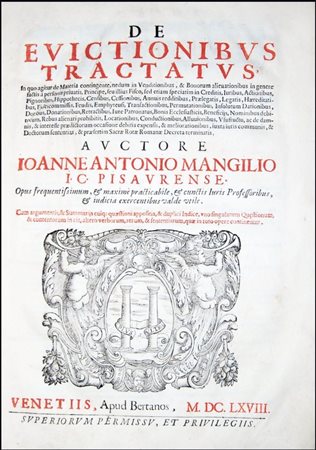
Lotto 150 UNCOMMON EXTENSIVE ESSAY ON EVICTION IN PRIVATE NEGOTIATIONS BY MANGILI
NO COPY OUT OF ITALY
Mangili, Giovanni Antonio. De euictionibus tractatus, in quo agitur de materia contingente, nedum in Venditionibus, & bonorum alienationibus in genere factis a personis priuatis, principe, seu illius fisco, sed etiam speciatim in creditis, iuribus, actionibus, pignoribus, hippothecis, censibus, cessionibus, annuis redditibus, praelegatis, legatis, haereditatibus, fideicommissis, feudis, emphyteusi, transactionibus, permutationibus, insolutum dationibus, dotibus, donationibus, retractibus, iure patronatus, bonis ecclesiasticis, beneficijs, nominibus debitorum, rebus alienari prohibitis, locationibus, conductionibus, alluuionibus, vsufructu, ac de damnis, & interesse praedictorum occasione debitis expensis, & meliorationibus, iuxta iuriscommunis, & doctorum sententias, & praesertim Sacrae Rotae Romanae Decreta terminatis. Auctore Ioanne Antonio Mangilio I.C. Pisaurense. Opus frequentissimum, et maxime practicabile, et cunctis iuris professoribus, et iudicia exercentibus valde vtile. cum argumentis, & summarijs cuique quaestioni appositis, & duplici indice [...]. Venetiis: apud Bertanos, 1668.
Folio (344x232 mm), contemporary paperboard binding; pp. [12], 436, [108]. Title-page in red and black types, with the printer's device (in a figured frame two columns joined by a ribbon with the motto: Plus ultra). Xylographic initials and head-pieces. Text in two columns.
Important and ponderous essay on eviction in private negotiations (in private law, we speak of eviction if a third party submits its title to the thing sold and subtracts it to the one who bought it).
Giovanni Antonio Mangili (o Mangilio; XVI-XVII cent.) was an Italian jurist.
Provenance: Private library of a Verona noble family, whose roots are in Mantua and in which there were distinguished lawyers and jurists.
Handwritten ownership inscriptions and annotations at first free-leaf (Joseph Thomasini, 19: 7bris [19 September] 1677).
References: IT\ICCU\MILE\005386. OCLC, 797707243. Apparently no copy of this edition out of Italy. -
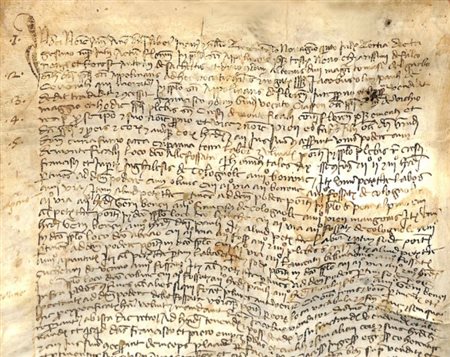
Lotto 151 MEDIEVAL NOTARY MANUSCRIPT ON VELLUM, 30 December 1400.
A long scroll of parchment (126x26 cm), written in brown ink by a 15th century notary handwriting .
4-lines capital I drawn in pen at the beginning of the document. At the lower left, the signum tabellionis of the notary Bindus de Balbiano near his signature.
This ponderous and early document regards the sale of a farm in the area of Colognole (near Florence, in the area of Chianti) from Jacopo de Covonibus to Francesco called Ciappon. Both De Covonibus family was an important Florentine family since Middle Ages; the Ciapponi surname still survives. -
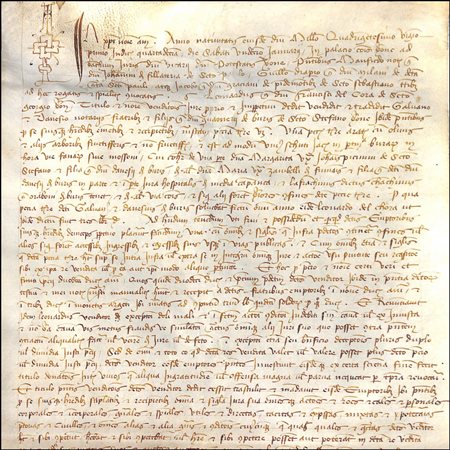
Lotto 152 MEDIEVAL NOTARY MANUSCRIPT ON VELLUM, Verona, 11 January 1421.
A scroll of parchment (54x25 cm), written in sepia ink by a neat 15th century cursive handwriting. Text in Latin.
7-lines capital I drawn in pen at the beginning of the document. At the upper left corner of the page, the signum tabellionis of the notary Bartolomeo Maticiani.
An agreement concerning the sale of a land with olive groves and orchards in the area of Verona.
The seller is Leonardo del Cora, from the contrada (a city quarter) of San Giorgio, and the buyers are the two brothers (both notaries) Galvano and Danesio de Buri from the contrada of Santo Stefano. The land was paid 200 Ducats.
The Buri family was very influential in Verona. The friar Fino de' Buri was prior of the Augustinian monastery of Santa Eufemia in 1262. In 1405 Galvano Buri, ascribed to the Noble Council of Verona, was one of the leaders of the College of Notaries. The descendants of Galvano obtained by the Venetians the title of count, with jurisdiction over the town of Villa Bartolommea, Lazise and San Bonifacio. The family also owned other properties in Verona and in its province. With the permission of the Venetians who ruled the Verona region, the Buri family built the villa near the Adige (still existing) that bears their name (Villa Bernini Buri). -
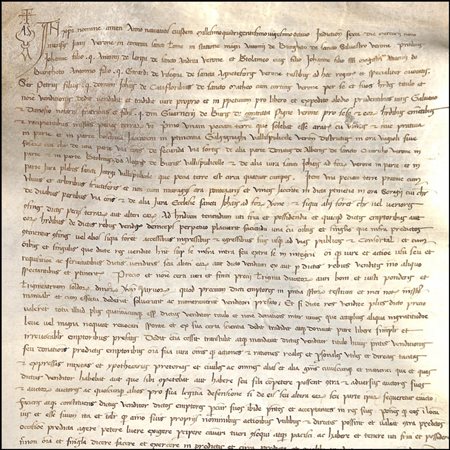
Lotto 153 MEDIEVAL NOTARY MANUSCRIPT ON VELLUM, Verona, 9 June 1428.
A scroll of parchment (63,5x24 cm), written in sepia ink by a very elegant 15th century cursive writing.Text in Latin.
5-lines capital I drawn in pen at the beginning of the document. At the upper left corner of the page, the signum tabellionis of the notary Antonius Santus Bonvicini from Gusolengo Gardesane (now Bussolengo, near Garda Lake).
An agreement concerning the sale of some grassland and wood land in the area of Galgagnago (now Gargagnago) in Valpolicella (the renowned area of Verona wine).
The seller is Pietro de Catafloribus, from the contrada (a city quarter) of San Matteo, and the buyers are the two brothers (both notaries) Galvano and Danesio de Buri (sons of Guarnerio de Buri) from the contrada called Pigna (so they moved from Santo Stefano to this new quarter, see previous lot 152).
The agreed price was 300 Ducats auri boni et iusti ponderis («pure gold and of proper weight») and 33 soldi veronesi.
The Buri family was very influential in Verona. The friar Fino de' Buri was prior of the Augustinian monastery of Santa Eufemia in 1262. In 1405 Galvano Buri, ascribed to the Noble Council of Verona, was one of the leaders of the College of Notaries. The descendants of Galvano obtained by the Venetians the title of count, with jurisdiction over the town of Villa Bartolommea, Lazise and San Bonifacio. The family also owned other properties in Verona and in its province. With the permission of the Venetians who ruled the Verona region, the Buri family built the villa near the Adige (still existing) that bears their name (Villa Bernini Buri). -
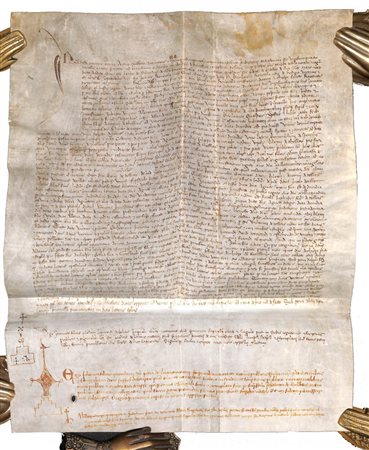
Lotto 154 MEDIEVAL NOTARY MANUSCRIPT ON VELLUM, Ferrara, 24 March 1450.
Single leaf of parchment (426x345 mm), written in sepia ink by a 15th century cursive writing, 61 lines of text in Latin.
14-lines capital I drawn in pen at the beginning of the document. At the bottom of the page, three signa tabellionis near the signatures.
The document is an agreement concerning buildins and a farmed land, including a dovecote.
The text refers to important people of the time such as Giovanni Roverella, relative and lawyer of the bishop of Ravenna Bartolomeo Roverella (1406-1476), Alberto D'Este (presumably the son of Niccolò III d’Este, born in 1415 and dead in 1502), Alberico de Manfredis (member of the important family of the Manfredi of Faenza) and many names of families living in the central regions of Italy.
The act was prepared by the notaries Giovanni de Belitis, Giovanni de Lorano and Anastasio Morello. -
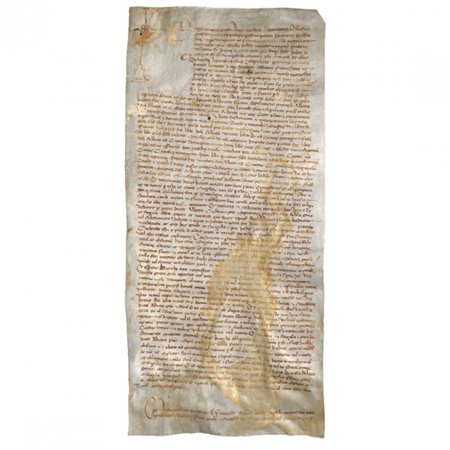
Lotto 155 A MEDIEVAL FRAUD
MEDIEVAL NOTARY MANUSCRIPT. Ferrara, 25 February 1454.
Single leaf of vellum (385x178 mm), 69 lines of text in Latin, written in elegant and small 15th century handwriting. 14-lines signum tabellionis of the notary Andrea de Francesco de Bao and initial at the beginning of the text.
The manuscript contains a warrant enacting some wares' requisition after the charge of fraud of some merchants in Ferrara.
The denounce was made by Guidone Pelacani, Giovanni of Contrada Santa Giulia, Giovanni de Muigero, Amighetti of the Contrada di Santo Romano e Battista called “linaiuolo” («flax manifacturer») son of Evangelista il Sarto, against Alberto di Bartolomeo of Contrada St. Leonardo.
The warrant prescribes to confiscate the goods indicated on the accused’s register until better decided. -
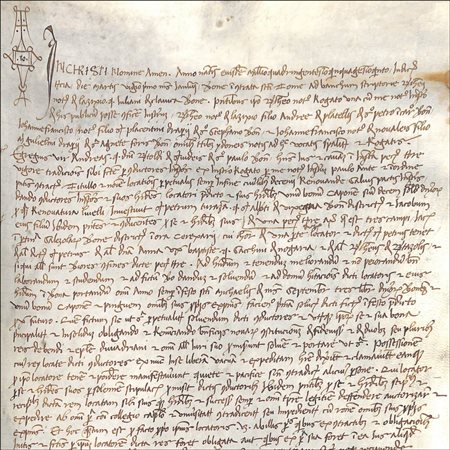
Lotto 156 MEDIEVAL NOTARY MANUSCRIPT ON VELLUM, Verona, 21 January 1455.
A scroll of parchment (56x22 cm), written in sepia ink by a very elegant 15th century cursive writing. Text in Latin.
6-lines capital I drawn in pen at the beginning of the document. At the upper left corner of the page, the signum tabellionis of the notary Giovanni de Magnini.
A lease agreement in which Andrea de Servidei from contrada San Paolo rents to Pietro Turazza and his son Jacopo some lands to farm.
The payment is agreed on the Feast of Saint Michael (19 September), with a part of the harvest and a "good" capon. -
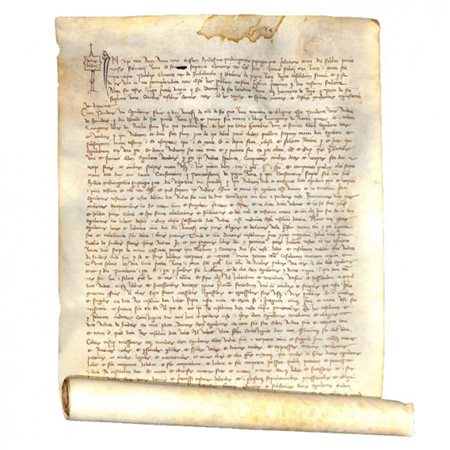
Lotto 157 MEDIEVAL NOTARY MANUSCRIPT ON VELLUM, Verona, 1 February 1455.
A scroll of parchment (80x30 cm), written in sepia ink by a very elegant 15th century cursive writing. Text in Latin.
5-lines capital I drawn in pen at the beginning of the document. At the upper left corner of the page, the signum tabellionis of the notary Giovanni Benedetto de Marano from the quarter called "Pigna".
An agreement concerning a great debt for a quantity of wine and wheat that Ognibene Veronesi from contrada San Quirico in Verona had with Andrea de Servidei from contrada San Paolo. The debt was partly paid with a house in contrada San Quirico and partly with 120 Ducats of gold; a third remaining part was condoned. -

Lotto 158 SWISS MEDIEVAL NOTARY MANUSCRIPT. Visp (Canton of Valais, South of Switzerland), 1480.
Single leaf of parchment (377x185-210 mm), 37 lines of text in 15th century cursive writing. 12-lines pens marginal extension to the first letter of the text. Signum tabellionis of the notary based on the pattern of the cross at the end of the leaf.
Very scarce Swiss notary manuscript, that includes some German names such as Creutzer, Wellerus and Dornen. These names, together with the notary’s signature of Petrus de Ryedtmatten de Vespia connect the document to the Swiss area of Viège/Visp in the Canton of Valais.
The Ryedtmatten (or Riedmatten) family is attested in the area since the 12th century and many of its members were notaries as well as bishops or institutional functionaries. Among them the bishops of Sion Adrian von Riedmatten (1529-1548), Hildebrand von Riedmatten (1565-1604) and Adrian II von Riedmatten (1604-1613), all of them important in the fight against Zwingli’s reformed opinions and the perduring of the predominant Catholic faith in Valais, and Pierre de Riedmatten, grand baillis of the Valais’ Canton from 1701 to 1707. -
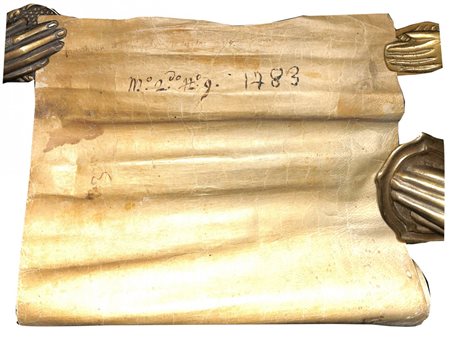
Lotto 159 MEDIEVAL NOTARY MANUSCRIPT ON VELLUM. Verona, 9 March 1483.
A scroll of parchment (63,5x25,5 cm), written in sepia ink by a 15th century cursive writing. Text in Latin.
7-lines capital I drawn in pen at the beginning of the document.
At the lower left corner of the page, the signum tabellionis of the notary Bartolomeo Zenoni.
An agreement concerning Bernardinus de Maranis, Paolo Dionisi, Filippino d'Emilei and others about some lands in Verona.
Both Emilei and Dionisi families are two important noble families of Verona. -
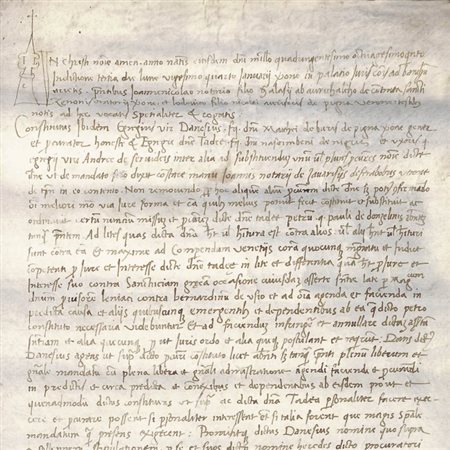
Lotto 160 MEDIEVAL NOTARY MANUSCRIPT ON VELLUM, Verona, 24 January 1485.
A scroll of parchment (58,5x20 cm), written in a very elegant 15th century cursive writing in brown ink. Text in Latin.
4-lines capital I drawn in pen at the beginning of the document. At the upper left corner of the page, the signum tabellionis of the notary Fioravante de Cattanis from the contrada of San Giovanni in Foro.
A rare document in which Mrs. Taddea Nascimbeni from Verona, wife of Andrea de Servideis gives the power of attorney to the notary Danesio de Buri to represent her in litigations. Taddea was involved in a litigation in Venice with a greek woman called Sanctucia. -
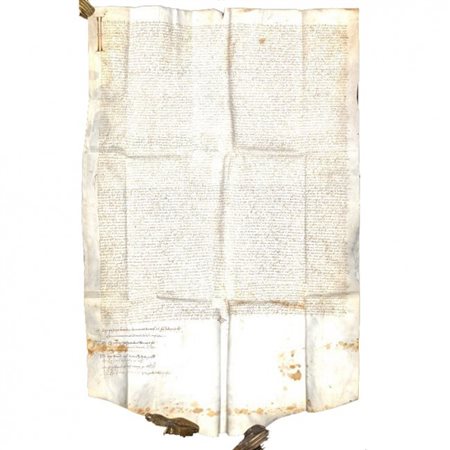
Lotto 161 MEDIEVAL NOTARY MANUSCRIPT ON VELLUM. Napoli, 22 December 1490.
A large leaf of parchment (a complete vellum of a sheep, 86x54 cm), written in sepia ink by a very elegant 15th century cursive writing. Text in Latin.
12-lines capital I drawn in pen at the beginning of the document. At the end of the text, a signum tabellionis of Bernardinus De Mauris.
A giant document, worth to be studied, also for the presence of 9 different notaries that sign it, including Bernardinus de Mauris and Benedictus de Biena. -

Lotto 163 RENAISSANCE NOTARY MANUSCRIPT ON VELLUM, Verona, 2 June 1505.
A long scroll of parchment (79x30 cm), written by a 16th century cursive writing in sepia ink. Text in Latin.
4-lines capital I drawn in pen at the beginning of the document. At the upper left corner of the page, the signum tabellionis of the notary Nicola de Barberiis.
A contract in which Stefanina, wife of Antonio de Tinonibus, and Pietro de Bonalini sell to Danesio de Buris some cultivated lands in Lazise (a small town on Garda Lake), in contrada Mondragone for 200 Ducats of gold.
The Buri family was very influential in Verona. The friar Fino de' Buri was prior of the Augustinian monastery of Santa Eufemia in 1262. In 1405 Galvano Buri, ascribed to the Noble Council of Verona, was one of the leaders of the College of Notaries. The descendants of Galvano obtained by the Venetians the title of count, with jurisdiction over the town of Villa Bartolommea, Lazise and San Bonifacio. The family also owned other properties in Verona and in its province. With the permission of the Venetians who ruled the Verona region, the Buri family built the villa near the Adige (still existing) that bears their name (Villa Bernini Buri). -
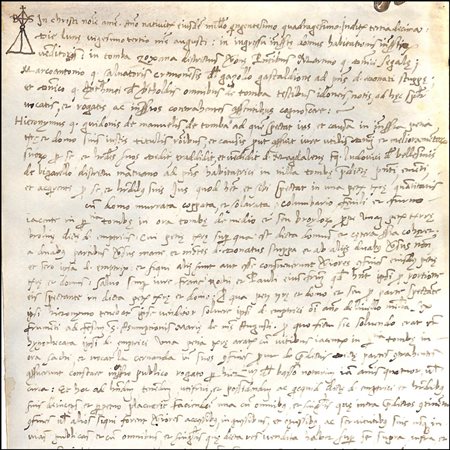
Lotto 164 RENAISSANCE NOTARY MANUSCRIPT ON VELLUM, Verona, 23 August 1540.
A scroll of parchment (65x20), written by a 16th century small cursive writing in sepia ink. Text in Latin.
At the upper left corner of the page, the signum tabellionis of the notary Camillo Sparaniri.
A contract in which Girolamo de Manuelis, son of Guidone, sells to Maddalena Bellesini from Bigarello (near Mantua) a house with dovecote. -
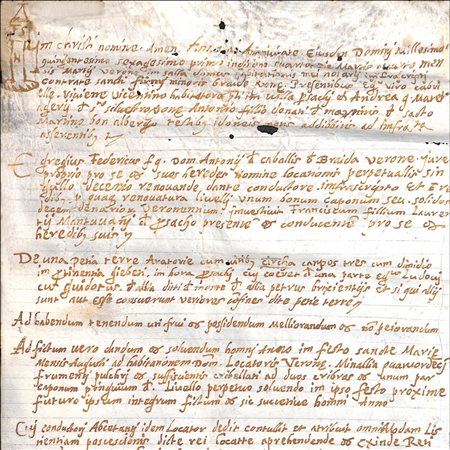
Lotto 165 RENAISSANCE NOTARY MANUSCRIPT ON VELLUM, Verona, 4 March 1561.
A scroll of parchment (70x24 cm), written by a 16th century cursive writing in sepia ink. Text in Latin.
At the upper left corner of the page, the signum tabellionis of the notary Fortunato Seraricus from contrada San Fermo.
A lease contract in which the lessee Federico de Caballis, rents to Francesco Mantovani a land to cultivate in Persacco (now Perzacco, near Verona). The contract is renewable every ten years.
It is interesting to report that, in this document like in other similar contracts of the same area, the payment is often annually agreed "on the Feast of the Assumption of Mary", the 15th of August, and the sum to correspond is a part of the harvested wheat and a "big capon". -
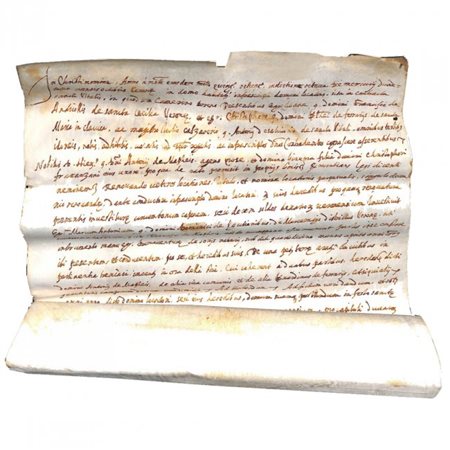
Lotto 166 RENAISSANCE NOTARY MANUSCRIPT ON VELLUM, Verona, 12 October 1580.
A scroll of parchment (46x24 cm), written by a 16th century cursive writing in sepia ink. Text in Latin.
At the lower left corner of the page, the signum tabellionis of the notary Giovanbattista Bonanici from Cremona.
A lease contract in which the lessee Antonio Maffei and his wife Ginepra Fracanzani rent to Domenico de Uguccioni from Marceniga a land to cultivate near the Garda Lake. The contract is renewable every ten years.
As in rental agreement of the previous lot, the payment is annually agreed "on the day of the Assumption of Mary", the 15th of August, and the sum to correspond is a part of the harvest and a "good capon". -
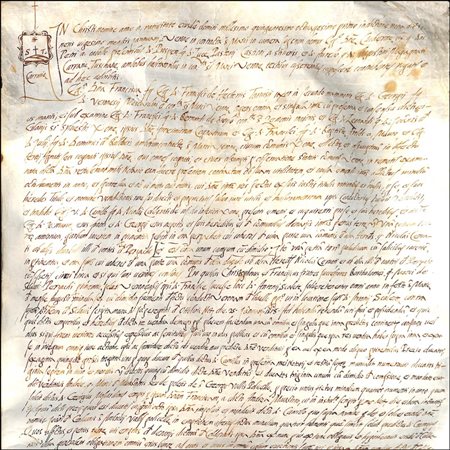
Lotto 167 RENAISSANCE NOTARY MANUSCRIPT ON VELLUM, Verona, 20 January 1581.
A long scroll of parchment (98x29 cm), written in an elegant 16th century cursive writing in sepia ink. Text in Latin.
At the lower left corner of the page, the signum tabellionis of the notary Stefano Carrara from contrada Santo Stefano in Verona.
A sale contract in which Francesca Tarvisi wife of Giorgio Moscardini from contrada San Marco in Verona and his relatives sell to Camillo Colderati from contrada Isolo in Verona a land to farm in Perzacco. -
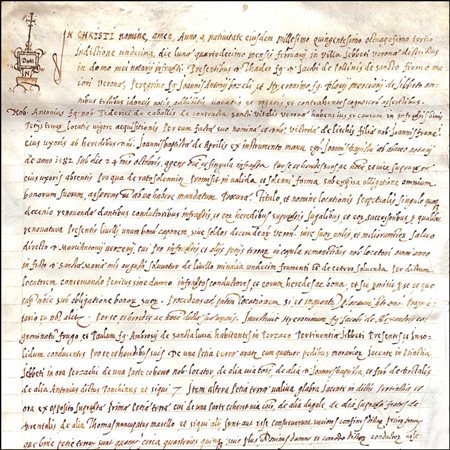
Lotto 168 RENAISSANCE NOTARY MANUSCRIPT ON VELLUM, Verona, 14 February 1583.
A scroll of parchment (51,5x23,5 cm), written in a 16th century cursive writing in brown ink. Text in Latin.
At the upper left corner of the page, the signum tabellionis of the notary Dominicus Mandula de Fachinis from .
A contract in which Antonio de Caballis son of Federico from contrada San Vitale in Verona and his wife Vittoria da Lisca rent to Girolamo Frugo and Paolo de Sancta Lucia a land to farm.
The contract was renewable every ten years.
As in other rental agreement of this period in the area of Verona, the payment is annually agreed "on the day of the Assumption of Mary", the 15th of August, and the sum to correspond is a part of the harvest and a "good capon".
The Da Lisca family was exiled from Florence and escaped in Verona in 1320.
They had ambassadors, notaries, judges and writers and still own the feud of Formighè, near Verona. -
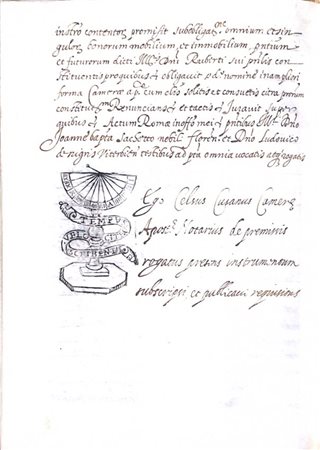
Lotto 169 CHARMING RENAISSANCE NOTARIAL MANUSCRIPT ON VELLUM REGARDING SOME ESTATES OF POPE PIUS V’S THE FAMILY
NOTARIAL MANUSCRIPT ON VELLUM, COLLECTING DEEDS AND PROCEDURES RELATED TO THE GHISLIERI FAMILY. [End of the 16th century].
4to (220x155 mm), contemporary limp vellum binding, double gilt fillet frame and decorative friezes to covers, remains of silk strings, ff. [24].
Many ancient handwritings in brown ink. Text in Latin.
Renaissance notarial manuscript on vellum with renowned notary stamps at the end of each writing, collecting deeds and procedures related to the Ghislieri family. Text in Latin. [Italy (area of Rome), end of 16th century].
SEVERAL NOTARIAL DEEDS RELATING TO THE SALE AND ADMINISTRATION OF ESTATES BELONGING TO THE FAMILY OF POPE PIUS V, NAMELY ANTONIO GHISLIERI. The writings deal with business made between 1595 and 1603 in central Italy.
PROVENANCE: I. Handwritten notes relating to the content to front and back covers. II. Very interesting notary stamps at the end of each writing. -

Lotto 170 BAROQUE NOTARY MANUSCRIPT ON VELLUM, Verona, 2 January 1600.
A scroll of parchment (61,5x23 cm), written in a 17th century cursive writing in brown ink. Text in Latin.
At the lower left part of the scroll, the beautiful signum tabellionis of the notary Antonio Ferro from contrada dell'Isolo.
A contract in which Filippo de Cometti sells to the brothers Valentino and Bernardino de Resiis a land to farm with trees. -

Lotto 171 ENGLISH INDENTURE. County of Dorset, 30 September 1648.
Single leaf of parchment (69x55 cm). 12-lines capital T at the beginning of the document. Five wax seals preserved (out of six). Some different signatures.
An agreement between Thomas Hanham from Wimbourn with his wife Jane (and others) and John Hoskins from Northmaperton for the sale of some lands in the County of Dorset.
Interesting and uncommon, the presence of women's signatures, because they were usually excluded from official trade negotiations and contracts.
References: Raymond Clemens, Manuscript Studies London, Cornell University Press, 2008. -

Lotto 172 A MANUSCRIPT REFERRING TO TO PERUSIA'S STATUTES AND LAWS MADE BY ONORIO DEODATI
Onorio Deodati Statuta Perusiae 1597-1Deodati, Onorio. [title-page of the first document:]Bulla confirmans Collegium Doctorum Causidicorum et Procuratorum Augustae Civitatis Perusiae erectum et institutum a Statutibus ut lib. prim[o] statut[orum] umbr[orum] [...]. [Perugia:] end on 16th century (years 1579-1597).
Folio, near contemporary mottled calf (the first binding was in vellum and the calligraphic were pasted in ancient time on the front cover), ff. [13, Index], [3, blanks], [1, Calendar], [6, Bulla], [1, blank], 285 (= pp. 570), [1].
Fascinating manuscript by the Perusian jurist Onorio Deodati, worth to be studied, referring to Perugia's Statutes and laws.
Provenance: Contemporary woodcut stamp of Honorius Deodati, Perusian notary and jurist. At verso of the last leaf the woodcut seal of Onorio Deodati.
References: Regarding Onorio Deodati, see G. Cecchini, La Biblioteca Augusta del Comune di Perugia, Roma, 1978, pp. 543-544. -

Lotto 173 MANUSCRIPT ON VELLUM SIGNED BY HENRY IV, Fointainbleau, 20 June 1607.
HENRY IV of BOURBON. A single leaf of parchment (32x26 cm), written in a 17th century chancery handwriting in brown ink. Text in French.
After the text, the signature Henry.
Original document signed by the King of France Henry IV of Bourbon, containing the Pledge of Allegiance of Claude Dauphin, that becomes Gentilhomme Servant du Roy («Gentleman Servant of the King»).
Henry IV (1553–1610), also known by the epithet "Good King Henry", was King of Navarre (as Henry III) from 1572 to 1610 and King of France from 1589 to 1610. He was the first French monarch of the House of Bourbon.
As a Huguenot, Henry was involved in the French Wars of Religion, barely escaping assassination in the St. Bartholomew's Day massacre, and later led Protestant forces against the royal army.
He initially kept the Protestant faith and had to fight against the Catholic League, which denied that he could wear France's crown as a Protestant, to obtain mastery over his kingdom. After four years of stalemate, he found it prudent to abjure the Calvinist faith. As a pragmatic politician, he displayed an unusual religious tolerance for the era. Notably, he promulgated the Edict of Nantes in 1598, which guaranteed religious liberties to Protestants, thereby effectively ending the Wars of Religion. He was assassinated by François Ravaillac, a fanatical Catholic, and was succeeded by his son Louis XIII. -

Lotto 174 HANDWRITTEN REGISTER OF LAWSUITS, PURCHASES OF GOODS AND LANDS, TRANSACTIONS OF MONEY AND OTHERS ACTIVITIES REFERRED TO THE PROPERTIES UNDER THE ABBEY OF ST. ANDREW IN RIVER TIBER (ROME), FROM 1621 TO 1741
Ill.mo et R. D. Ludovicus Card. Ludovic[...] Altieri et Commen.rio presso Abb. S. Andrei […] Registrum […]. Without place [nearby Rome], 1621-1741.
Manuscript on paper, 222x164 mm, original full vellum binding, with a folding vellum closure, traces of ties, with dedication and title handwritten at front cover [not easily readable]; leaves [1 b.], [8], [1 b.], [11], [1 b.], [8], [8 b.]; the initial 20 pages are numbered.
The notebook starts on 13 February 1621 and stops on 22 february 1741, having been written by at least three or four different “hands”. The document deserves further studies: anyhow, at first sight, it seems to be a register, taken by a notary or an accountant, referred to all the lawsuits, the purchases of pieces of land or goods, the transactions of money referred to the land and properties owned by Roman Church nearby Rome, depending from the Abbey of Saint Andrew in river Tiber (“Sant’Andrea in flumine”) where the administrator (“Commendatario”) at that time was a Cardinal of the Roman Church [probably one of these Cardinals was Lorenzo Altieri (1671-1741) even if in the title at front cover is mentioned a certain Ludovicus … Altieri].
In the text, inserted free between the pages, there are still some letters, documents and notes of the time; among them, there is a letter dated 1626. -

Lotto 175 A LITIGATION BETWEEN TWO DISTINGUISHED BOLOGNA NOBLE FAMILIES
Botti, Alessandro (notary). [title-page of the first document:]Processo avanti l'uditore che nella Causa vertente fra Costanza Bonasoni e Giambat(tis)ta Ramponi iugali da una parte, Filippo Carlo, e fra(te)lli Ghisilieri dall'altra per ottenere l'immissione a certi beni nel Com di S. Agostino venduti da Galeazzo Bonasoni al P(ad)re di d(ett)i Ghisilieri li 9 Giugno 1598 a fine di conseguire il compimento si sue Doti, Legati, ed altri crediti ad essa competenti.. [Bologna:] 8 January 1624.
Folio, contemporary blue-grey paperboards (some tears), ff. 257 (= pp. 574). Text in Latin. Chancery handwriting.
A litigation between Costanza Bonasoni (and his husband Giambattista Ramponi) and the brothers Ghislieri for some properties in the municipality of Sant'Agostino.
The Ghislieri (or Ghisleri) Family was one of the oldest noble family of Bologna. Invested since 1022 by Marquise Matilde del Capitanato di Sala, the family dispersed between Cremona, Asti and Madrid. The main branch, the Marquis Ghislieri became extinct in the mid-thirteenth century, the lineage Ghisleri still exists. The family owns the titles of Marquis of Ronsecco and Count of Villa della Torre. Among the famous members of the family are Pope Pius V Ghislieri and the famous political scientist Arcangelo Ghisleri.
The Bonasoni family came in Bologna from San Giovanni in Persiceto in 1472. In 1544, Galeazzo Ghislieri was appointed Cavalier and Count by Charles V. He built the Palazzo in via Ghislieri, still existing. Among the personalities of the past, Giovanni Ghislieri, professor of Canon Law at University.
Provenance: Atti di Alessandro Botti Attuario nel foro civile at front cover.
References: Pompeo Scipione Dolfi, Cronologia delle famiglie nobili di Bologna con le loro insegne, e nel fine i cimieri. Centuria prima, con un breve discorso della medesima città, Bologna, Gio. Battista Ferroni, 1670. -

Lotto 176 A SCARCE MANUSCRIPT OF CARAVITA'S INSTITUTIONS OF CRIMINAL LAW
[Caravita, Tommaso]. Institutionum Criminalium Libri IV. [at p. 1:] Ubi methodice exponuntur, tum Romanorum Leges ad eam rem pertinentes, tum Leges Regni Neapolitani [...]. (presumably Naples:), End of 17th century-beginning of 18th century.
Large 8vo, contemporary stiff vellum with ochre label and gilt title at spine, red sprinkled edges, pp. [4], 385, [4, Index].
Scarce manuscript of Caravita's Institution of Criminal Law according to Roman Law and to the laws of the Naples Kingdom.
The first edition of the book was printed in 1740 (Naples) and it is possible that this manuscript was taken from lectures at University and precedes the printed edition.
Tommaso Caravita (1678-1744) was a Neapolitan jurist. It is a complete manual of criminal law full of references to classic and modern jurists, «written with admirable order and great brevity not unaccompanied by the clarity that can form the best quality of a book» (Giustiniani, p. 219).
References: L. Giustiniani, Memoria istorica degli scrittori legali del Regno di Napoli, I, Napoli 1787, p. 219. Manna, Della giurisprudenza e del foro napoletano, Napoli, 1839, p. 209. -

Lotto 177 CONCESSION OF ROMAN CITIZENSHIP TO EUSEBIO SERISTA
OFFICIAL DOCUMENT ON VELLUM WITH THE CAPITOLINE SEAL
Nos Antonius Maria Alterius Bartholomaeus Capranica, Fran. Cecchinus Almae Urbis Conservatores De Probo Viri Illustri D. Eusebio Serista Sabino Romana Civitate Donando S.P.Q.R. auctoritate qua fungimur ita fieri censuimus […]. Ex Capitolio, Anno at Urbe Condita 2403, post Christum vero natum 1651, 20 Mensis Novembris.
Concession of Roman citizenship, for recognition of virtues and merits, to Eusebio Serista, coming from an honest family of the Sabina.
Official folded document (320x510 mm), in gilt types and rulers on vellum with the Capitoline seal, issued by the “Campidoglio” of Rome on Nov. 20, 1651.
Original folded vellum; wax seal of Roman Capitolium (S.P.Q.R.) on paper, stored in a round metal container tied with original rope at the bottom of the parchment.
Provenance: Private collection of a Roman noble family. -

Lotto 178 SCARCE MANUSCRIPT CONTAINING A REPERTORY OF THE MAIN TERMS USED IN JURIDICAL LANGUAGE
THE COPY BELONGED TO MATTIA TOTI, PRAETOR OF AMANDOLA
Anonymous (Mattia Toti?).Repertorium Universale. Amandola, 1652
A thick volume in-folio, contemporary vellum (traces of use) with calligraphic title at spine.
An interesting and scarce manuscript containing the complete repertory («Repertorium Universale») of all the all key entries, arranged in alphabetical order, used in legal language.
Provenance: The copy belonged to Mattia Toti, praetor of Amandola, (his painted coats of arms? at first inner cover) according to the inscriptions Petri Matthiae Toti Amandulae Pretoris. Amandola is a municipality in the Province of Fermo in the Italian region Marche. The town was founded in 1248 by the union of the castles of Agello Leone and Marrubbione, which formed a free municipality. -

Lotto 179 AN INTERESTING AND UNCOMMON CASE IN PAPAL STATE
Various Lawyers.R(everendissi)mo D(omino). Molines Decano Romana Assentistatus, seu Relevii Pro Ill(ustrissi)mo D(omino). Jo(s)e(pho) Antonio Paravicino herede R(everendi) P(atri) D(omini) Josephi Paravicini Contra Rev(erendam) Cameram Apostolicam. Romae, typis Rev(rerendae). Camerae Apostolicae, 1698.
Folio, contemporary stiff vellum, ff. 200 (= pp. 400). Text in Latin with many passages in Italian.
Very interesting documents of a scarce case of asiento between the Apostolic Camera (today "Papal Treasury") and Alessandro Zinaghi, architect of Pope Alexander VIII and Innocent XII.
Alessandro Zinaghi received two different asientos (see below) for five papal galleys: then he died without paying the debts for the enormous operating costs for the management of the ships: at his death the debt with the Apostolic Camera was 63,479.34 Roman Scudi.The Apostolic Camera sued the noblemen Antonio Paravicino and Antonio Colonna for the payment of the debts; the first one because was the heir of the papal treasurer responsible of the first asiento (sum to pay 36,735.66 Roman Scudi); the second one because he was Zinaghi's guarantor (sum to pay 26,743.68 Roman Scudi).
Both Paravicino and Colonna refused to pay Zinaghi's debts: these manuscript are the documents, preceding the printed version, of the complicate case (discussed between 29 November 1698 and 3 February 1699), with Paravicino against Colonna and both Paravicino and Colonna against the Apostolic Camera, with a defense counsel formed by the most authoritative lawyers of the time: Jacopo Sardinius, Johannes Julianus, Carolus de Ferraris, Petrus Corradinus and Franciscus Maria Panarius.
Such a deployment of forces is better understood calculating the purchasing power of a Roman scudo, that was approximately equal to $70: Zinaghi’s debt amounted to 4,443,553 US dollars today.
The great (and absent) protagonist of this tangled affair, Alessandro Zinaghi, was the architect that made the very expensive (100.000 Roman Scudi) project to restore the harbour of Anzio, in Papal State: not on the old site but to the east of it, with the opening to the east, a mistake which leads to its being frequently silted up; it has a depth of about 5 metres. According to these documents, we can suppouse that he wanted to start a business in the new harbour with the papal galleys. The historian Rasi describes Zinaghi (p. 32) as uomo di molta abilità nei maneggi («a very able man in monkey business»).
The general meaning of assento or, in Spanish, asiento (from the Spanish verb sentar, to sit, and this from Latin sedere) in Spanish is "consent" or "settlement, establishment". In a commercial context it means "contract, trading agreement.
Through an asiento, a trade relationship was established whereby a set of traders was given a monopoly over that route and/or product.
Provenance: Embossed seals at last leaf.
References: G.B. Rasi, Sul Porto e Territorio di Anzio, Pesaro, 1832, pp. 108 ss. -

Lotto 180 UNPUBLISHED MANUSCRIPT ON CENSORSHIP
Anonymous (but: Romanelli). De censuris in Comuni [...]. w.p. (but about late XVII cent.).
8vo (188x132 mm), limp binding in contemporary full parchment, handwritten title at flat spine, head-bands, residual closure laces at boards edges (light traces of use, some little spots); unnumbered leaves; pp. (4 b.), (456), (14 b.).
No title-page; text in Latin; handwritten marginal notes in the first 80 pp.
An interesting unpublished manuscript on juridical matters.
Among the issues included in the text: censorship (la censura in generale), excommunication (la scomunica), suspension (la sospensione) and irregularities (le irregolarità).
Provenance: Even if the book has no signature and no ownership inscription, it comes from the private collection of the heirs of the Romanelli's family (a noble family, from the province of Rome, of landowners, priests, lawyers and administrators of church properties).
References: Not present in ICCU; not in OCLC. -

Lotto 181 17TH CENTURY MANUSCRIPT ON JUSTINIAN'S INSTITUTIONS
Anonymous. Institutiones Justiniani. Romae: Typis Mascardi, 1641 (but between the end of the 17th century and the beginning of the 18th cenury).
8vo (188x128 mm), contemporary full parchment, with little four bands at spine, handwritten title at spine, head-bands (light traces of use, some little spots); pp. (2), 1268, (6 b.); printed title-page with handwritten title in a richly decorated frame with printer's data at bottom (Romae: Typis Mascardi, 1641); text in Latin.
A voluminous and interesting manuscript on juridical matters (Justinian institutions); it is a study copy, written probably on late 1600.
Provenance: Even if the book has no signature and no ownership inscription, it comes for sure from the private collection of the heirs of the Romanelli's family (a noble family, from the province of Rome, of landowners, priests, lawyers and administrators of ecclesiatical properties). Furthermore, it can be attributed to Pietro Angelo Romanelli (Domino Petro Angelo de Romanellis), since the handwriting of the text and the binding of the book are analogous to those of another manuscript written by this author offered in this auction.
References: Not present in ICCU; not in OCLC. -

Lotto 182 UNPUBLISHED COMMENTARY ON JUSTINIAN’S CODE CONCERNING CIVIL LAW
FOLLOWED BY A BRIEF HISTORY OF CIVIL LAW
[LAW MANUSCRIPT]. C[ode]x Iure Civili Libri II. [TOGETHER WITH:] Iuris Civilis Historia. [Italy: before 1760-1768].
4to (240x180 mm), 18th century vellum on paperboards binding (a bit worn), with many handwritten notes to covers, the title written in brown ink to front board, visible joints at spine, pp. from 3 to 240 [actually, 241], [6], [2, blank], [1, title], 24, [1, index], [1, blank]. Text in Latin, handwritten in brown ink.
The Institutiones had been requested by the emperor Justinian I to the renowned jurists Trebonianus, Teophilus and Doroteus in order to resume the Roman Civil Law for the students of the empire. They worked as a fundamental reference for the ancient law from that moment on, becoming the skeleton on which all following jurists would base their commentaries.
The present manuscript is one of those commentaries, written by an 18th century jurist and never published. The text follows step by step the structure of chapters and titles of the Institutiones, giving for every excerpt a clear and in-depht account.
Provenance:
I. Many contemporary handwritten inscriptions on the vellum binding. At front cover, mention to different religious authorities such as Mons. Tomaso Ant.nio Scotti and Mons. Card. Moriggia di S.ta Maria Maggiore; the names are followed by the place, Pavia. On the very same cover, the title of the volume was written in brown ink. On the back board, a different hand traces in brown ink: Carolus Antonius Nervianus Persius Papiensis, Venerandi Seminarij Alumnus sub disciplina D. B.ris [?] Francisci Bernerij eiusdem Rectori dignissimi Anno Domini 1701 4 nonas Mensis Martij. Just after, the signature by a different hand Aloysius Persi Pomus Papiensis.
II. At front paste-down, inscription in brown ink concerning the sale of the manuscript, quoting the place and year of the transaction: Dato a Lacello gli 11 Luglio 1768.
III. Just before the index if the first work, handwritten note Atti seguiti a favor della Com.ta di Cavaglio per l’anno 1760 de’ quali è dovuto l’emolumento. 14 7mbre Bando con imbig.ne di far la vindemia prima del tempo ordinato. The present and the former indications, act as a temporal mark for the datation of the manuscript, whose text was copied for sure before both notes. -

Lotto 183 ROMAN NOTARY MANUSCRIPT. Ponzano (Rome), February 1705.
Single leaf of parchment (31x24,5 cm). Marginal extensions. Some different signatures at the end of the text.
A Roman notary manuscript, compiled by Pietrangelo Romanelli, Vicar General and Commissioner of the Apostolic Camera. In this document, he probably provides some economic privilege to an unidentified Abbot (see following lot).
The Apostolic Camera (Latin: Reverenda Camera Apostolica), formerly known as the Papal Treasury, is an office in the Roman Curia. It was the central board of finance in the Papal administrative system and at one time was of great importance in the government of the States of the Church, and in the administration of justice, led by the Camerlengo of the Holy Roman Church. -

Lotto 184 ROMAN NOTARY MANUSCRIPT. Ponzano (Rome), April 1705.
Single leaf of parchment (38x28,5 cm). Marginal extensions. Some different signatures at the end of the text.
A Roman notary manuscript, compiled by Pietrangelo Romanelli, Vicar General and Commissioner of the Apostolic Camera. In this document, he probably provides some additional economic privileges to an unidentified Abbot (see previous lot).
The Apostolic Camera (Latin: Reverenda Camera Apostolica), formerly known as the Papal Treasury, is an office in the Roman Curia. It was the central board of finance in the Papal administrative system and at one time was of great importance in the government of the States of the Church, and in the administration of justice, led by the Camerlengo of the Holy Roman Church.
Continua la scheda -
![AN IMPORTANT COLLECTION OF DECISIONSOriginal[ia] Decisio[nes] R. P. D. Cerrj...](/Upl/Auctions/Cache/828/1657/178295/185-0.jpg/s0_450.jpg)
Lotto 185 AN IMPORTANT COLLECTION OF DECISIONS
Original[ia] Decisio[nes] R. P. D. Cerrj Ann[i] 1719. 1720. 1721.
[together with:]
Originalia Decisio[nes] R. P. D. Cerrj Ann[i] 1722. 1723. 1724.
[together with:]
Originalia Decisio[nes] R. P. D. Cerrj Ann[i] 1725. 1726.
3 thick volumes in small folio, contemporary limp vellum with handwritten titles at spine, traces of original ties.
A conspicuous collection of "original" Decisions, (as to say the original manuscripts), regarding the period 1719-26, written by Carlo Cerri.
The structure of the volumes is formed by hundreds of separate Decisions of Sacred Roman Rota, that were subsequently collected.
A long, detailed report on this lot is sent on request -

Lotto 186 APPARENTLY UNPUBLISHED LAW MANUSCRIPT
Caputi, Andrea. Dissertatio Academica Forensis De integrum Restitutionibus at titulum Pandectarum I. et Codicis XXII. [at colophon:] die 22 mensis Maji 1737. Sub disciplina V.I.D.D.A. Andreae Caputi publici privatique Lectoris.
Large 8vo, later colored wrappers, ff. [102, the last is blank].
Uncommon, apparently unpublished, academic dissertation on the chapter Restitutio ad integrum of Justinian's Pandects.
Restitutio ad integrum is a Latin term which means «restoration to original condition». It is one of the primary guiding principles behind the awarding of damages in common law negligence claims. The general rule, as the principle implies, is that the amount of compensation awarded should put the successful plaintiff in the position he or she would have been had the tortious action not been committed. Thus the plaintiff should clearly be awarded damages for direct expenses such as medical bills and property repairs and the loss of future earnings attributable to the injury (which often involves difficult speculation about the future career and promotion prospects).
Although monetary compensation cannot be directly equated with physical deprivation it is generally accepted that compensation should also be awarded for loss of amenities, reflecting the decrease in expected standard of living due to any injury suffered and pain and suffering. Damages awards in these categories are justified by the restitutio principle as monetary compensation provides the most practicable way of redressing the deprivation caused by physical injury. -

Lotto 187 APPARENTLY UNPUBLISHED MANUSCRIPT OF CIVIL PROCEDURE REGARDING «THE WAY TO ARGUE» IN TRIBUNAL
Anonymous. Direttorio de Modo di Litigare [...]. Italy, about 1740-60.
4to, contemporary stiff vellum with label and gilt title at spine, pp. 196, [20, the last is blank]. Text in Italian, Cursive writing.
Unpublished manuscript of this handbook of Civil procedure regarding the way to solve the litigations.
When a person begins a civil lawsuit, the person enters into a process called litigation. Under the various rules of Civil Procedure that govern actions in state and federal courts, litigation involves a series of steps that may lead to a court trial and ultimately a resolution of the matter.
References: There is no trace of printed work with this title in public libraries. -
![UNCOMMON UNPUBLISHED CURRENCY CONVERTERAnonymous. Trattato de' Conti [...]....](/Upl/Auctions/Cache/828/1657/178298/188-0.jpg/s0_450.jpg)
Lotto 188 UNCOMMON UNPUBLISHED CURRENCY CONVERTER
Anonymous. Trattato de' Conti [...]. Italy, about 1750-1790.
Small 4to, later colored wrappers, pp. 110, [numbered 295-405: but complete]. Text in Italian, Cursive writing.
Uncommon small treatise of currency exchange, apparently unpublished, in which the author explains the different conversions of the Italian coins of the time.
The manuscript is preceded by another, smaller manuscript containing a unit converter
References: There is no trace of printed work with this title in public libraries. -

Lotto 189 A GERMAN DEGREE IN LAW OF LUDWIG-MAXIMILIANS-UNIVERSITY OF INGOLSTADT
Ludwig-Maximilians-University of Ingolstadt. In nomine Sacrosantae et Individuae [T]rinitatis [...] Nos Petrus de Ickstatt Jurium Doctor, Serenissim ac Potentissimi Electoris, utriusque Bavariae Ducis [...]. Ingolstadt, 9 August, 1790.
4to, contemporary colored wrappers in orange and liquid gold, pp. [12], [2].
Illuminated title-page, illuminated borders at each page. Text in Latin.
The law degree in utroque jure (both Civil and Canon Law) of Johann Sebastian Hauser, released by Peter von Ickstatt (1743 - 1771), renowned jurist of the time and Dean of the Ludwig-Maximilians-University of Ingolstadt.
The degree is signed by the notary Ferdinandus Maria Mendl and has the embossed seal of the Ludwig-Maximilians-University in the final page.
Johann Sebastian Hauser is recorded in the book address of the town of Nürnberg (close to Ingolstadt) of the year 1794.
Ingolstadt is a city in the Free State of Bavaria, in the Federal Republic of Germany. It is located along the banks of the River Danube, in the centre of Bavaria.
In 1472 Louis IX, Duke of Bavaria founded the University of Ingolstadt which became the Ludwig-Maximilians-University. In 1800 it was moved to Landshut and eventually to Munich. The University of Ingolstadt was an important defender of the Roman Catholic Church during the Reformation era, led by such notable scholars as Johann Eck. In 1748, Adam Weishaupt, the founder of the Order of Illuminati, was born in Ingolstadt.
References: Reichs-Stadt Nürnbergisches Adresse-Buch: für das Jahr 1794 in 95. Nürnberg, 1794 p. 100. -

Lotto 190 SIGNED AND UNPUBLISHED MANUSCRIPT ON JUSTINIAN INSTITUTIONS
Moscatelli, Luigi (Aloysius Moscatelli). Elementa juris secundum ordinem Institutionum Justiniani. w.t., w.d.: but, about 1820.
Manuscript in two volumes (cm 20 x 13), half-light brown leather with corners and decorated paper at boards (traces of use at the boards, worn corners), gilted decoration and false bands at flat spine, gilted title on a brown leather label at spine; red colour sprinkled edges; pp. not numbered, but (372); (376), (2 b.).
Half-title: Iuris civilis elementa.
Signed manuscript on Justinian institutions. It is a study copy, written on early 1800, presumably a synthesis from the same titled work written by Johannes Voet or from another one, always with the same title, written by Johann Gottlieb Heinecke.
The work, preceded by the title (Elementa juris secundum ordinem Institutionum Justinianearum) and the preface, is divided in four books, each one subdivided in titles; in the end, the Author concludes his efforts writing: finis coronat opus, ad maiorem Dei gloriam, Aloysius Moscatelli.
Provenance: Signature Aloysius Moscatelli at verso of the last leaf. Luigi Moscatelli (Rome, 1777 - ?), was a studious of canon law, named subdeacon on 1807 and then Papal chaplain.
References: No work of this author in ICCU, nor in OCLC. -

Lotto 191 LAST EDITION OF THIS ALDINE BOOK ABOUT ROMAN LAWS
Manuzio, Paolo. Antiquitatum Romanarum Pauli. Manutii liber. de. legibus index rerum memorabilium. Editio postrema. Venetijs [Venezia]: Aldus. Manutius. Paulli. f.A.n., 1569 (Venetiis : Aldus. Manutius. Paulli. f.A.n., 1569).
8vo, 140x96 mm, original soft vellum binding, hanwritten title at spine; pp. 303, [73]. Editorial woodcut device at title-page (Aldus anchor).
Reprint of the 1559 edition. Preface dated 1557.
Text and index in Italic type, preface in Roman. The text is followed by the "Index rervm. memorabilivm." (36 leaves).
Provenance: Handwritten ownership inscription at last free-leaf of Giuseppe Massari (“Ego Joseph Massari possessori huius libri”).
References: IT\ICCU\BVEE\014656. OCLC, 82646366. -

Lotto 192 THE "GOLDEN MIRROR": A STANDARD RENAISSANCE HANDBOOK OF CIVIL LAW PROCEDURE
ONLY A COPY IN USA
Maranta, Roberto. Speculum aureum, & lumen aduocatorum praxis ciuilis, nouissime recognitum, ac miro ordine, opulentissimisque additionibus, in suis locis congruentibus locupletatum, per magnificum v.i.d. do. Petrum Follerium a s. Seuerino, originariaeque Parthenopaeum, non sine magna ac ingenti vtilitate legentium. Additis etiam per eundem vltra distinctiones vigesimas duabus alijs nouis distinctionibus. Accesserunt, et insuper decem disputationes quaestionum legalium eodem Do. Roberto Maranta auctore, summarijs quoque, & indice illustrate. Quae omnia recenti [...] nostra editione diligentissime [...] elaborata Auctore Ioanne Baptista Zilleto. Venetiis, apud Ioannem Mariam Bonellum, 1568.
4to (205x152 mm), contemporary limp vellum, pp. [112], 550, [2].
Fine Venetian edition of a standard Renaissance handbook of civil law procedure.
References: Adams M 513; not in BMSTC. CNCE 26242. OCLC 82936393 locates only a copy in US public libraries (Harvard Law Library). -

Lotto 193 EXCESSIVELY RARE FIRST EDITION OF MASCARDI'S CONCLUSIONS ON CANON AND CIVIL LAW, ALSO
INCLUDING CRIMINAL AND FEUDAL LAW
Mascardi, Giuseppe. Iosephi Mascardi ... Volumen primum (secundum et tertium). Conclusiones probationum omnium, quae in vtroque foro quotidie versantur, iudicibus, aduocatis, causidicis ... vtiles, praticabiles, ac necessariae. Quibus canonicae, ciuiles, feudales, criminales, caeteraeque, materiae continentur. Per ampliationes (ut dicitur) limitationes, intelligentiasque alphabetico ordine abunde digestae. Numquam hactenus in lucem aeditae. Summarijs, ac indice rerum, sententiarumque magis selectarum locupletissimo ornataeVenetiis: Apud Damianum Zenarum, 1584-1587.
Three volumes in-folio, contemporary stiff vellum binding, handwritten title at four raised bands spine. Red and black title-page, text on two columns, xylographic headletters.
Scarce first edition of Mascardi’s Conclusiones on Canon, Civil, Criminal and Feudal Law, also containing the first edition of Ricci-Nigro’s Additiones after the Index of the third volume, and with its own title-page. Giuseppe Mascardi, apostolic prothonotary and Bishop in Ajaccio is mainly famous for this work, also appreciated by Leibniz.
Giovanni Luigi Ricci, latinized Iohannes Aloysius Riccius (1570-1643) was member of the noble Naples family Riccio, or Rizzo. He became canon in the Naples Cathedral and Bishop in Vico Equense.
Provenance: Paper ex-libris at title-pages.
References: OCLC 28793638 (Harvard Law School Library and University of Chicago Library).