
Medieval Notary Manuscripts & Law Books
-
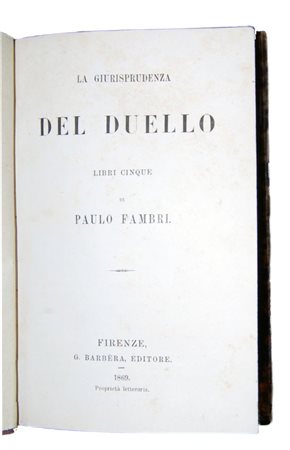
Lotto 97 JURISPRUDENCE ON DUELLING BY PAOLO FAMBRI
Fambri, Paolo. La giurisprudenza del duello. Libri cinque di Paulo Fambri. Firenze: G. Barbera, Editore, 1869.
8vo (182x112 mm), half percalline cloth binding, with marbled paper at boards, gilt title at spine; pp. XVII, 298.
Paolo Fambri was an Italian member of Parliament and a writer on literary, historical and legal topics.
Provenance: Private library of a Verona noble family, whose roots are in Mantua and in which there were distinguished lawyers and jurists.
References: IT\ICCU\SBL\0406693. OCLC, 680443712 (electronic reproduction). -

Lotto 98 SECOND EDITION OF CODEX FABRIANUS, CONTAINING THE DECISIONS OF THE SAVOY COURTS
Favre, Antoine.Codex Fabrianus definitionum forensium et rerum in sacro Sabaidae Senatu tractatarum: ex ordine titulorum codicis Iustinianei quantum fieri potuit accomodare ad usum forensem, in novem libros distributus auctore et compositore Antonio Fabro... Opus integrum, et omnibus iuris studiosis utilissimum, sed pragmaticis praecipue necessarium. Lugduni: Cardon, 1606.
Folio, contemporary half vellum on marbled paper, handwritten title at spine, ff. [14], pp. 579, ff. [27], pp. 822, ff. [15].
Title page printed in red and black, engraved portrait of the author.
Second edition of Codex Fabrianus, printed in the same year of the first one that was published in Geneve (Switzerland), but lacking (for censorship) the first leaf (De summa Trinitate) containing a list of punishments for the heretics.
Antoine Favre, baron of Pérouges (5 October 1557 – 1624) was a Savoisian nobleman and jurist. Favre was born in Bourg-en-Bresse. After studies in Paris and Turin, he practiced law in Chambéry. He was a member of the Savoyard court there from 1585 onwards, and its president from 1610 onwards.
His principal scholarly work is the Codex Fabrianus definitionum forensium (1609), a report of the decisions of his court organized after the Justinian Code. Favre's other research, conjectures about the Justinian code in which he endeavors to separate the Justinian insertions from the classical Roman texts, is still valued by scholars today.
References: Not is Sapori, that quotes other editions. OCLC, 634759070. -
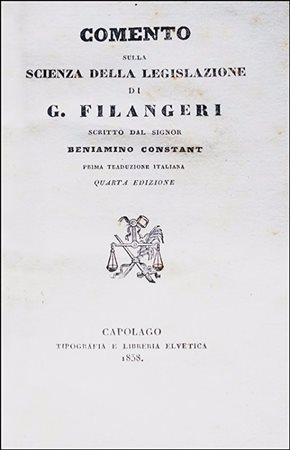
Lotto 99 THE ITALIAN EDITION OF CONSTANT'S COMMENTARY TO FILANGIERI'S SCIENCE OF LEGISLATION
Constant, Benjamin. Comento [sic!] sulla scienza della legislazione di G. Filangeri [sic!] scritto dal signor Beniamino Constant. Prima traduzione italiana. Quarta edizione. Capolago: Tipografia Elvetica, 1838.
8vo, contemporary half calf on marbled paper, orange label and gilt-lettered title at spine, pp. 352.
Fourth Italian edition of Constant's commentary on Filangieri's Scienza della Legislazione.
The «Science of Legislation» by Filangieri is a cornerstone of the legal, economic and political thinking of Italian and European Enlightenment. The work, published originally from 1780 in seven volumes (Naples, Raimondiana) had a great international echo, with translations in English, French, German and Spanish. Founded on a rigorous codification of the laws and a progressive reform of the criminal procedure, the work of Filangieri, influenced by Vico and Giannone as Montesquieu, also gave a new formulation of the concept of crime: «Not all actions contrary to the laws are crimes, not those who practice them are criminals. The violation of the law, must be accompanied by a desire to violate it».
The treatise, which also constituted one of the models of Benjamin Franklin and some of the other fathers of the American Constitution, was placed on the Index of Forbidden Books in 1784 for his ideas of reform and its harsh attacks on ecclesiastical privileges.
Palgrave: «Filangieri was one of the most important writers on economics in the latter years of the last century. He followed no leader, standing between the physiocratic and mercantilist theory. His works are thus the prelude to a historical system of social legislation».
References: IT\ICCU\PUV\0943663. OCLC 611020618 (two copies in Switzerland) and 52957586 (two copies in USA). -
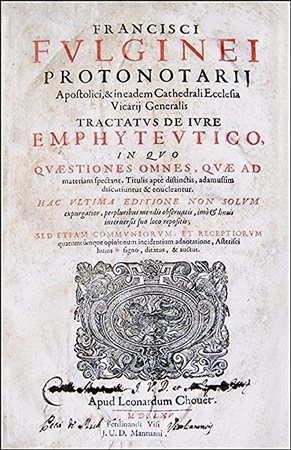
Lotto 100 ULTIMATE EDITION OF FOLIGNI'S RENOWNED TREATISE ON REAL PROPERTY AND LONG LEASE CONTRACTS
Foligni, Francesco (Fulgineo, Francesco). Francisci Fulginei […] Tractatus de iure emphyteutico, in quo quaestiones omnes, quae ad materiam spectant, titulis apte distinctis, adamussim discutiuntur & enucleantur. Hac vltima editione non solum expurgatior, […] sed etiam communiorum, et receptiorum quarumcumque opinionum incidentium adnotatione, […] auctus. Genevae (Geneve): apud Leonardum Chouet (Chouet, Léonard), 1665.
Folio, contemporary full stiff vellum, handwritten title at spine and at lower edge; pp. [12], 373 [i.e. 399], [57]; p. 399 is wrongly numbered 373.
Text in Latin in two columns.Title-page in red and black types, with a wide device representing the crowned salamander resurging by the flames. Engraved head and -tail pieces, engraved headletters.
Author’s dedicace to the cardinal Antonio Barberini.
Ultimate edition of main Foligni's treatises, regarding long lease contracts, that was reprinted until late 19th century.
The work deals with all the aspects regarding the long lease contract (also called, with the juridical term, emphyteusis), as to say the contract granting the use of a land for a long period receiving as payment a part of the profit (money or natural products) gained by it. The work is presented as a practical book, structured under the form of quaestiones (questions) with their punctual responses. An alphabetical index is added, to easily find the needed questions.
Francesco Foligni (died 1647), a lawyer and noble man from Foligno, was also apostholic protonotary and general curate of the cathedral of his town.
Provenance: Some not identified contemporary inscriptions at title-page.
References: ICCU\RMGE\000092. OCLC: 15052123 (locates two copies in USA) and 83753589 (locates a copy in USA at the University of California Berkeley Law Library). -
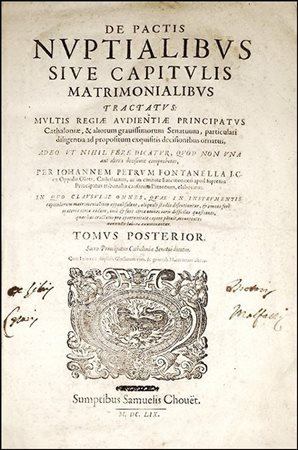
Lotto 101 THE MARRIAGE LAWS IN CATALONIA
Fontanella, Juan Pedro. De Pactis Nuptialibus sive Capitulis Matrimonialibus Tractatus: multisregiae audientiae principatus Cathaloniae, & aliorum gravissimorum Senatuum, particulari diligentia adpropositum exquisitis decisionibus ornatus [...] per Iohannem Petrum Fontanella I.C. ex Oppido Oloti,Cathalanum [...]. Tomus Posterior […]. Geneva, Sumptibus Samuelis Chouët, 1659.
Folio (365x235 mm), original paper boards with sepia ink handwritten titles at spine, visible joints, ff. [6], pp. 650, ff. [53, last blank]. Fine printer device at titlepage, xylographic decorations and headletters, text on two columns.
The fundamental treatise on Marriage Law compiled by the Catalan jurist Juan Pedro Fontanella.
The work, printed for first time in 1612, is here in the Geneve edition by Samuel Chouët, with the device of the Crowned Salamander.
The Marriage Law, base for the Family Law, was fundamental in Fontanella period, considering that with combined weddings for political reasons, they, at that time, changed the political situation of small lands as well as of entire countries.
Juan Pedro Fontanella (Gerona, 1576-Barcelona 1680) was a Catalan jurist that lived more that hundred years. Beside the present work, he compiled a famous treatise on Decisiones by the Senate of Catalonia.
Provenance: Sepia ink handwritten unidentified ownership inscription at titlepage, beside the printer device Ex Libris Noctoris (?) Cesaris Malfattis.
References: Fontana, pars I, col. 355. Not in Sapori, that mentions other five editions. IT\ICCU\CFIE\003331. -

Lotto 102 THE FIRST ITALIAN LAW ENCYCLOPEDIA
NO COPIES IN USA
Foramiti, Francesco. Enciclopedia Legale Ovvero Lessico Ragionato di Gius Naturale, Civile, Canonico, Mercantile-Cambiario-Marittimo, Feudale, Penale, Pubblico-Interno, e Delle Genti. Venice: Coi Tipi di Giuseppe Antonelli Ed., 1841-1843.
Four volumes in-4to, contemporary quarter calf over marbled boards, gilt titles and ornaments at spine. Main text in double columns.
Second and final edition of this remarkable and comprehensive law encyclopedia, with entries quite detailed. Possibly the first encyclopedia of Italian civil law, with its organizational style similar to that of Tomlins’s Law Dictionary.
References: OCLC locates 5 copies of the first edition in USA public libraries, no copies of this second edition. BMC, IX, 543. -
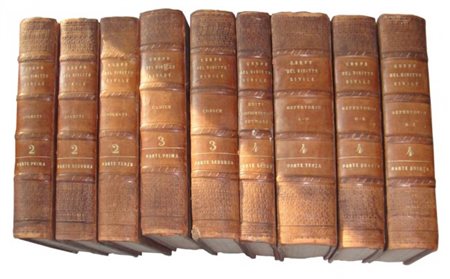
Lotto 103 THE FIRST ITALIAN TRANSLATION OF THE CORPUS JURIS CIVILIS BY THE EMPEROR JUSTINIAN
Foramiti, Francesco. Corpo del diritto civile: in cui si contengono le instituzioni di Giustiniano, i digesti o pandette, il codice, le autentiche, ossiano novelle costituzioni, e gli editti, non che le novelle costituzioni di Leone e di altri imperatori, i canoni de' santi e degli apostoli e i libri de' feudi : con brevi note indicanti le leggi simili, quelle che a vicenda s'illustrano, le contrarie e le abrogate, premessa La storia cronologica del diritto civile romano: nuova edizione eseguita su quella di Parigi del 1830 / prima versione italiana per istudio e cura di Francesco Foramiti.. Venezia: Tip. G. Antonelli, 1836-1844.
9 volumes (out of 10, it lacks the first volume), contemporary half calf with gilt-letterd titles at four raised bands spine.
Parallel text Latin-Italian.
First edition in Italian language of Corpus Iuris Civilis wanted by the Emperor Justinian: the Corpus, that was the founding text of European Law until 19th century, was translated and adapted to Italian language by Foramiti according to the critical Latin edition published in Paris in 1830.
Francesco Foramiti (XVIII-XIX secolo) was a Venetian jurist. He also published an Enciclopedia Legale ovvero Lessico ragionato di gius naturale, civile, canonico, mercantile-cambiario-marittimo, feudale, penale, pubblico-interno, e delle genti (Venice, 1838-40) and a Bibliografia legale ovvero vita e fatti più importanti dei primari giureconsulti (Venice, 1843), an historical account of all the most important jurists of every time.
References: IT\ICCU\MIL\0245763. OCLC 715454282. -
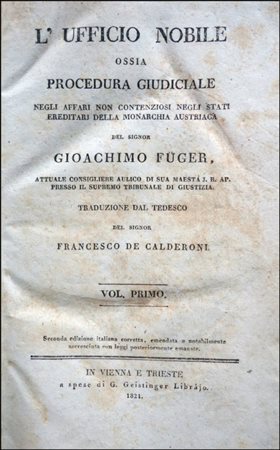
Lotto 104 THE CIVIL PROCEDURAL LAW IN THE AUSTRIAN EMPIRE
Fuger, Joachim. L'ufficio nobile ossia Procedura giudiciale negli affari non contenziosi negli stati ereditarj della monarchia austriaca del signor Gioachimo Füger [...]. Edizione seconda accresciuta e migliorata dall'Autore dietro il nuovo Codice Civile Universale. Traduzione dal tedesco del signor Francesco De Calderoni. Vol. Primo [-III]. In Venezia: nella Tipografia Picotti, a spese di G. Geistinger e Comp. di Trieste, 1821.
3 volumes bound together in-8vo, contemporary half calf binding, with marbled paper, pp. 218, [2]; 267 [i.e. 167], [1], [2] leaves of folded tab.; 224, [2] leaves of folded tables.
Second edition of a useful handbook of procedural law in non-contentious proceedings in the provinces of Austrian Empire.
The Austrian Empire (or simply: Austria) (in Austrian - German: Kaiserthum Oesterreich) was created out of the realms of the Habsburgs by proclamation in 1804. It was a multinational empire and one of the world's great powers. Proclaimed in response to the First French Empire, it overlapped with the Holy Roman Empire until the latter's dissolution in 1806. It included in its territory the Kingdom of Lombardy–Venetia. The Austro-Hungarian Compromise of 1867 elevated Hungary's status within the Austrian Empire, creating a new dual monarchy of Austria-Hungary.
References: IT\ICCU\MILE\023608 (5 copies). OCLC, 797907531. -
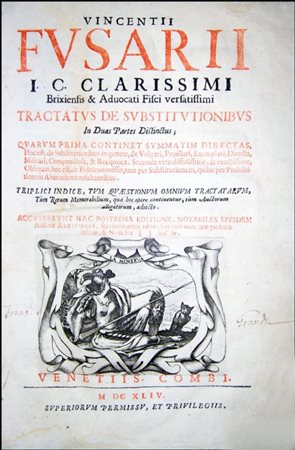
Lotto 105 A TREATISE OF INHERITANCE LAW
Fusari, Vincenzo. Tractatus de substitutionibus in duas partes distinctus; quarum prima continet summatim directas, hoc est, de substitutionibus in genere [...] Secunda vero diffusissime, & exactissime, obliquas, hoc est, de fideicommissis [...] Triplici indice [...] adiecto. Accesserunt hac postrema editione, notabiles eiusdem auctoris additiones, separatim antea editæ, suis vero nunc quæque locis insertæ, & notis his [ ] inclusæ. Venetiis: Combi, 1644.
Folio (326x224 mm), full vellum binding, four raised bands at spine (binding a bit loose), calligraphed title at bottom edge; pp. [136], 1088 [i.e. 1100]. Title-page in red and black types, with a large engraved printer's device representing Minerva. Xylographic initials and ornaments.
Uncommon treatise of inheritance law.
Provenance: Private library of a Verona noble family, whose roots are in Mantua and in which there were distinguished lawyers and jurists.
Handwritten ownership inscription at title-page, not readable (Franc. Grandi ?).
References: IT\ICCU\MILE\005385. OCLC, 81872347 (2 copies in USA), 222859790 (one copy in Canada), 457478049 (one copy in France). -

Lotto 106 AN EXTENSIVE TREATISE ON JUDICIAL PROCESS IN THE HOLY ROMAN EMPIRE CHAMBER, WRITTEN BY ANDREAS GAIL, TOGETHER WITH THE DEVELOPMENT OF THE MOST INTERESTING DISPUTES, COLLECTED BY FABRICIUS
[1.]: Gail, Andreas - Gymnich, Walter. Practicarum observationum, tam ad processum judiciarium, praesertim imperialis camerae, quam causarum decisiones pertinentium, libri duo. De pace publica [...]. De pignorationibus [...]. De manuum injectionibus [...] per nobilem ac clarissimum D. Andream Gaill, [...]. Editio postrema correctior, ex ultima recognitione Gualteri Gymnici [...] cum indice [...] locupletissimo. Coloniae Agrippinae [Koln]: Sumptibus & Typis Wilhelmi Metternich, Bibliop., Anno M.DC.XCVIIII. [1699].
[bound with:]
[2.]: Fabricius, Eberhard - Gail, Andreas. Everhardi Fabricii, Gailius enucleatus, hoc est enodatio controversiarum maxime nobilium, [...]. Opus omnibus utile, necessarium, [...] deductum. Coloniae Agrippinae [Koln]: Sumptibus & Typis Wilhelmi Metternich, Bibliop., Anno M.DC.XCVII. [1697].
8vo (206x170 mm), full mottled leather binding, four raised bands at spine with title, green and red sprinkled edges; pp. [28], 628; 272; [128]; 139, [1]. First work title-page in red and black types and second work title-page in black types, both with a printer's device (an eagle in a figured frame, with motto: Spirat ubi vult; printer's initials WFM). Xylographic initials and head- and final-pieces.
Andreas von Gail [Geihl] (1526-1587), German judge and jurisconsult, called the Papinian of Germany. His writings on public order, proscription, banishment and pledges were of considerable European influence.
Provenance: Private library of a Verona noble family, whose roots are in Mantua and in which there were distinguished lawyers and jurists.
Handwritten ownership inscriptions at title-page.
References:
[1.]: IT\ICCU\CAGE\016523 (2 copies). OCLC, 311477678 (1 copy in Germany).
[2.]: Not in ICCU. OCLC, 800830633 (1 copy in Italy at the Biblioteca Comunale di Trento), 31399714 (1 copy in USA, Syracuse University), 836690570 (1 copy in Germany). -
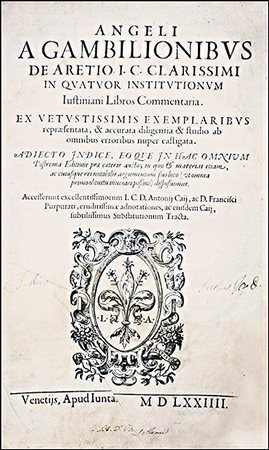
Lotto 107 THE GIUNTINE EDITION OF GAMBIGLIONI COMMENTARY ON JUSTINIAN'S INSTITUTIONS
Gambiglioni, Angelo. In quatuor Institutionum Iustiniani Libros Commentaria. Ex vetustissimis exemplaribus repraesentata, & accurata diligentia & studio ab omnibus erroribus nuper castigata. Adiecto Indice [...] Accesserunt excellentissimorum I. C. D. Antonij Caij, ac D. Francisci Purpurati, eruditissimae adnotationes, ac eiusdem Caij subtilissimus Substitutionum Tracta. Venetijs, Apud Iuntas, 1574 (al colophon: Venetiis, Apud Hieronymum Polum, 1574).
Folio (325x220 mm), XVII century stiff vellum (lightly worn, reinforced by vellum at spine), author name handwritten in sepia ink at spine, ff. 365, [1], 32. At leaf. 100v a fine woodcut with a Arbor Substitutionum.
Scarce Giunti’s edition of the important Gambiglioni’s commentary on Justinian's «Institutiones».
In the same period in which the reorganization of the law in the Pandette was started, Justinian asked the jurists Trebonianus, Teofilo e Doroteo to create a manual that summarized all the items of Roman Law to be used by students in the Empire. That book, the Institutiones, remained in the centuries as a cornerstone of the matter for its completeness and clarity, and it was, for that reasons, utilized by scholars as a skeleton on which to structure their own commentaries.
Angelo Gambiglioni named l'Aretino (m. 1465 ca.) was an Italian jurist and magistrate, teacher of law both at Bologna and Ferrara universities. He wrote many consilia and other law treatises as the famous De Maleficiis (1472), the Tractatus de criminibus (1476) and De testamentibus (1486).
Provenance: brown ink handwritten ownership signature beside the printer device, at title page, Tullius Tertius and, under printing place, another handwritten annotation Ex Lib. D. F (?) Meoni.
References: Only one copy in Italian public libraries, at Università degli Studi di Milano (CNCE 22422). OCLC locates 3 copies in USA (Harvard Law Library, George Washington University Law Library Washington, DC and Pitts Theology Library Candler School of Theology, Atlanta). -
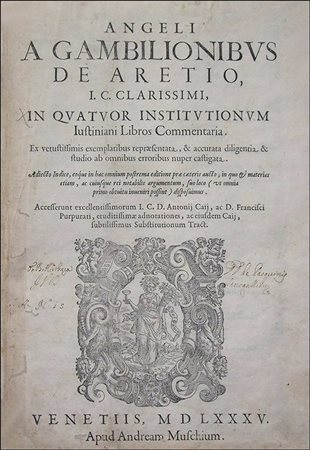
Lotto 108 APPARENTLY ONE COPY IN USA
Gambiglioni, Angelus (Aretinus). Super quatuor libros institutionum commentaria. Venetiis, apud Andream Muschium, 1585.
Folio (310x215 mm), 18th century half vellum on marbled paper, handwritten title at spine, pp. 365, ff. 32.
Uncommon edition of Gambiglioni's commentary to Justinian's «Institutions».
Angelo Gambiglioni was a famous Renaissance criminalist. He composed the treaty De maleficiis , one of the most famous and used law books of the fifteenth century.
References: OCLC 79160302 (apparently only one copy in US libraries of this edition at Berkeley Law Library). -
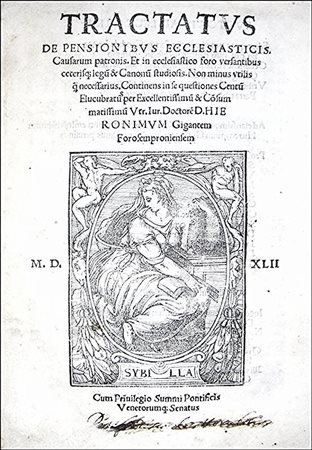
Lotto 109 A FOUNDING TEXT ON ECCLESIASTICAL BENEFITS
GIGANTI, GIROLAMO. Tractatus de pensionibus ecclesiasticis. Causarum patronis. Et in ecclesiastico foro versantibus ceterisque legum & canonum studiosis. ... Continens in se questiones centum elucubratum per ... D. Hieronimum Gigantem Forosemproniensem. Venetiis: impressum, mandato & expensis dominorum Francisci & Michaelis de Tramezinis, a Nicolao Bascarino, mense Maio 1542 (Venice: Tramezzino, May 1542).
4to, contemporary full limp vellum with handwritten titles on spine, ff. [24], 151, [1].
Two large-size woodcut printer’s devices, text in Roman and Italic types.
Rare first edition of a founding reference texts on ecclesiastical benefits printed in the sixteenth century.
Far from works of mere compilation, the Tractatus is characterized by a considerable moral profile, with a complete description of the abuse by the pensions’ beneficiaries and of means to control and repress them.
Girolamo Gigante, prominent canonist and writer, was born in Fossombrone, to the west of Ancona, around the end of the fifteenth century, and studied in Perugia and Bologna. From 1522 he acted as agent of the Duke of Urbino in Venice, and from 1541 he was ecclesiastical adviser to the Republic of Venice.
He was also the author of a remarkable treatise on Crimen Lesae Majestatis, which received considerable praise from a master of the Renaissance’s criminal law as Tiberio Deciani.
References: CNCE 20971. OCLC 28793653. -
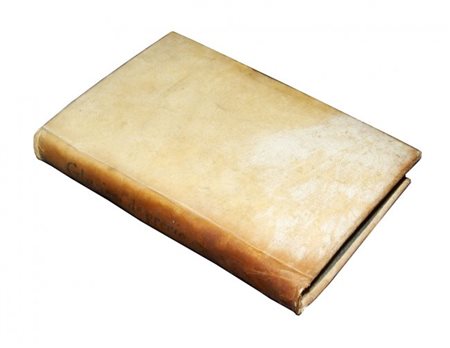
Lotto 110 FIRST EDITION OF THIS SCARCE TREATISE ON PRICES AND VALUE ACCORDING TO THE CIVIL CODE
Giussani, Giulio Cesare. Tractatus de precio et aestimatione secundum ius civile divisus in libros quatuor. Adsunt summaria atque index locupletissimus. Auctore Iulio Caesare Glusiano [...]. Mediolani [Milano]: apud Hieronymum Bordonum [Bordone], 1615.
8vo, 150x98 mm, contemporary full vellum binding, handwritten title at spine, green color sprinkled edges; pp. [24], 220, [4]. Last leaves blank. Editorial woodcut device at title-page (two hands coming out from the clouds: the left one with a palm tree, the other with a stick; motto in the center: "In labore solamen"; in the frame: "Iustus ut palma florebit").
References: IT\ICCU\MILE\007122 (5 copies). OCLC, 10166468 (one copy in USA, at the Harvard Business School, Knowledge and Library Services/Baker Library, Boston) and 60643225 (one copy in USA, at the University of Kansas Archives, Kenneth Spencer Research Library, Lawrence). -
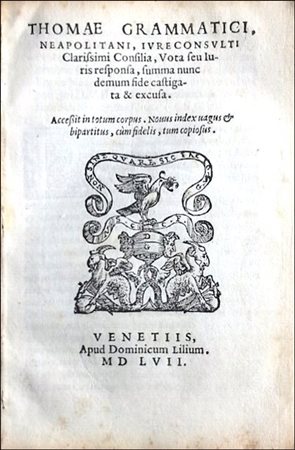
Lotto 111 THE LAW COUNSELS OF THE COUNSELOR OF THE KING OF ARAGON
Grammaticus, Thomas. Consilia, vota seu iuris responsa, summa nunc demum fide castigata & excusa. Accessit in totum corpus. Nouus index uagus & bipartius, cum fidelis, tum copiosus. Venetiis , apud Dominicum Lilium, 1557.
2 parts in a volume 8vo (157x107 mm), contemporary limp vellum with handwritten title at spine, ff. 240, [40].
Two separate title-pages, text on two columns, Roman type.
Fine Venetian edition of the «Counsels» by the Neapolitan lawyer Tommaso Grammatico, contains the same 70 consilia as published in Venice in 1542 under title Allegationes et consilia tam in causis criminalibus quam fiscalibus.
The index is by Giovanni Battista Ziletti.
Tommaso Grammatico was a renowned lawyer under the reign of Ferdinand II of Aragona in the south of Italy. He was created judge by Federico II of Aragon in 1496, fiscal lawyer in 1506 and Royal Counselor in 1535.
Provenance: Some not identified contemporary annotations.
References: CNCE 25840. OCLC 29955386.
V. Ventura, Profilo di Tommaso Grammatico giurista e letterato in «Scritti di St. del Dir. Ital. offerti dagli allievi a Domenico Maffei», edited by M. Ascheri, Padova, 1991, pp. 353-375. -
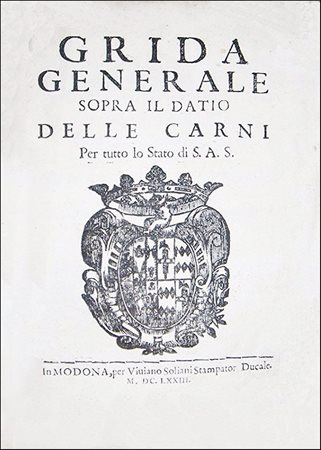
Lotto 112 EXCESSIVELY SCARCE BAN ON THE TAXES OF MEAT IN THE DUCHY OF MODENA
Grida generale sopra il Datio delle Carni per tutto lo Stato di S.A.S Modena, Soliani, 1673.
Scarce, unsophisticated and untrimmed document about the taxes on Meat in Baroque era in North-Italy.
References: Not in OPAC and ICCU, not in OCLC. Apparently the only surviving copy. -
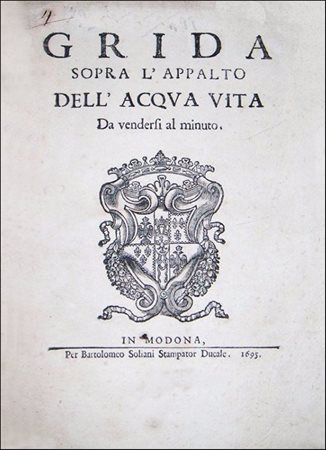
Lotto 113 RARE BAN ON THE TAXES ON GRAPPA IN THE DUCHY OF MODENA
ONLY ANOTHER KNOWN COPY
Grida sopra l'appalto dell'acqua vita da vendersi al minuto In Modena : per Bartolomeo Soliani stampator ducale, 1695.
Rare, unsophisticated and untrimmed document about the taxes on Grappa in Baroque era in North-Italy.
References: Only a copy in ICCU, at Biblioteca internazionale La Vigna (Vicenza). Not in OCLC: out of Italy, no copies in worldwide public libraries. -
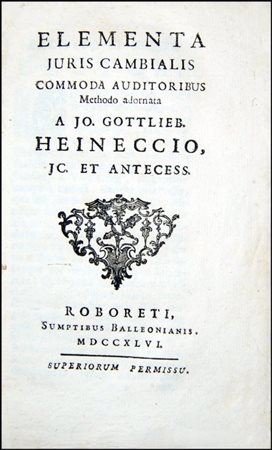
Lotto 114 HEINECKE'S LESSONS OF EXCHANGE LAW, TO WHICH IS ADDED AN ESSAY ON EXCHANGE INSTITUTIONS IN THE ROMAN ERA
Heinecke, Johann Gottlieb. Elementa juris cambialis commoda auditoribus methodo adornata a Jo. Gottlieb. Heineccio, Jc. et antecess. Roboreti [Rovereto]: sumptibus Balleonianis, 1746.
12mo (168x100 mm), original paper binding; pp. [6], 99, [3 b.]; xylographic illustration at title-page; xylographic initials and ornaments.
At leaf D7 the work is followed by another work, with its own title-page: Georgii Henrici Ayreri [...] De cambialis instituti vestigiis apud romanos diatribe.
Johann Gottlieb Heineccius (Heinecke) (September 11, 1681 – August 31, 1741) was a German jurist from Eisenberg, Thuringia. His chief works were: Antiquitatum Romanarum jurisprudentiam illustrantium syntagma (1718); Historia juris civilis Romani ac Germanici (1733); Elementa juris Germanici (1735); Elementa juris naturae et gentium (1737; Eng. trans. by Turnbull, 2 vols, London, 1763).
Georg Heinrich Ayrer (March 15, 1702 in Meiningen; 28 April 1774 in Göttingen) was a German jurist.
Provenance: Private library of a Verona noble family, whose roots are in Mantua and in which there were distinguished lawyers and jurists.
References: IT\ICCU\MILE\003412. OCLC, 41222511 (6 copies in USA). -
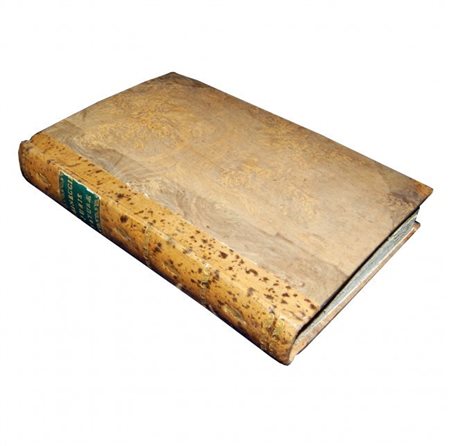
Lotto 115 THE MODERN THEORY OF NATURAL LAW AND INTERNATIONAL LAW, ACCORDING TO ENLIGHTENMENT'S NEW PERSPECTIVES
Heinecke, Johann Gottlieb. Jo. Gottlieb Heinecii Elementa juris naturae et gentium, commoda auditoribus methodo adornata. Editio caeteris italicis longe auctior & castigatior. Neapoli: prostant Venetiis: apud Jo. Baptistam Pasquali, 1776.
8vo (182x118; half sprinkled calf, with marbled paper at boards, gilt title on a green leather label at spine; pp. 504; xylographic printer device at title-page, with motto: Litterarum felicitas.
Johann Gottlieb Heineccius (Heinecke) (September 11, 1681 – August 31, 1741) was a German jurist from Eisenberg, Thuringia. His chief works were: Antiquitatum Romanarum jurisprudentiam illustrantium syntagma (1718); Historia juris civilis Romani ac Germanici (1733); Elementa juris Germanici (1735); Elementa juris naturae et gentium (1737; Eng. trans. by Turnbull, 2 vols, London, 1763).
Provenance: Private library of a Verona noble family, whose roots are in Mantua and in which there were distinguished lawyers and jurists.
References: IT\ICCU\LO1E\040685 (2 copies). OCLC, 797901699. -

Lotto 116 TWO CORNERSTONES IN THE HISTORY OF CIVIL LAW, ACCORDING TO THE JUSTINIAN'S CODES, EXAMINED WITH THE PHILOSOPHICAL AND AXIOMATIC METHOD DEVELOPED BY HEINECKE
Heinecke, Johann Gottlieb.
[1.]: Io. Gottlieb Heineccii [...] Elementa iuris ciuilis secundum ordinem institutionum, commoda auditoribus methodo adornata. Accedunt variorum notae et obseruationes. Editio noua italica ceteris longe auctior et emendatior. Pars I. [-II.]. Mediolani (Milano): apud Ioseph Galeatium Regium typographum, 1779.
[together with:]
[2.]: Io. Gottlieb Heineccii, ic. et antecessoris Elementa iuris civilis secundum ordinem pandectarum commoda auditoribus methodo adornata. Tomus primus [-secundus]. Editio caeteris italicis [...] collata. Papiae (Pavia): in Typographeo R & I. Monasterii S. Salvatoris prasid. rei litterar. permit, 1783.
[1.]: 8vo (192x114; half sprinkled calf, with marbled paper at boards, gilt title on a leather label at spine; 2 parts bound in 1 v.; pp. XIV, 350, [2]; [2], 353-640; xylographic end-pieces.
[2.]: 8vo (192x122; half sprinkled calf, with marbled paper at boards, gilt title on a leather label at spine; 2 vols; pp. XXXXIII, [1], 383, [1]; XXXV, [1], 460 [i.e. 480]. Page 480 misnumbered 460. Xylographic vignette at title-page.
Johann Gottlieb Heineccius (Heinecke) (September 11, 1681 – August 31, 1741) was a German jurist from Eisenberg, Thuringia. His chief works were: Antiquitatum Romanarum jurisprudentiam illustrantium syntagma (1718); Historia juris civilis Romani ac Germanici (1733); Elementa juris Germanici (1735); Elementa juris naturae et gentium (1737; Eng. trans. by Turnbull, 2 vols, London, 1763).
Provenance: Private library of a Verona noble family, whose roots are in Mantua and in which there were distinguished lawyers and jurists.
[2.]: Many inset-supplement leaves in the text, some left blank and others with handwritten study annotations.
References:
[1.]: IT\ICCU\PARE\018637 (10 copies). OCLC, 797465602.
[2.]: IT\ICCU\TO0E\033562 (5 copies). OCLC, 154639863 (one copy in New Zealand, at the Victoria University of Wellington, Kelburn Library). -
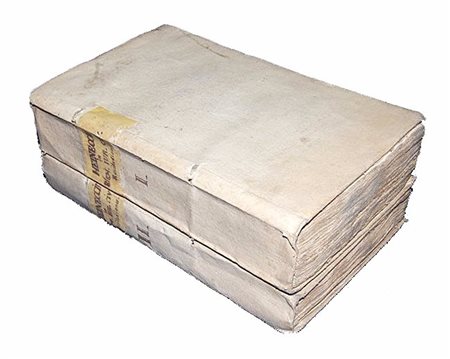
Lotto 117 HEINECKE'S ESSAYS ON CIVIL LAW, TOGETHER WITH OTHER AUTHORS' WORKS: THOMAISIUS'S COMMENTARY ON THE HISTORY OF LAW AND STRUVE'S BIBLIOGRAPHY ON LAW BOOKS
Heinecke, Johann Gottlieb. Io. Gottl. Heineccii [...] Recitationes in Elementa iuris civilis secundum ordinem Institutionum accedunt Io. Christ. Gottl. Heineccii [...] Commentarius de vita, fatis ac scriptis b. parentis auctior emendatior. Christiani Thomasii delineatio historiae juris nec non Burc. Gottelf. Struvii bibliotheca juris selectissima cum notis Hen. Contelmanni [...]. Tom. I. [-II.]. Ticini Regii (Pavia): in typographeo Monast. S. Salvatoris, 1780-1781.
in-8°, 204x134 mm), contemporary paperboards, with handwritten title on label glued at spines; 2 vols; pp. 501 [i.e. 499], [1]; 231, [1], III, [1], 29, [1], [2], 60. Some xylographic illustrations in the text.
Johann Gottlieb Heineccius (Heinecke) (September 11, 1681 – August 31, 1741) was a German jurist from Eisenberg, Thuringia. His chief works were: Antiquitatum Romanarum jurisprudentiam illustrantium syntagma (1718); Historia juris civilis Romani ac Germanici (1733); Elementa juris Germanici (1735); Elementa juris naturae et gentium (1737; Eng. trans. by Turnbull, 2 vols, London, 1763).
Migliorotto Maccioni (1732-1811), graduated in utroque iure, was an Italian jurist and professor of civil law at Pisa.
Christian Thomasius (1655-1728) was a German jurist and philosopher.
Burkhard Gotthelf Struve (1671-1738) was a German polymath and librarian.
Heinecke, Johann Christian Gottlieb (1718–1791), son of Johann Gottlieb, was a Prussian court counselor and professor of the Academy of Liegnitz.
Provenance: Private library of a Verona noble family, whose roots are in Mantua and in which there were distinguished lawyers and jurists.
References: IT\ICCU\PARE\020302. OCLC, 797546953 and 642325852 (one copy in Germany and one copy in Spain). -
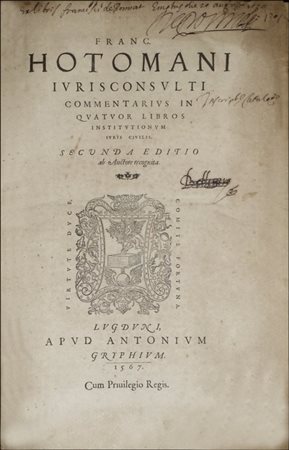
Lotto 118 SECOND EDITION OF HOTMAN'S COMMENTARY ON CIVIL LAW
Hotman, François. Commentarius in quatuor libros Institutionum Iuris Civilis. Secunda editio. Lugduni (Lyon), Gryphius, 1567.
Folio, 18th century calf binding (spine restored), pp. [12], 575, [17] .
Second edition of the renowned commentary of tte French jurist on Justinian's «Institutions».François Hotman was author of fundamental juridical works asAnti Tribonianus and Francogallia, and a great protagonist of the cultural and political debate of his age.
Provenance: 1. Contemporary inscription Francisci de Pomat and large calligraphic signature De Pomatat the upper blank margin of title-page. The owner also indicates the date of the purchase: 20 August 1634.
2. Other previous crossed out inscription Bell (?).
References: OCLC 633730148. -
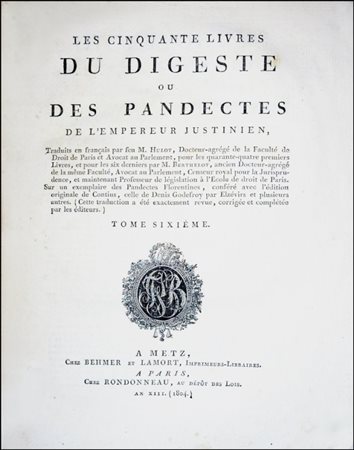
Lotto 119 THE FIRST EDITION IN FRENCH LANGUAGE OF JUSTINIAN'S PANDECTS
Hulot, Henry; Berthelot, Jean-François. Les Cinquante Livres du Digeste ou des Pandectes de l'Empereur Justinien. Metz, Behmer et Lamort, 1803-1804.
6 volumes out of 7, 4to (265x215 mm), original blue paperboard, pp. 28, 597, [3, last blank] at first volume, pp. 603, [1] at second volume, pp. 552, [20] at third, pp. 607, [5, last blank] at forth, pp. 567, [9], at fifth, pp. 616, [4] at sixth. Untrimmed.
First fundamental complete edition in French of Digestus and Pandectae.
Henri Hulot started for the first time the French translation of Corpus Iuris Civilis , the source of the Roman Law, targeting to publish in 1764 the Institutiones : this never happened because of the aversion by his colleagues at the Paris Law University. The edition was printed only from 1803 thanking the perseverance of Behmer and Lamort.
Henry Hulot (1732-1775) was a French Lawyer. When he decided to start the study of the roman law he was disbarred for having abandoned the forensic career. He spent his academic life translating the Digestus, translation never published during his life.
Jean-François Berthelot (18-19th century) was lawyer in the same University of Hulot, advisor of the parliament and of the King as well as law teacher in Gard
The present translation is still used in France and it was chosen as a reference work to be published on-line, Cfr. http://www.histoiredudroit.fr/ corpus_iuris_civilis.html.
References: ICCU, IT\ICCU\NAPE\000896. OCLC, 23099285 -
![[1.]: HUNTING IN PAPAL STATESAPPARENTLY THE ONLY KNOWN COPY[2.]: WOLF HUNTING...](/Upl/Auctions/Cache/828/1657/178231/120-0.jpg/s0_450.jpg)
Lotto 120 [1.]: HUNTING IN PAPAL STATES
APPARENTLY THE ONLY KNOWN COPY
[2.]: WOLF HUNTING IN PAPAL STATES
ONLY TWO KNOWN COPIES
[1.]: Papal States - Ministry Council - cardinal Galleffi (Camerlengo). Editto. Pier Francesco per la misericordia di Dio vescovo di Albano, Card. Galleffi, della S.R.C. camerlengo. Roma: presso Vincenzo Poggioli stampatore camerale, 1826.
[together with:]
[2.]: Apostolic Chamber - cardinal Galleffi (Camerlengo). Notificazione intorno ai premj per la uccisione dei lupi pubblicata dall'Emo e Rmo Signor card. Galleffi camerlengo di S.R. Chiesa li 16. settembre 1828. Roma: nella stamperia della Rev. Cam. Apost., 1828.
[1.]: A poster (580x450 mm), two column text in Italian; xylographic coat of arms of Pope Leo XII, amidst Roman Church's and cardinal Galleffi's arms.
[2.]: 4to (290x205 mm), unbound; pp. 5, (3, b.); text in Italian; xylographic coat of arms of Pope Leo XII, amidst Roman Church's and cardinal Galleffi's arms.
[2.]: Notification regarding the awards for wolf hunting in Papal States.
[1.]: Edict on a new general regulamentation of hunting in Papal States, decided by Pope Leo XII.
The text begins with the words: La conservazione della specie de' quadrupedi e volatili utili, oramai per comun lamento diminuita di molto a cagione degli arbitrarj e distruttivi modi di cacciare [...]. Signer and date at bottom ([Roma] dato in Camera Apostolica li 10. Luglio 1826.).
Pietro Francesco Galleffi (Galeffi) (1770–1837) was an Italian Cardinal. During the Napoleonic period, in 1798, he was expelled from Rome. He was created Cardinal in 1803. Then he was archbishop of Damasco in 1819, Archpriest of St. Peter's Basilica from 1820, Bishop of Albano in 1820, Bishop of Porto and Santa Rufina in 1830, Camerlengo from 1824 to 1837.
Pope Leo XII (1760–1829), born Annibale Sermattei della Genga, was Pope from 28 September 1823 to his death in 1829.
References: [1.]: The document is not in ICCU, which quotes a book on this edict, published on the same day (ICCU\RMSE\092438, available in the Biblioteca consorziale di Viterbo); not in OCLC: no other copy worldwide. Apparently the only extant copy worldwide.
[2.]: ICCU\RMSE\092569 (an only copy registered in the Biblioteca consorziale di Viterbo); not in OCLC: no other copy worldwide. Apparently one of the only two extant copies worldwide. -
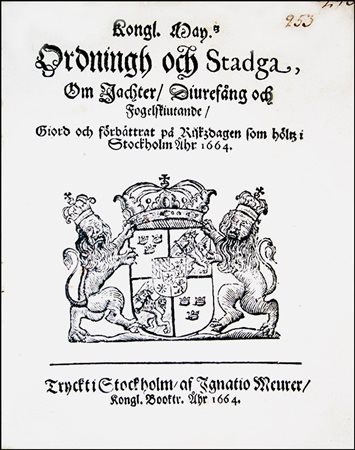
Lotto 121 EXCESSIVELY SCARCE LAW ON THE HUNTING IN SWEDEN
ONLY ANOTHER COPY KNOWN
SWEDEN GOVERNMENT.Kongl. may.tz Ordningh och Stadga, Om Jachter, Diurefång och Fogelskiutande, Giord och förbättrat på Rijkzdagen som höltz i Stockholm åhr 1664. Tryckt i Stockholm, af Ignatio Meurer, kongl. booktr. åhr 1664 (Stockholm: Ignatius Meurer, 1664).
4to, later colored paperboards, pp. [12].
Fine woodcut device at title-page with the royal coat of arms. Printed in Gothic type.
Excessively scarce publication of Sweden Government (dated 19 August 1669 and signed by the Queen Hedwig Eleonora) on hunting regulation in Sweden and Finland.
Hedwig Eleonora of Holstein-Gottorp (23 October 1636 – 24 November 1715) was Queen of Sweden from 1654 until 1660. She was the wife of Charles X Gustav of Sweden and mother of Charles XI. She served as regent during the minority of her son from 1660 until 1672, and during the minority of her grandson Charles XII in 1697. She also represented Charles XII during his absence in the Great Northern War from 1700 until the regency of her granddaughter Ulrika Eleonora in 1713. Hedwig Eleonora was described as a dominant personality and was regarded as the de facto first lady of the royal court for 61 years, from 1654 until her death.
References: OCLC 185352453 (only the copy at National Library of Sweden). -
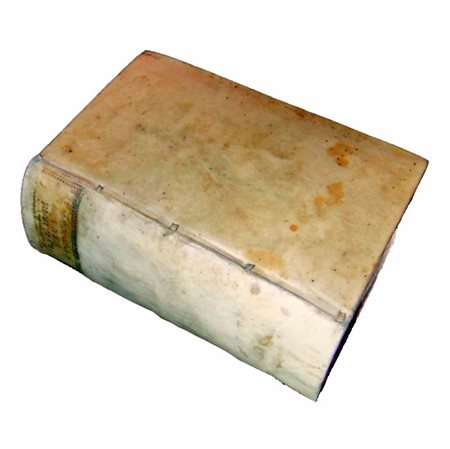
Lotto 122 HUTH'S COMMENTARY ON DECRETALS
NOT IN USA
HUTH, ADAM. Ius Canonicum Ad Libros V. Decretalium Gregorii IX : Explicatum Et Per Quaestiones Ac Responsa In Methodum Brevem Et Claram Redactum. 5, ... De Delictis et Poenis Authore R. P. Adamo Huth e Societatum Jesu, Ss. Canonum Doctore, eormque in Alma Electorali Universitate Heidelbergensi Professore Publico et Ordinario. Augustae Vindelicorum, Sumptibus Mathiae Wollf, 1738 (Augsburg: Wollf, 1738).
8vo, contemporary stiff vellum, red edges.
Xylographic frontispiece.
Good German edition of Huth's commentary on the five books of Pope Gregory IX's Decretals.
Reference: OCLC locates 18 copies worldwide, but no copy in USA. -
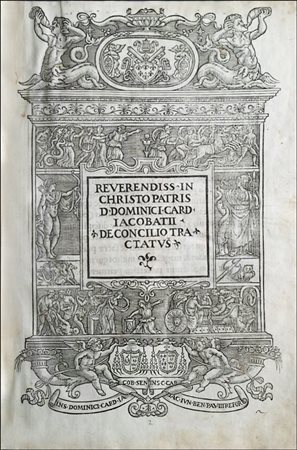
Lotto 123 FIRST EDITION OF THE HISTORY OF THE CHURCH COUNCILS
IACOBAZZI, DOMENICO. Reuerendiss. in Christo patris d. Dominici card. Iacobatii De concilio tractatus. Romae, excudebat Antonius Bladus, mense Octobri anno 1538.
A thick folio (295x196), late 17th century stiff vellum binding with five raised bands, lable and gilt-lettered title, sprinkled edges, pp. [40], 783, [1].
Sumptuous xylographic title-page, numerous head-letters (some with criblé background.
First edition of this exhaustive treatise on the History of Catholic Church Councils.
Domenico Iacobazzi or Giacobazzi (1444–1528) was an Italian Roman Catholic bishop and cardinal, scholar of Christian theology, civil and canon law. He participated in the Fifth Council of the Lateran and became the pope's vicar general. Pope Leo X made him a cardinal priest in the consistory of July 1517. He participated in both the papal conclave of 1521-22 that elected Pope Adrian VI, and in the papal conclave of 1523 that elected Pope Clement VII. In 1524, he became Bishop of Nocera dei Pagani.
References: Fumagalli, 46: «Bell' edizione». OCLC 66082678. -
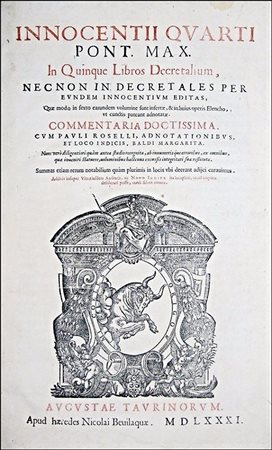
Lotto 124 POPE INNOCENTIUS IV'S COMMENTARY ON DECRETALS: A MILESTONE IN THE HISTORY OF CANON LAW
INNOCENTIUS IV, Pope. Innocentii IIII pont. max. In quinque libros decretalium, necnon in decretales per eundem Innocentium editas, quae modo in sexto earundem volumine sunt insertae, & in huius operis elencho, vt cunctis pateant adnotatae, commentaria doctissima. Cum Pauli Roselli, adnotationibus, et loco indicis, Baldi Margarita. Nunc vero diligentiori quam antea studio recognita, ab innumerisque erroribus, ex omnibus quae inueniri statuere, voluminibus hactenus excusis integritati suae restituta. Summas etiam rerum notabilium quam plurimis in locis vbi deerant adijci curauimus. Additis insuper vita eiusdem auctoris, ac nouo indice ita locupleti, vt nil amplius desiderari posse, certo sciant omnes. Venetiis, apud Iuntas, 1578.
Large folio volume, contemporary stiff vellum, handwritten titles on spine, ff. [24], 236, [32].
Title page with large-size printer’s device, woodcut head-letters, text on two columns.
Pope Innocentius IV’s famous commentary to the Gregorius IX’s decretals —here in a gorgeous edition of late 16th century: a milestone in the history of medieval canon law.
Sinibaldo Fieschi, later pope Innocentius IV (1243-1254), was born in Genoa before 1200. Brilliant scholar in Bologna, of renowned canonists as Laurentius Hispanus, Johannes Teutonicus, Jacobus de Albenga and Vincentius Hispanus as well as civil lawyers as Azo, Jacobus Balduinus and Accursius., after teaching canon law in the same university, soon became one of the most respected jurists in the Roman curia. Appointed, since 1226 Auditor of Audientia litterarum contradictarum, was created cardinal by Pope Gregory IX in 1127, and then elected pope in 1243, after the death of Celestine IV. His pontificate was not easy, marked, among other things, by the deposition of the Emperor Frederick II at the Council of Lyons in 1254.
References: CNCE 28474. OCLC 797733908. -
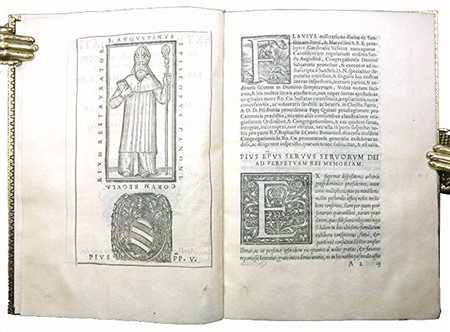
Lotto 125 VERY SCARCE COPY PRINTED ON VELLUM
THE COPY QUOTED BY BRUNET, WITH CARDINAL ORSINI’S SIGNATURE
PIUS V (POPE). EXTENSIO, AMPLIATIO | NOVA CONCESSIO, ET CON- | FIRMATIO PRIVILEGIORVM | SANCTISS. AC BEATISS. D. D. PII | HVIVS NOMINIS V. | PONT. MAX. | IN SACROS ORDINES, ET | CONGREGATIONES CLAUSTRALES. | PRO CANONICIS REGVLARIBVS | ORDINIS S. AUGUSTINI CONGREGATIONIS | DOMINI SALUATORIS. | R O M AE | APUD HAEREDES ANTONIJ BLADI IMPRESSORES CAMERALES. | M. D. LXVII. [Rome, Heirs of Antonio Blado, Cameral Printers, 1567].
4to (226x154 mm), blue morocco modern binding within a box in the same material, gilt frame to covers, five raised bands spine with decorations and letterings printed in gold, ff. [12].
At title-page, woodcut printer’s device with the Christus Salvator Mundi, full-page xylography at verso of title-page representing St. Augustin in episcopal dress and, by his feet, the arms of Pius V. Woodcut initials.
Very scarce copy printed on vellum, with the signature of Cardinal Flavio Orsini and the countersignature of the notary Matteo Boccarini: this is the copy quoted by Brunet in his Trèsor and, afterwards, by Graesse, both recording the presence of this copy on the antiquarian market around the middle of the 19th century.
The book deals with the confirmation and extension of the privileges bestowed by the Pope to the Regular Canons of the Congregation of the Holy Saviour in Lateran, best known as St. John in Lateran. On the 3rd of March of 1566, Pius V appointed Flavio Orsini dean of the Congregation of the Regular Canons of St. Augustin of the Holy Saviour: the original document is stored in the «Archivio Storico Capitolino».
Provenance: Presumably the copy made for the Pope himself, as proven by the use of vellum as printing basis. At verso of the last leaf, official signature Fra: Car.lis Urs.s with countersignature of the notary M. Boccarinus ca: ap: not(aius): he should be Matteo Boccarini from Amelia (near Terni), very close to the Orsini family. Boccarini himself was the notary that wrote the wedding contracts between Federico Sforza of St. Fiora and Beatrice Orsini, to whom Flavio Orsini let a dowry of 22000 scutes (Archivio Orsini, in «Archivio Storico Capitolino», II.A.26,003).
Census: No copy on vellum in Censimento. Also the paper copies are scarce, only 5 copies located in Italian public libraries: Bologna U; Reggio Emilia, Biblioteca Panizzi; Reggio Emilia, Archivio di Stato; Roma, N; Roma, Biblioteca Angelica. There seems to be no copy (unaccountably) at the Vatican Library.
References: The copy quoted by Brunet (IV, 681): «Un exemplaire imprimé sur VÉLIN, accompagné de la confirmation desdits priviléges, par le cardinal Orsini, en manuscrit. 2 liv. 16 sh. Libri, en 1859». Graesse, V, 307: «Il ne existe un ex. tiré sur vélin (15 fr. Mac-Carthy. 2 l. 16 sh. Libri)». For the original manuscript of this work see in «Archivio Storico Capitolino» (Archivio Orsini, II.A.26,005). -
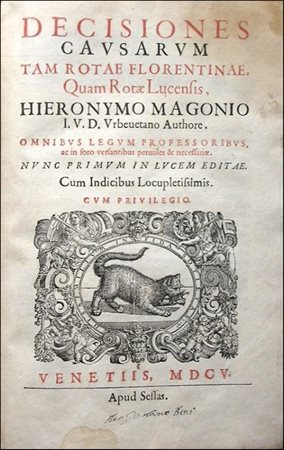
Lotto 126 THE DEFINITIVE EDITION OF THE COLLECTED SENTENCES OF FLORENCE AND LUCCA TRIBUNALS
Magonio, Girolamo. Decisiones causarum tam Rotae Florentinae, quam Rotae Lucensis. Omnibus legum professoribus, ac in foro versantibus perutiles & necessariae. Nunc primum in lucem editae. Cum indicibus locupletissimis.Venetiis, apud Sessas, 1605.
2 parts in a folio volume (325x220 mm), near contemporary vellum binding with handwritten title on four raised bands spine, pp. [56], 346, [70], 263, [1].
The first title-page printed in red and black; thext on two columns, numerous woodcut headletters.
Definitive edition of the collected sentences of Florence and Lucca Courts:it is the reprint of Sessa 1597 edition with the same commentary of the renowned jurist from Orvieto, but enlarged with a conspicuous index.
References: OCLC 14119171. -

Lotto 127 THE MOST COMPLETE EDITION OF THE STATUTES OF THE REPUBLIC OF VENICE, IN WHICH ARE COLLECTED THE CIVIL AND CRIMINAL LAWS FROM THE ELEVENTH CENTURY UNTIL THE EIGHTEENTH CENTURY
[1.]: Novissimum statutorum ac Venetarum legum volumen, duabus in partibus divisum, Aloysio Mocenigo Venetiarum principi dicatum. Venetiis: ex typographia ducali Pinelliana, 1729.
[bound together with:]
[2.]: Leggi criminali del serenissimo dominio Veneto in un solo volume raccolte, e per pubblico decreto ristampate. [Venezia]: Presso li figliuoli del qu: Gio: Antonio Pinelli Stampatori Ducali, 1751.
4to (240x180 mm), half vellum binding with corners, marbled paper at boards, gilt title on a red leather label at spine. Text in Latin and Italian.
[1.]: Leaves [13], 302 leaves, pp. 115, [1]. Printer's device at title-page (in a figured frame a woman, representing the Justice, with a sword in the right hand and a scale in the left, sitting on two lions).
Xylographic image at frontispiece representing the Lion of Saint Mark, holding the paw on the book of the Gospel opened with the words: Pax tibi Marce Evangelista meus. Another xylographic image representing the Lion of Saint Mark at leaf A1r.
Xylographic initials. Title at false title-page: Novissima Veneta statuta.
Important collection of Venetian statutes comprising the first five books of the Doge Giacomo Tiepolo and the sixth of the Doge Andrea Dandolo, the statutes of the judges of the petition formed the year 1244, the ancient laws under the title of Consulta, the Law Pisana issued on 1492, the practice of the Palace of Venice, the corrections of the Doges Barbarigo Loredan, Grimani, Gritti, Trevisan, Cicogna, Memo, Bembo, Priuli, Francesco Contarini, Erizzo, Carlo Contarini, Domenico Contarini and Alvise Contarini.
[2.]: Leaves 233, [1]. Xylographic image representing the Lion of Saint Mark at title-page. Other xylographic image representing the Lion of Saint Mark at leaf A1r.
Original edition of this collection of the criminal laws of the Republic of Venice.
Provenance: Private library of a Verona noble family, whose roots are in Mantua and in which there were distinguished lawyers and jurists.
References:
[1.]: IT\ICCU\VIAE\012929. OCLC, 691918 and 632085449.
[2.]: IT\ICCU\PUVE\003798. OCLC, 14136575. -
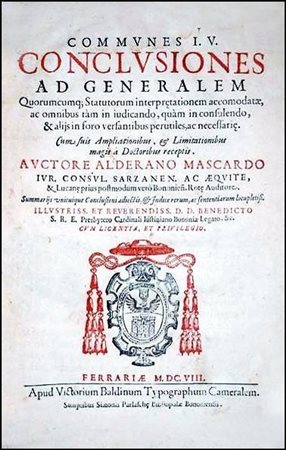
Lotto 128 VERY SCARCE FIRST EDITION OF MASCARDI'S COMMENTARY ON FERRARA STATUTES
APPARENTLY NO COPIES IN USA
Mascardi, Alderano. Commvnes i. v. conclvsiones ad generalem Quorumcumq, Statutorum interpretationem accommodatæ ac omnibus tam in iudicando, quam in consulendo, & alijs in foro versantibus perutiles, ac necessarie: cum suis ampliationibus, & limitationibus magis à doctoribus receptis; summarijs vnicuique conclusioni adiectis, & indice rerum, ac sententiarum locupletiss. Illustriss. et reuerendiss. D.D. Benedicto S.R.E. presbytero cardinali Iustiniano Bononiae legato, &c [...]. Ferrariae, Apud Victorium Baldinum Typographum Cameralem, 1608.
Folio (294x205 mm), full vellum binding, handwritten title at three raised bands spine, pp. [52], 414, [2, last blank]. Titlepage printed in red and black, with Cardinal coat of arms, xylographic headletters and decorations at preliminary pages.
Very scarce first edition of Mascardi's commentary on Ferrara Statutes.
Alderano Mascardi (1557-1607) was a jurist, brother of the more famous Giuseppe. He spent his career working on criminal and civil trials in Tuscan and Emilia, under the Doria family of Genoa, that supported him to become auditor for the Rota of Lucca, where he worked from 1602 to 1604, and for the Rota of Bologna, from 1604 to his death. The Conclusiones contained in this volume come from his activity as auditor, and are a representation of the Statutes of Ferrara based on custom. The subjects are organized by argument, and each detailed discussion is preceded by a general summary.
Provenance: Twinge handwritten annotations at external margin of p. 263.
References: Fontana, pars I, col. 633. Sapori, I, 1816 (imperfect). No copies in USA (OCLC 79045898 for the edition printed in Turin). Fontana, pars I, col. 633. Sapori, I, 1816 quotes only an incomplete copy. -
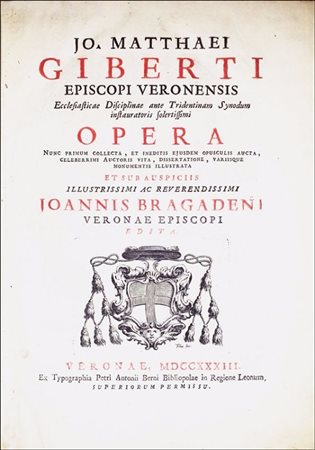
Lotto 129 FIRST EDITION OF GIBERTI'S COLLECTED WORKS, CONTAINING THE FAMOUS CONSTITUTIONES GIBERTINAE
Giberti, Matteo.Opera nunc primum collecta, et ineditis ejusdem opusculis aucta ... auctoris vita, dissertatione, variisque monumentis illustrata [by Petrus and Hieronymus Ballerinius]. et sub auspiciis illustrissimi ac reverendissimi Joannis Bragadeni Veronae episcopi edita. Veronae: Ex typographia Petri Antonii Berni, 1733.
Small folio, 19th century half calf, pp. [16], civ, 356.
One engraved plate with the bishop Giberti at the beginning of the Constitutions.
The Appendix contains: P.F. Zini Boni pastoris exemplum, ac specimen singulare ex I.M.G. ... expressum, atque propositum; A. Castiglionei orationem funebrem Italicam de ipsius Giberti laudibus: A. Fumani alteram Latinam funebrem laudationem, etc.
Title vignette; head- and tail-pieces, initials.
Most text in Latin, with some in Italian.
First edition of Giberti's Collected Works, edited by the philologists Pietro and Girolamo Ballerini, also containing the Constitutiones Gibertinae, both in Latin and Italian version.
Gian Matteo Giberti (1495–1543) was an Italian diplomat, Bishop of Verona.
Giberti was chosen a member of the Consilium de Emendanda Ecclesia, the reform committee decreed by the Fifth Lateran Council, but political events soon put an end to these labours. At Pavia (1525) he tried to make peace between Francis I of France and Charles V. It was at his prompting that Clement VII espoused the cause of France; the League of Cognac (22 May 1526) was also his work.
After the Sack of Rome (1527) he was put in prison and barely escaped death. He succeeded in making his escape, and went to Verona (1528) intending to devote himself to his diocese. He was done with politics, all the more because the pope had gone over to the imperial cause. However, he appeared from time to time in the Curia. Pope Paul III recalled him to Rome for the work of the Reform Committee; among other missions he was sent to Trent to make preparations for the council.
His efforts to reform his diocese, whose clergy were in a deplorable state, were crowned with success. The Tridentine reforms were put in force long before the council assembled. St. Charles Borromeo, before taking charge of his see at Milan, wished to study Giberti's system at Verona, and chose as his vicar-general a priest from Verona trained in Giberti's school.
His first aim was to improve the standard of ecclesiastical knowledge. In his own palace he set up a printing-press which turned out numerous editions of the Greek Fathers, in whose writings he was very learned. He reformed the choir-school of Verona; for the instruction of the young he had printed the catechism known as Dialogus, the work of Tullio Crispoldi (1539). -
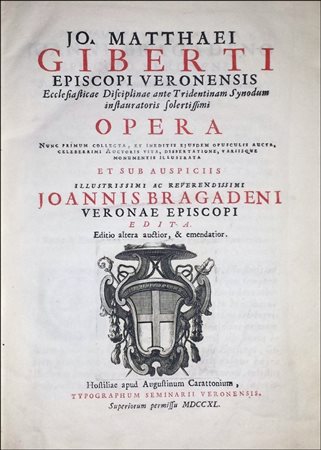
Lotto 130 SECOND EDITION OF GIBERTI'S COLLECTED WORKS, CONTAINING THE FAMOUS CONSTITUTIONES GIBERTINAE
Giberti, Matteo.Opera nunc primum collecta, et ineditis ejusdem opusculis aucta ... auctoris vita, dissertatione, variisque monumentis illustrata [by Petrus and Hieronymus Ballerinius]. Hostiliae (Ostiglia), Apud A. Carattonium, 1740..
Small folio, contemporary stiff vellum, pp. 349.
One engraved plate with the bishop Giberti at the beginning of the Constitutions.
The Appendix contains: P.F. Zini Boni pastoris exemplum, ac specimen singulare ex I.M.G. ... expressum, atque propositum; A. Castiglionei orationem funebrem Italicam de ipsius Giberti laudibus: A. Fumani alteram Latinam funebrem laudationem, etc.
Title vignette; head- and tail-pieces, initials.
Most text in Latin, with some in Italian.
Second edition of Giberti's Collected Works, edited by the philologists Pietro and Girolamo Ballerini, also containing the Constitutiones Gibertinae, both in Latin and Italian version.
Gian Matteo Giberti (1495–1543) was an Italian diplomat, Bishop of Verona.
Giberti was chosen a member of the Consilium de Emendanda Ecclesia, the reform committee decreed by the Fifth Lateran Council, but political events soon put an end to these labours. At Pavia (1525) he tried to make peace between Francis I of France and Charles V. It was at his prompting that Clement VII espoused the cause of France; the League of Cognac (22 May 1526) was also his work.
After the Sack of Rome (1527) he was put in prison and barely escaped death. He succeeded in making his escape, and went to Verona (1528) intending to devote himself to his diocese. He was done with politics, all the more because the pope had gone over to the imperial cause. However, he appeared from time to time in the Curia. Pope Paul III recalled him to Rome for the work of the Reform Committee; among other missions he was sent to Trent to make preparations for the council.
His efforts to reform his diocese, whose clergy were in a deplorable state, were crowned with success. The Tridentine reforms were put in force long before the council assembled. St. Charles Borromeo, before taking charge of his see at Milan, wished to study Giberti's system at Verona, and chose as his vicar-general a priest from Verona trained in Giberti's school.
His first aim was to improve the standard of ecclesiastical knowledge. In his own palace he set up a printing-press which turned out numerous editions of the Greek Fathers, in whose writings he was very learned. He reformed the choir-school of Verona; for the instruction of the young he had printed the catechism known as Dialogus, the work of Tullio Crispoldi (1539).
At Verona, moreover, he gathered around him a group of learned men to assist him in his efforts at reform. -
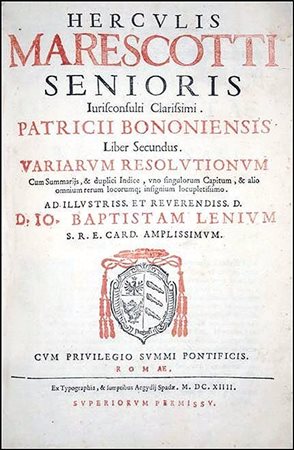
Lotto 131 RARE FIRST EDITION OF MARESCOTTI'S REPERTORY OF LAWSUITS
ONLY ONE COPY IN USA
Marescotti, Ercole. Variarum Resolutionum, Liber Primus, & Secundus. Inquibus selectiores Utriusque iuris materiae tam beneficiales, quam prophanae, quae apud omnia tribunalia frequentius in disputationem veniunt; necnon dubia, & quaestiones, [...] adducuntur [...]. Romae, Ex Typographia, & Sumptibus Aegydii Spadae, 1614.
Two volumes bound together, folio (313x215 mm), vellum binding with handwritten titles at spine, boards enriched by handcolored paper, edges sprayed in red and blue ink, ff. [20], 224, [4], 307, [145]. Titlepages printed in red and black, xylographic Cardinals coat of arms, typographical small hands at margins, xylographical decorations and headletters along the volume, text on two columns.
Scarce first edition of Resolutiones by Marescotti, that provides jurists, magistrates and students with a collection of real cases from Inheritance Law to Emphyteusis, from Commercial to Civil Law.
Ercole Marescotti (m. 1621) was a famous Italian jurisconsultant, belonging to an old noble family from Bologna.
Provenance: at titlepages sepia ink handwritten ownership signatures, Ex Libris de Vincentij de Ravanis I.C. beside the coat of arms.
Bibliography: Fontana, pars I, col. 621. Not in Sapori, that only mentions the Venetian edition of 1625 (I, 1784), the only Marescotti’s work present in the catalogue. OCLC 427998602 locates in USA only the copy at University of Michigan Law Library. -
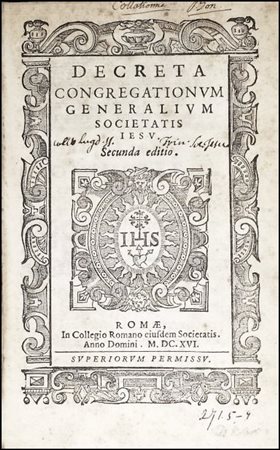
Lotto 132 SECOND EDITION OF THE DECREES OF THE SOCIETY OF JESUS
Various Authors (Jesuit Fathers). Decreta congregationum generalium Societatis Iesu. Secunda editio. Rome: in Collegio Romano eiusdem Societatis, 1616.
Large 8vo, 18th century calf (spine restored), blue edges, pp. [8], 560, [32].
Title within ornamental woodcut border. Xylographic device with the monogram of the Society of Jesus at title-page. Woodcut head- and tailpieces, woodcut initials. Printed marginal notes.
Second edition of the Jesuits Decrees (first printed in 1615), contains decrees of the first seven General Congregations, wanted by the of Superior General of the Society of Jesus, Claudio Aquaviva.
The edition was printed by the typography of the Roman College of the Jesuits.
References: Backer & Sommervogel, V, 96. IT\ICCU\UM1E\003237. OCLC, 38167643 (four copies in USA). -
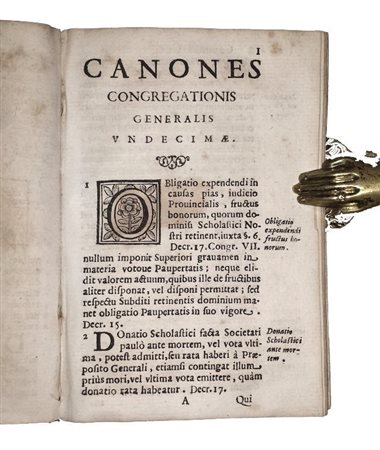
Lotto 133 EXCESSIVELY SCARCE COLLECTION OF JESUIT’S CANONS AND DECREES
NOT IN USA
1. Indiculus decretorum easdem res tractantium In Congregationibus Generalibus Societatis Iesu Confici iussus a Congregatione VIII. Decreto XIV. Editio Secunda auctior & emendatior. Romae, Typis Varesij, 1662.
[bound with:]
2.Vitelleschi, Muzio. Epistola reuerendi p.n. generalis Mutij Vitelleschi ad patres, et fratres Societatis Iesu [...] [Dated at end: Romae 15. Nouemb. 1639]
[bound with:]
3-4-5. Decreta congregationis octauae [nonae et decimae ] generalis [after 14. IV. 1646].
[bound with:]
6. Piccolomini, Francesco. Ordinatio pro studijs superioribus ex deputatione, quae de illis habita est in Congregatione nona generali. A R.P.N. Francisco Piccolomineo ad prouincias missa. Anno 1651
[bound with:]
7. Decreta congregationis generalis vndecimae
[bound with:]
8-9-10. Canones Congregationis generalis octauae [ nonae et decimae ]
[bound with:]
11. Canones Congregationis generalis vndecimae
[bound with:]
12. Instructio Pro administratione rerum temporalium collegiorum, ac domorum probationis Societatis Iesu. [S.l. s.n., not before 1646: publication date based on References in text (p. 1) to the Eighth General Congregation of the Jesuits, which took place in 1646].
[bound with:]
13. Regulae, quae a patribus reuisoribus generalibus Romae in recognoscendis nostrorum libris, ac scriptis obseruandae sunt .
[bound with:]
14. Deputatio pro ordinationibus non impressis recognouit, iuxta congregationis octauae praescriptum, censuras, & praecepta, generaliter hominibus societatis imposita.
[Probably all printed in Rome by Varesi, after the half of 17th century].
8vo (147x100 mm), limp marbled paperboards, pp. 93, [7, the last two blanks] for the first work; 221, [1, blank], 79, [9], 35, [1, blank], 25, [5, the last blank], 18, [12, the last 4 blanks], 6, [2], 16, 8, 13, [3, blanks]. Some woodcuts headletters and tail-pieces.
Excessively scarce collection of 14 conference publications containing decrees, letters, rules, congresses and canons relating to the Company of Jesus.
References:
1. OCLC 6718315 locates 3 copies —none in USA. Not in Backer-Sommervogel.
2. OCLC 775006721: only a copy worldwide, located at St. Louis University (Missouri). This Vitelleschi’s work is commonly known as De anno saeculari Societatis. See Backer-Sommervogel, v. 8, column 849, no. 7 and v. 5, column 114.
3-4-5. OCLC 40208901 locates only a copy in USA, at University of Chicago Library, that doesn’t owns the 11th Decree (no. 7).
6. Not in USA. OCLC, 560529901: the copy of British Library (UK). Not in Backer-Sommervogel. See volume 6, column 700.
7. Not in USA. OCLC 276917578 (BL). Not in Backer-Sommervogel.
8-9-10. Not in USA. OCLC 560513606 for the octava, OCLC 560513615 for the nona and OCLC 560513626 for the decima (all in British Library).
11. Not in USA. OCLC 560513635 (British Library). -
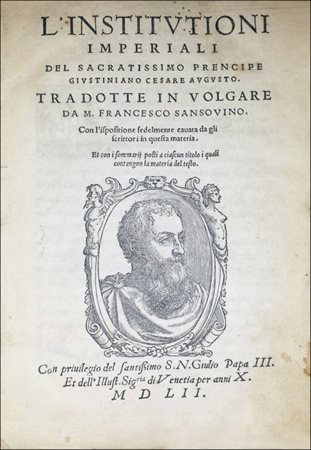
Lotto 134 FIRST EDITION IN ITALIAN LANGUAGE OF JUSTINIAN’S INSTITUTIONS
[Sources of Western Law] Justinianus-Sansovino (translator). L’Institutioni imperiali del sacratissimo prencipe Giustiniano Cesare Augusto. Tradotte in volgare da Francesco Sansouino. Con l’ispositione fedelmente cauata da gli scrittori in questa materia, e con i sommarij posti a ciascun titolo, i quali contengono la materia del testo. Venice: Bartolomeo Cesano, 1552.
4to, contemporary paperboards, ff. [4], 173 [i.e. 175], [1]. It lacks the leaves C2 and C3.
Rare first edition in Italian language of Justinian’s Institutions, the foundation of Roman Law, in the polite translation of Francesco Sansovino.
References: Cnce, Censimento, 13497. -
![AN UNCOMMON VENETIAN EDITION OF THE JUSTINIAN'S CODES[1.]: Iustinianus...](/Upl/Auctions/Cache/828/1657/178246/135-0.jpg/s1_450.jpg)
Lotto 135 AN UNCOMMON VENETIAN EDITION OF THE JUSTINIAN'S CODES
[1.]: Iustinianus Augustus - Accursius - Persius. Digestum vetus seu Pandectarum iuris ciuilis tomus primus [...] Commentarijs Accursii, et multorum insuper aliorum iurisconsultorum tam veterum, quam neotericorum, praecipue autem Antonii Persii scholijs, atque obseruationibus illustratus. Editio postrema. Venetiis: [Francesco De Franceschi, Gaspare Bindoni il vecchio, eredi di Niccolò Bevilacqua, Damiano Zenaro], 1575 (Venetiis: 1574).
[together with:]
[2.]: Iustinianus Augustus - Accursius - Leconte. Codicis dn. Iustiniani sacratissimi principis pp. Augusti repetitae praelectionis libri XII. Accursii commentarijs, & multorum veterum ac recentiorum iurisprudentium annotationibus tam ad textum, quam ad glossas, recens illustrati , mendisque quam plurimis passim repurgati: additis & restitutis quibusdam Graecis constitutionibus, [...] Accesserunt his Fasti regij et consulares vsque ad Iustiniani mortem [...] Antonio Contio auctore. Editio postrema. Venetiis: [Francesco De Franceschi, Gaspare Bindoni il vecchio, eredi di Niccolò Bevilacqua, Damiano Zenaro], 1574.
[1.]: 4to (248x174 mm), contemporary full vellum, three raised bands at spine, calligraphic title at bottom edge; pp. [172], 1493 [i.e. 1509], [1] leaf of folded table. Title-page and text in red and black types. A printers' device at title page, with the symbols (Pace, Occhio, Pazienza, Salamandra) and the initials (FS, GB, NB, DZ) of the printers (F. De Franceschi, G.Bindoni il vecchio, eredi di N. Bevilacqua e D. Zenaro). Xylographic initials and ornaments. Folded table between p. 80 and 81 with an engraving representing the tree of jurisditions (Arbor Iurisdictionum).
[2.]: 4to (248x170 mm), contemporary full vellum, three raised bands at spine, calligraphic title at bottom edge; [36] l., 2640 col., [28] leaves. Title-page and text in red and black types. A printers' device at title page, with the symbols (Pace, Occhio, Pazienza, Salamandra) and the initials (FS, GB, NB, DZ) of the printers (F. De Franceschi, G.Bindoni il vecchio, eredi di N. Bevilacqua e D. Zenaro). Xylographic initials and ornaments.
Accursius (in Italian Accursio, Accorso or also Accorso di Bagnolo; c. 1182-1263) was a Roman jurist. He is notable for his organization of the glosses, the medieval comments on Justinian's codification of Roman law, the Corpus Juris Civilis. He was not proficient in the classics, but he was called "the Idol of the Jurisconsults".
Antonio Persio (1542-1597) was an Italian philosopher, theologian and jurist.
Antoine Leconte (Antonio Conti)(1517-1586) was a French jurist, famous for his attacks on Calvin.
Iustinianus Augustus (Justinian I, 482-565), sometimes known as Justinian the Great, was a Byzantine (East Roman) emperor from 527 to 565. During his reign, Justinian sought to revive the empire's greatness and reconquer the lost western half of the historical Roman Empire. -
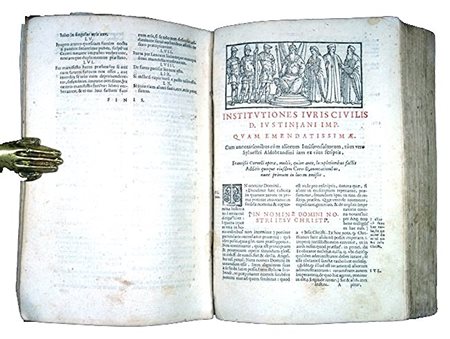
Lotto 136 NICE POCKET EDITION OF JUSTINIAN'S INSTITUTIONS
[Sources of Western Law, Institutions] Justinianus. Institutiones iuris ciuilis d. Iustiniani Imper. Accuratius quam unquam antea recognitae, atque emendatae. Cum omnibus Siluestri Aldobrandini, & aliorum clarissimorum iurisconsultorum annotationibus hactenus impressis. Quibus hac nouissima omnium editione accesserunt praeclarae Francisci Cornelli Brixiani annotationes, nunc primum editae, [...] Praeterea XII tab. quae extant fragmenta: varietas lectionum: index rerum, & verborum memorabilium, aptissime dispositus. Venice: Giunti, 1581.
A thick volume in 8vo, contemporary limp vellum, ff. [50], 391, [1].
Entirely printed in black and red and illustrated with a woodcut representing the Justice (the Emperor Justinian among his counsellors).
Nice pocket size Giunti edition in two colors of Justinian’s Institutions, with the commentary of the Florentine lawyer Silvestro Aldobrandini (1499-1558), father of Ippolito, the future Pope Clemens VIII and the Brixia jurist Francesco Cornello (sec. XV) that was teacher of the young Ippolito Aldobrandini.
References: Cnce, Censimento, 13484. OCLC, 797779912. -
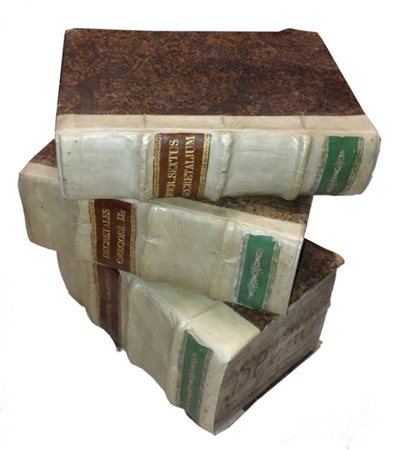
Lotto 137 A CORNERSTONE OF MEDIEVAL CANON LAW
Gratianus. Decretum Gratiani emendatum et notationibus illustratum una cum glossis, Gregorii XIII Pont. Max iussu editum.
(Together with:)
Liber sextus decretalium D. Bonifacii Papae VIII suae integritati una cum Clementinis & Extravagantibus, earumque glossis restitutus…
(Together with:)
Decretales D. Gregorii Papae IX suae integratati unà cum glossis restitutae, cum Gregorii XIII Pont. Max. & aliorum Principum. Romae, in Aedibus Populi Romani, 1584.
3 thick volumes in 4to (240x180 mm), 18th century half vellum, two labels with gilt-lettered titles at three raised bands spine, pp. [88], 1904, [28], two folding xylographic plates with genealogical trees; pp. [8], 592, [2], 243, [6], 262, [42], woodcut title-page at Constitutiones Clementinas, two other folding xylographic plates with genealogical trees; pp. [56], 1388, a xylographic plate representing the enthroned pope surrounded by the Fathers of the Church.
Woodcut devices at title-pages, woodcut head-letters.
Text in Latin on two columns, surrounded by the commentary and notes.
A good Roman edition of this cornerston of Medieval Canon Law, printed by the heirs of Aldus Manutius in their Roman Press.
Around 1140 in Bologna, the Camaldolese monk and canon law jurist Francis (or John) Gratian collected —under the significant title of Concordia discordantium canonum (afterwards better known as Decretum magistri Gratiani)—, papal decrees, councils’ canons, abstracts from the Church Fathers, from Roman law’s sources written before Justinianus, from the Lex romana Visigothorum and the Capitolari Carolingi. This compilation of documents was the first and main source of Canon law until the promulgation of the Codex iuris canonici, in 1917.
Provenance: Some not identified contemporary annotations.
References: OCLC 634747100. -
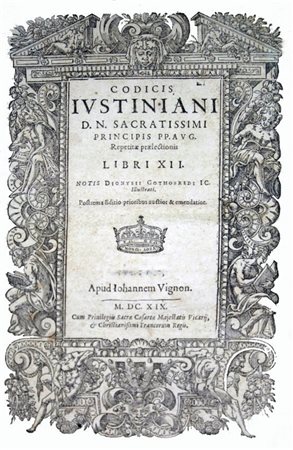
Lotto 138 THE FOUNDING WORK OF WESTERN LAW WITH GODEFROY'S COMMENTARY
[Sources of Western Law] Justinianus. Corpus ivris civilis, in IIII. partes distinctum. Qvarvm prima continentvr indices omnium iuris titulorum. Institutionum libri IIII. Digestorum seu Pandectarum libri L. Quae reliquis partib. includantur, quinta docebit pagina. His accesserunt notae repetitae tertiae quartaéque praelectionis Dionysio Gothofredo ic. authore: quibus, inter caetera, variae lectiones, leges similes, contrariae, abrogatae; verborum, legúmque difficilium interpretationes, selectae repetitiones, argumentata, compendia, atque epitomata, anni singulis. Codicis legibus additi, continentur. His additae sunt Institutionum, Nouellarum Iustiniani, Leonis & Feudorum epitomae ad ordinem Edicti perpetui compositae: eodem authore. Geneve, Vignon, 1619.
2 thick volumes in 4to, contemporary stiff vellum (spines worn), ff. [32], pp. 16, 17-126 columns. 2018 columns, ff. [8], 972 columns, ff. [4], 568 columns.
The Lyon edition (with Godefroy's Commentar) of the founding work of the Western Law.
References: ICCU, 019730 (2 copies). OCLC, 17403547 (4 copies in USA). -
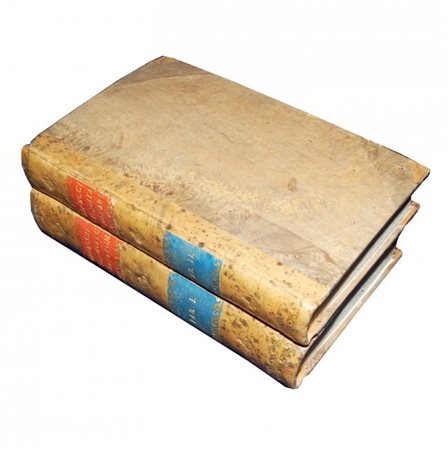
Lotto 139 AN EXTENSIVE TREATISE ON ROMAN LAW ACCORDING TO JUSTINIAN'S CODES
Heinecke, Johann Gottlieb. Jo. Gottlieb. Heineccii [...] Antiquitatum Romanarum jurisprudentiam illustrantium Syntagma secundum ordinem Institutionum Justiniani digestum, in quo multa juris Romani atque auctorum veterum loca explicantur, atque illustrantur. Pars prima [-secunda]. Venetiis: ex Typographia Balleoniana, 1764.
12mo (152x100; half leather binding, with marbled paper at boards, gilt title at spine; 2 vols.; pp. XXIV, 562, [2]; 455, [1], [1] leaf of folded table; xylographic device at title-page (a crowned double-headed eagle); xylographic initials and ornaments.
Johann Gottlieb Heineccius (Heinecke) (September 11, 1681 – August 31, 1741) was a German jurist from Eisenberg, Thuringia. His chief works were: Antiquitatum Romanarum jurisprudentiam illustrantium syntagma (1718); Historia juris civilis Romani ac Germanici (1733); Elementa juris Germanici (1735); Elementa juris naturae et gentium (1737; Eng. trans. by Turnbull, 2 vols, London, 1763).
Provenance: Private library of a Verona noble family, whose roots are in Mantua and in which there were distinguished lawyers and jurists.
References: IT\ICCU\MILE\007219. OCLC, 800918156, 807213154 (two copies in Spain) and 67009204 (one copy in USA, one copy in France; one copy in the Netherlands and one copy in South Africa). -
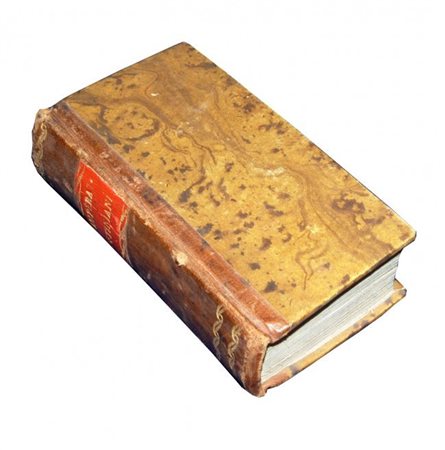
Lotto 140 VERY SCARCE POCKET EDITION OF THE JUSTINIAN'S CODES
NO COPY OUT OF ITALY
Iustinianus Augustus. Imperatoris Iustiniani Institutionum libri 4. Adiecti sunt ex digestis tituli de verborum significatione et de regulis iuris. Et in hac quoque impressione Institutionum Epitome Dionysij Gothofredi I.C. Cum indice ad eosdem & facili, & breui. Venetiis: apud Nicolaum Pezzana, 1672.
24mo (106x52 mm), half leather binding, marbled paper at boards, gilt title on a red leather label at spine, marbled edges; pp. 406, [26]. Title-page in black types in a double rulers frame, with an engraved ornamental lily.
Iustinianus Augustus (Justinian I, 482-565), sometimes known as Justinian the Great, was a Byzantine (East Roman) emperor from 527 to 565. During his reign, Justinian sought to revive the empire's greatness and reconquer the lost western half of the historical Roman Empire.
Justinian achieved lasting fame through his judicial reforms, particularly through the complete revision of all Roman law, something that had not previously been attempted. The total of Justinian's legislature is known today as the Corpus juris civilis. It consists of the Codex Iustinianus, the Digesta or Pandectae, the Institutiones, and the Novellae.
In particular, the
Denis Godefroi (Dionysius Gothofredus, 1549-1622) French jurist and law professor.
Provenance: Private library of a Verona noble family, whose roots are in Mantua and in which there were distinguished lawyers and jurists.
Handwritten ownership inscription at title page (Joseph Maria Resinus).
References: IT\ICCU\RMSE\082323 (2 copies). OCLC, 797327656. No copies of this edition out of Italy.
Title-page a bit worn and soiled (spots and lack of paper at bottom and top corners). Overall, a good copy. -

Lotto 141 AMUSING PORTABLE EDITION OF JUSTINIAN'S INSTITUTIONS
ONLY ONE COPY IN USA
[Source of Western Law, Handbook] Justinianus. Imperatoris Justiniani institutionum libri quatuor. Adjecti sunt ex Digestis Tituli de verborum significatione, & de Regulis Juris [...] Patavii, Typis Seminarii, Apud Ioannem Manfrè, 1754.
12mo (145x77 mm), red paperboard, sepia ink handwritten titles on red paper label, pp. 262 [missing last blank]. Xylographic head-letters and decorations at preliminary leaves.
Uncommon edition of Justinian’s Institutiones in pocket size, to be used by professor, students and lawyers.
In the same period in which it had started the Law reorganization in the Pandectae, Justinian asked the jurists Trebonianus, Theophilus e Dorotheus to create a manual that summarized the items of the Roman Law to be used by the students of the Empire. The Institutiones remained, along the centuries, a cornerstone of the matter because of the clarity and completeness, and for that reasons were utilized by the most important scholars as a skeleton to build their own commentary on it.
The text is followed by two indexes, quoting the specific terms used and the paragraphs where to find the definitions of the basic rules or Roman law.
References: IT\ICCU\TO0E\045911 (only four copies in Italian public libraries). OCLC 799215709 locates only 1 copie in USA (Yale). -
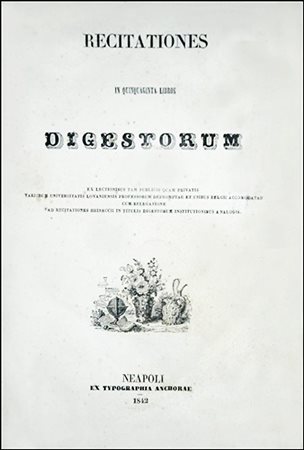
Lotto 142 SCARCE EDITION OF JUSTINIAN'S DIGEST FOR BELGIAN UNIVERSITIES
Justinian. Recitationes in quinquaginta libros Digestorum; ex lectionibus ... variorum professorum depromptae et usibus Belgii accommodatæ, cum relegatione ad recitationes Heinecci, in titulis Digestorum Institutionibus analogis. Neapoli, ex typographia Anchorae, 1842.
Large 8vo, contemporary half vellum with label and gilt title on spine, pp. 723.
Scarce Neapolitan edition of Justinian's Digest for the use of Belgium universities.
References: OCLC, 504618972 (the British Library copy). -
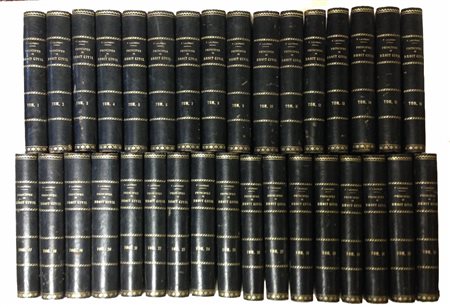
Lotto 143
THE RENOWNED LAURENT'S «PRINCIPES DE DROIT CIVIL», A FUNDAMENTAL CORNERSTONE OF FRENCH CIVIL LAW
Laurent, François. Principes de droit civil. Bruxelles: E. Bruylant; Paris: A. Chevalier-Marescq, 1887.
33 volumes in large 8vo, contemporary half blue morocco on marbled paper. Each volume contains approximately 500-600 pages.
Fourth edition of the celebrated Laurent's «Principles of Civil Law», first published between 1869 and 1878: the work was so successful that, already in 1879, the French Minister of Justice commissioned the author to prepare a report with a proposal for a revision of the French Civil Code.
François Laurent (1810-1887), was a French jurist, professor at Gand.
He was inspired by liberal and anticlerical ideas, that showed both in behavior and in his writing, gaining enemies and disagreements: but the integrity of his conduct meant that he kept the chair until his death.
References: OCLC 61645274. -
![TWO YEARBOOKS FOR THE LOMBARD-VENETIAN KINGDOM:[1.]: IMPERIAL ROYAL ALMANAC...](/Upl/Auctions/Cache/828/1657/178255/144-0.jpg/s1_450.jpg)
Lotto 144 TWO YEARBOOKS FOR THE LOMBARD-VENETIAN KINGDOM:
[1.]: IMPERIAL ROYAL ALMANAC FOR THE PROVINCES OF THE LOMBARD-VENETIAN KINGDOM FOR THE YEAR 1839
[2.]: TERRITORIAL ORGANIZATION OF THE PROVINCES OF THE VENETO REGION IN THE LOMBARD-VENETIAN KINGDOM IN THE YEAR 1853
[1.]: Almanacco imperiale reale per le provincie del Regno Lombardo-Veneto soggette al governo di Milano per l'anno 1839. Milano: dall'I. R. Stamperia, [1839].
[together with:]
[2.]: Compartimento territoriale delle provincie venete, attivato col primo luglio 1853. Allegato al n. 80 puntata 6, parte 1 del Bollettino delle leggi e degli atti ufficiali per le provincie venete del 1853. Venezia: dall'I.R. priv. stab. naz. di G. Antonelli, 1853
[1.]: 8vo (250x164 mm), editorial paper binding; pp. XXXII, 612; emblem with a double-headed eagle at title-pages.
[2.]: 8vo (247x156 mm), marbled paper board binding, with handwritten title on a paper label at front board; pp. 339; vignette at title-page with the crowned twice-headed eagle of the Lombard-Venetian Kingdom.
The Kingdom of Lombardy-Venetia (1815-1866) (Italian: Regno Lombardo-Veneto, German: Königreich Lombardo–Venetien), commonly called the Lombardo-Venetian Kingdom, was a constituent land (crown land) of the Austrian Empire. It was created in 1815 by resolution of the Congress of Vienna in recognition of the Austrian House of Habsburg-Lorraine's rights to Lombardy and the former Republic of Venice after the Napoleonic Kingdom of Italy, proclaimed in 1805, had collapsed.
Administratively the Kingdom of Lombardy-Venetia comprised two independent governments (Gubernien) in its two parts (Lombardy and Venetia), which officially were declared separate crown lands in 1851. Lombardy was annexed to Sardinia in 1859 and the kingdom ceased to exist when the rest of its territory was annexed to the Kingdom of Italy in 1866.
The Kingdom of Lombardy–Venetia was first ruled by Emperor Francis I from 1815 to his death in 1835. His son Ferdinand I ruled from 1835 to 1848. In Milan on 6 September 1838 he became the last king to be crowned with the Iron Crown of Lombardy. The crown was subsequently brought to Vienna after the loss of Lombardy in 1859, but was restored to Italy after the loss of Venetia in 1866.
Provenance: Private library of a Verona noble family, whose roots are in Mantua and in which there were distinguished lawyers and jurists.
References:
[1.]: ICCU registers a collection of 22 volumes of this Almanacco published one each year from 1814 to 1841 (IT\ICCU\TO0\0163498). OCLC, 802242423 (electronic copy).
[2.]: IT\ICCU\LO1\0573874 (10 copies). OCLC, 797737273.