
Medieval Notary Manuscripts & Law Books
-
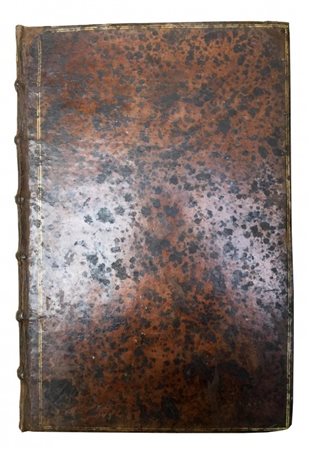
Lotto 49 UNCOMMON TREATISE REGARDING THE LAWS ON MONKS AND MONASTERIES
CHOPPIN, RENÉ. Renati Choppini Andegavi. I.C. Et in Supremo Parisiorum Senatu, Advocati Monasticon, seu, De Iure Coenobitarum, Libri Dvo.. [...]. Paris, Somnius, 1601.
Folio, contemporary mottled calf, gilt title and decorations on six raised bands spine, pp. 354, ff. [59].
Printer’s woodcut device at titlepage, woodcut head- and tail-pieces.
FIRST EDITION OF THE «MONASTICON» AN UNCOMMON LEGAL TREATISE ON THE LAWS REGARDING MONKS AND MONASTERIES.
René Choppin (1537-1606) was a French jurist. In his treatise De dominio Franciae (1574), he supported the rights of the king against those of the Church; later, however, defended Gregory XIV against Henry I. His major works are De legibus Andium municipalibus (1581) and De civilibus Parisiorum moribus (1596).
Provenance: Contemporary signature Augier at title-page, king's counselor, dean and professor of the Law Faculty of the University of Bourges He was the father of Jean-Baptiste Augier (1769-1819), the famous general and politician during the French Revolution.
References: IT\ICCU\PALE\001778. OCLC 705762355. -
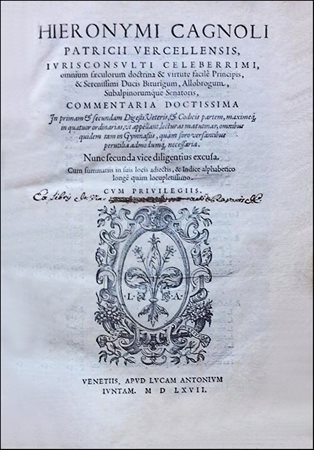
Lotto 50 THE SECOND EDITION OF CAGNOLI'S COMMENTARY ON JUSTINIAN DIGEST
Cagnoli, Girolamo. Hieronymi Cagnoli patricii Vercellensis, iurisconsulti celeberrimi ... Commentaria doctissima in primam & secundam Digesti veteris, & Codicis partem, maximeq́[ue] in quatuor ordinarias, vt appellant, lecturas matutinas.. Venetiis: Apud Lucam Antonium Iuntam, 1567.
Folio (325x215), half vellum on boards from an ancient manuscript with handwritten title at spine, pp. [56], 547, [1, blank].
Printer's device on title-page and colophon; woodcut initials.
Fine Giuntine edition of Cagnoli's commentary on Justinian Digest and Code.
Provenance: Contemporary inscription, partly crossed out, at title-page.
References: OCLC 78598583 locates three copies, at Harvard Law School Library, University of California (Berkeley Law Library) and Yale University (Law School Library). -

Lotto 51 VERY RARE FIRST ALDINE EDITION OF CICERO’S HARANGUES
[Cicero’s Harangues, Aldine] Cicero, Marcus Tullius. M. T. Ciceronis Orationum volumen primum [secundum et tertium]. Venice: Aldus Manutius, January-August 1519.
3 volumes in 8vo, 18th century full green morocco with labels and gilt letterings, gilt decorations, blue edges, marbled fly-leaves, green silk bookmarks, ff. [12], 305, [3, the last two are blanks] for the first volume; ff. [7], 281, [3, the last two are blanks] for the second volume; ff. [6], 275, [5, the last two penultimate are blanks] for the third volume.
Aldine device (woodcut) on title pages and at the last leaf of volume 3.
Very rare first Aldine edition of Cicero’s collected Orations, the renowned harangues made during his profession as a lawyer.
All the harangues of the most famous lawyer of every time, in the precious Aldine edition: according to Renouard, a complete and fine set is «a thing of absolute scarcity».
Provenance: Ex-libris Spellow Hill at first paste-down, with a signature C.A. Smith(?) M.A.
References: Renouard, 85.1; 86.2 and 86.3: «Très belles éditions […] Un exemplaire complet et bien conservé de Cicéron […] est une chose de toute rareté». CNCE 12211. IT\ICCU\UM1E\001645 (locating very often single volumes or uncomplete sets). OCLC 5850509. -
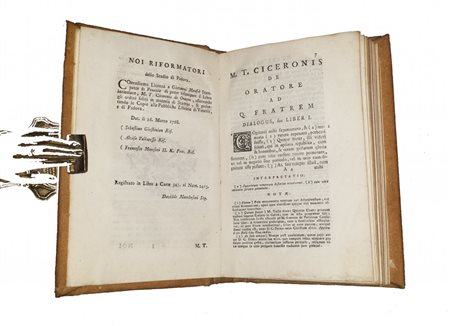
Lotto 52 THE ART OF SPEAKING AND THE PERFECT HARANGUE
Cicero, Marcus Tullius. M. Tullii Ciceronis De Oratore ad Q. fratrem libri III cum interpretatione ac notis Jacobi Proust e Secietate Jesu. Editio altera Patavina aliquibus locis castigata & aucta.Patavii (Padua): typis Seminarii ... apud Joannem Manfrè(IS), Seminario [et al.] 1768.
Large 8vo, contemporary paperboards, pp. 407, [1].
Woodcut head-letters, woodcut head and tail pieces.
Beautiful Padua edition of Cicero's De Oratore, a treatise on the art of the perfect speaker.
De Oratore («On the Orator»; not to be confused with «Orator») is a dialogue written by Cicero in 55 BC.
Amidst the moral and political decadence of the state, Cicero wrote De Oratore to describe the ideal orator and imagine him as a moral guide of the state. He did not intend De Oratore as merely a treatise on rhetoric, but went beyond mere technique to make several references to philosophical principles. Cicero understood that the power of persuasion—the ability to verbally manipulate opinion in crucial political decisions—was a key issue. The power of words in the hands of a man without scruples or principles would endanger the whole community.
As a consequence, moral principles can be taken either by the examples of noble men of the past or by the great Greek philosophers, who provided ethical ways to be followed in their teaching and their works. The perfect orator shall be not merely a skilled speaker without moral principles, but both an expert of rhetorical technique and a man of wide knowledge in law, history, and ethical principles. De Oratore is an exposition of issues, techniques, and divisions in rhetoric; it is also a parade of examples for several of them and it makes continuous references to philosophical concepts to be merged for a perfect result.
Marcus Tullius Cicero (106 BC – 43 BC) was a Roman philosopher, politician, lawyer, orator, political theorist, consul and constitutionalist. He came from a wealthy municipal family of the Roman equestrian order, and is widely considered one of Rome's greatest orators and prose stylists and the most famous lawyer of every time.
References: OCLC 97688036 -

Lotto 53 THE COLLECTED WORKS OF THE MOST FAMOUS LAWYER OF EVERY TIME IN A PRECIOUS ROMANTIC BINDING
Cicero, Marcus Tullius. M. Tull. Ciceronis opera, ex recensione Joseph. Vict. Le Clerc. Parisiis: Apud Lefevre Bibliopolam, 1823- 1825.
18 volumes in 16mo, attractive contemporary romantic binding with blind-tooled decorations on covers, double gilt borders and gilt corners, gilt decorations and gilt titles at spine, blind-tooled decorations at compartments, gilt edges, gilt inner dentelles.
Charming pocket Parisian edition of Cicero's Collected works.
CONTENT:
Vols 1-3: Rhetorica.
Vols. 4-9: Orationes.
Vols. 10-11: Epistolae ad diversos.
Vols. 12-13: Epistolae ad Atticum
Vols. 14-17: Opera Philosophica.
Vol. 18: Fragmenta.
Marcus Tullius Cicero (106 BC – 43 BC) was a Roman philosopher, politician, lawyer, orator, political theorist, consul and constitutionalist. He came from a wealthy municipal family of the Roman equestrian order, and is widely considered one of Rome's greatest orators and prose stylists and the most famous lawyer of every time.
References: OCLC 622329101 locates the copy at -
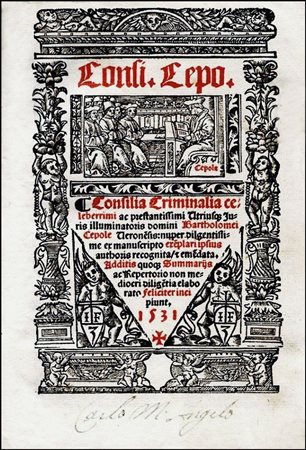
Lotto 54 AN IMPORTANT COLLECTION OF CRIMINAL LAW COUNSELS
CIPOLLA, BARTOLOMEO. Consi. Cepo. Consilia Criminalia celeberrimi ... domini Bartholomei Cepole Verone[n]sis: nuper dilgentissime [!] ex manuscripto exe[m]plari ipsius authoris recognita [et] eme[n]data. Additis quoq[ue] Summarijs ac Repertorio non mediocri dilige[n]tia elaborato Feliciter incipiunt. Impressum Lugduni, Antonius du Ry per Iacobum Iunctam, 1531 (at colophon: 1530) (Lyon: Giunti, 1531).
8vo (175 x 115 mm), ancient vellum, ff. [12] 172.
Architectural title-page printed in red and black, woodcut head-letters. Text in Gothic type.
Important, early and renewed edition of this celebrated collection of legal advices in criminal law, arranged using newly discovered manuscripts.
References: OCLC 797899020. Baudrier, VI, 140; Von Gultlingen, III, p. 200, no. 75; IA 140.35. -
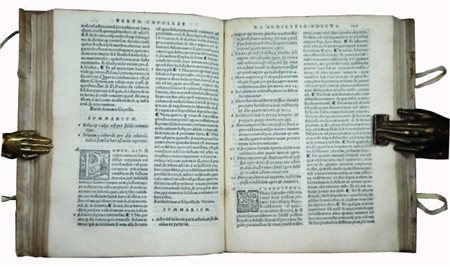
Lotto 55 FIRST EDITION OF CIPOLLA'S JURISPRUDENCE ON BUILDINGS IN THE RENAISSANCE
[Administrative Law, Buldings] Cipolla, Bartolomeo. D. Bartholomei Cepollae Veronensis v.i.d. praeclarissimi Commentaria in titu. ff. de aedilitio edicto, nunc primum in lucem edita. Cui accessere cuique legi & s. summaria, cum amplissimo [...] repertorio. Venice: [al segno della Fontana] 1550.
4to, contemporary limp vellum, ties renewed, ff. 167, [25, the last leaf is blank].
First edition of the Cipolla’s legal treatise collecting the building laws of the Renaissance.
The work was reprinted by Giunti in Lyon in the same year.
He gave rise to the phrase “Devices of Cepola”, due to the law-quirks of the Italian lawyer, teaching to elude the most express law and to perpetuate lawsuits.
Provenance: Inscription Priami Accursini Liber .
References: Not in Adams. Cnce, Censimento, 12577. OCLC, 21838181: only two copies in USA (Berkeley Law Library and Library of Congress). -
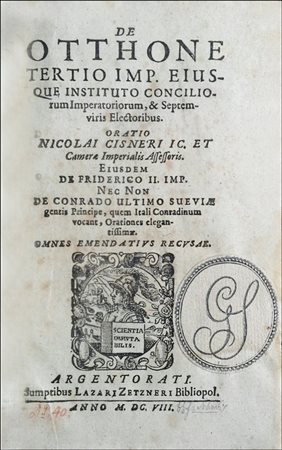
Lotto 56 CISNER, NIKOLAUS. De Otthone Tertio Imp. Eiusque Instituto Conciliorum Imperatoriorum, & Septemviris Electoribus oratio Nicolai Cisneri Ic. Et Camerae Imperialis Assessoris. Eiusdem De Friderico II. Imp. Nec Non De Conrado Ultimo Sueviae gentis Principe, quem Itali Conradinum vocant, Orationes elegantissimae. Argentorati (Strasbourg), sumptibus Lazari Zetzneri bibliopol., 1608.
Three works bound in 8vo (155 x 96), 19th century half calf, pp. 82, [2], 83-223, [3], 224-263 i.e. 272, [1].
Uncommon historical accounts of the famous German lawyer of the Renaissance on three famous sovereigns of the Holy Roman Empire and their reforms.
The first work is devoted to the Emperor Otto III and his utopian dream to renovate the ancient Imperial authority of the Roman Empire (Renovatio Imperii) through the new Christian thought. The other two works are devoted to Frederick II and to his nephew Conradin, the last of Hohenstaufen, beheaded in Naples in 1268.
Nikolaus Cisner or Kistner (1529 Mosbach - 1583 Heidelberg ) was a Palatine scholar of the Renaissance. He was rector of the University of Heidelberg, humanist, lawyer and poet.
br> Otto III (980 - 1002) was Holy Roman Emperor from 996 until his early death in 1002. A member of the Ottonian dynasty, Otto III was the only son of the Emperor Otto II and his wife Theophanu. Otto III was crowned as King of Germany in 983 at the age of three, shortly after his father's death in southern Italy while campaigning against the Byzantine Empire and the Emirate of Sicily. In 996, Otto III marched to Italy to claim the titles King of Italy and Holy Roman Emperor, which had been left unclaimed since the death of Otto II in 983. Crowned as Emperor, Otto III put down the Roman rebellion and installed his cousin as Pope Gregory V, the first Pope of German descent.
Frederick II (1194 – 1250), was one of the most powerful Holy Roman Emperors of the Middle Ages and head of the House of Hohenstaufen. His political and cultural ambitions, based in Sicily and stretching through Italy to Germany, and even to Jerusalem, were enormous. However, his enemies, especially the popes, prevailed, and his dynasty collapsed soon after his death. Historians have searched for superlatives to describe him, as in the case of Donald Detwiler, who wrote: «A man of extraordinary culture, energy, and ability – called by a contemporary chronicler stupor mundi (the wonder of the world), by Nietzsche the first European, and by many historians the first modern ruler – Frederick established in Sicily and southern Italy something very much like a modern, centrally governed kingdom with an efficient bureaucracy».
Conrad (1252 – 1268), called the Younger or the Boy, but usually known by the diminutive Conradin (German: Konradin, Italian: Corradino), was the Duke of Swabia (1254–1268, as Conrad IV), King of Jerusalem (1254–1268, as Conrad III), and King of Sicily (1254–1258, de jure until 1268, as Conrad II).
Provenance: 19th century monogrammed stamp (G.S.) of a not identified owner.
References: OCLC 311976440. -
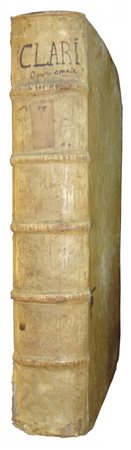
Lotto 57 SWISS EDITION OF CLARO'S PROCEDURE ON CIVIL AND CRIMINAL LAW
THE FOUNDATION OF COMMON CRIMINAL LAW IN EUROPE
Claro, Giulio (and others). Ivlii Clari Alexandrini Ivris-Consvlti, Longe Clarissimi, Philippi II. Hispan. Regis Supremi Consiliarij, ac Regentis dignissimi Opera Omnia, Sive Practica Civilis Atqve Criminalis : Cum doctissimis Additionibus Perillustrium Iurisconsultorum DD. Ioan. Baptistae Baiardi Parmensis ... Hisque nouißimè accesserunt Notae, & Animaduersiones ... DD. Ioan. Harprecti, Et Manfredi Goveani. Genevae: Chouët, 1666.
Folio, contemporary stiff vellum with handwritten title at five raised bands spine, pp. [24], 904, [92].
Title page in red and black.
The collected works by Giulio Claro, as to say the most important procedure of both civil and criminal law of his age.
With the additions of then jurists Giovanni Battista Baiardi, Antonio Droghi, Hieronymus Giacharius, Manfredus Goveanus, Jean Guyot, Johann Harpprecht, Bernardino Rossignoli.
Giulio Claro (or Clarus) (1525–1575) was an Italian jurist. He was born in Alessandria and took up the study of law in Pavia as early as 1536. After receiving a doctorate in 1550, Claro was appointed a Milanese Senator by Philip II in 1536, a royal pretor in Cremona in 1560/61, president of the Milanese Magistrato straordinario delle entrate in 1563 and regens of the Consejo d'Italia in Madrid in 1565.
Claro's work, together with that of Deciani and Farinacci, provided the theoretical foundation for the common criminal law of Europe. That common law held sway until it was attacked by Enlightenment legal critics such as Feuerbach and replaced by national penal codes in the 19th century.
References: OCLC 64758707 locates two copies in US libraries, at Cornell University Library (Ithaca, NY) and Harvard Law School Library. -
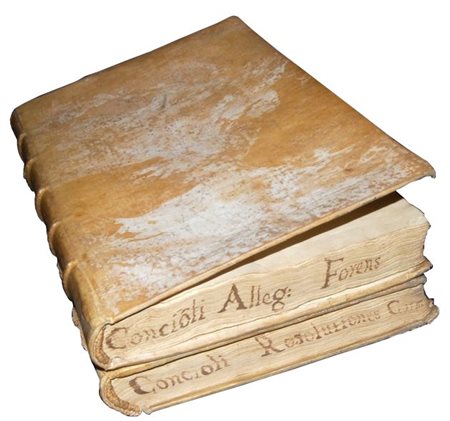
Lotto 58 TWO COLLECTION WORKS BY THE JURISCONSULT ANTONIO CONCIOLI, ONE WITH CRIMINAL COURT DECISIONS AND ONE WITH BOTH CRIMINAL AND CIVIL ALLEGATIONS, INCLUDING A TREATY ON THE STATUTES OF GUBBIO
[1.]: Concioli, Antonio. Antonii Concioli I.C. Cantianensis [...] Resolutiones criminales alphabetico ordine dispositae [...] cum triplici indice, nempe titulorum, resolutionum, & materiarum, in Resolutionibus praedictis contentarum. Quibus in hac secunda Veneta editione accessit in fine tractatus ad Statuta Eugubii cum Additionibus I. C. Francisci Romaguerae gerundensis. Venetiis: apud Nicolaum Pezzana, 1700.
[together with:]
[2.]: Concioli, Antonio. Antonii Concioli [...] Allegationes forenses civiles, et criminales [...] cum indice refertissimo, & ad quamlibet allegationem summariis. Venetiis: apud Nicolaum Pezzana, 1700.
[1.]: Folio (334x228 mm), full vellum binding, five raised bands at spine, calligraphic title at bottom edge; pp. [20], 436, [40]. Title page in red and black types. Florentine lily in red and black colors at title-page. Xylographic head-pieces.
Alone work itself, belonging to the Opera omnia by the same Author, as clearly written at false title-page.
[2.]: Folio (334x228 mm), full vellum binding, five raised bands at spine, calligraphic title at bottom edge; pp. [12] leaves, pp. 364, [40]. Title page in black types with a Florentine lily in black colors. Xylographic head-pieces.
Concioli Antonio (1602-1680) was a distinguished scholar and a talented jurist. He was appointed lieutenant of the city of Urbino. He wrote many works which are still considered in jurisprudence.
Provenance: Private library of a Verona noble family, whose roots are in Mantua and in which there were distinguished lawyers and jurists.
References:
[1.]: IT\ICCU\MODE\018173 (9 copie). OCLC, 644947285 (one copy in Spain) and 60668737 (one copy in USA, University of Kansas Archives, Kenneth Spencer Research Library, Lawrence).
[2.]: IT\ICCU\MILE\005640 (7 copies). OCLC, 82282522 (one copy in USA, University of California Berkeley Law Library), 23160226 (one copy in USA, Columbia University Law School, Diamond Law Library, New York) and 807795967 (one copy in Spain). -

Lotto 59 RARE EDITION OF LYON OF THE ACTS OF THE COUNCIL OF TRENTO WITH A BULL OF PIUS IV AND THE INDEX OF BANNED BOOKS
APPARENTLY NO COPY IN USA
Concilio di Trento. Sacrosancti et oecumenici Concilii Tridentini, sub Paulo 3. Iulio 3. & Pio 4. pont. max. celebrati, canones et decreta. Accesserunt duorum eruditiss. virorum D. Ioan. Sothealli theologi, et Horatij Lutij iuriscons. vtilissimæ ad marginem annotationes [...] Additæ præterea sunt ad finem, Pij 4. pont max. Bullæ, vna cum triplici vtilissimo Indice. Item catalogus et Index librorum prohibitorum [...]. Lugduni: apud hæredes Gulielmi Rouillii sub Scuto Veneto, 1610.
8vo, 160x100 mm, full eighteenth century brown calf binding, with gilt title and decorations at a five raised band spine, marbled paper at guards, red colored edges, silk bookmark; 2 parts; pp. [32], 253, [51]; 110. Two title-pages, both with woodcut devices, the first in red and black types, the second in black. Xyl. initials and head-pieces. Text in Latin.
Fine copy of this rare Lyon edition of the Proceedings of the Council of Trent, including a second part (“The index of banned books”), with its own title-page: Index librorum prohibitorum, cum regulis confectis per patres à Tridentina synodo delectos: auctotitzte Pii 4. Primum editus, postea verò à Sixto 5. auctus. Et nunc demum S.D.N. Clementis papæ 8. iussu recognitus, & publicatus [...].
The first Index of banned books was published by Pope Paul IV in 1559 at the request of the Inquisition, and confirmed in 1564. The Congregation of the Index was established in 1571. The Index was updated regularly until 1961, by addition of the Congregation of the Inquisition or the Pope.
Plein veau brun du 18e s., dos à nerfs richement décoré. Bel ex. de cette rare édition lyonnaise des actes du Concile de Trente avec un « Index librorum prohibitorum ». Le premier Index romain fut publié par le pape Paul IV en 1559 à la demande de l'Inquisition, et confirmé en 1564. La Congrégation de l'Index fut instituée en 1571. L'Index fut régulièrement mis à jour jusqu'en 1961, par ajout de la Congrégation de l'Inquisition ou du pape.
Provenance: Ex-libris label glued at first paste-down (initials: J.L.; a donkey with spectacles looking at a bookshelf).
References: IT\ICCU\CFIE\008640 (only one copy). OCLC, 461054829 (one copy in France but apparently without the Index of banned books). Apparently no copy in USA. -
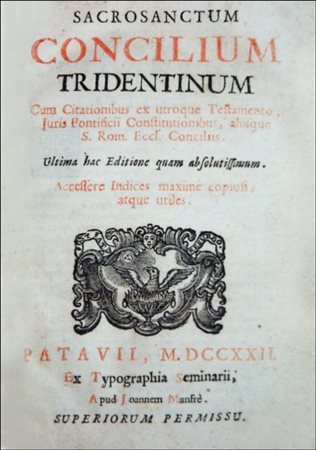
Lotto 60 18TH CENTURY EDITION, PUBLISHED IN PADUA, OF THE CANONS AND DECRETA ISSUED DURING THE COUNCIL OF TRENT
Council of Trent, Canons. Sacrosanctum Concilium Tridentinum cum citationibus ex utroque testamento, juris pontificii constitutionibus, aliisque S. Rom. Eccl. Conciliis . Patavii (Padova), ex typographia Seminarii apud Joannem Manfrè, 1722.
8vo (167x108 mm), half calf on colored paper, orange label with title and colored decorations, pp. [16], 420. FTitle page printed in red and black, woodcut head-letters.
18th century edition of the Canons and Decrees issued during the Council of Trent.
References: IT\ICCU\RMLE\014310. -
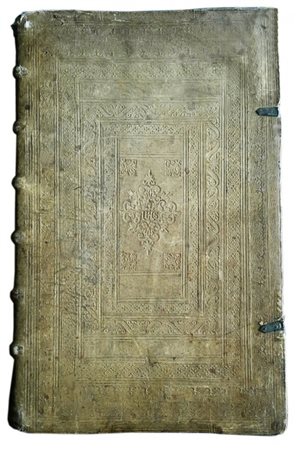
Lotto 61 THE COLLECTED WORKS OF THE MOST IMPORTANT MEDIEVAL SPANISH JURIST
Covarruvias y Leyva, Didacus. Opera omnia cum authoris tractatu in tit. de frigidis & maleficiatis, septem quaestionibus distincto, quibus an matrimonium cum hoc impedimento constare possit, accurate explicatur. Multis in locis a cl. ic. Cornelio Brederodio auctus, illustratus vt passim hanc notam designatur. Accesserunt hac postrema editione Joannis Vffeli [...] in varium resolutionum libros notae vberiores. Antwerpiae, apud Ioannem Keerbergium, 1610.
A large folio folum (390x250x105 mm), contemporary pigskin binding with blind-tooled decorations, pp. [12], 610, [2]; [8], 548, [48].
The collected works of one of the most renowned jurists of the Spanish Middle Age in a giant folio edition with handsome binding. References: OCLC, 65108241 locates only a copy in US libraries, at Yale Law School Library. -
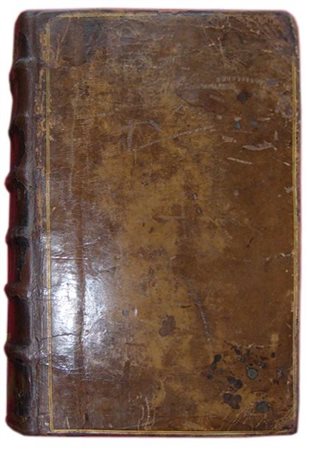
Lotto 62 FINE EDITION OF CUJAS' COLLECTED WORKS IN A BEAUTIFUL CONTEMPORARY BINDING
Cujas, Jacques. Iacobi Cuiacii Iurisconsulti, Operam quae de iure fecit et edi volvit. Ab ipso autore postremun recognita & libris quibusdam aucta. Genevae, apud Philippum Albert ex Alex, Pernet. 1609.
Four volumes bound in a volume in-folio (350x220 mm), contemporary brown calf, gilt borders at each cover, gilt title and decoration at spine (some repairs), pp. [16], 80, col. 81-404, pp. [12], col. 579, pp. [14], col. 788, pp. [18], col. 664, pp. [106].
Text in Latin on two columns, some passages in Greek.
Engraved dead-letters and head-pieces; a fine full-page engraved illustration of Arbor cognationum(genealogical tree).
Scarce imprint of Cujas' collected works, one of the last edition published under the direct supervision of the great French lawyer.
Provenance: Signature Ludovicus de (cancelled surname) at title-page.
References: OCLC 7098049 locates in USA only the copy of University of Rochester (NY). -
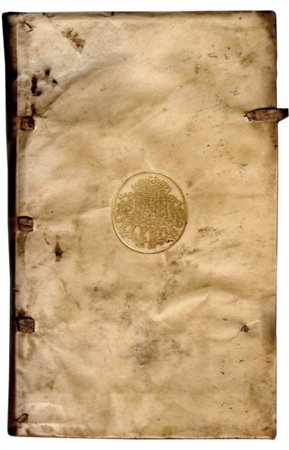
Lotto 63 CORTI'S TREATISE ON FEUDAL LAW
NOT IN USA
CORTI, FRANCESCHINO. Fran. Curtii iunioris ... Tractatus feudorum. Correctus atque adnotationibus, quae commentariorum vice esse possunt, illustratus a Ioanne Hauichorstio Monasterien. I.C. Adiecto indice rerum memoriam dignarum locupletissimo. Editio tertia, prioribus accuratior, & luculentior. Coloniae Agrippinae, apud Theodorum Baumium sub signo arboris, 1583.
8vo (160 x 95 mm), contemporary limp vellum with gilt nobiliar coat of arms at both covers, traces of ties, red edges, pp. [14], 550, [34].
Roman and Italic type.
Scarce and beautiful imprint of the third edition of Corti’s renowned treatise on feudal law.
References: OCLC locates only 10 copies worldwide (no copy in USA), 2 in Italy (ICUU). -
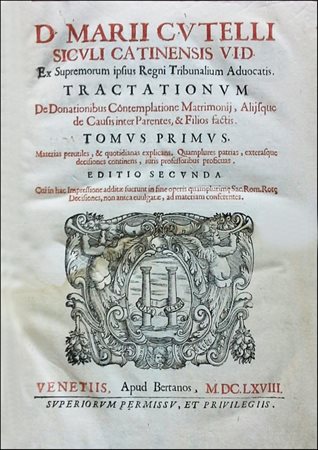
Lotto 64 ONE OF THE MOST IMPORTANT 16TH CENTURY'S TREATISE ON DONATIONS
CUTELLI, MARIUS. D.Marii Cutelli siculi catinensis V.I.D. ex supremorum ipsius Regni Tribunalium advocatis. Tractationum de donationibus contemplatione matrimonii, aliisque de causis inter parentes, et filios factis. Tomus primus et secundus. Editio secunda. Cui hac impressione additae fuerunt in fine quamplurime Sac. Rom. Rote decisiones, non antea evulgate, ad materiam conferentes. Venetiis, apud Bertanos, 1668.
2 parts bound together in a volume in folio, near contemporary half vellum, pp. 8, 191; 26, 263.
Woodcut head-letters, woodcut tail-pieces. Text on two columns.
Second edition, enlarged with a wide collection of Rota decisions, of this most wanted monograph in donations, one of the most important of 16th century.
References: OCLC locates 7 copies worldwide, 1 in Italy (ICUU) at University of Siena. -
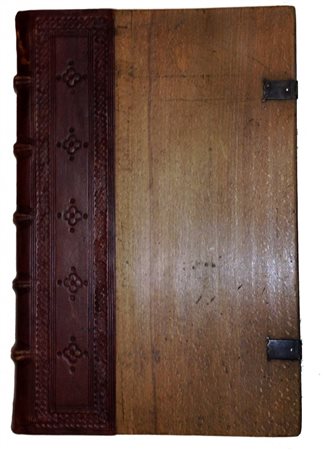
Lotto 65 RARE ALEXANDER DA IMOLA'S COMMENTARY IN JUSTINIAN'S DIGEST
THE BURKHARD STADTMANN COPY THEN PASSED TO GEORG RITTERHAUSEN
Tartagni, Alessandro. Aureu[m] opus excellentissimi. u.i. monarche Alexandri de Imola: super .j. [et] .ij. ff. vete. Summa cu[m] cura: o[mn]iq[ue] industria ex fidelissimis exe[m]plaribus excerptu[m] [et] in pristinu[m] nitore[m] eme[n]datu[m]. Cu[m] apostillis doctissimor[um] Doc. Fran. de Curte [et] Bernar. de Landriano: [et] cu[m] in numeris addi. q[uae] in alijs codicibus impressis no[n] reperiebant. Additis e[s]t addi. Do. Ant. Fra[n]cisci de Doc. necnon summarijs per spect. i.u. interpretem D[omi]n[u]m Nicolaum de Lacu compositis. Postremo aute[m] cu[m] vtilissimo Repertorio alphabetico singulares conclusiones dictor[um] per Alex. co[n]tine[n]te ac cu[m] copiosissimis additionib[us] Henrici Ferrandat Niuernen[sis] in hac vltima impressione in lucem editis.. (at colophon:) Lugduni : Impressa per Iacobum Mareschal. Impensis nobilium mercatorum Lugdunensium., Anno salutis dominice. M. ccccc. xx. de mense Decembris. (Lyon: Mareschal, 1520).
BOUND WITH:
Tartagni, Alessandro. Cu[m] apostillis doctissimoru[m] doctorum domini Francisci de Curte [et] Bernardini de Landriano. Et cu[m] alijs innumeris additionibus per d[omi]n[u]m Antoniu[m] Franciscum de Doctoribus Patauinum noviter editus. Postremo aut[em] cum singulari repertorio alphabetico conclusiones dictorum per Alex contine[n]te ac cum copiosissimis additionibus Hen. Ferrandat Niuern[ensis]. in hac vlti[m]a impressione in lucem editi. (at colophon:). Lugduni: Impensis nobilium mercatorum Lugdunensium, Anno a Virginis Partu .M. cccccxx. die xiii de mense Decembris (Lyon: Sachon, 1520).
Folio, original ancient wooden boards (monastic binding), renewed calf spine with five raised bands and blind-tooled decorations, metal clasps, handwritten title at edge, ff. 168, [2]; ff. I-CXLIII, 145-202 (misnumbered), 1-106, (2, the last is blank).
Title pages printed in red and black, with woodcut border; fine woodcut initials.
Very rare Alexander Da Imola's commentary on both Justinian's Digestus Vetus and Digestum Novus with the additions of Francesco Corte, Bernardino da Landriano, Antonfrancesco Dottori and Henri Ferrandat.
Alessandro Tartagni also called Alessandro da Imola (1424-1477) was an Italian jurist and canonist. He taught at Pavia, Bologna, Ferrara and Padua. His fame is due to the commentaries on Justinian's Digest and Code —but also in Decretals, showing a mastery of both Civil and Canon Law.
Provenance: 1. Contemporary signature Sebastianus Hallerius. -
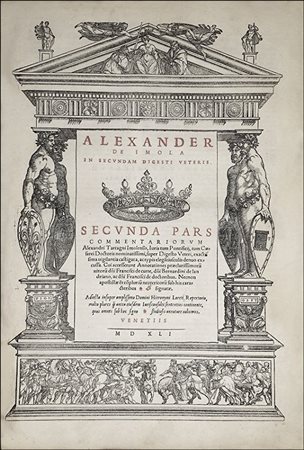
Lotto 66 VERY RARE DA IMOLA'S COMMENTARY IN JUSTINIAN'S DIGEST
NO COPIES IN USA
[Roman Law] Tartagni, Alessandro. Alexander de Imola In secundam Digesti veteris. Prima [-secunda] pars commentariorum Alexandri Tartagni Imolensis ... super Digesto veteri ... Cui accesserunt annotationes praeclarissimorum uirorum domini Francisci de curte, domini Bernardini de landriano, ac domini Francisci de doctoribus ... Adiecto insuper amplissimo domini Hieronymi Loreti Repertorio. Venetiis: [al segno della corona] 1541.
Folio, modern limp paperboards, leaves printed on both sides in double columns.
Very rare Tartagni's commentary on Justinian's Digestum Vetus.
Alessandro Tartagni also called Alessandro da Imola (1424-1477) was an Italian jurist and canonist. He taught at Pavia, Bologna, Ferrara and Padua. His fame is due to the commentaries on Justinian's Digest and Code —but also in Decretals, showing a mastery of both Civil and Canon Law.
References: Censimento, CNCE 49234. No copies in USA: OCLC, 44596200 locates a copy of the other part, the Digestum Novum, at University of Iowa Libraries. -
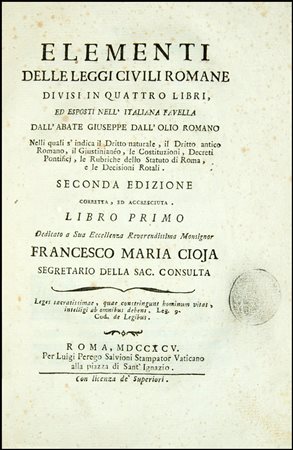
Lotto 67 UNCOMMON SECOND EDITION OF THIS COLLECTION OF ELEMENTS OF ROMAN CIVIL LAW
Dall'Olio, Giuseppe. Elementi delle leggi civili romane divisi in quattro libri, ed esposti nell'italiana favella dall'abate Giuseppe Dall'Olio romano. Nelli quali s'indica il diritto naturale [...]. Seconda edizione corretta, ed accresciuta. Libro primo [-quarto]. [...]. Roma: per Luigi Perego Salvioni Stampator Vaticano alla piazza di Sant'Ignazio, 1795.
8vo (230x152 mm), editorial paperback binding; 4 vols; pp. XXVIII, 174, [1] folded plate; VIII, 165, [3]; XXIV, 262, [2]; VIII, 176. Xyl. initials and head-pieces. Text in Italian.
Provenance: Family’s ink stamps at title-pages, not readable. Many handwritten ownership signatures (Jo Filippo Monetti, 1824; Jo Alessandro Moscatelli, Ponzano, 1824; Lorenzo Liberati; Vincenzo Di Silvio).
References: IT\ICCU\RLZE\013607 (7 copies). OCLC, 62140886 (3 copies in USA). -
Lotto 68 THE SERVITUDES ON ARABLE LANDS IN NORTH-ITALY
Dandini, Francesco Ercole.Herculis Francisci Dandini com. et jc. et in Patavino gymnasio Pandectarum, Codicis Justinianei et novellarum Constitutionum interpretis De servitutibus prædiorum interpretationes per epistolas ad loca quædam libri VII & VIII Pandectarum illustranda pertinentes. Verona: typis Seminarii, 1741.
Folio, contemporary printer's wrappers, pp. [12], 178.
Title page printed in red and black, engraved head-letters, engraved head and tail pieces.
Captions: Epistola ... Hercules Franciscus Dandinus Josepho Torello.
Very scarce and sumptuous Verona imprint of the first and only edition of the jurist Ercole Dandini regarding the laws on property, especially on Servitudes of arable lands.
Ercole Francesco Dandini (1695-1747) was an Italian lawyer who taught (from 1735 to his death) civil law at University of Padua.
References: OCLC 428014319 located only a copy in US libraries, at University of Michigan Law Library (Ann Arbor, MI). Apparently, never appeared in auction. -
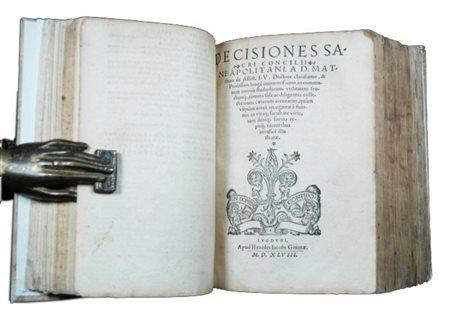
Lotto 69 THE COLLECTED VERDICTS OF THE ROYAL COURTS OF NAPLES IN THE RENAISSANCE
D'Afflitto, Matteo. Decisiones Sacri Consilii Neapolitani. Lyon: apud Haeredes Iacobi Giuntae, 1548.
Large 8vo, stiff vellum (restored) with handwritten title at spine, ff. [64, index], 375, [1, blank].
Two separate title-pages (the Index before the text), text on two columns. Woodcut head-letters.
Valuable edition of the collection of verdicts of the Royal Courts of Naples with the commentary of the renowned jurist Matteo D’Afflitto.
Published for the first time in 1509 with the participation of D’Afflitto’s cousin Michele, this work became necessary to the forensic activity in Naples and was frequently reprinted.
Matteo D’Afflitto, scholar of Civil and Feudal Law at the University of Naples, was one of the most renowned Neapolitan jurists of all times.
Provenance: Many ancient handwritten notes both at back cover and at the last leaf, blank.
References: OCLC 246332932 (3 copies in USA: University of California, Berkeley Law Library; University of Minnesota, Minneapolis and Washington University in St. Louis). -
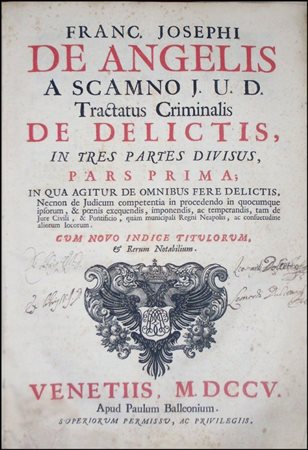
Lotto 70 A FOUNDING TEXT ON THE DISCIPLINE OF THE HOMICIDE
AND THE REHABILITATION OF THE GUILTY
DE ANGELIS, FRANCISCUS JOSEPHUS. Franc. Josephi De Angelis ... Tractatus criminalis de delictis, in tres partes divisus, pars prima; in qua agitur de omnibus fere delictis, necnon de judicum competentia in procedendo in quocumque ipsorum, & poenis exequendis, imponendis, ac temperandis, tam de jure civili, & pontificio, quam municipali regni Neapolis, ac consuetudine aliorum locorum. Cum novo indice titulorum, & rerum notabilium. Venetiis, apud Paulum Balleonium,1705.
[BOUND WITH]
Franc. Josephi De Angelis ... Tractatus criminalis de delictis pars secunda, in qua agitur de delictis propriis diversorum, ad proprium esse spectanctibus, vel ratione personae, vel muneris, seu proprii officii. Cum novo indice titulorum, ac rerum notabiliumVenetiis, apud Paulum Balleonium,1705.
[BOUND WITH]
Franc. Josephi De Angelis ... Tractatus de habilitatione reorum, in quo de habilitatione in genere; juratoria cautione; consignatione per chlamydem ... exacte explicatur. Opus omnibus, qui criminalibus incumbunt maxime utile, ac necessarium. Venetiis, apud Paulum Balleonium,1705.
3 parts in a volume in folio, contemporary limp vellum with calligraphic title at spine, pp. [8], 240, [28]; 120, [2], 125-162; 87, [1].
Title page printed in red & black, woodcut head-letters, woodcut head and -tail pieces. Text on two columns.
Scarce and fine edition of one of the founding texts about the legal discipline of the homicide, followed by another important work regarding the rehabilitation’s procedure for the guilty.
Taken a degree in utroque iure in Naples, De Angelis started a long a successful career as criminal lawyer and, at the end of his activity he printed this voluminous treatise, that was an example for completeness and methodicalness of exposition. Among the other worthy of note is the treatise on rehabilitation of a guilty and on precautionary measures.
References: OCLC locates only 5 copies worldwide and 8 complete copies in Italy (ICUU). -
Lotto 71 VERY SCARCE ITALIAN «BLOODY MURDER» CONTAINING THE DEATH SENTENCE OF A LAWYER FOR THE MURDER OF HIS BROTHER
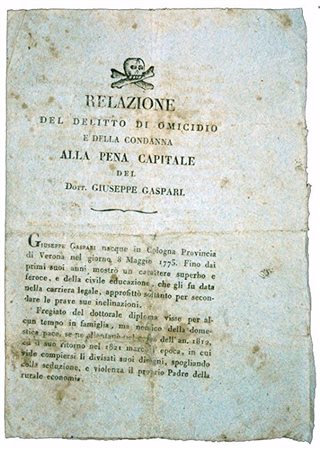
Relazione del delitto di omicidio e della condanna alla pena capitale del Dott. Giuseppe Gaspari. Verona, 29 Agosto, 1835 (printed by Libanti in Verona).
4to, printed on blue paper, pp. 4. A small woodcut with a skull and crossbones at the top of the text.
Very scarce «Bloody Murder» of the death sentence of a lawyer, Giuseppe Gaspari (born 8 may 1775) from Cologna Veneta (a village 20 km east from Verona, on the road to Venice), sentence executed by hanging on 29 August of 1835.
This documents tells the history of Gaspari, his childhood («he was proud and fierce»), his career as a lawyer and the continuous harassments against his father and his brother Sebastiano. On 13 September 1834, he starts to Cologna with a knife and the following morning, a Sunday, and waits for the arrival of his brother in the main square of the village, sitting at a coffee shop and pretending to write. When the brother arrives, he grabs him by the jacket with the left hand and with the right vibrates two stabbings, piercing his heart, and then a third stab wounds to the left thigh. Then he washes the knife at the fountain, declaring to have been satisfied with his revenge, and starts spontaneously towards the prison, leaving a widow and six children.
Styled at the time as "Last Dying Speeches" or "Bloody Murders" this kind of imprints «were sold to the audiences that gathered to witness public executions in 18th and 19th century (especially in Britain). These ephemeral publications were intended for the middle or lower classes, and most sold for a penny or less. Published by printers who specialized in this type of street literature, a typical example features an illustration (usually of the criminal, the crime scene, or the execution); an account of the crime and (sometimes) the trial; and the purported confession of the criminal, often cautioning the reader in doggerel verse to avoid the fate awaiting the perpetrator» (Crime Broadsides Project).
A classic Italian murder, committed by a lawyer.
References: For scholars and collectors interested in this topic, we suggest to see the beautiful «Crime Broadsides Project» of The Harvard School Library, a digitization of more than 500 broadsides. -
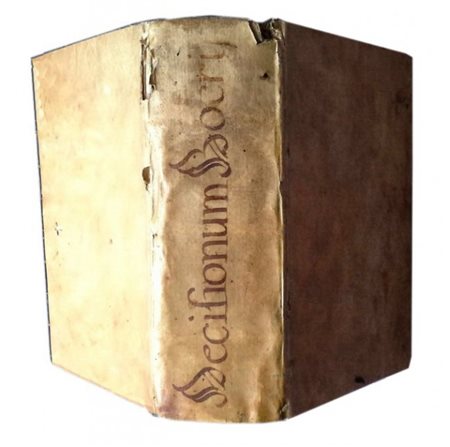
Lotto 72 FUNDAMENTAL COLLECTION OF DECISION OF THE PARLIAMENT OF BORDEAUX (FRANCE)
De Bohier, Nicolas.Decisionum aureum in sacro Burdegal. senatu olim discussarum ac promulgatarum Pars prima. [et secunda] Quas nunc demum, adhibitis nonnullis summi nominis iureconsultis, & accuratius emendatas, & summariis vtilissimis, indiceque locupletissimo illustratas, in gratiam studiosorum il lucem damus. Huc accesserunt doctissimae simul ac utilissimae additiones ab eodem autore editae in tractatum Ioannis Montani. Venetiis, iussu F. Sansouini, 1568.
A thick volume 4to (200x150 mm), contemporary limp vellum, handwritten titles at spine, pp. [56], 949, [1].
Two separate title-pages; two half-page illustrations.
Important collection of Decisions of the Parliament of Bordeaux (France), edited by Nicolas de Bohier, viscount Pommiers, president of the parliament in Bordeaux and renowned lawyer.
The work had a great success and was reprinted many times during the 16th century.
Provenance: Some cancelled contemporary signatures at title-page.
References: CNCE 7055. Apparently no copies of this edition in USA. -
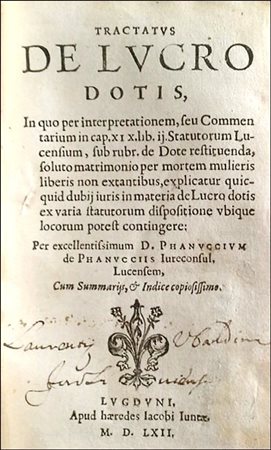
Lotto 73 RARE FIRST EDITION OF THIS TREATISE ON PRENUPTIAL AGREEMENTS AND DOWRY
DE FANUCCI, FANUCCIO. Tractatvs de lvcro dotis, in quo per interpretationem, seu commentarium in cap. XIX. lib. ij. Statutorum lucensium, sub rubr. De dote restituenda, soluto matrimonio per mortem mulieris liberis non extantibus, explicatur quicquid dubij iuris in materia de lucro dotis ex varia statutorum dispositione vbique locorum potest contingere. Lugduni (Lyon), apud haeredes Iacobi Iuntae, 1562 (colophon: Lugduni, excudebat Iacobus Faurus).
8vo (158 x 100), contemporary limp vellum with handwritten title of spine, traces of ancient ties, pp. 6, [58, 1 blank], 556, [2] (lacks the final blank).
Rare first edition of De Fanucci exhaustive treatise on prenuptial agreements that, indeed, is a large commentary on the 19th chapter of Lucca Statutes.
An important document of marriage contracts in Lucca area in the Renaissance.
Provenance: 17th century inscription Laurentii Ubaldi at title-page.
References: OCLC 15689243. -
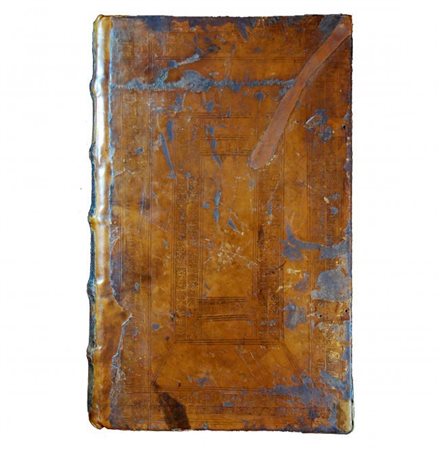
Lotto 74 ONE OF THE MOST ANCIENT TREATISES ON COMMERCIAL PRACTICE
ALSO INVOLVING ETHICS APPLIED TO ECONOMY
De Leys, Leonard (Lessio, Leonardo). De iustitia et iure ceterisque virtutibus cardinalibus libri quatuor, ad 2.2. D. Thomae a quaest. 47. usque ad q. 171. Auctore Leonardo Lessio e Societate Iesu […]. Editio quinta, auctior et castigatior cum appendice de Monte Pietatis. Antuerpiae (Antwerp): ex officina Plantiniana, apud Balthasarem Moretum et Viduam Jo. Moreti et Jo. Mursium, 1621.
Folio (36 x 23 cm); full brown leather on wooden boards, with five raised bands spine, gilted title on a light brown label at spine, gilted decorations at spine and decorated blind tooling at boards, corner bosses (traces of missing clasps at the board-edges, traces of use, leather repairs); pp. XVI, 825, LXIX. Text in Latin, printed in two columns.
Engraved title-page signed: Pet. Paul. Rubenius inuent. [Rubens] and Cor. Galleus sculpsit. [Corneille Galle]. Printer's device on verso of last leaf.
Initials; tailpieces; printed marginal notes.
Nice full-page engraving, pasted at the front inside-cover, not referred to the work, representing Alessandro Magno (Alexander Magnus Aristoteli Magistro Malin scientia rerum optimarum excellere quam opulentia. A. Gellius).
One of the many editions (probably the tenth) of this theological work (first published in Leuwen in 1605), also containing a juridical value, being one of the most ancient treatise on ethics applied to economy: Lessius's considerations on the morality of economic operations had an enormous influence on thought and behaviour of many political and ecclesiastical authorities.
The work is preceded by the dedicace to Albert VII, Archduke of Austria, made in Louwein on 28 Aug., 1605), the preface and the explanations; the text is divided in four books, one for every cardinal virtue: De prudentia (Prudence), De iustitia et iure (Justice), De fortitudine (Fortitude) and De temperantia (Temperance). Then, the text is followed by the Appendix (Appendix ad dubitationem XXIII. cap. XX. lib. II. de monte pietatis occasio scriptionis, p. 809-825), the Approbatio and the Index.
The author, Leonard de Leys (Leonardo Lessio, 1554-1623), was a Flemish moral theologian from the Jesuit order, teacher of philosophy and theology at Douay and Leuwen, best known for his treatise De iustitia et iure ("On Justice and Law"), of 1605 that had more than 20 editions in the 17th century. It is probably the first in-depth moral theological approach to economic and financial questions.
Lessius challenged in an authoritative way the traditional economic doctrines, and was consulted by the merchants of Antwerp as well as church leaders, statesmen. His work contains interesting details about the various forms of superstition, devil cult, sorcery and magic. Even ritual blasphemies were practiced, carnal love acts were performed on holy places. -
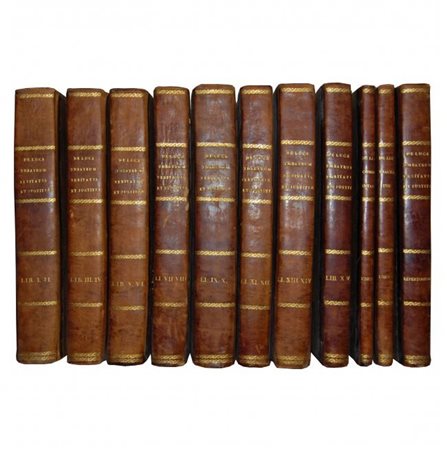
Lotto 75 A COMPREHENSIVE LEGAL ENCYCLOPEDIA BY GIOVANNI BATTISTA DE LUCA, WITH THE FAMOUS THEATER OF TRUTH, AND OF JUSTICE IN CANONICAL AND CIVIL DISPUTES, TOGETHER WITH TREATIES ON INHERITANCE, PENSION AND SALARY OF CHURCHMEN
De Luca, Giovanni Battista.
[1.]: Jo. Baptistae De Luca Venusini, [...] Theatrum veritatis, et justitiae, sive Decisivi discursus per materias, seu titulos distincti. & ad veritatem editi in forensibus controversiis canonicis & civilibus, in quibus in urbe advocatus, pro una partium scripsit, vel consultus respondit. Cum annotationibus, [...]. Adjectis, insuper in hac novissima editione. Liber primus [-decimusquintus]. Repertorium seu index generalis rerum notabilium quae continentur in Theatro Veritatis & Iustitiae cardinalis de Luca, a Nicolao Falconio [...]. Venetiis: ex typographia Balleoniana, 1759.
[together with:]
[2.]: Jo. Baptistae De Luca Venusini, [...] Commentaria ad constitutionem sanctae mem. Innocentii XI. de statutariis successionibus; cum particulis statutorum [...]. Accedit de pensionibus ecclesiasticis [...] ecclesiasticas pensiones. Venetiis: ex typographia Balleoniana, 1759.
[together with:]
[3.]: Jo. Baptistae De Luca Venusini, [...] Tractatus de officiis venalibus vacabilibus Romanae curiae; cum juribus [...]. Accedit alter tractatus de locis montium non vacabilium Urbis. Cum nonnullis [...] optime adjectis. Venetiis: ex typographia Balleoniana, 1759.
[1.]: Folio (396x242 mm), half leather binding, marbled paper at boards, gilt title at spine; 16 books bound in 8 vols. [Liber I-XV + Repertorium]; pp. [20], 513, [1]; [16], 368; [16], 434, [2]; [16], 360; [12], 228; [16], 551, [1]; [16], 383, [1]; [12], 288; [12], 328; [20], 535, [1]; [12], 238, [2]; 16], 367, [1]; [12], 296; [16], 427, [1]; [8], 552; 598, [2].
Title-page (Liber primus) printed in red and black; the other are in black. Calcographic frontispiece at the first vol. with the representation of the sepulchral monument of the author. Large vignette at each title-page with an imperial crowned double-headed eagle in a richly decorated frame. Xylographic initials, head- and final-pieces. Text printed in double columns.
[2.]: Folio (396x242 mm), half leather binding, marbled paper at boards, gilt title at spine; pp. 223.
Title-page printed in black. Large vignette at title-page with an imperial crowned double-headed eagle in a richly decorated frame. Xylographic initials, head- and final-pieces. Text printed in double columns.
[3.]: Folio (396x242 mm), half leather binding, marbled paper at boards, gilt title at spine; pp. 308.
Title-page printed in black. Large vignette at title-page with an imperial crowned double-headed eagle in a richly decorated frame. Xylographic initials, head- and final-pieces. Text printed in double columns.
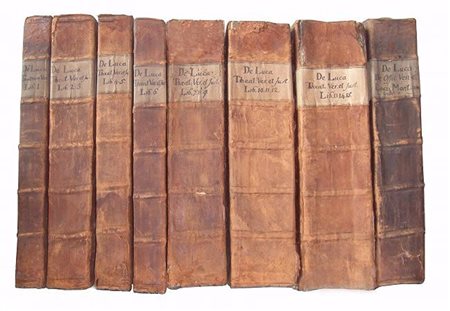
[1.]: Here the list of the titles of the 15 books and the index (Repertorium) composing the work Theatrum veritatis: -
Lotto 76 THE MOST IMPORTANT COMPREHENSIVE LEGAL ENCYCLOPEDIA OF ITS TIME
De Luca, Giovanni Battista.Jo. Baptistae De Luca Venusini, S.R.E. Presbyteri Cardinalis, Theatrum veritatis, et justitiae, sive, Decisivi discursus per materias, seu titulos distincti : & ad veritatem editi in forensibus controversiis canonicis & civilibus, in quibus in urbe advocatus, pro una partium scripsit, vel consultus respondit : cum annotationes, ac discursibus, qui anteà in supplementis extabant, necnon aliquibus Sacrae Rotae Romanae recentissimis decisionibus, & summorum pontificum constitutionibus ad materias facientibus, suis locis optimè adjectis..Venetiis : Ex typographia Balleoniana, 1734.
16 volumes bound in 6 volumes in-folio, contemporary half calf on paper boards, paper label and handwritten title at spine.
A comprehensive legal encyclopedia that became one of the most significant authorities of the late ius commune and was reprinted regularly up until the middle of the 18th century.
Giovanni Battista de Luca (1614–1683) was an Italian jurist and Cardinal of the Roman Catholic Church.
References: OCLC 58468162.
For content of the volumes, see the previous lot. -

Lotto 77 THE DECISIONS OF THE ROMAN ROTA COLLECTED BY DE LUCA
De Luca, Giovanni Battista.Mantissa decisionum Sacrae Rotae Romanae.Venetiis : Ex typographia Balleoniana, 1734.
Folio, contemporary half calf on paper boards, paper label and handwritten title at spine.
One volume (complete in itself) of the Decisions of Roman Rota collected by De Luca, here published with his work De officiis venalibus.
References: IT\ICCU\SBL\0164323. -
Lotto 78 A PRECIOUS COLLECTION OF RENAISSANCE TREATISES ON COMMERCIAL LAW
INCLUDING THE MAIN TREATISE OF BALDUS' BROTHER
ON THE MANAGEMENT OF COMPANIES MADE BETWEEN TWO BROTHERS
ONLY ONE COPY IN USA
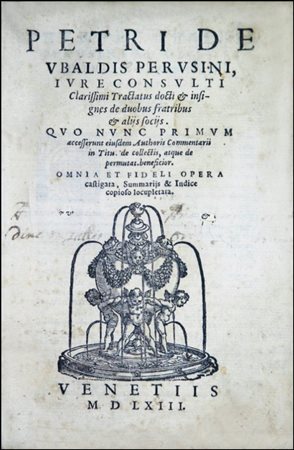
De’ Ubaldis, Pietro. Petri de Vbaldi Perusini iureconsulti clarissimi Tractatus doct. et insignes de duobus fratribus et aliis sociis. Quo nunc primum accesserunt eiusdem authoris commentarii in titu. de collectis atque de permutas. beneficior. Omnia et fideli opera castigata, summarijs & indice copioso locupletata. Venice: [al segno della Fontana] 1563. [at colophon:] Venetiis: Apud Cominum de Tridino, Montisferrati. 1563.
8vo, contemporary limp vellum, ff. 192, [12].
Precious collection of Renaissance treatises on commercial law, including Petrus de Ubaldi's work on companies management.
1. The main work is attributed to Pietro de Ubaldis, brother to the more renowned jurist Baldo to whom the authority of the work is likely to be ascribed. De duobus fratribus et aliis sociis («On two brothers and other partners») is a company law treatise dealing with the formation, management and closing down of companies especially made between two brothers but also among other partners.
2. The Commentarii in titulum de collectis constitutes an out-and-out treatise of fiscal and tax law based on the difference of taxation between citizens and foreign people, able and disabled people, clergy and laymen.
3. The collection is closed by some fiscal advices and by the Tractatus de permutatione beneficiorum, that concerns canon law and the goods reserved to clergymen.
Provenance: Interesting annotations by a contemporary hand.
References: Not in Adams. Cnce, Censimento, 41374. OCLC, 183164158 (only the copy of the Library of Congress). -
Lotto 79 SCARCE EDITION OF DELLA VALLE'S LEGAL ADVICES
NO COPIES IN WORLDWIDE PUBLIC LIBRARIES, NOT IN USA
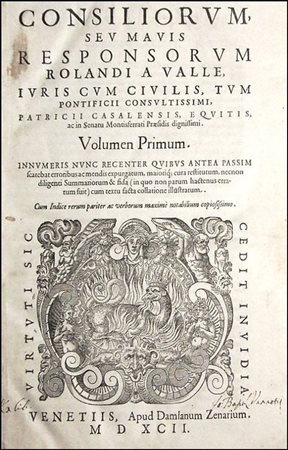
DELLA VALLE, ROLANDO. Consiliorum, seu mauis responsorum Rolandi a Valle, iuris cum ciuilis, tum pontificii consultissimi ... Volumen primum (-quartum). Innumeris nunc recenter quibus antea passim scatebat erroribus ac mendis expurgatum. Venetiis, apud Damianum Zenarium, 1592.
Four parts in two volumes in-folio (360x240 mm), contemporary stiff vellum binding with handwritten title at spine, pp. [4], 306, [2]; 275, [1]; 307, [1]; [4], 267, [153].
Scarce edition of the of legal advices of Rolando dalla Valle, one of the most renowned law counselor in late 16th century.
Even if frequently reprinted, the entire four-parts set it’s very sought-after and hard to find on the antiquarian market.
Rolando della Valle was among the most known figure in the juridical environment of mid XVI century. He was a lawyer, Judge and General Commissioner for the Hebrew in Monferrato in 1537, Governor of Casale and was appointed President of the Senate of that city on May, 2nd, 1567 by Duke William I. His main work was this collection of Consilia; printed first in two volumes and then, in a complete edition of four volumes, it had a huge success and it was reprinted many times along the centuries.
References: DEZZA, E. Rolando della Valle (1500-1575). Politica, diritto, strategie familiari nell’esperienza di un giurista casalese del Cinquecento. In Monferrato, arte e Storia, IX ( 1997), pp. 23-43.
Reference: Out of Italy (7 copies), OCLC locates no copies worldwide. -
Lotto 80 TWO TREATISES ON CRIMINAL LAW: THE RULES OF EVIDENCE AND THE RAPE OF THE VIRGINS
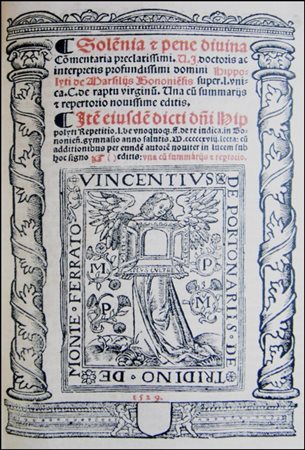
DE MARSIGLI, IPPOLITO. Sole[m]nis [et] pene divina vtriusq[ue] iuris doctoris ac interp[re]tis profundissimi d[omi]ni Hippolyti de Marsilijs Bononien[sis]. Repetitio rubrice. C. de probationibus. : Cum additionibus per eunde[m] autore[m] nouiter in luce[m] sub hoc signo [pointing hand] ( ) editis. Una cum summariis [et] repertorio nouissime appositis.. Lugduni, per Jouannem David dit la mouche, 1529, die 28 Aprilis (Lyon, La Mouche, 28 April 1529).
BOUND WITH:
DE MARSILIIS, IPPOLITO. Sole[n]nia et pene diuina Co[m]mentaria ... domini Hippolyti de Marsilijs Bononie[n]sis super l. vnica C. de raptu virginu[m]. Vna cu[m] summarijs et repertorio nouissime editis. Ite[m] eiusde[m] dicti domini Hippolyti Repetitio. l. de vnoquoq[ue] ff. de re iudica. Lugduni, per Joannem David dit la mouche, 1529, die vero 11 Mensis Iunii (Lyon, La Mouche, 11 June 1529).
2 works in a 8vo volume, ancient paperboards, ff. 55, [1]; 66.
Woodcut title-pages printed in red and black, woodcut head-letters. Text in Gothic type.
Rare and remarkable collection two of important treaties dedicated to criminal matters.
1. The first work is a large commentary to the title De probationibus of Justinian’s Codex, with a thorough analysis of the rules of evidence and the powers of the judge related to their admission and evaluation.
2. The second work contains regards the criminal legislation related to the crimes of kidnapping and rape of the virgins.
These lecturae represent a testimony of scientific maturity and autonomy achieved by the criminal law in early Renaissance, now equipped with an apparatus of terms, rules and institutions distinct from civil law, elaborated in practice, revised by jurists in their works and now sufficiently structured to to be taught separately. The structure of the two works is strongly affected by this new approach; the matter is treated uniformly, combining profiles of substantive law and procedural law, and then enriched with the opinions of doctores and judicial practice.
Provenance: Not identified annotations by a near contemporary hand.
References: 1. OCLC locates 5 copies in worldwide public libraries (2 in USA, at University of California Berkeley Law Library and at Harvard Law School Library).
2. OCLC locates 4 copies in worldwide public libraries (1 in USA, at Harvard Law School Library). -

Lotto 81 THE JURIDICAL REQUIREMENTS TO GET ECCLESIASTIC BENEFICES
ONE COPY IN USA
Garcia, Nicolás. Nicolai Garcia Hispani, J.U. professoris [...] Tractatus de Beneficiis amplissimuset doctissimus, declarationibus cardinalium Sacrae Congregationis Concilii Tridentini, DecisionibusqueSacrae Rotae Romanae [...] Accedunt huic Novae Editioni, S. Rotae Romanae Decisiones RecentissimaeNumquam anteà lucem editae, Materiam De Beneficiis ab Authore pertractatam […] Tomus Secundus. Coloniae Allobrogum, Sumpt. Perachon & Cramer, 1735.
Folio (350x220 mm), full vellum binding, handwritten title at second sector of 5 raised bands spine, ff. [8], 400, [104, last blank], [12], 216, [20, last blank]. Xylographic printer device with Crowned Salamander surrounded by flames at title-page, woodcut head-letters and decorations at preliminary leaves, text on two columns.
Uncommon edition of Garcìa's treatise on ecclesiastic benefices: in this work the author lists the moral and juridical requirements to get a benefice, beneficium, the procedure to follow and the motivation to give or to withdraw one.
Annex to the text there is a collection of Decisiones or judgments related to benefices, for complexity of the matter that can be considered among the Canon Law and the Civil Law.
References: Not in Sapori that mentions other editions. ICCU, IT\ICCU\RLZE\032181 (only two copies in Italian public libraries). OCLC 84418392 locates only one copy in USA (Harvard) -
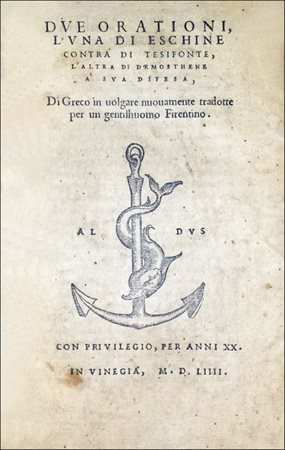
Lotto 82 AESCHINES' AND DEMOSTHENES' HARANGUES: PROSECUTION AND DEFENSE IN A FAMOUS TRIAL OF ANCIENT GREECE
DEMOSTHENES-AESCHINES. Due orationi, l'vna di Eschine contra di Tesifonte, l'altra di Demosthene à sua difesa. Di greco in volgare nuouamente tradotte per un gentilhuomo firentino [sic]. In Vinegia: [Venice: heirs of Aldo Manuzio], 1554.
8vo, attractive binding in 18th century water-colored wrappers, ff. 106, [2]. Text in Italian, translated from Greek language by the Florentine humanist Girolamo Ferro.
Aldine dolphin and anchor device on title-page and final leaf (woodcuts).
Capital spaces with guide letters.
First and only Aldine edition of the two harangues by Aeschines and Demosthes, the first one as Ctesiphon's prosecutor and the second as his defense attorney.
Demosthenes won the legal battle with Aeschines, although Aeschines' legal objections to the crowning were probably valid.
THE TRIAL:
Ctesiphon was an orator in Athens during the reign of Alexander the Great. He is best known for sparking this controversy that led to Demosthenes' speech «On the Crown» and Aeschines' speech «Against Ctesiphon».
In 336 BC, Alexander the Great's empire was spreading, and many in Athens were opposed to the ongoing wars. Among the most outspoken was the orator Demosthenes. In 336 BC, Ctesiphon proposed that Athens honor Demosthenes for services to the city by presenting him with a golden crown. This proposal became a political issue, and in 330 BC, Aeschines prosecuted Ctesiphon on charges of legal irregularities. In his most brilliant speech, On the Crown, Demosthenes effectively defended Ctesiphon and attacked vehemently those who backed Alexander the Great's empire. On legal irregularities Aeschines prosecuted Ctesiphon for having violated the law in three points:
1. For making false allegations in a state document.
2. For unlawfully conferring a crown to a state official (Demosthenes) who had not yet rendered a report of his term of office.
3. For unlawfully offering the crown at the Dionysia.
Demosthenes (384–322 BC), was a prominent Greek statesman and orator of ancient Athens. His orations constitute a significant expression of contemporary Athenian intellectual prowess and provide an insight into the politics and culture of ancient Greece during the 4th century BC. For a time, Demosthenes made his living as a professional speech-writer (logographer) and a lawyer, writing speeches for use in private legal suits.
He went on to devote his most productive years to opposing Macedon’s expansion. He idealized his city and strove throughout his life to restore Athens’ supremacy and motivate his compatriots against Philip II of Macedon. He sought to preserve his city’s freedom and to establish an alliance against Macedon, in an unsuccessful attempt to impede Philip’s plans to expand his influence southwards by conquering all the Greek states. -
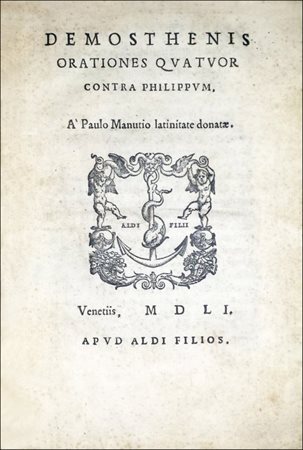
Lotto 83 DEMOSTHENES TRANSLATED BY THE YOUNG ALDUS’ SON
DEMOSTHENES. Demosthenis Orationes Quatuor contra Philippum, A Paulo Manutio latinitate donatae. Venetiis, Apud Aldi Filios, 1551 [Venice: Sons of Aldus, 1551].
4to, 18th century stiff vellum with blavk label and gilt lettered title at spine, ff. [52].
Aldine anchor of Aldus’ heirs at title-page. Dedicatory letter to Jean Morvilliers.
Scarce second edition of this elegant and esteemed translation made by Paolo Manuzio of the four Demosthenes’ «Philippics», the Orations against Philip of Macedon who was beginning his conquest of the Greece.
In September 1549, Francesco Greco wrote to Paolo Manuzio that, reading this translation, he seemed «to hear Demosthenes speaking Latin».
The first oration (351-350 BC) centered on the need for successful resistance for financial reform of the theorical fund to prepare for war and for swift action to avoid defeat. The second (344-343 BC) was a vehement attack against Philip and his Athenian supporters, delivered in the wake of the unsatisfactory Peace of Philocrates, which left Philip’s increasing power largely unchecked. Nonetheless it errs on the side of caution, perhaps indicative of Demosthenes’ own fear of the King, before whom he is said to have fainted. The third (341), the best of Demosthenes’ political orations, contrasts the ancient spirit of Athens with her present degeneracy. Having risen by his oratory to become the most influential politician in Athens, Demosthenes was able to weaken the pro-Macedonian factions, formulating alliances with other small states. He demands resolute action against Philip, a burst of energy from the Athenian people and the immediate dispatch of force. The fourth is the subject of controversy, with Demosthenes' authorship called into doubt, although the sentiment is similar to the third, the style is different.
It has been suggested that the text is descended not from his carefully honed speeches, but from notes for a spot oration, hence its unusual lack of finesse. Described by Cicero as «the perfect orator» and extolled as lex orandi by Quintilian, Demosthenes has long been regarded as one of the great minds of the Classical era, and his works remain a benchmark of eloquence and erudition.
References: CNCE 16744. Renouard, 146, 6: «les exemplaires sont rares, ainsi que ceux de la réimpression de 1551». Lettere volgari, vol. III (Francesco Greco write to Paulus Manutius): «Ho letto le quattro Filippiche di Demosthene, che V. S. ha voltato, anzi ho udito Demosthene parlante in latino, & in che lingua? in quella medesima certo che Cicerone, padre della Romana eloquenza, lo fece già rispondere ad Eschine, suo avversario [...]».BM STC Italian, 213. Dibdin, 486: «This translation is elegant and esteemed". Brunet II, 592: «Traduction estimée». -
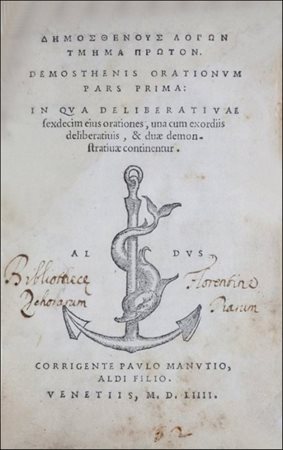
Lotto 84 FIRST AND ONLY ALDINE EDITION OF DEMOSTHENES’ ORATION IN THE ORIGINAL GREEK TEXT
DEMOSTHENES. Demosthenis Orationum pars prima: in qua deliberativae sexdecim eius orationes, una cum exordiis deliberativis, & duae demonstrativae continentur. Corrigente Paulo Manutio, Aldi Filio. Venetiis, 1554.
[TOGETHER WITH:]
DEMOSTHENES. Demosthenis Orationum pars secunda: in qua iudiciales novem eius publicae orationes continentur. Corrigente Paulo Manutio, Aldi Filio. Venetiis, 1554.
[TOGETHER WITH:]
DEMOSTHENES. Demosthenis Orationum pars tertia: quae iudiciales tres, et triginta privatas eius continet orationes. Corrigente Paulo Manutio, Aldi Filio. Venetiis, 1554.
3 volumes in-8vo, 19th century half calf with labels and gilt-lettered titles and decorations (the first volume is taller than the others); v. 1, [8], 122, [2] leaves; v. 2, 248, [2] leaves; v. 3, [2], 243 [i.e. 242], [2] leaves.
Aldine anchor at each title page; woodcut headletters. Entirely printed in Greek.
Very rare first and only Aldine edition of the original Greek text of Demosthenes Orations.
Described by Cicero as «the perfect orator» and extolled as lex orandi by Quintilian, Demosthenes has long been regarded as one of the great minds of the Classical era, and his works remain a benchmark of eloquence and erudition.
Provenance: 17th century inscription Bibliothec(a)e Florentin(a)e Scholarum Piarum
References: Renouard, 160.10: «fort rare». CNCE, 16746. OCLC, 6737363. -
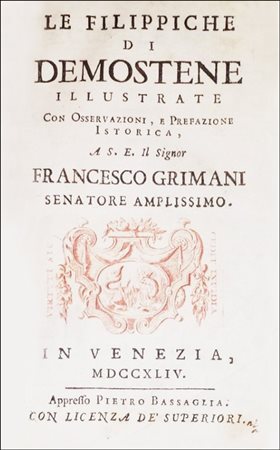
Lotto 85 DEMOSTHENES’ HARANGUES: THE ACME OF THE ART OF PERSUASION
THE FRANCESCO GUASTAVILLANI COPY
ONLY TWO COPIES IN USA
DEMOSTHENES. Le Filippiche di Demostene illustrate con Osservazioni, e Prefazione Istorica a S. E. il signor Francesco Grimani senatore amplissimo [...]. In Venezia, appresso Pietro Bassaglia, MDCCXLIV [Venice: Pietro Bassaglia, 1744].
A thick volume in-8vo (155x90 mm), contemporary stiff vellum, six raised bands with handwritten title at spine, sprinkled red edges pp. [32], 140, 485, [1, blank].
TWO ENGRAVINGS IN RED, THE FIRST ONE AT FRONTISPIECE, REPRESENTING THE COATS OF ARMS OF THE NOBLE VENETIAN FAMILY GRIMANI, AND THE OTHER ONE AT TITLE-PAGE WITH THE PRINTER’S DEVICE.
FINE VENETIAN EDITION OF DEMOSTHENES HARANGUES AGAINST PHILIP II OF MACEDON, THE ACME OF ANCIENT ART OF PERSUASION AND A SOURCE OF INSPIRATION FOR THE AUTHORS OF THE «FEDERALIST PAPERS» OF THE UNITED STATES CONSTITUTION.
This edition has a long historical preface about the History of Macedon.
DEMOSTHENES (384–322 BC), was a prominent Greek statesman and orator of ancient Athens. His orations constitute a significant expression of contemporary Athenian intellectual prowess and provide an insight into the politics and culture of ancient Greece during the 4th century BC.. He delivered his first judicial speeches at the age of 20, in which he argued effectively to gain from his guardians what was left of his inheritance. For a time, Demosthenes made his living as a professional speech-writer (logographer) and a lawyer, writing speeches for use in private legal suits.
He went on to devote his most productive years to opposing Macedon’s expansion. He idealized his city and strove throughout his life to restore Athens’ supremacy and motivate his compatriots against Philip II of Macedon. He sought to preserve his city’s freedom and to establish an alliance against Macedon, in an unsuccessful attempt to impede Philip’s plans to expand his influence southwards by conquering all the Greek states. After Philip’s death, Demosthenes played a leading part in his city’s uprising against the new King of Macedon, Alexander the Great. However, his efforts failed and the revolt was met with a harsh Macedonian reaction. To prevent a similar revolt against his own rule, Alexander’s successor in this region, Antipater, sent his men to track Demosthenes down. Demosthenes took his own life, in order to avoid being arrested by Archias, Antipater’s confidant.
The Alexandrian Canon compiled by Aristophanes of Byzantium and Aristarchus of Samothrace recognized Demosthenes as one of the ten greatest Attic orators and logographers. According to Longinus, Demosthenes «perfected to the utmost the tone of lofty speech, living passions, copiousness, readiness, speed». Cicero acclaimed him as «the perfect orator» who lacked nothing, and Quintilian extolled him as lex orandi («the standard of oratory») and that inter omnes unus excellat («he stands alone among all the orators»). -
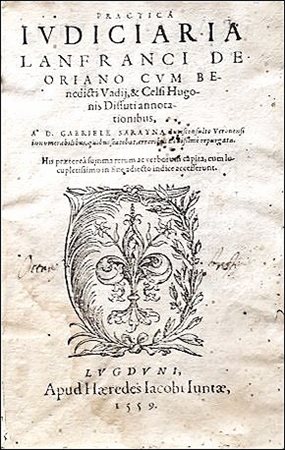
Lotto 86 THE GIUNTINE EDITION OF ORIANO'S STANDARD PRAXIS OF LAW PROCEDURE
Oriano, Lanfrancus (De). Practica iudiciaria Lanfranci De Oriano, cum Benedicti Vadii, et Celsi Hugonis annotationibus. A Iacobo Boniour plurimis axiomatibus, in schematibus proximè locupletata. Ad Cardin. Lotharingum Carolum Lotharing. Lugduni, apud Haeredes Iacobi Iuntae, 1559.
8vo (150x103 mm), contemporary limp vellum (spine partly defective), ff. 179, [9].
Scarce and fundamental Renaissance treatise on legal procedure.
Provenance: Numerous contemporary underlinings and maniculae(«small hands»).
References: Sapori 1617. OCLC 69006914 locates in USA only the copy at Harvard Law library. -
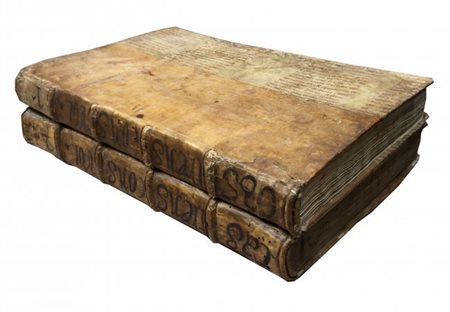
Lotto 87 RARE GIUNTINE EDITION OF DI CASTRO’S COUNSELS
WITH A BINDING FROM A MEDIEVAL MANUSCRIPT
ONLY A COPY IN WORLDWIDE PUBLIC LIBRARIES
DI CASTRO, PAOLO. Consiliorvm sive responsorvm [...] cvivs haec omnivm postrema editio habet tvm consuetas multorum adnotationes, & praesertim Nicolai Michaelis [...] emendata [...].Venice, Giunti, 1617.
3 parts bound in 2 volumes in-folio (360x226), contemporary stiff vellum with a part from an ancient early manuscript, calligraphic title on four raised bands spines, ff. [2], 242, [18]; 222, [12]; 42, [8].
Printer’s woodcut device at titlepages.
VERY RARE GIUNTINE EDITION, REPRINT OF THE 1580 EDITION, OF PAOLO DI CASTRO’S «COUNSELS», ONE OF THE MOST IMPORTANT COLLECTION OF LEGAL ADVICES OF THE MIDDLE AGES.
The binding is partly composed with a vellum from a Medieval manuscript written in a fine semigothic handwriting.
Paolo di Castro (1394-1441), jurist of the "school of commentators", scholar of Baldo degli Ubaldi, studied and taught at Avignon; then he was teacher of civil law at Florence, Siena, Bologna and Padova; he was also mayor at Viterbo. After Bartolo and Baldo, he was the most influent medieval lawyer of his time.
References: IT\ICCU\VIAE\017590 (only 2 copies). OPAC locates only two copies in Italy of this edition; out of Italy, OCLC 80356333 locates only a copy in worldwide public libraries at Harvard Law Library. -
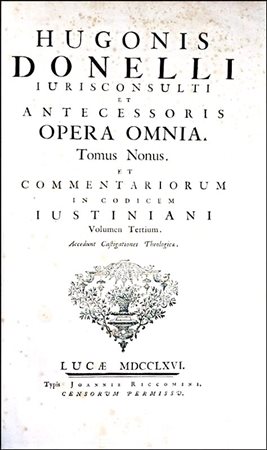
Lotto 88 DONEAU'S COMMENTARY ON JUSTINIAN'S CORPUS JURIS CIVILIS
Doneau, Hugues. Opera Omnia Tomus Nonus. Et Commentariorum in codicem Iustiniani Volumen Tertium. Accedunt Castigationes Teologicae. Lucae (Lucca), Typis Joannis Riccomini, 1766.
Folio (374x253 mm), 19th century colored paper, ff. [4, pages at verso are blanks], VI, columns 1560.
Xylographic endpieces, text on two columns, romanic and italic types.
Ninth volume (complete in itself) of Hugues Doneau’s Opera Omnia, containing his commentary to the Justinian’s Corpus Iuris Civilis and treatises on fundamental issues about Commercial Law and Inheritance Law. Among the other we find the following items: writings containing Last Wills, Interdiction, Heirs, Distraint, Mortgages, Bequests.
Hugues Doneau (1527-1591, latinized name Hugonis Donellus and italianised Ugo Donello) was a French jurist belonging to the Scuola Culta. He was follower of Andrea Alciato, trying to apply his humanistic methods to the law enviroment.
The Scuola Culta is a social movement of lawyers of the late Middle Age that worked toghether for the renewal of current laws, with the objective to create a new set of laws, philologically coherent with its Justinian roots.
References: ICCU, IT\ICCU\RLZE\025708. OCLC, 832171090. -
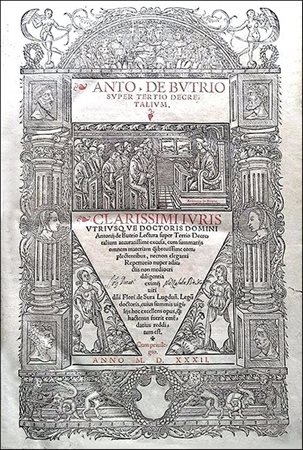
Lotto 89 BUTRIO'S COMMENTARY ON POPE GREGORY IX'S DECRETALS
De Butrio, Antonio.Lectura Super tertio et quarto decretalium.Lyon: Luxembourg de Gabiano, Hugues de La Porte and Jean Crespin, 1532.
Two volumes (out of five) bound together in folio (368 x 255), contemporary stiff vellum with handwritten title at raised bands spine, ff. 208, 63.
Elaborate xylographic title-pages in red and black, woodcut head-letters.
Text on two columns. Gothic type.
Fine early Lyon edition of Butrio's commentary on third and fourth book of Decretals.
The Decretales, or Decretals of Pope Gregory IX are an important source of medieval canon law, collected by the dominican St. Raymond of Peñafort under the order of the same Gregory IX; they are composed of five books, each one divided in several tituli (titles).
References: OCLC 603740010. -
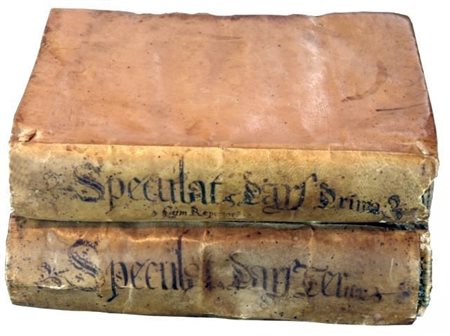
Lotto 90 A SOURCE FOR THE STUDY OF MEDIEVAL CIVIL AND CRIMINAL PROCESSES
ONLY TWO COPIES IN WORLDWIDE LIBRARIES, NONE IN USA
Durand, Guillaume. Speculi Gulielmi Durandi Venetiis, [Printer Device with Fountain], 1566.
Two volumes in 4to (204x150 mm), contemporary full vellum with sepia ink handwritten titles at spine, ff. [84], pp. 534, [2] for the first volume; pp. 797, [3] for the third volume. Text in Latin, two columns. Some xylographic decorations and headletters.
First and third volumes (out of four) of a very scarce edition of this remarkable medieval treatise that deals with all the issues related to civil and criminal process.
Guillaume Durand (1237-1296) was a French jurist and ecclesiastical. His career was brilliant in both the areas: at first he was Canon Law teacher in Modena, then auditor in Rome, Bishop (from 1290) in Mende, in Lozèr, and Archbishop in Ravenna (from 1295), as well as rector in Romagna and Marche. He is remembered for the present work, that led him to be condemned by Dante in Epistole (Ep. XI, 16) as an exponent of the formalist doctrine, and for a treatise on the symbology of ecclesiastical architecture and liturgical celebrations (Rationale divinorum officiorum, ca. 1280).
References: Not in Fontana, that doesn’t mention any Venetian edition of Speculum. Edit16, CNCE 17903. NO COPIES IN USA. Out of Italy, OCLC locates only two copies worldwide (Canada and France). -
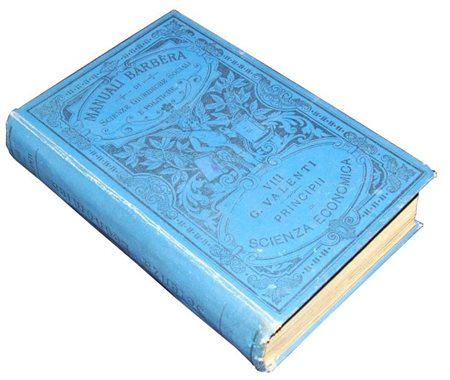
Lotto 91 FOUR WORKS ON POLITICAL ECONOMY WRITTEN BY FAMOUS ECONOMISTS AND STATESMEN
[1.]: Minghetti, Marco. Des rapports de l'economie publique avec la morale et le droit par M. Minghetti; traduit par M. Saint-German Leduc; precede d'un introduction par M. H. Passy. Paris: Guillaumin, 1863.
[together with:]
[2.]: Minghetti, Marco. Della economia pubblica e delle sue attinenze colla morale e col diritto: libri cinque. 2. ed., riveduta dall'autore. Firenze: Succ. Le Monnier, 1868.
[together with:]
[3.]: Lampertico, Fedele. Economia dei popoli e degli stati. Introduzione. Milano: Fratelli Treves, Editori, 1874.
[together with:]
[4.]: Valenti, Ghino. Principi di scienza economica. Introduzione allo studio dell'economia politica, i principii dell' economia individuale, i principii dell' economia sociale. Firenze: G. Barbera, Editore, 1906.
[1.]: 8vo (180x106 mm), half percalline cloth binding, with marbled paper, blue sprinkled edges; pp. XXXII, 560. Work belonging to the collection Bibliothèque des sciences morales et politiques.
[2.]: 176x112 mm, half leather binding; pp. VIII, 509.
[3.]: 8vo (180x116 mm), half cloth binding and marbled paper at boards, title at spine; pp. XXI, 341. Editorial device at title-page with motto: laboremus.
[4.]: 8vo (165x120 mm), editorial blue cloth binding; pp. XXVIII, 521, [1 b.]. Editorial device at title-page (a butterfly that comes near to a rose, with the motto: non bramo altr'esca).
The work belongs to the collection: Manuali Barbera di scienze giuridiche sociali e politiche. Serie teorica. 8.1.
Marco Minghetti (1818-1886) was an Italian economist and statesman, Minister of the Interior, then Minister of Finance, Prime Minister in 1863 and, finally, Minister of Agriculture.
Fedele Lampertico (1833-1906), economist, writer, senator, jurist, statistician, was also interested in Venetian history.
Ghino Valenti (1852-1920), economist, university professor, was interested in agricultural economy, problems of customs, Director of Agricultural Statistics, Minister of Agriculture, Secretary of the "Society of Italian farmers."
Provenance: Private library of a Verona noble family, whose roots are in Mantua and in which there were distinguished lawyers and jurists.
References:
[1.]: IT\ICCU\LO1\0036479 (8 copies). OCLC, 30076526.
[2.]: IT\ICCU\NAP\0116066. OCLC, 187189722 (one copy in Sweden).
[3.]: IT\ICCU\RAV\0239622. OCLC, 249692603 (one copy in Germany), 872259159 (one copy in Denmark).
[4.]: IT\ICCU\NAP\0117147. OCLC, 860492055 -
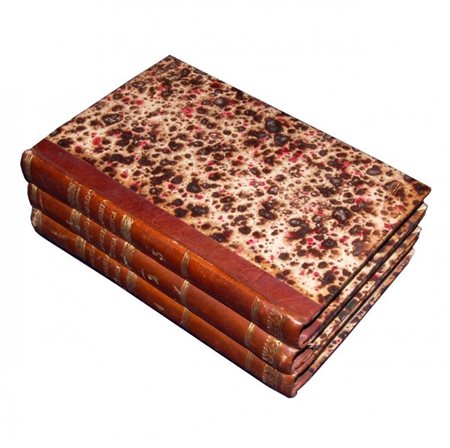
Lotto 92 A THEORETICAL AND PRACTICAL TREATISE ON POLITICAL ECONOMY BY GEROLAMO BOCCARDO
Boccardo, Gerolamo. Trattato teorico-pratico di economia politica del Cav. Prof. Avv. Gerolamo Boccardo. Seconda edizione riveduta e considerevolmente ampliata dall'Autore. Vol. Primo [-Terzo]. Torino: Sebastiano Franco e Figli e compagnia, 1859.
8vo (170x110 mm), half leather binding, with marbled paper at boards, gilt title at spine; 3 vols.; pp. 312; 304; 280.
The volumes have the following different titles: Vol. Primo: Economia teoretica. Vol. Secondo: Economia pratica. Vol. Terzo: Economia pratica.
Gerolamo Boccardo (Genova, 1829-1904) was one of the leading Italian economists of the nineteenth century. Teacher at the University of Genova and Senator, wrote extensively, spreading in Italy the theories of John Stuart Mill.
Provenance: Private library of a Verona noble family, whose roots are in Mantua and in which there were distinguished lawyers and jurists.
References: IT\ICCU\RAV\0335857. OCLC, 33256238 (one copy in USA at the Syracuse University, and one copy in Japan at the Aoyama Gakuin University Shibuya-Ku, Tokyo). -
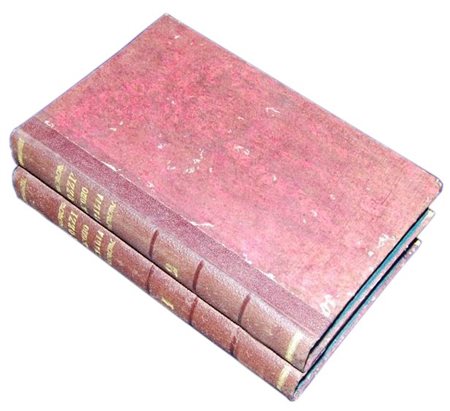
Lotto 93 TWO WORKS ON RELATIONSHIP BETWEEN WORK AND LEISURE, THE EFFECTS OF BOTH IN THE ECONOMY OF VARIOUS ITALIAN REGIONS AND FOREIGN COUNTRIES, WRITTEN BY FAMOUS ECONOMISTS
[1.]: Lampertico, Fedele. Economia dei popoli e degli stati. Il lavoro. Milano: Fratelli Treves, 1875.
[together with:]
[2.]: Lozzi, Carlo. Dell'ozio in Italia: libri quattro di Carlo Lozzi. Primo [Secondo-] volume. Torino; Napoli: Unione Tipografico-Editrice, 1870-1871
[1.]: 8vo (180x116 mm), half cloth binding and marbled paper at boards, title at spine; pp. XII, 400. Editorial device at title-page with motto: laboremus.
[2.]: 8vo (180x108 mm), half percalline cloth binding and marbled paper at boards, title at spine, blue sprinkled edges; 2 vols.; pp. 434; 428. Work belonging to the collection: "Biblioteca educativa per il popolo italiano".
Lampertico, Fedele (1833-1906), economist, writer, senator, jurist, statistician, was also interested in Venetian history.
Carlo Lozzi (1829 - 1915) was an Italian jurist and scholar.
Provenance: Private library of a Verona noble family, whose roots are in Mantua and in which there were distinguished lawyers and jurists.
References:
[1.]: IT\ICCU\RAV\0239625. OCLC, 886144540.
[2.]: IT\ICCU\BIA\0010383. OCLC, 457680399 (1 copy in France), 645385224 (1 copy in Germany). -
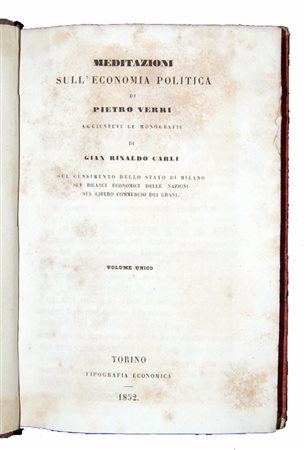
Lotto 94 THE MEDITATIONS ON POLITICAL ECONOMY BY PIETRO VERRI, WITH ORIGINAL THEORIES ON TAXATION, ON INTERNAL FREE TRADE AND FREE EXPORT OF CORN
Verri, Pietro. Meditazioni sull'economia politica di Pietro Verri aggiuntevi le monografie di Gian Rinaldo Carli sul censimento dello Stato di Milano sui bilanci economici delle Nazioni sul libero commercio dei grani. Volume unico. Torino: Tipografia Economica, 1852.
8vo (178x116 mm), half leather binding with orange striped paper at boards, gilt title and decorations at spine; pp. 289.
Monographs by Gian Rinaldo Carli published in this volume:
Il censimento di Milano.
Breve ragionamento sopra i bilanci economici delle nazioni.
Del libero commercio de' grani.
Sull'impiego del danaro.
Saggio politico ed economico sopra la Toscana, fatto nell'anno 1737.
Pietro Verri (1728-1797) was an Italian philosopher, economist, historian and writer. He was author of political writings, historical, social, literary and satirical, and translated the plays of Destouches. As a politician, he covered also various government positions.
Gian Rinaldo Carli (1720-1795) was an Italian writer, economist, historian and also a numismatist.
Provenance: Private library of a Verona noble family, whose roots are in Mantua and in which there were distinguished lawyers and jurists.
References: IT\ICCU\MIL\0261748. OCLC, 875187395. -
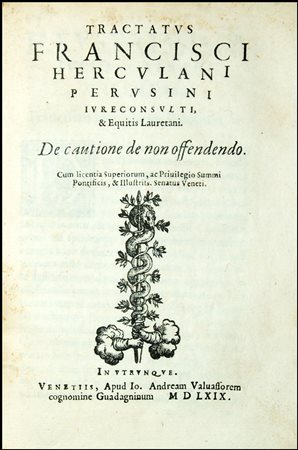
Lotto 95 FIRST EDITION OF THIS UNCOMMON TREATISE ABOUT THE INTERDICT
Ercolani, Francesco. Tractatus Francisci Herculani Perusini [...] de cautione de non offendendo. Venetiis [Venezia]: apud Io. Andream Valuassorem cognomine Guadagninum [Valvassore], 1569.
8vo, 148x100 mm, original soft vellum binding, hanwritten title at spine, calligraphed title at lower edge, remains of ties; [36], 187, [1] leaves. Editorial woodcut device at title-page (two hands hold a stick on which a snake and branches of ivy are wrapped; motto: In utrunque).
Ercolani 's treatise addresses the Roman law of interdict, a category of orders or prohibitions issued by a magistrate and addressed to a Particular person to give immediate protection to a threatened interest of a complainer. They were also used to protect public interests, such as waterways.
References: IT\ICCU\RLZE\018246. OCLC, 78550653 (one copy in USA), 22402237 (one copy in USA and one copy in Japan), 491510214 (one copy in France) and 246135852 (five copies in Germany). -
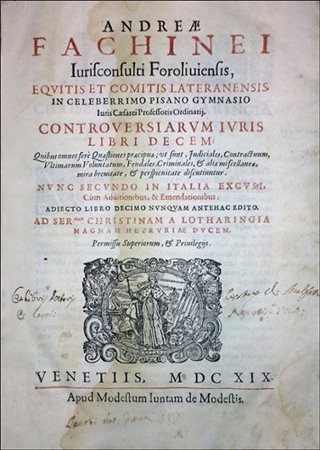
Lotto 96 ENLARGED EDITION OF FACHINEI'S COLLECTION OF CONTROVERSIES AND LITIGATIONS
Fachinei, Andrea. Andreae Fachinei ... Controversiarum iuris libris decem [-tredecim] Quibus omnes fere quaestiones praecipuae; ut sunt, judiciales, contractuum, ultimarum voluntatum, feudales, criminales, & aliae miscellaneae, mira brevitate, & perspicuitate discutiuntur. Nunc secundo in Italia excusi. Cum additionibus & emendationibus; adiecto libro decimo nunquam antehac edito.Venetiis, Apud Modestum Iuntam de Modestis, 1619-1620.
Folio, contemporary stiff vellum (a light tear at spine), 1372, 329 columns.
Title-page in red and black.
Second edition of Fachinei Controversiae on various topics: contracts, testaments, feudal and criminal law, with the addition for the first time of a tenth book.
Provenance: Near contemporary inscription Ex libris doctoris Cesaris de Malfattis at title-page.
References: OCLC 2918198.