
Medieval Notary Manuscripts & Law Books
-
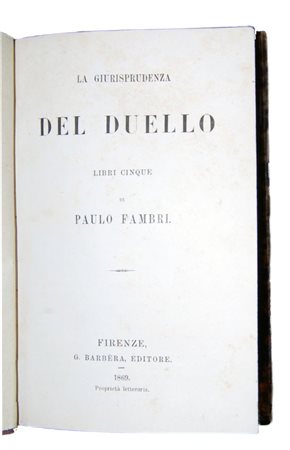
Lotto 97 JURISPRUDENCE ON DUELLING BY PAOLO FAMBRI
Fambri, Paolo. La giurisprudenza del duello. Libri cinque di Paulo Fambri. Firenze: G. Barbera, Editore, 1869.
8vo (182x112 mm), half percalline cloth binding, with marbled paper at boards, gilt title at spine; pp. XVII, 298.
Paolo Fambri was an Italian member of Parliament and a writer on literary, historical and legal topics.
Provenance: Private library of a Verona noble family, whose roots are in Mantua and in which there were distinguished lawyers and jurists.
References: IT\ICCU\SBL\0406693. OCLC, 680443712 (electronic reproduction). -

Lotto 98 SECOND EDITION OF CODEX FABRIANUS, CONTAINING THE DECISIONS OF THE SAVOY COURTS
Favre, Antoine.Codex Fabrianus definitionum forensium et rerum in sacro Sabaidae Senatu tractatarum: ex ordine titulorum codicis Iustinianei quantum fieri potuit accomodare ad usum forensem, in novem libros distributus auctore et compositore Antonio Fabro... Opus integrum, et omnibus iuris studiosis utilissimum, sed pragmaticis praecipue necessarium. Lugduni: Cardon, 1606.
Folio, contemporary half vellum on marbled paper, handwritten title at spine, ff. [14], pp. 579, ff. [27], pp. 822, ff. [15].
Title page printed in red and black, engraved portrait of the author.
Second edition of Codex Fabrianus, printed in the same year of the first one that was published in Geneve (Switzerland), but lacking (for censorship) the first leaf (De summa Trinitate) containing a list of punishments for the heretics.
Antoine Favre, baron of Pérouges (5 October 1557 – 1624) was a Savoisian nobleman and jurist. Favre was born in Bourg-en-Bresse. After studies in Paris and Turin, he practiced law in Chambéry. He was a member of the Savoyard court there from 1585 onwards, and its president from 1610 onwards.
His principal scholarly work is the Codex Fabrianus definitionum forensium (1609), a report of the decisions of his court organized after the Justinian Code. Favre's other research, conjectures about the Justinian code in which he endeavors to separate the Justinian insertions from the classical Roman texts, is still valued by scholars today.
References: Not is Sapori, that quotes other editions. OCLC, 634759070. -
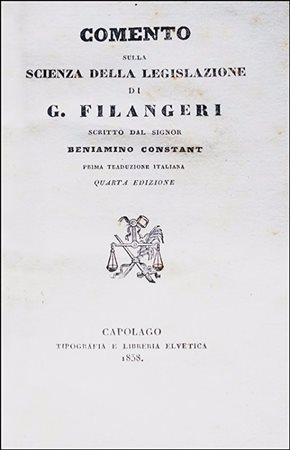
Lotto 99 THE ITALIAN EDITION OF CONSTANT'S COMMENTARY TO FILANGIERI'S SCIENCE OF LEGISLATION
Constant, Benjamin. Comento [sic!] sulla scienza della legislazione di G. Filangeri [sic!] scritto dal signor Beniamino Constant. Prima traduzione italiana. Quarta edizione. Capolago: Tipografia Elvetica, 1838.
8vo, contemporary half calf on marbled paper, orange label and gilt-lettered title at spine, pp. 352.
Fourth Italian edition of Constant's commentary on Filangieri's Scienza della Legislazione.
The «Science of Legislation» by Filangieri is a cornerstone of the legal, economic and political thinking of Italian and European Enlightenment. The work, published originally from 1780 in seven volumes (Naples, Raimondiana) had a great international echo, with translations in English, French, German and Spanish. Founded on a rigorous codification of the laws and a progressive reform of the criminal procedure, the work of Filangieri, influenced by Vico and Giannone as Montesquieu, also gave a new formulation of the concept of crime: «Not all actions contrary to the laws are crimes, not those who practice them are criminals. The violation of the law, must be accompanied by a desire to violate it».
The treatise, which also constituted one of the models of Benjamin Franklin and some of the other fathers of the American Constitution, was placed on the Index of Forbidden Books in 1784 for his ideas of reform and its harsh attacks on ecclesiastical privileges.
Palgrave: «Filangieri was one of the most important writers on economics in the latter years of the last century. He followed no leader, standing between the physiocratic and mercantilist theory. His works are thus the prelude to a historical system of social legislation».
References: IT\ICCU\PUV\0943663. OCLC 611020618 (two copies in Switzerland) and 52957586 (two copies in USA). -
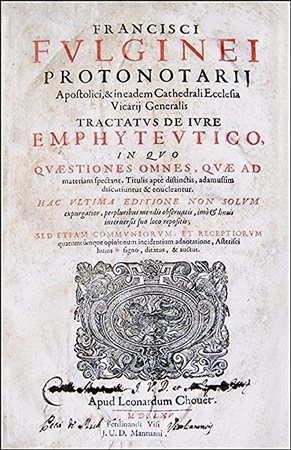
Lotto 100 ULTIMATE EDITION OF FOLIGNI'S RENOWNED TREATISE ON REAL PROPERTY AND LONG LEASE CONTRACTS
Foligni, Francesco (Fulgineo, Francesco). Francisci Fulginei […] Tractatus de iure emphyteutico, in quo quaestiones omnes, quae ad materiam spectant, titulis apte distinctis, adamussim discutiuntur & enucleantur. Hac vltima editione non solum expurgatior, […] sed etiam communiorum, et receptiorum quarumcumque opinionum incidentium adnotatione, […] auctus. Genevae (Geneve): apud Leonardum Chouet (Chouet, Léonard), 1665.
Folio, contemporary full stiff vellum, handwritten title at spine and at lower edge; pp. [12], 373 [i.e. 399], [57]; p. 399 is wrongly numbered 373.
Text in Latin in two columns.Title-page in red and black types, with a wide device representing the crowned salamander resurging by the flames. Engraved head and -tail pieces, engraved headletters.
Author’s dedicace to the cardinal Antonio Barberini.
Ultimate edition of main Foligni's treatises, regarding long lease contracts, that was reprinted until late 19th century.
The work deals with all the aspects regarding the long lease contract (also called, with the juridical term, emphyteusis), as to say the contract granting the use of a land for a long period receiving as payment a part of the profit (money or natural products) gained by it. The work is presented as a practical book, structured under the form of quaestiones (questions) with their punctual responses. An alphabetical index is added, to easily find the needed questions.
Francesco Foligni (died 1647), a lawyer and noble man from Foligno, was also apostholic protonotary and general curate of the cathedral of his town.
Provenance: Some not identified contemporary inscriptions at title-page.
References: ICCU\RMGE\000092. OCLC: 15052123 (locates two copies in USA) and 83753589 (locates a copy in USA at the University of California Berkeley Law Library). -
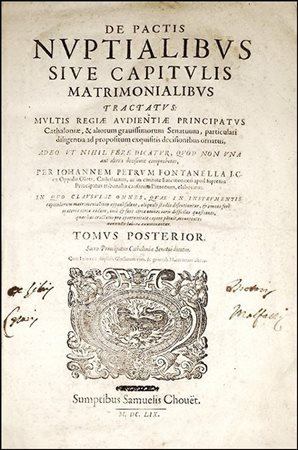
Lotto 101 THE MARRIAGE LAWS IN CATALONIA
Fontanella, Juan Pedro. De Pactis Nuptialibus sive Capitulis Matrimonialibus Tractatus: multisregiae audientiae principatus Cathaloniae, & aliorum gravissimorum Senatuum, particulari diligentia adpropositum exquisitis decisionibus ornatus [...] per Iohannem Petrum Fontanella I.C. ex Oppido Oloti,Cathalanum [...]. Tomus Posterior […]. Geneva, Sumptibus Samuelis Chouët, 1659.
Folio (365x235 mm), original paper boards with sepia ink handwritten titles at spine, visible joints, ff. [6], pp. 650, ff. [53, last blank]. Fine printer device at titlepage, xylographic decorations and headletters, text on two columns.
The fundamental treatise on Marriage Law compiled by the Catalan jurist Juan Pedro Fontanella.
The work, printed for first time in 1612, is here in the Geneve edition by Samuel Chouët, with the device of the Crowned Salamander.
The Marriage Law, base for the Family Law, was fundamental in Fontanella period, considering that with combined weddings for political reasons, they, at that time, changed the political situation of small lands as well as of entire countries.
Juan Pedro Fontanella (Gerona, 1576-Barcelona 1680) was a Catalan jurist that lived more that hundred years. Beside the present work, he compiled a famous treatise on Decisiones by the Senate of Catalonia.
Provenance: Sepia ink handwritten unidentified ownership inscription at titlepage, beside the printer device Ex Libris Noctoris (?) Cesaris Malfattis.
References: Fontana, pars I, col. 355. Not in Sapori, that mentions other five editions. IT\ICCU\CFIE\003331. -

Lotto 102 THE FIRST ITALIAN LAW ENCYCLOPEDIA
NO COPIES IN USA
Foramiti, Francesco. Enciclopedia Legale Ovvero Lessico Ragionato di Gius Naturale, Civile, Canonico, Mercantile-Cambiario-Marittimo, Feudale, Penale, Pubblico-Interno, e Delle Genti. Venice: Coi Tipi di Giuseppe Antonelli Ed., 1841-1843.
Four volumes in-4to, contemporary quarter calf over marbled boards, gilt titles and ornaments at spine. Main text in double columns.
Second and final edition of this remarkable and comprehensive law encyclopedia, with entries quite detailed. Possibly the first encyclopedia of Italian civil law, with its organizational style similar to that of Tomlins’s Law Dictionary.
References: OCLC locates 5 copies of the first edition in USA public libraries, no copies of this second edition. BMC, IX, 543. -
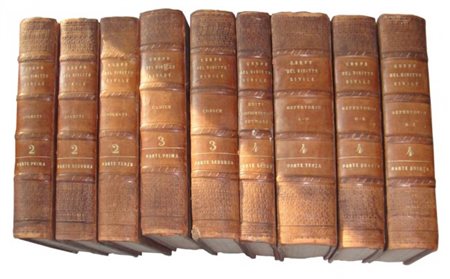
Lotto 103 THE FIRST ITALIAN TRANSLATION OF THE CORPUS JURIS CIVILIS BY THE EMPEROR JUSTINIAN
Foramiti, Francesco. Corpo del diritto civile: in cui si contengono le instituzioni di Giustiniano, i digesti o pandette, il codice, le autentiche, ossiano novelle costituzioni, e gli editti, non che le novelle costituzioni di Leone e di altri imperatori, i canoni de' santi e degli apostoli e i libri de' feudi : con brevi note indicanti le leggi simili, quelle che a vicenda s'illustrano, le contrarie e le abrogate, premessa La storia cronologica del diritto civile romano: nuova edizione eseguita su quella di Parigi del 1830 / prima versione italiana per istudio e cura di Francesco Foramiti.. Venezia: Tip. G. Antonelli, 1836-1844.
9 volumes (out of 10, it lacks the first volume), contemporary half calf with gilt-letterd titles at four raised bands spine.
Parallel text Latin-Italian.
First edition in Italian language of Corpus Iuris Civilis wanted by the Emperor Justinian: the Corpus, that was the founding text of European Law until 19th century, was translated and adapted to Italian language by Foramiti according to the critical Latin edition published in Paris in 1830.
Francesco Foramiti (XVIII-XIX secolo) was a Venetian jurist. He also published an Enciclopedia Legale ovvero Lessico ragionato di gius naturale, civile, canonico, mercantile-cambiario-marittimo, feudale, penale, pubblico-interno, e delle genti (Venice, 1838-40) and a Bibliografia legale ovvero vita e fatti più importanti dei primari giureconsulti (Venice, 1843), an historical account of all the most important jurists of every time.
References: IT\ICCU\MIL\0245763. OCLC 715454282. -
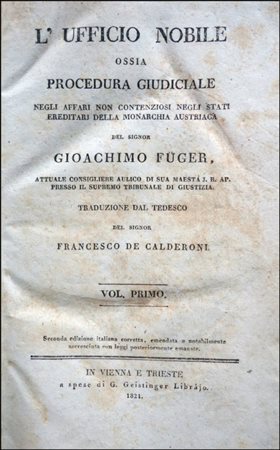
Lotto 104 THE CIVIL PROCEDURAL LAW IN THE AUSTRIAN EMPIRE
Fuger, Joachim. L'ufficio nobile ossia Procedura giudiciale negli affari non contenziosi negli stati ereditarj della monarchia austriaca del signor Gioachimo Füger [...]. Edizione seconda accresciuta e migliorata dall'Autore dietro il nuovo Codice Civile Universale. Traduzione dal tedesco del signor Francesco De Calderoni. Vol. Primo [-III]. In Venezia: nella Tipografia Picotti, a spese di G. Geistinger e Comp. di Trieste, 1821.
3 volumes bound together in-8vo, contemporary half calf binding, with marbled paper, pp. 218, [2]; 267 [i.e. 167], [1], [2] leaves of folded tab.; 224, [2] leaves of folded tables.
Second edition of a useful handbook of procedural law in non-contentious proceedings in the provinces of Austrian Empire.
The Austrian Empire (or simply: Austria) (in Austrian - German: Kaiserthum Oesterreich) was created out of the realms of the Habsburgs by proclamation in 1804. It was a multinational empire and one of the world's great powers. Proclaimed in response to the First French Empire, it overlapped with the Holy Roman Empire until the latter's dissolution in 1806. It included in its territory the Kingdom of Lombardy–Venetia. The Austro-Hungarian Compromise of 1867 elevated Hungary's status within the Austrian Empire, creating a new dual monarchy of Austria-Hungary.
References: IT\ICCU\MILE\023608 (5 copies). OCLC, 797907531. -
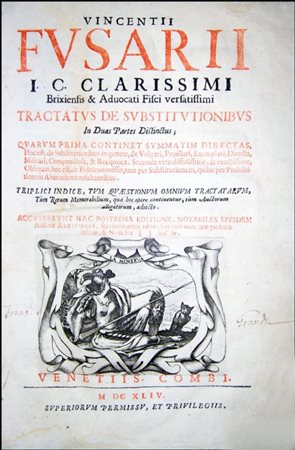
Lotto 105 A TREATISE OF INHERITANCE LAW
Fusari, Vincenzo. Tractatus de substitutionibus in duas partes distinctus; quarum prima continet summatim directas, hoc est, de substitutionibus in genere [...] Secunda vero diffusissime, & exactissime, obliquas, hoc est, de fideicommissis [...] Triplici indice [...] adiecto. Accesserunt hac postrema editione, notabiles eiusdem auctoris additiones, separatim antea editæ, suis vero nunc quæque locis insertæ, & notis his [ ] inclusæ. Venetiis: Combi, 1644.
Folio (326x224 mm), full vellum binding, four raised bands at spine (binding a bit loose), calligraphed title at bottom edge; pp. [136], 1088 [i.e. 1100]. Title-page in red and black types, with a large engraved printer's device representing Minerva. Xylographic initials and ornaments.
Uncommon treatise of inheritance law.
Provenance: Private library of a Verona noble family, whose roots are in Mantua and in which there were distinguished lawyers and jurists.
Handwritten ownership inscription at title-page, not readable (Franc. Grandi ?).
References: IT\ICCU\MILE\005385. OCLC, 81872347 (2 copies in USA), 222859790 (one copy in Canada), 457478049 (one copy in France). -

Lotto 106 AN EXTENSIVE TREATISE ON JUDICIAL PROCESS IN THE HOLY ROMAN EMPIRE CHAMBER, WRITTEN BY ANDREAS GAIL, TOGETHER WITH THE DEVELOPMENT OF THE MOST INTERESTING DISPUTES, COLLECTED BY FABRICIUS
[1.]: Gail, Andreas - Gymnich, Walter. Practicarum observationum, tam ad processum judiciarium, praesertim imperialis camerae, quam causarum decisiones pertinentium, libri duo. De pace publica [...]. De pignorationibus [...]. De manuum injectionibus [...] per nobilem ac clarissimum D. Andream Gaill, [...]. Editio postrema correctior, ex ultima recognitione Gualteri Gymnici [...] cum indice [...] locupletissimo. Coloniae Agrippinae [Koln]: Sumptibus & Typis Wilhelmi Metternich, Bibliop., Anno M.DC.XCVIIII. [1699].
[bound with:]
[2.]: Fabricius, Eberhard - Gail, Andreas. Everhardi Fabricii, Gailius enucleatus, hoc est enodatio controversiarum maxime nobilium, [...]. Opus omnibus utile, necessarium, [...] deductum. Coloniae Agrippinae [Koln]: Sumptibus & Typis Wilhelmi Metternich, Bibliop., Anno M.DC.XCVII. [1697].
8vo (206x170 mm), full mottled leather binding, four raised bands at spine with title, green and red sprinkled edges; pp. [28], 628; 272; [128]; 139, [1]. First work title-page in red and black types and second work title-page in black types, both with a printer's device (an eagle in a figured frame, with motto: Spirat ubi vult; printer's initials WFM). Xylographic initials and head- and final-pieces.
Andreas von Gail [Geihl] (1526-1587), German judge and jurisconsult, called the Papinian of Germany. His writings on public order, proscription, banishment and pledges were of considerable European influence.
Provenance: Private library of a Verona noble family, whose roots are in Mantua and in which there were distinguished lawyers and jurists.
Handwritten ownership inscriptions at title-page.
References:
[1.]: IT\ICCU\CAGE\016523 (2 copies). OCLC, 311477678 (1 copy in Germany).
[2.]: Not in ICCU. OCLC, 800830633 (1 copy in Italy at the Biblioteca Comunale di Trento), 31399714 (1 copy in USA, Syracuse University), 836690570 (1 copy in Germany). -
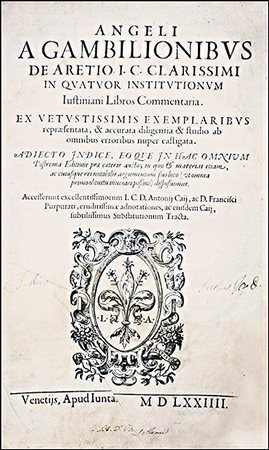
Lotto 107 THE GIUNTINE EDITION OF GAMBIGLIONI COMMENTARY ON JUSTINIAN'S INSTITUTIONS
Gambiglioni, Angelo. In quatuor Institutionum Iustiniani Libros Commentaria. Ex vetustissimis exemplaribus repraesentata, & accurata diligentia & studio ab omnibus erroribus nuper castigata. Adiecto Indice [...] Accesserunt excellentissimorum I. C. D. Antonij Caij, ac D. Francisci Purpurati, eruditissimae adnotationes, ac eiusdem Caij subtilissimus Substitutionum Tracta. Venetijs, Apud Iuntas, 1574 (al colophon: Venetiis, Apud Hieronymum Polum, 1574).
Folio (325x220 mm), XVII century stiff vellum (lightly worn, reinforced by vellum at spine), author name handwritten in sepia ink at spine, ff. 365, [1], 32. At leaf. 100v a fine woodcut with a Arbor Substitutionum.
Scarce Giunti’s edition of the important Gambiglioni’s commentary on Justinian's «Institutiones».
In the same period in which the reorganization of the law in the Pandette was started, Justinian asked the jurists Trebonianus, Teofilo e Doroteo to create a manual that summarized all the items of Roman Law to be used by students in the Empire. That book, the Institutiones, remained in the centuries as a cornerstone of the matter for its completeness and clarity, and it was, for that reasons, utilized by scholars as a skeleton on which to structure their own commentaries.
Angelo Gambiglioni named l'Aretino (m. 1465 ca.) was an Italian jurist and magistrate, teacher of law both at Bologna and Ferrara universities. He wrote many consilia and other law treatises as the famous De Maleficiis (1472), the Tractatus de criminibus (1476) and De testamentibus (1486).
Provenance: brown ink handwritten ownership signature beside the printer device, at title page, Tullius Tertius and, under printing place, another handwritten annotation Ex Lib. D. F (?) Meoni.
References: Only one copy in Italian public libraries, at Università degli Studi di Milano (CNCE 22422). OCLC locates 3 copies in USA (Harvard Law Library, George Washington University Law Library Washington, DC and Pitts Theology Library Candler School of Theology, Atlanta). -
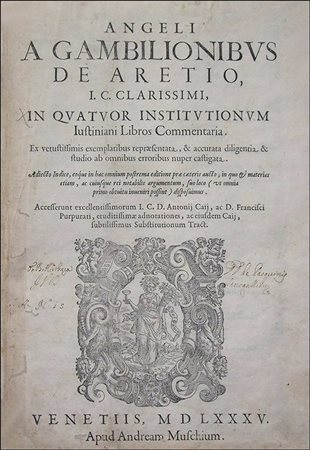
Lotto 108 APPARENTLY ONE COPY IN USA
Gambiglioni, Angelus (Aretinus). Super quatuor libros institutionum commentaria. Venetiis, apud Andream Muschium, 1585.
Folio (310x215 mm), 18th century half vellum on marbled paper, handwritten title at spine, pp. 365, ff. 32.
Uncommon edition of Gambiglioni's commentary to Justinian's «Institutions».
Angelo Gambiglioni was a famous Renaissance criminalist. He composed the treaty De maleficiis , one of the most famous and used law books of the fifteenth century.
References: OCLC 79160302 (apparently only one copy in US libraries of this edition at Berkeley Law Library).