
Medieval Notary Manuscripts & Law Books
-
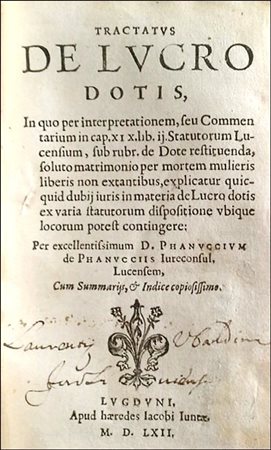
Lotto 73 RARE FIRST EDITION OF THIS TREATISE ON PRENUPTIAL AGREEMENTS AND DOWRY
DE FANUCCI, FANUCCIO. Tractatvs de lvcro dotis, in quo per interpretationem, seu commentarium in cap. XIX. lib. ij. Statutorum lucensium, sub rubr. De dote restituenda, soluto matrimonio per mortem mulieris liberis non extantibus, explicatur quicquid dubij iuris in materia de lucro dotis ex varia statutorum dispositione vbique locorum potest contingere. Lugduni (Lyon), apud haeredes Iacobi Iuntae, 1562 (colophon: Lugduni, excudebat Iacobus Faurus).
8vo (158 x 100), contemporary limp vellum with handwritten title of spine, traces of ancient ties, pp. 6, [58, 1 blank], 556, [2] (lacks the final blank).
Rare first edition of De Fanucci exhaustive treatise on prenuptial agreements that, indeed, is a large commentary on the 19th chapter of Lucca Statutes.
An important document of marriage contracts in Lucca area in the Renaissance.
Provenance: 17th century inscription Laurentii Ubaldi at title-page.
References: OCLC 15689243. -
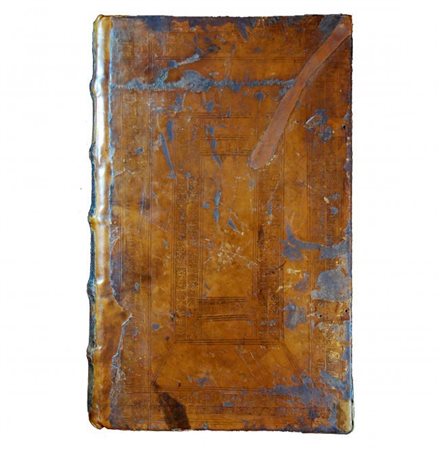
Lotto 74 ONE OF THE MOST ANCIENT TREATISES ON COMMERCIAL PRACTICE
ALSO INVOLVING ETHICS APPLIED TO ECONOMY
De Leys, Leonard (Lessio, Leonardo). De iustitia et iure ceterisque virtutibus cardinalibus libri quatuor, ad 2.2. D. Thomae a quaest. 47. usque ad q. 171. Auctore Leonardo Lessio e Societate Iesu […]. Editio quinta, auctior et castigatior cum appendice de Monte Pietatis. Antuerpiae (Antwerp): ex officina Plantiniana, apud Balthasarem Moretum et Viduam Jo. Moreti et Jo. Mursium, 1621.
Folio (36 x 23 cm); full brown leather on wooden boards, with five raised bands spine, gilted title on a light brown label at spine, gilted decorations at spine and decorated blind tooling at boards, corner bosses (traces of missing clasps at the board-edges, traces of use, leather repairs); pp. XVI, 825, LXIX. Text in Latin, printed in two columns.
Engraved title-page signed: Pet. Paul. Rubenius inuent. [Rubens] and Cor. Galleus sculpsit. [Corneille Galle]. Printer's device on verso of last leaf.
Initials; tailpieces; printed marginal notes.
Nice full-page engraving, pasted at the front inside-cover, not referred to the work, representing Alessandro Magno (Alexander Magnus Aristoteli Magistro Malin scientia rerum optimarum excellere quam opulentia. A. Gellius).
One of the many editions (probably the tenth) of this theological work (first published in Leuwen in 1605), also containing a juridical value, being one of the most ancient treatise on ethics applied to economy: Lessius's considerations on the morality of economic operations had an enormous influence on thought and behaviour of many political and ecclesiastical authorities.
The work is preceded by the dedicace to Albert VII, Archduke of Austria, made in Louwein on 28 Aug., 1605), the preface and the explanations; the text is divided in four books, one for every cardinal virtue: De prudentia (Prudence), De iustitia et iure (Justice), De fortitudine (Fortitude) and De temperantia (Temperance). Then, the text is followed by the Appendix (Appendix ad dubitationem XXIII. cap. XX. lib. II. de monte pietatis occasio scriptionis, p. 809-825), the Approbatio and the Index.
The author, Leonard de Leys (Leonardo Lessio, 1554-1623), was a Flemish moral theologian from the Jesuit order, teacher of philosophy and theology at Douay and Leuwen, best known for his treatise De iustitia et iure ("On Justice and Law"), of 1605 that had more than 20 editions in the 17th century. It is probably the first in-depth moral theological approach to economic and financial questions.
Lessius challenged in an authoritative way the traditional economic doctrines, and was consulted by the merchants of Antwerp as well as church leaders, statesmen. His work contains interesting details about the various forms of superstition, devil cult, sorcery and magic. Even ritual blasphemies were practiced, carnal love acts were performed on holy places. -

Lotto 75 A COMPREHENSIVE LEGAL ENCYCLOPEDIA BY GIOVANNI BATTISTA DE LUCA, WITH THE FAMOUS THEATER OF TRUTH, AND OF JUSTICE IN CANONICAL AND CIVIL DISPUTES, TOGETHER WITH TREATIES ON INHERITANCE, PENSION AND SALARY OF CHURCHMEN
De Luca, Giovanni Battista.
[1.]: Jo. Baptistae De Luca Venusini, [...] Theatrum veritatis, et justitiae, sive Decisivi discursus per materias, seu titulos distincti. & ad veritatem editi in forensibus controversiis canonicis & civilibus, in quibus in urbe advocatus, pro una partium scripsit, vel consultus respondit. Cum annotationibus, [...]. Adjectis, insuper in hac novissima editione. Liber primus [-decimusquintus]. Repertorium seu index generalis rerum notabilium quae continentur in Theatro Veritatis & Iustitiae cardinalis de Luca, a Nicolao Falconio [...]. Venetiis: ex typographia Balleoniana, 1759.
[together with:]
[2.]: Jo. Baptistae De Luca Venusini, [...] Commentaria ad constitutionem sanctae mem. Innocentii XI. de statutariis successionibus; cum particulis statutorum [...]. Accedit de pensionibus ecclesiasticis [...] ecclesiasticas pensiones. Venetiis: ex typographia Balleoniana, 1759.
[together with:]
[3.]: Jo. Baptistae De Luca Venusini, [...] Tractatus de officiis venalibus vacabilibus Romanae curiae; cum juribus [...]. Accedit alter tractatus de locis montium non vacabilium Urbis. Cum nonnullis [...] optime adjectis. Venetiis: ex typographia Balleoniana, 1759.
[1.]: Folio (396x242 mm), half leather binding, marbled paper at boards, gilt title at spine; 16 books bound in 8 vols. [Liber I-XV + Repertorium]; pp. [20], 513, [1]; [16], 368; [16], 434, [2]; [16], 360; [12], 228; [16], 551, [1]; [16], 383, [1]; [12], 288; [12], 328; [20], 535, [1]; [12], 238, [2]; 16], 367, [1]; [12], 296; [16], 427, [1]; [8], 552; 598, [2].
Title-page (Liber primus) printed in red and black; the other are in black. Calcographic frontispiece at the first vol. with the representation of the sepulchral monument of the author. Large vignette at each title-page with an imperial crowned double-headed eagle in a richly decorated frame. Xylographic initials, head- and final-pieces. Text printed in double columns.
[2.]: Folio (396x242 mm), half leather binding, marbled paper at boards, gilt title at spine; pp. 223.
Title-page printed in black. Large vignette at title-page with an imperial crowned double-headed eagle in a richly decorated frame. Xylographic initials, head- and final-pieces. Text printed in double columns.
[3.]: Folio (396x242 mm), half leather binding, marbled paper at boards, gilt title at spine; pp. 308.
Title-page printed in black. Large vignette at title-page with an imperial crowned double-headed eagle in a richly decorated frame. Xylographic initials, head- and final-pieces. Text printed in double columns.
[1.]: Here the list of the titles of the 15 books and the index (Repertorium) composing the work Theatrum veritatis: -
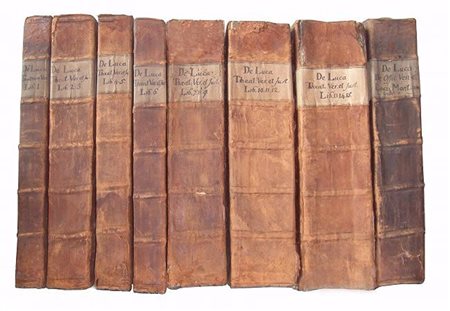
Lotto 76 THE MOST IMPORTANT COMPREHENSIVE LEGAL ENCYCLOPEDIA OF ITS TIME
De Luca, Giovanni Battista.Jo. Baptistae De Luca Venusini, S.R.E. Presbyteri Cardinalis, Theatrum veritatis, et justitiae, sive, Decisivi discursus per materias, seu titulos distincti : & ad veritatem editi in forensibus controversiis canonicis & civilibus, in quibus in urbe advocatus, pro una partium scripsit, vel consultus respondit : cum annotationes, ac discursibus, qui anteà in supplementis extabant, necnon aliquibus Sacrae Rotae Romanae recentissimis decisionibus, & summorum pontificum constitutionibus ad materias facientibus, suis locis optimè adjectis..Venetiis : Ex typographia Balleoniana, 1734.
16 volumes bound in 6 volumes in-folio, contemporary half calf on paper boards, paper label and handwritten title at spine.
A comprehensive legal encyclopedia that became one of the most significant authorities of the late ius commune and was reprinted regularly up until the middle of the 18th century.
Giovanni Battista de Luca (1614–1683) was an Italian jurist and Cardinal of the Roman Catholic Church.
References: OCLC 58468162.
For content of the volumes, see the previous lot. -

Lotto 77 THE DECISIONS OF THE ROMAN ROTA COLLECTED BY DE LUCA
De Luca, Giovanni Battista.Mantissa decisionum Sacrae Rotae Romanae.Venetiis : Ex typographia Balleoniana, 1734.
Folio, contemporary half calf on paper boards, paper label and handwritten title at spine.
One volume (complete in itself) of the Decisions of Roman Rota collected by De Luca, here published with his work De officiis venalibus.
References: IT\ICCU\SBL\0164323. -
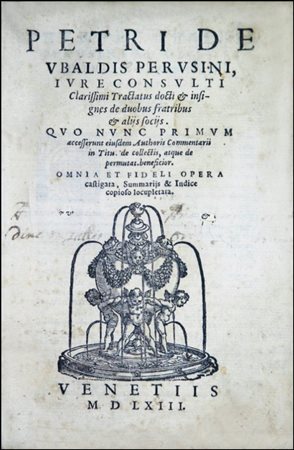
Lotto 78 A PRECIOUS COLLECTION OF RENAISSANCE TREATISES ON COMMERCIAL LAW
INCLUDING THE MAIN TREATISE OF BALDUS' BROTHER
ON THE MANAGEMENT OF COMPANIES MADE BETWEEN TWO BROTHERS
ONLY ONE COPY IN USA
De’ Ubaldis, Pietro. Petri de Vbaldi Perusini iureconsulti clarissimi Tractatus doct. et insignes de duobus fratribus et aliis sociis. Quo nunc primum accesserunt eiusdem authoris commentarii in titu. de collectis atque de permutas. beneficior. Omnia et fideli opera castigata, summarijs & indice copioso locupletata. Venice: [al segno della Fontana] 1563. [at colophon:] Venetiis: Apud Cominum de Tridino, Montisferrati. 1563.
8vo, contemporary limp vellum, ff. 192, [12].
Precious collection of Renaissance treatises on commercial law, including Petrus de Ubaldi's work on companies management.
1. The main work is attributed to Pietro de Ubaldis, brother to the more renowned jurist Baldo to whom the authority of the work is likely to be ascribed. De duobus fratribus et aliis sociis («On two brothers and other partners») is a company law treatise dealing with the formation, management and closing down of companies especially made between two brothers but also among other partners.
2. The Commentarii in titulum de collectis constitutes an out-and-out treatise of fiscal and tax law based on the difference of taxation between citizens and foreign people, able and disabled people, clergy and laymen.
3. The collection is closed by some fiscal advices and by the Tractatus de permutatione beneficiorum, that concerns canon law and the goods reserved to clergymen.
Provenance: Interesting annotations by a contemporary hand.
References: Not in Adams. Cnce, Censimento, 41374. OCLC, 183164158 (only the copy of the Library of Congress). -
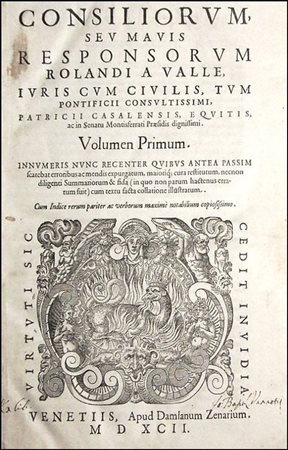
Lotto 79 SCARCE EDITION OF DELLA VALLE'S LEGAL ADVICES
NO COPIES IN WORLDWIDE PUBLIC LIBRARIES, NOT IN USA
DELLA VALLE, ROLANDO. Consiliorum, seu mauis responsorum Rolandi a Valle, iuris cum ciuilis, tum pontificii consultissimi ... Volumen primum (-quartum). Innumeris nunc recenter quibus antea passim scatebat erroribus ac mendis expurgatum. Venetiis, apud Damianum Zenarium, 1592.
Four parts in two volumes in-folio (360x240 mm), contemporary stiff vellum binding with handwritten title at spine, pp. [4], 306, [2]; 275, [1]; 307, [1]; [4], 267, [153].
Scarce edition of the of legal advices of Rolando dalla Valle, one of the most renowned law counselor in late 16th century.
Even if frequently reprinted, the entire four-parts set it’s very sought-after and hard to find on the antiquarian market.
Rolando della Valle was among the most known figure in the juridical environment of mid XVI century. He was a lawyer, Judge and General Commissioner for the Hebrew in Monferrato in 1537, Governor of Casale and was appointed President of the Senate of that city on May, 2nd, 1567 by Duke William I. His main work was this collection of Consilia; printed first in two volumes and then, in a complete edition of four volumes, it had a huge success and it was reprinted many times along the centuries.
References: DEZZA, E. Rolando della Valle (1500-1575). Politica, diritto, strategie familiari nell’esperienza di un giurista casalese del Cinquecento. In Monferrato, arte e Storia, IX ( 1997), pp. 23-43.
Reference: Out of Italy (7 copies), OCLC locates no copies worldwide. -
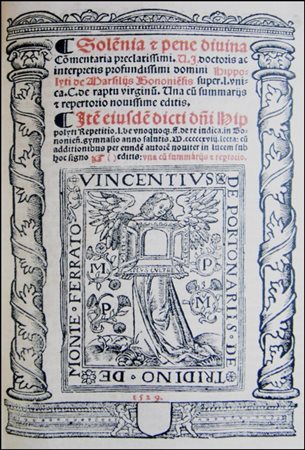
Lotto 80 TWO TREATISES ON CRIMINAL LAW: THE RULES OF EVIDENCE AND THE RAPE OF THE VIRGINS
DE MARSIGLI, IPPOLITO. Sole[m]nis [et] pene divina vtriusq[ue] iuris doctoris ac interp[re]tis profundissimi d[omi]ni Hippolyti de Marsilijs Bononien[sis]. Repetitio rubrice. C. de probationibus. : Cum additionibus per eunde[m] autore[m] nouiter in luce[m] sub hoc signo [pointing hand] ( ) editis. Una cum summariis [et] repertorio nouissime appositis.. Lugduni, per Jouannem David dit la mouche, 1529, die 28 Aprilis (Lyon, La Mouche, 28 April 1529).
BOUND WITH:
DE MARSILIIS, IPPOLITO. Sole[n]nia et pene diuina Co[m]mentaria ... domini Hippolyti de Marsilijs Bononie[n]sis super l. vnica C. de raptu virginu[m]. Vna cu[m] summarijs et repertorio nouissime editis. Ite[m] eiusde[m] dicti domini Hippolyti Repetitio. l. de vnoquoq[ue] ff. de re iudica. Lugduni, per Joannem David dit la mouche, 1529, die vero 11 Mensis Iunii (Lyon, La Mouche, 11 June 1529).
2 works in a 8vo volume, ancient paperboards, ff. 55, [1]; 66.
Woodcut title-pages printed in red and black, woodcut head-letters. Text in Gothic type.
Rare and remarkable collection two of important treaties dedicated to criminal matters.
1. The first work is a large commentary to the title De probationibus of Justinian’s Codex, with a thorough analysis of the rules of evidence and the powers of the judge related to their admission and evaluation.
2. The second work contains regards the criminal legislation related to the crimes of kidnapping and rape of the virgins.
These lecturae represent a testimony of scientific maturity and autonomy achieved by the criminal law in early Renaissance, now equipped with an apparatus of terms, rules and institutions distinct from civil law, elaborated in practice, revised by jurists in their works and now sufficiently structured to to be taught separately. The structure of the two works is strongly affected by this new approach; the matter is treated uniformly, combining profiles of substantive law and procedural law, and then enriched with the opinions of doctores and judicial practice.
Provenance: Not identified annotations by a near contemporary hand.
References: 1. OCLC locates 5 copies in worldwide public libraries (2 in USA, at University of California Berkeley Law Library and at Harvard Law School Library).
2. OCLC locates 4 copies in worldwide public libraries (1 in USA, at Harvard Law School Library). -

Lotto 81 THE JURIDICAL REQUIREMENTS TO GET ECCLESIASTIC BENEFICES
ONE COPY IN USA
Garcia, Nicolás. Nicolai Garcia Hispani, J.U. professoris [...] Tractatus de Beneficiis amplissimuset doctissimus, declarationibus cardinalium Sacrae Congregationis Concilii Tridentini, DecisionibusqueSacrae Rotae Romanae [...] Accedunt huic Novae Editioni, S. Rotae Romanae Decisiones RecentissimaeNumquam anteà lucem editae, Materiam De Beneficiis ab Authore pertractatam […] Tomus Secundus. Coloniae Allobrogum, Sumpt. Perachon & Cramer, 1735.
Folio (350x220 mm), full vellum binding, handwritten title at second sector of 5 raised bands spine, ff. [8], 400, [104, last blank], [12], 216, [20, last blank]. Xylographic printer device with Crowned Salamander surrounded by flames at title-page, woodcut head-letters and decorations at preliminary leaves, text on two columns.
Uncommon edition of Garcìa's treatise on ecclesiastic benefices: in this work the author lists the moral and juridical requirements to get a benefice, beneficium, the procedure to follow and the motivation to give or to withdraw one.
Annex to the text there is a collection of Decisiones or judgments related to benefices, for complexity of the matter that can be considered among the Canon Law and the Civil Law.
References: Not in Sapori that mentions other editions. ICCU, IT\ICCU\RLZE\032181 (only two copies in Italian public libraries). OCLC 84418392 locates only one copy in USA (Harvard) -
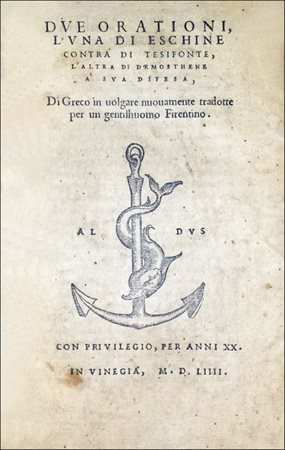
Lotto 82 AESCHINES' AND DEMOSTHENES' HARANGUES: PROSECUTION AND DEFENSE IN A FAMOUS TRIAL OF ANCIENT GREECE
DEMOSTHENES-AESCHINES. Due orationi, l'vna di Eschine contra di Tesifonte, l'altra di Demosthene à sua difesa. Di greco in volgare nuouamente tradotte per un gentilhuomo firentino [sic]. In Vinegia: [Venice: heirs of Aldo Manuzio], 1554.
8vo, attractive binding in 18th century water-colored wrappers, ff. 106, [2]. Text in Italian, translated from Greek language by the Florentine humanist Girolamo Ferro.
Aldine dolphin and anchor device on title-page and final leaf (woodcuts).
Capital spaces with guide letters.
First and only Aldine edition of the two harangues by Aeschines and Demosthes, the first one as Ctesiphon's prosecutor and the second as his defense attorney.
Demosthenes won the legal battle with Aeschines, although Aeschines' legal objections to the crowning were probably valid.
THE TRIAL:
Ctesiphon was an orator in Athens during the reign of Alexander the Great. He is best known for sparking this controversy that led to Demosthenes' speech «On the Crown» and Aeschines' speech «Against Ctesiphon».
In 336 BC, Alexander the Great's empire was spreading, and many in Athens were opposed to the ongoing wars. Among the most outspoken was the orator Demosthenes. In 336 BC, Ctesiphon proposed that Athens honor Demosthenes for services to the city by presenting him with a golden crown. This proposal became a political issue, and in 330 BC, Aeschines prosecuted Ctesiphon on charges of legal irregularities. In his most brilliant speech, On the Crown, Demosthenes effectively defended Ctesiphon and attacked vehemently those who backed Alexander the Great's empire. On legal irregularities Aeschines prosecuted Ctesiphon for having violated the law in three points:
1. For making false allegations in a state document.
2. For unlawfully conferring a crown to a state official (Demosthenes) who had not yet rendered a report of his term of office.
3. For unlawfully offering the crown at the Dionysia.
Demosthenes (384–322 BC), was a prominent Greek statesman and orator of ancient Athens. His orations constitute a significant expression of contemporary Athenian intellectual prowess and provide an insight into the politics and culture of ancient Greece during the 4th century BC. For a time, Demosthenes made his living as a professional speech-writer (logographer) and a lawyer, writing speeches for use in private legal suits.
He went on to devote his most productive years to opposing Macedon’s expansion. He idealized his city and strove throughout his life to restore Athens’ supremacy and motivate his compatriots against Philip II of Macedon. He sought to preserve his city’s freedom and to establish an alliance against Macedon, in an unsuccessful attempt to impede Philip’s plans to expand his influence southwards by conquering all the Greek states. -
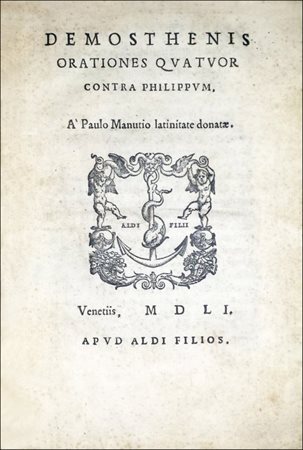
Lotto 83 DEMOSTHENES TRANSLATED BY THE YOUNG ALDUS’ SON
DEMOSTHENES. Demosthenis Orationes Quatuor contra Philippum, A Paulo Manutio latinitate donatae. Venetiis, Apud Aldi Filios, 1551 [Venice: Sons of Aldus, 1551].
4to, 18th century stiff vellum with blavk label and gilt lettered title at spine, ff. [52].
Aldine anchor of Aldus’ heirs at title-page. Dedicatory letter to Jean Morvilliers.
Scarce second edition of this elegant and esteemed translation made by Paolo Manuzio of the four Demosthenes’ «Philippics», the Orations against Philip of Macedon who was beginning his conquest of the Greece.
In September 1549, Francesco Greco wrote to Paolo Manuzio that, reading this translation, he seemed «to hear Demosthenes speaking Latin».
The first oration (351-350 BC) centered on the need for successful resistance for financial reform of the theorical fund to prepare for war and for swift action to avoid defeat. The second (344-343 BC) was a vehement attack against Philip and his Athenian supporters, delivered in the wake of the unsatisfactory Peace of Philocrates, which left Philip’s increasing power largely unchecked. Nonetheless it errs on the side of caution, perhaps indicative of Demosthenes’ own fear of the King, before whom he is said to have fainted. The third (341), the best of Demosthenes’ political orations, contrasts the ancient spirit of Athens with her present degeneracy. Having risen by his oratory to become the most influential politician in Athens, Demosthenes was able to weaken the pro-Macedonian factions, formulating alliances with other small states. He demands resolute action against Philip, a burst of energy from the Athenian people and the immediate dispatch of force. The fourth is the subject of controversy, with Demosthenes' authorship called into doubt, although the sentiment is similar to the third, the style is different.
It has been suggested that the text is descended not from his carefully honed speeches, but from notes for a spot oration, hence its unusual lack of finesse. Described by Cicero as «the perfect orator» and extolled as lex orandi by Quintilian, Demosthenes has long been regarded as one of the great minds of the Classical era, and his works remain a benchmark of eloquence and erudition.
References: CNCE 16744. Renouard, 146, 6: «les exemplaires sont rares, ainsi que ceux de la réimpression de 1551». Lettere volgari, vol. III (Francesco Greco write to Paulus Manutius): «Ho letto le quattro Filippiche di Demosthene, che V. S. ha voltato, anzi ho udito Demosthene parlante in latino, & in che lingua? in quella medesima certo che Cicerone, padre della Romana eloquenza, lo fece già rispondere ad Eschine, suo avversario [...]».BM STC Italian, 213. Dibdin, 486: «This translation is elegant and esteemed". Brunet II, 592: «Traduction estimée». -
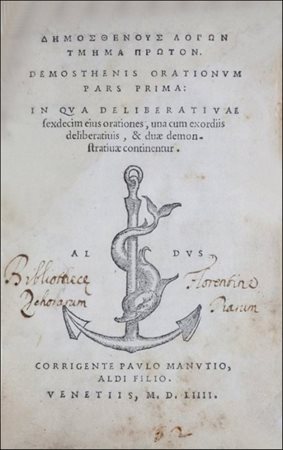
Lotto 84 FIRST AND ONLY ALDINE EDITION OF DEMOSTHENES’ ORATION IN THE ORIGINAL GREEK TEXT
DEMOSTHENES. Demosthenis Orationum pars prima: in qua deliberativae sexdecim eius orationes, una cum exordiis deliberativis, & duae demonstrativae continentur. Corrigente Paulo Manutio, Aldi Filio. Venetiis, 1554.
[TOGETHER WITH:]
DEMOSTHENES. Demosthenis Orationum pars secunda: in qua iudiciales novem eius publicae orationes continentur. Corrigente Paulo Manutio, Aldi Filio. Venetiis, 1554.
[TOGETHER WITH:]
DEMOSTHENES. Demosthenis Orationum pars tertia: quae iudiciales tres, et triginta privatas eius continet orationes. Corrigente Paulo Manutio, Aldi Filio. Venetiis, 1554.
3 volumes in-8vo, 19th century half calf with labels and gilt-lettered titles and decorations (the first volume is taller than the others); v. 1, [8], 122, [2] leaves; v. 2, 248, [2] leaves; v. 3, [2], 243 [i.e. 242], [2] leaves.
Aldine anchor at each title page; woodcut headletters. Entirely printed in Greek.
Very rare first and only Aldine edition of the original Greek text of Demosthenes Orations.
Described by Cicero as «the perfect orator» and extolled as lex orandi by Quintilian, Demosthenes has long been regarded as one of the great minds of the Classical era, and his works remain a benchmark of eloquence and erudition.
Provenance: 17th century inscription Bibliothec(a)e Florentin(a)e Scholarum Piarum
References: Renouard, 160.10: «fort rare». CNCE, 16746. OCLC, 6737363.