
Medieval Notary Manuscripts & Law Books
-

Lotto 37 A FOUNDING TEXT OF MODERN CANON LAW
Reiffenstuel, Anacletus. Jus Canonicum Universum clara methodo iuxta titulos Quinque Librorum Decretalium [...]. Venetiis, Apud Jo: Baptistam Recurti, Ad Signum Religionis, 1717.
5 tomes in 4 volumes, folio (340x230 mm), contemporary quarter calf binding, gilt titles on a red label at five raised bands spine, edges sprayed in red ink. First volume titlepage printed in red and black, some xylographic headletters and decorations, text on two columns.
Remarkable Venetian edition of this important commentary to Pope Gregory IX’s Decretales and to Canon Law.
Johann George Reiffenstuel called Anaklet (1642-1703), was canonist and professor at Frisingen high school. This work, Ius Canonicum universum, is his most famous treatise and it was reprinted many times for the seminarians’ use.
References: Not in Sapori, that quotes a 1778 edition (I, 2451) printed by Pezzana.
OCLC, 6325056. -
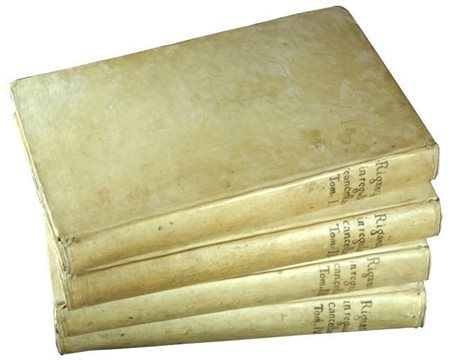
Lotto 38 FIRST EDITION OF THIS COMMENTARY TO THE RULES OF APOSTOLIC CHANCELLERY
Rigantius, Johannes Baptista. Joannis Baptistae Rigantii Commentaria in regulas, constitutiones, & ordinationes Cancellariae Apostolicae opus posthumum. Tomus I [-IV]. Romae, typis Generosi Salomoni prope Ecclesiam S. Eustachii, 1744-1747.
4 volumes, folio (366x234 mm), full stiff vellum binding, sepia ink handwritten titles at spine, edges colored in red ink, pp. [12], 479, [1] at first volume, pp. [8], 463, [1] at second, pp. [8], 458, [2] at third and pp. [8], 518, [2] at fourth. Engraved headletters and vignettes, red and black title-pages, text on two columns.
First edition of this important commentary to the rules of the Apostolic Chancellery.
CONTENT:
Tomus 1: Complectens regulas octo ad Benedictus XIV
Tomus 2: Complectens regulam 9. usque ad 24. ad eminentissimum, & reverendissimum principem Nerium S.R.E. cardinalem Corsinium
Tomus 3: Complectens regulam 25. usque ad 48. ad eminentissimum, & reverendissimum principem Antonium Xaverium
Tomus 4: Complectens regulam 49. usque ad postremam; necnon rerum omnium notabilium quae in aliis quoque tribus tomis continentur indicem locupletissimum
Comparing the different works on the subject, Riganzio detected their incompleteness and backwardness; for that reason he tried to correct and complete the treatises by Mandosius, Gomesius, Gonzalez, Peleus and Quesada with the indults, privileges and ordinances promulgated by the Popes along the time. In the text Riganzio analyze all the rules promulgate from XIV century on, in a chronological order, without an organic organization by subject; nevertheless information on the courts, spread along the text, can be traced back using an Index added at the time of publication, happened years after the death of the author by order of the Pope and edited by author’s nephews, Nicola and Giovanni Battista.
Giovanni Battista Riganzio (1661-1735, lat. Johannes Baptista Rigantius), born in Puglia, moved to Rome in 1675 to study law and at the age of 22 he became pupil of cardinale Bandinus Panciaticus (1629-1718). He became later prefect of Congregazione per l'interpretazione del Concilio di Trento.
Bibliography: Cfr. M.R. Di Simone, La giustizia dello Stato pontificio in età moderna , in «L'amministrazione moderna della giustizia. Le Gran Corti Civili del Regno delle Due Sicilie», atti del convegno di Taranto 21-22 maggio 2010, Napoli, Edizioni Scientifiche Italiane, 2010.
References: IT\ICCU\RMSE\001297. OCLC 31813960 locates only two copies in USA (Baylor University Libraries, Moody Memorial Library, Waco; and Saint Joseph's University - Francis A. Drexel Library, Francis A. Drexel Library, Philadelphia). -
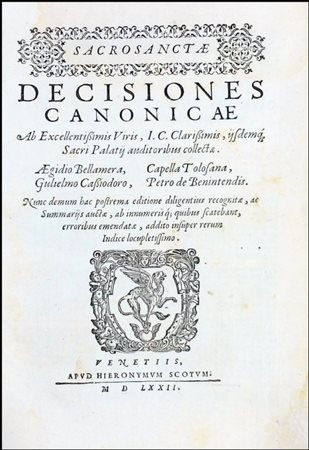
Lotto 39 FIRST ITALIAN EDITION OF AN IMPORTANT COLLECTION OF MEDIEVAL AND RENAISSANCE DECISIONS
Tribunale della Sacra Rota romana. Sacrosanctae decisiones canonicae ab excellentissimi viris, i.c. clarissimis, iisdemque Sacri Palatii auditoribus collectae. Aegidio Bellamera, Capella Tolosana, Gulielmo Cassiodoro, Petro de Benintendis. Nunc demum hac postrema editione diligentius recognitae, ac summariis auctae, ab innumerisque quibus scatebant, erroribus emendatae, addito insuper rerum indice locupletissimo. Venetiis : apud Hieronymum Scotum, 1572 (Venetiis : apud Hieronymum Scotum, 1571)
4to, 220x158 mm, contemporary stiff parchment binding with three bands at spine (strong signs of use, many repairs at spine and at back board), calligraphic title at spine, pp. [96], 1254 (i.e. 1154), [2]; errors in page-numbering (p. 899 is followed by p. 1000, skipping 100 pp.); title-page with black and red characters; two different woodcut printer devices, one at title-page (Griffin in profile supporting with a claw a table which in its turn is supporting by a chain a winged globe, symbol of the world, in a figured frame) and one at colophon (winged Fame blowing a horn, holding a shield with the initials OSM and stands with one foot on a prisoner, with motto: Famam extendere factis est virtutis opus).
First Italian edition (followed by two other Venetian editions, always by Scoto, on 1599 and 1613; the first in absolute had been published in Lyon by Giunta on 1567) of an important collection of decisiones placeable between the second half of the fourteenth century and the mid-sixteenth century, attributed to four of the main proponents of the Sacra Rota of that time (Gilles de Bellemère, Pietro Benintendi, Guillaume Cassador and Etienne Aufreri).
Apostolic Tribunal of the Roman Sacred Rota: is the highest appellate tribunal of the Roman Catholic Church, with respect to both Latin-rite members and the eastern-rite members and is, with respect to judicial trials conducted in the Catholic Church, the highest ecclesiastical court constituted by the Holy See. The court is named Rota (wheel) because the judges, called auditors, originally met in a round room to hear cases. The Rota was established in the 13th century. It was set up to receive judgments in second and further instances from any other regional and diocesan tribunal; it was composed of auditors and chaired by the dean.
Gilles de Bellemère (1337-1407), often italianized in Egidio de Bellamera, was a French Catholic bishop. Auditor of the Roman Rota at Avignon and auditor litterarum contradictarum from 1376. This work contains 755 Conclusiones spanning the entire legal universe and for the period 1374-78.
Pietro Benintendi (active in the mid-sixteenth century, from Cesena), was a judge of the Rota in Bologna; just refer to this activity the 98 Conclusionesof the Sacra Rota of Bologna, written by Benintendi between 1540 and 1545. -

Lotto 40 A COLLECTION OF THREE HUNDRED AND SEVENTY-FIVE LEGAL CASES AND DECISIONS OF THE ROMAN SACRED ROTE
Stato Pontificio, Rota Romana. Decisiones rotae Romanae Francisci card. Mantica a Germanico Mantica [...] in lucem editae [...]. Romae: ex typographia Camerae Apostolicae, 1618.
4to, 220x160 mm; contemporary full vellum binding, with calligraphic title at a flat spine; pp. [88], 598, [2].
Title page in red and black types, with engraved coat of arms of the dedicatee cardinal Scipione Borghese, with a cardinal's hat; woodcut at colophon (an eagle holding a cloth with claws). Two-column layout.
Dedicace by Germano Mantica to cardinal Scipione Borghese.
A collection of three hundred and seventy-five legal texts prepared for the Tribunal between February 1587 to May 1596, including indexes, compiled by the Card. Francesco Mantica and published after his death by his nephew Germanico.
Another edition of this work appeared in the same year in Venice.
Francesco Mantica (Venzone, 20 marzo 1534 – Roma, 28 gennaio 1614) was an Italian cardinal and a jurist .
Germanico Mantica (m. 1639), nephew of Francesco Mantica, Abbot, was bishop of Famagusta.
References: IT\ICCU\RMGE\000709. OCLC, 48083914 (2 copies in USA, 1 copy in Switzerland) and 630423004 (2 copies in Germany). -
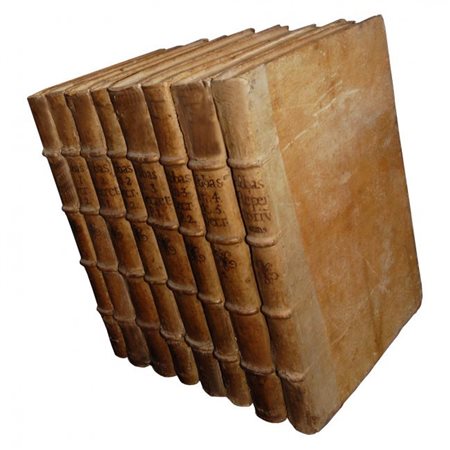
Lotto 41 EXCESSIVELY SCARCE EDITION OF TEDESCHI'S COMMENTARIES IN DECRETALS
APPARENTLY NO COMPLETE COPIES WORLDWIDE, NOT IN USA
FOUNDATION OF MEDIEVAL CANON LAW
«THE LAMP OF THE LAW»
Tedeschi, Niccolò (Abbas Panormitanus). Abbatis Panormitani Commentaria […] primae partis in primum decretalium librum. Quam plurium iurisconsultorum, qui probe hucusque aliquid iis addidisse apparuerunt, adnotationibus illustrata; […] observari consueta.
[together with, 2:]
Abbatis Panormitani Commentaria […] secundae partis in primum decretalium librum […].
[together with, 3:]
Abbatis Panormitani Commentaria […] primae partis in secundum decretalium librum. Quam plurium iurisconsultorum, qui probe hucusque aliquid iis addidisse apparuerunt, adnotationibus illustrata; […] observari consueta.
[together with, 4:]
Abbatis Panormitani Commentaria […] in secundam secundi decretalium libri partem […].
[together with, 5:]
Abbatis Panormitani Commentaria […] in tertiam secundi decretalium libri partem […].
[together with, 6:]
Abbatis Panormitani Commentaria […] in tertium decretalium librum […].
[together with, 7:]
Abbatis Panormitani Commentaria […] in quartum & quintum decretalium librum. Quam plurium iurisconsultorum, qui probe hucusque aliquid iis addidisse apparuerunt, adnotationibus illustrata; […] observari consueta.
[together with, 8:]
Abbatis Panormitani Repertorium in luculentissimas praelectiones, […]. Venetiis (Venice): [Società dell'aquila che si rinnova], apud Guerraeos fratres, & socios, 1578.
8 volumes in folio (370x270 mm); contemporary full vellum with four raised bands spine (traces of use and stains, neat repairs at some spine and corner); handwritten title and decorations at spine; pp. 219; 230; 293; 210; 180; 307; 247; 170. The page numbering is progressively made at the recto of the leaves. Text in Latin, printed in many columns.
Title-page in black types, with a typographical device representing an eagle pecking at a rock, with the motto: Renovabitur vt aquila iuventus tua.; a portrait of the Author is printed at the beginning of each volume in an oval ornate frame. Engraved head and -tail pieces, engraved headletters.
EXCESSIVELY SCARCE EDITION OF A COMPLETE SET OF TEDESCHI'S COMMENTARS ON DECRETALS, a founding work of medieval Canon Law It was his canonical works, especially, that won him the title of lucerna juris («lamp of the law») and insured him great authority.
The last volume, Repertorium, is edited by Galvano da Bologna, whose name is indicated at the end of leave X10r: Finis differentiarum inter leges et canones Do. Gualuani [...]. -
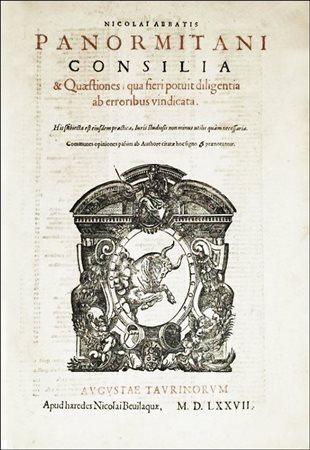
Lotto 42 SCARCE EDITION OF TEDESCHI'S COUNSELS: FOUNDATION OF MEDIEVAL CANON LAW
«THE LAMP OF THE LAW»
ONLY A COPY IN USA
Tedeschi, Niccolò (Abbas Panormitanus). Nicolai Abbatis Panormitani Consilia & quaestiones, qua fieri potuit diligentia ab erroribus vindicata. His subiecta […] praenotantur. Augustae Taurinorum (Turin): Apud haeredes Nicolai Bevilaquae (eredi Niccolò Bevilacqua), 1577.
[bound with]:
Index locupletissimus in omnia Nicolai siculi Panormitani vulgo dicti, opera. Augustae Taurinorum (Turin): Apud haeredes Nicolai Bevilaquae (eredi Niccolò Bevilacqua), 1577.
Two works bound together in a volume in folio (430x270 mm); contemporary full vellum, with four raised bands spine (rebacked, traces of use), calligrafic title at lower edge; pp. 173, [1], [1, blank]; [122]. The page numbering is progressively made at the recto of the leaves. Text in Latin, printed in two columns.
Title-page in red and black types at the first work (Consilia) and in black types at the second one (Index locupletissimus), both with a large typographical device (representing, in a decorated frame, a kicking bull who comes out of a cloud, with the Taurus constellation stars on its body and the motto: Mi coelestis origo.); Engraved head and -tail pieces, engraved headletters.
SCARCE EDITION OF TEDESCHI'S «COUNSELS» and «QUESTIONS» of Canon Law, works that integrate his Commentaries (see previous lot).
Niccolò Tedeschi, also known as Niccolò Tedesco, or Niccolò de' Tedeschi, or de' Todeschi, or de' Tudeschi, or Tudisco, or Abbas Panormitanus, or Abbas Siculus, or Abbas Modernus said Panormitanus (Catania, Sicily, 1386 - Palermo, 1445) was an Italian Benedictine canonist, auditor of the Rota and Apostolic referendary, archbishop and also pseudocardinal named by the anti-Pope Felix V; teacher of canon law, writer of many juridical treatises, among all he wrote "Consilia", "Quaestiones", "Repetitiones", "Disputationes, disceptationes et allegationes", "Decretals commentary" and "Flores utriusque juris".
References: ICCU\TO0E\033929-033930. OCLC 732246294 locates in USA only one copy at the Library of Congress. -
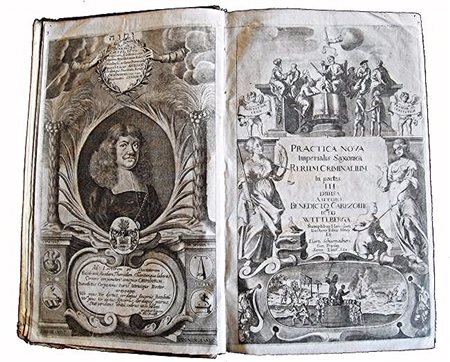
Lotto 43 THE CRIMINAL LAW IN GERMANY
Carpzovius, Benedictus. Practicae novae Imperialis Saxonicae rerum criminalium pars I. [-pars III.]: ex jure civili romano, imperiali, saxonico, ordinat. & constitut. elector. decisiones ... exhibens autore Benedicto Carpzov. Wittebergae: Sumptibus haredum T. Mevii & E. Schumachaeri; Francofurti: Typis B.C. Wustii, 1684.
3 volumes in a thick folio, stiff vellum with handwritten title at spine.
Text in Latin, numerous passages in German.
Title-page in red and black, engraved frontispiece, engraved title-page.
Very important criminal procedure in Germany (Saxony), a cornerstone of 17th and 18th century law.
CONTENT:
Pars I. Quaestionum fere universarum in materia cujusque generis homicidiorum, fractae pacis publicae, laesae majestatis ... falsificationis monetarum ... decisiones absolutas ... exhibens.
Pars II. Quaestionum fere universarum in materia delictorum carnis ... decisiones absolutas exhibens.
Pars III. Quaestionum fere universarum in materia processus criminalis tam ordinarii quam inquisitorii ... decisiones absolutas ... exhibens.
Provenance: Inscription Ex Libris Francisci (not identified surname) at title-page.
References: OCLC 32941266. -
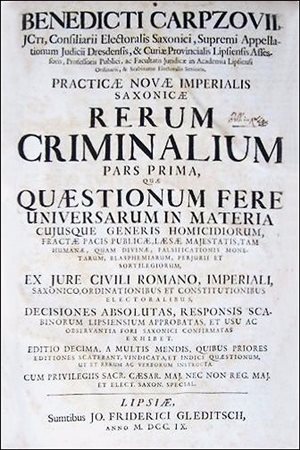
Lotto 44 THE CRIMINAL LAW IN GERMANY
Carpzovius, Benedictus. Practicae novae imperialis saxonicae rerum criminalium. Pars 1. [-3] [...]Ex jure civili Romano, imperiali, Saxonico, ordinat. & constitut. electoral. Decisiones absolutas, responsis scabinorum Lipsensium approbatas, & usu ac observatia Fori Saxonici confirmatas, exibens: autore Benedicto Carpzov. Lipsiae, sumptibus Joh. Friderici Gleditschii, 1709.
3 volumes in a thick folio, contemporary half calf, label and gilt title on six raised bands spine (slightly worn at the foot), red edges, ff. [5], pp. 298, ff. [4], pp. 371, ff. [4], pp. 356, ff. [47]. Text in Latin, numerous passages in German.
Very important criminal procedure in Germany (Saxony), a cornerstone of 17th and 18th century law.
References: OCLC 79612438 locates in US only the copy at Harvard Law Library. -
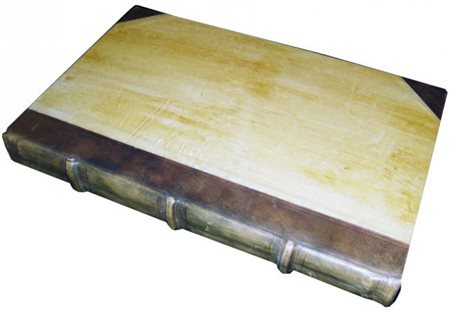
Lotto 45 FIRST EDITION OF TWO IMPORTANT RENAISSANCE TREATISES OF FAMILY LAW
DAMHOUDER, JODUCUS – CAVALCANI, BORGNINUS. Patrocinium pupillorum et viduarum nouum; siue De tutore, curatore, et de vsufructu mulieri relicto, ... tractatus, auctoribus ... D. Iodoco Damhouderio I.C. Brugensi, ... & D. Borgnino Caualcano I.C. Fiuizanensi, .... Correctius et emendatius secundo nunc editum; notationibusque nonnullis auctum a F.M. Francisco Modio! I.C.B. Cum indice notabilium et additionum longe locupletissimo. Impressum Francofurti ad Moenum, per Petrum Fabricium, impensis Sigismundi Feyrabendii, 1586. (Frankfurt, Fabricius for Feyrabend, 1586).
2 works in a volume in folio (340x215 mm), later half calf, ff. [9], 59, [10]; [4], 74, [24].
Two separate title-pages (the first one printed in red and black). Woodcut devices, woodcut head-letters, head and –tail pieces, woodcut half-page illustration. Text on two columns.
First edition of two most important Renaissance treatises of Family Law.
Provenance: Not identified annotations of a contemporary hand.
References: OCLC locates 20 copies worldwide, only 2 complete copies in Italy (ICUU), OCLC 166002245/ 28708933; VD 16 D 53. -
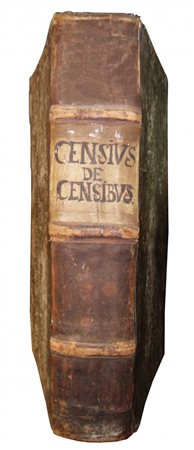
Lotto 46 THE LAWS ON PROPERTY AND RICHNESS
Cenci, Lodovico. Tractatvs Lud. Cencii iurisconsulti Perusini De censibus : totam materiam constituendi, conservandi, & extinguendi annuos census iuxta formam, & stylum etiam in Romana Curia adhiberi solitum, theoricè, & practicè explicatam continens : cui accesserunt non modo additiones, & S. Rotae Romanae decisiones iam separatim impressae, sed & aliae pleraeque ab ipso authore manuscriptae suis locis repositae sunt, necnon Ioan. Baptistae Leonelij, & Ludovici Molinae commentaria ad bullam Pij V. de censibus. Lugduni (Lyon): Sumptibus Philippi Borde, Laurentij Arnaud, & Claudij Rigaud (Borde, Philippe & Arnaud, Laurent & Rigaud, Claude), 1658.
Two works bound in a volume in folio, contemporary stiff vellum, handwritten title at raised bands spine, pp. [60], 270, [2]; [48],348, [2] Text in Latin, title-pages printed in red and black.
Woodcut head and -tail pieces, woodcut head-letters.
Early edition of the standard, renowned and many times reprinted treatise on property, first published in Venice and Turin on 1621.
The volume also contains a collection of Sacra Rota decisions, referred to the same matter (property) and includes also two Papal Bulls promulgated respectively by Pope Sixtus V and Pope Clement VIII, both regarding property.
Lodovico Cenci (1557-1637) was a jurist, teacher of Canon law at Perugia, member of the Accademia degli Insensati ("Academy of Fools") in Perugia.
Giovanni Battista Leonelli Bartolini (born in Perugia, mid 16th century, and died in early 17th cent.), was teacher of Canon law at Perugia, and wrote many juridical and theological texts.
Luis de Molina (1535-1600) was a Spanish Jesuit priest and a staunch Scholastic defender of 'human liberty' in the Divine grace and human liberty controversy of the Renaissance (Molinism); he wrote many theological and philosophical texts.
Provenance: Not identified contemporary owners' inscriptions.
References: OCLC, 65344036. -
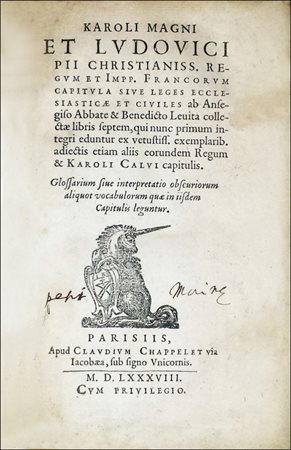
Lotto 47 CHARLEMAGNE’S CAPITULARIES: THE SOURCE OF THE LAWS OF CAROLINGIAN EMPIRE
[Carolingian Statute] Charlemagne, Emperor-Charles II, King of France (edited by Saint Ansegisus and Benedict Levita). Karoli Magni et Lvdovici pii Christianiss. regvm et impp. Francorvm capitvla sive leges ecclesiasticæ et civiles ab ansegiso abbate & benedicto leuita collectæ libris septem, qui nunc primum integri eduntur ex vetustiss. exemplarib. adiectis etiam aliis eorundem regum & Karoli Calvi capitulis: glossarium siue interpretatio obscuriorum aliquot vocabulorum quæ in iisdem capitulis leguntur. arisiis : Apvd Clavdivm Chappelet via Iacobæa, sub signo vnicornis, 1588.
8vo, contemporary limp vellum with calligraphic title at spine, ff. [12], 424, [15].
Rare first Chappelet edition of Carolingian Statute of the civil and canon law statutes of Charlemagne and of Louis the Debonair transcribed from a manuscript in the Pithou library.
The work was completed by 827, gained the approval of the church in France Germany and Italy and served for a long period as official record of canon and civil law of the Empire.
A capitulary (medieval Latin capitularium) was a series of legislative or administrative acts emanating from the Frankish court of the Merovingian and Carolingian dynasties, especially that of the first emperor, Charlemagne. They were so called because they were formally divided into sections called capitula («chapters»).
As soon as the capitulary was composed, it was sent to the various functionaries of the Frankish empire, archbishops, bishops and counts, a copy being kept by the chancellor in the archives of the palace. The last emperor to compose capitularies was Lambert in 898.
St. Ansegisus (c. 770 – c. 834), equally valued by Charlemagne and his son Louis, had reformed several monasteries before being put in charge of Luxeuil in 817. He later became abbot of Fontenelle (called also St. Vandrille) near Rouen, where he greatly enriched the library. Under his stewardship Fontenelle became an important centre of learning; Ansegisus was sent by Louis on embassies abroad. He collected the laws and decrees of the two Carolingian kings, dividing them into chapters called capitularies; the first and second of the four books of his compilation relate to church affairs and the third and fourth to state affairs.
The capitularies of St. Ansegisus are followed by Benedict Levita’s collections of the the capitularies of Charles the Bald, and by the Glossarium Siue Interpretatio obscuriorum aliquot vocabulorum, que in Capitularibus leguntur, an alphabetically organised glossary of obscure terms to be found in the preceding texts.
According to Kirsch (Catholic Encyclopedia, sub Levita) Benedict Levita «is the name given to himself by the author of a forged collection of capitularies which appeared in the ninth century. The collection belongs to the group of pseudo-Isidorian forgeries […]. -

Lotto 48 THE FISCAL LAWS OF THE REIGN OF SARDINIA AND PIEDMONT
Charles Emanuel, king of Sardinia. Editto di S. M. riguardante alcune dichiarazioni sopra le generali costituzioni, e contenente la Tariffa degli emolumenti, e dritti dovuti all’Erario Regio ed agli uffiziali di stato, di giustizia, del fisco, ed altri. […]. Torino: per. Gio. Battista Valetta stampatore di S.M., e de’ regj magistrati: con privilegio di S.M. concesso a Francesco Antonio Gattinara librajo al palazzo dell'illustrissima citta, 1740.
Large 4to, contemporary stiff vellum with handwritten title at five raised bands spine, red edges, pp. 351, (1, errata).
First edition of the edict wanted by Carlo Emanuele, king of Sardinia, about the taxes to be paid to Erario Regio («Royal Treasury») and the rates for particular performances of some classes of public officers (justice officers, fiscal officers) in the Reign of Sardinia (including Piedmont).
Provenance: Signature at title-page.
References: IT\ICCU\TO0E\024137 (no copies in Sardinia's libraries).