
Medieval Notary Manuscripts & Law Books
-
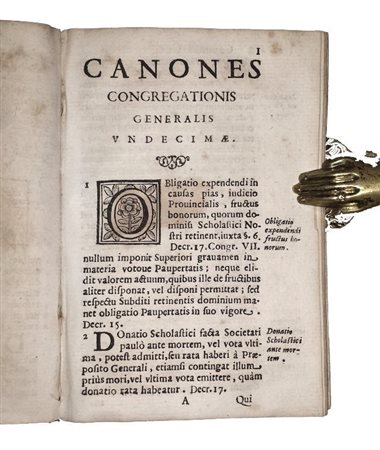
Lotto 133 EXCESSIVELY SCARCE COLLECTION OF JESUIT’S CANONS AND DECREES
NOT IN USA
1. Indiculus decretorum easdem res tractantium In Congregationibus Generalibus Societatis Iesu Confici iussus a Congregatione VIII. Decreto XIV. Editio Secunda auctior & emendatior. Romae, Typis Varesij, 1662.
[bound with:]
2.Vitelleschi, Muzio. Epistola reuerendi p.n. generalis Mutij Vitelleschi ad patres, et fratres Societatis Iesu [...] [Dated at end: Romae 15. Nouemb. 1639]
[bound with:]
3-4-5. Decreta congregationis octauae [nonae et decimae ] generalis [after 14. IV. 1646].
[bound with:]
6. Piccolomini, Francesco. Ordinatio pro studijs superioribus ex deputatione, quae de illis habita est in Congregatione nona generali. A R.P.N. Francisco Piccolomineo ad prouincias missa. Anno 1651
[bound with:]
7. Decreta congregationis generalis vndecimae
[bound with:]
8-9-10. Canones Congregationis generalis octauae [ nonae et decimae ]
[bound with:]
11. Canones Congregationis generalis vndecimae
[bound with:]
12. Instructio Pro administratione rerum temporalium collegiorum, ac domorum probationis Societatis Iesu. [S.l. s.n., not before 1646: publication date based on References in text (p. 1) to the Eighth General Congregation of the Jesuits, which took place in 1646].
[bound with:]
13. Regulae, quae a patribus reuisoribus generalibus Romae in recognoscendis nostrorum libris, ac scriptis obseruandae sunt .
[bound with:]
14. Deputatio pro ordinationibus non impressis recognouit, iuxta congregationis octauae praescriptum, censuras, & praecepta, generaliter hominibus societatis imposita.
[Probably all printed in Rome by Varesi, after the half of 17th century].
8vo (147x100 mm), limp marbled paperboards, pp. 93, [7, the last two blanks] for the first work; 221, [1, blank], 79, [9], 35, [1, blank], 25, [5, the last blank], 18, [12, the last 4 blanks], 6, [2], 16, 8, 13, [3, blanks]. Some woodcuts headletters and tail-pieces.
Excessively scarce collection of 14 conference publications containing decrees, letters, rules, congresses and canons relating to the Company of Jesus.
References:
1. OCLC 6718315 locates 3 copies —none in USA. Not in Backer-Sommervogel.
2. OCLC 775006721: only a copy worldwide, located at St. Louis University (Missouri). This Vitelleschi’s work is commonly known as De anno saeculari Societatis. See Backer-Sommervogel, v. 8, column 849, no. 7 and v. 5, column 114.
3-4-5. OCLC 40208901 locates only a copy in USA, at University of Chicago Library, that doesn’t owns the 11th Decree (no. 7).
6. Not in USA. OCLC, 560529901: the copy of British Library (UK). Not in Backer-Sommervogel. See volume 6, column 700.
7. Not in USA. OCLC 276917578 (BL). Not in Backer-Sommervogel.
8-9-10. Not in USA. OCLC 560513606 for the octava, OCLC 560513615 for the nona and OCLC 560513626 for the decima (all in British Library).
11. Not in USA. OCLC 560513635 (British Library). -
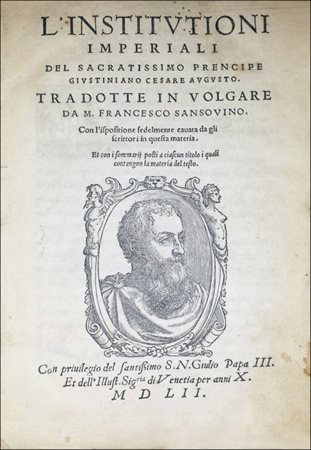
Lotto 134 FIRST EDITION IN ITALIAN LANGUAGE OF JUSTINIAN’S INSTITUTIONS
[Sources of Western Law] Justinianus-Sansovino (translator). L’Institutioni imperiali del sacratissimo prencipe Giustiniano Cesare Augusto. Tradotte in volgare da Francesco Sansouino. Con l’ispositione fedelmente cauata da gli scrittori in questa materia, e con i sommarij posti a ciascun titolo, i quali contengono la materia del testo. Venice: Bartolomeo Cesano, 1552.
4to, contemporary paperboards, ff. [4], 173 [i.e. 175], [1]. It lacks the leaves C2 and C3.
Rare first edition in Italian language of Justinian’s Institutions, the foundation of Roman Law, in the polite translation of Francesco Sansovino.
References: Cnce, Censimento, 13497. -
![AN UNCOMMON VENETIAN EDITION OF THE JUSTINIAN'S CODES[1.]: Iustinianus...](/Upl/Auctions/Cache/828/1657/178246/135-0.jpg/s1_450.jpg)
Lotto 135 AN UNCOMMON VENETIAN EDITION OF THE JUSTINIAN'S CODES
[1.]: Iustinianus Augustus - Accursius - Persius. Digestum vetus seu Pandectarum iuris ciuilis tomus primus [...] Commentarijs Accursii, et multorum insuper aliorum iurisconsultorum tam veterum, quam neotericorum, praecipue autem Antonii Persii scholijs, atque obseruationibus illustratus. Editio postrema. Venetiis: [Francesco De Franceschi, Gaspare Bindoni il vecchio, eredi di Niccolò Bevilacqua, Damiano Zenaro], 1575 (Venetiis: 1574).
[together with:]
[2.]: Iustinianus Augustus - Accursius - Leconte. Codicis dn. Iustiniani sacratissimi principis pp. Augusti repetitae praelectionis libri XII. Accursii commentarijs, & multorum veterum ac recentiorum iurisprudentium annotationibus tam ad textum, quam ad glossas, recens illustrati , mendisque quam plurimis passim repurgati: additis & restitutis quibusdam Graecis constitutionibus, [...] Accesserunt his Fasti regij et consulares vsque ad Iustiniani mortem [...] Antonio Contio auctore. Editio postrema. Venetiis: [Francesco De Franceschi, Gaspare Bindoni il vecchio, eredi di Niccolò Bevilacqua, Damiano Zenaro], 1574.
[1.]: 4to (248x174 mm), contemporary full vellum, three raised bands at spine, calligraphic title at bottom edge; pp. [172], 1493 [i.e. 1509], [1] leaf of folded table. Title-page and text in red and black types. A printers' device at title page, with the symbols (Pace, Occhio, Pazienza, Salamandra) and the initials (FS, GB, NB, DZ) of the printers (F. De Franceschi, G.Bindoni il vecchio, eredi di N. Bevilacqua e D. Zenaro). Xylographic initials and ornaments. Folded table between p. 80 and 81 with an engraving representing the tree of jurisditions (Arbor Iurisdictionum).
[2.]: 4to (248x170 mm), contemporary full vellum, three raised bands at spine, calligraphic title at bottom edge; [36] l., 2640 col., [28] leaves. Title-page and text in red and black types. A printers' device at title page, with the symbols (Pace, Occhio, Pazienza, Salamandra) and the initials (FS, GB, NB, DZ) of the printers (F. De Franceschi, G.Bindoni il vecchio, eredi di N. Bevilacqua e D. Zenaro). Xylographic initials and ornaments.
Accursius (in Italian Accursio, Accorso or also Accorso di Bagnolo; c. 1182-1263) was a Roman jurist. He is notable for his organization of the glosses, the medieval comments on Justinian's codification of Roman law, the Corpus Juris Civilis. He was not proficient in the classics, but he was called "the Idol of the Jurisconsults".
Antonio Persio (1542-1597) was an Italian philosopher, theologian and jurist.
Antoine Leconte (Antonio Conti)(1517-1586) was a French jurist, famous for his attacks on Calvin.
Iustinianus Augustus (Justinian I, 482-565), sometimes known as Justinian the Great, was a Byzantine (East Roman) emperor from 527 to 565. During his reign, Justinian sought to revive the empire's greatness and reconquer the lost western half of the historical Roman Empire. -
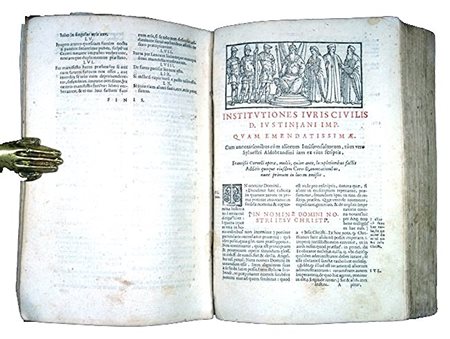
Lotto 136 NICE POCKET EDITION OF JUSTINIAN'S INSTITUTIONS
[Sources of Western Law, Institutions] Justinianus. Institutiones iuris ciuilis d. Iustiniani Imper. Accuratius quam unquam antea recognitae, atque emendatae. Cum omnibus Siluestri Aldobrandini, & aliorum clarissimorum iurisconsultorum annotationibus hactenus impressis. Quibus hac nouissima omnium editione accesserunt praeclarae Francisci Cornelli Brixiani annotationes, nunc primum editae, [...] Praeterea XII tab. quae extant fragmenta: varietas lectionum: index rerum, & verborum memorabilium, aptissime dispositus. Venice: Giunti, 1581.
A thick volume in 8vo, contemporary limp vellum, ff. [50], 391, [1].
Entirely printed in black and red and illustrated with a woodcut representing the Justice (the Emperor Justinian among his counsellors).
Nice pocket size Giunti edition in two colors of Justinian’s Institutions, with the commentary of the Florentine lawyer Silvestro Aldobrandini (1499-1558), father of Ippolito, the future Pope Clemens VIII and the Brixia jurist Francesco Cornello (sec. XV) that was teacher of the young Ippolito Aldobrandini.
References: Cnce, Censimento, 13484. OCLC, 797779912. -
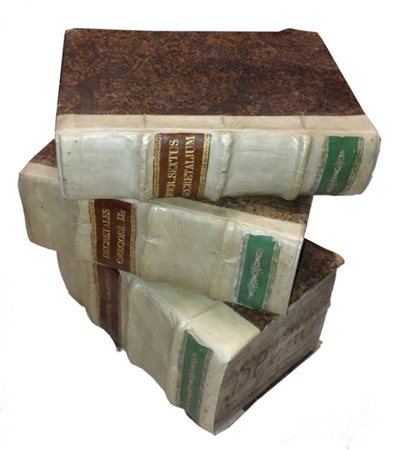
Lotto 137 A CORNERSTONE OF MEDIEVAL CANON LAW
Gratianus. Decretum Gratiani emendatum et notationibus illustratum una cum glossis, Gregorii XIII Pont. Max iussu editum.
(Together with:)
Liber sextus decretalium D. Bonifacii Papae VIII suae integritati una cum Clementinis & Extravagantibus, earumque glossis restitutus…
(Together with:)
Decretales D. Gregorii Papae IX suae integratati unà cum glossis restitutae, cum Gregorii XIII Pont. Max. & aliorum Principum. Romae, in Aedibus Populi Romani, 1584.
3 thick volumes in 4to (240x180 mm), 18th century half vellum, two labels with gilt-lettered titles at three raised bands spine, pp. [88], 1904, [28], two folding xylographic plates with genealogical trees; pp. [8], 592, [2], 243, [6], 262, [42], woodcut title-page at Constitutiones Clementinas, two other folding xylographic plates with genealogical trees; pp. [56], 1388, a xylographic plate representing the enthroned pope surrounded by the Fathers of the Church.
Woodcut devices at title-pages, woodcut head-letters.
Text in Latin on two columns, surrounded by the commentary and notes.
A good Roman edition of this cornerston of Medieval Canon Law, printed by the heirs of Aldus Manutius in their Roman Press.
Around 1140 in Bologna, the Camaldolese monk and canon law jurist Francis (or John) Gratian collected —under the significant title of Concordia discordantium canonum (afterwards better known as Decretum magistri Gratiani)—, papal decrees, councils’ canons, abstracts from the Church Fathers, from Roman law’s sources written before Justinianus, from the Lex romana Visigothorum and the Capitolari Carolingi. This compilation of documents was the first and main source of Canon law until the promulgation of the Codex iuris canonici, in 1917.
Provenance: Some not identified contemporary annotations.
References: OCLC 634747100. -
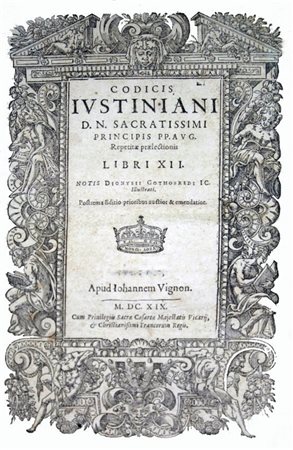
Lotto 138 THE FOUNDING WORK OF WESTERN LAW WITH GODEFROY'S COMMENTARY
[Sources of Western Law] Justinianus. Corpus ivris civilis, in IIII. partes distinctum. Qvarvm prima continentvr indices omnium iuris titulorum. Institutionum libri IIII. Digestorum seu Pandectarum libri L. Quae reliquis partib. includantur, quinta docebit pagina. His accesserunt notae repetitae tertiae quartaéque praelectionis Dionysio Gothofredo ic. authore: quibus, inter caetera, variae lectiones, leges similes, contrariae, abrogatae; verborum, legúmque difficilium interpretationes, selectae repetitiones, argumentata, compendia, atque epitomata, anni singulis. Codicis legibus additi, continentur. His additae sunt Institutionum, Nouellarum Iustiniani, Leonis & Feudorum epitomae ad ordinem Edicti perpetui compositae: eodem authore. Geneve, Vignon, 1619.
2 thick volumes in 4to, contemporary stiff vellum (spines worn), ff. [32], pp. 16, 17-126 columns. 2018 columns, ff. [8], 972 columns, ff. [4], 568 columns.
The Lyon edition (with Godefroy's Commentar) of the founding work of the Western Law.
References: ICCU, 019730 (2 copies). OCLC, 17403547 (4 copies in USA). -
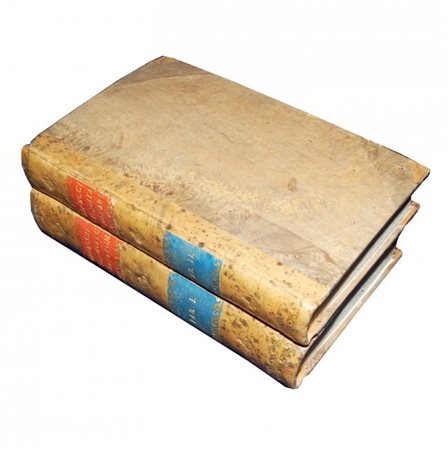
Lotto 139 AN EXTENSIVE TREATISE ON ROMAN LAW ACCORDING TO JUSTINIAN'S CODES
Heinecke, Johann Gottlieb. Jo. Gottlieb. Heineccii [...] Antiquitatum Romanarum jurisprudentiam illustrantium Syntagma secundum ordinem Institutionum Justiniani digestum, in quo multa juris Romani atque auctorum veterum loca explicantur, atque illustrantur. Pars prima [-secunda]. Venetiis: ex Typographia Balleoniana, 1764.
12mo (152x100; half leather binding, with marbled paper at boards, gilt title at spine; 2 vols.; pp. XXIV, 562, [2]; 455, [1], [1] leaf of folded table; xylographic device at title-page (a crowned double-headed eagle); xylographic initials and ornaments.
Johann Gottlieb Heineccius (Heinecke) (September 11, 1681 – August 31, 1741) was a German jurist from Eisenberg, Thuringia. His chief works were: Antiquitatum Romanarum jurisprudentiam illustrantium syntagma (1718); Historia juris civilis Romani ac Germanici (1733); Elementa juris Germanici (1735); Elementa juris naturae et gentium (1737; Eng. trans. by Turnbull, 2 vols, London, 1763).
Provenance: Private library of a Verona noble family, whose roots are in Mantua and in which there were distinguished lawyers and jurists.
References: IT\ICCU\MILE\007219. OCLC, 800918156, 807213154 (two copies in Spain) and 67009204 (one copy in USA, one copy in France; one copy in the Netherlands and one copy in South Africa). -
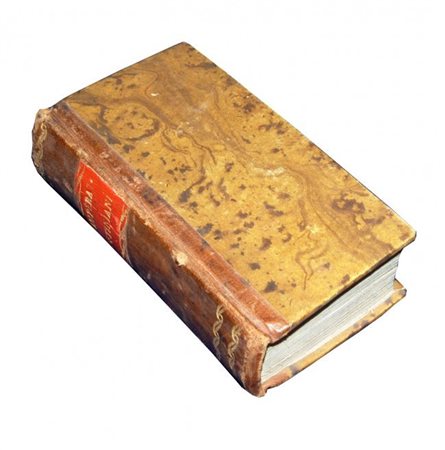
Lotto 140 VERY SCARCE POCKET EDITION OF THE JUSTINIAN'S CODES
NO COPY OUT OF ITALY
Iustinianus Augustus. Imperatoris Iustiniani Institutionum libri 4. Adiecti sunt ex digestis tituli de verborum significatione et de regulis iuris. Et in hac quoque impressione Institutionum Epitome Dionysij Gothofredi I.C. Cum indice ad eosdem & facili, & breui. Venetiis: apud Nicolaum Pezzana, 1672.
24mo (106x52 mm), half leather binding, marbled paper at boards, gilt title on a red leather label at spine, marbled edges; pp. 406, [26]. Title-page in black types in a double rulers frame, with an engraved ornamental lily.
Iustinianus Augustus (Justinian I, 482-565), sometimes known as Justinian the Great, was a Byzantine (East Roman) emperor from 527 to 565. During his reign, Justinian sought to revive the empire's greatness and reconquer the lost western half of the historical Roman Empire.
Justinian achieved lasting fame through his judicial reforms, particularly through the complete revision of all Roman law, something that had not previously been attempted. The total of Justinian's legislature is known today as the Corpus juris civilis. It consists of the Codex Iustinianus, the Digesta or Pandectae, the Institutiones, and the Novellae.
In particular, the
Denis Godefroi (Dionysius Gothofredus, 1549-1622) French jurist and law professor.
Provenance: Private library of a Verona noble family, whose roots are in Mantua and in which there were distinguished lawyers and jurists.
Handwritten ownership inscription at title page (Joseph Maria Resinus).
References: IT\ICCU\RMSE\082323 (2 copies). OCLC, 797327656. No copies of this edition out of Italy.
Title-page a bit worn and soiled (spots and lack of paper at bottom and top corners). Overall, a good copy. -

Lotto 141 AMUSING PORTABLE EDITION OF JUSTINIAN'S INSTITUTIONS
ONLY ONE COPY IN USA
[Source of Western Law, Handbook] Justinianus. Imperatoris Justiniani institutionum libri quatuor. Adjecti sunt ex Digestis Tituli de verborum significatione, & de Regulis Juris [...] Patavii, Typis Seminarii, Apud Ioannem Manfrè, 1754.
12mo (145x77 mm), red paperboard, sepia ink handwritten titles on red paper label, pp. 262 [missing last blank]. Xylographic head-letters and decorations at preliminary leaves.
Uncommon edition of Justinian’s Institutiones in pocket size, to be used by professor, students and lawyers.
In the same period in which it had started the Law reorganization in the Pandectae, Justinian asked the jurists Trebonianus, Theophilus e Dorotheus to create a manual that summarized the items of the Roman Law to be used by the students of the Empire. The Institutiones remained, along the centuries, a cornerstone of the matter because of the clarity and completeness, and for that reasons were utilized by the most important scholars as a skeleton to build their own commentary on it.
The text is followed by two indexes, quoting the specific terms used and the paragraphs where to find the definitions of the basic rules or Roman law.
References: IT\ICCU\TO0E\045911 (only four copies in Italian public libraries). OCLC 799215709 locates only 1 copie in USA (Yale). -
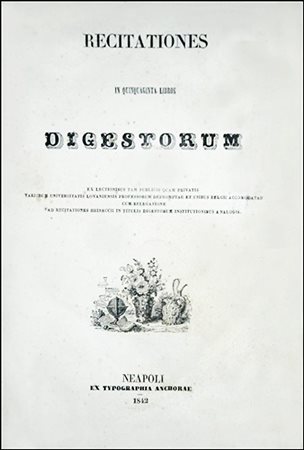
Lotto 142 SCARCE EDITION OF JUSTINIAN'S DIGEST FOR BELGIAN UNIVERSITIES
Justinian. Recitationes in quinquaginta libros Digestorum; ex lectionibus ... variorum professorum depromptae et usibus Belgii accommodatæ, cum relegatione ad recitationes Heinecci, in titulis Digestorum Institutionibus analogis. Neapoli, ex typographia Anchorae, 1842.
Large 8vo, contemporary half vellum with label and gilt title on spine, pp. 723.
Scarce Neapolitan edition of Justinian's Digest for the use of Belgium universities.
References: OCLC, 504618972 (the British Library copy). -
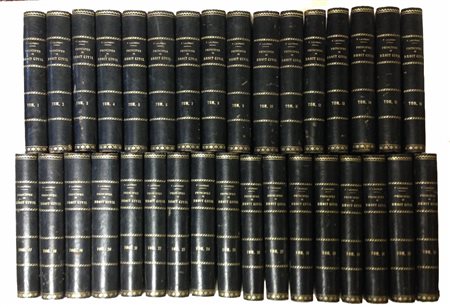
Lotto 143
THE RENOWNED LAURENT'S «PRINCIPES DE DROIT CIVIL», A FUNDAMENTAL CORNERSTONE OF FRENCH CIVIL LAW
Laurent, François. Principes de droit civil. Bruxelles: E. Bruylant; Paris: A. Chevalier-Marescq, 1887.
33 volumes in large 8vo, contemporary half blue morocco on marbled paper. Each volume contains approximately 500-600 pages.
Fourth edition of the celebrated Laurent's «Principles of Civil Law», first published between 1869 and 1878: the work was so successful that, already in 1879, the French Minister of Justice commissioned the author to prepare a report with a proposal for a revision of the French Civil Code.
François Laurent (1810-1887), was a French jurist, professor at Gand.
He was inspired by liberal and anticlerical ideas, that showed both in behavior and in his writing, gaining enemies and disagreements: but the integrity of his conduct meant that he kept the chair until his death.
References: OCLC 61645274. -
![TWO YEARBOOKS FOR THE LOMBARD-VENETIAN KINGDOM:[1.]: IMPERIAL ROYAL ALMANAC...](/Upl/Auctions/Cache/828/1657/178255/144-0.jpg/s1_450.jpg)
Lotto 144 TWO YEARBOOKS FOR THE LOMBARD-VENETIAN KINGDOM:
[1.]: IMPERIAL ROYAL ALMANAC FOR THE PROVINCES OF THE LOMBARD-VENETIAN KINGDOM FOR THE YEAR 1839
[2.]: TERRITORIAL ORGANIZATION OF THE PROVINCES OF THE VENETO REGION IN THE LOMBARD-VENETIAN KINGDOM IN THE YEAR 1853
[1.]: Almanacco imperiale reale per le provincie del Regno Lombardo-Veneto soggette al governo di Milano per l'anno 1839. Milano: dall'I. R. Stamperia, [1839].
[together with:]
[2.]: Compartimento territoriale delle provincie venete, attivato col primo luglio 1853. Allegato al n. 80 puntata 6, parte 1 del Bollettino delle leggi e degli atti ufficiali per le provincie venete del 1853. Venezia: dall'I.R. priv. stab. naz. di G. Antonelli, 1853
[1.]: 8vo (250x164 mm), editorial paper binding; pp. XXXII, 612; emblem with a double-headed eagle at title-pages.
[2.]: 8vo (247x156 mm), marbled paper board binding, with handwritten title on a paper label at front board; pp. 339; vignette at title-page with the crowned twice-headed eagle of the Lombard-Venetian Kingdom.
The Kingdom of Lombardy-Venetia (1815-1866) (Italian: Regno Lombardo-Veneto, German: Königreich Lombardo–Venetien), commonly called the Lombardo-Venetian Kingdom, was a constituent land (crown land) of the Austrian Empire. It was created in 1815 by resolution of the Congress of Vienna in recognition of the Austrian House of Habsburg-Lorraine's rights to Lombardy and the former Republic of Venice after the Napoleonic Kingdom of Italy, proclaimed in 1805, had collapsed.
Administratively the Kingdom of Lombardy-Venetia comprised two independent governments (Gubernien) in its two parts (Lombardy and Venetia), which officially were declared separate crown lands in 1851. Lombardy was annexed to Sardinia in 1859 and the kingdom ceased to exist when the rest of its territory was annexed to the Kingdom of Italy in 1866.
The Kingdom of Lombardy–Venetia was first ruled by Emperor Francis I from 1815 to his death in 1835. His son Ferdinand I ruled from 1835 to 1848. In Milan on 6 September 1838 he became the last king to be crowned with the Iron Crown of Lombardy. The crown was subsequently brought to Vienna after the loss of Lombardy in 1859, but was restored to Italy after the loss of Venetia in 1866.
Provenance: Private library of a Verona noble family, whose roots are in Mantua and in which there were distinguished lawyers and jurists.
References:
[1.]: ICCU registers a collection of 22 volumes of this Almanacco published one each year from 1814 to 1841 (IT\ICCU\TO0\0163498). OCLC, 802242423 (electronic copy).
[2.]: IT\ICCU\LO1\0573874 (10 copies). OCLC, 797737273.