
Pre-Asta PALAZZO DUODO – DIPINTI ANTICHI E DEL XIX SECOLO
-
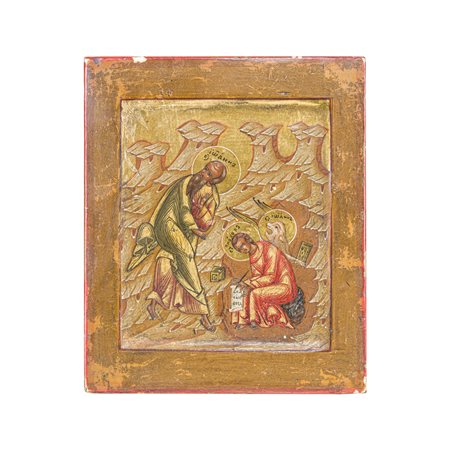
Lotto 265 Icona
San Giovanni teologo e Procoro
Russia centrale, XIX secolo
Tempera su tavola
12,5 x 10,5 cm
An icon
Saint John the Theologian and Prochorus
Central Russia, 19th century
Tempera on wood panel
12,5 × 10,5 cm -
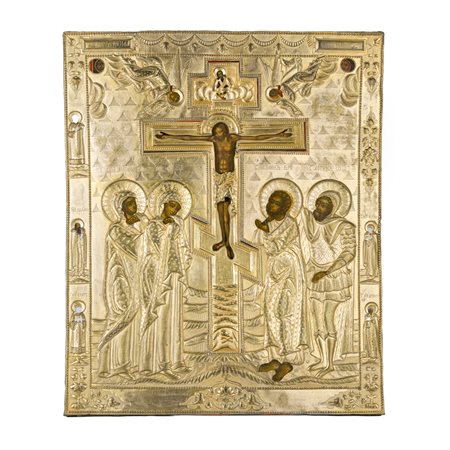
Lotto 266 Icona
Stauroteca, ai piedi della Croce a sinistra Maria Maddalena e la Madre di Dio, a destra San Giovanni e il centurione Longino
Tempera su tavola, riza in metallo dorato
Russia, Bottega dei Vecchi Credenti, XIX secolo
53,5 x 42 cm
An icon
Staurotheke (reliquary of the True Cross), with Mary Magdalene and the Mother of God to the left of the Cross, and Saint John and the centurion Longinus to the right
Tempera on wood panel, with gilt-metal riza
Russia, Old Believers Workshop, 19th century
53,5 x 42 cm -
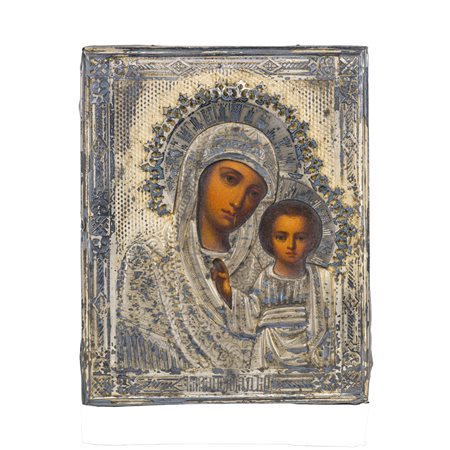
Lotto 267 Icona
Madonna di Kazan
Tempera su tavola, riza in argento
Russia, Mosca, inizio del XX secolo
18 x 14,5 cm
An icon
Our Lady of Kazan
Tempera on wood panel, with silver riza
Russia, Moscow, early 20th century
18 × 14,5 cm -
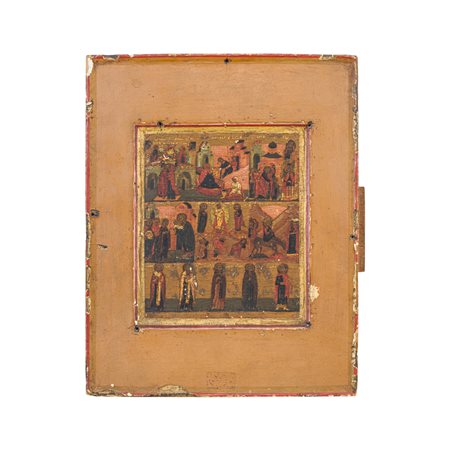
Lotto 268 Icona
Scene della Concezione di Sant'Anna, Nascita di Maria, Presentazione della Vergine al Tempio (prima fila)
Presentazione di Gesù al Tempio, Trasfigurazione, Monte Tabor, ingresso a Gerusalemme (seconda fila)
Santi scelti (terza fila)
Tempera su tavola
Russia, Mosca, XVIII secolo
23,5 x 18,5 cm
An icon
Scenes from the Conception of Saint Anne, the Birth of the Virgin, and the Presentation of the Virgin in the Temple (first row)
The Presentation of Jesus in the Temple, the Transfiguration, Mount Tabor, and the Entry into Jerusalem (second row)
Selected Saints (third row)
Tempera on wood panel
Russia, Moscow, 18th century
23,5 × 18,5 cm -
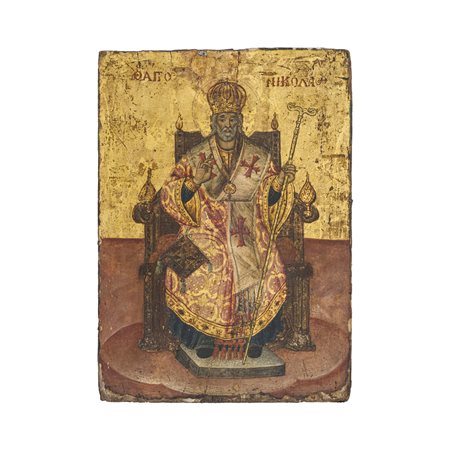
Lotto 269 Icona veneto cretese o eptanese del XVII/XVIII secolo
San Nicola in trono
Tempera e oro su tavola
34 x 24 cm
L'icona, di ottima qualità e ben conservata, riproduce il santo seduto in trono secondo un'iconografia tradizionale ben consolidata, come dimostrano le icone conservate presso i musei della Vestfalia e al Louvre.
Si veda:
https://westfalen.museum-digital.de/people/168386
https://collections.louvre.fr/en/ark:/53355/cl010531327
A Cretan-Venetian or Heptanese Icon of the 17th/18th century
Saint Nicholas Enthroned
Tempera and gold on wood panel
34 × 24 cm
The icon, of excellent quality and in good condition, depicts the saint seated on a throne, following a well-established traditional iconographic model, as evidenced by comparable icons preserved in the museums of Westphalia and at the Louvre.
See:
https://westfalen.museum-digital.de/people/168386
https://collections.louvre.fr/en/ark:/53355/cl010531327 -
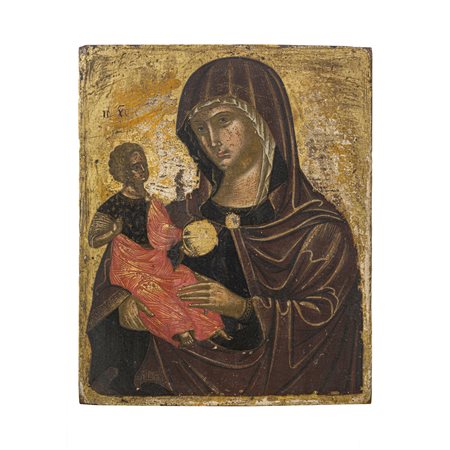
Lotto 270 Icona veneto cretese del XV/XVI secolo
Madre della Consolazione
Tempera e oro su tavola
21 x 17 cm
L'icona riprende il modello di Nikolaos Tzafouris: la ricca decorazione in oro che esalta le vesti connota la ricchezza del committente e la levatura dell'autore e/o della bottega dove fu eseguita. Per comprendere più compiutamente l'importanza di quest'opera risulta molto interessante il confronto con le due icone, dello stesso soggetto, conservate presso l'Istituto di ricerca Wyvern, si veda:
https://wyvernresearch.org/news/3-two-icons-of-the-madre-della-consolazione-by-nikolaos-tzafouris-1455-1501/
A Cretan-Venetian Icon of the 15th/16th century
Mother of Consolation
Tempera and gold on wood panel
21 × 17 cm
The icon follows the model established by Nikolaos Tzafouris. The rich gold decoration embellishing the garments reflects both the wealth of the patron and the artistic standing of the painter and/or the workshop in which the work was executed.
For a fuller understanding of the significance of this work, a comparison with the two icons of the same subject attributed to Nikolaos Tzafouris and preserved in the Wyvern Research Institute is particularly interesting. See: https://wyvernresearch.org/news/3-two-icons-of-the-madre-della-consolazione-by-nikolaos-tzafouris-1455-1501/ -
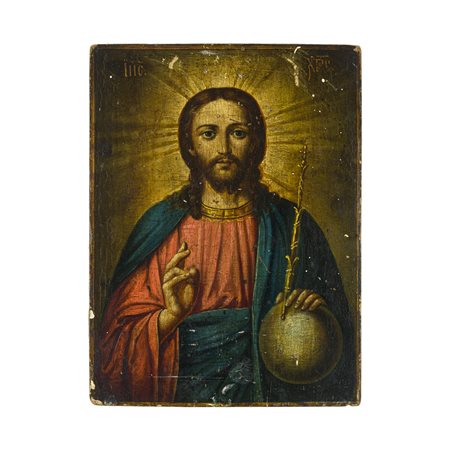
Lotto 271 Icona
Cristo benedicente
Tempera su legno
Russia, XIX/XX secolo
35,5 x 26,5 cm
An icon
Christ Blessing
Tempera on wood panel
Russia, 19th/20th century
35,5 × 26,5 cm -
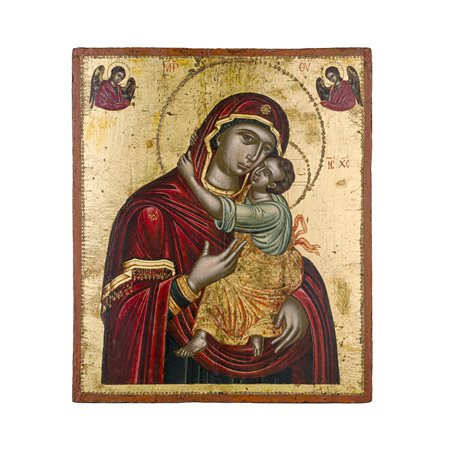
Lotto 272 Icona veneto cretese del XVII secolo
Vergine Eleousa o della Tenerezza
Tempera e oro su tavola
44 x 37 cm
La Vergine Eleousa, detta anche Madre di Dio della Tenerezza, ha origine nel cristianesimo bizantino. Essa è una variante della più antica Vergine Odigitria, ovvero la Vergine che indica la via, dalla quale si differenzia per la postura non più frontale, con chiari accenni al lato umano della Vergine e del Bambino, ripresi in un atto di tenerezza reciproca. Le testimonianze più antiche risalgono all'VIII-IX secolo e si ripetono nei secoli seguendo la parabola delle icone veneto-cretesi e del mondo del cristianesimo ortodosso.
A Veneto-Cretan icon of the 17th century
Virgin Eleousa (Our Lady of Tenderness)
Tempera and gold on panel
44 × 37 cm
The Virgin Eleousa, also known as Our Lady of Tenderness, originated in the Byzantine Christian tradition. It represents a variant of the earlier Hodegetria type, in which the Virgin points the way. Unlike the latter, the Eleousa is characterised by a less frontal composition, emphasising the human dimension of both the Virgin and Child through their tender physical interaction and reciprocal gestures of affection. The earliest examples date back to the 8th-9th centuries. This iconographic type continued to be reproduced over the centuries, particularly within the Veneto-Cretan school and the Eastern Orthodox Christian tradition. -
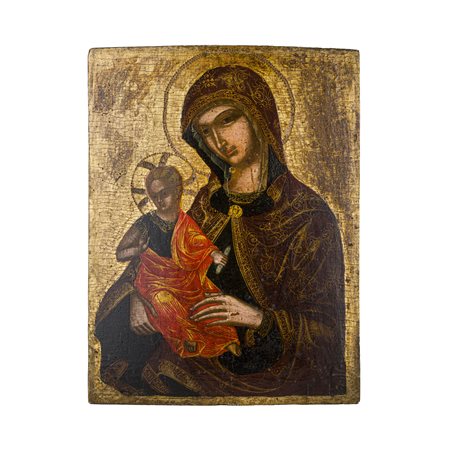
Lotto 273 Nikolaos Tzafouris (Creta 1468 - 1501) attribuita
Vergine della Consolazione
Tempera e oro su tavola
21 x 17 cm
L'immagine di questa icona veneto cretese del XVI secolo nacque grazie a Nikolaos Tzafouris sul finire del Quattrocento. Rappresenta uno degli esempi più sintomatici di come l'arte bizantina si sia intrecciata con l'arte occidentale, in particolare quella veneta. Pare infatti che sia nata durante il soggiorno veneziano di Tzafouris, il quale rimase affascinato dalle madonne di Giovanni Bellini.
Nikolaos Tzafouris dopo aver mosso i primi passi in patria, si recò a Venezia per completare la propria formazione artistica. Seppur senza notizie precise, entrò probabilmente in contatto con Giovanni Bellini, di cui, forse, fu allievo. In seguito, fece ritorno a Creta, all'epoca parte dei possedimenti della Repubblica di Venezia, dove avviò una bottega che lo rese conosciuto sia tra i credenti ortodossi greci sia tra i cattolici sparsi nel mediterraneo orientale.
Nikolaos Tzafouris (Crete 1468 - 1501) attributed
Virgin of Consolation
Tempera and gold on panel
21 x 17 cm
This 16th-century Venetian-Cretan icon was created by Nikolaos Tzafouris towards the end of the 15th century. It represents one of the most telling examples of how Byzantine art intertwined with Western art, particularly that of Venice. Indeed, it appears to have been created during Tzafouris’s stay in Venice, where he was captivated by Giovanni Bellini’s Madonnas. -
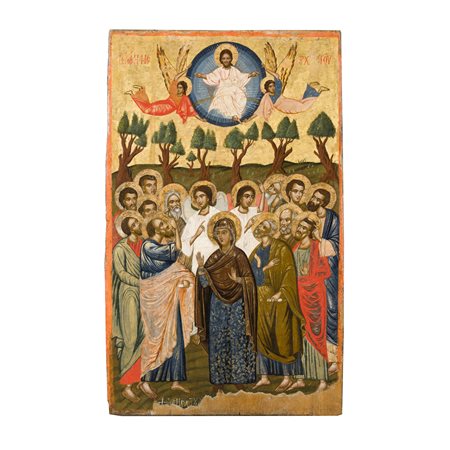
Lotto 274 Emmanuel Tzanes (Rethymno 1610 - Venezia 1690) attribuito
Ascensione di Gesù Cristo
Tempera e oro su tavola
119 x 69 cm
Dall'esame puntuale di questa icona di scuola veneto-cretese databile alla seconda metà del Seicento, emerge un insieme di elementi sia stilistici che tecnici che ricordano l'arte di Emmanuel Tzanes.
Partendo dal supporto, notiamo che la tavola pare essere di abete rosso, essenza lignea molto in uso a Venezia per la sua peculiare resistenza all'umidità. Dal punto di vista stilistico convergono elementi tipici della pittura del maestro cretese, quali: l'estrema semplificazione del paesaggio, la nervosa e peculiare realizzazione degli arbusti, siano essi cipressi o ulivi, la realizzazione del collo dei personaggi di forma conica allungata, infine la tecnica di realizzazione delle barbe e dei capelli.
Infine, è interessante notare come l'artista caratterizzi in senso veneziano l'icona realizzando il bellissimo ricamo d'oro della veste della Vergine, memore dell'antica pittura veneziana bizantineggiante di Lorenzo Veneziano e della scuola veneziana del Trecento.
La storia di questa immagine sacra risale alle rappresentazioni paleocristiane. La Vergine, non menzionata negli "Atti degli Apostoli", compare nell'iconografia dell'Ascensione solo dopo il Concilio di Nicea del 431. Essa rappresenta la Chiesa in terra, presenzia simbolicamente senza volgere lo sguardo al cielo. Posta al centro della disposizione degli apostoli Lei è simbolo dell'incarnazione di Cristo. In cielo due angeli elevano l'aureola di luce di Gesù Cristo benedicente, mentre altri due in candide vesti annunciano agli apostoli il ritorno di Cristo. Infine, da notare come gli apostoli siano tornati ad essere dodici; dopo il tradimento di Giuda fu scelto al suo posto Mattia.
Emmanuel Tzanes (Rethymno 1610 - Venice 1690) attributed
The Ascension of Christ
Tempera and gold on panel
119 × 69 cm
A close examination of this Cretan-Venetian icon, datable to the second half of the seventeenth century, reveals a combination of stylistic and technical features that recall the work of Emmanuel Tzanes.
The panel appears to be made of spruce, a wood widely used in Venice for its particular resistance to humidity. Stylistically, several distinctive elements associated with the Cretan master converge here: the extreme simplification of the landscape; the nervous and highly characteristic rendering of the vegetation, whether cypresses or olive trees; the elongated, conical treatment of the figures’ necks; and, finally, the distinctive technique employed in the rendering of beards and hair.
Of particular interest is the artist’s Venetian interpretation of the icon, most notably in the exquisite gold embroidery of the Virgin’s robe. This detail recalls the Byzantine-influenced Venetian painting of Lorenzo Veneziano and the Venetian school of the fourteenth century. The iconography of the Ascension of Christ has its roots in Early Christian representations. Although the Virgin is not mentioned in the Acts of the Apostles, she appears in representations of the Ascension only after the Council of Ephesus in 431. She symbolically represents the Church on earth, standing present without turning her gaze towards heaven. Positioned at the centre of the group of Apostles, she also serves as a symbol of the Incarnation of Christ. In heaven, two angels raise the luminous aureole surrounding the blessing Christ, while two others, dressed in white, announce His return to the Apostles. It is also noteworthy that the Apostles are once again depicted as twelve: following Judas’s betrayal, Matthias was chosen to take his place. -
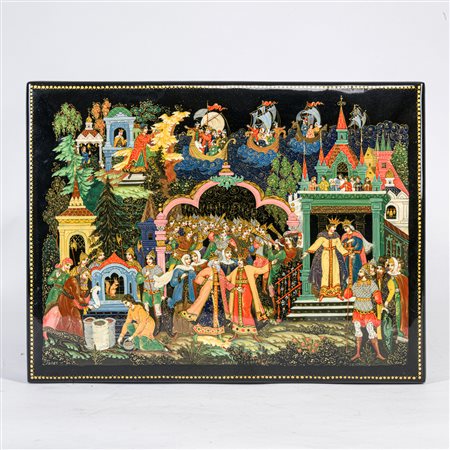
Lotto 275 Scatola porta gioie
Cartapesta laccata
Scuola di Palekh, Russia, XIX/XX secolo
6 x 32 x 26 cm
Coperchio raffigurante lo zar Saltan con il principe e la principessa dalla famosa fiaba di Puškin
Sul fondo marchio dorato con l'uccello mitologico o la fenice tipica dell'artigianato artistico di Palekh, villaggio dell'Oblast' di Ivanovo in Russia
A jewelry box
Lacquered papier-mâché
Palekh school, 19th/20th century
6 x 32 x 26 cm
Lid depicting Tsar Saltan with the Prince and Princess, from Pushkin’s famous fairy tale
On the bottom, there is a gilded mark featuring a mythological bird, or a phoenix, typical of the artistic craftsmanship of Palekh, a village in the Ivanovo Oblast of Russia