
ASTA 267 - GLITTICA
-
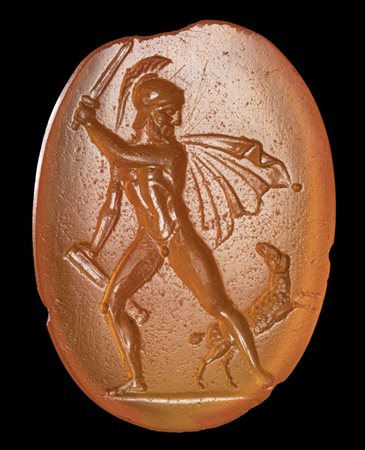
Lotto 433 A NEOCLASSICAL CARNELIAN INTAGLIO. AJAX KILLING THE ANIMALS.
Late 18th- Early 19th century A.D.
15x20x4 mm
This scene appears to be a prototype for the Poniatwoski Gems with the same theme. A similar intaglio was engraved by Giovanni Calandrelli (1784-1853 ; see the drawing n° VI.3, p. 95 in Platz-Horster, L'antica maniera). Ajax mad, is depicted with a sword killing the animals of the greeks ( a ram). Wear marks. Made as an ancient revival.
Provenance: U.S. private collection, acquired on the art market. This lot is sold under temporary import status. -
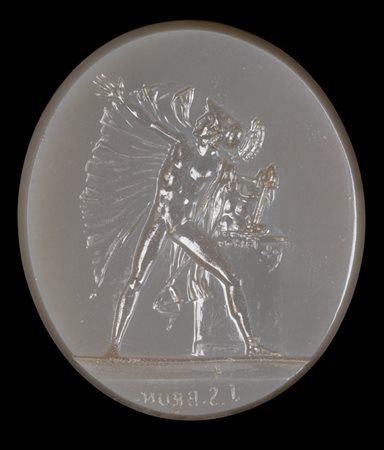
Lotto 434 A NEOCLASSICAL CHALCEDONY INTAGLIO SIGNED J.S BRUN (1792-1860 CIRCA). ORESTES IN FURY.
First half of 19th century
26x31x7 mm
This scene, with some variations, is recordered in the Paoletti collection, inv.n°.MR27830 (see L. Pirzio Biroli Stefanelli, La collezione Paoletti, Rome, 2012, vol.VIII.I.n°2). Behind the groundline, the signature J.S. Brun. Joseph Silvestre Brun was a French gem engraver, student of François Lemot, François Jouffroy and Nicolas Augustin Matte. Brun was awarded the First Prize of Rome medal engraving in 1817 based upon a depiction of Androcles and the lion. He also executed a silvered bronze medal in 1825 to celebrate the coronation of Charles X of France in Reims.
Provenance: U.S. private collection, acquired on the art market. This lot is sold under temporary import status. -
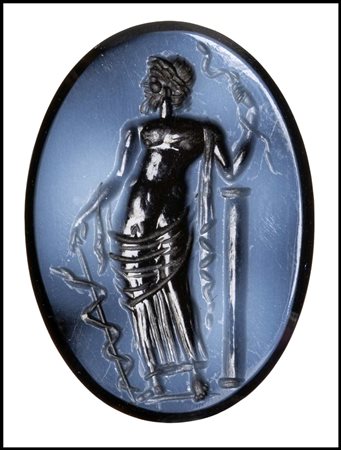
Lotto 435 A NEOCLASSICAL NICOLO INTAGLIO SIGNED MICHELINI. AESCULAPIUS.
19th century
15x20x2 mm
On the back of the gem, the typical signature "Michelini" engraved with the diamond point (Luigi Michelini, 1798-1858); above, a number, below also is specified the type of stone with "Nicolo". Standing figure of Aesculapius facing left, with frontal body and head turned in profile. With his right hand he holds the scepter with the intertwined snake, with the left he holds a snake leaning his elbow against a column. Light wear marks.
Provenance: U.K private collection -
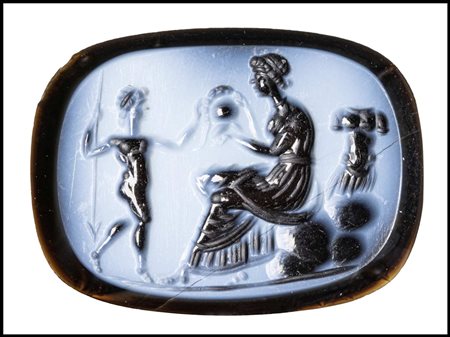
Lotto 436 A NEOCLASSICAL NICOLO INTAGLIO SIGNED MICHELINI. EROS BRINGS THE WEAPONS OF MARS TO VENUS.
19th century
15x20x2 mm
To the left, Eros walks towards Venus sitting on a rock on the right side. The young man holds a spear pointing downwards and offers a helmet to the deity. Venus is dressed in a tunic and is flanked by armor resting on the rocks. Scene inspired by ancient models. Light signs of wear. On the back of the gem, the typical signature "Michelini" engraved with the diamond point (Luigi Michelini, 1798-1858); below also is specified the type of stone with "Nicolo".
Provenance: U.K private collection -
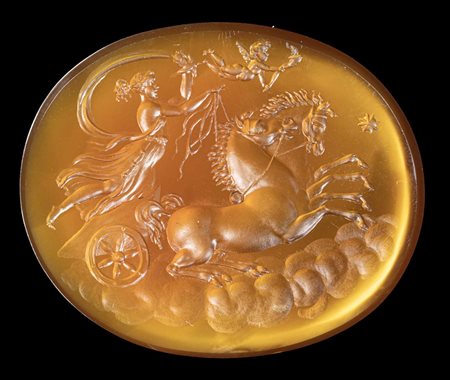
Lotto 437 A LARGE NEOCLASSICAL CARNELIAN INTAGLIO. AURORA ON THE CHARIOT.
19th century
31x37x5,5 mm
The figure is represented riding a biga above clouds. On top, a winged Eros holding a torch. In front of the biga, a star. Very nice polishing of the engraving. Fine execution, close to the Pichler's and Cerbara's intaglios with the same subject. Attractive honey tone. Slight wear marks.
Provenance: U.K private collection -
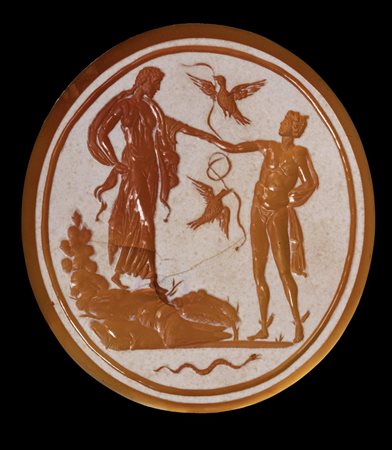
Lotto 438 A LARGE AGATE INTAGLIO. PERSEUS FREEING ANDROMEDA.
Early 19th century
34x37x4 mm
The mythological scene is composed of Perseus on the right helping Andromeda to descend from the rocks to which she had been chained. At the bottom, under the baseline, a snake to symbolize the monstrous creature defeated by the hero to free Andromeda. In the background, two doves hold in their beaks a ribbon wound between the two figures, symbol of triumphant love. The scene, excluding the presence of the doves and the snake, is based on an ancient Roman marble bas-relief already well known in the 18th century (Rome, Musei Capitolini). Some engravers, including Giovanni Pichler (1734-1791) carved this scene. The intaglio, engraved on a treated carnelian, is characterized by a thin white layer to obtain an elegant contrast effect. The same type of stone is also engraved by famous artists such as Morelli. Slight superficial crack in the central area of the stone. This carnelian has been treated with alkali and heat (not honey).
"Multum in parvo" (Wartski's catalogue of egraved gems): p. 114 n. 63; p. 122 n. 68 and p. 130 n 73 (same type of stone and style, by Niccolò Morelli 1771-1838).
Provenance: U.K private collection -
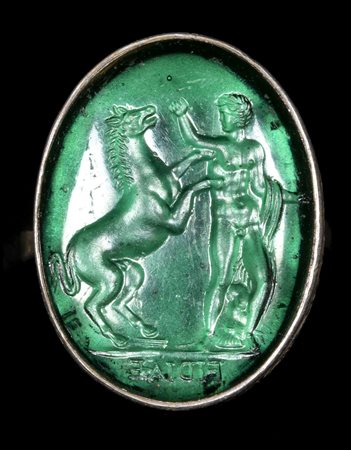
Lotto 439 A GREEN GLASS IMPRESSION SET IN A SILVER RING - FOB. MAN WITH AN HORSE.
19th century
Glass 18x24 mm; Int. size 18x19 mm; 11 gr
Probably Alexander the Great taming Bucefalus, after the statuary group on the Quirinal Hill in Rome (I Dioscuri). Groundline. Signed FIDIAE. Wear marks.
P.J. Mariette, Traite des pierres gravees, p. 97 n. XCVII.
Provenance: U.S. private collection, acquired on the art market. This lot is sold under temporary import status. -
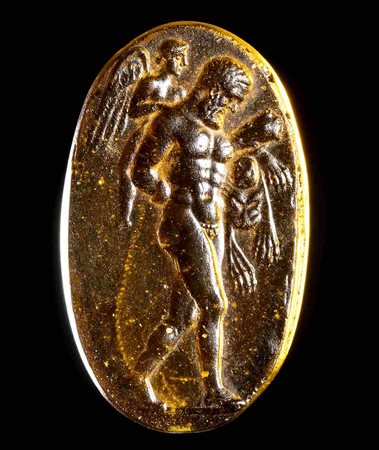
Lotto 440 A GRAND TOUR GLASS PASTE CAST IMPRESSION AFTER AN INTAGLIO. HERCULES SUBDUED BY EROS.
19th century
14 x 24 x 4 mm
The hero is walking right, naked holding the club and wearing the lion skin. On his back, on top of him, a winged Eros. Allegory of Love triumphing over Strenght. Wear marks.
Provenance: From the collection of an european gentleman, acquired on the art market -
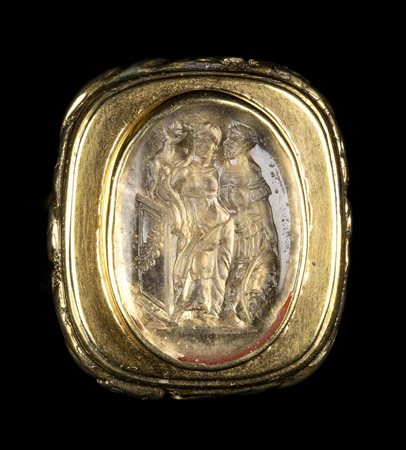
Lotto 441 A GLASS IMPRESSION SET IN A GILDED FOB SEAL. VENUS AND MARS.
18th-19th century
Glass 14x19 mm; H 21 mm; 8,64 gr
Grand Tour Era glass impression after a prase intaglio in the collection of the King of France (inv.58.2296). Eros crowns Mars and Venus. The god of war holds a shield, while the goddess of beauty leans against an altar. Wear marks.
Chabouillet, Anatole. Catalogue général et raisonné des camées et pierres gravées de la Bibliothèque impériale. Paris : 1858, n°2296.
Mariette, Pierre-Jean. Traité des Pierres gravées. Paris : 1750, t.II, n°XX..
Provenance: U.S. private collection, acquired on the art market. This lot is sold under temporary import status. -
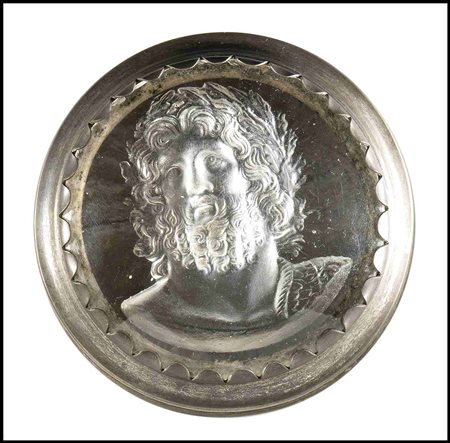
Lotto 442 A SILVER BOX WITH A GLASS IMPRESSION. BUST OF JUPITER.
19th century
H Max. 56 mm; Diam. 90 mm
Large glass intaglio from an impression of an ancient cameo from the 2nd century B.C., representing the bust of Jupiter Ægiochus, known under the name of "Cameo Zulian". Found in Ephesus, it is kept today in the Archaeological Museum of Venice. The god, bearded, wears a crown of foliage and the aegis. The molding was executed in very thick glass surrounded by a silver box.
For a similar exemplar see: Cabinet des Médailles, Paris, AA.VA.11
Provenance: U.S. private collection, acquired on the art market. This lot is sold under temporary import status. -
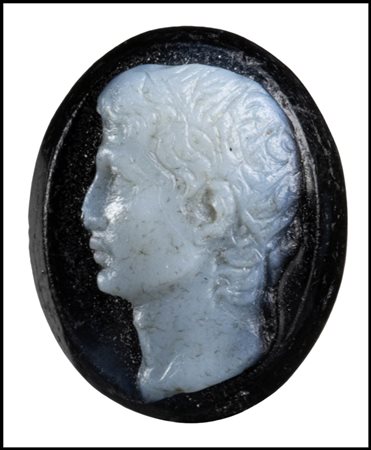
Lotto 443 A GRAND TOUR TWO-LAYERS GLASS PASTE CAMEO. PORTRAIT OF AUGUST.
19th century
8x10x3 mm
The emperor is facing left. Small lack on the tip of the nose. Wear marks.
Provenance: U.S. private collection, acquired on the art market. This lot is sold under temporary import status. -
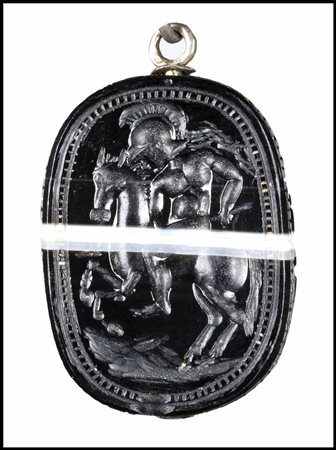
Lotto 444 A LARGE REVIVAL ONYX ENGRAVED SCARAB. HELMETED WARRIOR ON A HORSE.
18th century
18x25x15 mm
Pierced lenghtwise. The back is carved in a naturalistic way. The reverse is engraved with a naked warrior riding an horse to the left. Hatched border. Chips on the edge. Typical of the Etruscan Revivals scarabs production.
Provenance: U.S. private collection, acquired on the art market. This lot is sold under temporary import status.