
ASTA 267 - GLITTICA
-
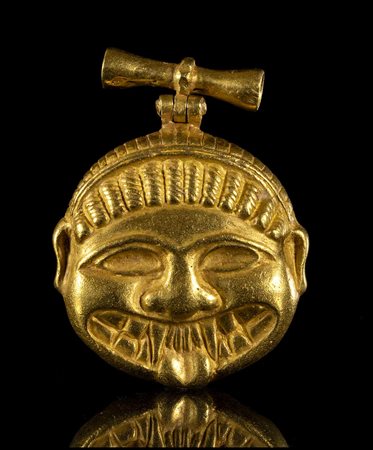
Lotto 421 AN ETRUSCAN MODERN REVIVAL GOLD MASK OF A GORGONA.
19th - 20th century
H max 50 mm; 33,40 gr
Gorgona apotropaic solid gold mask with open jaws showing sharp teeth and tongue. Slight wear marks. Probably used originally as a pendant.
Provenance: U.K private collection -
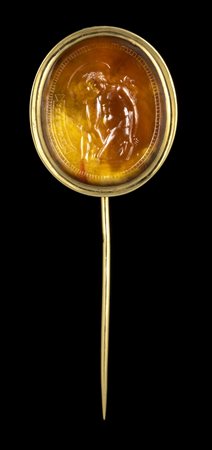
Lotto 422 A FINE NEOCLASSICAL CARNELIAN INTAGLIO SET IN A GOLD STICK PIN. MENELAUS CARRYING THE BODY OF PATROCLUS.
18th - 19th century
Stone 17x21 mm; H max 54 mm; 4,26 gr
Inspired by the models of classical statuary, this powerful scene depicts Menelaus carrying the lifeless body of Patroclus with his shield (or Ajax and Achilles). The anatomical details and the expressive rendering are engraved with great art. In the field, a cartouche with a Greek name in genitive, probably a signature (to be identified): possibly "ΓHEAΡΔOY" . Hatched border. The gem has signs of wear and light internal burn.
Provenance: U.K private collection -
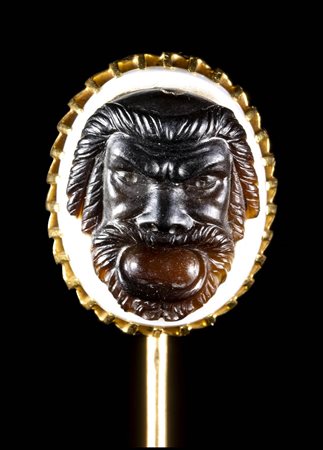
Lotto 423 A SARDONYX CAMEO SET IN A GOLD STICK PIN. THEATRICAL MASK.
19th century
Stone 17x21 mm; H max 80 mm; 9,05 gr
Frontal mask of theatrical type, engraved in high relief using the brown layer of the agate on a white ground. The effigy is characterized by ancient Roman-style braided hair, a wide open mouth and a furrowed forehead in an almost dramatic expression. Fine execution.
Provenance: U.K collection acquired on the art market -
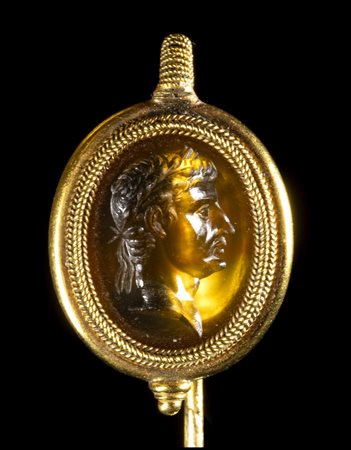
Lotto 424 A NEOCLASSICAL AGATE INTAGLIO SET IN A GOLD STICK PIN. JULIO-CLAUDIAN PORTRAIT.
19th century
Stone 10x12 mm; H Max. 64 mm; 3,18
This fine engraved portrait of a laureated Julio Claudian emperor can be identified as Augustus. The stone is set in an elegant gold stick pin with intertwined elements in the revival archeological style.
Provenance: U.S. private collection, acquired on the art market. This lot is sold under temporary import status. -
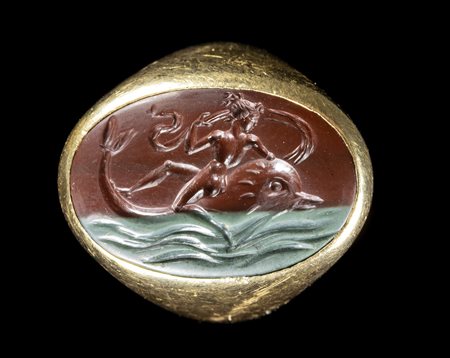
Lotto 425 A RARE BICOLOR JASPER SET IN A GOLD RING. VENUS ON A DOLPHIN.
18th-19th century
Stone 14x21 mm; int. Size 17x18,5 mm; 16,57 gr.
Venus rides a dolphin swimming to right. The figure leans in an almost acrobatic pose, leaning with her right elbow on the rounded head of the animal, with her right foot instead on the tail. With her left hand, the figure holds a drapery that flies with the wind, while her left foot is immersed in the blue water of the sea, rendered in an extraordinary way by the artist who masterfully uses the two colors of the stone. Slight wear marks.
Provenance: U.K. private collection -
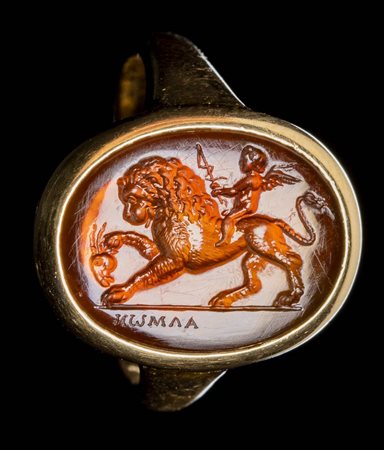
Lotto 426 A FINE NEOCLASSICAL SIGNED CARNELIAN INTAGLIO SET IN A GOLD RING. EROS RIDING A LION.
18th-19th century
Stone 12x16 mm; int. diam 17 mm; 6,45 gr.
Allegory of "AMOR OMNIA VINCIT", with Eros riding and taming a lion with a whip; the animal touches a goat skull with a paw. Ground line. Below, the pseudo ancient Greek signature "ΑΛΜΟΝ" (Neoclassical). Very fine execution. Scratches and signs of wear.
Provenance: U.K collection acquired on the art market -
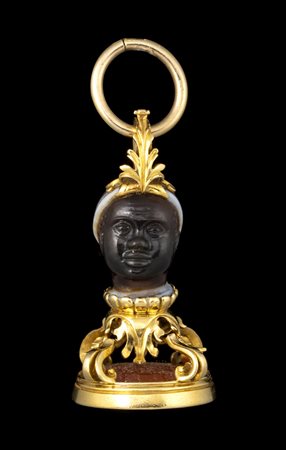
Lotto 427 A FINE NEOCLASSICAL CARNELIAN INTAGLIO SET IN A GOLD SEAL WITH A BANDED AGATE MOORE HEAD. ROMAN MALE PORTRAIT.
18th century
H max. 37 mm; stone 15x16 mm; 13,18 gr.
A fine portrait of an elderly Roman with close-cropped hair and a wart on his chin. The head is characterized by a pointed nose, narrow lips and pronounced chin, wide neck with goitre, small ear, close-fitting hair. This fine intaglio is apparently the exact copy of an ancient roman chalcedony intaglio, from George James Howard coll., 9th Earl of Carlisle. The stone is set in a splendid gold fob seal composed by a leaves ornamental patterns attached to the bezel, ending with a finely carved banded agate moore head with an additonal chiseled plants pattern motifs with a suspension ring. Very good condition.
Marie-Louise Vollenweider, Die Portratgemmen der romischen Republik, Tafel 65 (description p. 42). The original stone is a chalcedony from British Museum coll. No. 1890,0601.59
Provenance: U.K. collection, acquired on the british art market. -
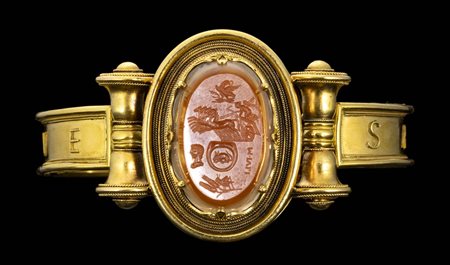
Lotto 428 A FINE GRAND TOUR GOLD BANGLE WITH A NEOCLASSICAL AGATE INTAGLIO. ALLEGORICAL SCENE.
19th century
Stone 18x26 mm; int. Size 48x58 mm; 41,95 gr.
PIERRET Ernesto (Born in Paris, 1824). A Gold bangle bracelet set with a large agate intaglio. Circa 1860
Of archaeological revival design, the oval intaglio, possibly a merchant’s seal, within a rope twist surround, two scrolls to either side, the bangle inscribed ‘SALVE’, translating s the Latin for ‘Hail’.
The intaglio shows a Victory riding a quadriga to the left, on top an eagle holding a laurel wreath in its backs and thunderbolts in its paws. Beneath, portrait of a youth facing left, mouse inside a ring and grasshopper on ear of corns. Inscription retrograde ‘M.IVLI’.
Ernesto Pierret was one of these jewelers. Born in Paris in 1824, Pierret moved to Rome in the 1840s, where he trained as a goldsmith. Historians speculate that he may have been apprenticed under Castellani, as Pierret's style was very similar to – and often compared to – the more popular Castellani. In 1846, Pierret opened his workshop. It was then that he began to build a reputation. The opening of his studio took place directly after his marriage to Virginia Crespi, the daughter of a wealthy lawyer. These family connections allowed him to move his studio to Rome's illustrious jewelry and artist district, where Pierret began to prosper.
Provenance: U.K. private collection acquired on the art market. -
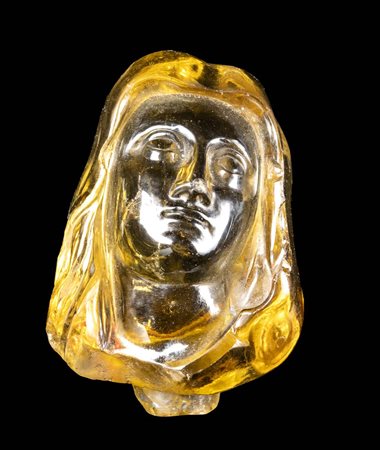
Lotto 429 A LARGE CITRINE SCULPTED HEAD. THE VEILED VIRGIN MARY.
19th century
H max 37 mm
Splendid sculpted work in the round depicting the veiled Virgin Mary, with her face tilted to the right and facing upwards, in mystical contemplation. Devotional subject. Attractive bright and intense yellow color of the stone with golden tones. The head ends in a small cylindrical termination probably to fix it in a support. Mirror polishing. Traces of a red inscription under the cut of the neck, perhaps from an old collection. Small defects and light internal cracks. Wear marks.
Provenance: U.K. private collection acquired on the art market. -
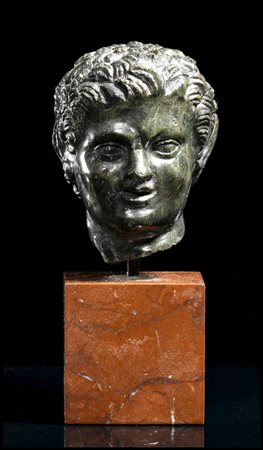
Lotto 430 A MOTTLED GREEN JASPER OR SERPENTINE SCULPTED HEAD OF A FAUN.
19th century A.D. or later
H 55 mm
The head slighlty turned, is characterized by young features; almond shaped eyes, straight nose, full lips and rounded chin. The front is surmounted by short thick hair with hair fork on the right. The ears are pointed. Probably a Grand Tour production, after the Antique. Broken on the base of the neck.
Provenance: U.S. private collection, acquired on the art market. This lot is sold under temporary import status. -
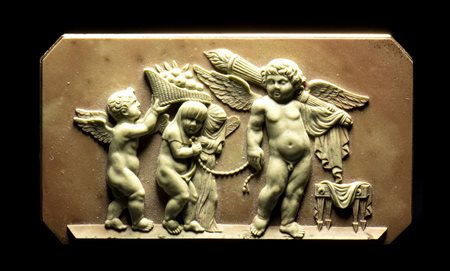
Lotto 431 A CISELED GOLD BOX SET WITH A LARGE TWO-LAYERED AGATE CAMEO ON THE LID. THE WEDDING OF CUPID & PSYCHE.
19th century
45x79xH 26 mm; 97,20 gr
Yamsk jasper cameo snuff box depicting the famous scene of the Wedding of Cupid and Psyche mounted in a gold snuff box attributed to the Yekaterinburg Lapidary (circa 1820-1830). Likely an imperial presentation snuff box or diplomatic gift from the imperial cabinet. The snuff box lid corresponds to a yamsk Jasper in the Hermitage Museum (inv. no. K-5720) which entered in the collection circa 1826 during the reign of Czar Nicholas I while the Imperial Lapidary was under the management of Yakov Vasilievich Kokovin. The cameo scene is after an ancient onyx cameo by the gem engraver Tryphon formerly in the collection of P.P. Rubens (Boston, Museum of Fine arts). Presence of the mark ET on the metal frame of the box, probably for ETRANGERE, so imported trough the custom in France. Very good condition. Minor missing on the stone and wear marks.
Provenance: Russian Imperial Cabinet, presumably as a diplomatic gift or presentation snuff box. Christie's, Geneva, November 19, 1980, Lot 302;Christie's, London, Opulence: Silver, Gold Boxes, 19th Century Furniture & Works of Art,
November 29, 2016, Lot 78. U.S. private collection, acquired on the art market.This lot is sold under temporary import status. -
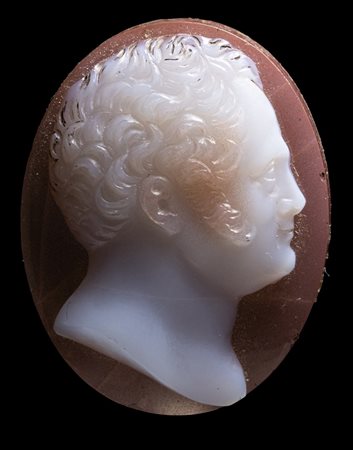
Lotto 432 A NEOCLASSICAL TWO-LAYERED AGATE CAMEO. PORTRAIT OF TSAR ALEXANDER I OF RUSSIA.
19th century A.D.
27x35x7 mm
Emperor Alexander I of Russia (1777-1825) was one of the key figures in the downfall of Napoleon. Having forced the French into a humiliating retreat from Moscow, on 31 March 1814 Alexander marched into Paris forcing Napoleon to abdicate. In this cameo the portrait is facing right and it is engraved with great art. A possible attribution might be found in the Roman gem engraver Giuseppe Girometti (1780 - 1851). Originally set in a silver box marked for Elkington & Co.
For comparison see: Hermitage Museum (imv. No K-1100), a capita jugata portrait of Alexander and his wife Empress Elizabeth Alexeievna. See also Kunsthistorisches Museum, Wien, Kunstkammer inv. No. Antikensammlung, XII 472 by Giuseppe Pichler; Hermitage Museum inv. K-1096; P.B. Stefanelli, La Collezione Paoletti n. 346.
Provenance: U.S. private collection, acquired on the art market. This lot is sold under temporary import status.