
ASTA 267 - GLITTICA
-
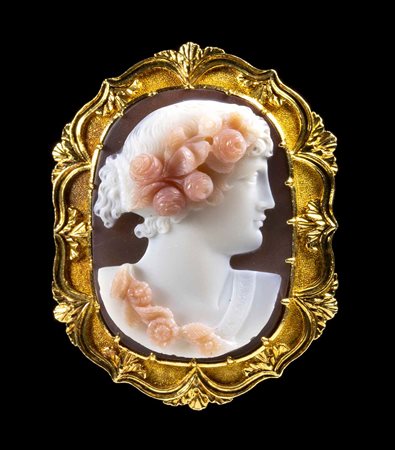
Lotto 397 A LARGE THREE-LAYERED AGATE CAMEO SIGNED BY VINCENZO CATENACCI (1786-1855), MOUNTED IN A GOLD BROOCH. BUST OF FLORA.
19th century A.D.
Stone 24x32,5 mm; Brooch 33x43 mm; 13 gr (pin missing)
Cameo of Flora by the Italian medalist and gem engraver Vincenzo Catenacci (1786-1855). Signed Catenacci on the shoulder strap. Catenacci produced a variety of medals including Joachim Murat, Flavius Gioia, Francis I and several others. A cameo by Catenacci is mounted in a Tiara presented by Napoleon to Empress Josephine presently among the royal Jewels of Sweden. Catenacci also has a cameo of Ares in the British Museum, inv. 1978,1002.292
Provenance: U.S. private collection, acquired on the art market. This lot is sold under temporary import status. -
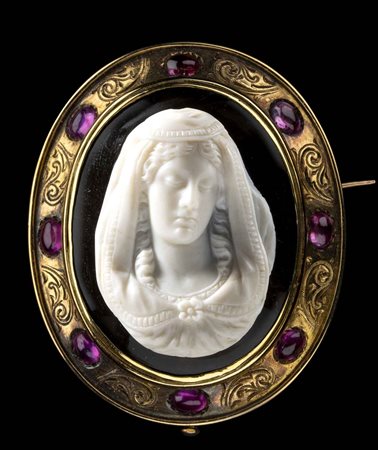
Lotto 398 A NEOCLASSICAL GOLD CISELED BROOCH WITH RUBELITES AND SET WITH A LARGE ONYX CAMEO. BUST OF THE VIRGIN MARY.
19th century
Stone 33x43 mm; Brooch 46x56 mm; 53.95 gr
The bust is facing front, the head slighlty turned is characterized by soft features; close almond shaped eyes, straight nose small full lips and rounded chin. The long wavy hair are separated in the middle of the front and partially covered by a delicate embroided veil attached in the center of the bust by a floral brooch. The composition and the iconography are referrable to a depiction of the Virgin Mary. Probably French or Italian work. The cameo is set in a large beautiful ciseled gold brooch with 8 treated rubelite cabochons.
Provenance: U.S. private collection, acquired on the art market. This lot is sold under temporary import status. -
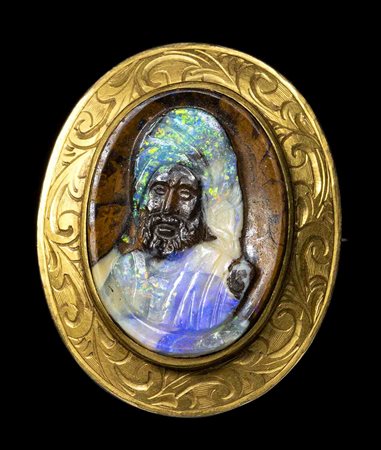
Lotto 399 A RARE OPAL CAMEO SET IN A GOLD CISELED BROOCH. BUST OF A BERBER MOOR.
Late 19th- Early 20th century
Stone 16x21 mm; Brooch 22x28 mm; 5,30 gr
Carved into an opal matrix. This beautiful work of art is probably attributable to the German cameo engraver, Wilhelm Schmidt (1845-1938). The artist use with great skills the different natural colours of the stone to shows the contrast of the skin and clothes.
Provenance: U.S. private collection, acquired on the art market. This lot is sold under temporary import status. -
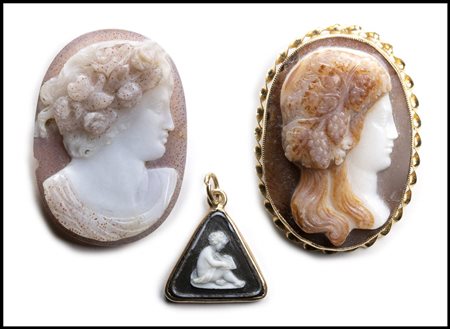
Lotto 400 A SET OF 3 NEOCLASSICAL AGATE CAMEOS.
19th century
24x34x8 mm; 16x18x3,5 mm; 25x36x13 mm
Lot composed of: an agate cameo with the bust of Flora facing right (small chip on the edge); an agate cameo set in a gold brooch, with a Maenad portrait facing right; a small triangular onyx cameo set in a gold pendant, a seated child writing.
Provenance: U.S. private collection, acquired on the art market. This lot is sold under temporary import status. -
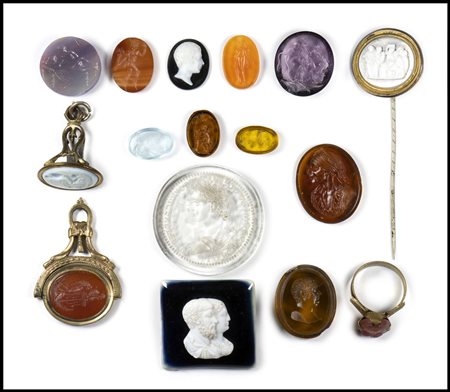
Lotto 401 A LOT OF 16 MISCELLANEA.
19th-21th century
Min. 10x15 mm ; Max. Diam 39 mm
From left to right: a purple glass impression with erotic scene; an agate intaglio with flying Hermes; a two-layered glass cameo with head of a youth; a orange intaglio with a female figure and inscription; a purple glass impression with a sacrifice scene (chipped on the edge); a gilded metal seal with a glass impression; a hardstone (probably beryl) with winged sphinx; an orange glass impression with Eros playing the lyra; a yellow impression with Nereid on a seahorse; a carnelian intaglio set in a gilded metal swivel seal, with the Hope; a transparent glass impression with a portrait of Domitian after a modern medal; a orange glass impression with a French Revolutionary character (Marat); a gilded metal stickpin with a glass cameo; a blue and white glass cameo with a Capita Jugata portrait; an orange glass impression with a male portrait; a gilded metal ring set with a glass cameo.
Provenance: U.S. private collection, acquired on the art market. This lot is sold under temporary import status. -
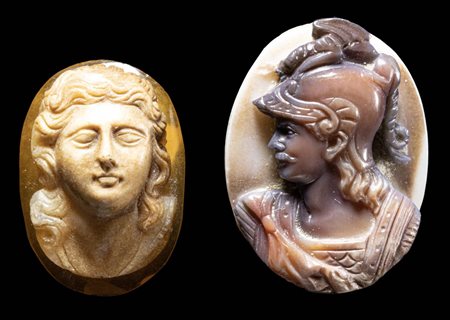
Lotto 402 A LOT OF TWO AGATE CAMEOS. FRONTAL MALE BUST AND HELMETED WARRIOR.
17th-18th century
12,5x18x9,5 mm; 15x20x6 mm
Male frontal bust of an Hellenistic subject, probably of Alexander the Great. Small lack on the nose and wear marks; Neo-Renaissance style warrior bust with head turned to the left. Dragon above the helmet.
Provenance: U.K. private collection acquired on the art market. -
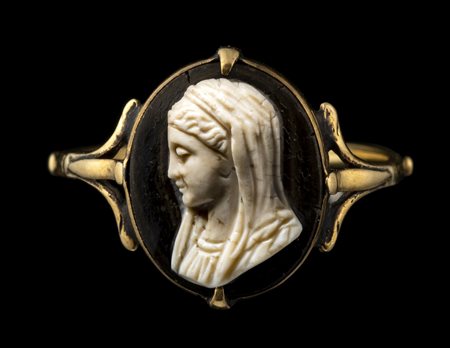
Lotto 403 A VICTORIAN DEVOTIONAL GOLD RING SET WITH AN AGATE CAMEO. VEILED BUST OF THE VIRGIN MARY.
19th century
Cameo 11 x 12 mm; 2 grs ; int diam 17 mm
With thin rounded hoop expanding onto the shoulders in a lily-flower shape and set with a double layered cameo; The figure is facing left and characterized by her soft young features. The hair partially covered by a draped veil. Wear marks.
Provenance: From the collection of an european gentleman, acquired on the art market -
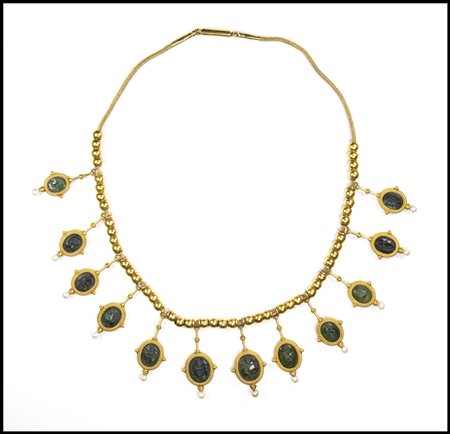
Lotto 404 A RARE GOLD ARCHEOLOGICAL REVIVAL NECKLACE BY GIACINTO MELILLO WITH TWELVE ROMAN GREEN CHALCEDONY INTAGLIOS AND PEARLS. VARIOUS SUBJECTS.
Stones: 2nd-3rd century A.D. Mounting: Second half of 19th century
400 mm circa; stone min. 6x9 mm max. 9x12 mm; 50,54 gr.
This precious necklace is composed of a serie of gold elements assembled on a large braided gold chain; 12 oval box-setting made of granules, braided and twisted gold wires decorated at the base with a small pearl. In each box-setting a roman green chalcedony intaglio. Each element is alternated by 4 gold spherical beads. From left to right the intaglios show: goat and tree; male bust facing left; young faunus playing the double flute in front of a column; Gryllos composed by a female bust conjoined with two silenos masks; a warrior; seated satyr near a tree; a running erote with a panther; a draped offerer; Venus Victrix; winged Nike; Fortuna Tyche; Venus with sea attributes. This model is a perfect example of the Revival Jewellery of the 19th century, assembling both ancient roman and modern elements. This model can be related to the Castellani Archaeological Revival necklace in the Museo Nazionale Etrusco di Villa Giulia in Rome (inv. 85013). The story of Giacinto Melillo (1846-1915) is intertwined with Alessandro Castellani's, when he put him under the direction of his first workshop in Naples in 1863. At this time, Melillo was only 18-19 years old and considered much more than an apprentice, more even than a normal employee: Augusto Castellani declared in 1878 that much of his brother’s jewellery was actually Melillo’s work .
A eulogy of the work of Giacinto Melillo was published in 1896 by a celebrated collector, count Michel Tyskiewicz. “Naples does not shine in the perfection of its pseudo-antique jewellery. The treatment is coarse, heavy, pretentious and often absurd. Yet Naples possesses a goldsmith of the first order in Mr Melillo, who has far surpassed the work of the Casa Castellani in Rome. Whilst Carlo Giuliano had already taken-over the London shop, Melillo then took-over the ownership of the Naples workshop in 1870, and he immediately started trading under his own name. Melillo in the 1870's was still producing unsigned Castellani-type jewels, that were sold through Alessandro Castellani.
An Archeological Revival necklace, Museo Etrusco di Villa Giulia, collection Castellani donated by Alfredo Castellani in 1919, inv. 8513. See also: Geoffrey Munn, "Giacinto Melillo: a pupil of Castellani", The Connoisseur, vol. 196 (1977), pp. 20-22; Geoffrey Munn, Les bijoutiers Castellani et Giuliano. Retour à l’antique au XIXe siècle, Fribourg 1983
Provenance: European collection, acquired on the market, early 2000's. -
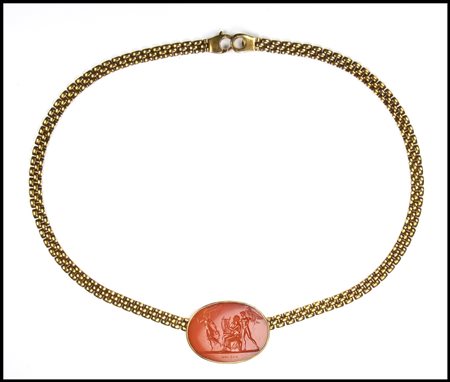
Lotto 405 A PONIATOWSKI CARNELIAN INTAGLIO SET IN A MODERN GOLD NECKLACE. MYTHOLOGICAL SCENE WITH HOMER.
19th century
400 mm circa; stone 24x33 mm; 31,88 gr.
A large Neoclassical carnelian intaglio engraved for the Prince Stanislas Poniatowski (1754-1833). Above the greek pseudo signature (pretending to be a work of the ancient engraver Allion), it depicts "HOMER PLAYING THE LYRE ATTENDED BY FAME AND A GENIUS". This beautiful gem is set in a modern gold brick-link necklace.
Published: Catalogue des pierres gravées antiques de S.A. le Prince Stanislas Poniatowski , Florence 1830-1833, no. VIII.6.3 ; James Prendeville, Explanatory catalogue of the proof-impressions of the antique gems possessed by the late Prince Poniatowski and now in the possession of John Tyrrell, Esq , London 1841, no. 1207; Hadrien Rambach, « The Gem Collection of Prince Poniatowski », in American Numismatic Society magazine , vol. 13- 2 (2014), pp. 34-49, fig. 16
Provenance: From the collection of Prince Poniatowski; offered at auction at Christie's (London), 29 April - 21 May 1839, lot 2460; purchased by John Tyrrell; part of a group of gems pawned to Frederick John, 5th Baron Monson (1809-1841), inherited by his estate; offered at Christie's(London), 27 June 1854, lot 77. -
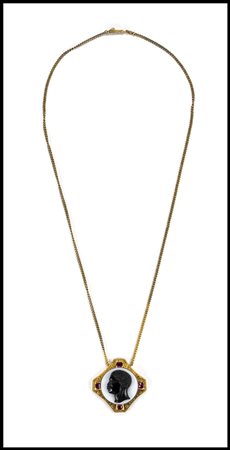
Lotto 406 A LATE 19TH CENTURY GOLD NECKLACE WITH A TWO-LAYERED AGATE CAMEO. HEAD OF BLACKMOORE.
19th century
Stone diam. 21 mm; H Max. 480 mm circa; 12,30 gr.
Composed of a gold chain with a central losange-shaped gold pendant with filigree and 4 rubies and set with a large two-layered agate cameo showing the head of a Blackmoore facing left.
Provenance: U.S. private collection, acquired on the art market. This lot is sold under temporary import status. -
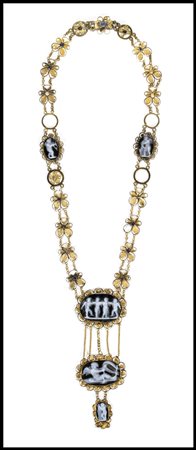
Lotto 407 A GOLD NECKLACE SET WITH 5 ONYX CAMEO. EROTES.
Late 19th century
H max. 560 mm circa; Stone min. 9x14 mm; Max. 20x28 mm; 20,95 gr.
The necklace consisting of flower elements each joined by two small gold chains and gold settings with 2 cameos respectivelly figuring a putto with a bow and a putto playing with a dog. The central pendant is a large cameo in a gold frame showing 4 dancing putti (cracks). Below, attached to the central pendant by 4 gold chains an other onyx cameo showing a putto on a raft sailing (crack); at the end suspended by two gold chains the latter cameo showing a putto against a column. Missing elements on the necklace and numerous restoration with (probably) tin solders.
Provenance: U.S. private collection, acquired on the art market. This lot is sold under temporary import status. -

Lotto 408 A VICTORIAN GOLD BRACELET WITH SEVEN ROMAN HARDSTONES INTAGLIOS AND CORAL ROSES. VARIOUS SUBJECTS.
Stones: 2nd-3rd century A.D.; Mounting: 19th century
185 mm; stone min. 8x11 max. 10x16 mm;27,31 gr.
From left to right: red jasper intaglio with a laureated male bust; a burnt agate intaglio with winged Nike; red jasper intaglio with Mount Argaios, two stars and laurel wreath; three layers agate intaglio with standing Hercules holding the club; carnelian intaglio with Hermes; red jasper intaglio with a Gryllos; carnelian intaglio with Offerer. Wear marks. Each intaglio is set in a gold box-setting linked by a double chain ornamented by two coral roses cameos.
Provenance: U.K. collection, acquired on the british art market.