
ASTA 267 - GLITTICA
-
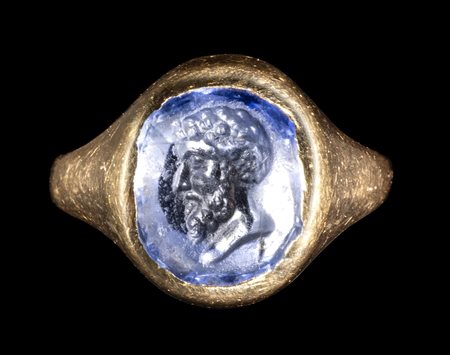
Lotto 337 A RARE RENAISSANCE SAPPHIRE INTAGLIO SET IN A GOLD RING. PORTRAIT OF LUCIUS VERUS.
16th century
Stone 8x10 mm; Int. Size 13x14,5 mm; 3,65
A beautiful portrait of the emperor Lucius Verus, reigning together with his adopted brother Marcus Aurelius, from 161 until his death. The portrait is facing left; the effigy is characterized by his typical abundant curly hair, long beard, elongated profile.The backside is pointed and facetted. Beautiful color of the stone. Wear marks.
Provenance: U.S. private collection, acquired on the art market. This lot is sold under temporary import status. -
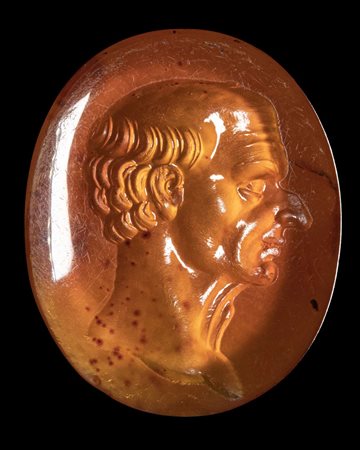
Lotto 338 A POSTCLASSICAL CARNELIAN INTAGLIO. MALE PORTRAIT.
17th-18th century
18x23x4,5 mm
Interesting private portrait of a male character, characterized by a partially bald skull and a very pronounced nose. The effigy recalls in some details the Roman portraits of the late Republican age of the Cicero or Julius Caesar type. Wear marks.
Provenance: U.K. private collection -
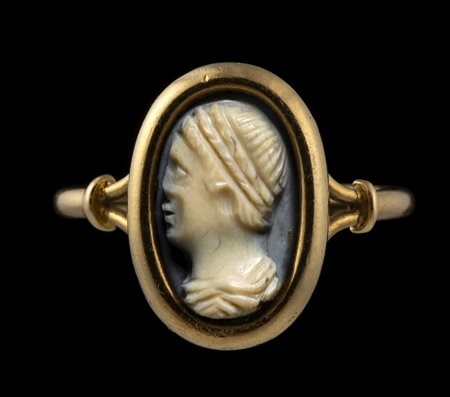
Lotto 339 AN EARLY RENAISSANCE AGATE CAMEO SET IN A GOLD RING. BUST OF AN EMPEROR.
15th - 16th century
Cameo 8 x 12 x 4 mm ; 4 grs; int diam 17 mm
With rounded hoop ending onto the shoulders in two sections joined by a "knot" and surmounting an oval thick bezel with an agate cameo; the male portrait is laureated and facing left with short hair. The physiognomy reminds the byzantine portraiture. Nose partially missing.
Provenance: From the collection of an European gentleman, acquired on the art market -
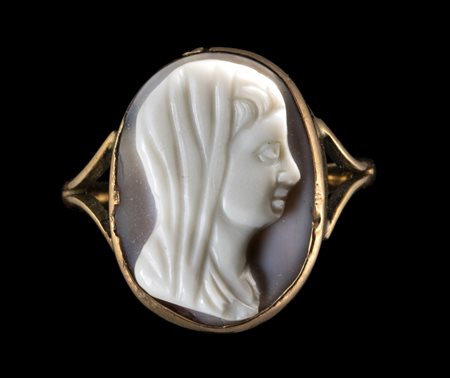
Lotto 340 AN AGATE CAMEO SET IN A GOLD RING. VEILED BUST OF A YOUTH.
17th - 18th century
Stone 14x18 mm; Int. Size 14x18 mm; 3,19 gr
The young character is facing right. Missing on the bust.
Provenance: U.S. private collection, acquired on the art market. This lot is sold under temporary import status. -
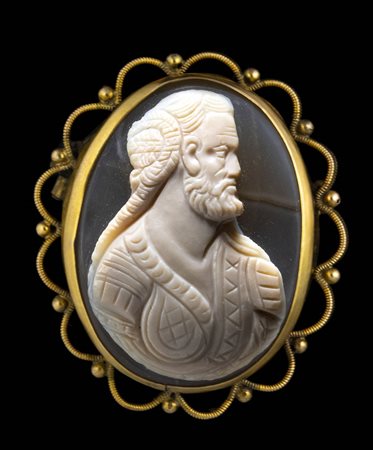
Lotto 341 A LATE RENAISSANCE AGATE CAMEO SET IN A GOLD BROOCH. AN EXOTIC MALE PORTRAIT.
16th - 17th century
Stone 26x29 mm; Brooch 29x34 mm; 9,74 gr.
Possibly the portrait of a man "a la turque", bearded, with two long hair braids that descend from the intricate braid behind the neck. The dress closes in a V shape on the partially uncovered chest and is embroidered. Interesting subject that requires further study. The cameo is mounted in a brooch characterized by spherical elements.
Provenance: European collection, acquired on the market, early 2000's. -
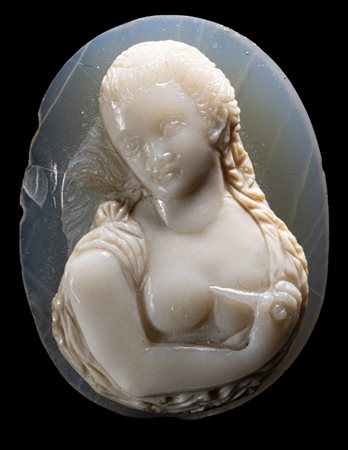
Lotto 342 A RENAISSANCE AGATE CAMEO. THE SUICIDE OF LUCRETIA.
16th century
25x32x10 mm
Bust slightly three-quarters to right; the three-quarter face turned to the left creating an elegant torsion. The heroine shows her breasts uncovered while her shoulders covered by a drapery, and she presses a dagger against her chest. This subject becomes particularly appreciated during the Renaissance becoming the emblem of conjugal virtuosity and sacrifice. Small internal cracks on the bottom, chips on the edge and wear marks.
Provenance: U.K. private collection acquired on the art market. -
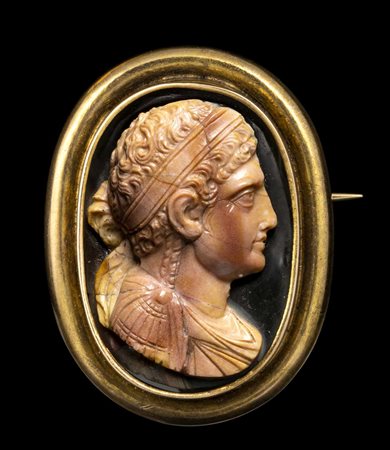
Lotto 343 AN AGATE CAMEO SET IN A GOLD BROOCH. PORTRAIT OF A GREEK HELLENISTIC RULER.
17th-18th century
Stone 21x30 mm; Brooch 28x37 mm; 11.61 gr.
Interesting revisitation of the bust of a Hellenistic sovereign facing right, with thick hair held by a wide ribbon and two small braids that descend on the neck. The bust is draped and armor under the cloak. Behind the neck, a large bow or drapery (?). Small surface cracks. Wear marks.
Provenance: U.K. private collection acquired on the art market. -
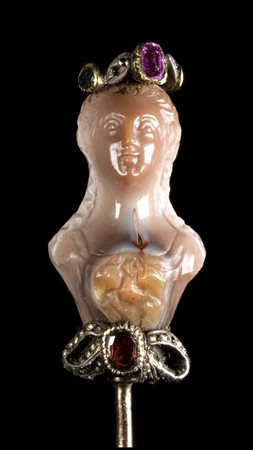
Lotto 344 AN AGATE BUST OF A WOMAN MOUNTED IN A GEORGIAN GOLD STICK PIN WITH STONES.
Bust: 17th century; mounting 18th century
Stone H 22 mm; H Max. 100 mm; 5,70 gr
A small female bust carved in a pinkish agate with orange and bluish tones, ornated by a crown and a ribbon with semiprecious stones.
Provenance: U.S. private collection, acquired on the art market. This lot is sold under temporary import status. -
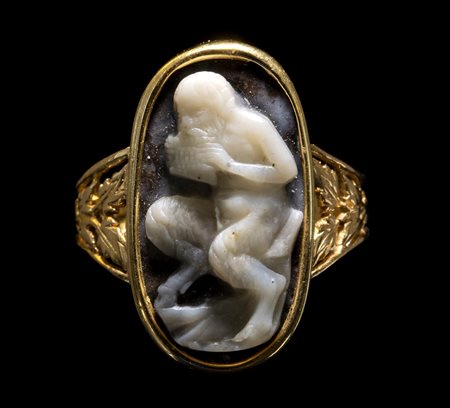
Lotto 345 A FINE RENAISSANCE AGATE CAMEO SET IN A GOLD RING. PAN PLAYING THE PIPE.
16th century
Stone 11x20 mm; int. Size 17x18 mm; 4,10 gr
The character is facing left, seated on a rock, depicted playing the panpipe. The figure is turned three-quarters in a forward leaning pose. Beautiful execution, inspired by the ancient style. The cameo is mounted in a beautiful gold ring with openwork leaf decorations.
Cfr. Tassie n. 5168.
Provenance: U.K private collection -
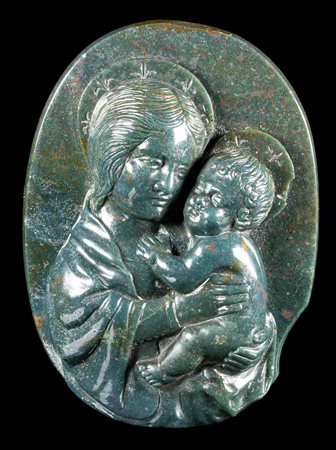
Lotto 346 A LARGE LATE RENAISSANCE BLOODSTONE CAMEO. MADONNA WITH THE CHILD.
Probably 16th century
55x75x24 mm
Her shoulders and back covered by a cloak, the nimbus with lilies on the head, the long hair finely chiseled with very thin and wavy lines. With both hands she holds the holy child, also with a nimbus with lilies. The woman looks to the right with her face tilted downwards in three-quarters, while the child with his face tilted upwards in three-quarters with a tender gaze. The work is carved in high relief with great skill. Probably Italian. Beautiful execution. Missing on the edge.
Provenance: From the Chenel collection, Paris; U.K. private collection. -
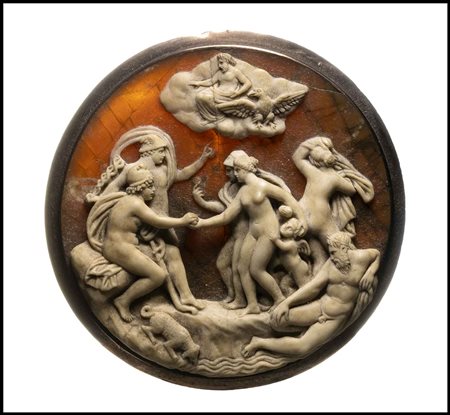
Lotto 347 A FINE RENAISSANCE AGATE CAMEO SET IN A FRAME. THE JUDGMENT OF PARIS.
16th century
Total diam 69 mm
Zeus prepared a banquet for the celebration of the marriage of Peleus and Thetis, future parents of Achilles. Eris, the goddess of discord, was not invited and, angered by this outrage, went to the banquet place and threw a golden apple with the inscription "to the fairest".
The three goddesses who claimed it, unleashing furious quarrels, were Hera, Athena and Aphrodite. They spoke to Zeus to convince him to choose the most beautiful among them, but the father of the gods, not knowing who to deliver her to, established that deciding who was the most beautiful could only be the most beautiful of mortals, Paris, an unwitting prince of Troy, who was favored by the god Ares. Hermes was commissioned to bring the three goddesses to the young Trojan, who still lived among the shepherds and grazed the sheep, and each of them promised him a reward in exchange for the apple: Athena would make him wise and unbeatable in war, allowing him to overcome every warrior; Hera promised wealth and immense power, so much so that entire peoples would have submitted to her gesture, and so much glory that her name would have echoed up to the stars; Aphrodite would have granted him the love of the most beautiful woman in the world.
Paris favored the latter, unleashing the wrath of the other two. The goddess of love then helped Paris to kidnap Helen, wife of Menelaus, king of Sparta, and the fact was the trigger of the Trojan War. In this fine and large agate cameo, on the left: Paris is seated on a rock, next to him is Hermes with his typical attributes. The young man gives the apple to Aphrodite flanked by Eros; next to her Athena and Hera. Below, a river deity and a dog drinking in the river. Above, Zeus with his eagle above the clouds, symbolizing Olympus. The cameo has superficial fissures and small internal cracks. The stone is solid and firmly inside the metal frame. With box from an old collection.
Provenance: U.K. private collection acquired on the art market. -
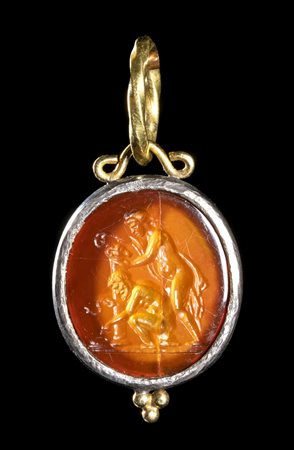
Lotto 348 A POSTCLASSICAL CARNELIAN INTAGLIO SET IN A SILVER AND GOLD PENDANT. VOTIVE SCENE.
17th- 18th century
Stone 13x16x2; 3 gr
A male character, turned to the left, is seated down on the ground on a small base, holding a snake in his right hand and pointing at a bowl with the left one; ; behind, a naked female figure, with a fluttering drapery held by her right arm, is lifting a patera with her right hand while holding a goat head in the left one, close to a plynth. Groundline. An allegorical scene, inspired by ancient models, which recurs in glyptic production from 17th century up to 18th-19th. The gem is broken into two parts, kept together by the metallic mounting.
For comparisons: Valerio Belli vicentino. 1468c. - 1546, Howard Burns, Marco Collareta, Davide Gasparotto, p.248 ("Sacrificio bacchico". Etching from P.J. Mariette), p. 522 n. cat. n. 157.I).
Provenance: U.K private collection