
ASTA 267 - GLITTICA
-
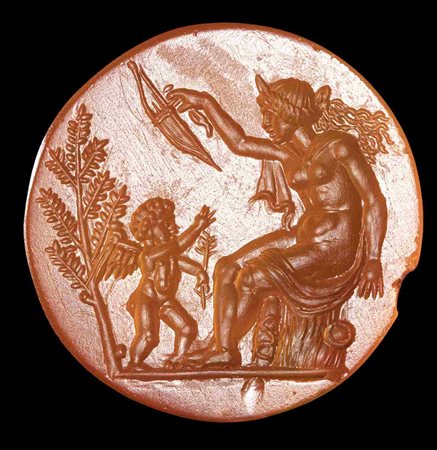
Lotto 325 A POSTCLASSICAL CARNELIAN INTAGLIO. VENUS PLAYING WITH EROS.
17th century
Diam 20x4 mm
Beautiful mythological scene composed of Venus playing with Cupid's weapons. The goddess of Love is seated in the right side, facing left, in the act of lifting the bow above the little Eros who tries to grasp it. The young boy is winged and holds an arrow in his left hand. Next to him, a small tree. The female figure is naked but with a cloak that partially covers her, and shows her feet crossed in a very elegant pose. Missing and chips on the edge. Wear marks.
Provenance: U.K private collection -
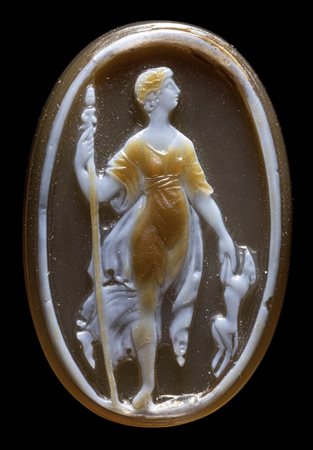
Lotto 326 A RARE RENAISSANCE AGATE CAMEO. DANCING MAENAD WITH A PREY.
16th century
21x32x5 mm
The figure is advancing to the right, with a bacchic dance step raising the left foot backwards, holding the thyrsus with the right hand, and a prey with the left. The face is turned to the right with the gaze slightly raised upwards. Her elongated body is covered by a robe with flaps floating in the air, as the ancient graeco-roman models. Around the figure, a frame in relief carved in the white layer of the agate. Interesting work, executed with great art. Minor missing and wear marks.
Provenance: U.K private collection -
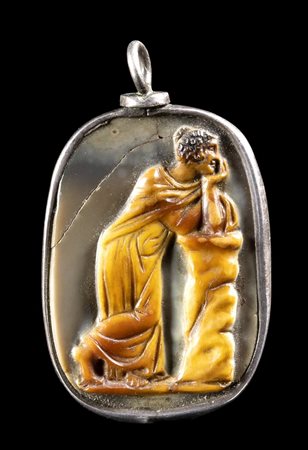
Lotto 327 A POSTCLASSICAL AGATE CAMEO SET IN A SILVER PENDANT. A MUSE.
16th - 17th century
18,5x26x3 mm; 2,65 gr
The figure is tunicated and also wearing a cloak, and is leaning against a pillar of rocks. Her legs are crossed, and she rests her chin on the palm of her left hand in her typical pose. The Muse is identifiable with Polymnia. Interesting choice of stone, diagonally cracked upward. The stone is fixed in a silver frame as a pendant.
Provenance: European collection, acquired on the market, early 2000's. -
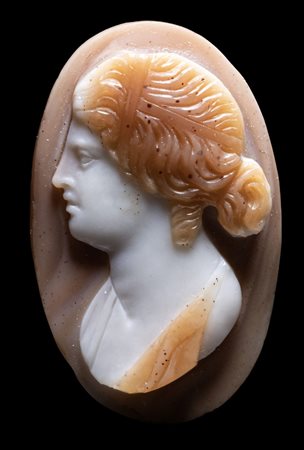
Lotto 328 A LATE RENAISSANCE AGATE CAMEO. FEMALE BUST.
16th - 17th century
13x20x4 mm
Female tunicated bust facing left, characterized by hair held by two ribbons according to the classic models. Fine condition.
Provenance: U.K private collection -
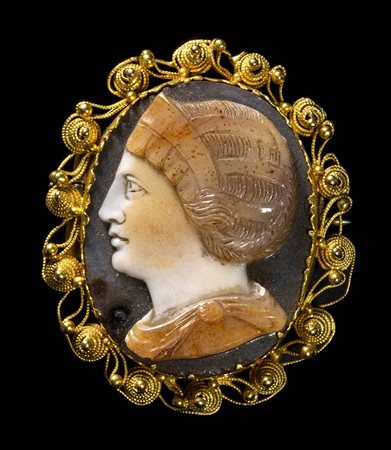
Lotto 329 A THREE LAYERED AGATE CAMEO SET IN A GOLD BROOCH. BUST OF A ROMAN EMPRESS.
Stone: 17th- 18th century; brooch: 19th
Stone 21x26 mm; Brooch 28x32 mm; 7,67 gr
The effigy faces left, is diademed and is characterized by a hair typical of the Roman imperial portraits of the end of the second century A.D. The bust is tunicated. The engraver skilfully used the three different layers of the agate. The cameo is mounted in a later delicate gold brooch.
Provenance: U.K private collection -
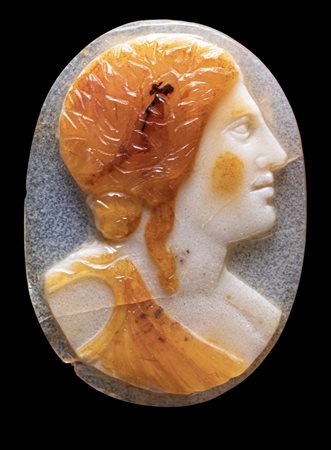
Lotto 330 A POSTCLASSICAL AGATE CAMEO. FEMALE BUST.
17th-18th century
17,5x24x3 mm
Interesting bust of Bacchante, facing right, with face slightly upwards. The hair and tunic are engraved in the orange layer of the agate, the face, neck and bust in the white layer (except for the cheek specially characterized by a trace of the orange layer); the bottom layer is transparent with white dots. The head is crowned with a crown of ivy. The stone is very thin, and is slightly cracked. Small missing on the edge.
Provenance: European collection, acquired on the market, early 2000's. -
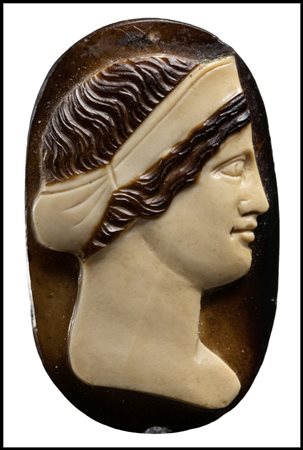
Lotto 331 A POSTCLASSICAL AGATE CAMEO. DIADEMED BUST OF JUNO.
17th-18th century
15x24x4 mm
The effigy is facing right and is characterized by a diademed head with hair gathered in a small sakkos on the nape of the neck. The anatomical details of the profile and of the hair are engraved with deep strong lines according to the ancient style. Interesting work done on a four layered agate with nice caramel tones.
Provenance: U.K private collection -
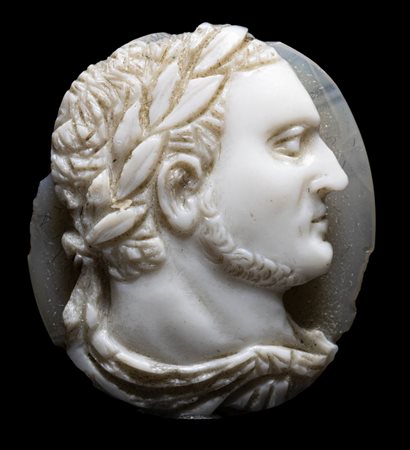
Lotto 332 A RENAISSANCE AGATE CAMEO. PORTRAIT OF AN EMPEROR.
16th century
16x19x5 mm
The effigy is laureated, with the bust draped and facing right. Missing and chips on the edge.
Provenance: U.K private collection -
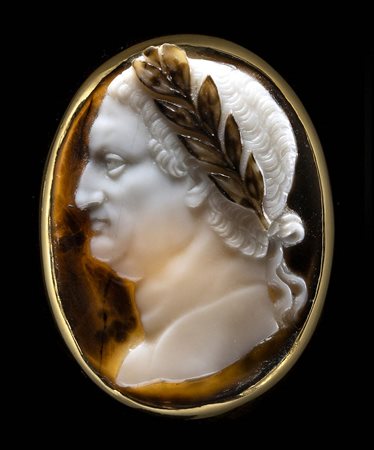
Lotto 333 A LARGE SARDONYX CAMEO SET IN A GOLD RING. PORTRAIT OF VESPASIAN.
17th-18th century
Stone 22x39 mm; Int. Size 20x22 mm; 15.88 gr
Beautiful laureated portrait of the Roman emperor Vespasian, facing left. The portrait is engraved on the white layer, while the laurel wreath on the speckled dark brown layer. Also the bottom is of a nice dark brown with some "maculae". The stone is slightly cracked. The style and the technique reminds the Renaissance production, but this cameo can be dated to a slightly later artistic phase.
Provenance: U.S. private collection, acquired on the art market. This lot is sold under temporary import status. -
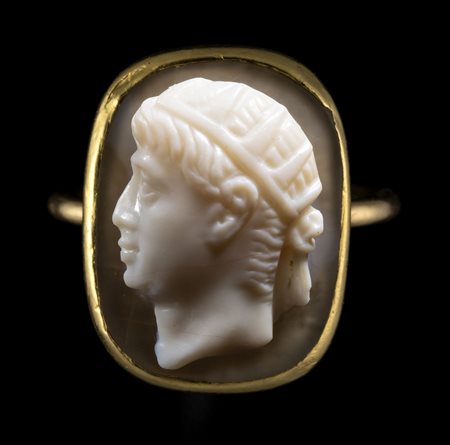
Lotto 334 A LATE RENAISSANCE AGATE CAMEO SET IN A GOLD RING. HEAD OF A RADIATED EMPEROR.
17th century
Stone 13x18 mm; Int. size 14x16 mm; 4,70 gr
Interesting expressive portrait of a Roman emperor characterized by youthful traits and a radiate crown, to the left. Slight natural cracks in the stone only on the surface. Slight wear marks. Later gold mounting.
Provenance: U.K collection acquired on the art market -
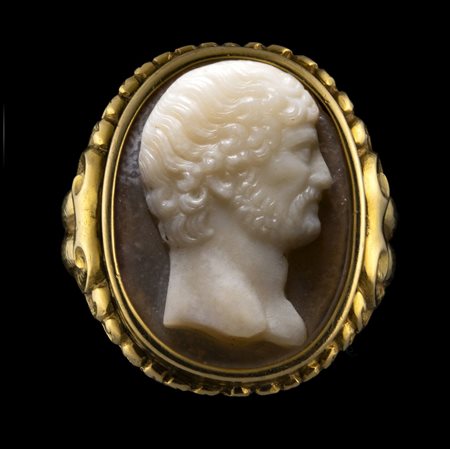
Lotto 335 A POSTCLASSICAL AGATE CAMEO SET IN A GOLD RING. PORTRAIT OF THE EMPEROR HADRIAN.
17th-18th century
Stone 18x24 mm; int. Size 21x22 mm; 17 gr.
Idealized portrait without laurel wreath of the Roman emperor Hadrian, facing right. The effigy is characterized by thick hair and a muscular neck. The cameo is mounted in a gold ring decorated with plant patterns.
Provenance: European collection, acquired on the market, early 2000's. -
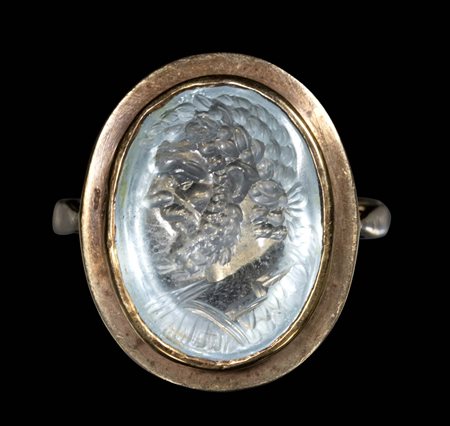
Lotto 336 A FINE RENAISSANCE BERYL INTAGLIO SET IN A GOLD RING. PORTRAIT OF A ROMAN EMPEROR.
16th - 17th century
Stone 12x16 mm; int. Diam. 18 mm; 5 gr
The emperor has the laureated head in profile to the left with the bust slightly three-quarters seen from behind. The physiognomic features and the hair are typical of the portraits between the Antonine and of the Severian dynasty. The effigy is probably the stylized portrait of Lucius Verus or, for some details, likely Pertinax. The hair is thick, held by a large laurel crown, the beard equally thick, the mouth slightly open, the nose pronounced. The shoulders and the back are covered with an armor. The portrait is deeply engraved. Beryl of beautiful bluish color, characterized by a remarkable brightness. Wear marks. The gem is set in a low gold Victorian ring with hallmarks (to be identified).
Provenance: U.K. private collection acquired in the british art market.