
ASTA 267 - GLITTICA
-
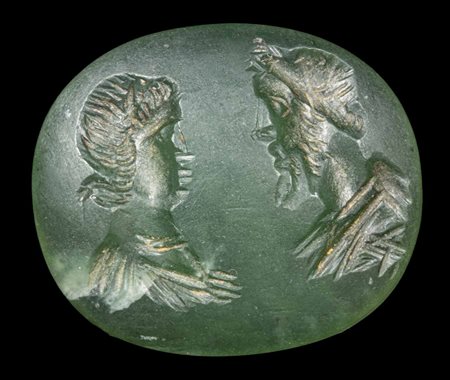
Lotto 313 A LARGE GREEN CHALCEDONY EASTERN ROMAN INTAGLIO. DOUBLE BUST PORTRAIT.
2nd - 3rd century A.D.
16x18x5 mm
Left side, a draped female bust; in the right side, a bearded and draped male bust. The two characters are facing each other. Large gem. Wear marks.
Provenance: U.K private collection -
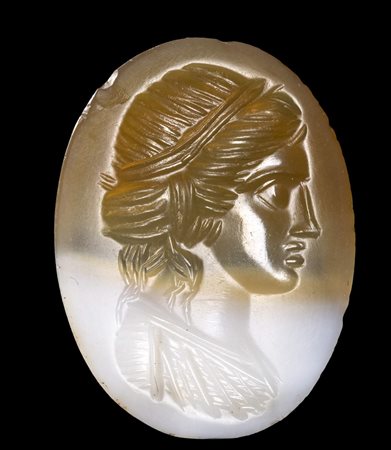
Lotto 314 A POSTCLASSICAL PROVINCIAL BANDED AGATE INTAGLIO. FEMALE BUST.
19th - 20th century
17x21,5x3 mm
Female bust tunicated and facing right. Probably Eastern. Wear marks.
Provenance: From a private collection, France, acquired on the London art market 1990s-early 2000s -
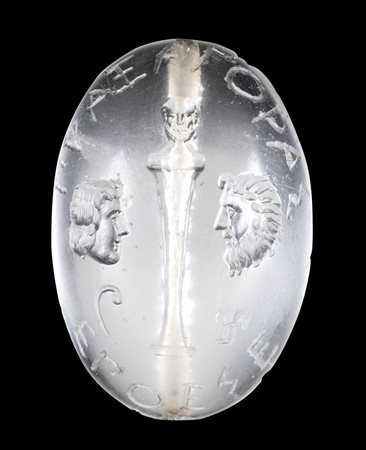
Lotto 315 A LARGE POSTCLASSICAL ROCK CRYSTAL INTAGLIO. HERM WITH TWO MASKS AND AN INSCRIPTION.
19th century or later (?)
24x35x10 mm
An unusual large intaglio, originally a pierced bead and later cut in half. The convex front part is characterized by an allegorical composition with a herm in the center, two masks on the sides with two symbols underneath, and an inscription in the upper and lower part of the scene (to be identified). Probably an ancient amulet in rock crystal enriched with engraved details in a later period. Wear marks.
Provenance: U.K private collection -
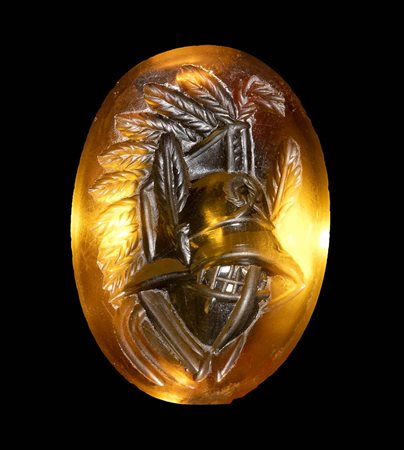
Lotto 316 A REVIVAL CITRINE INTAGLIO. HELM OF A GLADIATOR.
Probably 20th century A.D. or later.
Gladiator's helmet depicted in three-quarters view facing right. The helmet is a "Murmillo" type and is decorated with numerous feathers and a small laurel wreath engraved on the helmet, as a symbol of triumph. Wear marks. In front of the stone is slightly convex, while behind a lot of cabochons. The gem is characterized by an attractive honey amber tone color and an extraordinary brilliance. Rare subject. Postclassical stone.
Provenance: U.K. private collection acquired on the british art market. -
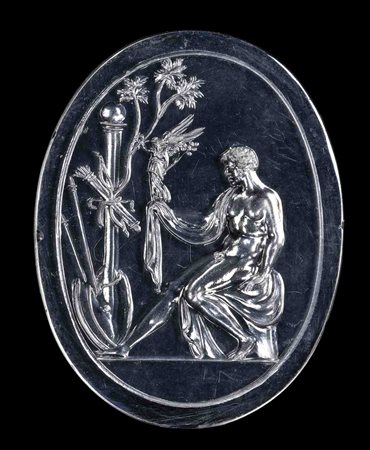
Lotto 317 A LARGE RENAISSANCE ROCK CRYSTAL INTAGLIO ATTRIBUITED TO VALERIO BELLI. ALLEGORICAL SCENE WITH SEATED HERO AND ASSOCIATED EMBLEMA.
16th century
36x47,5x3 mm
This fine rock crystal intaglio is attributed to the Renaissance gem engraver Valerio Belli (c. 1468 – 1546). The intaglio depicts a seated nude hero offering a statue of Nike to a triumphal ‘victory’ column or cippus surmounted by a sphere and a pile of arms and armor. It is referenced as Tassie-Raspe impression 7846 and has been identified as a model for early Wedgwood works described as an ‘Offering to Victory’ as well as related Matthew Boulton ormolu plaquettes. Although the intaglio is unsigned, there are many physical and stylistic similarities to various works by and attribuited to Valerio Belli, particularly works commissioned by Pope Clement VII. The victorious hero in the scene, depicted with curly hair and sideburns, resembles the Duke of Florence Alessandro de’ Medici, the suspected son of Pope Clement VII. Duke Alessandro had to rumored fathers, one was Lorenzo II de'Medici, later Pope Clement VII who was Valerio Belli's most important patron. Although his lineage cannot be confirmed, historians generally regard Alessandro's father to be Pope Clement VII due the contemporary accounts as well as a Alessandro's lifelong favoritism by Clement VII, including his appointemnt as the Duke of Florence. The Medici dynasty was in perennial conflict with Republican factions in Florence, rebelling against Medici control over the city in 1527.
As a consequence of an alliance between Charles V and Clement VII, Papal and Imperial armies laid siege to Florence for 10 months, and Alessandro de Medici was installed on the throne of Venice in 1530 and subsequently made a hereditary Duke by Charles V in 1532, ending the Florentine Republic, and cementing Medici control over the city. The Medici, who were very conscious of their depictions, made numerous efforts to portray the young Duke Alessandro as a warrior, Roman emperor and hero in paintings, sculpture as well as medals, intaglios and cameos attribuited to Domenico de'Polo. Furthermore, a rock crystal vessel, attribuited to Valerio Belli, depicts both Pope Clement VII and Alessandro, demonstrating the intimate connection between these two historical figures. The Duke Alessandro was assassinated in 1537 by his cousin. This rock crystal intaglio, characterized by an exceptional limpidity, was originally mounted in a brooch designed by Marc Koven during the mid 20th century.
The rock crystal has an engraved border around the scene and stylistic parallels to several similar Renaissance rock crystals & medals commissioned by the Medici family (particularly the Medici Vase in the Louvre and the famous Medici Chest in the Uffizi). The rock crystal has similar dimensions to valerio Belli's documented and attribuited works, corresponding closely in size to "Herakles between Minerva and Venus, inscribed Valerius VAF (4.7 cm by 3.8 cm), Mutius Scaevola inscribed CONSTANTIOR (4.7 cm by 3.7 cm). It has also a corresponding thickness (3 mm) to the oval rock crystal depicting a sacrifice scene in the British Museum and the rock crystal depictiong the Judgement of Paris in the V&A Museum, both attribuited to Valerio Belli.
This rock crystal intaglio, although undocumented in the literature, has a number of clear parallels in works attributed to Valerio Belli in major texts on the 16th century engraver. The scene is typical of Medici coinage from the period, specifically Cavino’s posthumous medal of Giuliano II de’ Medici and is believed to be a depiction of the later assassinated Duke Alessandro de’ Medici. Some features, particularly the cippus with an attached bow and quiver of arrows parallel those identified in an intaglio of Herakles being crowned by Minerva, formerly in the collection of Peter Paul Rubens and later Baron Philip von Stosch, attribuited to Valerio Belli. The composition with a figure seatd in an elegant pose, with one or both legs outstretched, is common in many Belli's compositions.
For comparisons: Tassie n. 7846. The intaglio is described in Tassie 7846 as: “*_________ __________ A young hero sitting without arms, with the statue of Victory in his left hand, before a cippus on which his arms are suspended. It may be called Achilles victorious, in his retirement. For such subjects see the article Achilles and Mars in repose.”; There are some minor differences between the rock crystal and the Tassie impression which appear to be the result of an incomplete transfer. It is very likely that Tassie did not identify the owner of the engraved gem or the material in his text because he did not take the impression of the gem, but rather received the impression from another collector or performed his impression from an unidentified impression. The absence of the intaglio border in the Tassie impression suggests the engraved gem was previously mounted in a brooch or pendant which covered the border when the original impression was performed. Two thin spears appear in the rock crystal version, it is only possible to see the traces of a thin line representing one spear in the Tassie impression. The shield also has an additional thin line in the rock crystal. Additionally, small pieces of hair which form the side-burns on the face of the figure are also not visible. Because these differences are very minor features and all other details appear consistent, it is very likely that this Tassie impression derives from the original rock crystal above Unsigned - Attributed - Valerio Belli, Seated Virtue with Fame and a Genius, oval bronze plaquette, 50 x 39mm (Lewis D. in Valerio Belli Vicentino (2000), p. 134, 100 – and also p. 331, 125; Bange 812; Warren, Ashmolean Museum Plaquettes, 243); Tassie 7853. Cornelian. King of France; Intaglio stamp depicting an offering to Victory - 1774 - Wedgwood and Bentley. Intaglios produced from this stamp listed as #300 in Wedgwood and Bentley's 1774 Catalogue. See: Donati and Casadio, Bronzi e Pietre Dure nelle Incisioni di Valerio Belli Vicentino; Vasari, Giorgio Lives of the Most Eminent Painters, Sculptors, and Architects, Volume 3. Howards Burns, MArco Collareta and Davude Gasparotto, Valerio Belli Vicentino 1468 c. - 1546; Nicholas Goodison, Matthew Boulton: Ormolu.
Provenance: Acquired by Marc Koven (1903-1970), of Koven Freres who mounted the rock crystal into a modern setting circa late 1960s ; U.S. private collection, acquired on the art market. This lot is sold under temporary import status. -
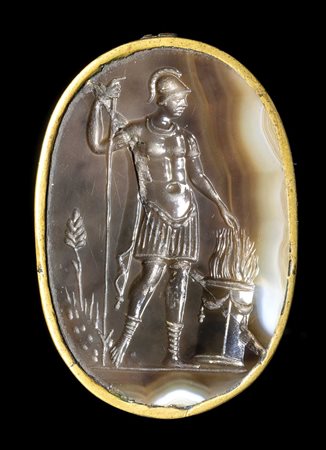
Lotto 318 A LARGE LATE RENAISSANCE AGATE INTAGLIO SET IN A METAL FRAME. MUZIUS SCAEVOLA.
16th - 17th century.
32x46x4 mm
The soldier is standing facing right, wearing armour, helmet and cloak. With his right hand he holds a spear, while he places his left hand above the fire of a burning altar in his famous gesture of courage and virtue. The scene symbolizes the power of Roman Virtus. Nice choice of zoned agate, unfortunately brocken in two parts diagonally. The stone is fixed in a metal frame. Wear marks.
Provenance: European collection, acquired on the market, early 2000's. -
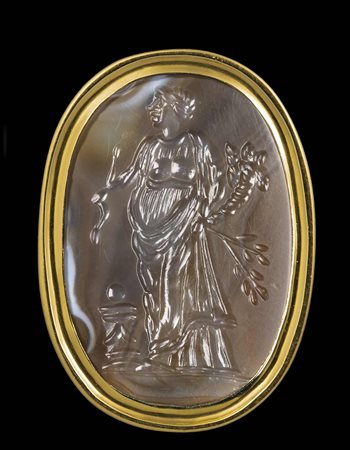
Lotto 319 A LARGE AGATE INTAGLIO SET IN A GOLD RING. ALLEGORICAL FIGURE.
Early 17th century
Stone 19x28 mm; Int. diamo 18,5 mm; 16 gr.
Female figure draped and standing with head to the left, holding a snake in her right hand, with a cornucopia and a laurel (or olive) branch in her left hand. Below, a small altar is above a globe. Allegorical figure referable to abundance and good health. North italian atelier. Beautiful choice of the stone. Slight wear marks.
Provenance: U.K. private collection -
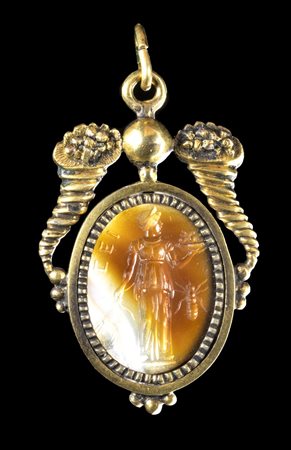
Lotto 320 A LATE RENAISSANCE BANDED AGATE INTAGLIO SET IN A GOLD PENDANT. THE ABUNDANCE WITH AN ANT.
Late 16th- Early 17th century
Stone 13x17 mm; Brooch 20x32 mm; 3,94 gr
The allegorical figure is standing with the head facing right. With her right hand she holds two ear of corns and with the left one she holds a vessel with fruits. In the field, an inscription "CEI" and an ant. This beautiful stone is set in a two tones gold pendant ornated with two cornucopiae.
Provenance: U.S. private collection, acquired on the art market. This lot is sold under temporary import status. -
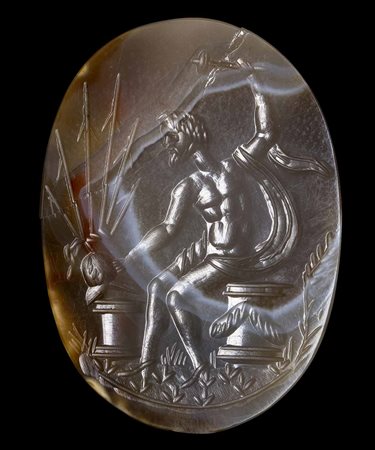
Lotto 321 A LATE RENAISSANCE AGATE INTAGLIO. HEPHAESTUS FORGING THE WEAPONS.
Early 17th century
28 x 39 x 3 mm
The god is shown seated on an altar at his work in the act of forging an helmet and spears. Groundline. Stone brocken in two parts. North italian atelier.
Provenance: From the collection of an European gentleman, acquired on the art market -
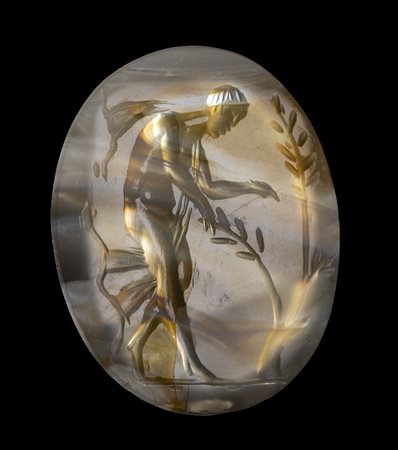
Lotto 322 A LATE RENAISSANCE AGATE INTAGLIO. ALLEGORICAL FIGURE.
Early 17th century
17 x 20 x 4 mm
The young naked man is wearing a drapery, gathering a tree in front of him. Groundline. Slight cracks. North italian atelier.
Provenance: From the collection of an European gentleman, acquired on the art market -
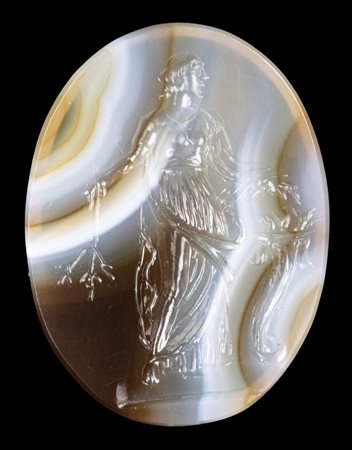
Lotto 323 A LATE RENAISSANCE AGATE INTAGLIO. THE ABUNDANCE.
16th - 17th century
15x20x2 mm
Standing, tunicated female figure facing right with head in profile. With his right hand she holds a branch (laurel or olive tree), while she raises her right hand above a large cornucopia. Allegory of Abundance. Beautiful variety of banded agate.
Provenance: U.K private collection -
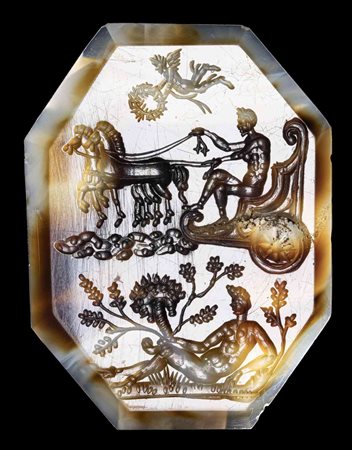
Lotto 324 A LARGE OCTAGONAL AGATE INTAGLIO. ALLEGORICAL SCENE WITH A MAN ON A CHARIOT.
End of 16th - Early 17th century
45x59x3 mm
Of rare octagonal shape and of extraordinary size, this unusual intaglio is engraved on a beautiful variety of banded agate, comparable to that used for the ancient imperial vases in Murrina. The allegorical scene can be divided into two registers: Below, a naked male figure is half-reclining among shrubs holding a cornucopia (?); above, a naked and laureated male figure stands on a chariot pulled by two horses. Above, a winged eros flies holding a laurel wreath, symbol of triumph. The style and the execution can be referred to the production of the northern Italian Cisalpine workshops. Slight wear marks.
For the style, cfr.: Le Gemme dei Medici al Museo degli Argenti - Cammei e Intagli nelle collezioni di Palazzo pitti, pp. 375 ss.
Provenance: U.K private collection