
WEB AUCTION 118 - LIBRI E AUTOGRAFI
-
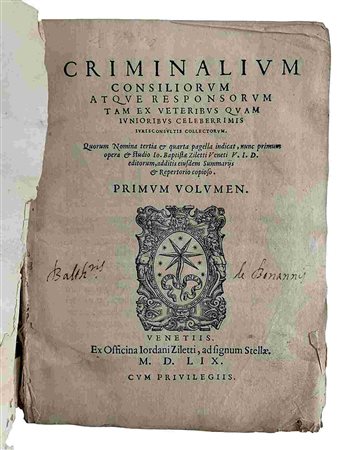
Lotto 37 JOHANNES BAPTISTA ZILETTI
Criminalium Consiliorum, Venezia, Ex Officina Iordani Ziletti, 1559
4°, contemporary limp vellum. The first two blank pages damaged. -
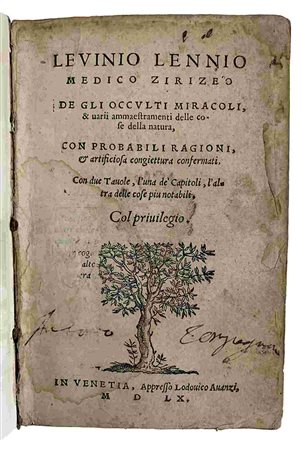
Lotto 39 LEVINIO LEMNIO
De Gli Occulti Miracoli, Venezia, Ludovico Avanzi, 1560
8°. Modern half vellum, good copy. -
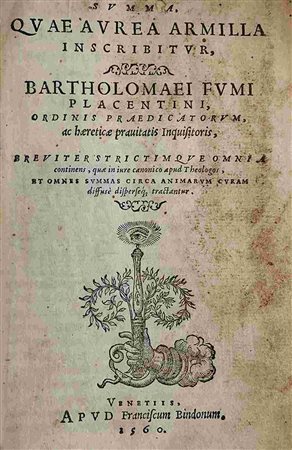
Lotto 40 LEVINIO LEMNIO
De Gli Occulti Miracoli, Venezia, Ludovico Avanzi, 1560
8°. Modern half vellum, good copy. -

Lotto 41 AA.VV.
Tractatus Diversi Super Maleficiis, Venezia, Hyeronimus Lilius, 1560
Complete
Modern binding with ancient material. Slight water stains on the lower blank margin.
Slight water stains. Moderate foxing due to paper quality.
Good copy -
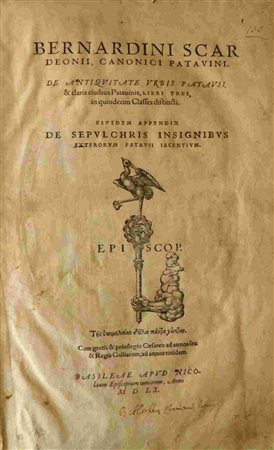
Lotto 42 bernardino Scardeone (1482-1574)
Bernardini Scardeonii, Canonici Patavinii. De antiquitate urbis Patavii, & claris civibus Patavinis, libri tres, in quindecim classes distincti. ..Basileae apud Nicolaum Episcopium iuniorem, 1560
§ Small folio; [8] leaves, 437, [1] pp., [11] leaves. Sign: ..11-8 (last blank), a-z1-6, A-O1-6, P1-8. Large woodcut printer’s device on title page, repeated on last leaf, full-page woodcut on title page verso, depicting Padua, woodcut initials and several reproductions of ancient inscriptions. Contemporary hard vellum. Marginal annotations in an ancient hand, old ownership annotation on title page, few pages faintly browned, unobtrusive wormhole on external margin. Good copy.
First edition. Scardeone, ecclesiastic and historiographer, wrote several works or religious subjects, but he is best remembered for the present book, where he describes the antiquities of Padua as well as the lives of illustrious men from the same city.
“Scardeone described the origins and cultural heritage of Padua, paying considerable attention to its ancient monuments and transcribing many inscriptions from tombs. He also devoted a chapter to the artists of Padua, from the 14th century to his own day, including Andrea Mantegna, Francesco Squarcione, Andrea Riccio and Tiziano Minio. This was the first attempt, outside Florence, to compose a local compendium of artistic biographies. (Grove Art online). “Opera orgogliosamente municipale, il De antiquitate ha la struttura di un dizionario biografico dei padovani illustri, dall’età romana al 1559, cui sono premessi alcuni libri che trattano della storia antica e della geografia del territorio, di monumenti epigrafici insigni (alcuni dei quali raccolti da Scardeone), dell’organizzazione religiosa dello spazio urbano (parrocchie, monasteri e conventi, ospedali, luoghi pii)..” (DBI). Ref: Battilotti,D. Scardeone, Bernardino, in Grove Art online ; Piovan, F. Scardeone, Bernardino, in: DBI, ad vocem. -
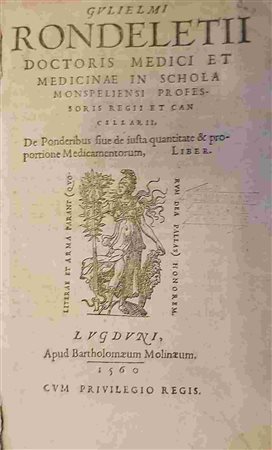
Lotto 43 GUILLAUME RONDELET (1507-1566)
Gulielmi Rondeletii ... De Ponderibus sive de justa quantitate & proportione medicamentorum, Liber. Lugduni (Lyon) Apud Bartholomaeum Molinaeum, 1560
§ 8° (163 x 102 ), ( 24, 168, 58 pp.), contemporary limp vellum (remounted ) with remnants of clasps, flyleaves renewed, author’s portrait into oval frame. woodcut head and tail-pieces, printed typhographical notes on margins, scattered minimal brownig, fine copy.
The utmost are first edition. Rondelet, physician and naturalist, is best known for his work on aquatic life (Libri de piscibus marinis and Universae aquatilium historiae), which described about 250 species, far more than any earlier work in that field and, despite its theoretical limitation, laid the foundations for later ichthyological research, remaining the standard reference work for over a century. Rondelet was regius professor at the university of Montpellier and personal physician to François Cardinal Tournon; in 1556, he was elected chancellor and at his initiative the university set up its first anatomy theater: “in 1556, Henri II, urged by Rondelet, had an anatomical amphitheater built in the faculty of Montpellier, where Rondelet was elected chancellor in November of the same year.” (Hoefer, 599, translated). Rondelet has also written several medical books; in the present work he deals with the problem of establishing de iusta quantitate & proportione (the right quantity and proportion) of the different types of drugs to be used and which factors must be taken into consideration. He first describes the difficulties of the task, the reasons that can influence the effectiveness of the remedies depending on the quantity administered, the criteria to be followed to make a decision, when to increase or decrease the prescribed doses; he then describes several remedies and for each one suggests how to calculate the correct dose to obtain the desired result.
Ref: Hoefer, XLII, 599-600; -
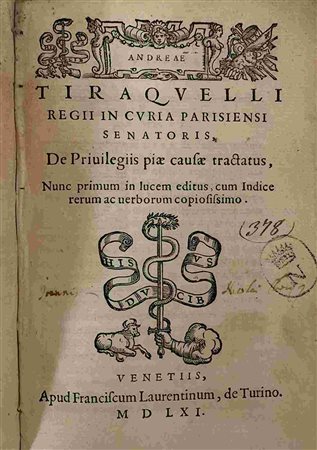
Lotto 44 ANDREAS TIRAQUELLUS
De Privilegiis piae causa tractus, Venezia 1661
De praescrptionibus, Venezia 1663
16°, two rowks in one volume, modern vellum with ancient materials, fine copy -
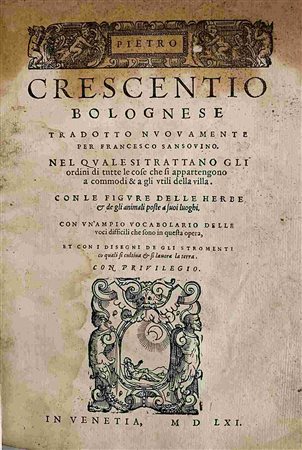
Lotto 45 PETRUS CRESCENTIUS
Pietro Crescentio Bolognese Tradotto Nuovamente, Venezia, Per Francesco Sansovino, 1561
Complete.
Fascinating copy, with illustrautive images.
Water stain at the top of first pages. The cover is contemporary limp vellum but rebound and nicely restored. -
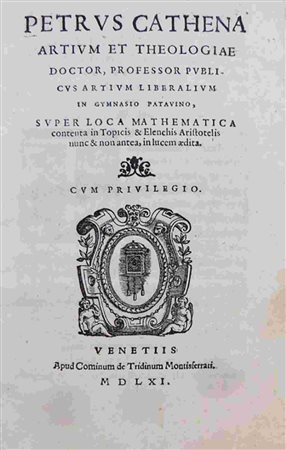
Lotto 46 PIETRO CATENA (1501-1576)
Petrus Cathena artium et theologiae doctor, professor publicus artium liberalium in gymnasio patavino, Super Loca Mathematica contenta in Topicis & Elenchis Aristotelis nunc & non antea, in lucem aedita.Venetiis, Apud Cominum de Tridinum Montisserati, 1561
§ Small 4to (200 x 140 ; 16 leaves (A-D1-4). Woodcut on title page, woodcut initials, several schematic illustrations. Later wrappers. Unimportant stains on last 3 leaves, otherwise fine.
First edition. Petrus Catena was an astronomer, philosopher, mathematician, theologian, a catholic priest and public lecturer of Metaphysics and professor of mathematics at the University of Padua, a precursor of the Renaissance scientific revolution, Catena investigated on the relationships between mathematics, logic and philosophy. “The historical importance of C. is due to the fact that he was one of the first, in the XVIth century, to address the problem of the formal and epistemological evaluation of Euclidean mathematics, naturally from the view-point of Aristotelian logic and philosophy, Ref: Giulio Cesare Giacobbe Catena, Pietro In: Dizionario Biografico degli Italiani, ad vocem.. -
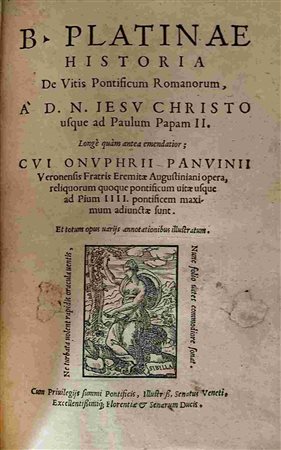
Lotto 47 PLATINA GIOVANNI BATTISTA
Historiae De Vitis Pontificum, Venezia, Michele Tramezzinio, 1562
4°
Modern hard vellum. Good copy. -
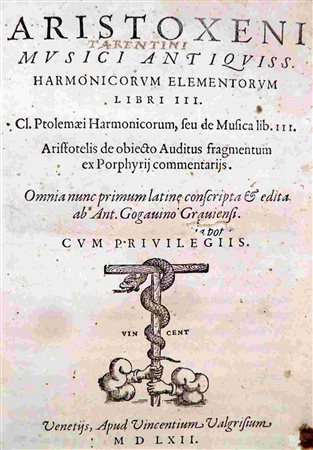
Lotto 48 ARISTOXENUS OF TARENTUM (C.375-322 BC); CLAUDIUS PTOLEMAEUS (C. 100- 160 CE)
Aristoxeni musici antiquiss. Harmonicorum Elementorum libri III. Cl. Ptolomaei Hormonicorum, seu de Musica libri III. Aristotelis de obiecto auditus fragmentum ex Porphyrij commentarijs. Omnia nunc primum latine conscripta & edita ab Ant. Gogavino Graviensi. Venetijs, apud Vincentium Valgrisium, 1562
§ 4to, 165, [3] pp.; sign.: A-X4 (leaf X4 blank). Woodcut diagrams throughout Ptolemy’s work (pp. 47-150). Tables for the ratios of enharmonic, chromatic and diatonic scales at pp. 112-114, for octave species (σχῆμα τοῦ διὰ πασῶν) and intervals at pp. 102-106, 116-123. An excerpt from a work by Porphyry of Tyre, not listed in the title page, can be found at pp. 161-165 (De decem praedicamentis liber, seu potius pars libri de Praedicabilibus). Each work except the first one has its own half-title page (pp. 47, 151, 161); printer’s device repeated on leaf X3v. Contemporary full brown calf binding. Nice and clean copy with the upper margin slightly short.
Extremely scarce and sought-after first Latin edition of the two most ancient surviving treatise on ancient Greek musical theory. Aristoxenus himself endeavoured to describe the musical system in all its coherence and complexity, setting out from the simplest of entities (musical sound) and proceeding to increasingly complex combinations of intervals and ‘systems’, envisaged simultaneously according to their ‘range’, ‘disposition’ and ‘function’. The last part of the treatise is a set of theorems setting out the laws of harmonics.
Ref Adams A 1973; Eitner IV, 298; Fétis I, 137; A. Barker (ed.), Greek Musical Writings, II. Harmonic and Acoustic Theory, pp. 119-189, 270-391; S. Gibson, Aristoxenus of Tarentum and the Birth of Musicology; A. Barker, Scientific Method in Ptolemy’s “Harmonics”. -
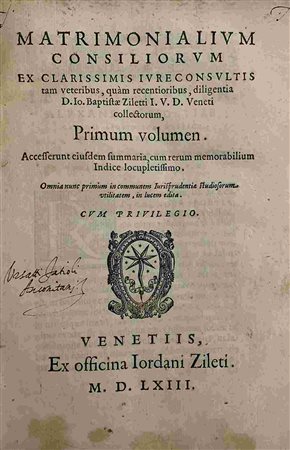
Lotto 49 JOHANNES BAPTISTA ZILETTI
Matrimonialium Consiliorum, Venezia, Ex Officina Iordani Ziletti, 1563
4°
Contemporary limp vellum, with handwritten title on the spine, partially disbound. Good copy.