
WEB AUCTION 118 - LIBRI E AUTOGRAFI
-
![LUDOVICO ARIOSTO (1474 - 1533): Orlando Furioso di M. Lodovico Ariosto. Tomo I. [IV.]. Venezia, presso Antonio Zatta, 1772-3](/Upl/Auctions/Cache/2963/5030/721771/219-1087462.jpg/s0_450.jpg)
Lotto 219 LUDOVICO ARIOSTO (1474 - 1533)
Orlando Furioso di M. Lodovico Ariosto. Tomo I. [IV.]. Venezia, presso Antonio Zatta, 1772-3
§ 4to, Four volumes. I: [16], LX, 300 pp., [21] leaves of plates, sign.: *-**4, a-g4, h2, A-OO4, PP2; II: [214] leaves, [15] leaves of plates, sign.: A-FFF4, GGG6; III: [206] leaves, [16] leaves of plates; IV: [268] leaves, [14] leaves of plates, sign.: A-XXX4. XIXth century blue paper binding, four title pages, each one with its own gorgeous engraved frontispiece and title page inscribed into ornamental frame; a beautiful, crisp copy with very limpid engravings and a fine chiaroscuro rendering
. One of the most famous and fascinating illustrated book printed in Venice in the XVIIIth century, exquisitely engraved by several of the most famous artist of the age: 58 full-page and 36 half-page engravings, 51 argomenti engraved at the beginning of each canto, 20 among heads and tailpieces, designed by Novelli and others and engraved by Giuliano Zuliani (1730 - 1814), Tommaso Baratti (fl. 1772 - 1801), Ferdinando Fambrini (fl. 1763 - 1794), Giacomo Malosso (fl. 1772 - 1773) and others. The text was edited and revised by Leonardo Marcellotto (fl. 1744 - 1773) and Antonio Cilis (fl. 1772 - 1773), with the addition of a biography of Ludovico Ariosto by Giovanni Andrea Barotti (1701 - 1772) at the beginning of the first volume.
Ref: Agnelli-Ravegnani, Annali delle edizioni ariostee, I, pp. 202-204; Brunet I, 437; De Grassi, p. 169 -
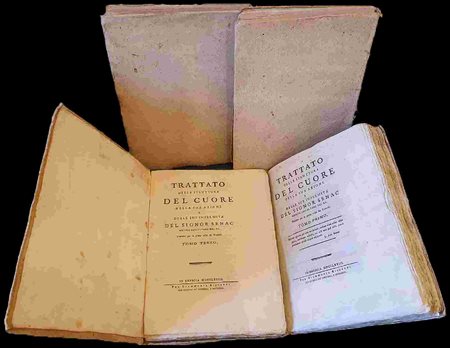
Lotto 220 JEAN BAPTISTE SENAC (1693-1770)
Trattato della struttura del cuore della sua azione e delle sue infermità del signor Senac medico consultore del re. Tradotto per la prima volta dal francese. Brescia, per Giammaria Rizzardi, 1773.
§ In 4° (ca. 280 x 210 mm), 4 volumes.: XLIII, [1], 287, [1] pp.; 368 pp.; 275, [1] pp.; 340 pp.; XVII anatomical folding plates at the end of vol. I; Magnificent, clean and crisp copy with wide, uncut margins, original rustic cardboard binding.
The only Italian edition of the remarkable first work completely devoted to the cardiac anatomy, physiology and pathology (or. ed. Traité de la structure du coeur, de son action et de ses maladies. Paris, chez Jacques Vincent rue & vis-à-vis l'Eglise de S. Severin à l'Ange, 1749).
In this treatise Senac discusses heart disorders and diseases that he analyzed personally, as well as diagnoses that were determined by other physicians. He was the first physician to describe the correlation between atrial fibrillation and mitral valve disease, as well as the first to provide a comprehensive study of cardiac hypertrophy. He also conducted research of cinchona extract and rhubarb as possible treatments for cardiac irregularities. Moreover he served as a personal physician to King Louis XV (1710 - 1774) from 1752 until his death.
Ref.: Blake, 414; Eloy, VI, 138; OCLC 14834038. -
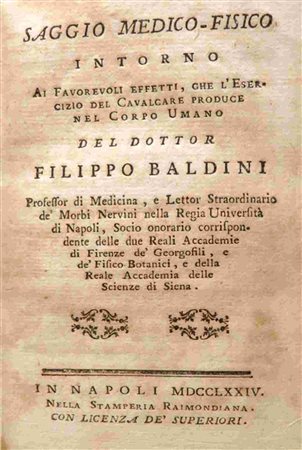
Lotto 221 Filippo Baldini (fl. 1770 - 1797)
Saggio medico-fisico intorno ai favorevoli effetti, che l’esercizio del cavalcare produce nel corpo umano del dottor Filippo Baldini, Professor di Medicina, e Lettor Straordinario de’ Morbi Nervini nella Regia Università di Napoli, Socio onorario corrispondente delle due Reali Accademie di Firenze de’ Georgofili, e de’ Fisico-Botanici, e della Reale Accademica delle Scienze di Siena. Napoli, nella Stamperia Raimondiana, 1774.
§ 8vo, 87, [1] pp.; sign.: A-E8, F4. Slightly later coloured paperboard, a fina and crisp copy.
First, extremely scarce, edition of this curious treatise dedicated to the beneficial effects of horse-riding. As part of Baldini’s works dedicated to the benefit of sports and recreational activities, together with his treatises on ship-cruising and rowing (Sugli effetti del moto della barca nel corpo umano, originally published in the second volume of Baldini’s Omnia, 1787) and hunting (Dell’esercizio della caccia atto a conservare, ed a restituire all’uomo la sanità. Napoli [s.d.], 1778), this pamphlet is one of the first scientific publications dedicated to the beneficial aspects of activities complementary to medical therapies. Ref: Blake (p. 29), OCLC 14860950. -
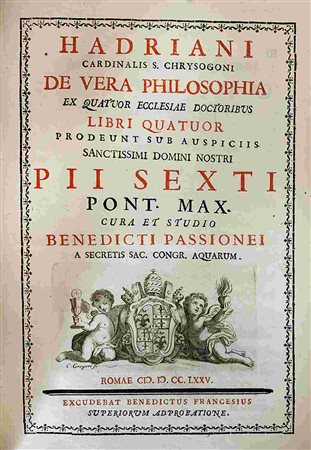
Lotto 222 ADRIANUS CHRISOGONUS
De Vera Philosophia, Roma, Benedetto Francesi, 1775
4°
Contemporary calf, with gilded ornaments. Very fine copy. -
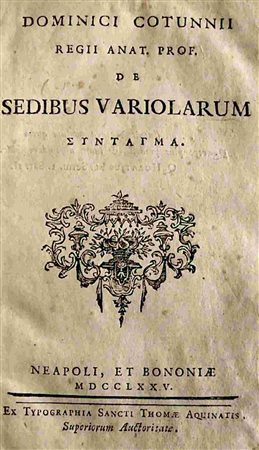
Lotto 223 DOMENICO COTUGNO (1736-1822)
Dominici Cotunnii regi anat. prof. de sedibus variolarum sintagma Napoli, et Bononiae, ex Typographia Sancti Thomae Aquinatis, 1775
§ 8vo (12,5x19x1,5 cm.); 171, [1] pp., sign: A-K1-8, L1-6. One engraved plate. Contemporary half-calf with corners, spine gilt, green morocco title-piece on spine. Fine copy.
First published in 1769, 29 years before Jenner’s discovery. Cotugno studies the localization of smallpox lesions and, on the basis of several observations, he concludes that they are only external and do not affect internal organs. the internal mucous membranes however, were also affected when exposed to the air, as he was able to observe in a patient's prolapsed intestine and haemorrhoids.
Cotugno was professor of surgery and anatomy in Naples and he is best known for his studies, especially in the field of neurology. “In the early 19th century, his reputation as a physician was such that, as the saying went, ‘‘no one in Naples could die without a passport from Cotugno’’.
Ref: De Renzi, V, 195-197, 330 and 808-809; Loris Premuda Cotugno, Domenico In: Dizionario Biografico degli Italiani; -
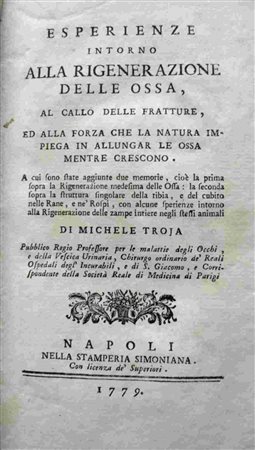
Lotto 224 MICHELE TROJA (1747-1827)
Esperienze intorno alla rigenerazione delle ossa, al callo delle fratture, ed alla forza che la natura impiega in allungar le ossa mentre crescono. ... Napoli, nella stamperia Simoniana, 1779
§ Large 8vo (200 x 175.); XIX, [1], 288 pp., signature a1-10, A-S1-8; VIII engraved folding plates, 1 folding table. Contemporary vellum, blind-tooled arabesque on both centre-boards, labelled title-piece . Some browning at the plates, but very fine copy.
First Italian edition, previously published in Latin in 1775. Michele Troja is widely renowned for his works on the formation of bone callus and on bone nutrition and regeneration. “For this work, which continued that of Henri-Louis Duhamel du Monceau, he was nominated corresponding member of the Paris Academy and was invited by Diderot to write a number of articles for the supplement of the Encyclopédie.” (Castellani). Back in Naples, he obtained the chair of ophtalmology and published a collection of his lectures on the subject; he also wrote important works in urology also inventin the flexible catheter. “Troja in 1775 wrote in Latinh his work on the bones. Then, in 1779 he reprinted it in Italian, adding two memoirs, one on the regeneration of the bones of quadrupeds; the other on the singular structure of the tibia and cubit in frogs and toads, with some experiences on the regeneration of the entire legs of the same animals. ... “Michele Troja ... a laissé à la posterité un grand nombre d’ouvrages dignes des plus grands maîtres.” (Orloff - Duval).
Ref: De Renzi Storia della medicina in Italia Napoli, 1848, V, pp. 211-214 and passim; Grégoire Orloff, Amaury Duval Mémoire historiques, politiques et littéraires sur le Royaume de Naples Paris, 1821, vol V pp. 40-41; Carlo Castellani, Troja, Michele In: encyclopedia.com -
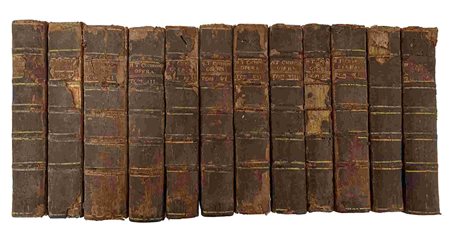
Lotto 225 MARCUS TULLIUS CICERO
Opera, Biponti, Ex Tip. Societatis, 1780
8°, contemporary half vellum
good copy
12 volumes, spines defected -
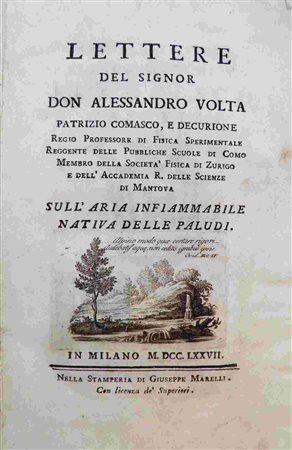
Lotto 226 Alessandro Volta (1745-1827)
Lettere del sig. Alessandro Volta patrizio comasco ... sull'aria infiammabile nativa delle paludi In Milano, nella stamperia di Giuseppe Marelli, 1777
Large 8°, (190 x 120) , 147,(1) pp, nicely engraved vignette at title page, engraved head and tail pieces, an excellent and crisp copy almost uncut, in original wrappers.
First complete edition, an edition containing only the first two letters was published few weeks earlier and it is overlooked by most bibliographers. The present work includes seven letters by Alessandro Volta to Father Carlo Giuseppe Campi (1732-1799), who was the first to draw Volta's attention to the phenomenon of the "inflammable airs": "Precisely a report from Father Campi to his friend and disciple was an opportunity to attract Volta's attention to the "arie infiammabili native". He (Campi) reported to have observed (1776) a source of "arie infiammabili native" (Magatti, p. 156). Volta's observations brought him to the discovery of the marsh gas, later called methane, previously confused with hydrogen; he collected it by stirring the mud with a stick and letting the bubbles pass into an inverted bottle filled with water. "The discovery of marsh gas... is described by Volta in some letters to Campi, dated from Como (November 1776 to January 1777)... He distinguished it from the inflammable air from metals (hydrogen) by its azure-blue flame and slower combustion, and by its requiring 10-12 vols. Of air for detonation. A much larger electric spark was necessary to ignite marsh gas than to ignite hydrogen. Volta, who invented the electric pistol, thought detonating gas could be used as a propellant..." (Partington). Volta discovery of methane led to its application to the eudiometer, meant to determine the quality of the air, and provided the groundwork to the discovery of the composition of water. A milestone in the history of science.
& Bruno Magatti Le arie infiammabili e la scoperta del metano pp. 151-158 In: A. Volta, Lettere ... sull'aria infiammabile, Reprint, Como, Attilio Sampietro di Menaggio, 2008, pp. 149-211; Partington, History of Chemistry, III, p. 814; Duveen, p. 606; Poggendorff II, 1231; DSB XV, pp. 74-76; Honeyman, 3072; Neville p. 593; Cole 1321; Guareschi La chimica in Italia dal 1750 al 1800 In: Suppl. ann. Enc. Chim., 1912, pp. 395- 403; Mariano Galliano P. Campi Carlo Giuseppe: chierico regolare somasco amico e collaboratore di Alessandro Volta Genova: Editrice Studio e Vita, no date (about 1960) -
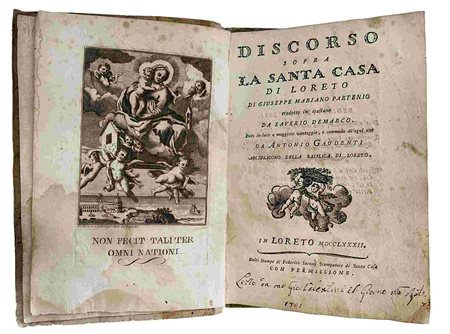
Lotto 227 GIUSEPPE MARIANO PARTENIO
Discorso Sopra La Santa Casa, Loreto, Federico Sartori, 1782
4°, contemporay paperboard
good copy -
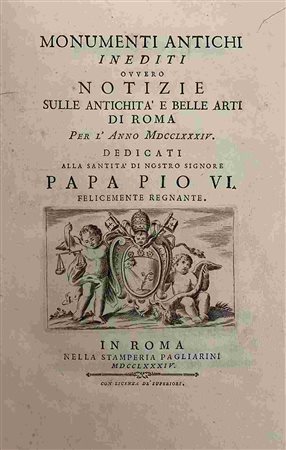
Lotto 228 GIUSEPPE ANTONIO GUATTANI
Monumenti Antichi Inediti, Roma, Stamperia Pagliarini, 1784
4°
Original half calf. With 31 engraved plates and one engraved folding plate. Very good copy.
-
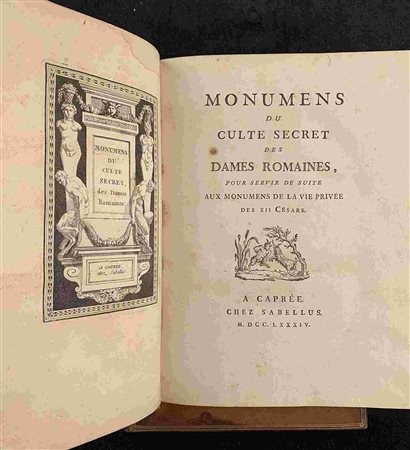
Lotto 229 HANCARVILLE HUGUES PIERRE FRANCOIS
Monumens de la vie privée des douze Cesars - Monumens du culte secret des dames romaines.
A Caprées, chez Sabellus (ma Nancy, Leclerc) 1780-1784
In-4 large 26.6x20.4 cm
2 volumes in full morocco citron binding of the time.
Illustrated with 2 antiporta and 100 plates outside the text. -
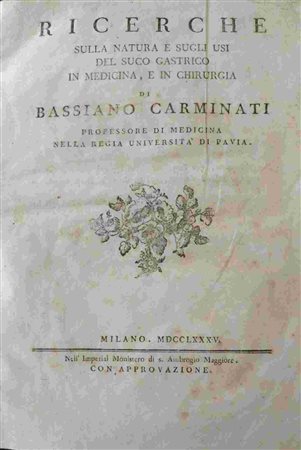
Lotto 230 BASSIANO CARMINATI (1750-1830)
Ricerche sulla natura e sugli usi del suco gastrico in medicina, e in chirurgia di Bassiano Carminati professore di medicina nella regia università di Pavia Milano, nell’imperial monistero di s. Ambrogio Maggiore, 1785
§ 4to (205 x260); [IV] leaves, 130 pp., sign: [no signature]1-4, A-P1-4, Q1-6. Contemporary vellum, with later addition of marbled paper on spine and part of both cover, gilt title piece on spine. Fine copy.
First edition, translated in German in the same year. The Italian physician Bassiano Carminati studied in Pavia and for some years he practiced medicine in Lodi, his birthplace; here he also published his first work in 1777 and the success obtained earned him the position of professor of general therapy, medical matters and pharmacology at the University of Pavia. He taught until 1810 and was then appointed Member of the Institute of Sciences, Letters and Arts of Italy.” (Hoefer; De Renzi). Carminati studied the differences of the gastric juice in fed and fasted animals and suggested their use in the treatment of some kind of cancer, ulcers and wounds.
Ref: De Renzi, V, 357 and passim; Hoefer VIII p. 770; James Southworth Steen A Selected Chronological Bibliography of Biology and Medicine Part 1B 1637-1809 ;Willich, A. F. M. The Domestic Encyclopædia (Vol. 1, 1802) p. 430