
WEB AUCTION 118 - LIBRI E AUTOGRAFI
-
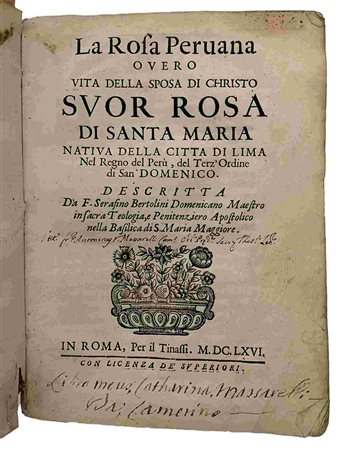
Lotto 146 SERAFINO BERTOLINI
La Rosa Peruana, Roma, Per Il Tinassi, 1666
4°
Contemporary limp vellum, with handwritten title on the spine, partially disbound. Slight waters stains all over the book, otherwise good copy. -
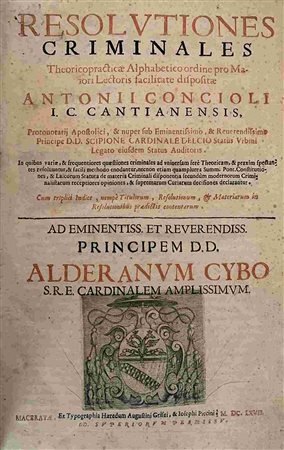
Lotto 147 ANTONIUS CONCIìOLUS
Resolutiones Criminales, Macerata, Eredi Grifei-Piccini, 1667
Contemporary velum, an ancient restoration of the 4-rib spine, very fine copy, some slight foxing. PP. 47/52 old restorations and tears but the text not missing. -
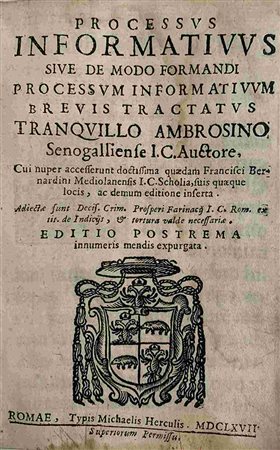
Lotto 148 TRANQUILLUS AMBROSINUS
Processus Informativus, Roma, Typis Michaelis Herculis, 1667
Complete.
Contemporary limp vellum, with manuscripted title on the spine and handwritten on the cover.
Good copy -
![JOANNES KINNAMOS (C. 1143 - C. 1185): Joannis Cinnami imperatorii grammatici historiarum libri sex, seu De rebus gestis a Joanne et Manuele Comnensis [...]Accedunt Caroli Du Fresne, D. Du Cange [...]](/Upl/Auctions/Cache/2963/5030/721702/149-1087187.jpg/s1_450.jpg)
Lotto 149 JOANNES KINNAMOS (c. 1143 - c. 1185)
Joannis Cinnami imperatorii grammatici historiarum libri sex, seu De rebus gestis a Joanne et Manuele Comnensis [...]Accedunt Caroli Du Fresne, D. Du Cange [...] in Nicephori Bryennii caesaris Annae Comnenae caesarissae, & ejusdem Joannis Cinnami Historiam Comnenicam notae historicae & philologicae. His adiungitur Pauli Silentiarii descriptio sanctae Sophiae, quae nunc primum prodit Graece & Latinae, cum uberiori commentario. Parisiis, e Typographia Regia, curante Sebastiano Mabre-Cramoisy, eiusdem typographiae directore, 1670
§ Folio (440 x 300 x 60.); [22], 602, [32] pp., signature: ã1-6, ẽ1-4, ĩ1, A-Z1-4, Aa-Zz1-4, AAa-ZZz1-4, AAaa-IIii1-4 KKkk1-5. Large engraved coat-of-arms on title page, large engraved head- and tail-pieces, engraved initials, two engraved illustrations (a map of Constantinople and a profile of Hagia Sophia). Partially parallel Greek and Latin text. Contemporary red morocco, gilt coat-of-arms and fillets with decorative corners on both covers, gilt spine. 2 stamps and old ownership annotation (dated 1680) on title page, some browning / foxing as usual but a good / very good copy in a magnificent binding.
First complete edition of Joannes Kinnamos Byzantine chronicle, covering the years 1118-1176, during the reigns of John II (1087 - 1143) and Manuel I Komnenos (1118 - 1180), until Manuel's unsuccessful campaign against the Turks, which ended with the disastrous Battle of Myriokephalon (September 17, 1176). This chronicle had been originally created as a continuation of the Alexiad, written around 1148 by Princess Anna Komnene (1083 - 1153), daughter of the Emperor Alexios I Komnenos (1048/1056 - 1118). The volume contains also the editio princeps of the description of the Church of Saint Sophia of Costantinople (Hagia Sophia), an ekphrasis of 1029 hexameters with a 134 iambic trimeters introduction by Paulos Silentiarios (d. 580 AD), recited at the second dedication of the building, in 562 AD.
This magnificent book is part of the celebrated series of 24 volumes, printed between 1648 and 1711, forming the Corpus Byzantinae Historiae.
The present copy preserves, almost intact, the original red morocco leather binding, with richly gilt back and gilt coat of arms of Marc-Antoine Mazenod (XVIIth century) on both covers. Mazenod was lawyer at the Parliament and at the royal court of Lyon. After his death, this volume, perhaps as well as a large portion of his library, became property of the Jesuit's College of Lyon, as it is stated by a manuscript note on the titlepage.
Ref: Brunet I, 1435 (14); Hoffmann II, 429; OCLC 314617783; OHR 1520 (for the coat of arms). -
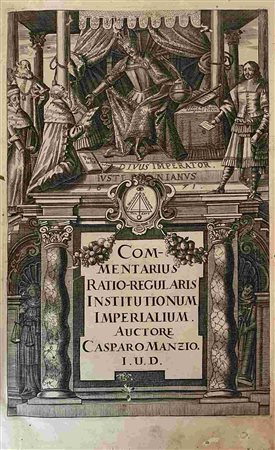
Lotto 150 CASPAR MANZ
Commentarius Ratio.Regularis, Nonimberga, Fredrick Endter, 1673
folio, 17th century half vellum
good copy
2 volumes -
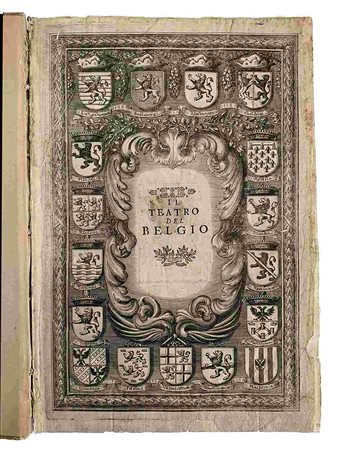
Lotto 151 GALEAZZO GUALDO PRIORATO
Teatro Del Belgio, Frankfurt, S.T., 1673
folio, modern half vellum
Tile page and three plates missing, present all 120 engraving of fortifications of all important cities and towns. -

Lotto 152 GULIELMUS DONDINI
Historia De Rebus In Galliae Gestis, Roma, Apud Nicolaum Angelum Tynassi, 1673
Contemporary half calf, complete with an engraved frontispiece and five folding plates. Very fin -
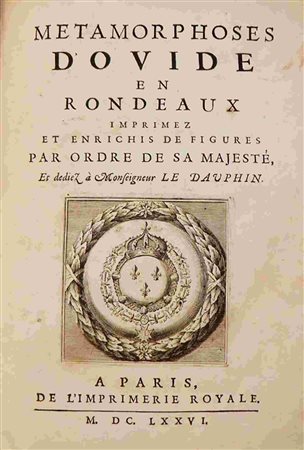
Lotto 153 OVIDIUS (43 BC - 17/18 AD), CHARLES LE BRUN (1619-1690) SEBASTIEN LE CLERC THE ELDER(1637-1714), FRANÇOIS CHAUVEAU (1613-1676), CHARLES LEBRUN (1619-1690), ISAAC DE BENSERADE (1613-1691)
Metamorphoses d’Ovide en rondeaux imprimez et enrichis de figures par ordre de sa majesté, et dediez à Monsieur le Dauphin A Paris, de l’Imprimerie Royale, 1676
§ 4to (220 x 305); [12], 463, [18] pp. Signature: [no sign.]1-6, A-Z1-4, Aa-Zz1-4, AAa-NNn1-4. Engraved frontispiece, engraved vignette on title page (coat-of-arms of Louis XIV), 2 large engraved tail-pieces, about 226 engraved illustrations. Frontispiece signed by Charles Le Brun (artist) and Sebastien Le Clerc (engraver). Some of the illustrations signed by Sebastien Le Clerc (artist and engraver) and François Chaveau (artist and engraver). Contemporary calf, gilt coat-of-arms of Louis XIV on both covers, spine gilt. Very good copy.
First edition, beautifully illustrated. Benserade was a French poet, writer and playwright; he composed several ballets, which thanks to him became a true literary genre, and collaborated with Lully. The Metamorphoses, as the same Benserade had expected, had no success and it was this failure that prompted him to retire to his house in Gentilly.
Ref. Brunet IV, 288; Graesse, V, p. 90; Schweiger, III, p. 700-701; Benserade: les Métamorphoses d'Ovide en rondeaux -
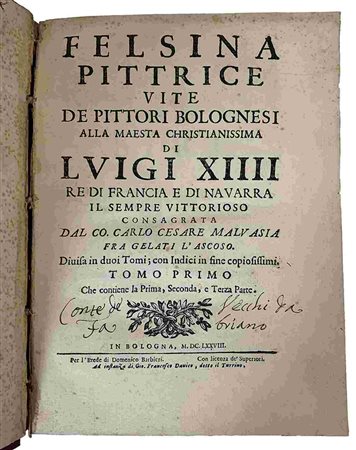
Lotto 154 CARLO CESARE MALVASIA
Felsina Pittrice, Bologna, Eredi Domenico Barbieri, 1678
4°, modern half canvas
good copy
first volume only (of 3) -
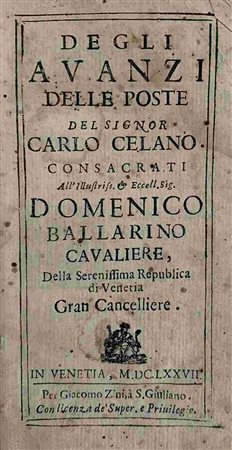
Lotto 155 CARLO CELANO
Degli Avanzi Delle Poste, Venezia, Giacomo Zinia, 1678
Complete.
Worm holes, moderate foxing. Partially disbound. Copertina di cartonato d’attesa.
Nice copy. -
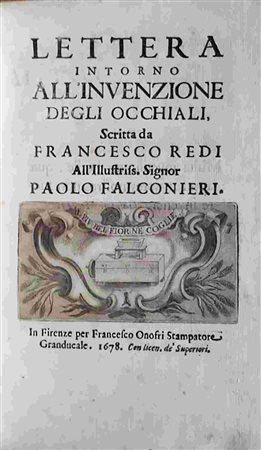
Lotto 156 FRANCESCO REDI (1626-1697)
Lettera intorno all’invenzione degli occhiali scritta da Francesco Redi all’illustriss. Signor Paolo Falconieri. In Firenze, per Francesco Onofri stampatore Granducale, 1678
§ 4to (245 x 175); 14, [2] pp (last blanks); signature: A-B1-4 (B4 blank). Large engraved printer’s device on title page, large engraved heraldic head-piece, woodcut initial. Original boards. Unimportant foxing. Fine copy.
The famous controversy on the invention of spectacles began around 1668, when the philologist Carlo Roberto Dati (1619 - 1676) dedicated to his friend and colleague Francesco Redi one of his learned dissertation called vigils (veglie), concerning the invention of spectacles. In it mention is made for the first time of what would appear to be the oldest known reference to the manufacture of spectacles - produced by the Dominican friar Alessandro della Spina (d. 1286) -, as observed in a XIV century chronicle of the convent of Saint Catherine of Alexandria in Pisa (now MS 78 of the Biblioteca Cateriniana of Pisa, leaf 13r).
The Dati’s vigil remained unpublished until 1780 but when Redi disclosed the research contained in it through the present Lettera, he gave rise to a contention that lasted for over two centuries.
Like Galileo, Redi used the Italian language with mastery, both in his scientific works and in the consultations, he produced as a practicing physician.
Ref; Brunet IV, 1175; Gamba 825 : “Prima e rara edizione”; Prandi 19; Razzolini-Bacchi della Lega, p. 288. -
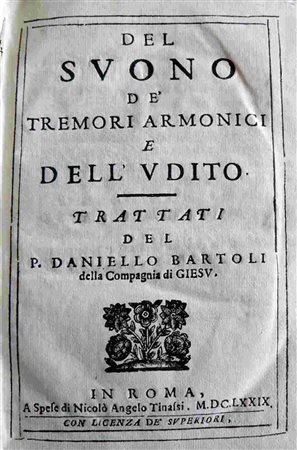
Lotto 157 DANIELLO BARTOLI (1608-1685)
Del suono de’ tremori armonici e dell’udito. Trattati del P. Daniello Bartoli dellla compagnia di Giesu. In Roma, a spese di Nicolò Angelo Tinassi, 1679
§ 4to (200 x 140.); [16], 330, [2] pp.; signature: a-b1-4, A-Z1-4, Aa-Rr1-4, Ss1-6 (numbered Ss1-2, Tt1-4). Small woodcut on title page, woodcut tail-pieces and initials, several schematic woodcut illustrations. Contemporary vellum. Inner hinges loosening, very small worm-hole on last page and free leaves. Fine copy.
First edition. Daniello Bartoli, a Jesuit, was the official historian of the Jesuit order and the rector of the Collegio Romano from 1671 to 1673. Beyond his famous historical work on the first century of Jesuit activity and several moral and religious treatises, he wrote some books of scientific subject, such as barometric experiments, acoustics and about phenomena linked to freezing. The present work is the first extensive treatise on acoustics, discipline generally neglected during the XVI and the XVII century. Bartoli devised a series of ingenious experiments to study the movement of sound through bodies of different densities, the speed of sounds different in loudness, pitch and timbre; the form and transmission of sounds and the rules governing harmonic and sympathetic vibrations.. Bartoli was the first to demonstrate that sounds can be conducted through solid bodies as well as through air; he denies Kircher’s and Gassendi’s assertion that loud sounds are endowed with more speed than subdued ones.. A large section is dedicated to the anatomy of the ear, where Bartoli borrows much from Bartholin and Realdo Colombo, but recognizes for the first time the function of the Eustachian tube in the ventilation of tympanic cavity. Ref: DSB I, 483-484; Honeyman 233; Wellcome II, 109; Zeitlinger 4395 (2nd supplement): “Rare”; Gamba 1775; Vinciana 1512.