
WEB AUCTION 118 - LIBRI E AUTOGRAFI
-
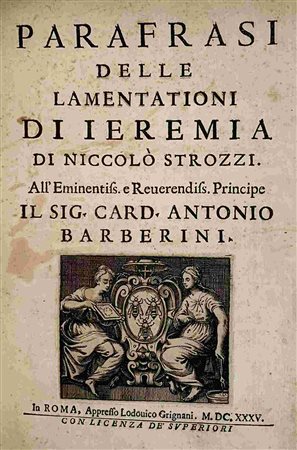
Lotto 134 NICCOLO' STROZZI
Parafrasi delle Lamentationi, Roma 1635
La Clemenza Trionfante, Venezia 1651
Delle lodi d’Anna Maria Maurizia d’Austria Regina di Francia, Orazione Funerale, Firenze 1666
Three works in one volume. Contemporary velum, 4-rib spine, handwritten title on the spine. -
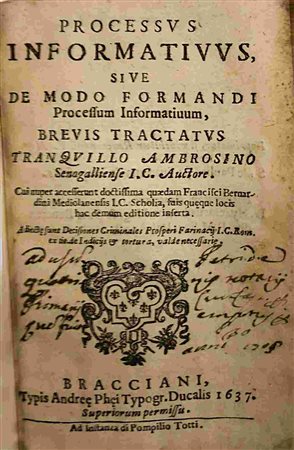
Lotto 135 TRANQUILLUS AMBROSINUS
Processus Informativus, Bracciano, Typis Andree Phaei, 1637
8°. Contemporary vellum, handwritten title on spine, fine and genuine copy with some pages uncut. Rare edition printed in Bracciano. -
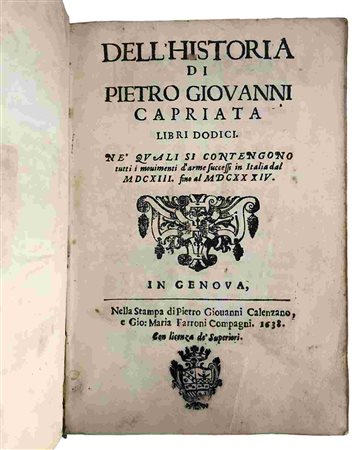
Lotto 136 PIETRO GIOVANNI CAPRIATA
Dell'Historia, Genova, P.G. Calenzano & G.M. Farroni, 1638
4°, modern half vellum
Very fine copy. -
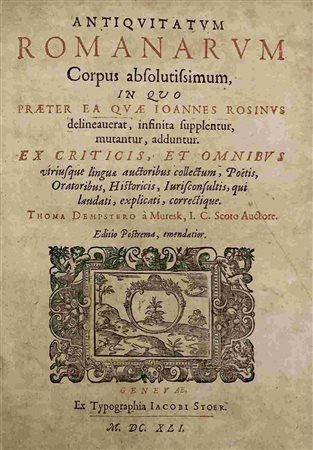
Lotto 137 IOANNES ROSINUS
Romanarum Corpus, Geneve, Jacob Stoer, 1641
4°, red morocco du seuil style, five-rib calf with gilded ornamentation. Two folding plates with maps of Rome. The second one torn in half. Good copy. -
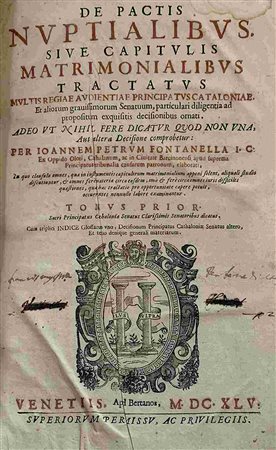
Lotto 138 GIOVANNI PIETRO FONTANELLA
De Pactis Nuptialibus, Venezia, Apud Bertanos, 1645
Contemporary velum, spine damaged, wormholes on last pages, missing last blank, one of two volumes only. -
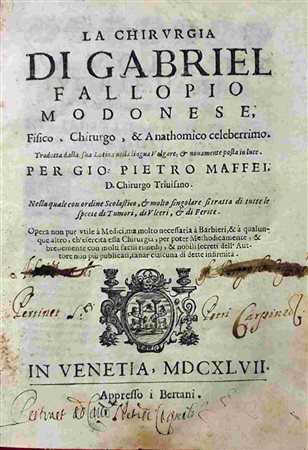
Lotto 139 Gabriele Fallop(p)io (1523-1562)
La Chirurgia di Gabriel Fallopio modonese Fisico, Chirurgo & Anathomico celeberrimo. Tradotto dalla sua Latina nella lingua Volgare & nuovamente posta in luce per Gio: Pietro Maffei, D. Chirurgo Trivisano. ... In Venezia, appresso i Bertani, 1647.
§ 4° (220 x 150), [8], 430 leaves, contemporary hard vellum, fine and well preserved copy
Italian edition, originally published in Latin, of this famous work on surgery , by the great physician and anatomist Gabriele Falloppio; all his works, except one, were published posthumously, mostly edited by his pupils.
“Falloppio at the age of 24 occupied the chair of anatomy in Ferrara, from which he moved to Pisa, and then in Padua, where he taught surgery, anatomy and botany until the time of his early death.” (De Renzi, 158, translated). “Gabriele Falloppio is to be counted among the illustrious surgeons of his time. ... "Fallopio, says the Portal, was one of the greatest anatomists, and one of the greatest surgeons of the sixteenth century. His genius shines everywhere, and everywhere he shows himself a judicious observer." In Fallopio's works all parts of surgery are illuminated by an uncommon judgment; he constantly modifies old beliefs, introduces new methods, adds the wealth of facts and observations. ... To him we owe above all new and more suitable methods for the treatment of dislocations; he describes all the operations and carefully examines the indications and contraindications; and in this, as in surgery, he was worthy of the time of him and his contemporaries.” (De Renzi, 641-642). Ref: De Renzi, III, 157-161; 641-643 and passim; Gabriella Belloni Speciale Falloppio, Gabriele In: Dizionario Biografico degli Italiani, ad vocem -
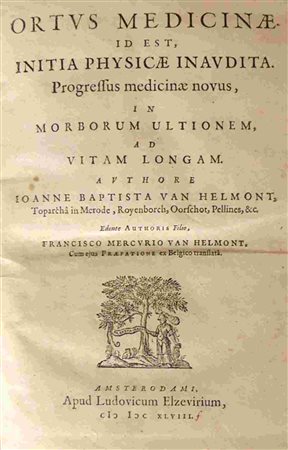
Lotto 140 JAN BAPTIST VAN HELMONT (1580 - 1644)
Ortus medicinae. Id est, Initia phisicae inaudita. Progressus medicinae novus, in morborum ultionem, ad vitam longam. Authore Ioanne Baptista van Helmont, Toparcha in Merode, Royenborch, Oorschot, Pellines, & c. Edente authoris filio, Francisco Mercurio van Helmont, cum eius praefatione ex belgico translata. [bound with:] Joannis Baptistae van Helmont, Toparchae in Royenborch, Pellines, & c. Opuscula medica inaudita. I. De lithiasi. II. De febribus. III. De humoribus Galeni. IV. De peste. Amsterodami, apud Ludovicum Elzevirium, 1648
§ 4° (200 x 152 ), [36], 800 [i.e. 808]; [8], 110, [2, blank], 115, [1], 88 pp.; sign.: *-****4, *****2, A-IIIII4; A-P4; A-O4, P2; A-L4. Original full vellum binding (slightly soiled) with manuscript title on the spine; author and author’s son portrait on leaf *4v , truly fresh and wide margined copy.
Provenance: The personal collection of the German pathologist and medical historian Walter Pagel (1898 - 1983), with ink inscription (Walter Pagel MCMXLVIII) inside the front cover and ex-libris of his son, the British astrophysicist Bernard Pagel (1930 - 2007) on the lower left corner (Ex libris B[ernard]. E[phraim]. J[ulius]. Pagel)
First collected edition of the works of the Flemish alchemist, physician and physiologist Jan B
aptist van Helmont, edited posthumously by his son Franciscus Mercurius (1614 - 1698/1699).
Scientific genius but man of his time as well, van Helmont was, on the one hand, a disciple of Paracelsus (though he scornfully repudiated his errors as well as those of most other contemporary authorities), a mystic and alchemist. On the other hand, he was touched with the new learning based on experiment that was producing men like William Harvey, Galileo Galilei and Francis Bacon. Van Helmont is furthermore regarded as the founder of pneumatic chemistry, as he was the first to understand that there are gases distinct in kind from atmospheric air. The very word gas he claimed as his own invention -
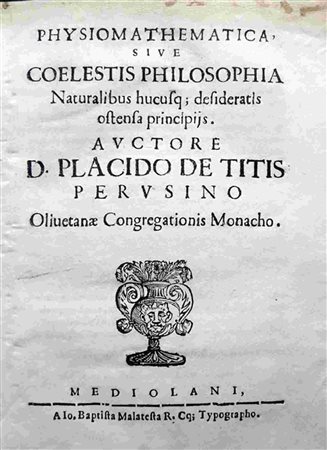
Lotto 141 PLACIDUS DE PLACIDO TITIS (1603-1668)
Physiomathematica sive coelestis philosophia Naturalibus hucusq: desideratis ostenta principijs. Mediolani, A Io.Baptista Malatesta R. Cq; Typographo, no date (but 1650).
§ 4to; [8], [8], 323, [1] pp. (pp. 299-300 misbound), 9 (fold) plts, 15 large woodcut schematic ills. Cont. boards. Very fine copy.
Not much is known about the Benedictine monk Placido Titi; he wrote several works of astrological subject, that he was convinced can be studied scientifically. Titi styled himself “physiomathematicus”, meaning with the term an investigator ov earthly events under neither quantitative nor analysable astral influences. Few copies of the present work were originally printed in Milan in 1647 under the title Quaestionum physiomathematicarum libri tres but the author failed to obtain the imprimatur and the publication was supended. Titi then turned to the Sant’Ufficio (“Holy Office”) in Rome, that submitted the text to a physician (Silverstro Collicola) and a theologian (Raffaele Aversa); the permission was finally obtained in September 1650, subjected to the addition of a list of correction at the beginning of the work, and the publication was completed before the end of the year (Baldini).
Ref. Ugo Baldini Titi, Placido In: Dizionario Biografico degli Italiani. -
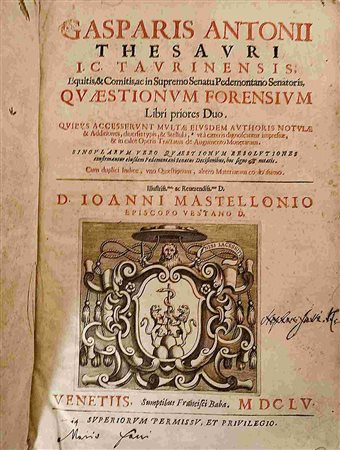
Lotto 142 GASPARE ANTONIO TESAURO
Quaestionum Forensium, Venezia, Francesco Baba, 1655
Contemporary velum, an ancient restoration of the 4-rib spine, very fine copy, some slight foxing. -
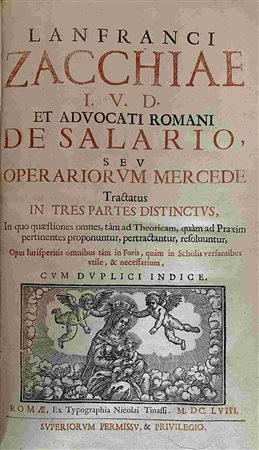
Lotto 143 LANFRANCO ZACCHIA
De Salario Tractatus, Roma, Niccolo' Tinassi, 1658
279/280 blank margin missing with and old restoration, contemporary hard vellum, 5-rib spine, fair copy -
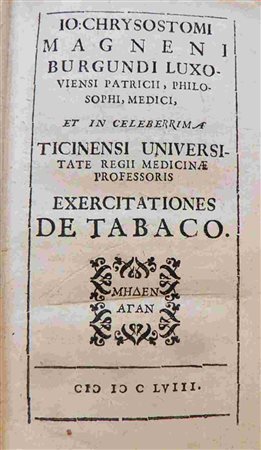
Lotto 144 JOHANNES CHRISTOSTOMUS MAGNENUS (c. 1590 - c. 1679)
Io: Chrysostomi Magneni Burgundi Luxoviensi patricii, philosophi, medici et in celeberrima Ticinensi universitate regii medicinae professoris Exercitationes de Tabaco. No place, no printer, 1658 Bound with: Io: Chrysostomi Magneni ... De Manna No place, no printer, 1658
§ 2 works in 1 volume, 12mo (140 x 80); [24], 222, [2] pp. (last blank); [20], 100 pp. (*1-2, A-I1-12, K1-4 - K4 blank; *1-10, A-D1-12, E1-2). 1 woodcut schematic illustration. Contemporary vellum, handwritten title on spine. Some browning in places, otherwise a good copy.
Second edition of both works, previously published in 1648. Magnenus, a French physician, was professor of medicine and, later, of philosophy at the university of Pavia. In 1660 he accompanied to Paris the count of Fuensaldagne, ambassador to the French court, as his personal physician. Magnenus is best remembered for his work aimed to rediscover the Democritean theory of atomism; his ideas, however, were quite distinct from Democritus’ and he advanced eight fundamental proposition for the existence of atoms, based on mathematical as well as chemical and other experimental considerations. The present publication includes the other two works written by Magnus, dealing with tobacco and manna. In the first one the author describes the tobacco plant, its history and origin, cultivation and medical application; he prescribed tobacco syrup as a standard remedy for his patients. In the second work the manna is described: its origin, formation, the different kind, the opinion of ancient authors and its use are described.
Ref:Martin Fichman Magnenus, Johann Chrysostom In: https://www.encyclopedia.com -
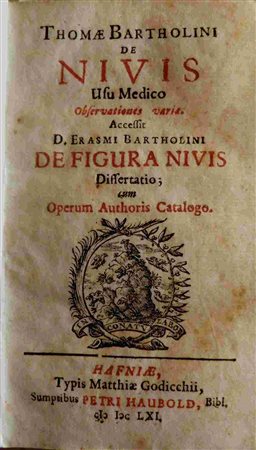
Lotto 145 THOMAS BARTHOLINUS (1616-1680)
Thomae Bartholini de nivis usu medico observationes varia. Accessit D. Erasmi Bartholini De figura nivis dissertatio; cum operum authoris catalogo Hafniae (Copenhagen), typis Matthiae Godicchii, sumptibus Petri Haubold, 1661
§ 3 parts in 1 vol., 8vo (9,5x15,5,2,5 cm.); [24], 232, [8] pp.; [6], 42 pp.; [16] pp. Signature: 1-8, 1-4, A-P1-8; a-c1-8; (*)1-8. 1 engraved plate; 2 different woodcuts on 1st and 3rd title pages, woodcut head-pieces and initials. Printed exlibris (Zlatko Ivan Pozeg) on front pastedown. Contemporary boards covered in red paper, handwritten label on spine. Slightly browned, but good copy.
First edition. The Danish physician, naturalist, physiologist, anatomist and mathematician Thomas Bartholin belong to a family of renowned scientists. He is best remembered for his work on the lymphatic system and his studies on anatomy. In the present work he describes, for the first time since Avicenna, the use of refrigeration as anaesthetic method for surgery, for which method he credits a Neapolitan physician. The second part is a work by Thomas younger brother, Erasmus, on snow crystals. The third part is a catalogue of Thomas Bartholin’s works, listing forty-five titles.
Ref. DSB vol. I, pp. 481-483; Thorndike vol. VIII, 323; Wellcome II, 107; Waller 726.