
ASTA 107 - Glittica
-
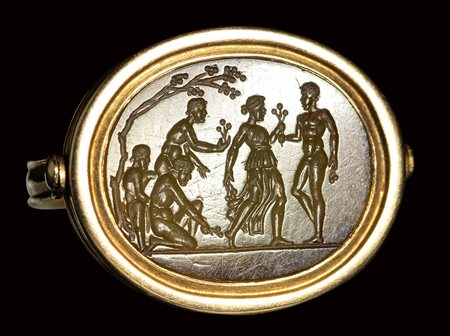
Lotto 289 A fine renaissance agate intaglio set in a swivel gold ring. Mythological scene with Triptolemus and Ceres.
17th century.
Interesting allegorical scene depicting Triptolemus who received poppy flowers from Ceres; these flowers, distributed to farmers, produce a sweet sleep and a quiet rest. The female figure is also interpreted as the Night. After an intaglio by Valerio Belli. The stone is set in a 18th century swivel ring. Very good condition. Parallels: L.P. P. Stefanelli, La Collezione Paoletti, vol. 1, p. 134 n. 198. After a model of Valerio Belli. Cfr. red jasper intaglio, Paris, BNF Cabinet des Médailles (Mariette 1750, I, tav. LX- Reinach 1895, tav. 88, 60. Valerio Belli Vincentino 2000, p. 359 n. 157, fig. p. 146. Cfr. Plaquette in Hermitage Museum, Saint Petesburg.
Stone 14 x 17 mm; ring size 17 x 20 mm; 4,70 gr.
-
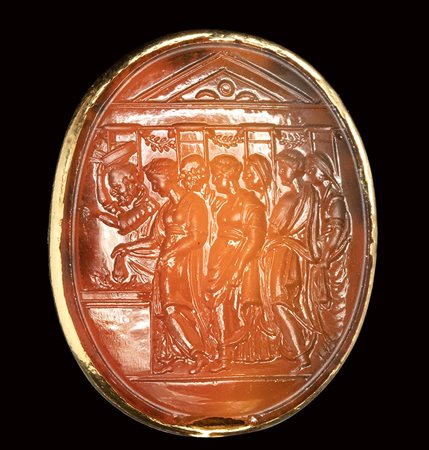
Lotto 290 A fine renaissance carnelian intaglio set in a gold seal fob. Sacrifice scene after Valerio Belli.
16th century.
The scene is composed of seven characters, all facing right, dressed in tunics and cloaks in the ancient roman style. The figures are towards an altar with burning flames proceeding a sacrifice. In the background, a tetrastyle temple with a tympanum and decorated with garlands. Some figures have a veiled head. After Valerio Belli, with variants. Wear marks. Chip on the edge, under the groud line. Cfr. Beazley Archive, TASSIE nn. 8993-8414; R. Gennaioli, Le Gemme dei Medici al Museo degli Argenti. Cammei e Intagli nelle collezioni di Palazzo Pitti, p. 365 n. 492; H. Burns, M. Collareta, D. Gasparotto, Valerio Belli Vicentino (1468c. - 1546), cat. n. 12-13-14-15 (Rock crystal and gold, Chatsworth, Duke of Devonshire coll; Rock crystal, Hermitage Museum, Saint-Petesburgh; Rock crystal, London, BM; cfr. bronze plaquettes).
Stone 19 x 23 mm; H. 27 mm; 10,48 gr. -
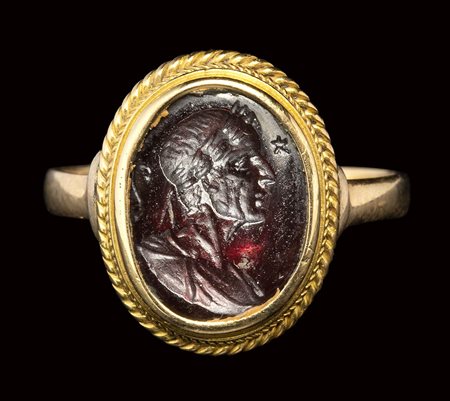
Lotto 291 A garnet intaglio set in later gold ring. Bust of Julius Caesar.
17th - 18th century.
The bust of the roman dictator faces right. On the head, a laurel wreath. The bust is draped. In the field, the lituus and a star, symbol of its apotheosis. The portrait is characterized by his typical aquiline profile, with realistic anatomical features. Slight signs of wear. The gem is mounted in a later gold ring, with a braided frame. Attractive color of the stone.
Stone 9 x 12 mm; ring size 17 x 17,5 mm; 3,27 gr. -
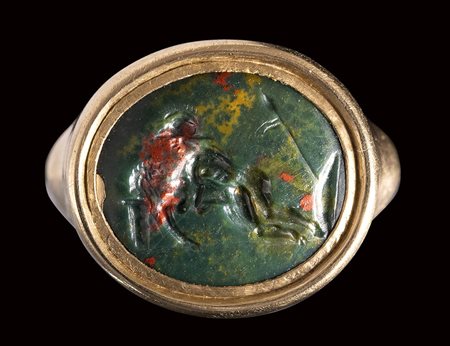
Lotto 292 A renaissance heliotrope intaglio set in a modern massive gold ring. Erotic scene.
17th century.
The scene shows an helmeted warrior taking a naked young woman from behind, their faces facing each other. In the field, shield and spear. Groundline. With rounded hoop extanding on broader shoulders into an oval bezel where the intaglio is inserted. Small gold integration on the edge of the stone. Parallels: for the subject and the scene, see Le gemme dei Medici al Museo degli Argenti. Cammei ed intagli nelle collezioni di Palazzo Pitti, n. 511 p. 374, erotic scene inspired by the Modi of Marcantonio Raimondi after the drawings of Giulio Romano.
Int diam 20 mm; intaglio 15x17 mm; 19 gr.
-
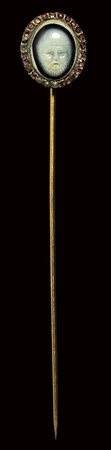
Lotto 293 Agate cameo set in a stick pin. Mask of an old character.
17th - 18th century.
Unusual three-layered onyx cameo, mounted on a gold stick pin and surrounded by small faceted garnets, partially missing. Facing head of a bearded man, wearing a skullcap.
Stone 9 x 12 mm; H. 80,5 mm; 3,19 gr. -
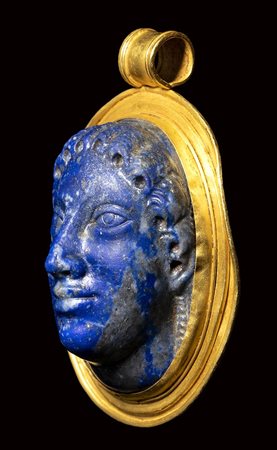
Lotto 294 A large postclassical lapis lazuli cameo set in a gold pendant. Head of Apollo.
19th century (?).
The face is frontal, with youthful features, characterized by large eyes with engraved iris, long linear nose, archaic smile. The hair is divided into curls and braids. For the iconography, probably Apollo, the subject seems to be inspired by the Etruscan art and by the Greek kouros. The stone shows ancient signs of wear and deposits. Probably a product of the late 19th century Etruscan revival. The cameo, characterized by a very protruding high relief, is mounted with a solid gold pendant. Edge of the frame slightly damaged.
cameo 35x49 mm; overall 48x71 mm; 82,24 gr. -
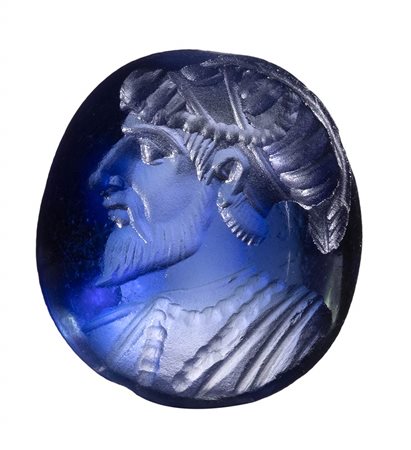
Lotto 295 A safavid blue sapphire intaglio. Bust of a ruler.
16th - 17th century
The male bust is presented facing left and characterized by well-engraved details; he wears an ornamented turban with jewels and a long feather covering a part of his hair. The face is framed by a long pointed beard. He wears an ornamented tunic with necklaces. Beautiful deep blue color.
9x10x4 mm
-
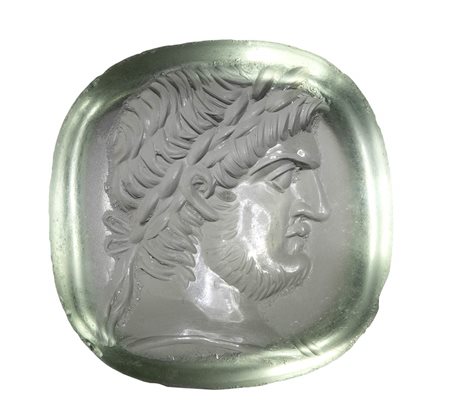
Lotto 296 A neoclassical beryl intaglio. Portrait of Nero.
19th century
The laureated emperor is facing right and characterized by strong features: severe gaze, frowning eyebrows, a straight nose, full lips. His face is framed by a short beard and hair made up of short wavy locks.
15x15x4 mm -
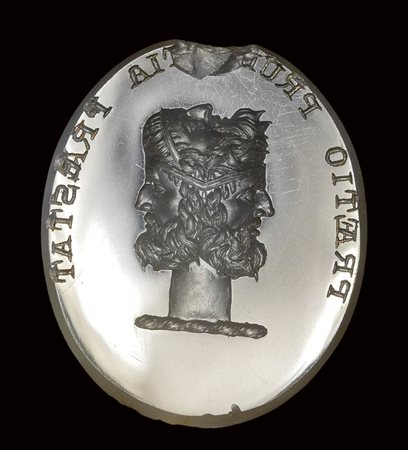
Lotto 297 A Georgian agate seal. Gryllos with a motto.
18th century.
The hybrid creature is composed by three bearded male heads conjoined over a broad neck, which rests on an intertwined ground line. All around, the motto with three latin words, a metaphor for prudence: "PRAETIO PRUDENTIA PRAESTAT" ("Prudence supplies a reward"). Chip at the top of the edge, above PRUDENTIA.
Stone bezel 18 x 23 mm; H. 35 mm; 6.70 gr. -
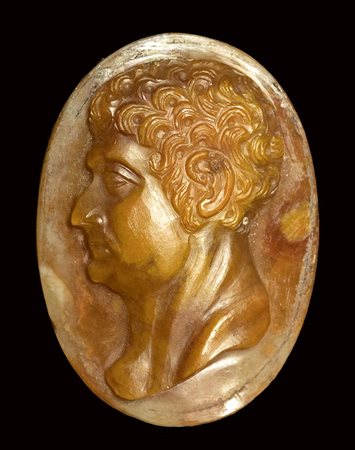
Lotto 298 A postclassical agate cameo. Male bust.
18th century
The young character is facing left and characterized by a muscular neck and thick curly hair. Inspired by classical models. The stone is engraved in high-relief. .
19 x 26 x 6,5 mm.
-
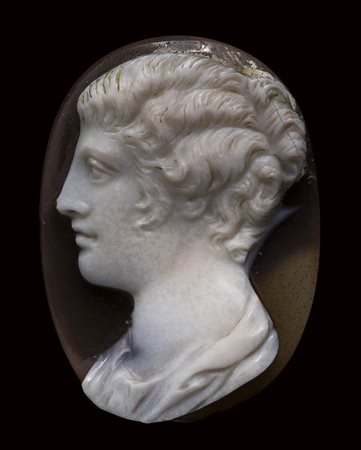
Lotto 299 A fine neoclassical agate cameo. Female bust.
18th century.
The female effigy faces left, and is characterized by a draped bust and refined hair. The typology of the portrait refers to the models of the early roman imperial age. Slight crack at the top of the gathered hair. Beautiful execution.
15x21x4 mm -
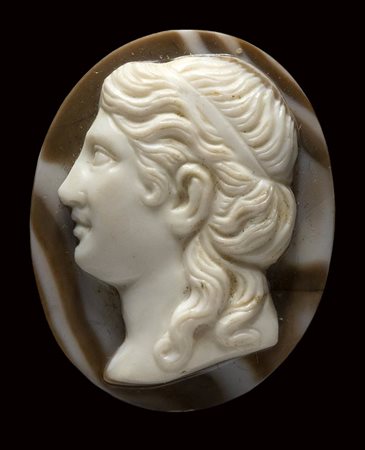
Lotto 300 A neoclassical onyx cameo. Female portrait.
Early 19th century.
The deity, probably Juno, is facing left, with long hair hanging over the shoulder and gathered in a headband. The background is characterized by beautiful white on brown zoning. Said to have been found "in excavations outside the walls of Rome".
20 x 25 x 6 mm. -
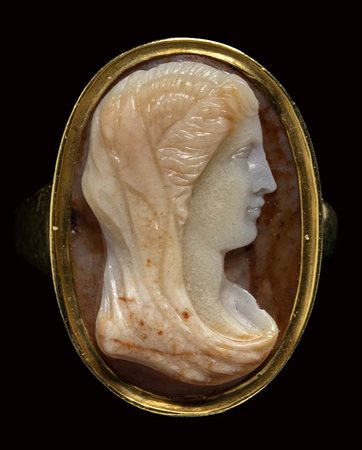
Lotto 301 A fine agate cameo set in a gold ring. Veiled bust
18th - 19th century.
Veiled female bust, facing right. Probably a Vestal, or an empress. Beautiful execution with refined and delicate details. Very good condition.
Stone 15 x 22 mm; ring size 16 x 18 mm; 12,27 gr. -
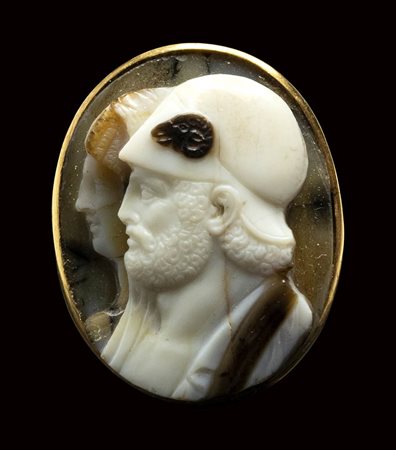
Lotto 302 A fine onyx cameo set in a gold ring. Conjoined busts of Pericles and Aspasia.
18th - 19th century.
The two busts are joined, facing to the left. In the foreground, the bearded and helmeted character, with his shoulders covered by a cloak, is identifiable with the athenian statesman Pericles. In the background, the bust of Aspasia. Wear marks and slight surface cracks in the stone. Interesting artistic use of the different colored layers of the agate.
Stone 23 x 28 mm; ring size 18 x 19mm; 11,20 gr. -
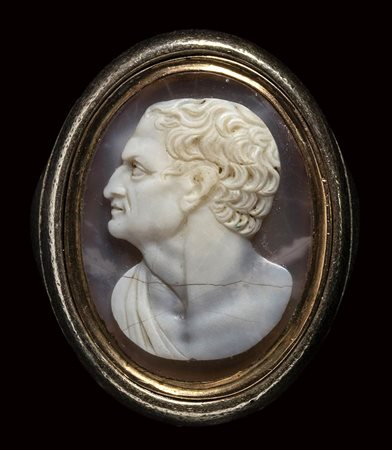
Lotto 303 A neoclassical agate cameo set in a silver ring. Bust of Phocion.
18th - 19th century.
The character is depicted with a frontal bust and the face in profile, facing left. Phocion was an Athenian politician, military leader, famous for his moral integrity. His iconography spread during the 18th - 19th century and it was engraved by different artists, with the same pose, as Girometti and Santarelli (cameo in agate, signed Girometti – in Greek letters, on antique market n. LU1203427973, referred to an ancient chalcographic engraving, titled: PHOCION ATHENIENSIS Dux Summus, Summus Orator - Cingoli apud Anton Maria Castiglionum). The stone is slightly cracked. Chip on the ear and wear marks. The cameo has a gold frame (probably was a seal), converted in a solid silver ring.
See: Lucia Pirzio Biroli Stefanelli, La collezione Paoletti (vol.2), cast n. 355 Tome V, drawer 6 n. inv. MR 26989 (cameo in agate-chalcedony signed by Pichler, called Lisimaco, Farnese collection, Naples, National Archaeological Museum; cast n. 33 Tome VI drawer n. 1, inv. MR 27237).
Stone 18 x 24 mm; ring size diam. 20 mm; 34,50 gr.
-
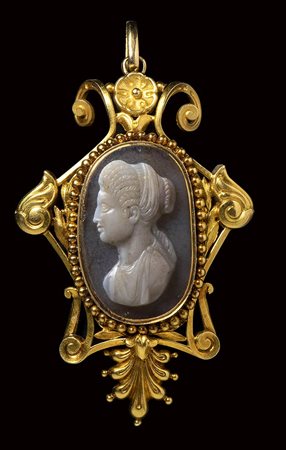
Lotto 304 A Grand Tour agate cameo set in a gold brooch. Bust of a matrona.
18th century.
Draped bust of matrona, facing left. The hairstyle is referable to the Flavian era. Probably a portrait of a roman empress or a princess (Julia Titi?). The cameo, engraved on a two-layer agate, is mounted in an elegant 19th century brooch, with a mixtilinear frame, decorated with floral and vegetal elements (palmette, rosette, leaves). Very good condition.
cameo 19x29x5 mm; overall 44x60 mm; 21,48 gr.
-
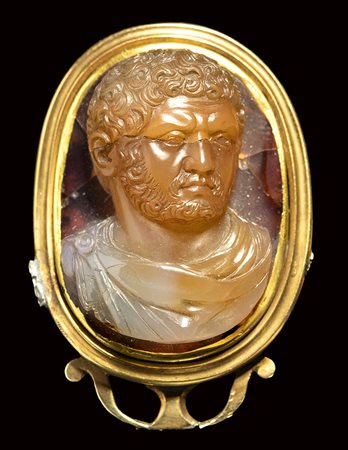
Lotto 305 A fine agate cameo set in a gold mounting. Bust of the emperor Caracalla.
18th century.
The emperor is depicted with the frontal torso and the face turned three-quarters to the right, in his typical pose with the neck in torsion. The sturdy shoulders are covered by a chlamys with a buckle. The beautiful execution reveals a great knowledge of the anatomical volumes. Beautiful variety of agate. The stone is broken in half but is still firm in its original setting. The gold frame is characterized by small lacks.
Stone 25 x 34; mounting 30 x 44 mm; 22,10 gr. -
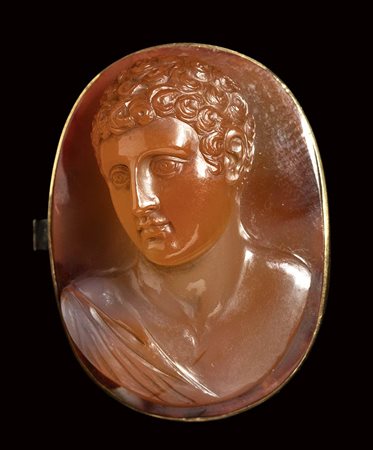
Lotto 306 A fine agate cameo set in a gold brooch. Bust of Hermes.
18th century.
The bust of the deity is depicted frontally, with only one shoulder covered by the cloak. The face is slightly reclined three-quarters, with the eyes in an expression of sweet melancholy. Refined execution, of great beauty. The stone is characterized by a mirror polish and intense color. The subject is inspired by the graeco-roman statuary models.
Stone 26 x 34 mm; 14,69 gr. -
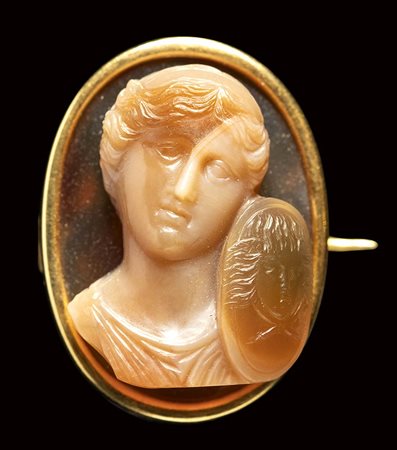
Lotto 307 An italian agate cameo set in a gold brooch. Female bust with a Medusa shield.
Early 19th century.
The divinity is presumably to be identified with Athena, characterized by her typical tunic and the hairs gathered, divided in the center of the forehead, usually covered by the helmet. Unusual is the presence of the shield attached to the face and bust of the figure; its size is smaller than usual but its allegorical and apotropaic meaning, with the Medusa mask, always remains important. Rare.
Stone 18 x 25 mm; 9,45 gr.
-
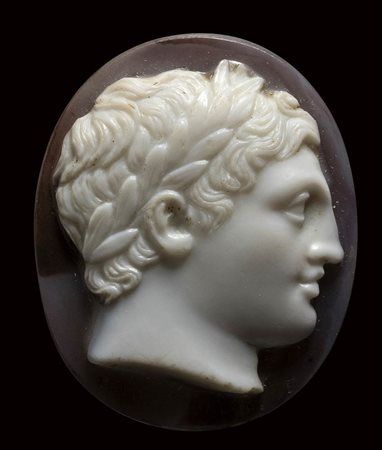
Lotto 308 A rare neoclassical onyx cameo signed by Teresa Talani. Head of Apollo.
Early 19th century.
Beautiful head of Apollo laureate facing right. The model is certainly the gold stater of Philip II (Macedonia, Amphipolis 340-328 B.C.). The cameo is signed TERESA TALANI F. Two layer agate. Beautiful execution. For comparison: Gabriella Tassinari, Teresa Talani, incisore di gemme in epoca napoleonica in LANX 18 (2014), pp. 48-128.
21 x 26 x 7 mm. -
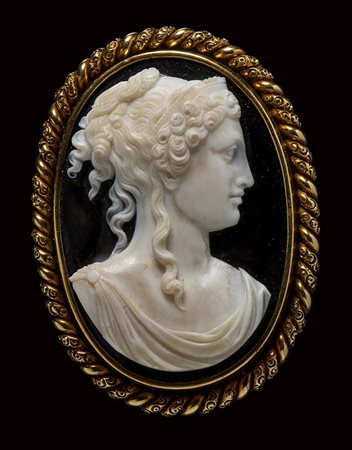
Lotto 309 A large neoclassical agate cameo set in a gold brooch. Female bust.
19th century.
The deity, probably Venus, has an almost frontal bust and a head in profile. The figure is characterized by a very thick and elaborate hair, finely engraved. This large agate, in two layers with a white effigy on a dark background, is mounted in a gold brooch with a twisted frame. The brooch closure mechanism is damaged.
cameo 34x50x12 mm; overall 45x60 mm; 67,48 gr. -
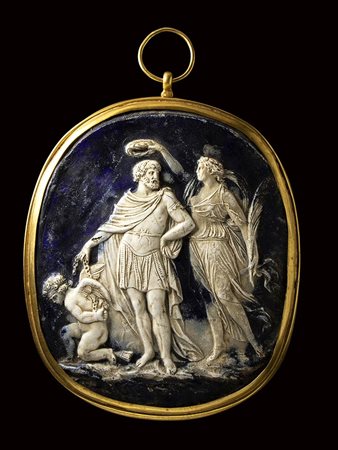
Lotto 310 A very large glass paste cameo plaque set in a gold frame. Allegorical scene.
18th - 19th century.
In the center, a standing male figure, with armor and cloak, facing left but with his head turned back to the right (Emperor, Mars?). With his right hand he holds Eros in chains, kneeling and captive. On the right side of the scene, a draped allegorical female figure crowns the male figure, and holds a palm branch, symbol of victory. The scene, probably taken from the repertoires of the Wedgwood manufacture (or similar), is an allegory of submissive love. The cameo is obtained using a two-layered glass paste: the figures are white, the field is dark blue. The work is mounted in a solid gold frame with a ring to hang it. Very decorative composition.
cameo 107x125x15 mm ; overall 170x122 mm
-
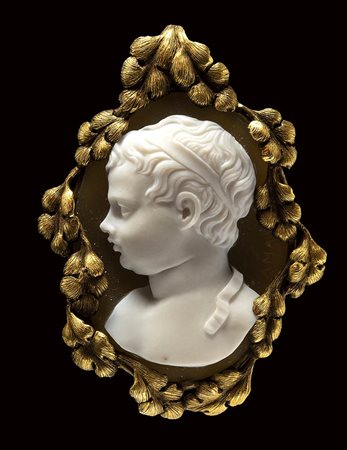
Lotto 311 A large agate cameo set in a gold brooch. Bust of a child signed Amastini
19th century.
Bust of a child, facing left, with the bust in three quarters and the face in profile.. The portrait is characterized by a very refined hair tied by a tenia as for the hellenistic princes. Beautiful execution of the anatomical details, with high and well-proportioned volumes. On the field, the signature AMASTINI, partially covered by this Victorian gold leaf frame. Probably Niccolò Amastini (born Rome 1780–1851).
Stone 32 x 42 mm; mounting 43 x 57 mm; 24,37 gr. -
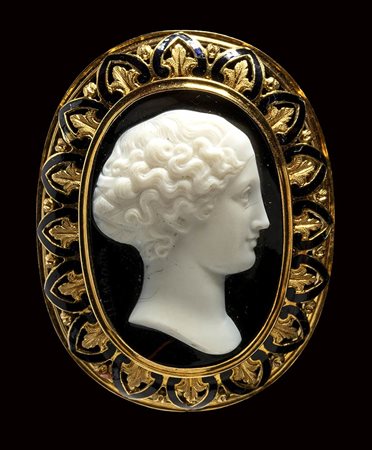
Lotto 312 A very fine onyx cameo set in a gold and enamel brooch. Female bust signed Girometti.
Early 19th century
Splendid female portrait, probably of a Muse, signed and engraved by Giuseppe Girometti (Italian, Rome 1780–1851 Rome). The figure is turned to the right, and is characterized by an extremely finely engraved hair, comparable to the best works of the Italian engraver. The profile is typically neoclassical and is characterized by a passage of the various volumes / anatomical details performed with great art. The two-layer stone is mounted in a precious 18k gold brooch decorated with chiseled palmettes and parts in dark blue enamel. Very good condition.
Cfr. Metropolitan Museum, inv. 40.20.39. Head of a maiden, sardonyx cameo by Giuseppe Girometti (Italian, Rome 1780–1851 Rome).
Stone 19 x 26 mm; mounting 29 x 37 mm; 11,28 gr.
-
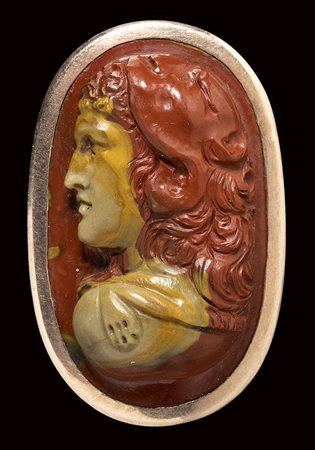
Lotto 313 A fine bicolor jasper cameo set in a gold frame. Bust of Hercules.
18th - 19th century.
The hero is depicted with the head in profile and the shoulder seen from behind, slightly in three-quarter. The head is covered by the leontea, which goes down to the back; the paw rests on his shoulder. The profile is marked, beardless. Exceptional use of the two colors of the stone; the yellow part is used strictly for the face, neck and shoulder of Hercules; his hair and the leontea are red. The cameo is mounted in a gold frame.
cameo 19x31x8 mm; overall 23x29 mm; 9,13 gr. -

Lotto 314 An important signed agate cameo set in a gold ring. Centaur with Cupid.
18th century.
This large hardstone cameo of the Centaur with Cupid (Allegory of the invincible strength of the Love) is engraved by Ludwig Friederich Walther (1757-1817), with his signature in Greek. The stone is mounted in a Georgian gold ring, c. 1780. Missing on the figure and a crack in the stone. This cameo can be identified as a gem which was commissioned by «the equerry von Crailsheim», i.e. the baron Alexander Hannibal von Crailsheim (c. 1740-1816), chamberlain at the Brandenburg-Ansbach court, personal master of the stable of the duke, and which he had set a ring, which became before 1793 the personal ring of an important member of the Hohenzollen family, Christian Friederich Karl Alexander (1736-1806), last margrave of Beyreuth and Ansbach. The margrave was a well-known amateur of horses and of love. About the career of the gem engraver Walther, the centaur cameo is one of his few gems attested in contemporary literature, documented by 1793 as one of his masterpiece. It seems that the material used for this gem is a rare type of fossilized wood, found from 1767 onwards in Rodach - north of Coburg- and exploited by the Walther family until it was exhausted in the late 18th century, became a stone, comparable to an agate. The motif of Centaur with Cupid is copied from a 2nd century A.D. (Hadrianic) marble statue (from Borghese coll. than to Louvre coll. in Paris). This subject was engraved twice by Giovanni Pichler, the last one carved before 1782.
Stone 20 x 25 mm; ring size 17 x 18 mm; 8,46 gr.
-
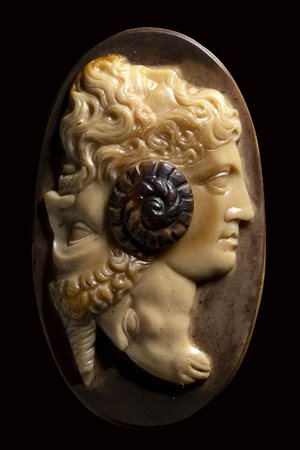
Lotto 315 A fine agate cameo. Gryllos.
18th century.
The hybrid creature is engraved on a three-layered agate, and is composed of: a youthful male face, a bearded male face, to which another bearded face is conjoined with a pointed horn (Poseidon?); to the three human heads is added a ram's head, whose horns are carved in the darker brown layer. Apotropaic iconography, inspired by roman and renaissance models. Beautiful execution.
20x33x7 mm -
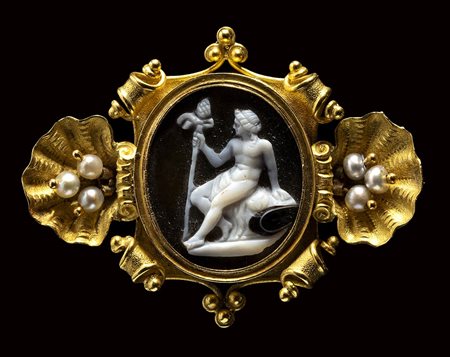
Lotto 316 A french onyx cameo set in a gold brooch with pearls. Dyonisus with tyrsus.
19th century.
The god is facing left, seated and holding a thyrsus with his right hand. Sardonyx cameo set in a french 18ct gold brooch, c. 1850s (“hibou” hallmark), set with natural pearls. The pearls might symbolize Aphrodite. Very good condition.
Stone 16 x 20 mm; mounting 31 x 42 mm; 8,30 gr.
-
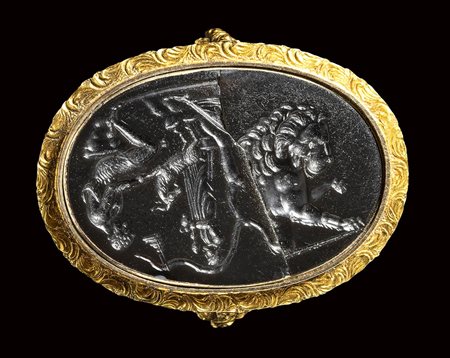
Lotto 317 An important Grand Tour sard intaglio (two fragments) set in a gold ring. Lion and Bacchic scene.
18th - 19th century.
Published: Dr. Archibald Billing, The science of Gems, Jewels, Coins and Medals, ancient and modern, revised edition London 1875, p. 81, figs.117-118&120: "Two of the best specimens that have been produced of forged fragments are in possession of Mr. R. Phillips, of Cockspur Street; these two are made out of one stone, - a dark brown Oriental sard; the engraver brocke it across, and on the larger portion made a most antique-looking intaglio (117), apparently thee worship of Pan, or some such subject, quite open to a controversy such as might have been sustained by Visconti; it really looks a highly respectable fragment of an antique. But the engraver, it would seem, thought it a pity that the other portion of such a fine stone should be left unemployed; so he made that into another antique fragment, with another subject; that is to say, the head, neck and fore quarter of a lion (118) passant, very well engraved; not a modern heraldic lion passant, but a real grumy-looking lion, from an arena, perhaps, of the Coliseum-it would pass for the fore-part of the group of Cybele riding on a Lion, which is a common antique subject (119); this fragment he antiquified more than the other; for whereas the one with the sacrifice is smooth on the back, the other with the lion has been much scratched. (120) is the absurd-looking impression when the two pieces are reunited. It is strange that, after their wanderings, they should have met again in the possession of any one connoisseur". Extraordinary specimen. Very good condition.
Stone 17 x 26 mm; ring size 17 x 21 mm; 6,13 gr. -
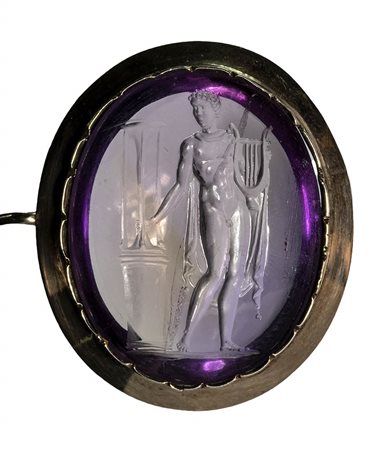
Lotto 318 A fine amethyst neoclassical intaglio set in a gold brooch. Apollo playing lyra.
First half of 19th century.
Apollo is standing, his body naked; his shoulders draped with a cloak. The face is turned in three quarters to the left while the body is slightly twisted to the right. It stands next to an altar / column with the tripod. With his left hand he holds the lyre, while with his right hand he caresses the tripod, perhaps as an allusion to his poetic and artistic superiority, certainly victorious. The intaglio is engraved on a beautiful amethyst of pure and luminous color, slightly convex. Although there are some variations, the model of inspiration must be identified with the splendid amethyst engraved with the same subject, preserved in Paris, Cabinet des Médailles. M.L. Vollenweider identifies it as a representation of Nero as Apollo, at the time when he had five-year celebrations, the Neronia, set up, with music and poetic competitions. A series of coins also represents Nero Citherede.
Parallel: "Cabinet des Médailles BNF- Database: inv. DdL.1625; MR.86 (Louvre) ; reg.Y.22320; Cfr. Vollenweider, M.-L.., Avisseau-Broustet, Mathilde. Camées et intailles, II, Les portraits romains du Cabinet des Médailles. Paris : Bibliothèque nationale de France, 2003, p.114-115, n°128.
Le trésor de Saint-Denis [cat.exp.]. Paris : RMN, 1991, p.288-289, n°63 D. Gaborit-Chopin et M.L. Vollenweider.
Montfaucon, B.. L'antiquité expliquée et représentée en figures. Paris : entre 1719 et 1724, t.I, pl.XLIX, n°3."
Stone 22 x 27 mm; mounting 26 x 30 mm; 7,53 gr.
-
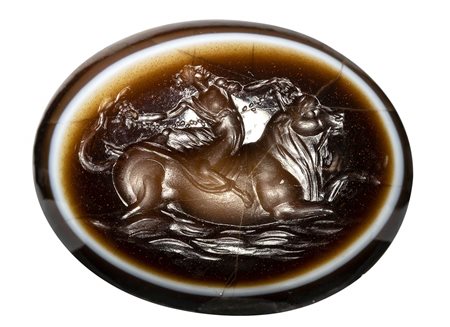
Lotto 319 A fine neoclassical bull's eye agate intaglio. The abduction of Europa.
19th century
The scene depicts the famous mythical episode in which Zeus in the guise of a bull kidnaps Europa, crossing the sea waves. Intaglio engraved with great technical skill, considering the convex surface of the stone. Very thin internal crack. Close to the Berini's manner.
Parallel: This is very close to another gem (engraved by Antonio Berini [1770-1861]), illustrated by Georg Lippold (Gemmen und Kameen des Altertums und der Neuzeit, Stuttgart s.d. [1922], pl. CXLIII-9). Its style is more free than that of the gem by Berini (Lucia Pirzio Biroli Stefanelli, La Collezione Paoletti. Stampi in vetro per impronte di intaglio e cammei, vol. II, Roma 2012, p. 291, no. VIII-98; p. 312 n. VIII-389; p. 316 n. VIII-452). The type was also treated by Brown (see Julia O. Kagan, Reznye kamni Vil'yama i Charlza Braunov, St. Petersburg 1976, p. 23, no. 3).
18 x 23 x 6 mm. -
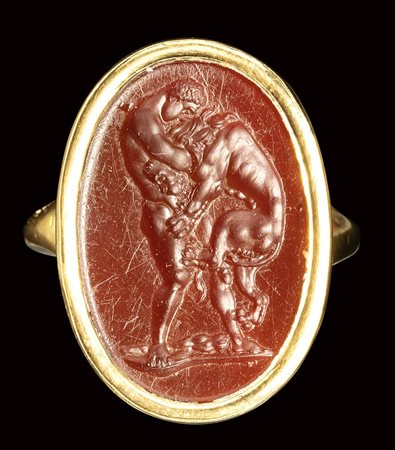
Lotto 320 A fine neoclassical carnelian intaglio set in a modern gold ring. Hercules fighting the Nemean Lion.
Late 18th - early 19th century.
The hero strangles the Nemean lion. His muscles are tense for the effort. The beast clings to Hercules, but its defeat is very close. Below, the club. Groundline formed by a ground portion. The work is performed with great skill and particular attention to the anatomical details deeply engraved. The model is certainly ancient, but this intaglio is to be considered neoclassical, close to the production of Pichler and Calandrelli. Both engravers in fact, produced intaglios with this exact depiction, after an ancient intaglio in nicolo, formerly in the Jenkins collection, then Poniatowski (print engraved by Thomas Worlidge, 1757, London British Museum, Dep. Prints and Drawings n. 1859.0709.889 A Pichler’s intaglio with the same subject (onyx, before 1787) is defined by sources as “from an ancient gem”; that Pichler’s work is signed Filemonos in Greek letters, as a pseudonym and “forgery” for the Grand Tour market. Calandrelli engraved the same subject, with minimal variations.
Parallels: L.P. B. Stefanelli, La Collezione Paoletti, vol. 2, p. 57 n. 359 (Tomo V); p. 66 n. 457 (tomo V); p. 209 n. 103 (Tomo VII). See also J. Boardman, J. Kagan, C. Wagner, Natter's Museum Britannicum, n. 260 (sard intaglio).
Stone 15 x 22 mm; ring size diam. 20 mm; 13.16 gr.
-
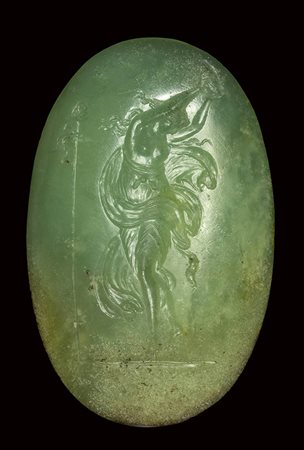
Lotto 321 A large jadeite neoclassical intaglio. Dancing Maenad.
Second half of 18th century.
The Bacchante is characterized by a naked bust, going to the left, with her head leaning towards right. The moving figure is wrapped in his fluttering robe, in the act of raising his arms to play the cymbals. A long tyrsus on her right side. Groundline. Large intaglio, masterfully engraved on a not common material. The subject is inspired by classic models. Parallels: Lucia Pirzio Biroli Stefanelli, La Collezione Paoletti. Stampi in vetro per impronte di intaglio e cammei, vol.II, Roma, 2012, p. 58 n. V-368 (violet glass Num.inv. MR72002, drawn from a carnelian intaglio ante 1782, portraying a dancer, engraved and signed by Pilcher. Subject drawn by a detail of the Trionfo di Bacco e Arianna by Annibale Carracci (1560-1609), Roma, Galleria Palazzo Farnese. Also called "bacchante" or "dancing timbrel-player". For any in-depth analysis see the above-mentioned sheet and Gabriella Tassinari, Giovanni Pilcher. Raccolta di impronte di intagli e di cammei del gabinetto numismatico e medagliere dellle raccolte artistiche del castello sforzesco di Milano (Dattiloteche1), Milan 2012, pp.357-358, no. III-20.
20 x 31 x 3 mm. -
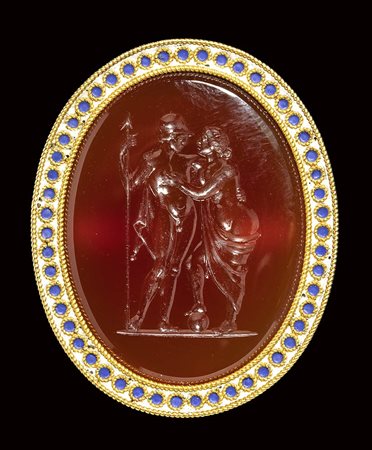
Lotto 322 A fine neoclassical carnelian intaglio set in an gold and enamel mounting . Mars and Venus.
19th century.
Venus is caressing the helmeted Mars, the god of the War, who wants to depart, armed with his spear. Several statuary groups depict “Venus detaining Mars from the Wars”, similar to that intaglio engraved in a deep red carnelian. The examples found in neoclassical art are after ancient roman versions. The marble group from Ostia (in the Museo Nazionale Romano), and the one in the Louvre are both roman copies after lost greek original, mixing the types of the Ares Borghese and of the Aphrodite of Capua. This intaglio could be a neoclassical version of earlier gems. Almost identical gems were cast by Tassie: three are inverted (n. 6514-6516), one is in the same direction but heads are further apart (n. 6517), one in green chalcedony (n. 6518) and a lost one is in jasper (n.6519). A terminus post-quem for the original design is given by the gem once owned by Claude de Boudaloue (d. 1715), possibly the one later copied by William Brown. This carnelian intaglio is set in an elegant cuff-button, 1860’s marked TIFFANY & CO 18ct on the reverse. The gold mount is bordered with twisted wirework, applied with opaque white enamel decorated with circular opaque royal blue enameled motif surrounded by twisted wirework. Tiffany & Co had a collection of antique gems in addition to its stock of contemporary examples.
Stone 18 x 24 mm; mounting 24 x 30 mm; 9,60 gr.
-

Lotto 323 A "magical eye" agate intaglio. Two figures with attributes.
18th century.
In the foreground, a naked female figure holding a scepter with snakes and a fluttering cloak; in the background, a naked, helmeted male figure advances with a spear. The male character wears military shoes (Mars?). Groundline. Allegorical scene, engraved in the center of an attractive magic eye on two-layered agate.
Diam. 20 mm circa x 6 mm. -

Lotto 324 A three-layered agate cameo set in a gold stick pin. Bust of Zeus.
17th - 18th century.
The deity faces right. The bearded figure is characterized by thick hair falling on the neck with long braids. Laurel wreath. Slight cracking on the surface and wear marks.
Stone 13 x 18 mm; H. 61 mm; 4,24 gr. -
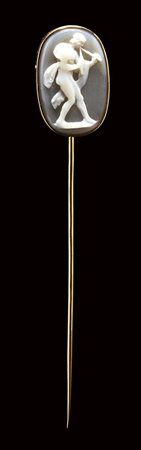
Lotto 325 An agate cameo set in a gold stick pin. Ephebus playing the flute.
18th - 19th century.
The young character is facing right, depicted naked, covered only by a fluttering drapery, while playing a double flute. The hairs are held by a tenia. Subject inspired by classical Greek models.
Stone 17 x 26 mm; H. 100 mm; 6,04 gr. -
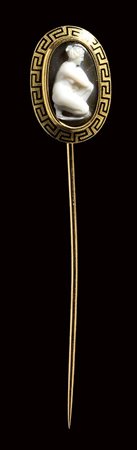
Lotto 326 A fine onyx cameo set in a gold and black enamel stick pin. Crouched Venus.
18th century.
The deity is depicted naked, crouching with one knee on the ground, coming out of the bathroom. The pose is inspired by a famous model from the hellenistic Greek era, also sculpted during the Roman empire. The cameo can be considered a 18th century french work, while the black enamel meander setting was made in the 19th century. Very similar to the type sculpted by Antoine Coysevox towards the end of the 17th century (marble in the Louvre, Paris).
Stone 11 x 18 mm; H. 83 mm; 6,16 gr. -
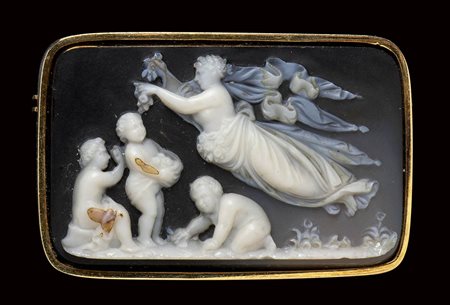
Lotto 327 A large agate cameo set in a gold brooch. Allegorical scene.
19th century.
The scene is composed of three putti and an allegorical personification of Abundance. The female figure is finely draped suspended in the air, in the act of offering fruits / flowers to a putto who collects them in a drapery. Next to it, another cherub collects flowers kneeling on the ground. Another erote is seated. The scene is inspired by neoclassical models. The details of the anatomy and of the garments (fluttering drapery) are engraved with great skill. The rectangular stone, a three layer agate, is mounted in a gold brooch.
cameo 24x38x6 mm; overall 27x42 mm; 15,08 gr. -
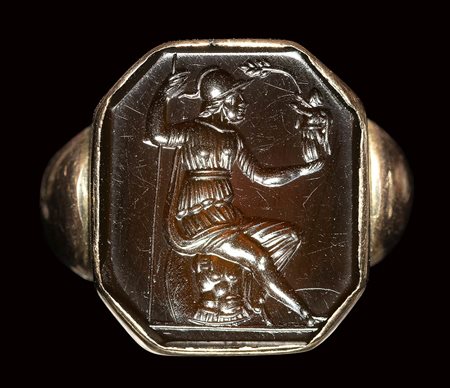
Lotto 328 An octagonal sard intaglio set in a gold ring. Athena.
18th - 19th century.
The deity is seated on a panoply (shield and armor), and is facing right. With his right hand she holds the spear, with the left she holds a winged victory offering her a laurel frond. Groundline. Interesting stylized Georgian intaglio. Very good condition.
Stone 15 x 19 mm; ring size 17 x 19 mm, 5,96 gr. -
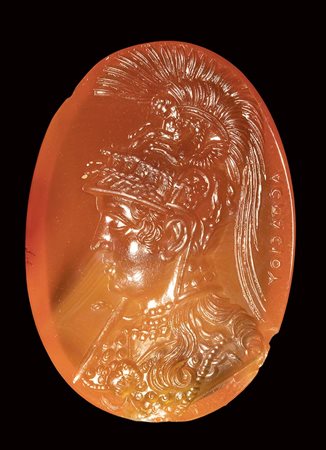
Lotto 329 A large carnelian intaglio signed Aspasios. Bust of Athena Parthenos.
18th century.
Bust of Athena Parthenos facing left. The effigy is certainly inspired by the famous ancient stone engraved with the same subject and signed by the roman gem engraver Aspasios (red jasper, Rome, Palazzo Massimo National Roman Museum). However, the physiognomic features of the face are not idealized but instead refer to an historical private portrait: the features of the profile recall Catherine II of Russia. The helmet, the hair, the gorgoneion are engraved with great technical mastery. The spear rests on the shoulder. In the field, the signature in Greek of Aspasios. Beautiful vivid color of the gem. Small chip on the edge.
25 x 35 x 6 mm. -
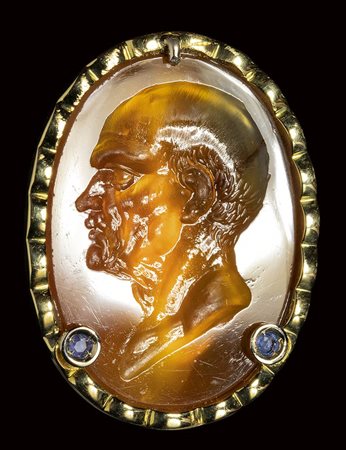
Lotto 330 A fine agate intaglio set in a gold brooch with precious stones. Male portrait.
Early 18th century (intaglio).
Portrait of a Roman general (Caio Mario?) in profile to the left. This portrait is characterized by an hard and strong-willed face expression, suited to military command. Its physiognomic and anatomical confor- mation are similar of some Roman military leader’s portraits of the late 1st century B.C. Large stone set in a beautiful modern mounting adorned by precious stone.
Stone 20 x 28 nmm; mounting 23 x 31 mm; 13,72 gr.
-
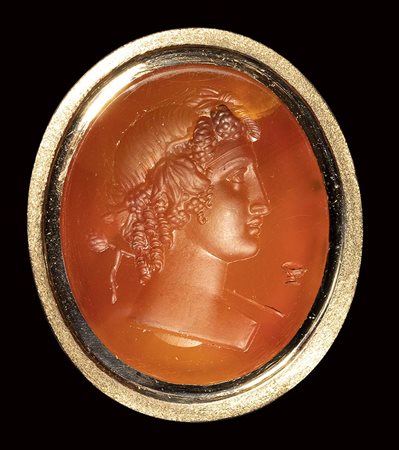
Lotto 331 A neoclassical carnelian intaglio set in a modern ring. Bust of a Bacchante.
19th century.
The bacchante is depicted in profile facing right, with a naked bust and hair adorned with bunches of grapes. In the background her attributes: the thyrsus and a small cup for wine. The profile is linear in the typical neoclassical style. Attractive color of the stone. The gem is set in an older gold frame from a seal readjusted into a modern ring. Very good condition.
Stone 17 x 21 mm; ring size diam 16 mm circa; 10,65 gr. -
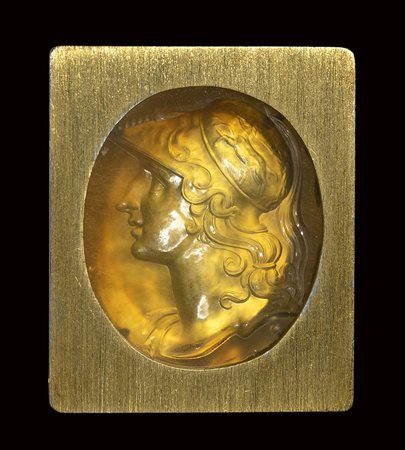
Lotto 332 A fine chalcedony intaglio set in a contemporary gold brooch with diamonds. Helmeted bust of Athena.
Early 18th century.
Head of Minerva, in profile to the left, with a finely decorated helmet with a dragon and a mask on the visor. The hair falling to the shoulder, engraved with great art. The profile is characterized by a slightly open mouth, inspired by hellenistic models. The gem is set in a contemporary gold jewel with diamonds. An almost identical intaglio, both in style and in subject, is in Florence, Palazzo Pitti (Museo degli Argenti), from the Collezioni Granducali. Probably these two gems were engraved by the same engraver. Le Gemme dei Medici al Museo degli Argenti. Cammei e Intagli nelle collezioni di Palazzo Pitti, p. 397, inv. Gemme del 1921 n. 217, GFSSPMF 297136 (Rock crystal intaglio set in a gold frame).
Stone 19 x 22 mm; mounting 25 x 30 mm; 19,92 gr. -

Lotto 333 A fine carnelian intaglio by Pichler. Head of Ceres.
18th - 19th century.
Head of Ceres, facing left, signed Pichler in greek. Chip with lack on the edge. The work can be attributed, as Paoletti refers for an almost identical intaglio, to Giuseppe Pichler: in the "Sessione 4, Opere di Giuseppe Pichler" in the Paoletti casts, there is a head of "Cerere Dea dell'Agricoltura", inv. MR 26760 n. 123 tomo V, with exactly the same head but with a draped bust (carnelian intaglio). Several others versions exist, all with variants. Giuseppe, alias Johann Joseph Pichler, was born in Rome in 1760. He was the son of the second wife of Antonio Pichler (1697-1779) and half-brother of the more famous Giovanni who initiated him into the family art. Very fine style. Parallel: L.P. B. Stefanelli, La Collezione Paoletti, vol. 2, p. 33 n. 123.
19 x 25 x 4 mm. -
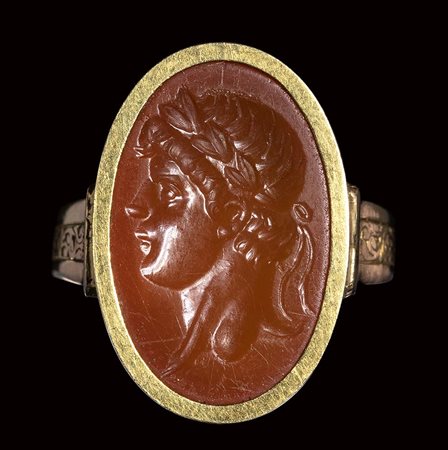
Lotto 334 A postclassical carnelian intaglio set in a gold ring. Portrait of an emperor.
18th century.
The intaglio shows the portrait of a young laureated emperor turned left. The features are soft with small rounded eye, a small aquiline nose and a semi-opened mouth. The rounded chin and cheek contrast with a muscular neck. The short forehead is surmounted by voluminous short hair framing the face and letting the ear uncovered. The laurel wreath is ending in the back with a knot and ribbons. Classical representation of a young roman emperor inspired by roman glyptics productions. The gold mounting with rounded hoop, chiseled foliages on the shoulders support and large oval gold box-setting (different gold ?). Gold mark.
int diam 17 mm; intaglio 11x18 mm; 3,79 gr.
-
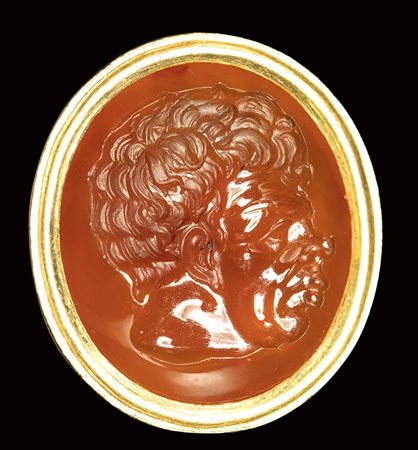
Lotto 335 A carnelian intaglio set in a gold fob seal. Male grotesque portrait.
Mid 18th century.
Male head facing right, characterized by realistic and almost grotesque features, perhaps a caricature. The typology of the portrait recurs with variations in the graphic production of Pier Leone Ghezzi, also known for his extraordinary caricatures. This gem is likely inspired by this mid-18th century repertoire. Fine style. Work expertly polished. Attractive deep red color of the stone, mounted as a seal. Very good condition.
Stone 17 x 20 mm; seal H. 25 mm; 5.76 gr. -
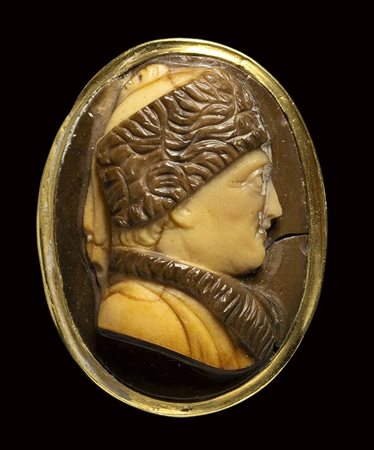
Lotto 336 An unusual agate cameo set in a gold ring. Historical portrait.
Late18th century.
The character is facing right, and is characterized by a large fur headdress and a dress equally fitted with fur in front. The engraver has sculpted the three layers of the stone with great skill, sculpting the fur in the brown part (as in reality). The stone is damaged in front of the profile and repaired (crack on the field and nose repaired). Due to the close iconography and physiognomy resemblance it could be the portrait of the french writer Jean Jacques Rousseau.
Stone 19 x 26 mm; ring size 18 x 20 mm;15,30 gr.