
ASTA 107 - Glittica
-
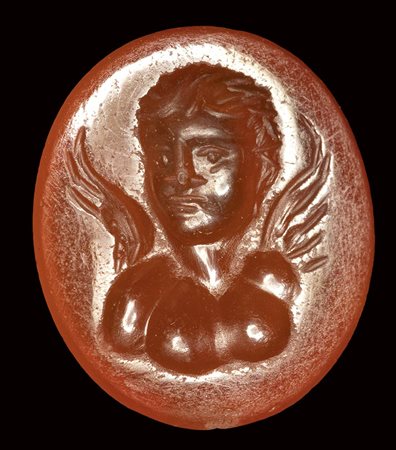
Lotto 193 A roman carnelian intaglio. Bust of Eros.
Late 1st century B.C. - Early 1st century A.D.
The young winged Eros is depicted frontally, with a very light torsion of the bust to the right and of the head to the left. Very fine execution. Use of globular elements (late republican style). Beautiful color of the stone. Slight wear marks.
12 x 13 x 3 mm. -
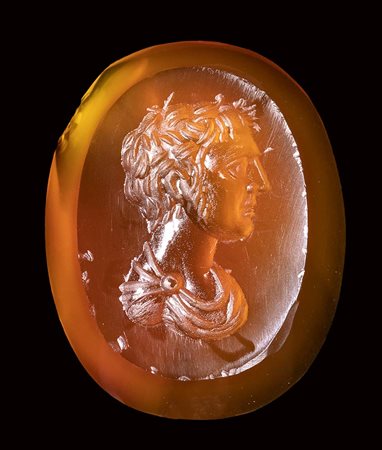
Lotto 194 A fine roman carnelian intaglio. Male bust.
1st - 2nd century A.D.
The male character is facing right and characterized by viril features with a barbula: a strong look, straight nose, semi-opened lips and prominent chin. His face is framed by thick hair composed of short locks and long sideburn. He wears a chlamys attached with a fibula on his left shoulder. Probably a portrait of an official of the military elite. Large size. Slight wear marks.
16x20x4 mm -
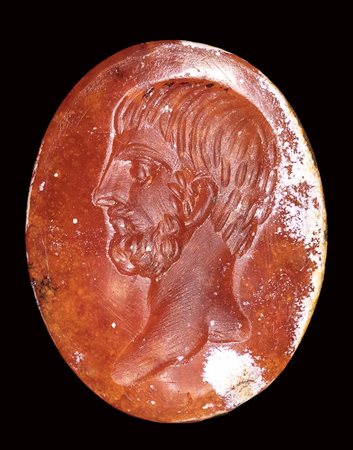
Lotto 195 A roman burnt carnelian intaglio. Male portrait.
2nd century A.D.
The male character is facing left. He is characterized by short hair and trick beard framing his face. Straight nose, and mouth framed by a moustache joining the beard; globular eye. The neck is raised by rendered muscles. Typical features and style referred to the 2nd century A.D. after the imperial Severian dinasty. Fine private portrait. The stone is partially burnt.
12x16x4 mm -
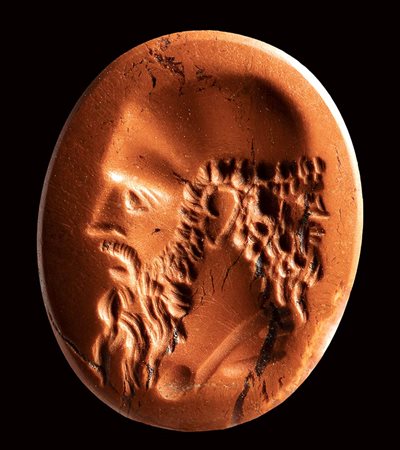
Lotto 196 A roman red jasper intaglio. Bust of a philosopher.
2nd century A.D.
The character is facing left, and is characterized by a partially bald skull, a long beard and thick hair on the nape of the neck where a face can be seen. Interesting subject. Slight wear marks.
12 x 15 x 3,5 mm. -
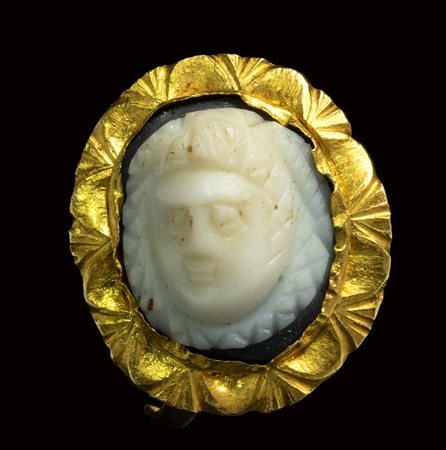
Lotto 197 A roman onyx cameo set in a gold ring. Frontal mask of Medusa.
3rd century A.D.
Typical late roman stylized Medusa mask, with the snakes around the face and the winged head. The shank would appear to be deliberately "split" to make the size adjustable. Slight wear marks.
Stone 10 x 11 mm; mounting 13 x 15; ring size 12 x 13 mm; 2,17 gr. -
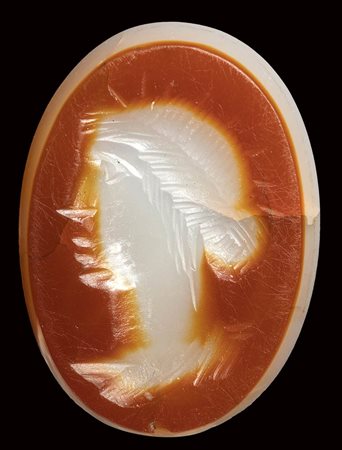
Lotto 198 A roman agate intaglio. Bust of Apollo.
2nd-3rd century A.D.
The divinity is turned to the left, with the radiated head and the draped bust. The intaglio is engraved on a two-layered agate. Small chips on the edge and slight internal cracks.
11 x 16 x 2,5 mm. -
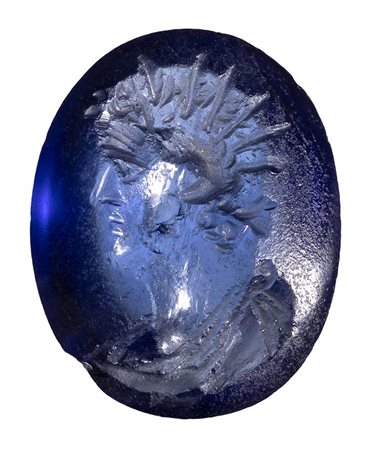
Lotto 199 A roman blue glass intaglio. Portrait of Helios.
2nd century A.D.
Facing left, with his radiated crown. He wears a tunic attached by a fibula. Signs of Wear on the surface of the stone. Beautiful deep blue color.
10x12x3 mm -
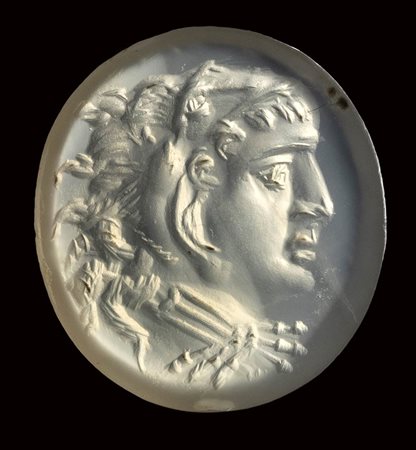
Lotto 200 A roman chalcedony intaglio. Alexander the Great.
1st - 2nd century A.D.
The king of the Macedonians faces right and wears a leontea on his head. The face is in profile and is characterized by its typical features. The carving is done with a certain spontaneity. Beautiful variety of chalcedony. Slight signs of wear.
Parallels: M-L. Wollenweider, Camées et intailles. Les portraits grecs du Cabinet des médailles Tome I. pp. 27 ss.
18 x 20 x 0,4 mm.
-
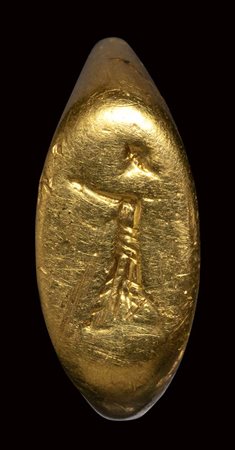
Lotto 201 A roman gold engraved ring. Nike.
1st century A.D.
With elliptical hoop, extending with broader shoulders to an elongated oval engraved bezel. The scene shows a Nike, standing and walking left. Her arms raised. She wears a long dress. Her hair tided back in a bun. Signs of use and wears on the bezel and on the general surface of the mounting.
int diam 15 mm; bezel 7x14 mm; 4,61 gr. -
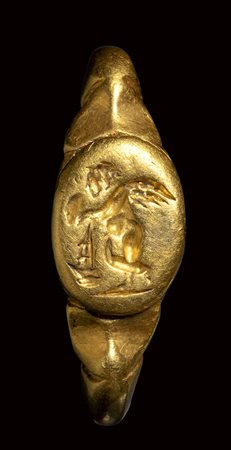
Lotto 202 A late roman engraved gold ring. Funerary Erote.
Late 2nd - 3rd century A.D.
With elliptical hoop, flat within, extending with broader and concave triangular-shaped shoulders, surmounted by an oval bezel engraved with a winged Eros. The character is standing, his body in three-quarters his head turned left. The right leg crossed on the left one. His arms extending, he holds a patera (?) on top of an incense burner. Groundline. Slight wear marks on the surface.
int diam 14 mm; bezel 7x10 mm; 4,67 gr.
-
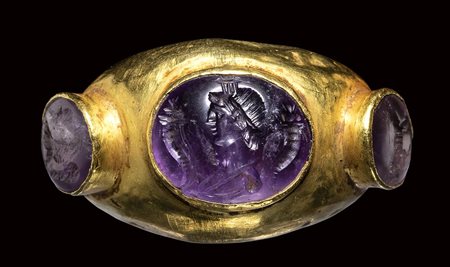
Lotto 203 A large roman gold ring set with three amethyst intaglios. Eagle, Male portrait with cornucopia and a sow.
3rd century A.D.
A large roman gold ring set with three amethyst intaglios. Eagle, Tyche of Antioch bust with cornucopiae and a sow.
Large hollowed hoop expending at the shoulders, on each side above two round raised settings containing amethyst intaglios. In the center, a larger oval raised setting containing a large amethyst intaglio. Intaglios depict respectively; an eagle with wide-spreaded wings, a bust of a Tyche of Antioch facing left and framed by two cornucopiae; a sow facing right. Wear marks and deposits. Rare tipology.
Parallels: Marshall, F.H., 1968, PL. XXI, 851.
int diam 22 mm; intaglios 9x11 mm; 12x16 mm; 9x11 mm; 16,39 gr.
-
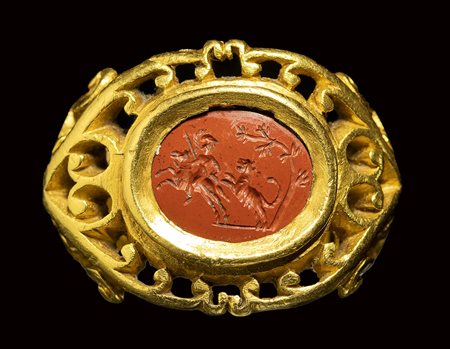
Lotto 204 An important roman openwork gold ring set with a red jasper intaglio. Hunting scene.
2nd - 3rd century A.D.
The gold ring with heavy opus interrasile hoop with stylized openwork scrolling foliate design with broad shoulders, reset with a flat oval stone depicting a hunter mounted on a rearing horse, wearing crested helmet with a spear in his hand, looking back at an attacking lion, which emerges from beneath a bowed tree. Very good condition. Slight wear marks.
Stone 11 x 14 mm ; ring size 18 x 21 mm; 34,05 gr
-

Lotto 205 A fine roman gold bracelet with a sard intaglio. Shepard with a goat.
2nd - 3rd century A.D.
A fine roman gold bracelet with a sard intaglio. Shepherd with a goat.
Shepherd with petasus, club and a goat. The specimen has an authenticity certificate (St James Ancient Art- C.J Martin director): “extremely fine and delicate Roman golden necklace consists of thirty (fifteen in each side of the intaglio) hollow, double-leaf-shaped sections. Each section is made from golden sheet, and the sections are joined by links and loops on the back. The shape of the sections has evolved from double leaf and double bird shaped links in Roman jewelery into a more schematic shape as observed on this piece. The end of the chain has a triangular terminal with a hook for fastening, decorated with incised concentric circles. With a golden loop on the other side, it forms a clasp. In the center there is a golden setting with an inlaid oval carnelian intaglio depicting a shepherd wearing a hat and holding a staff. There is a small goat to his left side”. Very fine, intact, minor encrustations on the surface. Slight indentations to golden sections and minor scratches to the gem stone. Intaglio could be earlier for its early roman Italic stylistic influence.
Stone 11 x 16 mm; Length 200,8 mm; 18,43 gr.
-

Lotto 206 A modern gold bracelet with eleven hardstones intaglios. Various subjects.
2nd century B.C.- 2nd - 3rd century A.D.
From right to left: sard intaglio with a dionysiac scene (satyr in front of priapic herm, with tyrsus); carnelian intaglio with erote on a panther; an italic carnelian intaglio, dotted frame, with Prometheus; Italic black onyx intaglio with Hermes psychopomp; agate intaglio with imperial portrait; carnelian intaglio with a dancer; carnelian intaglio with bucolic scene (shepherds with goats); carnelian intaglio offerer; carnelian intaglio priapic scene with a satyr; carnelian intaglio with two warriors; carnelian intaglio with Athena. The gems are set in a 17th century gold bracelet. Each gem is surrounded by a smooth frame to which a curvilinear element is attached on each side, to be hooked with a horizontal link, to another bezel. Patina deposits.
Stones min. 7x9 to max. 11x14 mm; ; length 200,5 mm; 20,90 gr.
-

Lotto 207 A roman gold bracelet with six hardstones intaglios. Various subjects.
2nd - 3rd century A.D.
From right to left: agate intaglio with male figure catching a big fish with a trident; carnelian intaglio with seated Zeus holding eagle, with attributes; green chalcedony intaglio with male head between a cornucopia and ear of wheat; carnelian intaglio with a sea monster; amethyst intaglio with eagle between star and crescent moon; agate intaglio with a lion. The gems are mounted in an original gold roman bracelet: each stone is surrounded by a frame with four rings, to which two registers of chains are attached, formed by modules of seven links. The closure is by clasp. Wear marks and deposits. Intact, with minor restoration.
Stones min. 8 x 11 to max. 9 x 12 mm circa ; length. 190,5 mm; 27,18 gr
-
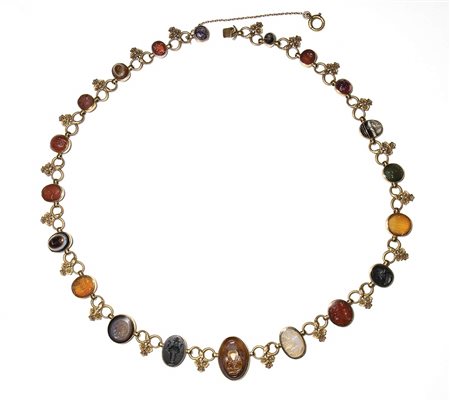
Lotto 208 A revival gold necklace in the style of Louis Wiese set with 20 roman intaglios and cameos.
Late 19 th century - early 20th century intaglios & cameos : 1st - 3rd century A.D.
Composed of a long chain with 20 gold snakes, each one intertwined in the infinity-shape with three flowers. Suspension hoop on each side of these holding an oval box-setting set with an intaglio or a cameo. From left to right; amethyst intaglio : eagle and man, carnelian intaglio: crab, three-layered agate intaglio: portrait of Serapis, carnelian intaglio: gryllos, carnelian intaglio Fortuna-Tyche, carnelian intaglio: Athena, three-layered agate intaglio: sea-goat with stars, carnelian intaglio: Fortuna-Tyche encrowned by Mercury, nicolo intaglio: double portrait of Isis and Serapis, eliotrope intaglio: mummiformed Osiris, three-layered cameo: Osiris canopic jar (crown missing), two-layered agate cameo: panther, carnelian intaglio: Victory and armour, bloodstone intaglio: bust of Ceres, carnelian intaglio: Dioscures, green chalcedony intaglio: Bacchus with panther, banded agate intaglio: seated warrior, garnet intaglio: griffin, carnelian intaglio: crouched dog, three-layered agate intaglio: head of boy. The mounting renaissance style set with these roman stones reminds the work of Louis Wiese (1852-1923) son of the famous jeweller Jules Wiese, well-known for his ornamental repertoire of the Middle Ages and the Renaissance. WIESE’s jewelry has a strong sculptural character always inspired from original ancient models. Very fine condition.
Total length with clasp 59 cm; min stone 5x6 mm; max 16x22 mm; 29,14 gr.
-
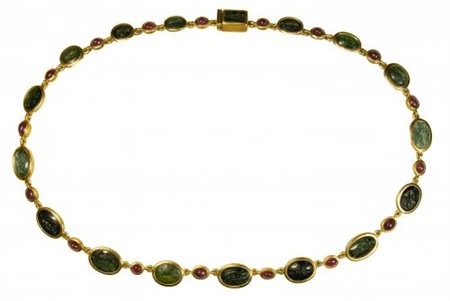
Lotto 209 A fine gold necklace with 17 roman green chalcedony intaglios and rubies. Various subjects.
Stones: 2nd-3rd century A.D.
To right: warrior holding an helmet and a spear, with a shield at his feet; warrior with a sword; wheat harvester; helmeted Athena with spear and shield; two cocks; seated Athena Nikephora; Fortuna Tyche with cornucopia and rudder; Athena inside a temple, with the owl on the front and MM (Minerva Medica ?). Rare subject; Pastoral scene; the drunkness allegory; ant; Athena Promachos; Seated Athena Nikephora; Venus Anadyomene; running figure with attributes; standing female idol holding a scepter and covered by a large veil; Athena with attributes. Slight wear marks for the most part of the gems. Very good condition. English manufacture for this exceptional modern gold mounting with cabochon rubies.
Max length 470 mm circa; 72.10 gr.
-
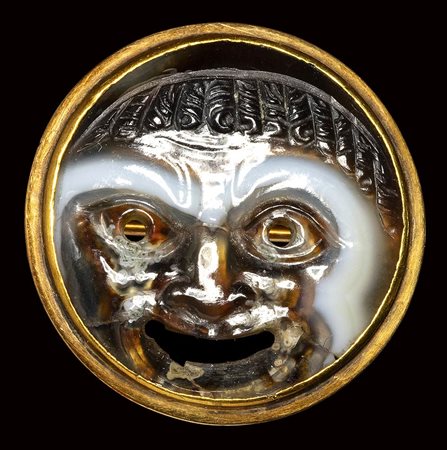
Lotto 210 A fine roman sardonyx "Murrina" cameo set in a gold brooch. Mask.
1st century A.D. - 1st century B.C. (mounting 18th - 19th century).
Comic frontal mask of a male character, characterized by braided hair, large eyes (hole passing through the pupils) and large mouth in a smiling grimace (through opening). Mirror polishing. On the back there are some natural micro holes/inclusions due to the natural conformation of the mineral (Sardonyx - Murrina). This kind of stone was used by the best gem engravers to create the most refined and precious works of Art during the Late Hellenistic and the Imperial Roman period. The cameo is mounted in a 19th century brooch with a thin rounded frame. Rare. For the Murrina examples, see D. Del Bufalo, Murrina Vasa. A luxury of Imperial Rome, 2016.
Stone diam. 25 mm; mounting diam. 28 mm; 5,10 gr.
-
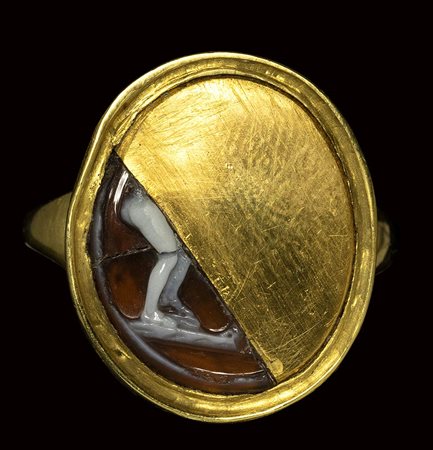
Lotto 211 A fine fragmentary roman agate cameo set in gold ring with repair. Artemis's legs.
1st century B.C. - 1st century A.D.
Fragment of a roman agate cameo of high quality, depicting Artemis bathing (bending woman standing, the left foot on a small pedestal and the right foot on the ground), probably inspired by Ovid's classic story from the Metamorphosis: in that episode Acteon, while resting during a hunt, happens to see Artemis bathing in a nearby pool. To prevent him boasting that he had seen her naked, she changes him in a stag, whereupon his own group of hounds tears him to pieces. The cameo, even if a fragment has a very high quality. The larger missing part is repaired with a gold flat integration.
Stone 11 x 16 mm (fragment max. length.); ring size 17 x 19 mm; 20,27 gr
-
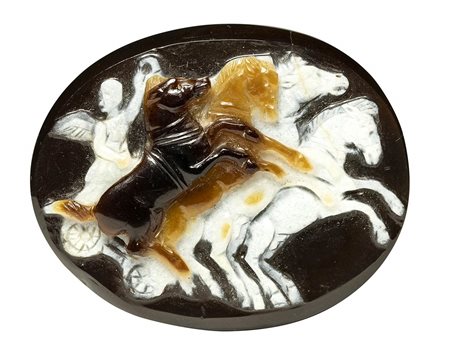
Lotto 212 A large sardonyx roman cameo. Victory driving a quadriga.
1st-2nd century A.D.
The winged figure is tunicated, with naked arms, with the head turned back; with her right arm she holds the reins, with her left she raises a crown as a sign of triumph. The four horses gallop to the right, pulling the small chariot, whose wheels have about 8/10 spokes forming a kind of flower. The front legs of the animals are raised and arched. The cameo, of exceptional size, is engraved on a four-layered sardonyx. Starting from the bottom, the female figure is sculpted in the white layer, like two horses; a third horse is honey-colored, while the fourth (in the foreground) is brown. The different colors of the horses symbolize, according to Winckelmann, twilight-night, day and dawn; in fact usually the guide of such a chariot is Eos (Aurora). But the presence of the wings and the crown are attributable to the Victory. Fine composition, spontaneous and dynamic. The style and technique are reminiscent of a sardonyx cameo in the British Museum (1867,0507.284), while the composition and iconography certainly reminds the splendid sardonyx cameo in the Archeological Museum of Naples (Farnese Collection).
See: U. Pannuti, La collezione glittica, vol.2, p. 188-189 n. 156; Winckelmann, Saggio sull'Allegoria, in Opere, vol. VII, Prato 1831 pp. 463-465).The cameo is in excellent condition and has only a small crack at the top that starts from the edge to descend on the front part of the two white horses (cameo is solid). The cameo was originally mounted on a Victorian metal snuffbox, and the edges of the stone, like the back, were probably re-polished in the 19th century, at the same time as the stone was adapted to the snuffbox. Specimen of great beauty and rarity.
42 x 52 x 0,9 mm
-
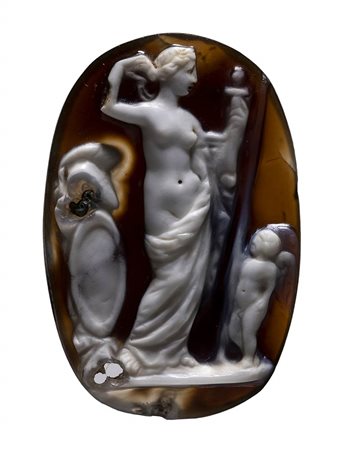
Lotto 213 A very fine roman sardonyx cameo. Venus Victrix.
1st century B.C. - 1st century A.D.
The divinity is standing, facing right, with the head in profile and the body slightly in three quarters. The right arm is raised, in the act of wearing over the shoulder the sheath strap (belt) that support the sword. With her left hand she holds the sword. The upper part of the body is naked, leaving the beautiful torso uncovered up to the pubis; the tunic covers the legs leaving the feet uncovered, the right one seen from the front and the left one in profile. The pose is of great elegance. The anatomical details and the drapery are engraved with great mastery. The model is inspired by hellenistic Greek models. The figure rests on a thick groundline. On the right, facing the deity, is a winged erote holding the spear (Amor). To the left of the scene, a helmet over a shield. Allegory of the victorious love. The goddess of beauty arms herself with the weapons of Mars, god of war, with the help of Love. The scene is sculpted on a two-layered sardonyx of exceptional beauty, characterized by a white layer and a variegated honey-colored background with more brownish areas, transparent or dark inclusions (Murrina). The stone has small holes of natural origin (mineral). The raised right forearm is characterized by a darker part which is not a defect but an inclusion. A part from the small lacks of natural origin, the gem has only slight micro cracks on the edge, not relevant. Chip on the back of the stone, that is miraculously remained intact despite the very thin thickness, and the large size that makes it even more fragile. A work of great rarity. A very close comparison comes from the Grand Ducal collections (Florence, Medici collection) with an onyx cameo with Venus Victrix in a very similar pose and stylistic rendering. This cameo in Florence, without the Eros, in 1786 described Venus "che si cava la cintura, a cui è appeso un parazzonio, e che ha ai piedi uno scudo antico (sic)"; 1799: Venere stante seminuda con allato lo scudo argolico in atto di cavarsi il brodiero da cui pende il parazonio quale si vede in una statua del Museo Borghesiano", interesting for the marble model (coll. Borghese); 1862: Venere Vincitrice. Giulio Cesare, rampollo di una Famiglia che nella sua genealogia risaliva a Venere, ed insieme prode ed invitto generale d'invitti soldati, con molta giustizia adottò il costume spartando vestendo delle armi la madre d'Amore, e facendo a ciò alludere il nome di Venere Vincitrice..... deposto lo scudo si toglie il telamone, al quale è appeso il parazonio ch'ella sostiene colla sinistra". Parallel: A. Giuliano, I Cammei dalla Collezione Medicea, del Museo Archeologico di Firenze, p. 154 n. 29.
19x22x3 mm -
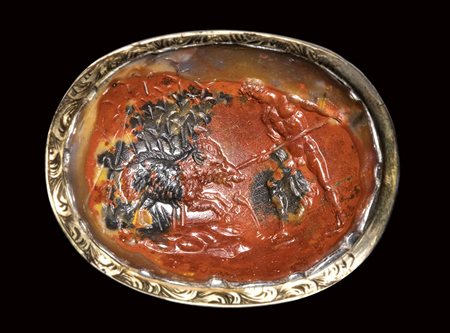
Lotto 214 A fine roman moss agate intaglio set in a gilded frame. Meleager kills the boar.
1st - 2nd A.D.
After an abundant harvest Oineo had offered a sacrifice to all the gods but forgot to honor Artemis, who in retaliation sent a boar of enormous proportions to the lands of Calydon which devastated the fields and killed anyone who came out of the city walls. To kill the animal, the father appealed to many heroes and once gathered the group entrusted them to his son Meleager who started the hunt. Among them also appeared Atalanta, a beautiful huntress who infatuated Meleager. The boar wounded by an arrow is then killed by Meleager with the spear. The scene is inspired by mosaics and by some scenes carved on the marble sarcophagi (Roma, Musei Capitolini; Galleria Doria Pamphili; ). In this extraordinary intaglio, engraved on a large moss agate, a naked youth with a cloack attacks a boar in a cane thicket, with his spear. Rocky ground. The young man is to be identified with Meleager. The hero is naked and wears only a cloak that flutters in the air for his dynamic hunting movement. The legs are well divaricated in the classic pose taken from greek art, and the strong arms mercilessly sink the spear, to kill the beast. The wild boar is large and muscular, characterized by an almost prickly shaggy coat. The naturalism of its rendering makes it expressive and almost alive, both in the movement and in its feral charge. The animal emerges from a cane thicket on a rocky and hostile ground. At the hero's feet, a poppy flower, symbol of the underworld and prelude to his death. The intaglio is performed with great art and technical mastery. The choice of this extraordinary variety of stone matches perfectly with the scene, and the various macules and inclusions symbolize its details. Above, clear cerulean inclusions symbolize the sky, the green inclusions the vegetation, the beautiful red inclusion (similar to jasper) looks like a blood curtain that dyes the killing scene. The edge has small chips, the back a slight crack. The gem has a convex surface, with signs of wear, and is mounted in an old chiseled frame from the 18th / 19th century, likely a central pendant of a necklace. On the back of the metal edge, traces of welding for ancient repairs of the chain rings / hooks, missing. The subject seems to have subsequently inspired a second intaglio but in chalcedony, probably to be attributed to Natter (with variants, for example without the poppy flower). The sources record the existence of another (lost) intaglio in nicolo (broken?) with the same scene. Parallel: AGDS Munchen, vol. 2 n. 880 for the boar with the plants. See also J. Boardman, J. Kagan, C. Wagner, Natter's Museum Britannicum, n. 388 for a very close depiction: "chez Mons. Le comte de Sizdome acheté a Rome, fait en deux, mais rejoint. Gravée dans un nicolo - Meleager tue le sanglier". Once Louis, Duc de Blacas d'Aulps. Cf. Chalcedony intaglio, possibly Natter's copy, Leiden, RMO GS-10369.
Stone 23 x 30 mm, with mounting 26 x 34 mm; 7,67 gr. -
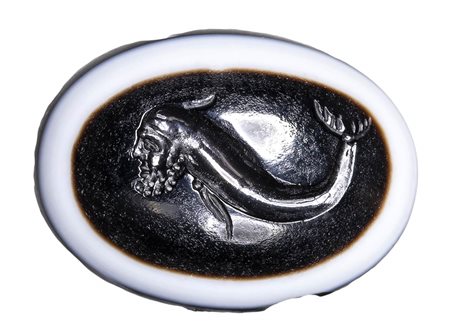
Lotto 215 A roman three-layered agate intaglio. Hybrid sea creature.
1st century B.C. - 1st century A.D.
This unusual intaglio depicts an hybrid creature with a bearded man head and a dolphin body, facing left. In the Greek and Roman mythology dolphins were considered as divine creatures associated to the gods such as Neptune, Jupiter, Eros. The hybrid character of this one may symbolized a metamorphosis of a god, yet the lack of attributes regarding the male head do not allow a further identification (the face here used is the type of the Silenus, the same for the Gryllos). Use of globular elements for the beard, fin and tail of the creature. Nice mirror polishing for the engraving and wear marks.
Parallels: AGKM (Kunst Museum, Wien), n. 2106-2107; AGDS n. 209-210. See also AGDS n. 1115 and 1113.
17x23x6 mm
-
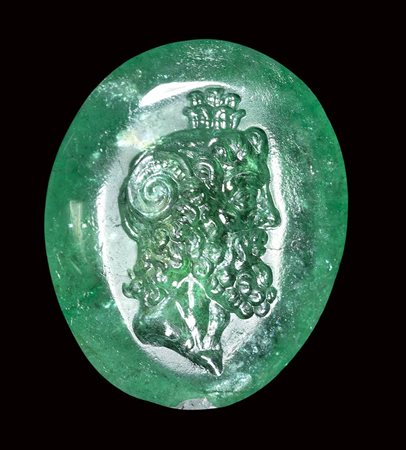
Lotto 216 A very fine roman imperial emerald intaglio. Bust of Pantheistic Zeus.
2nd century A.D.
The bearded divinity faces right, and is characterized by a modio (attribute of Jupiter Serapis) and the horns of a ram (attribute of Jupiter Ammon). Usually, this type of combination also more commonly includes the solar rays of Helios, and the staff of Asclepius, all in the same gem. The particularly interesting aspects of this intaglio are the iconography (rare), the extraordinary refined executive style (after a Greek model), and above all the material: the emerald. The stone is large in size, characterized by an exceptional color. The shape is oval, cabochon on the back, while the surface is flatter near the face. Wear marks. Mirror polished. The anatomical details are expertly engraved, just as the modius is engraved with great tecnique. Probably alexandrian workshop. The face shows some interesting physiognomic features, which for some details is very similar to the portraits of the emperor Septimius Severus (the nose, the eye with the thick contours, the thick beard and the curly hair). The presence of the cult of Zeus Serapis is attested in the coeval coinage (Septimius Severus, bronze minted at Nikopolis ad Istrum. between 193-211 AD, REV: NIKOPOL PROC IC, Draped bust of Serapis in modius, facing right). Gold Aureus of Septimius Severus (193-211 C.E.; and a Frontal Portrait of Jupiter Ammon on the Reverse. Rev. IOVI VICTORI Head of Jupiter Ammon facing three-quarters r. C 249. BMC p. 219 note *. Hunterian 91. RIC 272. Calicó 2468.) For the style and subject see also emperor Hadrien drachm, from Egypt. Parallels: G.M.A. Richter, p. 66 n. 262; AGDS, Band III, Gottingen/Kassel, n. 89. BNF Cabinet des Médailles, intaille "Buste de Sérapis-Ammon, inv.58.2021; intaille "Buste de Sérapis-Ammon radié" inv.58.2022; intaille en emeraude, "Jupiter lauré"nv.58.1415bis.
15x18x5 mm -
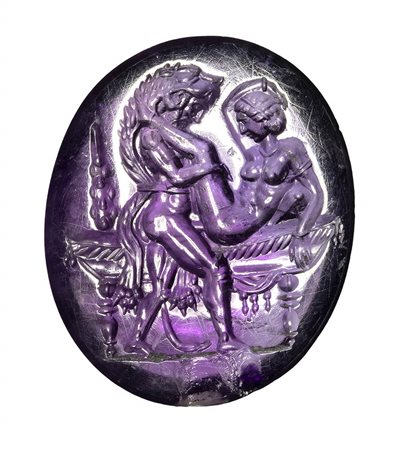
Lotto 217 A large roman amethyst intaglio. Erotic scene.
2nd century A.D.
The man is standing, facing right, and wearing a large leontea that goes from the head down to the calves, covering his back. The woman is semi-reclining on a bed characterized by legs made of ovoid and disc-shaped elements; elegant fringed padding and a pillow make this moment of pure lust beautifully comfortable. Next to the couple, the club of Hercules, a symbol of strength and power. The man grabs her by the legs firmly, showing all his muscles, to penetrate her. The woman raises an arm next to her face, as a sign of satisfaction. The physiognomic features and the hair are referable to the 2nd century A.D., probably to the Antonine era. Chip on the edge below the ground line. Large gem characterized by an extraordinary color. Slight wear marks.
21 x 25 x 0,4 mm. -
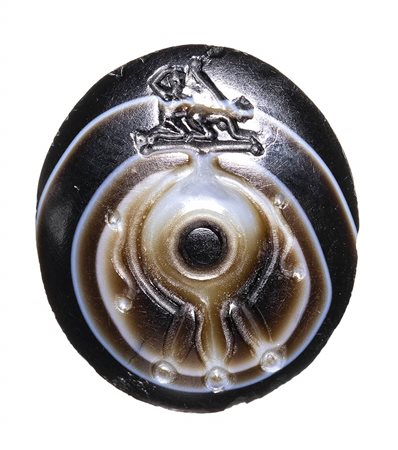
Lotto 218 A roman sardonyx intaglio. Erotic scene on an oil lamp.
Early 1st century A.D.
Tricline oil lamp (three "beaks" or "fires") adorned above the handle ("triangular reflector") by an erotic scene: a young man on his knees is intent on penetrating a kneeling woman from behind ("coitus da tergo"). The type of lamp can be traced back to the Julio-Claudian era. Presence of globular elements. Beautiful variety of banded magical eye sardonyx. Wear marks. Parallels: AGDS n. 232; n. 747. AGKM (Kunst, Wien), vol. II, n. 950.
19x22x6 mm -
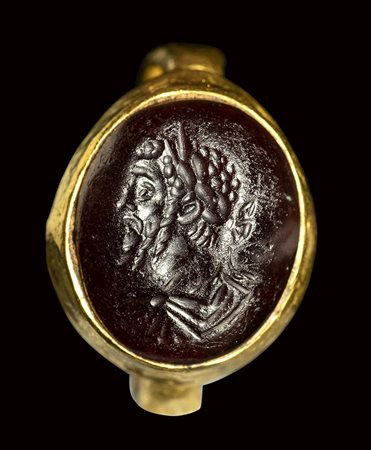
Lotto 219 A roman garnet intaglio set in a gold ring. Bust of Septimius Severus.
2nd century A.D.
Portrait of the emperor Septimius Severus (145-211), facing left. He wears a laurel wreath on his head and a cloak with a chlamys on his shoulders. The typical physiognomy of the face and the anatomical details fit perfectly to his portraits. A sure comparison comes from the coins, but there are some portraits engraved on gems and very similar cameos. This portrait is engraved on a large cabochon, still mounted in its original ancient mount. Signs of wear. Exemplary of great historical importance. Parallel: G.M.A. Richter, The engraved gems of the romans, part two, n. 572 ss.; M-L. Volleinweider, Camées et Intailles. Les portraits romains du Cabinet des médailles, Tome II n. 204 ss.
Stone 13 x 15 mm; ring size 17 x 18 mm; 10,24 gr
-
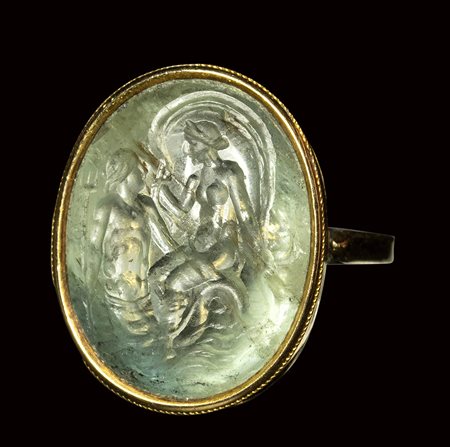
Lotto 220 A rare roman beryl intaglio set in a gold ring. Venus Pelagia on a Triton.
Early 1st century A.D.
A female figure seated on the tail fin of the young, beardless Triton in the middle of the sea represented by incised wavy lines. She is naked except for the drapery covering her legs; she holds the triton’s fin with her right hand, while in the left one she holds a part of a mantle flying over her head. Her hair is braided around the head and tied in a bun at the nape. She wears a diadem. Triton holds the woman by his right hand in the gesture of carrying; as a son of Poseidon, he has a trident in his left. The subject is ancient and was popular in glyptics from the hellenistic period. The diademed female figure can be identified with a marine Venus (Venus Pelagia) rather than with a nereid. This subject is related to the Augustean ideological program and the victory of the battle of Actium by Augustus. Extraordinary testimony engraved on a precious stone of great rarity for ancient times. The gem is biconvex, deep cabochon, set in a 19th century collector’s gold ring. Slight internal cracks due to time, but the gem is solid. Wear marks.
Published: Pawel Golyzniak, Nereid of Venus? The impact of Augustus'"cultural programme" in the private sphere reflected in glyptics, fig. 1; L.P.B. Stefanelli, La Collezione Paoletti, vol. 1, n. 419 (Tomo I).
Stone 15 x 19 mm; ring size 15 x 17 mm; 5,79 gr.
-
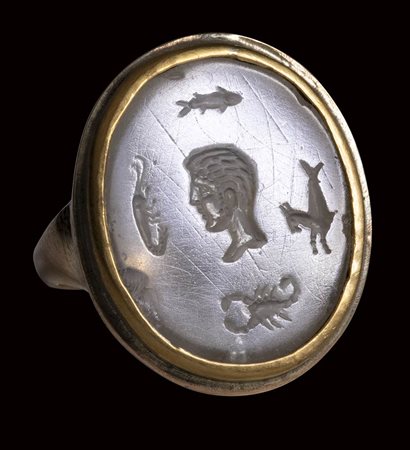
Lotto 221 A large roman rock crystal astrological intaglio set in a gold ring. Portrait of youth with zodiacal and sea animals.
Early 1st century A.D.
Juvenile head in profile facing left. The hair is short, a slight barbula goes down near the ear. The profile is linear, of the Octavian Augustus type. Around the portrait, there are four animals: a fish, a seagoat, a scorpion and a shrimp. These strongly symbolic animals can have, except for the shrimp, an astrological and allegorical meaning, especially the sea capricorn. Some details are engraved with small globular elements. The style is attributable to the end of the Republican age and the beginning of the Augustan period. Interesting allegorical composition. The work is engraved on a large rock crystal. Signs of wear and some light scratches on the surface. Small chips on the edge. The bezel edge is in high carat gold. Parallels: M.L. Volleinweider, Camées et intailles. Les Portraits romains du Cabinet des Médailles, pl. 46. ; M.L. Volleinweider, Die portratgemmen der Romischen Republik, pl. 142 n. 1, 2, 4, 6, ss; pl. 143, 144, ss; 149 n. 15; pl. 151 n. 16 ss. See the coinage. For the subject, a very close intaglio in AGKM (Kunst Museum, Wien) n. 520.
Provenance: UK private collection S.B. London, 1970s, acquired on the London market in 70s. Based on the mounting from a late 19th - early 20th century collection.
Stone 15x18x3 mm; int diam 18 mm; 19x23 mm; 8,15 gr.
-
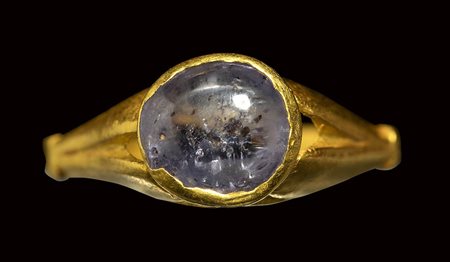
Lotto 222 A late roman gold ring set with a cabochon blue pale sapphire.
3rd - 4th century A.D.
With elliptical hoop , projection below either shoulder ornamented with incised lines. Raised circular bezel with a cabochon blue pale sapphire. Signs of wears and chips on the surface of the stone. Slight missing material on the edge of the box-setting.
Parallel: for similar ring typology see Marshall, F.H., 1968, 976
Stone 10 x 12 mm; ring size 14 x 16 mm; 3,56 gr.
-
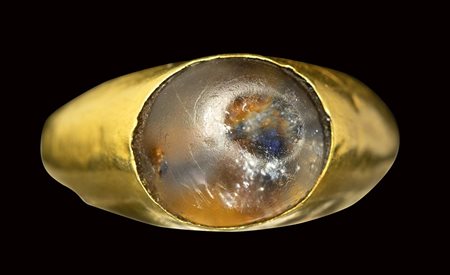
Lotto 223 A roman gold ring set with a translucent sapphire.
2nd - 3rd century A.D.
With massive elliptical hoop, slight flatten within; extending in broader shoulders with raised oval bezel set with a cabochon sapphire stone. Slight signs of wears with slight depression on the surface. Unusual blue and orange shades. Good State of conservation for the mounting.
Stone 6 x 7 mm; ring size 15 x 16 mm; 2,13 gr. -
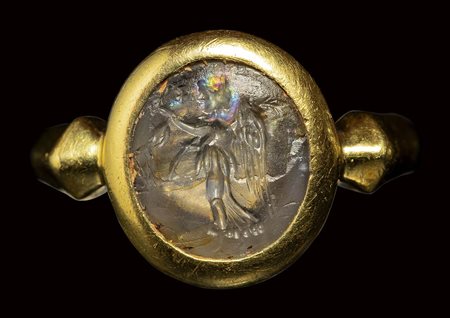
Lotto 224 A rare roman sapphire intaglio set in a gold ring. Nike.
1st - 2nd century A.D.
The intaglio depicts a winged Nike standing and turned left. She holds a palm branch and a laurel wreath in her hands. Slight chips and wear marks on the surface of the stone. The later massive gold mounting with elliptical hoop, flatten within is extending with sided shoulders narrowed toward the junction with the rounded bezel.
Stone 9 x 11 mm; ring size 14 x 16 mm; 7,47 gr. -
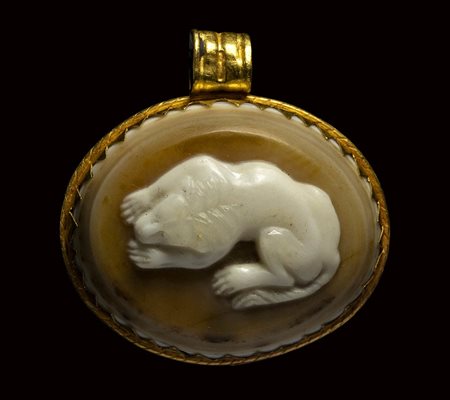
Lotto 225 A large roman agate cameo set in a later gold pendant. Sleeping dog.
2nd - 3rd century A.D.
Sleeping dog reclining to the left, his head resting between his paws. The cameo is carved from a multi-layered agate. The animal is engraved in the white layer with transparencies above a honey-colored background. The stone is mounted in a modern gold revival pendant in the antique style. Parallels: A.P. Kozloff, ed., Animals in Ancient Art From the Leo Mildenberg Collection, Cleveland, 1981, no. 186.; U. Gehrig, ed., Tierbilder aus vier Jahrtausenden, Antiken der Sammlung Mildenberg, Mainz am Rhein, 1983, no. 186.
Stone 27 x 32 mm; mounting 34 x 34 mm; 13,70 gr. -

Lotto 226 A roman heliotrope intaglio. Fight scene with two gladiators.
2nd century A.D.
Two gladiators are facing each other, over a ground line. Both are equipped with similar armament, but with variants. The fighter on the right has an helmet with a closed visor; left arm armed with a curved sword and covered by protection; belt and pelvis protection; greaves and closed shoes. The warrior on the left always has a similar helmet with a closed visor, greaves, belt but has leather belts on his back that hold a breastplate (?); arm armed with a sharp pointed sword with arm protection. The left arm instead holds an ax. His shield is on the ground. His opponent instead protects himself from his violent attack with the shield. The scene is strongly inspired by Roman mosaics. The choice of the dark green heliotrope with vivid red inclusions, to symbolize the blood, the death and the violence of the clash, makes this rare representation very interesting and extraordinary. Parallels: AGKM (Kunst Museum), n. 1701; AGDS Berlin, n. 482. E. Z-Dihel, Die Gemmen und Kameen des Dreikonigenschreines, n. 259 (in heliotrope. The gladiator is described as a "secutor"). AGDM (Munchen) n. 2384. L.P.B. Stefanelli, La Collezione Paoletti, vol. I, n. 560-561 for a very close type (tomo II, cas. 8).
16 x 19 x 2 mm -
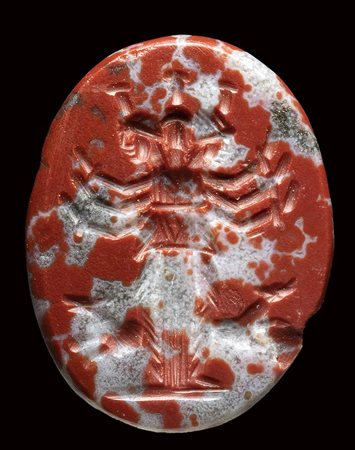
Lotto 227 A rare roman magical mottled chalcedony intaglio. Hecate.
2nd - 3rd century A.D.
Hekate flanked by two dogs. This depiction shows a very rare combination of the goddess with dogs. Her worship was widespread in all the graeco-roman world, especially in the regions of Caria, Lydia, Phrygia and Thrace. For her complex personality and function, referred to both the earthly and celestial scope, the goddess mainly acquires a role of mediator between the world of the living and the world of the dead, intermediary in human events, trivium divinity and protective of roads and crossroads. Especially linked to the infernal sphere, she is a guide for restless spirits and demons from the afterlife; she is represented holding torches in order to dissipate darkness, and followed by a band of dogs. The back of the setting shows a rut on the edge (presumably afterwards it was converted into a talisman pendant). The particular choice of the kind of stone is related to its precise protective effects. Light chippings on the field.
Parallels: Attilio Mastrocinque, Sylloge gemmarum gnosticarum, parte I (Bollettino di numismatica- monografia) IPZS pp. 344-346.
11 x 14 x 3 mm.
-
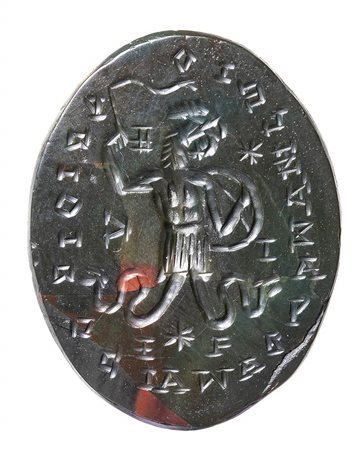
Lotto 228 A large heliotrope roman gnostic intaglio. Anguipes with letters - Helios on a lion with letters.
2nd - 3rd century A.D.
The first side of the stone shows a cock-headed Anguipes in frontal view, his head turned right. He wears a skirt, shield and whip. Around, greek letters, charakteres and inscriptions « ΙΑω - ΑΒΡΑωΑΞ - ΛΕΙΟ - ΡΒΙΟΙΒΟC»….
On the other side, Helios standing right on a lion, holding a whip in his right arm, and his left one upraised.
Around, inscriptions « FΜΟΙ Ι Ι ΡΟF »
On the edge of the stone, inscription « ΑΒΛΑΝΑΝΑΙΟ»
Parallel: A. Mastrocinque, Sylloge Gemmarum Gnostocarum, P.1, 2003, p.296, n° 24
23x29x5 mm -

Lotto 229 A large eastern roman gnostic hematite intaglio. Anubis with astrological symbols.
3rd century A.D.
The scene depicts the jackal-headed Anubis in armour, standing to left on a crocodile; also to left. Both arms raised and bent in elbow, the left hand holding a whip, right hand a trident. Above Anubis, two eight-pointed stars and a scorpion. Around the figure and in the free field: letters and charakteres including a pentagram and a star. Groundline. Slight chips on the edge of the stone. Traces of deposit inside the engravings. Parallel: The Campbell Bonner Magical gems database, CBd-2575
19x28x3 mm -
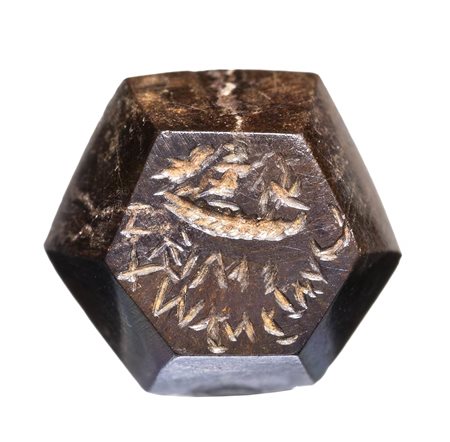
Lotto 230 A roman hexagonal hematite magical intaglio. Figures on a papyrus boat with inscription.
2nd - 3rd century A.D.
The scene shows on top, Harpocrates sitting, to right, in a papyrus boat. Two birds (falcons ?) perch at the prow and stern of the boat. Below, hebrew pseudo-script (?) inscriptions. Rare.
12x11x6 mm -
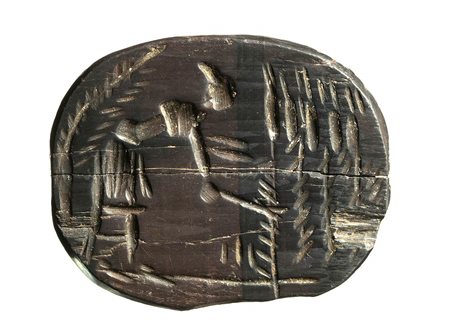
Lotto 231 A roman hematite gnostic intaglio. Reaper- Eagle.
2nd - 3rd century A.D.
A) Reaper wearing high cap and kilt, stooping to right to cut five stalks of grain with a long-handled sickle. Behind him, on the left, a tree.
B) Eagle with widespread wings. Above, the greek letter Ρ.
Longitudinal crack visible on the stone (stone is broken in 2 pieces). A series of hematite intaglios show a reaper leaning forward to cut tall stalks of wheat with his sickle; behind him rises a tree branch. On most of them, we found inscriptions on the reverse, indicating they are amulets against hip pain. This lies in the fact that this type of work presupposes that one does not suffer from the hips. Hematite was a stone appreciated for its ease in breaking, because hematite dust was frequently used in medicine. The breaks of hematite gems can testify to a medical rite in which a part of the stone was pulverized to make a medicine.
Parallel: Mastrocinque, Attilio. Les intailles magiques du département des Monnaies, médailles et antiques. Paris : Bibliothèque nationale de France, 2014, p.169, n°460. Bonner, C.. Studies in magical amulets. 1950, n° 120, p, 272.
21 x 27 x 4 mm.
-
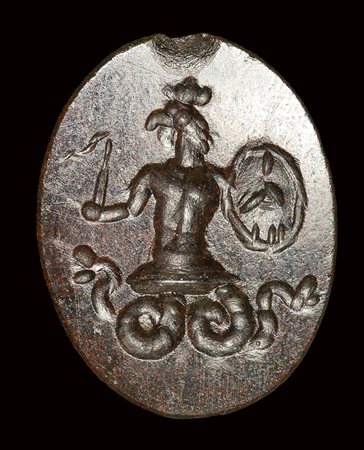
Lotto 232 A roman magical abrasax heliotrope intaglio. Anguipes cock.
2nd - 3rd century A.D.
The hybrid figure is turned on the left. With the right hand he holds the solar whip; the left holds the round shield which is inscribed Ἰάω. On the reverse and on the edge, magical letters. Chip on the top edge and wear marks on both sides. Very nice color of the stone. Parallel : Mastrocinque, Attilio. Les intailles magiques du département des Monnaies, médailles et antiques. Paris : Bibliothèque nationale de France, 2014, p.116, n°303.
11 x 14 x 4 mm. -
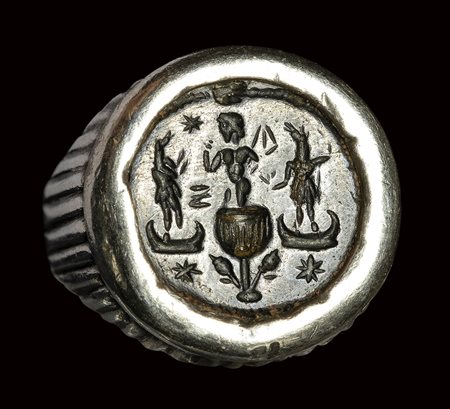
Lotto 233 A roman hematite magical intaglio set on a silver ring. Harpocrates on a lotus flower.
2nd - 3rd century A.D.
A) In the center, Harpocrates as a youth standing naked on a lotus flower (the lower part of the body hidden inside the lotus ?). On each side, Hermanubis, standing toward the young Horus, on a boat and worshipping. Stars and charakteres. All around, an ouroboros.
B) Partially erased inscriptions.
A praxis known from a papyrus (PGM LXI 1-38) specifies that love charms had to be incised with the image of Horus on a lotus flower and the magical name Abraxas (here impossible to confirm the inscription on the reverse). Pieces with the Horus-scheme used as love charms: CBd-533, CBd-534.
Slight crack and restoration.
Stone diam. 15 mm; ring size 19,5 mm circa; 12,34 gr. -
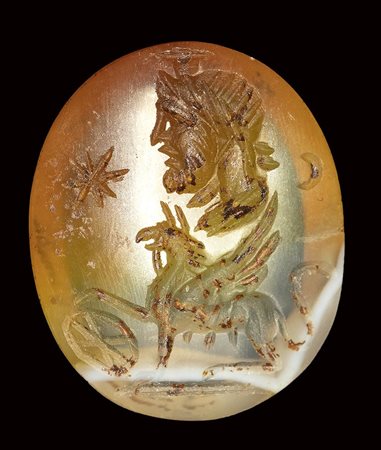
Lotto 234 A roman magical agate intaglio. Nemesis allegory.
2nd century A.D.
Bust of Zeus facing left, above a griffin with wheel. On the sides, a star and a crescent moon. Groundline. Allegorical emblem of revenge (Nemesis) with astrological symbols. Beautiful variety of honey tone agate with a white band near the groundline. Iron traces and slight wear marks.
15 x 18 x 4 mm. -
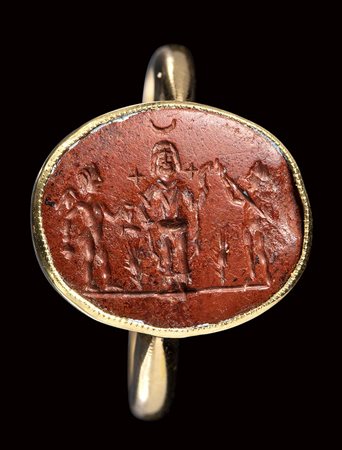
Lotto 235 A roman red jasper magical intaglio set in a gold ring. Votive scene.
2nd - 3rd century A.D.
The intaglio shows a central male in front, wearing a cloak and a sickle surrounded by astral symbol (stars and crescent moon), on each side a winged erotes holding vases (?) and an other young character holding a stick (?). Ear of corns on the ground. Groundline. The central character could be a representation of Kronos. Magical symbolic related to fertility and rebirth.
The 18k gold mounting is with rounded hoop with French mark (eagle head). Rare.
int diam 16 mm; intaglio 11x13mm; 3,41 gr. -
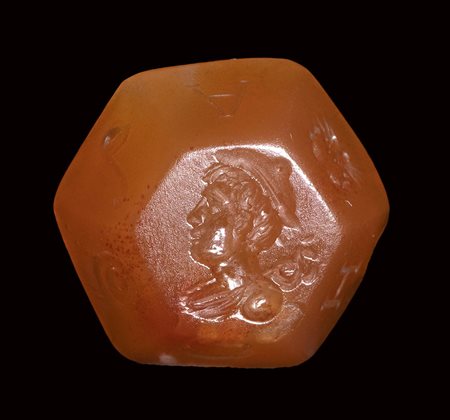
Lotto 236 A roman magical carnelian intaglio. Bust of Mercury/Astrological symbols.
2nd - 3rd century A.D.
The hexagonal stone is engraved on is flat side with a bust of Mercury facing left, wearing petasus and holding on his shoulder a caduceus. The other edge sides engraved with a letter or symbol: A, crab, H, crescent moon, patera (?), simpulum (?). Astrological-magical gem. Rare.
15x16 mm -
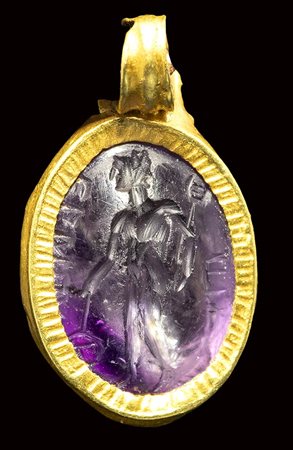
Lotto 237 A roman gold pendant set with a gnostic amethyst intaglio. Mercury with attributes.
2nd - 3rd century A.D.
The gold box-setting with suspension hoop is decorated on the edge with thin engraved lines.
The intaglio is depicting on one side— Standing Mercury, turned left and crowned with stylized little wings. He only wears a cloak, holding the caduceus in one hand and the purse in the other one. On both sides greek letters and charakterês. Magical gems depicting Hermes/Mercury are very rare. The citizens of the Empire who worn rings with the image of this god were numerous. But on magical gems, the figure of Thut was more used.
Stone 0,8 x 10 mm; h. max 16 mm; 1 gr.
-

Lotto 238 A roman lapis lazuli magical intaglio. Gorgona mask with torch.
3rd century A.D.
Slightly three-quarters, almost frontal Gorgona mask. Eyes with engraved iris and winged head with snakes; below, a burning torch. Magical depiction for protective and apotropaic purposes. Rare combination of subject and material. Slight signs of wear.
12x14x3 mm -
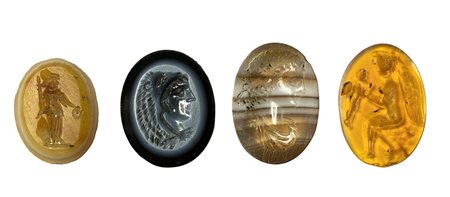
Lotto 239 A group of 4 intaglios. Various subjects.
3rd century A.D.
From left to right: A three-layered agate helmeted Minerva standing, turned right. A nicolo intaglio with portrait of Hercules turned right and wearing the lion skin. A banded agate intaglio with the bust of an hellenistic ruler turned right.
An orange glass impression with a winged Nike and Eros.
Nicolo 12 x 15 x 2 mm; carnelian 11 x 16 x 2 mm; agate 11 x 13 x 2 mm; banded agate 11 x 16 x 2 mm. -

Lotto 240 A roman agate "magical eye" bead.
Early 1st millenium A.D.
The long convex oval stone is a three-layers agate also call « eye bead » since the natural layers of the stone reminds an eye with apotropaic power.
Parallel: for a similar bead see Christie’s NY, December 6th 2007, lot 466
22 x 38 x 13 mm.