
ASTA 107 - Glittica
-
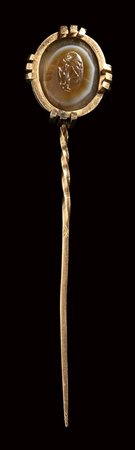
Lotto 145 A roman agate intaglio set in a gold stick pin. Apollo.
2nd - 3rd century A.D.
The divinity is facing right. In his right hand he holds a drapery, a laurel branch in his left; on his shoulder, a quiver. The subject is engraved on a three-layered agate (magic eye). Very good condition.
Stone 11 x 15 mm; H. 70 mm; 5.20 gr. -
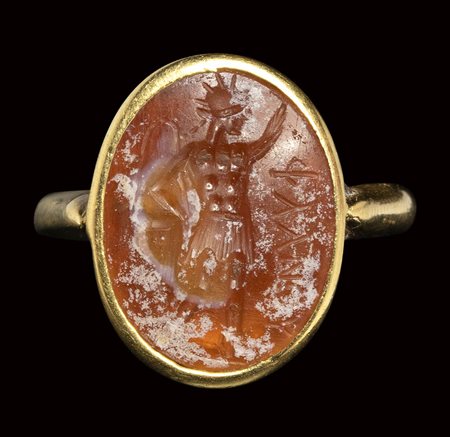
Lotto 146 A roman burnt carnelian intaglio set in a gold ring. Sol Invictus.
2nd - 3rd century A.D.
The god is standing, with his head radiated and with his right hand raised, in the typical pose of the Sol Invictus; with his left hand he holds the solar whip and a drapery. In the field, a greek inscription. Partially burnt surface of the stone.
Stone 13 x 17 mm; ring size 18 mm; 7,12 gr. -
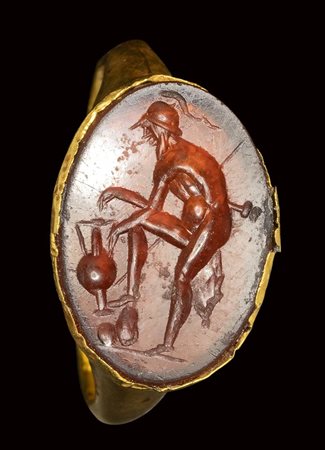
Lotto 147 A roman carnelian intaglio set in a gold ring. Heraclides attempting a draw.
1st century A.D.
The hero is depicted in profile, with his right foot resting on a rock, as he attempts a draw inside an amphora. The Greek warrior is naked, helmeted and armed with a spear and sword. Groundline. The subject is taken from the group of Three Heraclides who attend the draw with the amphora, a mythical episode with complicated events. Wear marks. Ring formed by a hollow sheet of gold. Rare subject.
Parallel: U. Pannuti, Catalogo della collezione glittica vol I, Napoli, Museo Nazionale, n. 147-148.
Stone 10 x 14 mm; ring size diam 16 mm; 1,83 gr.
-
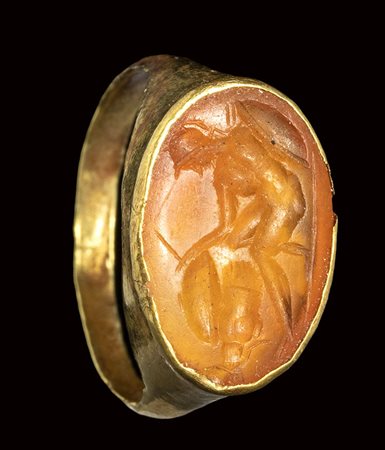
Lotto 148 A roman carnelian intaglio set in an ancient gold ring. Warrior.
1st - 2nd century A.D.
The figure is depicted in a reclined position, on the ground, and leans on a shield with his left arm, while with his right hand he touches another shield on top of an armor, with a shield. Probably a votive representation or of lamentation towards a comrade who died in a military act. The ring is formed of hollow sheet gold. Wear marks and little missing on the bezel edge.
Stone 9 x 13 mm; ring size 14 mm; 1,18 gr.
-
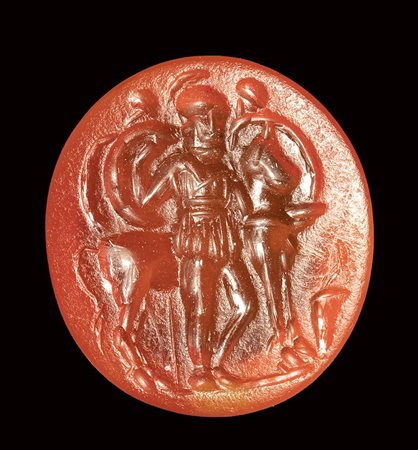
Lotto 149 A rare roman carnelian intaglio. Scene of a sacrifice by Agamemnon.
1st century BC - 1st century AD.
The Achaeons' supreme leader, wearing a helm, is portrayed holding the shield with his left hand, while offering a patera with his right hand, in front of a small altar at his feet. A bull at his side, and others helmets/ shields on the background, in order to symbolize soldiers. The scene can be identified for sure with the sacrifice that Agamemnon made at Aulis before sailing to Troy. Indeed, this rare iconography can be identified in an ancient sardonic intaglio, the which was also displayed by in the collection of Paoletti’s glass paste impressions, and preserved in Philadelphia (University of Pennsyilvania Museum of Archeology and anthropology, inv. 29-128-900, already M. Sommerville collection).
11,5 x 13 x 5 mm. -
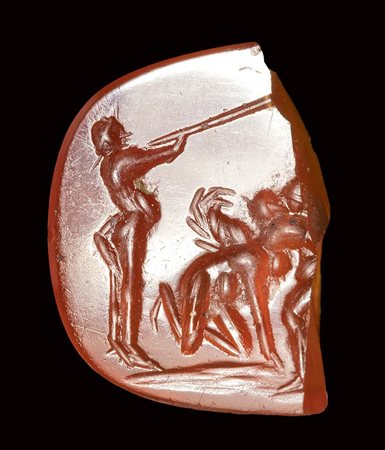
Lotto 150 A roman carnelian fragment of an intaglio. Fighting scene with putti.
2nd century A.D.
In the center, an erote subdues another winged erote to the ground, with a victorious hold for submission; on the left, a referee blows a long trumpet to announce victory. Groundline. Fragmentary stone.
10 x 12 x 3 mm. -
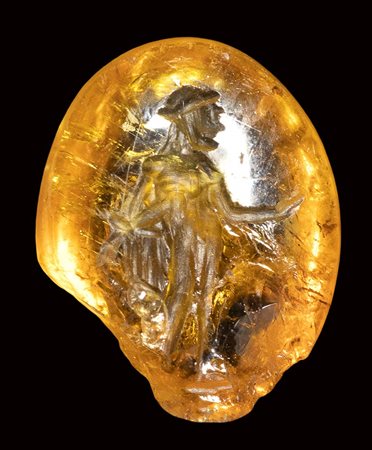
Lotto 151 A rare roman citrine intaglio. Apollo.
2nd century A.D.
This gem has lacks on the edge and chips. However, the young naked figure who appears to be leaning on a tripod (?), could be identified with Apollo. Citrine of extraordinary intense and brilliant color. Rare.
9,5 x 12 x 4 mm. -
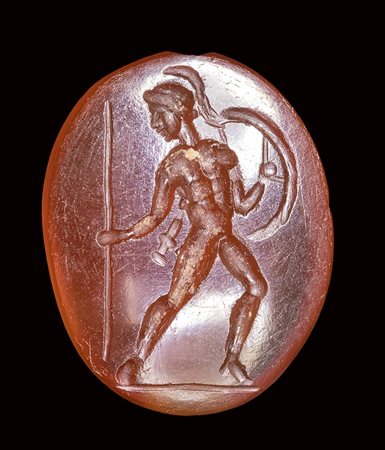
Lotto 152 A roman carnelian intaglio. Warrior.
1st - 2nd century A.D.
The soldier advances to the right, with the frontal torso and the head turned back in profile. The figure is naked and protected by a shield and helmet. With his right hand he holds the spear; the sword is hung with a belt. Groundline. Typical pose inspired by Greek models. Fine quality for the small size of the stone. Slight wear marks.
9x12x3 mm -
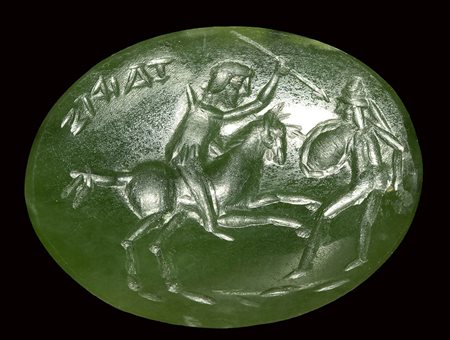
Lotto 153 An eastern roman green chalcedony intaglio. Military fight scene.
2nd - 3rd century A.D.
A soldier on horseback advances against a soldier on the ground (wearing an helmet and holding a shield). The character on horseback raises a spear to kill his enemy and appears to be characterized by a headdress (Leontea?). Greek inscription on the background. Probably Alexander the Great fighting a soldier. Wear marks. Eastern workshop.
17 x 22 x 4 mm. -
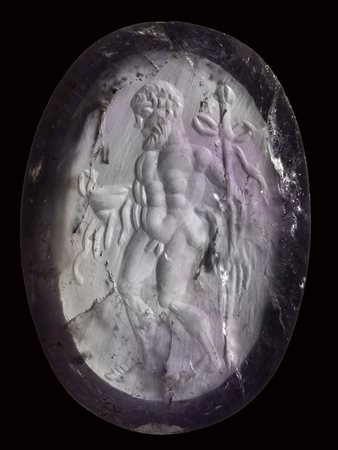
Lotto 154 A large concave roman amethyst intaglio. Silenus.
2nd - 3rd century A.D.
Unusual work, propably from a provincial eastern atelier. A muscular Silenus advances to the left, holding the thyrsus with his left hand and a cup with his right hand. The choice of the amethyst is to be connected to the Dionysiac theme. Large cabochon gem, engraved in the concave inner part. Wear marks.
24 x 34 x 11 mm. -
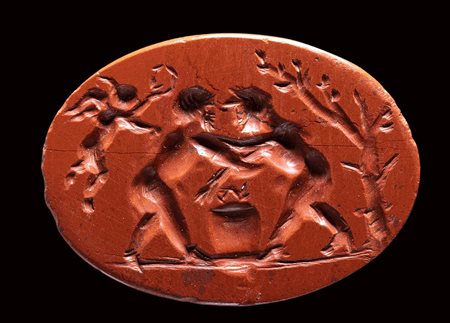
Lotto 155 A roman red jasper intaglio. Fight scene.
2nd - 3rd century A.D.
Two young characters fight in front of an altar. In the background, on the right, a tree; on the left, a winged erote raising a laurel wreath for the next winner. Groundline. Well composed scene. Attractive color of the stone. Slight wear marks.
15x18x3 mm -
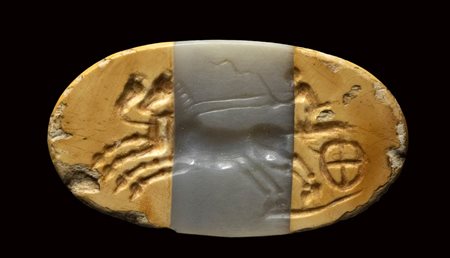
Lotto 156 A roman republican burnt agate intaglio. Biga.
1st century B.C.
Two horses are running to the left, pulling a small chariot driven by a charioteer with a whip. The stone was heated by the fire. Small chips on the edge.
9 x 16 x 2 mm. -
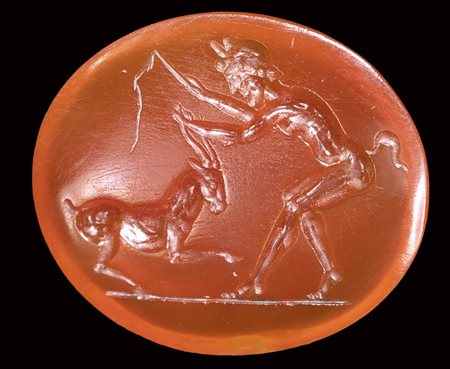
Lotto 157 A roman carnelian intaglio. Faun with goat.
1st century B.C. - 1st century A.D.
The scene shows a bucolic scene with a faun turned left playing with a goat. The mythological character is in flexion, his left leg and arm forward, catching one animal horn, while his other arm holds a branch with a string, in order to excite the goat. Groundline. The anatomical features of both figures and the rendering of volumes with some use of globular elements are well executed. Nice polishing for the engraving, and sign of use on he surface of the stone.
15x17x3 mm -
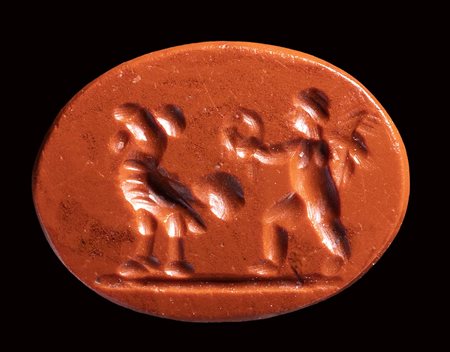
Lotto 158 A roman red jasper intaglio. Winged eros with rooster.
1st - 2nd century A.D.
The scene shows a winged eros standing left toward a rooster and holding a laurel wreath. Groundline.
7x10x2 mm -
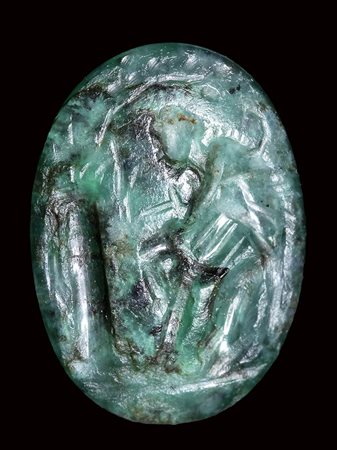
Lotto 159 A roman green chalcedony intaglio. Bucolic scene.
1st- 2nd century A.D.
The scene shows an old male character wearing a large cloak and a stick, seating on a rock in front of a column supporting a vase. Above, branch of fruit. Probably a shepherd in front a votive altar. Groundline.
7x10x2 mm
-
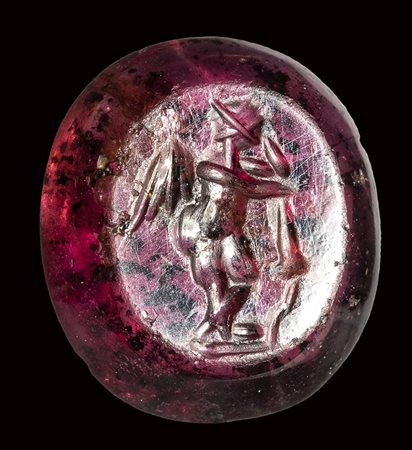
Lotto 160 A roman garnet intaglio. Eros with a torch.
3rd century A.D.
The figure leaning on an overturned torch can be identified both as an erote and as a funerary genius. In fact, the inverted torch symbolizes the sunset of life and the funerary world. Slight wear marks.
11 x 12 x 3 mm. -

Lotto 161 A roman agate intaglio. Fortuna-Tyche.
2nd - 3rd century A.D.
The figure is standing, facing right. With her right hand she holds the cornucopia, with her left the rudder. On the head, a modius. Three-layered agate (magic eye). Slight wear marks with traces of heat.
11 x 14 x 5 mm.
-
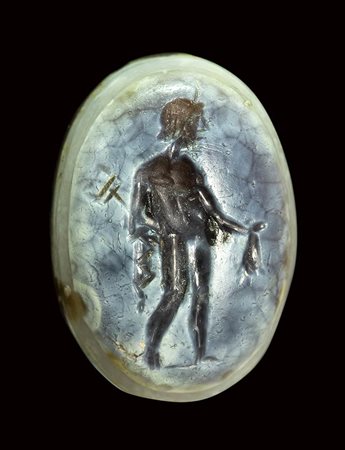
Lotto 162 A roman burnt agate intaglio. Mercury.
2nd century A.D.
The deity faces right. With his left hand he holds the purse with coins, with his right the caduceus. The surface of the stone is slightly burnt.
11 x 15 x 6 mm. -
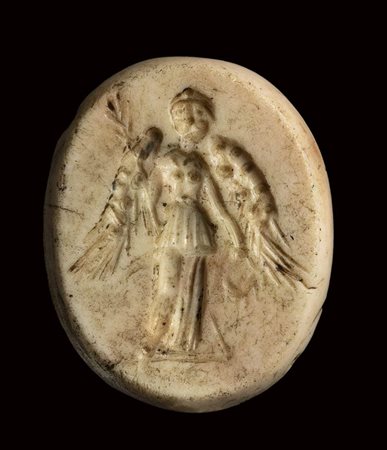
Lotto 163 A roman burnt carnelian intaglio. Victory.
1st century B.C.
The figure is winged, tunicated and depicted frontally. With the right hand she holds a palm branch, with her left a laurel wreath, symbols of victory and triumph. The stone is burnt.
13 x 15 x 2,5 mm. -
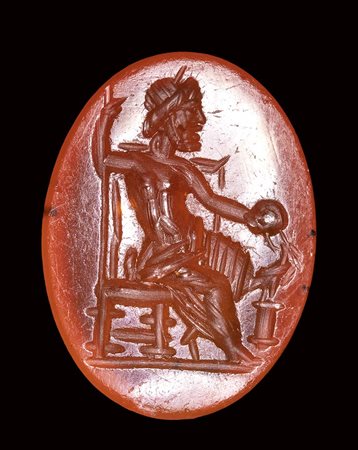
Lotto 164 A roman carnelian intaglio. Seated Zeus.
2nd century A.D.
The god is seated, facing right, holding a scepter in his right hand, and a globe in the left one. At his feet, on a column, an eagle. Groundline. Wear marks.
10x14x3 mm -
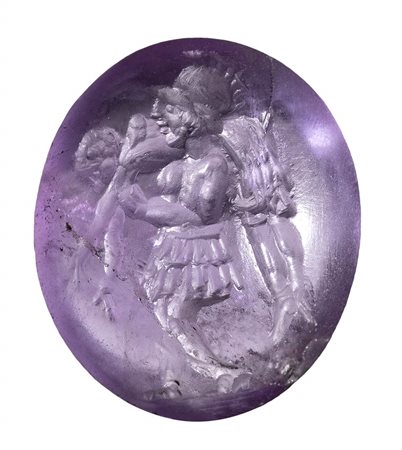
Lotto 165 A roman amethyst intaglio. Two soldiers.
2nd century B.C.
Slightly convex on the engraved side. A standing soldier with crested helmet is carrying the lima body of a dead fellow. Each wears a cuirass over a short chiton. Groundline. Similar gems with same subject referenced and classified as etruscanizing group III by Richter.
Parallel: for a similar depiction see Richter M.A, Catalogue of engraved gems, 2006, pl.XXXIV, 218
14x16x6 mm -
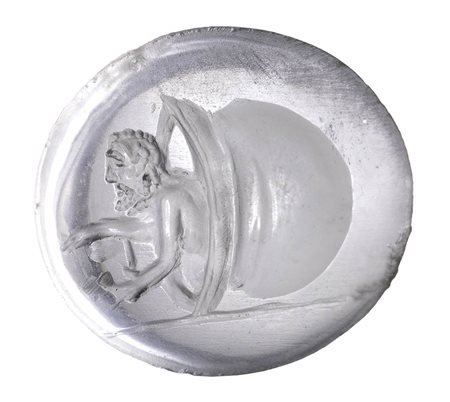
Lotto 166 A roman rock crystal intaglio. Diogenes in his pithos.
1st century B.C.
The old philosopher is shown facing left, the upper part of his body outside from the pithos and holding a papyrus (?). This iconography is linked to the famoust greek philosopher’s lifestyle, far from social conventions and affluence he was renowned for fleeing comfort, sleeping in a simple pithos. Extraordinary work engraved on a very thin gem with the backside slightly cabochon. Parallel: AGDM (Munchen) n. 2757. AGDS Munchen, vol. 2 n. 1007-1008.
13x15x3 mm -

Lotto 167 A roman two-layered agate intaglio. Harpocrates.
2nd - 3rd century A.D.
The figure is standing, to the right. With his right hand he holds the cornucopia, symbol of abundance; the left hand is raised towards the face, in its typical gestures. The effigy, of magical and protective power, is engraved on a large, slightly cabochon two-layered honey agate on a white background. Slight crack at the bottom left.
15x18x6 mm -
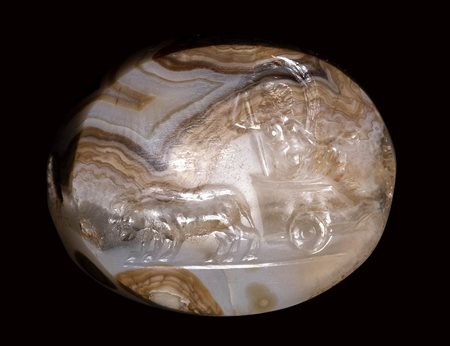
Lotto 168 An eastern roman agate scaraboid engraved seal. The return of Dionysos.
2nd century A.D.
The scene shows Bacchus seated on a chariot pulled by two panthers. Groundline. The god is depicted naked, the lower part of his body covered by a drapery, in his right hand he holds a cup, meanwhile his left hand holds a scepter surmounted by a veil. The style of the depiction suggests that the intaglio is roman, but carved on an more ancient scaraboid seal, probably eastern Greek.
17x21x12 mm
-
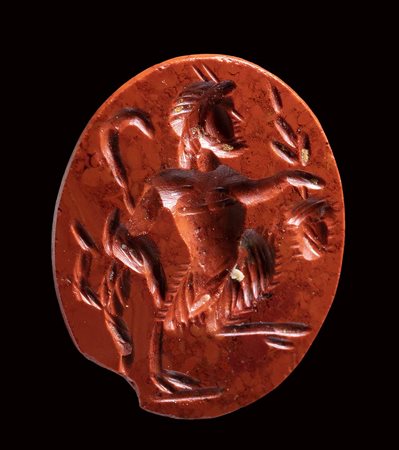
Lotto 169 A roman red jasper intaglio. Pan.
2nd - 3rd century A.D.
The figure steps to the right, lifting its left goat leg. With his right hand he holds a drapery and the pedum; with the left, a bunch of grapes. Subject linked to the Dionysiac sphere. Chip on the edge.
10x12x2 mm -
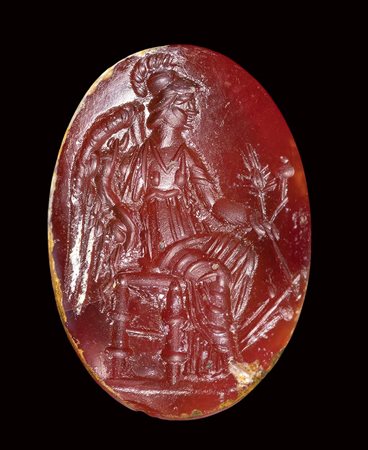
Lotto 170 A roman carnelian intaglio. Pantheistic goddess.
1st - 2nd century A.D.
The pantheistic divinity is seated on a throne, facing right, with numerous attributes: she holds the cornucopia with the left hand, the rudder and the ears of corn with the right. The figure is winged, draped and helmeted. That combination symbolizes the allegorical power of Athena and Fortuna-Tyche. Slight traces of burning.
9x13x4 mm -
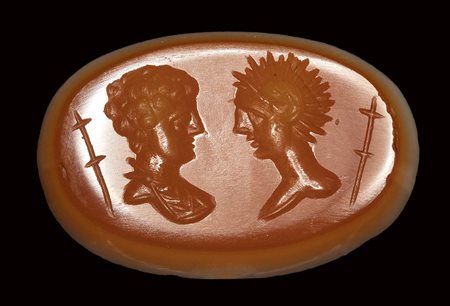
Lotto 171 A roman agate intaglio. Two busts.
2nd - 3rd century A.D.
Two busts face each other: on the left a male figure, draped; on the right, Helios-Ammon. Behind them, a sword (or torch?). Votive intaglio dedicated to the solar cult. Agate with two layers. Slight wear marks.
12 x 19 x 4 mm. -
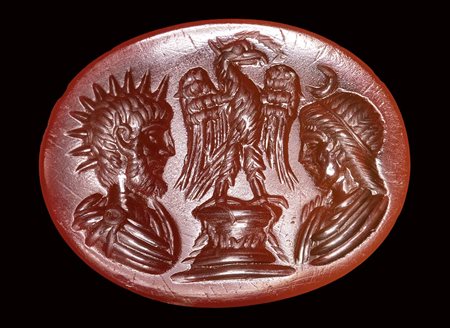
Lotto 172 A roman carnelian intaglio. Two private portraits as Helios and Selene, with an eagle.
End of 1st century A.D. - early 2nd century A.D.
Two busts, one male and bearded, the other female, are shown in profile facing each other, with an eagle perched on a wreathed altar, between them. In the eagle's beak is a wreath. The woman has a chiton and a mantle; on top of the woman's head is a crescent moon. The man also wear a chiton and a mantle; his head is radiated. Late Antonine period. The woman hairstyle reminds Crispina’s, the wife of Commodus. Attractive color of the stone. Slight wear marks. Parallel: G.M.A. Richter, Catalogue of Engraved Gems, The Metropolitan Museum of Art, New York, p. 108 n. 494.
14x17x3 mm -
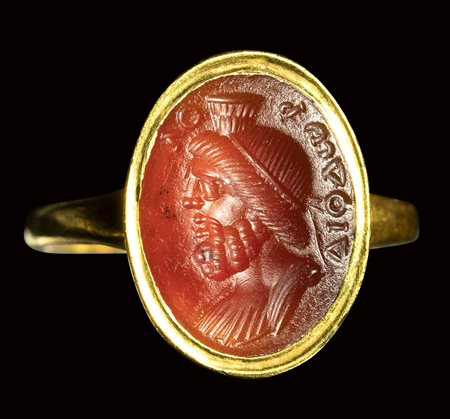
Lotto 173 A fine roman carnelian intaglio mounted in a modern gold ring. Bust of Serapis with greek inscriptions.
2nd - 3rd century A.D.
The modern 22k mounting with rounded hoop, flatten within is extending with broader shoulders and conical box-setting containing a large oval carnelian intaglio. The scene depicts the bust of the god Serapis, facing left. He is characterized by a beard made of curly locks, short hair tided with a band and crowned with a modius. The eye is large and wide-open, the nose is straight and small, the mouth is opened. He wears a draped cloak on his shoulders. Around, greek letters ΔΙΟΔω Ρ ΟΛ. Gold mark inside the hoop.
Parallels: Henig, M., Catalogue of the Engraved Gems and Finger rings in the Ashmolean Museum, no 1.104
Stone 11 x 15 mm; ring size 18 x 19 mm; 5,76 gr. -
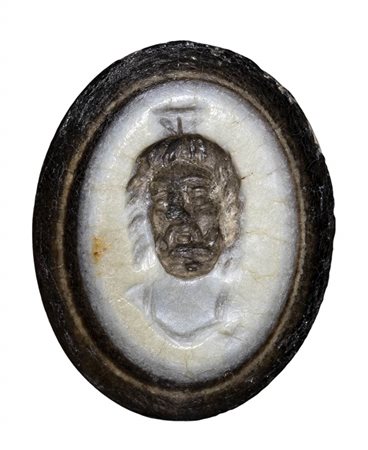
Lotto 174 A roman nicolo intaglio. Frontal bust of Zeus Serapis.
2nd century A.D.
Bust of Jupiter Serapis almost frontal, with the modius on the head and the draped shoulders, deep engraved. Slightly burnt stone. Beautiful execution, inspired by greek models. Slight wear marks.
10x13x3 mm -
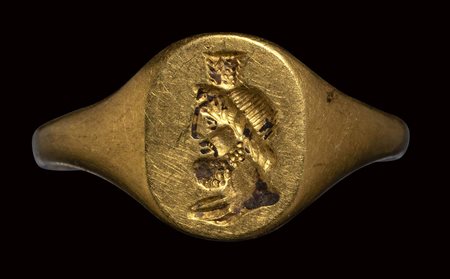
Lotto 175 A roman or later engraved gold ring. Portrait of Zeus Serapis.
2nd century A.D. or later.
The thin rounded hoop is extending with broader shoulders upwards on an oval bezel. Engraved portrait of god Serapis, turned left. He is characterized by a voluminous beard and hair. On top of his head, the modius.
Slight wear marks.
int diam 17 mm; bezel 8x9 mm; 2,42 gr.
-
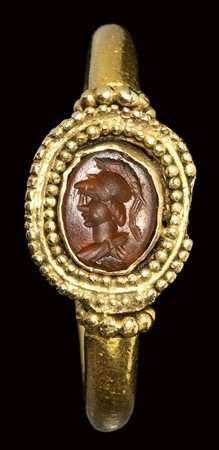
Lotto 176 A roman carnelian intaglio set in an ancient gold ring. Bust of Athena.
3rd century A.D.
The deity is helmeted, with the tunicated bust, facing left. The gold bezel is characterized by a double frame formed by globular elements, also present on the hoop. Wear marks and small lacks in the frame.
Stone 6 x 7,5 mm; ring size 15 x 20 mm; 6,57 gr. -
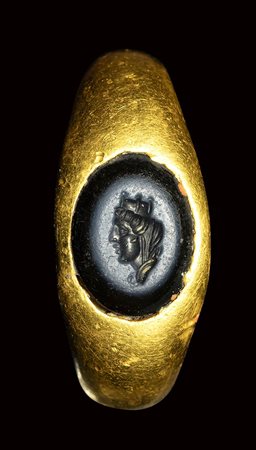
Lotto 177 A roman gold ring set with a nicolo intaglio. Portrait of Tyche of Antioch.
2nd - 3rd century A.D.
With a large massive elliptical hoop and outbroad shoulders extending into an oval bezel set with a nicolo intaglio. The subject is a portrait of Tyche. Facing left, she wears the crown of Antioch, Syria. Her hair partially veiled. Signs of wears on the surface of the stone and the ring. Slight crack on one side of the ring under the bezel.
Stone 0,9 x 13 mm; ring size 13 x 18 mm; 22,54 gr -
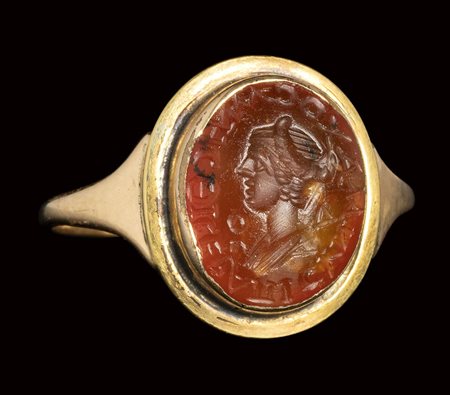
Lotto 178 A roman carnelian intaglio set in a later gold ring. Bust of a Matrona with inscription.
2nd - 3rd century A.D.
Female portrait with draped bust, facing left. The hairstyle refers to the imperial portraits of the second century A.D. The effigy is surrounded by a Greek inscription, probably votive. The gem is mounted in a ring from the Grand Tour era. Excellent condition.
Stone 10 x 13 mm; ring size 16,5 x 18 mm; 2.35 gr. -
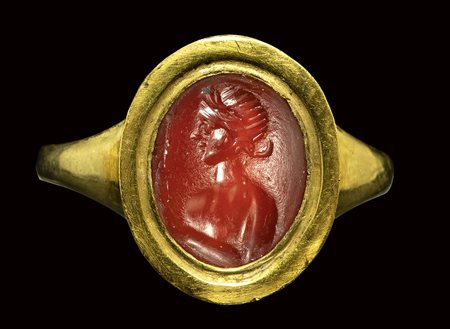
Lotto 179 A roman carnelian intaglio set in a modern gold ring. Bust of Venus.
1st - 2nd century A.D.
The scene depicts the bust of a young woman shows in three-quarters, her face turned left. She is naked, her hair tided back in a bun with a large braid around the face. Her left arm bent is on the foreground, and she seems to hold an accessory in her hand, looking at it, probably a mirror (?). The 18k gold mounting has a massive hoop extending at the shoulders and with a large oval framed box-setting. Slight wear marks on the surface of the stone.
Stone 9 x 12 mm; ring size 17 x 18 mm; 8,84 gr. -
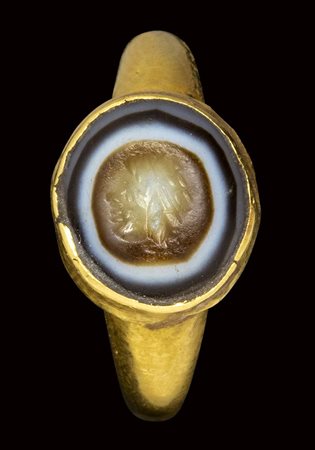
Lotto 180 A roman agate intaglio set in an ancient gold ring. Mask.
2nd - 3rd century A.D.
The theatrical mask is facing left and is characterized by elaborate hair. The subject is engraved on an attractive four-layered sardonyx agate (magic eye). Slight wear marks.
Stone diam 10 mm; ring size 15 x 16 mm; 5.34 gr. -
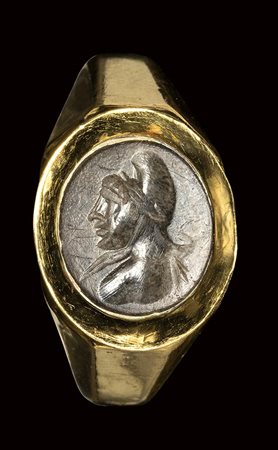
Lotto 181 A roman jasper intaglio set in a modern massive gold ring. Bust of a Phrygian.
2nd century A.D.
The stone depicts a male character turned left. He is characterized by strong features; wide-open eye, straight nose with large nostril and semi-opened mouth. The head is surmounted by a phrygian hat. Probably Ganymede. The massive gold mounting with angular and sided hoop is surmounted by a large oval bezel.
Stone 12 x 14 mm; ring size 18 x 19,5 mm; 21,26 gr. -
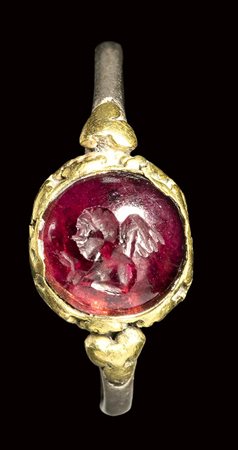
Lotto 182 A late roman bimetallic ring with garnet cabochon intaglio. Eros.
3rd century A.D.
With silver rounded hoop, the shoulders with trefoiled gold beads, and gold rounded bezel set with a garnet cabochon intaglio. The scene depicts a bust of winged eros turned left.
Stone 7 x 8 mm; ring size 16 x 17,5 mm; 2,19 gr. -
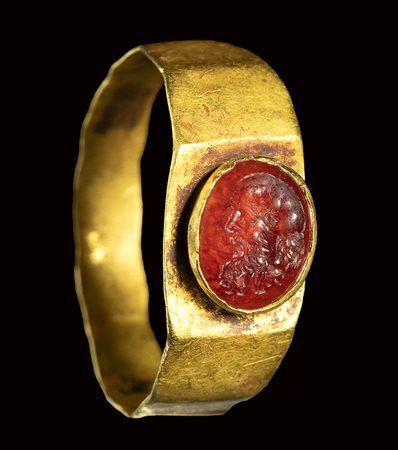
Lotto 183 A roman carnelian intaglio set in a gold ring. Head of a Silenus.
2nd century A.D.
With rounded hoop extending on angular shoulders, the oval box-setting resting on a rectangular plaque and set with a carnelian intaglio. The intaglio depicts the head of a Silenus turned left. The features are characterized by a strong expression, Wide-open eye, raised eyebrow, small large nose and full lips partial covered by a moustache and a very voluminous beard. The shaved skull is framing by wavy hair joining the beard on the back. Nice vivid colour of the stone, and mirror polishing on the engraving.
Stone 7 x 8 mm; ring size 17 x 19 mm; 2,60 gr. -
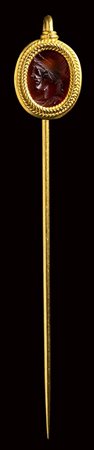
Lotto 184 A roman carnelian intaglio set in a gold stick pin. Apollo.
2nd century A.D.
The intaglio shows the portrait of a male character turned left. He is characterized by young features, wide open eye, straight short nose, semi-opened mouth. He wears a cloak. His hair adorned with a band or tenia. The youthful features and the hair ornament suggest it may be a representation of the god Apollo. Slight wear marks on the surface of the stone. Nice mirror polishing for the engraving. The gold stick pin is composed of a large oval box-setting with three twisted gold wires. Two gold hoops on top of the bezel for the attach of the pin. On the back, open-worked section, with a large oval gold sheet attached to the rest by 8 gold heart-shaped clasps. The style reminds Castellani gold mountings.
intaglio 6x9 mm; overall 10x15 mm; length 70 mm; 3,58 gr. -
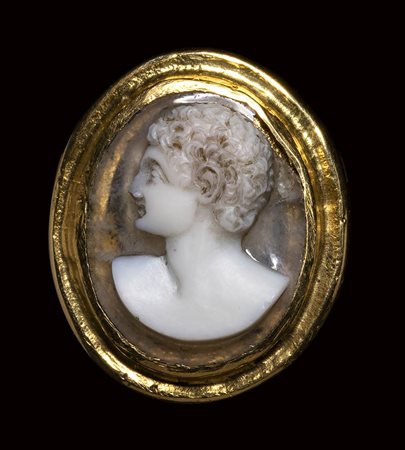
Lotto 185 A roman agate cameo mounted in a gold ring. Male portrait.
2nd century A.D.
The young character is presented in front, his head turned left, with an upraised look. His young features are characterized by short folded hair framing the face with uncovered ear. Aquiline nose (tip of it missing), small full semi-opened lips, with proeminent chin and squared jaw. The gold mounting is composed of a large rounded hoop, flatten within and surmounted by a large oval levelled box-setting. Wear marks.
int diam 20 mm; cameo 15x18x5 mm; 12,05 gr. -
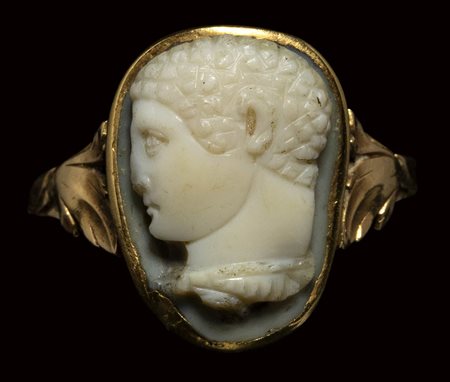
Lotto 186 A fine roman onyx cameo set in a later gold ring. Hercules bust.
2nd - 3rd century A.D.
The hero is facing left, in profile, and is characterized by a curly head and by a large neck, with the leontea wrapped around it. The nose is chipped. The edge was probably reshaped in ancient times. The stone is mounted in a beautiful 18th/19th century chiseled gold ring, with the rod decorated with leaves motifs. Wear marks.
Stone 14 x 19 mm; ring size diam 21 mm; 7,22 gr. -
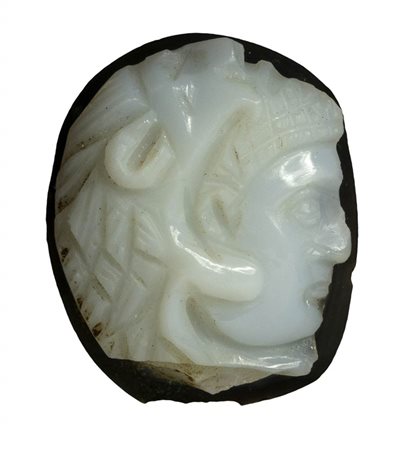
Lotto 187 A roman onyx cameo. Head of Alexander the Great.
3rd century A.D.
The ruler is facing right, with the leontea on his head. Typical iconography of Alexander the Great, after the greek coinage. The cameo is carved in high relief on a two-layered nicolo agate: the portrait in the whitish cerulean part; the background is dark. Small lack at the bottom and chips on the back.
15 x 18 x 10 mm. -
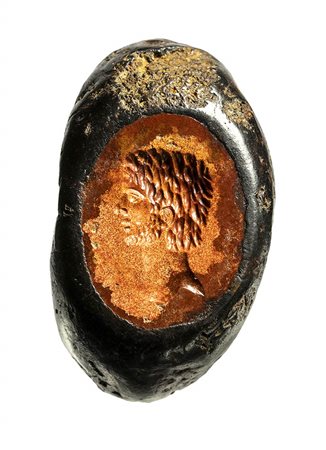
Lotto 188 A roman imperial burnt jasper intaglio set in an iron ring. Male bust.
Late 2nd century A.D.
Beautiful male portrait, facing left, engraved with depth in the stone. The gem has traces of burning and deposits of ferrous oxydes that have penetrated its surface. The stone is still inside its original iron ring, which shows strong corrosion and oxydation. The juvenile portrait is referable to the Severian period, between the period of Pescennio Nigro and Settimio Severo. The fashion of the hair and beard still has influences from the Hadrian and Antonine period, but the stylistic characteristics reveal its belonging more to the end of the second century AD. Fine male portrait, probably a member of the aristocracy in the military elite, near the emperor's family. Rare. Parallel: M-L. Volleinweider, Camées et intailles. Les Portraits romains du Cabinet des médailles. Tome II, p. 115 n. 220, p. 118 n. 225,226 ss.
Stone 13 x 17 mm; ring size 10 x 13 mm circa; mounting 21 x 29 mm circa. 9,74 gr. -
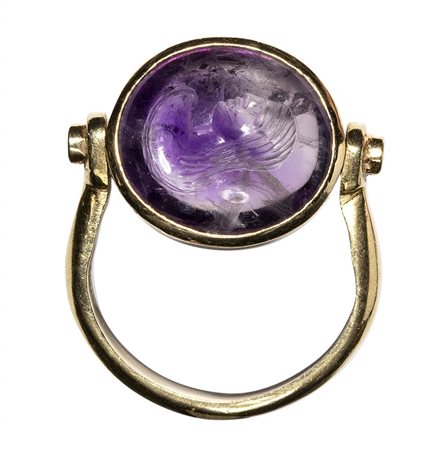
Lotto 189 A roman amethyst intaglio set in a modern gold ring with diamonds. Bust of Nereid.
1st century B.C. - 1st century A.D.
The young figure is turned to the left, and is characterized by a slightly open mouth, rounded chin, long and thick hair. The face, facing in profile, is characterized by delicate features mirror polished. The left shoulder is seen from behind, as in the typical movement of swimming. Use of globulo for the eye. The figure is variously interpreted as Nereid or as Leandro crossing the Dardanelles to reach the lover Ero. By some the subject is interpreted as a marine divinity or Selene. The figure expresses beauty and elegance. Attractive intense color of the stone. Cabochon both side. Slight wear marks. The stone is mounted in a modern gold ring with two diamonds.
Parallels: A. Giuliano, I cammei dalla Collezione Medicea del Museo Archeologico di Firenze, pp. 216-217; L. P. B. Stefanelli, La collezione Paoletti, vol. 1, tomo 2 n. 218, tomo 3 n. 480; Le Gemme Farnese, 1994, p. 122 n. 184 (225); G.M. A. Richter, Engraved gems. Greek, Etruscan and Roman, The Metropolitan Museum of New York, n. 150; J. Boardman, Greek gems and finger rings, n. 1003.
int diam 19 mm; intaglio 14x15 mm; 10,78 gr. -
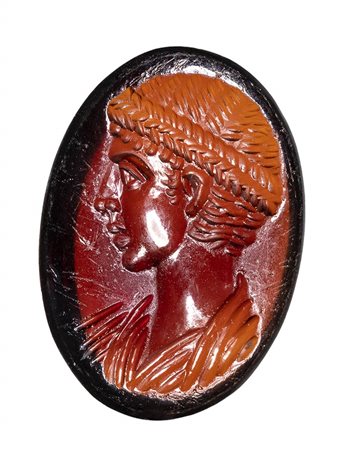
Lotto 190 A fine late roman garnet intaglio. Female bust.
2nd century A.D.
The portrait faces left, and is characterized by a face with youthful features, a draped bust and a refined hairstyle; a large braid surrounds the head in a circular sense, almost forming a diadem that holds the rounded hair. Small locks go down on the forehead and also on the nape of the neck. Although her face is idealized, her youth is emphasized by the sensitive modeling of her smooth, rounded face and high cheekbones. The iconography seems to refer to the 2nd century hairstyle. Probably a portrait of an aristocrat, close to the imperial family. Garnet of extraordinary color and size. Work done with great refinement, mirror polished. Slight wear marks. Parallels: Portrait Head of a Young Woman, A.D. 130/40 Roman Marble; The Art Institute of Chicago, 1960.64, cat. 7.
12x17x3 mm -
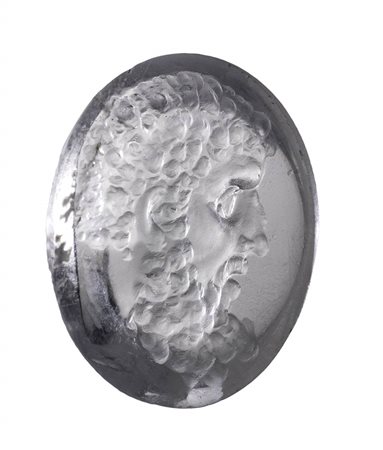
Lotto 191 A fine roman rock crystal intaglio. Head of Hercules.
1st - 2nd century B.C.
The hero is facing right with viril features: thick curly beard and hair framing the face and letting the par uncovered. Eyebrows furrowed, nose wide and straight, and full lips. The style reminds the hellenistic representation of Hercules. Nice engraved polishing and sign of wears on the surface of the stone. Close to the Antonine portraits.
13x14x3 mm
-
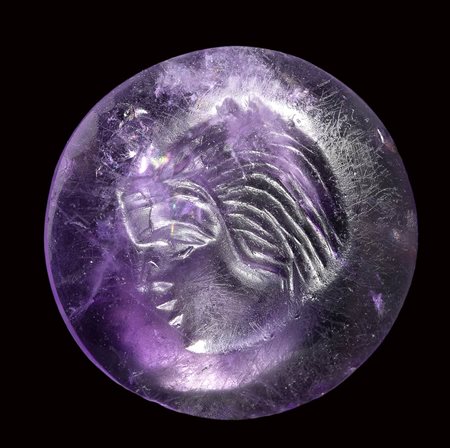
Lotto 192 A fine roman republican amethyst intaglio. Mask.
1st century B.C.
Theatrical mask of a young faun, facing left and placed in the center of the rounded gem. The style, composition and choice of stone refer to the late Republican production. Attractive intense purple color. Slight wear marks.
Diam. 16 mm circa x 3 mm.