
ASTA 107 - Glittica
-

Lotto 49 A late hellenistic carnelian intaglio. Offerer.
2nd century B.C.
The character is depicted frontally, in the act of offer votive offerings. The young figure is tunicated, with a robe that adheres elegantly to the body. Wear marks and abrasions in the field. Rare type.
13 x 17 x 3 mm.
Provenance: UK private collection. -
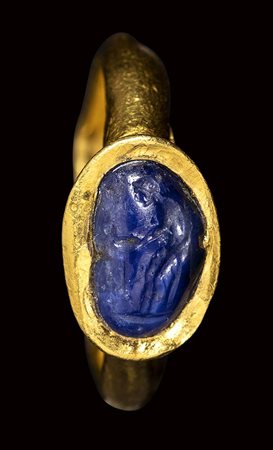
Lotto 50 A rare late hellenistic sapphire intaglio set in a later gold ring. Venus at the fountain.
2nd - 1st century B.C.
The ring with rounded hoop, flatten within, is extending with broader shoulders to an oval raised box-setting containing a rare blue sapphire intaglio. The intaglio shows Venus standing right and bent toward a fountain. Groundline.
The mounting is embossed and with restorations under the bezel. Probably from Alexandria workshops. Rare.
int diam 17 mm; intaglio 6x9 mm; 3,26 grs
-
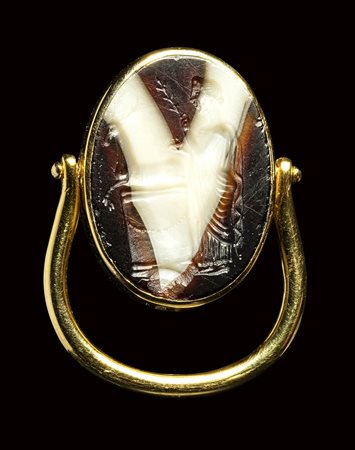
Lotto 51 A large roman italic banded agate intaglio set in a swivel gold ring. Sacrifice to Artemis.
2nd century B.C.
Important italic intaglio set into a collector's heavy swivel ring with a gold impression of the intaglio at its back. The figure has been generally identified heretofore as Diana Nemorensis. This subject may represent Diana Nemorensis or, alternatively, Iphigenia, the founder of Nemi sanctuary togheter with her brother Orestes in the story recounted by Servius (Ad Aen. VI.136). In that depiction, the figure is facing left, wearing a chiton with a himation over it. In her left hand she holds a branch and in her right, a patera. Before her is a garlanded altar, upon which is a deer. Cfr. Martin Henig et al., Classical gems. Ancient and modern intaglio and cameos in the Fitzwilliam Museum, Cambridge 1994, p. 77. Francoise-Hélène Pairault, "Diana Nemorensis. Déesse latine, déesse hellénisée", in Melanges d'Archeologie et d'Histoire, vol. LXXXI (1969), pp. 425-471; AGDI I, II Munchen n. 696 and AGD IV, Hannover, n. 73.
Stone 17 x 22 mm; ring size 16 x 19 mm; 17 gr.
Provenance: european private collection. -
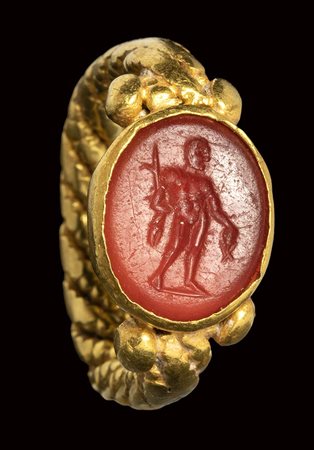
Lotto 52 A roman italic carnelian intaglio set in a barbaric gold ring. Perseus
2nd century B.C. / 5th - 7th century A.D.
The hero is depicted with the frontal body and the head turned in profile to the right. With the right hand he holds the hooked sword, with the right the severed head of Medusa. Groundline. Wear marks. The gem, of Italic production, was formerly reassembled in ancient time into a solid gold ring of barbarian production, with an intertwined rod and spherical elements welded to the bezel. Rare.
Stone 9 x 11 mm; ring size 13 x 15 mm; 7,80 gr.
Provenance: UK private collection. Previously UK private coll. Since 1956. Formed in the 1950s by Mr and Mrs S. Brouka, thence by descent. -
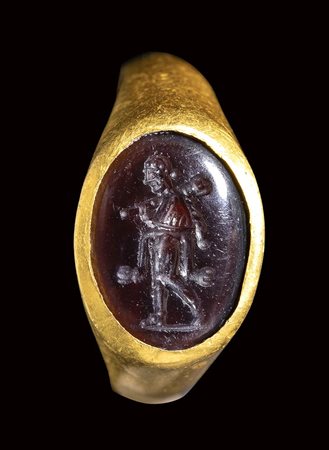
Lotto 53 A late italic garnet intaglio set in a gold ring. Omphale.
2nd - 1st century B.C.
This plain rounded hoop, flatten within and extending outbroad on the shoulders with a ridge. The oval box setting contains a garnet intaglio with engraved scene depicting Omphale walking left with a club on his right shoulders. Groundline.Wear marks.
Int diam 14 mm; stone 6x9 mm; 3,76 gr.
Provenance: UK private collection. -
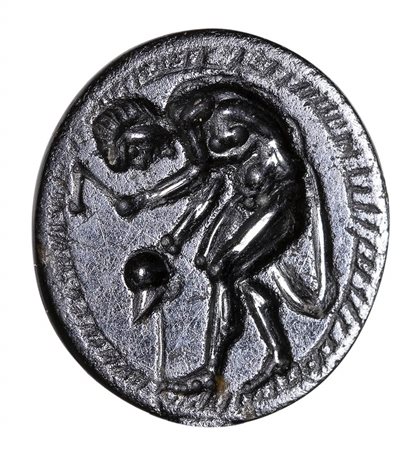
Lotto 54 An early italic black agate intaglio. Blacksmith.
3rd - 2nd century B.C.
The craftsman is intent on making a soldier's helmet; he is facing left, bent forward, and with his left hand he strikes the metal helmet with a tool to forge it. The helmet is inserted into a pole that supports it and acts as a support. Use of globular elements. Dotted frame. Wear marks. Parallel: AGDS, Band I, Munchen, Tafel 23 n. 204 (same subject -etruscan scarab- with variant).
10x11 mm -
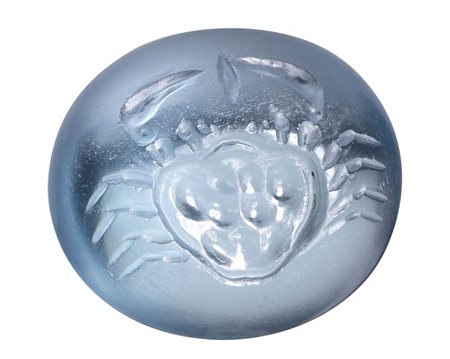
Lotto 55 A rare greek hellenistic beryl intaglio. Crab.
2nd - 1st century B.C.
The crustacean is seen from above. The crab holds a shell (mussel?) between its claws. Every anatomical detail is rendered with great skill and naturalism. Popular and frequent subject in classical glyptic production; the reference model is identifiable to the late classical Greek art. The animal is deeply engraved in an extraordinary beryl, characterized by an intense and luminous color, thanks to the very convex surface. The shape of thr stone is more typical of the early hellenistic period. Wear marks on the surface. Mirror polishing inside the intaglio. Of great rarity. Parallel: See greek coinage: Sicily, Akragas, silver Didrachm (circa 490-470 BC); Akragas, Sicily. Circa 414-413 BC. AR Tetradrachm.
15x16x8 mm
Provenance: London, art market 1990s.
-
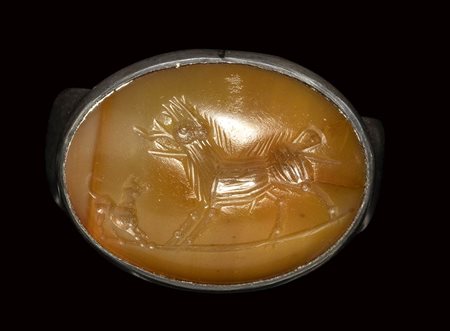
Lotto 56 A roman italic agate intaglio set in a silver ring. Boar with a dog.
2nd century B.C.
On the left, a small dog is facing a large boar, which is on the right. Groundline. Presence of globular elements. Large convex gem, mounted on a post-classical ring with french marks.
Stone 15 x 21 mm; ring size 17 x 18 mm; 12,30 gr.
Provenance: UK private collection. -
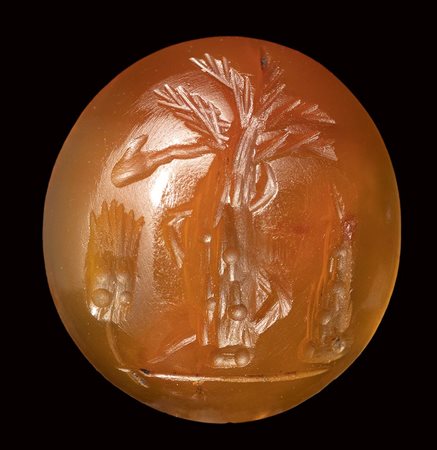
Lotto 57 A roman italic carnelian intaglio. Palm tree with attributes.
1st century B.C.
In the center, a palm tree, on which a snake climbs. On the sides, an ear of corn and a club. Groundline. Allegorical emblem referable to strength and prosperity. Convex gem.
11 x 12,5 x 3 mm. -
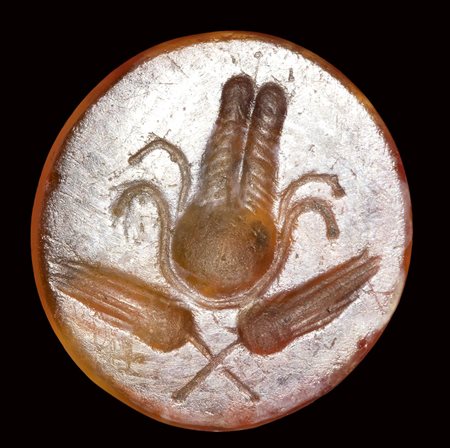
Lotto 58 A roman late republican agate intaglio. Isiac emblema.
1st century B.C.
In the center, the Isiac emblema; below, two crossed ears of wheat. Surface slightly burned. Use of small globular elements.
diam 12 x 2,5 mm.
-

Lotto 59 An italic carnelian intaglio. Standing male figure.
1st century B.C.
The male character is standing in contrapposto, the body in three-quarters, the head facing right. His right arm bent holds a spear (?), meanwhile his left arm a bag (?). He wears an hat or helmet. Presence of globular elements for the face and the body. Groundline. Chip on the edge.
12x16x3 mm -
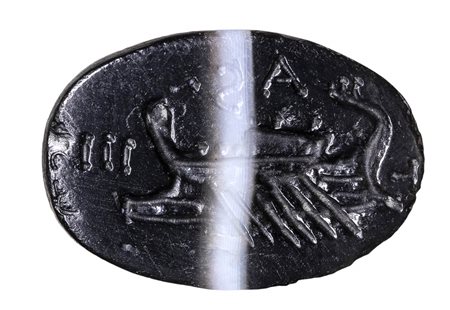
Lotto 60 An italic banded agate intaglio. Warship.
2nd century B.C.
A trireme sailing right, on top two latin letters « SA » preceded by a globe. On the left of the ship the latin number « III ». The inverted direction of the letters suggests that the intaglio was used as a seal. With naval military symbolic. Use of globular elements.
9x13x2 mm
-
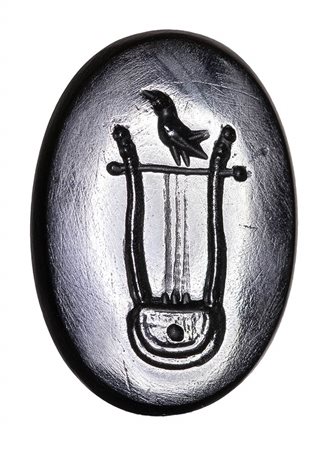
Lotto 61 An italic onyx intaglio. Lyra.
2nd century B.C.
This elegant scene depicts a lyra supporting a songbird. Use of globular elements for the musical instrument and the bird. Symbols of Poetry and inspiration. Slight wear marks.
12x18x2 mm -
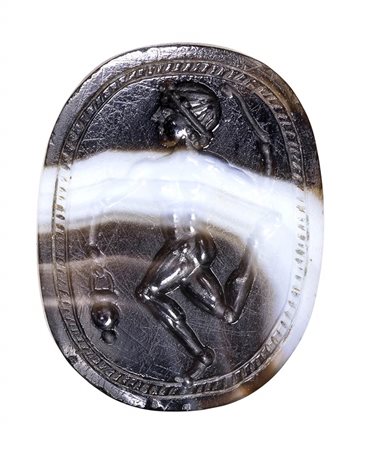
Lotto 62 An italic banded agate engraved scarab. Athlete.
3rd - 2nd century B.C.
The back with naturalistic details and large border and the underside with engraved design: an athlete presented with his naked body in motion, the bust in front, meanwhile legs and head are toward left. Each arm holding a toilet accessory; strigil and an ointment vase. He is characterized by a strong musculature raised with engraved details, thighs and calves. His hair adorned with a band. Hatched border. Use of globular elements typical of the italic productions with an inspiration from the etruscan engraved scarab workshops. Wear marks.
14x18x7 mm -
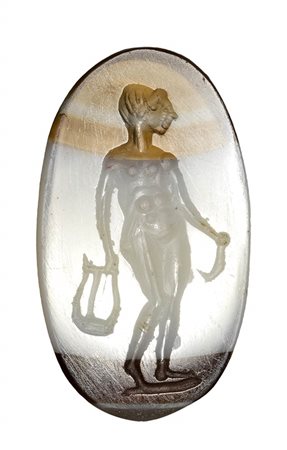
Lotto 63 A large roman italic banded agate intaglio. Male figure with attributes.
2nd century B.C.
The male character is standing, naked and facing right. With his right hand he holds a lyra (?), While with his right a strigil (?). Groundline. Use of globular elements. Typical italic style. Large gem and attractive banded agate variety.
13 x 21 x 3 mm. -
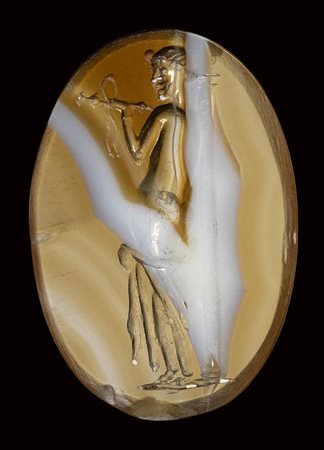
Lotto 64 A large roman italic banded agate intaglio. Venus with a column.
2nd century B.C.
Very fine depiction of Venus, near a column, holding a sword (attribute of Mars). The figure is viewed from behind, slightly in three-quarters. The back and butt are uncovered, while the legs are draped. The architectural element can also refer to a funerary symbolism (monument of a warrior), therefore a votive and commemorative scene of lamentation. Extraordinary agate cut, characterized by a white V-shaped inclusion that follows the composition of the scene. Presence of globular elements typical of italian production. Very fine specimen.
15 x 21 x 1,5 mm.
Provenance: UK private collection. -
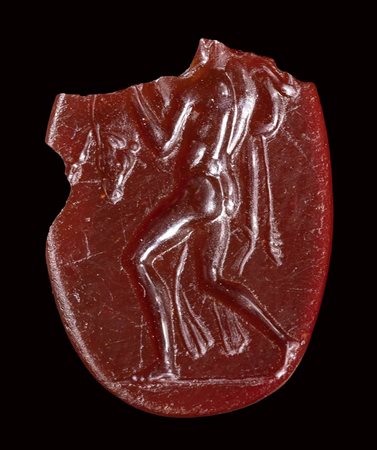
Lotto 65 A fine roman carnelian fragmentary intaglio. Hercules with the bull.
1st century B.C.
Nice fragment with Hercules raising and defeating the Cretan bull. The hero is facing left, depicted with his back seen in three quarters from behind. The legs are spread apart for the effort. Groundline. Beautiful execution, inspired by Greek models. Fragmentary gem with a large miss at the top and a chip on the edge.
11x14x2 mm
Provenance: UK private collection. -
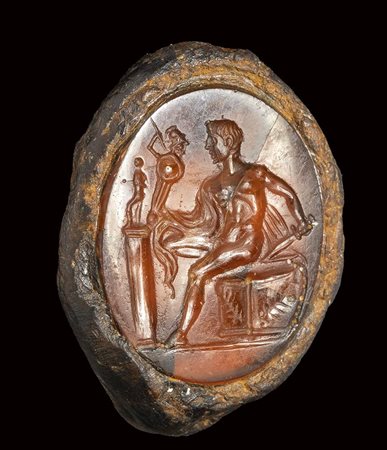
Lotto 66 A fine roman carnelian intaglio set in a fragmentary iron ring. Diomedes with Palladium.
1st century B.C.
The hero is seated on an altar decorated with garlands, facing left. The head is in profile, the torso of three quarters; the right leg is raised with the knee bent and resting on the base, the left leg is stretched and rests on the ground, on the groundline. Diomedes is naked covered on his arm only by a cloak. With his right hand he holds the Palladium, with his left a sword. In front of him, a column with an idol. The scene depicts the famous mythical episode of the Trojan War. The intaglio is executed with great skill and refinement in the anatomical details. Use of globular elements. The gem is still mounted and firmly fixed in its iron ring (fragmentary, without the rod), and is broken inside the setting (probably due to the swelling of the iron over time). Late republican style with greek influences. Parallels: Jean-marc Moret, Les pierres gravées antiques représentant le rapt du Palladion, n. 15(Chatsworth), 19 (La Haye), 103, 116, 180 ss (Cambridge, Hermitage etc.)., 219 (Genève), 221 (British Museum), 225 (Duke of Chatsworth) signed Gnaios, 226 (Chatsworth, Duke of Devonshire), signed Dioskourides, 270 (Coll. Sangiorgi).
Stone 14 x 17 mm; moumnting 16 x 22 mm.
Provenance: UK private collection. -
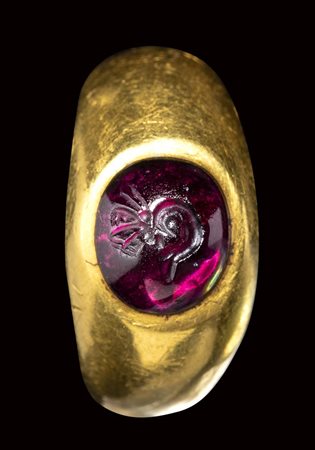
Lotto 67 A roman gold ring set with a garnet cabochon intaglio. Butterfly metamorphosis.
1st century B.C.
Large rounded hoop, flatten within, with outbroad shoulders extending into an oval bezel set with a garnet cabochon intaglio. The scene depicts a butterfly emerging from its chrysalis. Allegory of metamorphosis and rebirth. Deep intense color of the stone. Presence of globular elements. Slight signs of wears on the surface of the ring. Very rare subject.
int diam 15 mm; intaglio 7x8 mm; 4,85 gr.
Provenance: UK art market, London. -
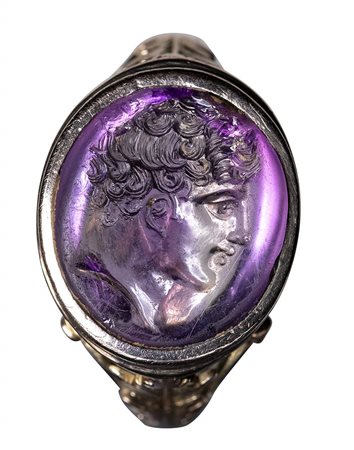
Lotto 68 An exceptional greek hellenistic amethyst intaglio set in a late 19th century gold ring. Head of a Youth.
Stone : 2nd century B.C.
The mounting with rounded leafed-shape hoop extending outbroad in three parts on the shoulders and surmonted by an oval openworked hatched box-setting containing the amethyst intaglio (cabochon on the backside). The young male head is facing right and characterized by very fine features. The face is engraved with very low and delicate volumes; pupil and iris engraved. The hair is formed by deeply engraved locks, with very fine lines. Intaglio made by a greek master. Probably an idealized portrait of a ptolemaic prince. Parallels: for the style, the anatomycal features and the portrait's typology see M-L. Vollenweider, Camées et intailles. Tome I, Les Portraits grecs du Cabinet des médailles pl. 67 n. 123, 124, (La dynastie des Ptolémées)
Stone : 13x14x5 mm; int diam 19 mm; 2,89 gr.
Provenance: UK private collection, from the english art market. From a 19th century collection based on the mounting. -
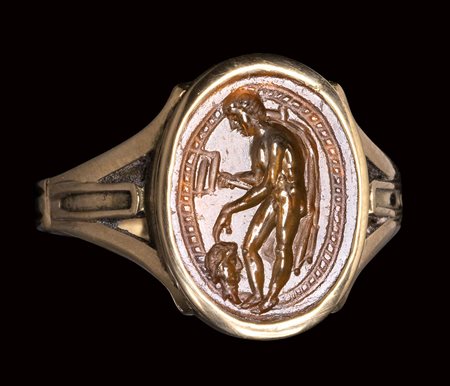
Lotto 69 An italic sard intaglio set in a gold ring. Hermes psychopomp.
2nd century B.C.
The standing god is facing left and slightly bent toward the ground. He is naked, his back covered by a cloak. His right hand holding the caduceus meanwhile with his left hand, the fingers delicately touch a male head, probably a deceased one that he must bring to the Underworld. This scene shows Hermes in his function of Psychopomp, the one that guides the death souls. This subject is probably referred to the Pythagoreanism. Use of globular elements. Hatched border. Nice polishing for the engraving, and signs of wears on the surface. The late 19th/ early 20th century gold mouting is made of a rounded hoop dividing in three sections on the shoulders and extending onto an oval box-setting with thin incised grooves. Parallels: AGDS, n. 60; AGDS Berlin n. 299. AGKM (Kunst, Wien) n. 126. G.M.A. Richter, Catalogue of engraved gems, The Metropolitan Museum of Art, New York, n. 225-226. AGDS Munchen, vol. 2 n. 723.
Int diam 19 mm; stone 10x13 mm; 6 gr.
Provenance: UK private collection. -
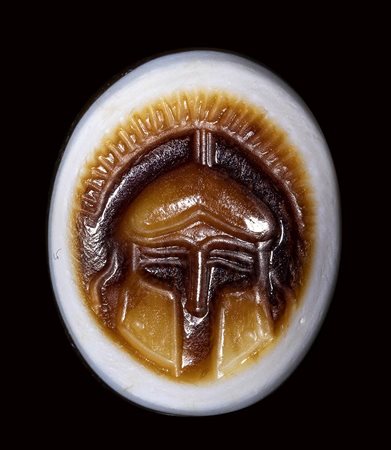
Lotto 70 Frontal helmet with crest. Pierced lenghtwise. Wear marks. Beautiful three- layered sardonyx.
3rd - 2nd century B.C.
Frontal helmet with crest. Trough hole. Wear marks. Beautiful three layers sardonyx. Parallel: greek coinage cfr. Thrace. Mesembria. Diobol. s. IV BC. (SNG BM Black Sea-268/271). (Topalov, Messambria-8). (Karyatov I-37/38). Anv.: Frontal helmet. Rev.: wheel with META within the spokes and radiant lines on the edge.
15 x 19 x 8 mm
Provenance: UK private collection.
-
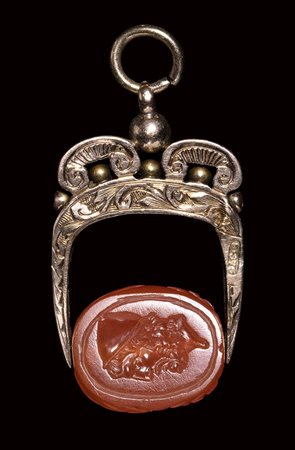
Lotto 71 A late italic carnelian engraved scarab set in a 19th century gold mounting. Head of Ulysses.
2nd century - 1st century B.C.
Bearded head of Ulysses with the pileus, facing left. Use of small globular elements for the nose, mouth, eyes and termination of the neck and the hat. Expressive and well engraved face despite the small dimension of the gem. Linear frame engraved around the effigy of the greek hero. Chip on the back of the beetle. Through hole. Slight wear marks. The stone is mounted on a swivel and chiseled 19th century gold seal. Rare subject.
Stone 10 x 12 x 8 mm; H. 28 mm; 3 gr.
Provenance: UK private collection.
-
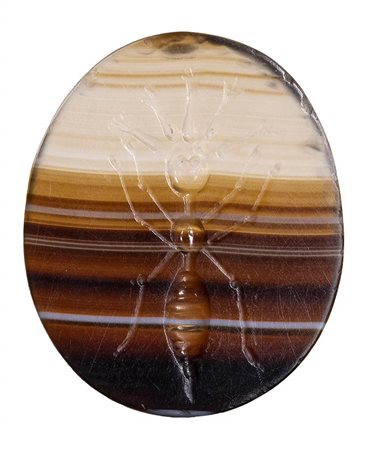
Lotto 72 A large italic banded agate intaglio. Ant.
2nd century B.C.
The large stone depicts an ant with naturalistic details engraved with great skills. Above her head, five radiated grains of wheat. Presence of globular elements on the head, the thorax and the legs of the insect. Signs of wear on the surface. Parallels: The Cornell Universit, plaster cast collection, database n. 51. Rare.
16x19x2 mm
-
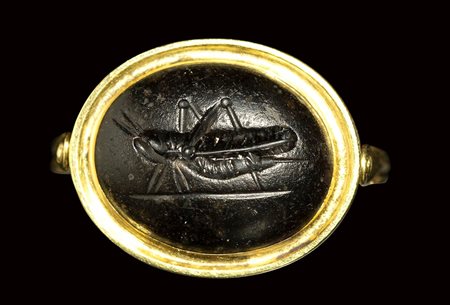
Lotto 73 A roman dark agate intaglio set in a gold swivel ring. Grasshopper.
1st century B.C. - 1st century A.D.
Fine depiction of the insect, facing left. Use of globular elements. Groundline. Slight wear marks. 18th - 19th century swivel mounting.
Stone 11 x 14 mm; ring size 16,5 x 18 mm; 2,93 gr
Provenance: UK private collection D.C.
-
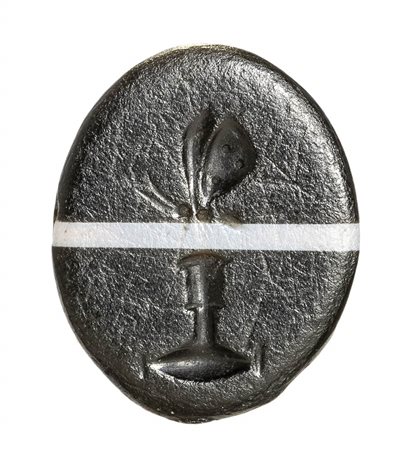
Lotto 74 A roman banded agate intaglio. Allegorical emblema with a butterfly.
1st century A.D. - 1st century B.C.
Very fine and elegant allegorical emblem with a butterfly resting on an object to be identified (ampoule?). Slight wear marks.
8 x 10 x 2 mm. -
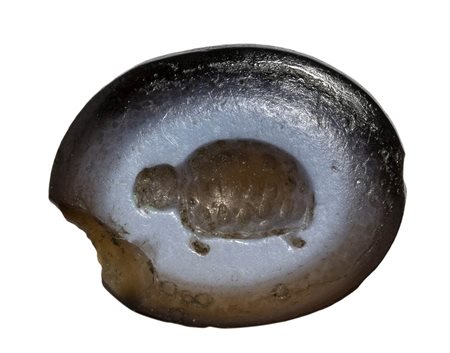
Lotto 75 A roman nicolo intaglio. Turtle.
1st - 2nd century A.D.
The animal is facing left, and is characterized by a rounded head that comes out of the shell, and two small visible legs. Missing on the edge and wear marks. Rare.
7 x 9 x 2 mm. -
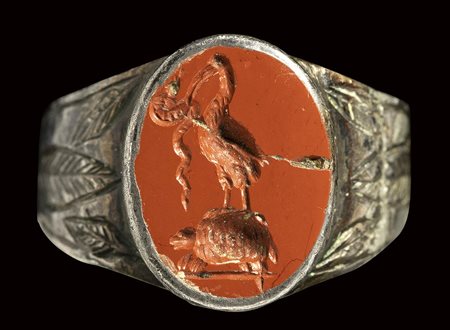
Lotto 76 A roman red jasper intaglio mounted on a silver ring. Ibis on a turtle with a snake.
2nd century A.D.
The oval stone is depicting an ibis standing and turned left catching/eating a snake with its beak. He is standing on top of a turtle. Groundline. The references to the god Mercury are various in this scene— the ibis bird, also known as the animal representation of the god Thot, egyptian pendant of Hermes; the turtle closely linked to Hermes and seen as his animal-attribute (Hermes made the first lyre with a turtle’s shell, see Homeric Hymn to Hermes, 24-61).
Early 20th century silver mounting, the shoulders decorated with engraved leaves. Published in: Theodora Hadzisteliou Price, "An Ionian Silver Ring with Sard" in Antike Kunst, 15, 1972, pp. 60-63.
Stone 10 x 12 mm; ring size 17 x 18 mm; 3,50 gr.
From the old collection of Prof. Constantine Athanasius Trypanis (1909-1993), found on the lands of his father Athanasius G. Trypanus in 1905. -
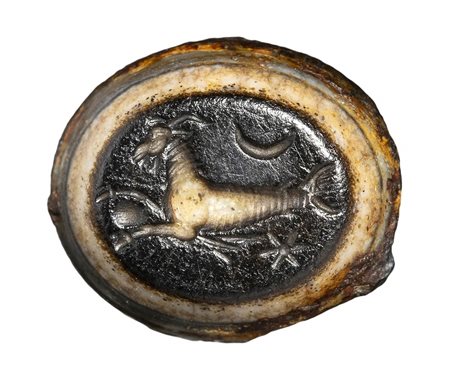
Lotto 77 A roman agate intaglio. Seagoat with astrological attributes.
1st century A.D.
The sea creature to the left, holding the globe in its paws. Above, a crescent moon; below, a star. Astrological intaglio engraved on a layered agate. Traces of the ancient iron mounting. Wear marks.
10 x 12 x 4 mm. -
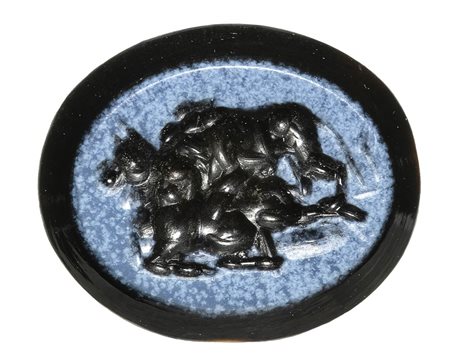
Lotto 78 A roman nicolo intaglio. Hunting scene.
2nd - 3rd century A.D.
A lion attacks a bull, biting him on the shoulder and assaulting him from behind. The mighty quadruped folds his legs to the ground as a sign of defeat. Scene inspired by greek models.
10 x 12 x 2 mm.
Provenance: UK private collection. -
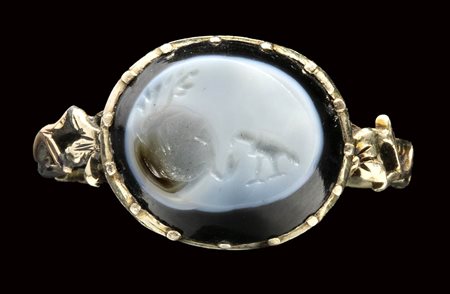
Lotto 79 A rare nicolo agate intaglio set in a gold ring. Allegorical scene with animals.
1st - 2nd century A.D.
A snake emerges from a snail shell (or sea shell) and opens its mouth wide against a parrot. The bird is there in front of the shell. Behind, a branch of a tree. Rare scene. The gem is mounted in an elegant chiseled gold ring with floral and plant motifs, dating to the 19th century.
Stone 11 x 13 mm; ring size 15 x 18 mm; 3,07 gr.
Provenance: UK private collection. -
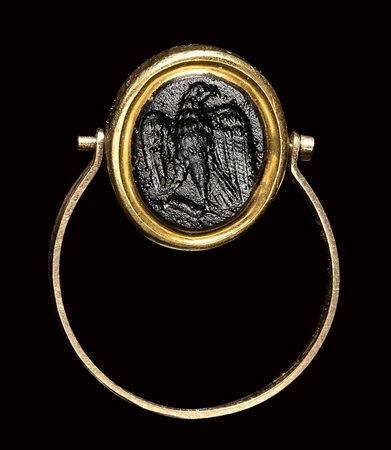
Lotto 80 A roman dark glass paste intaglio set in a gold swivel ring. Eagle.
1st - 3rd century A.D.
The animal is depicted frontally, with its wings open and the head turned in profile. With his claws he grabs a boar's head. Emblem of imperial military power. Wear marks. Little missing on the mounting. Parallel: For a same glass paste intaglio see Metropolitan Museum of Art database, inv. n. 17.194.56.
Glass 10 x 11 mm; ring size 17 x 18 mm; 2,53 gr.
Provenance: UK private collection. -
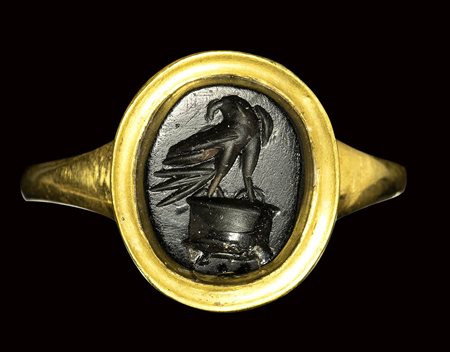
Lotto 81 A roman obsidian intaglio mounted on a modern gold ring. Eagle on altar.
2nd century A.D.
The scene depicts an eagle standing on an altar. His head turned left. Chips on the edge of the stone.
The mounting made in 18k gold, with rounded hoop extending in broader shoulders with an oval box-setting.
Stone 10 x 12 mm; ring size 18 x 19 mm; 7,26 gr.
-
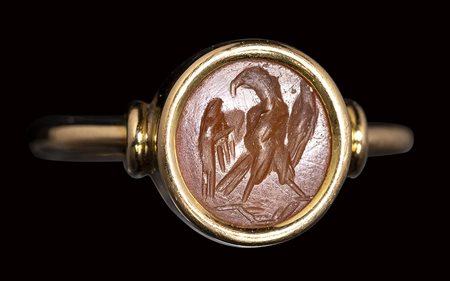
Lotto 82 A roman carnelian intaglio set in a gold ring. Eagle.
2nd - 3rd century A.D.
The intaglio shows an eagle in front, his head turned left with widespread wings. The gold mounting is with rounded hoop extending on the shoulders with terminal tubular endings and rounded box-setting. Presence of a hallmark on the hoop.
int diam 19 mm; intaglio diam 10 mm; 6,03 gr. -
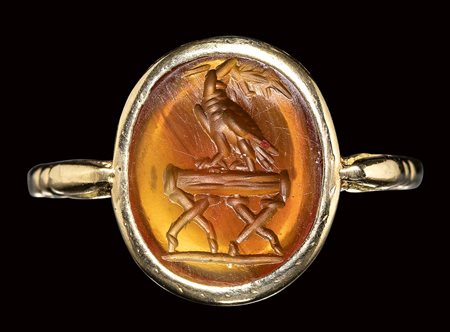
Lotto 83 A roman carnelian intaglio mounted on a modern gold ring. Eagle on a stand.
2nd century A.D.
The intaglio shows an eagle with the head turned right holding a laurel branch in its beak. He is standing on a crossed-legs stand. Allegory of military power of the roman Empire. Slight wear marks on the surface of the stone. The gold mounting is with rounded hoop, within two spherical beads on each side. The shoulders with engraved lines are ending in foliage. The rounded box-setting with engraved leaves motifs. Hallmark on the hoop.
int diam 19 mm; intaglio 10x11 mm; 2,56 gr.
-
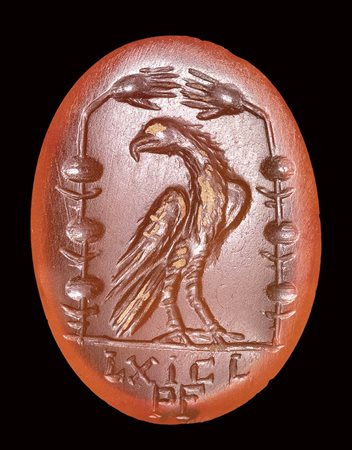
Lotto 84 A roman carnelian intaglio. Emblema of victory with eagle and latin letters.
2nd century A.D.
The stone shows an eagle, his body turned right meanwhile his head is turned left. Framed by two military standards. Groundline. Beneath, two rows of latin inscription « LXICL » « PF ». Military victory emblema.
12x16x3 mm -
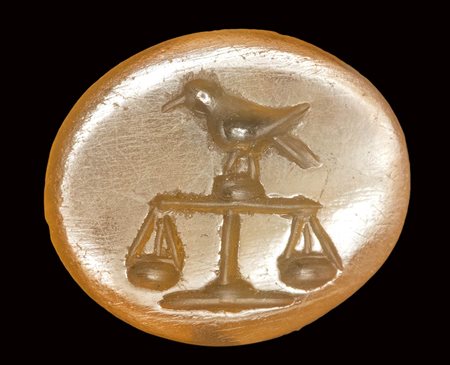
Lotto 85 A roman carnelian intaglio. Bird on a scale.
2nd - 3rd century A.D.
A bird stands on a scale, symbol of the Harmony and of the Justice, allegory of Balance. Rare iconography.
9,5 x 12 x 2 mm.
Provenance: UK private collection.
-
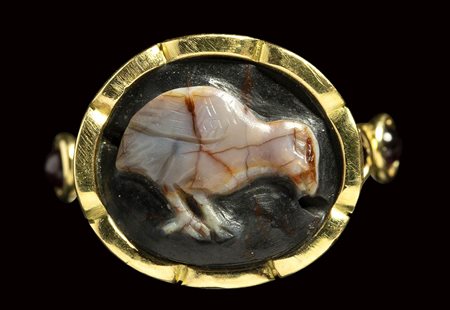
Lotto 86 A rare agate cameo set in a modern gold ring. Partridge.
2nd - 3rd century A.D.
The bird is facing right, with its head slightly lowered forward. The engraver masterfully used the polychrome clear layer over a dark background with naturalistic purpose. The colors of the stone imitate the plumage and cartilages of the bird. Little missing on the edge, as the stone was pierced as a bead. Parallel: for the same subject, on the same stone with the same style see U. Pannuti, Catalogo della collezione glittica vol II, Napoli, Museo Nazionale, pp. 281-283 (Farnese Collection).
Stone 13 x 16 mm; ring size diam. 18 mm; 11,83 gr. -
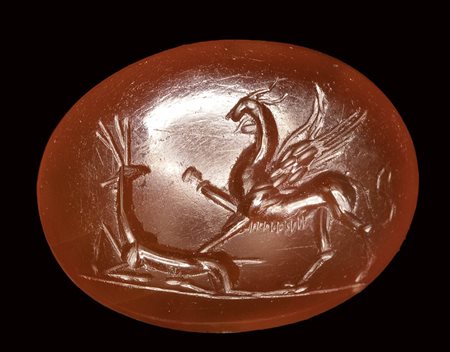
Lotto 87 A roman carnelian intaglio. Griffin with deer.
2nd - 3rd century A.D.
The hunting scene consists of a winged griffin attacking a deer that has fallen to the ground. The composition is inspired by classical Greek models. Groundline. Slight wear marks.
13 x 18 x 6 mm. -
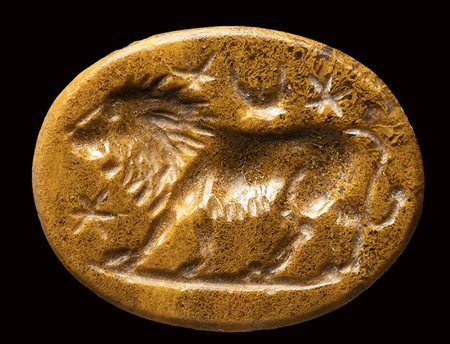
Lotto 88 A roman yellow jasper magical intaglio. Lion with moon and stars.
2nd - 3rd century A.D.
The mighty feline walks to the left, surrounded by three stars and a crescent moon. The astrological attributes denote the magical character of the gem. The presence of the breasts reveal that she is a lioness. Groundline. Slight wear marks.
11 x 15 x 3 mm. -
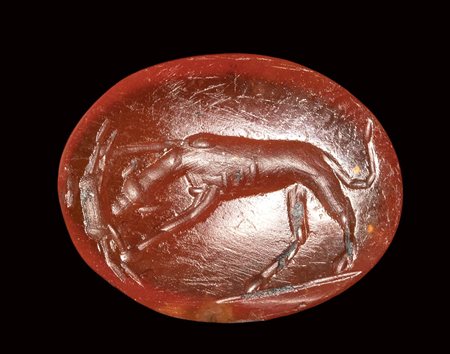
Lotto 89 A roman carnelian intaglio. Dog with prey.
1st - 2nd century A.D.
Hunting scene composed of a dog biting a hare. Groundline. Attractive color of the stone. Slight wear marks.
9,5 x 12 x 3 mm. -
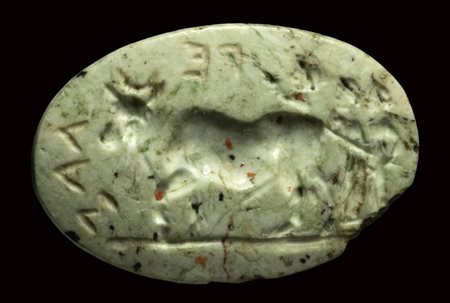
Lotto 90 A rare burnt chalcedony intaglio. Ritual procession with Apis.
1st - 2nd century A.D.
The bull characterized by a crescent moon on its head can be identified as Apis, the Egyptian deity, the sacred bull son of Hathor. Behind him there are three characters as in a sacral procession. A figure points up towards an inscription (to be identified). The stone is burnt and has a lack on the edge. Rare iconography referable to the Isiac cults in Rome.
8 x 12 x 3 mm. -
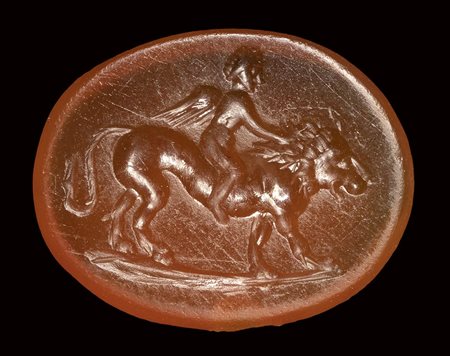
Lotto 91 A roman carnelian intaglio. Eros on a lion.
1st - 2nd century A.D.
The mighty feline walks to the right, carrying a winged erote on its back. The erote grabs the lion's mane to hold on. Groundline. Allegory of love that subdues the strenght. Slight wear marks.
12 x 15 x 3 mm. -
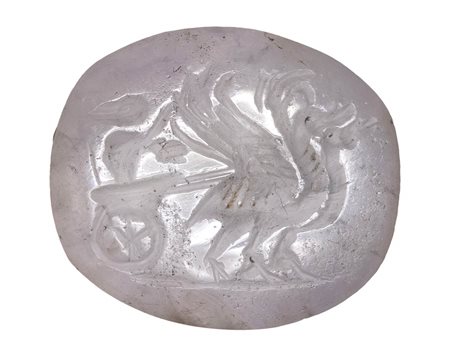
Lotto 92 A roman rock crystal intaglio. A mouse riding a chariot with swans.
2nd century A.D.
The scene depicted shows a mouse riding a chariot toward right, with two swans. The movement is rendered by the widespread wings and the raised heads of the swans. Groundline. AGDS Munchen, vol. 2 n. 918-919.
12x14x5 mm -
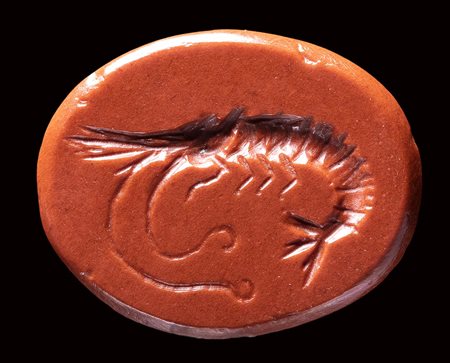
Lotto 93 A roman red jasper intaglio. Shrimp.
1st century A.D.
Shown in profile to the left, the crustacean with its inwardly curved tail is engraved in great detail and naturalism. Slight wear marks.
Provenance: English art market.
12x15x3 mm
-
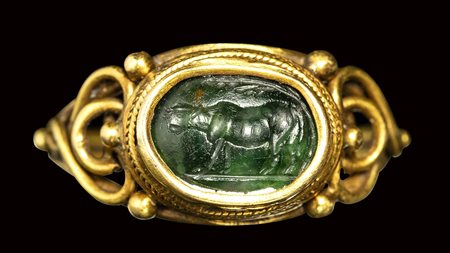
Lotto 94 A roman green chalcedony intaglio set in a gold ring. Heafer under a tree.
2nd century A.D.
The animal is facing left. Beautiful color of the stone, set in a close collet with ropetwist details, openwork, love knot shoulders and double wire shank. Published: Diana Scarisbrick for S.J. Phillips Ltd, The Wellington Gems. (Catalogue) published on the occasion of the exhibition June 8-10, 13-17, London 1977, cat n. 14: "Gold ring with bloodstone (sic) intaglio. A cow. Roman".
Stone 7 x 9 mm; ring size 17 x 18 mm; 4,90 gr. -
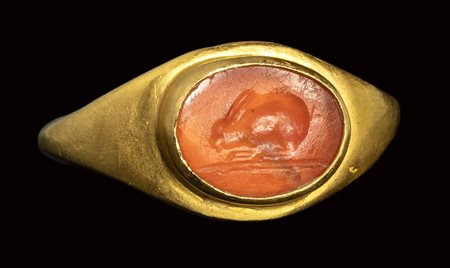
Lotto 95 A roman carnelian intaglio set in an ancient gold ring. Rabbit.
2nd - 3rd century A.D.
The animal is facing left. Groundline. Wear marks. D section hoop with flared shoulders.
Stone 8 x 11 mm; ring size 15 x 19 mm; 5,65 gr. -
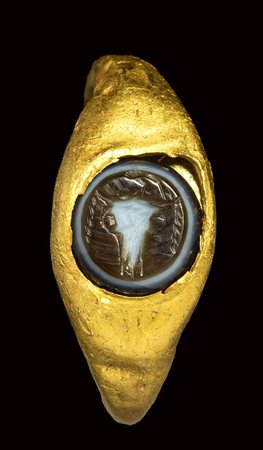
Lotto 96 A roman gold ring set with a three-layered agate intaglio. bucrane.
1st - 2nd century A.D.
Rounded hoop with broader shoulders and rounded box-setting containing a three-layered agate intaglio. Bucrane seen in front with garlands. The mounting presents some shocks and the box-setting seems to be wider than the intaglio. Although both elements are genuine and ancient, the mounting does not seem belonging to the intaglio.
Stone diam. 8 mm; ring size diam. 18 mm; 3,71 gr.