
ASTA 107 - Glittica
-
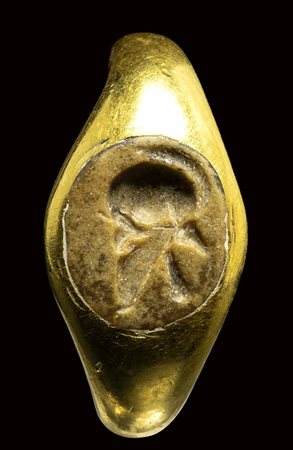
Lotto 97 A roman jasper intaglio mounted in a later gold ring. Helmet.
1st - 2nd A.D.
The crested helmet is formed with a wild boar’s head. The gold mounting is with rounded hoop, flatten within and extending at the shoulders with an oval bezel. Signs of use on the surface of the stone.
Stone 9 x 11 mm; ring size 17 x 19 mm ; 8,03 gr
-
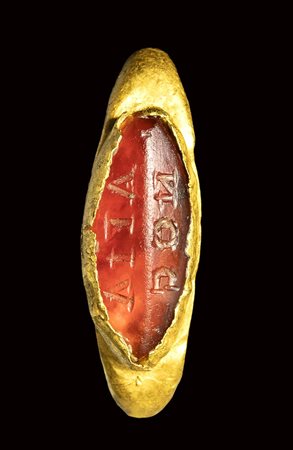
Lotto 98 A late roman gold signet ring set with a carnelian intaglio. Greek letters.
Early 3rd century A.D.
This hoop, expending suddenly at the shoulders, above a thin elongated almond-shaped box setting containing a carnelian intaglio with greek letters (probably a name) : Α P Ι A Ν Ο C . Arianos is a fairly common Greek name; there is a Greek general by that name and an early Christian saint. Damages on the edge of the box setting. Slight chip on the edge of the intaglio.
Stone 6 x 13 mm; ring size 12 x 14 mm; 2,62 gr. -
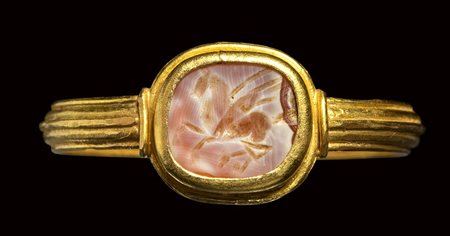
Lotto 99 A roman burnt agate intaglio set in a gold ring. Pegasus.
2nd century A.D.
Thick hoop, facetted; oval box setting with an burnt agate intaglio depicting Pegasus, the winged horse, flying left.
Stone 7 x 8 mm; ring size 18 x 20 mm; 3,10 gr. -
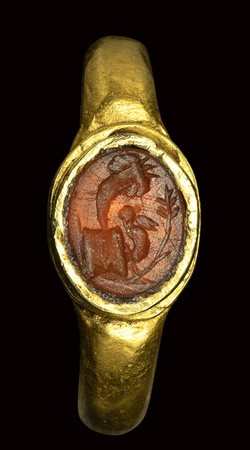
Lotto 100 A roman carnelian intaglio set in a gold ring. Allegorical emblema.
2nd century A.D.
Hoop rounded without and within extending on the shoulders with embossed angles. The box-setting made of two oval levels containing a carnelian intaglio depicting a cornucopia, a basket (kalathos), a mouse (?) holding a grape, a branch. Allegory of abundance and prosperity. Slight wears marks on the surface of the stone.
Stone 7 x 9 mm; ring size 17 x 18,5 mm; 7,04 gr. -
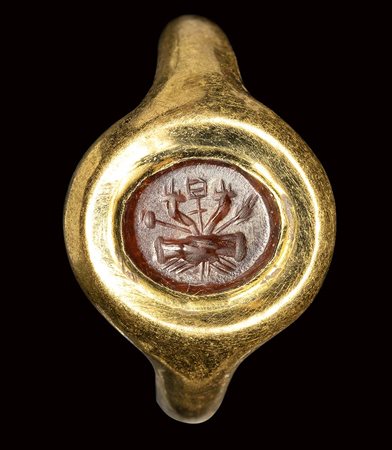
Lotto 101 A roman carnelian intaglio set in a gold ring. Dextrarum Junctio.
2nd century A.D.
The stone is engraved with two clasped hands (dextrarum junctio), with two cornucopiae, ear of corn, and poppy flower. In the center, emerging, a caduceus. Allegory of abundance and luck in union.
The gold mounting is massive with rounded hoop, and large oval bezel. Sign of use on the surface of the stone and wear marks on the surface of the mounting.
Stone 8 x 10 mm; ring size 20 x 23 mm; 4 gr. -
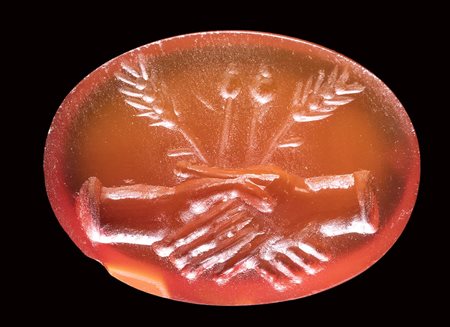
Lotto 102 An italic carnelian intaglio. Dextrarum junctio.
1st century B.C. - 1st century A.D.
The scene depicts two hands clasping and holding poppy flowers and ears of corn. Wear marks.
12x17x4 mm -
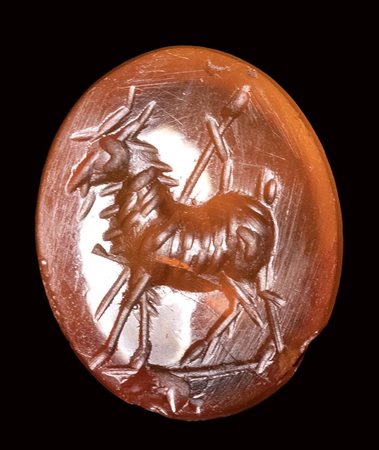
Lotto 103 A roman carnelian intaglio. Goat with thyrsus.
1st century A.D.
The goat is facing left , behind her the thyrsus. Groundline. Dionysiac symbolic emblema.
8x10x3 mm -
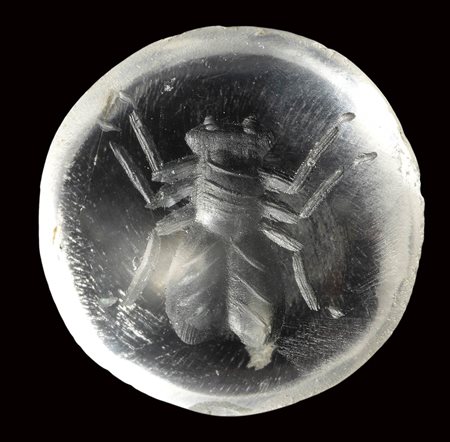
Lotto 104 A roman rock crystal intaglio. Fly.
1st - 2nd century A.D.
The insect is seen from above and is engraved on a lenticular gem of beautiful brightness and transparency. Slight wear of marks.
Diam. 12 x 4 mm. -
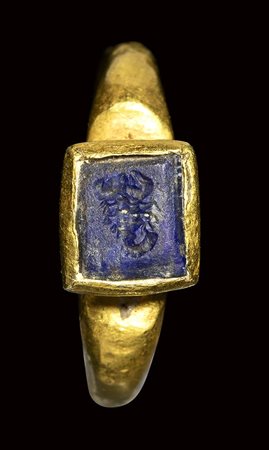
Lotto 105 A late roman gold ring set with a lapis lazuli intaglio. Scorpio.
3rd century A.D.
With rounded hoop, extending on high-raised shoulders and with a hollowed neck. The high raised rectangular box setting is set with a lapis lazuli intaglio depicting a naturalistic scorpio. Possibly with astrological meaning. Wear marks.
Stone 5 x 6 mm; ring size diam 15 mm; 1,80 gr. -
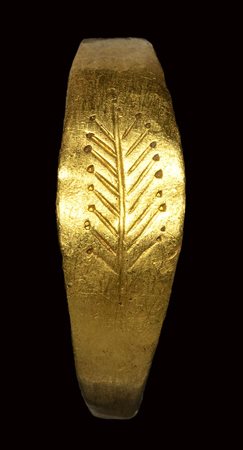
Lotto 106 A roman gold ring engraved with palm branch.
2nd century A.D.
With rounded hoop, flat within, extending with a broader bezel, engraved with a stylized palm branch.
Parallel: British Museum, inv. AF.208
ring size 18 x 19 mm; 1.90 gr. -
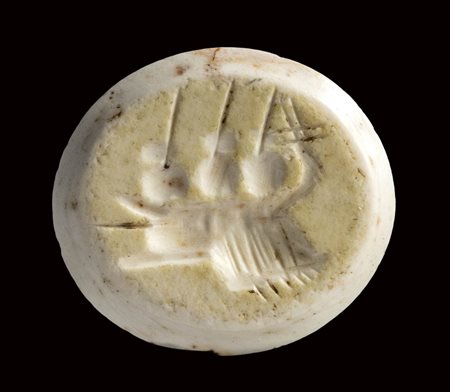
Lotto 107 A roman burnt agate intaglio. Warship.
2nd - 3rd century A.D.
Warship, with rostrum and aplustre, facing left. Above, three stylized hoplites armed with shields and spears. Burnt stone.
10 x 12 x 2 mm. -
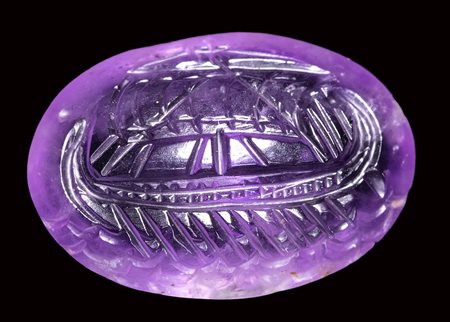
Lotto 108 A roman amethyst intaglio. Warship.
1st century A.D.
Trireme sailing left, the pars lowered, billowing sail by the wind, the waves finely depicted. The iconography refers to early roman coinage as the depictions of Pompey naval victories on silver denarii. Double cabochon. Attractive color of the stone.
10x14x5 mm