
ASTA 107 - Glittica
-
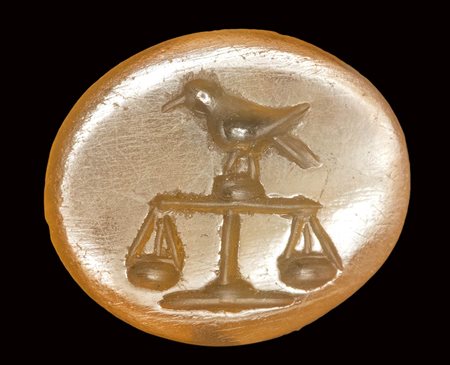
Lotto 85 A roman carnelian intaglio. Bird on a scale.
2nd - 3rd century A.D.
A bird stands on a scale, symbol of the Harmony and of the Justice, allegory of Balance. Rare iconography.
9,5 x 12 x 2 mm.
Provenance: UK private collection.
-
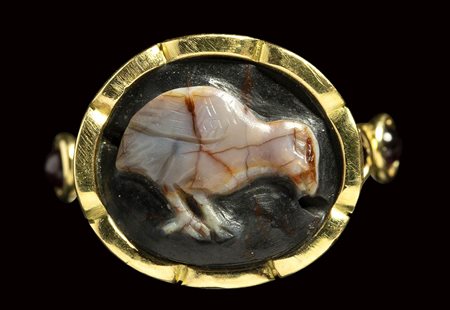
Lotto 86 A rare agate cameo set in a modern gold ring. Partridge.
2nd - 3rd century A.D.
The bird is facing right, with its head slightly lowered forward. The engraver masterfully used the polychrome clear layer over a dark background with naturalistic purpose. The colors of the stone imitate the plumage and cartilages of the bird. Little missing on the edge, as the stone was pierced as a bead. Parallel: for the same subject, on the same stone with the same style see U. Pannuti, Catalogo della collezione glittica vol II, Napoli, Museo Nazionale, pp. 281-283 (Farnese Collection).
Stone 13 x 16 mm; ring size diam. 18 mm; 11,83 gr. -
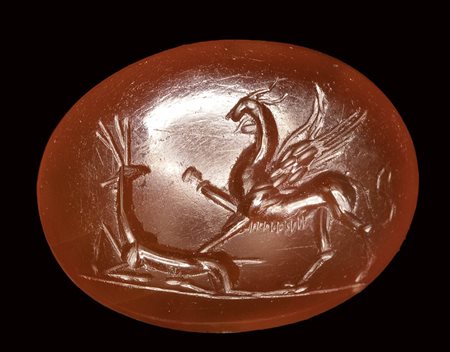
Lotto 87 A roman carnelian intaglio. Griffin with deer.
2nd - 3rd century A.D.
The hunting scene consists of a winged griffin attacking a deer that has fallen to the ground. The composition is inspired by classical Greek models. Groundline. Slight wear marks.
13 x 18 x 6 mm. -
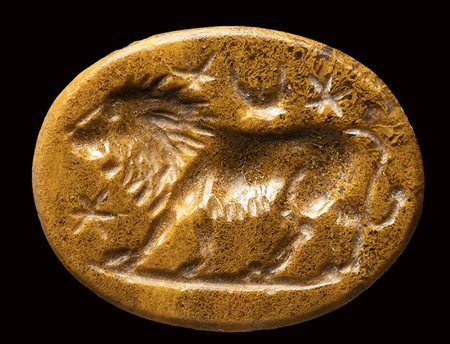
Lotto 88 A roman yellow jasper magical intaglio. Lion with moon and stars.
2nd - 3rd century A.D.
The mighty feline walks to the left, surrounded by three stars and a crescent moon. The astrological attributes denote the magical character of the gem. The presence of the breasts reveal that she is a lioness. Groundline. Slight wear marks.
11 x 15 x 3 mm. -
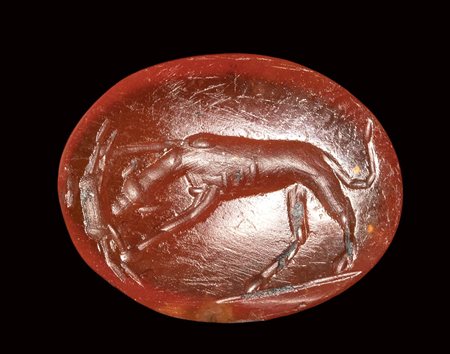
Lotto 89 A roman carnelian intaglio. Dog with prey.
1st - 2nd century A.D.
Hunting scene composed of a dog biting a hare. Groundline. Attractive color of the stone. Slight wear marks.
9,5 x 12 x 3 mm. -
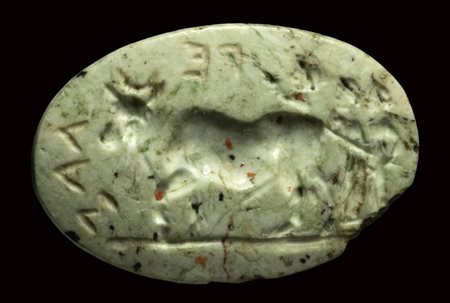
Lotto 90 A rare burnt chalcedony intaglio. Ritual procession with Apis.
1st - 2nd century A.D.
The bull characterized by a crescent moon on its head can be identified as Apis, the Egyptian deity, the sacred bull son of Hathor. Behind him there are three characters as in a sacral procession. A figure points up towards an inscription (to be identified). The stone is burnt and has a lack on the edge. Rare iconography referable to the Isiac cults in Rome.
8 x 12 x 3 mm. -
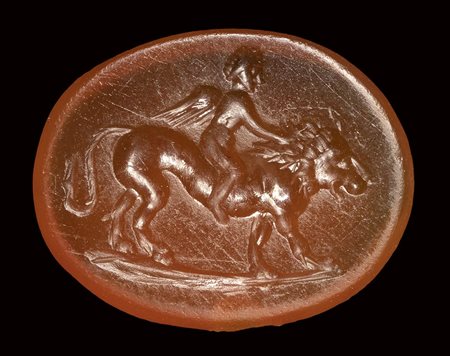
Lotto 91 A roman carnelian intaglio. Eros on a lion.
1st - 2nd century A.D.
The mighty feline walks to the right, carrying a winged erote on its back. The erote grabs the lion's mane to hold on. Groundline. Allegory of love that subdues the strenght. Slight wear marks.
12 x 15 x 3 mm. -
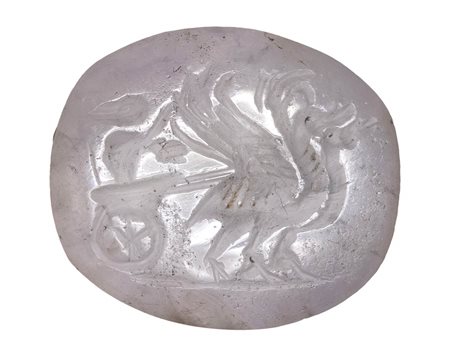
Lotto 92 A roman rock crystal intaglio. A mouse riding a chariot with swans.
2nd century A.D.
The scene depicted shows a mouse riding a chariot toward right, with two swans. The movement is rendered by the widespread wings and the raised heads of the swans. Groundline. AGDS Munchen, vol. 2 n. 918-919.
12x14x5 mm -
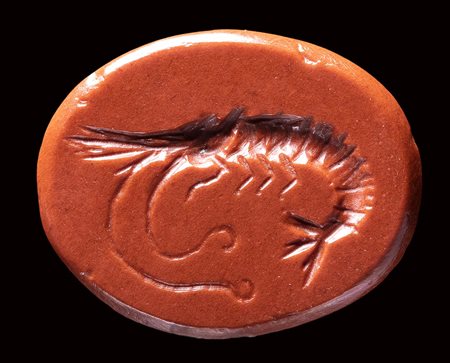
Lotto 93 A roman red jasper intaglio. Shrimp.
1st century A.D.
Shown in profile to the left, the crustacean with its inwardly curved tail is engraved in great detail and naturalism. Slight wear marks.
Provenance: English art market.
12x15x3 mm
-
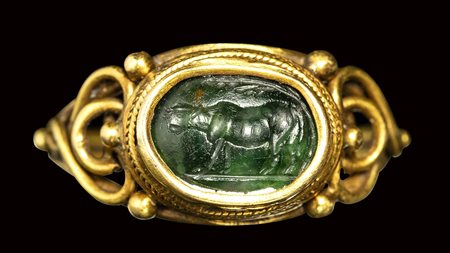
Lotto 94 A roman green chalcedony intaglio set in a gold ring. Heafer under a tree.
2nd century A.D.
The animal is facing left. Beautiful color of the stone, set in a close collet with ropetwist details, openwork, love knot shoulders and double wire shank. Published: Diana Scarisbrick for S.J. Phillips Ltd, The Wellington Gems. (Catalogue) published on the occasion of the exhibition June 8-10, 13-17, London 1977, cat n. 14: "Gold ring with bloodstone (sic) intaglio. A cow. Roman".
Stone 7 x 9 mm; ring size 17 x 18 mm; 4,90 gr. -
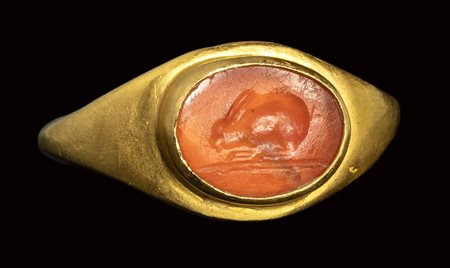
Lotto 95 A roman carnelian intaglio set in an ancient gold ring. Rabbit.
2nd - 3rd century A.D.
The animal is facing left. Groundline. Wear marks. D section hoop with flared shoulders.
Stone 8 x 11 mm; ring size 15 x 19 mm; 5,65 gr. -
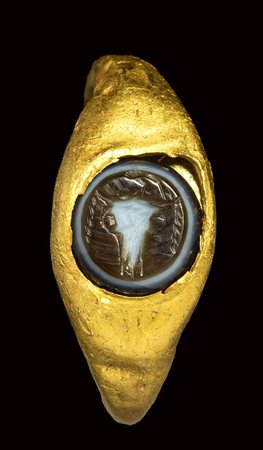
Lotto 96 A roman gold ring set with a three-layered agate intaglio. bucrane.
1st - 2nd century A.D.
Rounded hoop with broader shoulders and rounded box-setting containing a three-layered agate intaglio. Bucrane seen in front with garlands. The mounting presents some shocks and the box-setting seems to be wider than the intaglio. Although both elements are genuine and ancient, the mounting does not seem belonging to the intaglio.
Stone diam. 8 mm; ring size diam. 18 mm; 3,71 gr.