
ASTA 107 - Glittica
-
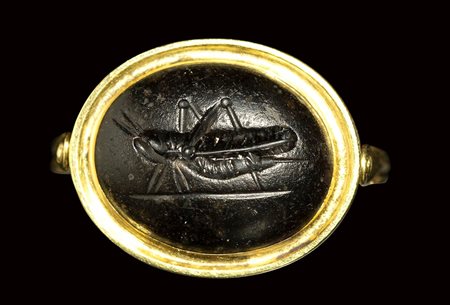
Lotto 73 A roman dark agate intaglio set in a gold swivel ring. Grasshopper.
1st century B.C. - 1st century A.D.
Fine depiction of the insect, facing left. Use of globular elements. Groundline. Slight wear marks. 18th - 19th century swivel mounting.
Stone 11 x 14 mm; ring size 16,5 x 18 mm; 2,93 gr
Provenance: UK private collection D.C.
-
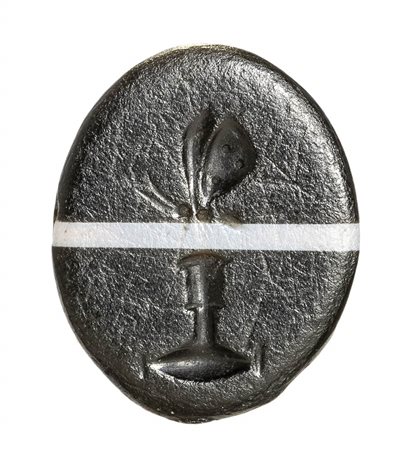
Lotto 74 A roman banded agate intaglio. Allegorical emblema with a butterfly.
1st century A.D. - 1st century B.C.
Very fine and elegant allegorical emblem with a butterfly resting on an object to be identified (ampoule?). Slight wear marks.
8 x 10 x 2 mm. -
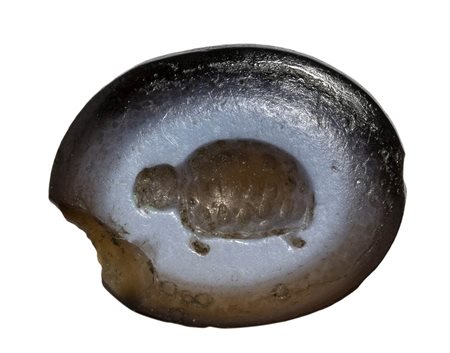
Lotto 75 A roman nicolo intaglio. Turtle.
1st - 2nd century A.D.
The animal is facing left, and is characterized by a rounded head that comes out of the shell, and two small visible legs. Missing on the edge and wear marks. Rare.
7 x 9 x 2 mm. -
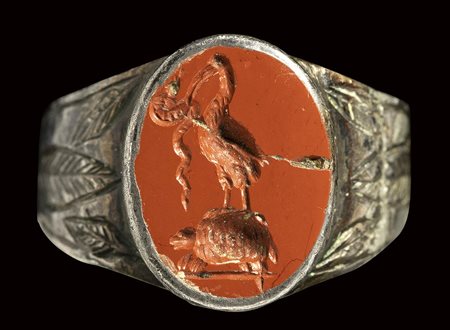
Lotto 76 A roman red jasper intaglio mounted on a silver ring. Ibis on a turtle with a snake.
2nd century A.D.
The oval stone is depicting an ibis standing and turned left catching/eating a snake with its beak. He is standing on top of a turtle. Groundline. The references to the god Mercury are various in this scene— the ibis bird, also known as the animal representation of the god Thot, egyptian pendant of Hermes; the turtle closely linked to Hermes and seen as his animal-attribute (Hermes made the first lyre with a turtle’s shell, see Homeric Hymn to Hermes, 24-61).
Early 20th century silver mounting, the shoulders decorated with engraved leaves. Published in: Theodora Hadzisteliou Price, "An Ionian Silver Ring with Sard" in Antike Kunst, 15, 1972, pp. 60-63.
Stone 10 x 12 mm; ring size 17 x 18 mm; 3,50 gr.
From the old collection of Prof. Constantine Athanasius Trypanis (1909-1993), found on the lands of his father Athanasius G. Trypanus in 1905. -
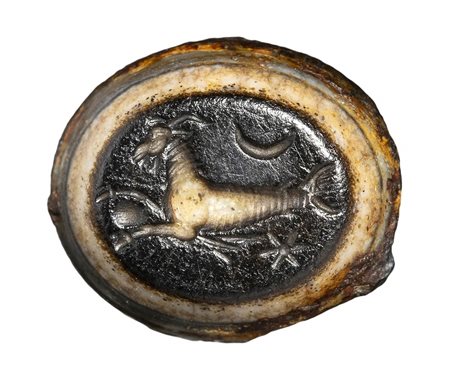
Lotto 77 A roman agate intaglio. Seagoat with astrological attributes.
1st century A.D.
The sea creature to the left, holding the globe in its paws. Above, a crescent moon; below, a star. Astrological intaglio engraved on a layered agate. Traces of the ancient iron mounting. Wear marks.
10 x 12 x 4 mm. -
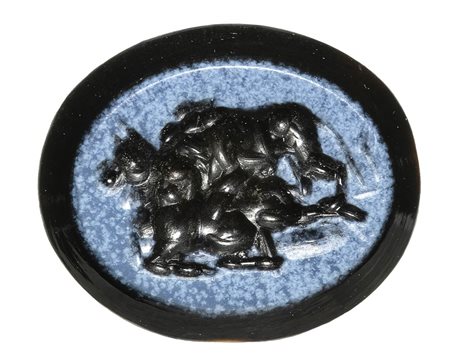
Lotto 78 A roman nicolo intaglio. Hunting scene.
2nd - 3rd century A.D.
A lion attacks a bull, biting him on the shoulder and assaulting him from behind. The mighty quadruped folds his legs to the ground as a sign of defeat. Scene inspired by greek models.
10 x 12 x 2 mm.
Provenance: UK private collection. -
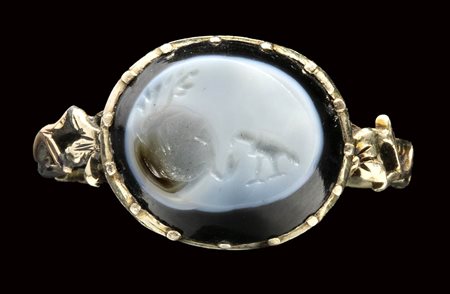
Lotto 79 A rare nicolo agate intaglio set in a gold ring. Allegorical scene with animals.
1st - 2nd century A.D.
A snake emerges from a snail shell (or sea shell) and opens its mouth wide against a parrot. The bird is there in front of the shell. Behind, a branch of a tree. Rare scene. The gem is mounted in an elegant chiseled gold ring with floral and plant motifs, dating to the 19th century.
Stone 11 x 13 mm; ring size 15 x 18 mm; 3,07 gr.
Provenance: UK private collection. -
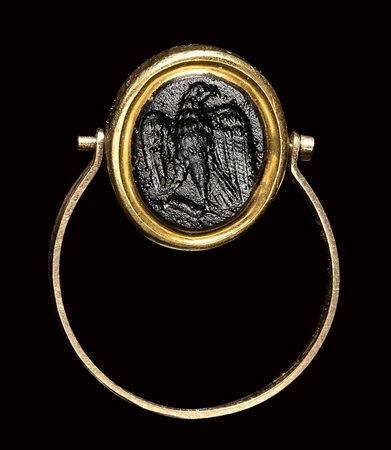
Lotto 80 A roman dark glass paste intaglio set in a gold swivel ring. Eagle.
1st - 3rd century A.D.
The animal is depicted frontally, with its wings open and the head turned in profile. With his claws he grabs a boar's head. Emblem of imperial military power. Wear marks. Little missing on the mounting. Parallel: For a same glass paste intaglio see Metropolitan Museum of Art database, inv. n. 17.194.56.
Glass 10 x 11 mm; ring size 17 x 18 mm; 2,53 gr.
Provenance: UK private collection. -
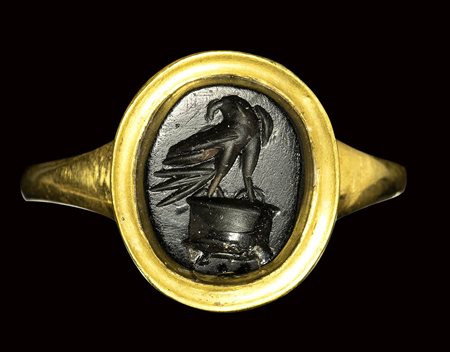
Lotto 81 A roman obsidian intaglio mounted on a modern gold ring. Eagle on altar.
2nd century A.D.
The scene depicts an eagle standing on an altar. His head turned left. Chips on the edge of the stone.
The mounting made in 18k gold, with rounded hoop extending in broader shoulders with an oval box-setting.
Stone 10 x 12 mm; ring size 18 x 19 mm; 7,26 gr.
-
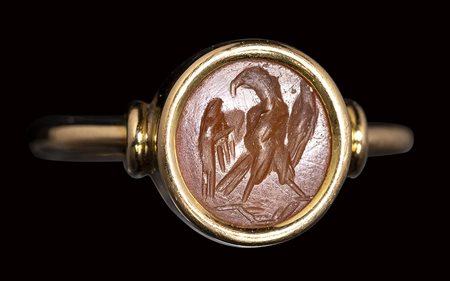
Lotto 82 A roman carnelian intaglio set in a gold ring. Eagle.
2nd - 3rd century A.D.
The intaglio shows an eagle in front, his head turned left with widespread wings. The gold mounting is with rounded hoop extending on the shoulders with terminal tubular endings and rounded box-setting. Presence of a hallmark on the hoop.
int diam 19 mm; intaglio diam 10 mm; 6,03 gr. -
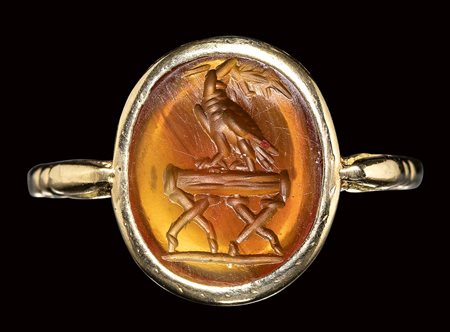
Lotto 83 A roman carnelian intaglio mounted on a modern gold ring. Eagle on a stand.
2nd century A.D.
The intaglio shows an eagle with the head turned right holding a laurel branch in its beak. He is standing on a crossed-legs stand. Allegory of military power of the roman Empire. Slight wear marks on the surface of the stone. The gold mounting is with rounded hoop, within two spherical beads on each side. The shoulders with engraved lines are ending in foliage. The rounded box-setting with engraved leaves motifs. Hallmark on the hoop.
int diam 19 mm; intaglio 10x11 mm; 2,56 gr.
-
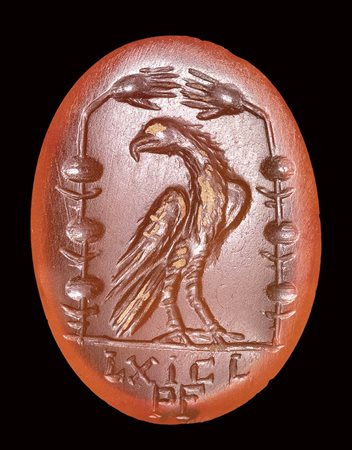
Lotto 84 A roman carnelian intaglio. Emblema of victory with eagle and latin letters.
2nd century A.D.
The stone shows an eagle, his body turned right meanwhile his head is turned left. Framed by two military standards. Groundline. Beneath, two rows of latin inscription « LXICL » « PF ». Military victory emblema.
12x16x3 mm