
ASTA 107 - Glittica
-

Lotto 49 A late hellenistic carnelian intaglio. Offerer.
2nd century B.C.
The character is depicted frontally, in the act of offer votive offerings. The young figure is tunicated, with a robe that adheres elegantly to the body. Wear marks and abrasions in the field. Rare type.
13 x 17 x 3 mm.
Provenance: UK private collection. -
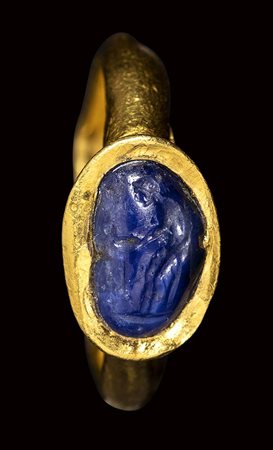
Lotto 50 A rare late hellenistic sapphire intaglio set in a later gold ring. Venus at the fountain.
2nd - 1st century B.C.
The ring with rounded hoop, flatten within, is extending with broader shoulders to an oval raised box-setting containing a rare blue sapphire intaglio. The intaglio shows Venus standing right and bent toward a fountain. Groundline.
The mounting is embossed and with restorations under the bezel. Probably from Alexandria workshops. Rare.
int diam 17 mm; intaglio 6x9 mm; 3,26 grs
-
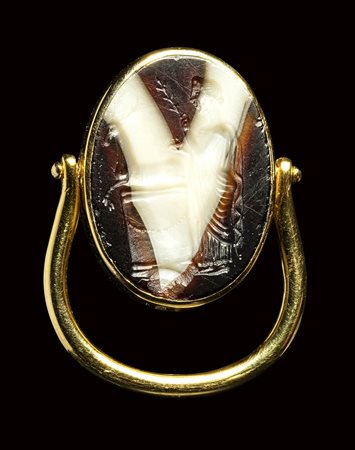
Lotto 51 A large roman italic banded agate intaglio set in a swivel gold ring. Sacrifice to Artemis.
2nd century B.C.
Important italic intaglio set into a collector's heavy swivel ring with a gold impression of the intaglio at its back. The figure has been generally identified heretofore as Diana Nemorensis. This subject may represent Diana Nemorensis or, alternatively, Iphigenia, the founder of Nemi sanctuary togheter with her brother Orestes in the story recounted by Servius (Ad Aen. VI.136). In that depiction, the figure is facing left, wearing a chiton with a himation over it. In her left hand she holds a branch and in her right, a patera. Before her is a garlanded altar, upon which is a deer. Cfr. Martin Henig et al., Classical gems. Ancient and modern intaglio and cameos in the Fitzwilliam Museum, Cambridge 1994, p. 77. Francoise-Hélène Pairault, "Diana Nemorensis. Déesse latine, déesse hellénisée", in Melanges d'Archeologie et d'Histoire, vol. LXXXI (1969), pp. 425-471; AGDI I, II Munchen n. 696 and AGD IV, Hannover, n. 73.
Stone 17 x 22 mm; ring size 16 x 19 mm; 17 gr.
Provenance: european private collection. -
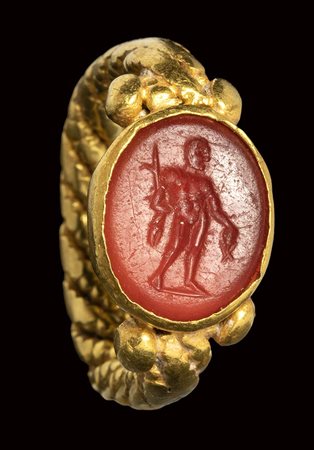
Lotto 52 A roman italic carnelian intaglio set in a barbaric gold ring. Perseus
2nd century B.C. / 5th - 7th century A.D.
The hero is depicted with the frontal body and the head turned in profile to the right. With the right hand he holds the hooked sword, with the right the severed head of Medusa. Groundline. Wear marks. The gem, of Italic production, was formerly reassembled in ancient time into a solid gold ring of barbarian production, with an intertwined rod and spherical elements welded to the bezel. Rare.
Stone 9 x 11 mm; ring size 13 x 15 mm; 7,80 gr.
Provenance: UK private collection. Previously UK private coll. Since 1956. Formed in the 1950s by Mr and Mrs S. Brouka, thence by descent. -
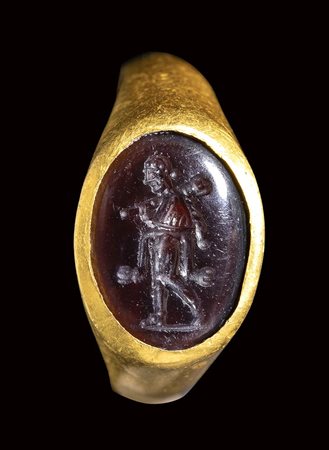
Lotto 53 A late italic garnet intaglio set in a gold ring. Omphale.
2nd - 1st century B.C.
This plain rounded hoop, flatten within and extending outbroad on the shoulders with a ridge. The oval box setting contains a garnet intaglio with engraved scene depicting Omphale walking left with a club on his right shoulders. Groundline.Wear marks.
Int diam 14 mm; stone 6x9 mm; 3,76 gr.
Provenance: UK private collection. -
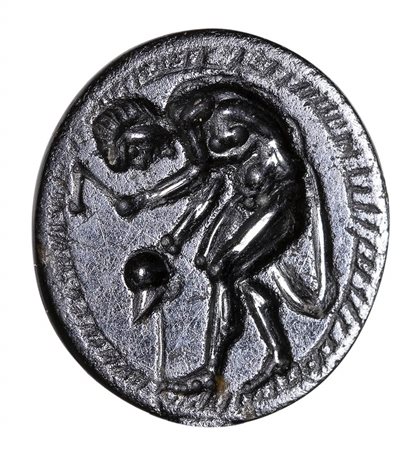
Lotto 54 An early italic black agate intaglio. Blacksmith.
3rd - 2nd century B.C.
The craftsman is intent on making a soldier's helmet; he is facing left, bent forward, and with his left hand he strikes the metal helmet with a tool to forge it. The helmet is inserted into a pole that supports it and acts as a support. Use of globular elements. Dotted frame. Wear marks. Parallel: AGDS, Band I, Munchen, Tafel 23 n. 204 (same subject -etruscan scarab- with variant).
10x11 mm -
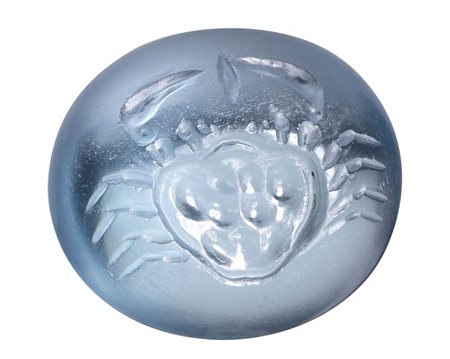
Lotto 55 A rare greek hellenistic beryl intaglio. Crab.
2nd - 1st century B.C.
The crustacean is seen from above. The crab holds a shell (mussel?) between its claws. Every anatomical detail is rendered with great skill and naturalism. Popular and frequent subject in classical glyptic production; the reference model is identifiable to the late classical Greek art. The animal is deeply engraved in an extraordinary beryl, characterized by an intense and luminous color, thanks to the very convex surface. The shape of thr stone is more typical of the early hellenistic period. Wear marks on the surface. Mirror polishing inside the intaglio. Of great rarity. Parallel: See greek coinage: Sicily, Akragas, silver Didrachm (circa 490-470 BC); Akragas, Sicily. Circa 414-413 BC. AR Tetradrachm.
15x16x8 mm
Provenance: London, art market 1990s.
-
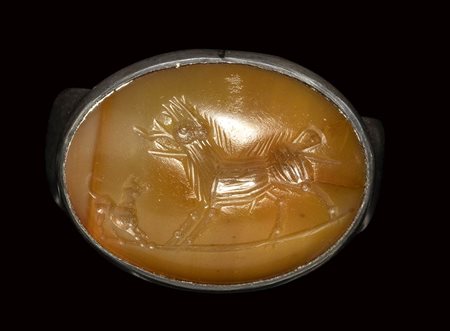
Lotto 56 A roman italic agate intaglio set in a silver ring. Boar with a dog.
2nd century B.C.
On the left, a small dog is facing a large boar, which is on the right. Groundline. Presence of globular elements. Large convex gem, mounted on a post-classical ring with french marks.
Stone 15 x 21 mm; ring size 17 x 18 mm; 12,30 gr.
Provenance: UK private collection. -
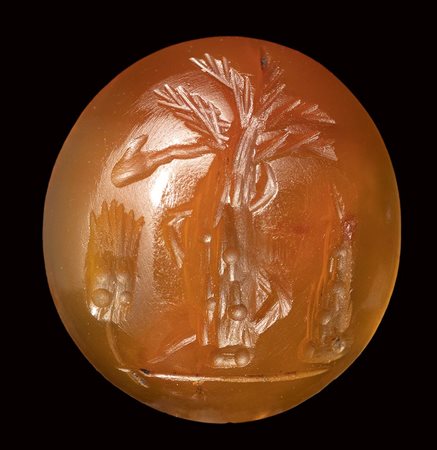
Lotto 57 A roman italic carnelian intaglio. Palm tree with attributes.
1st century B.C.
In the center, a palm tree, on which a snake climbs. On the sides, an ear of corn and a club. Groundline. Allegorical emblem referable to strength and prosperity. Convex gem.
11 x 12,5 x 3 mm. -
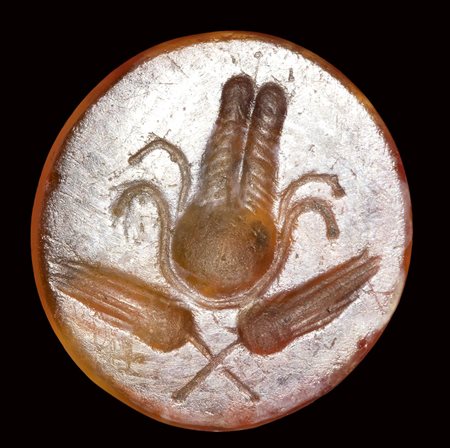
Lotto 58 A roman late republican agate intaglio. Isiac emblema.
1st century B.C.
In the center, the Isiac emblema; below, two crossed ears of wheat. Surface slightly burned. Use of small globular elements.
diam 12 x 2,5 mm.
-

Lotto 59 An italic carnelian intaglio. Standing male figure.
1st century B.C.
The male character is standing in contrapposto, the body in three-quarters, the head facing right. His right arm bent holds a spear (?), meanwhile his left arm a bag (?). He wears an hat or helmet. Presence of globular elements for the face and the body. Groundline. Chip on the edge.
12x16x3 mm -
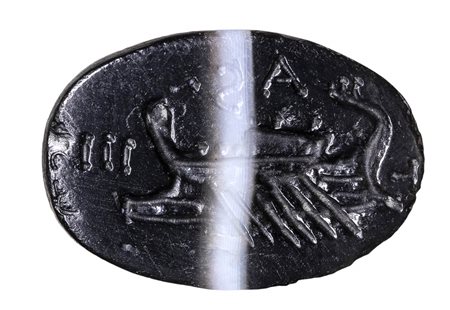
Lotto 60 An italic banded agate intaglio. Warship.
2nd century B.C.
A trireme sailing right, on top two latin letters « SA » preceded by a globe. On the left of the ship the latin number « III ». The inverted direction of the letters suggests that the intaglio was used as a seal. With naval military symbolic. Use of globular elements.
9x13x2 mm