
ASTA 107 - Glittica
-
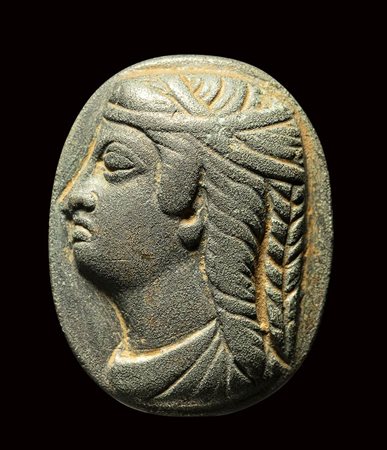
Lotto 37 A graeco-roman bronze ring. Ptolemaic bust.
3rd century B.C.
The hoop is flat within and rounded without. Large circular bezel with design in relief: portrait of an ptolemaic queen (?), turned left, with long looks and a band.
Parallel: Marshall, F.H., Catalogue of the Finger rings, British Museum, 1968, Pl.XXXI, 1280,129
Bezel 16 x 21 mm; ring size 15 x 18 mm; 8,34 gr.
Provenance: London, art market.
-
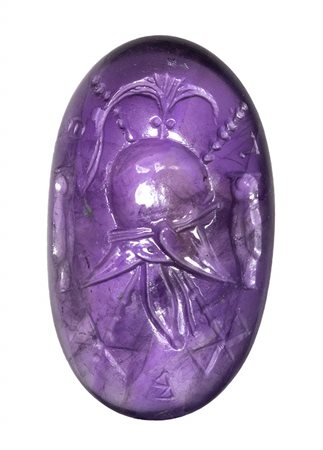
Lotto 38 A greek late hellenistic amethyst intaglio. Panoplia.
3rd - 2nd century B.C.
In the center, a Macedonian-type helmet, behind, two crossed double axes. On the sides, two greaves. In the field, three greek letters (Gamma, Beta, Theta). Rare composition, very detailed, well balanced and engraved with great technical mastery, inspired by coinage. Presence of globular elements. Macedonian military emblema. Intense color. Gem with convex surface and flat back. The helmet is very similar to that depicted in a garnet (Munich, Antike Munzsammlung). Parallels: AGDS n. 234; AGDS Munchen, n. 384. For a very close type see D. Plantzos, Hellenistic engraved gems, n. 650.
14x23x6 mm
Provenance: UK art market. -
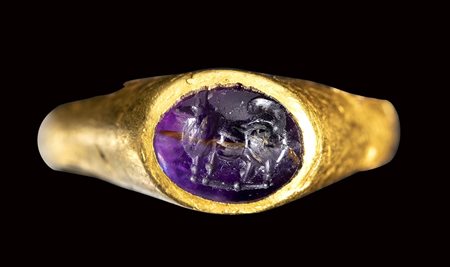
Lotto 39 A greek hellenistic gold ring set with an amethyst intaglio. Maltese dog.
4th - 3rd century B.C.
The animal is facing left. The well-executed details of its anatomy indicate that it is a Maltese dog. The uncommon subject is represented on certain scaraboid gems of Graeco-Persian production from the end of the classical age. In this case, the choice of a small amethyst cabochon places the gem in the Hellenistic era. This ring was intended for a child as revealed by the small size of the gold frame. Slight signs of wear. Rare.
int diam 13 mm; intaglio 4x6 mm; 2,35 gr. -
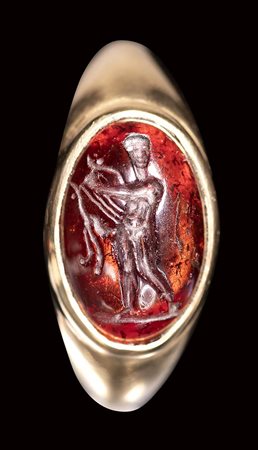
Lotto 40 An hellenistic garnet intaglio set in a gold ring. Apollo.
2nd century B.C.
The divinity is depicted frontally, with the head turned slightly right and the body to the left, in a slight twist. Typical Hellenistic pose. With his hands he holds the lyra. Groundline. The gem is cabochon and concave on the back. Attractive stone color. The modern gold mounting is made of a plain rounded hoop, flatten within with outbroad shoulders extending into an oval box-setting containing the intaglio.
Parallels: AGDS Munchen, n. 559-566, 572; G.M.A. Richter, Catalogue of engraved gems, The Metropolitan Museum of Art, New York, n. 157 - 159.
Int diam 20 mm; stone 8x14 mm; 7,37 gr.
Provenance: UK private collection.
-
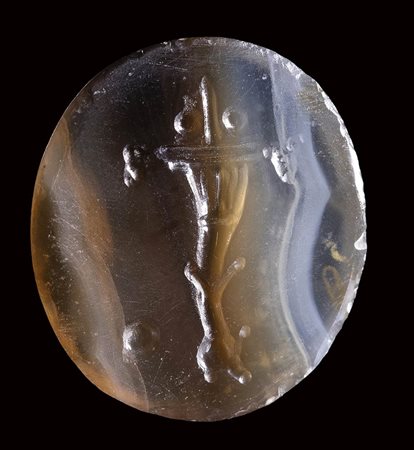
Lotto 41 A large italic banded agate intaglio. Cornucopia.
2nd century B.C.
A cornucopia with stems and bunch of grape. On its left, a globe. Use of globular elements. Wear marks. Interesting choice of stone.
16x17x3 mm
Provenance: UK private collection. -
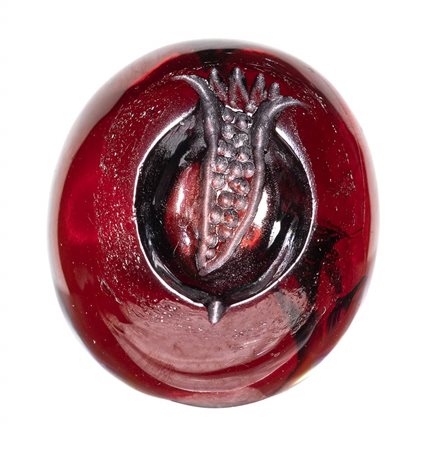
Lotto 42 A rare greek hellenistic garnet cabochon intaglio. Pomegrenate.
4th - 3rd century B.C.
A slightly open pomegranate with a natural central “laceration”, with its internal seeds visible. Rare and unusual representation of a fruit breaking and opening. The subject, present in the Greek coinage but whole without openings with visible seeds, is engraved in a beautiful high convex cabochon garnet, with a concave back. The combination of the subject with the material was masterfully chosen to allude its natural color. Mirror polishing. Extremely detailed and deeply carved intaglio. Slight internal crack (non-passing and not dangerous; the gem is solid). Wear marks. Parallel: See greek coinage: for the subject of the pomegrenate cfr. Side. Circa 430-400 BC. Stater, Pomegranate with its stem above and flower below. SNG France 627. SNG von Aulock 4765; Pamphylia, Side AR Stater. Circa 490-450 BC. Pomegranate, ΣIΔH (retrograde) to left; all within beaded circular border; Melos - ΜΑΛΟΣ - date: ca. 450-440 BC - silver stater - description obverse: pomegranate.
15x17x9 mm
Provenance: UK private collection, acquired in the London art market 1980s.
-
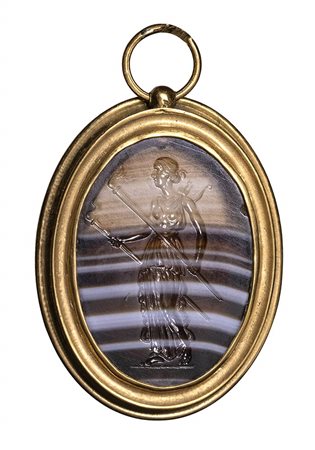
Lotto 43 A fine greek late classical banded agate intaglio set in a gold pendant. Diana Lucifera.
4th century B.C.
The divinity is standing, facing left. With both hands she holds two long burning torches. The figure is draped with a long tunic characterized by very fine drapery folds and engraved with extreme refinement. The right foot is resting on the ground, while the left is slightly raised. Groundline. The body is slightly three-quarters, while the head is in profile. The hair is elegantly gathered; the delicate profile with idealized features. Diana wears a bow and quiver on her shoulders, while the torches identify her as a “lucifera” with reference also to the figure of Hecate and to the magical world (Inferos). The gem has the traces of two ancient micro holes on the edge probably for a rotating mounting. The banded agate is characterized at the top by a lighter and more transparent part (possibly referable to the light of the torches and the earthly brightness), while going down to the stone it has a darker area (symbolizing the night and the underworld). Mirror polishing. Wonderful style and execution. Signs of wear and small chips on the edge. The gem is set in a 22ct gold pendant, likely from the late 19th century/ early 20th, with a swivel suspension hoop.
Parallels: J. Boardman, Intaglios and rings. Greek, Etruscan and Eastern from a private collection, n. 39. J. Boardman, GGFR, n. 533 and 735 for a very close specimen (from the London Market, 1934. A fine greek classical gold ring. Kore, with two torches, Sotheby, 18. VII. 1934 n.116). On a coin of Kyzikos, Nomisma VII, pl. 6.12. See greco-roman coinage with the same figure (Artemis Phosphoros). 53435. Cfr. Statue einer Frau als Diana Lucifera ergänzt mit nicht zugehörigem Kopf: Musei Vaticani, Galleria Chiaramonti in Amelung, Vat.Kat. I 677 Nr. 548 Taf. 72; B. Andreae (Hrsg.), Museo Chiaramonti. Bildkatalog der Skulpturen des Vatikanischen Museums I 2 (1995) Taf. 764 (Arachne database - Koeln). See roman coinage: Faustina II bronze As RIC 1629 ; Aureus of Julia Domna Coh. 31 RIC 548 Calico 2610, reverse: DIANA LVCIFERA.
Stone 18x24x4 mm; overall 25x33 mm; 7,07 gr.
Provenance: UK private collection, acquired in the London art market 1980s; previously from the F. M-G collection 70's.
-
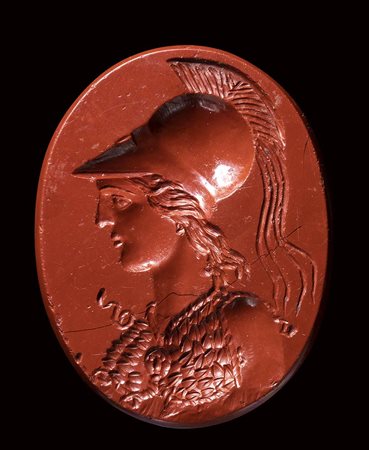
Lotto 44 A large greek hellenistic red jasper intaglio. Bust of Athena.
3rd century B.C.
The deity is facing left. The head is helmeted while the bust is covered by the gorgoneion, with the mask of Medusa in the center, due to its apotropaic power and invincibility; small snakes rise from the mythical breastplate. The shoulder is naked. The hair falls elegantly on the neck, engraved with very thin and refined lines. Other details of the helmet (crest) and of the anatomy (eyes, browline) are also engraved with very fine lines. The work, of great artistic importance, is engraved on an extraordinarily large red jasper. The black line that runs horizontally through the stone is not a crack but a black inclusion (vein), typical of the jasper. The back of the gem shows engraved unfinished marks with the dry diamond point of an ornamental motif (vegetable or floral). This unfinished but just begun processing trace is an equally extraordinary testimony of to the greek engraving technique during the Hellenistic Era. Slight signs of wear and small chips on the edge.
Parallel: for the subject in AGDS, tafel 189 n. 2182. For a close type, but engraved later (1st B.C. - 1st A.D.) see AGKM (Kunst, Wien) n. 1069.
25x31x6 mm
Provenance: english private collection, ex London art market 1970 circa; from the R.T. collection, London.
-
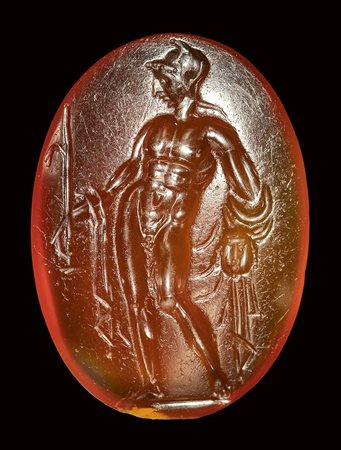
Lotto 45 A fine roman carnelian intaglio. Perseus with Medusa head.
1st century B.C.
The hero is standing, with his body slightly out of three quarters, in a slight torsion, his head facing left. The body is naked. With his right hand he holds a sword, with his left the severed head of medusa; with his forearms he holds a cloak, which hangs elegantly behind. The anatomical details are engraved with technical skill. Use of globular elements. Late Italic period - early Republican. Very fine style. Attractive stone color. Wear marks. Parallel: C. Gasparri, Le Gemme Farnese, p. 122 n. 183.
15 x 21 x 0,4 mm.
Provenance: UK private collection. -
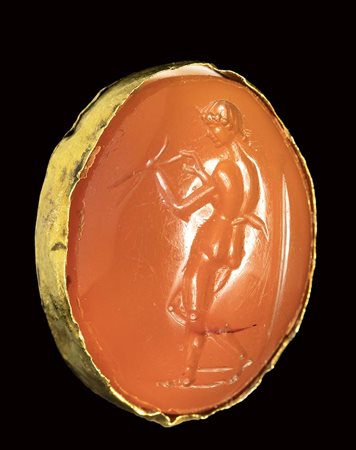
Lotto 46 A fine hellenistic carnelian intaglio set in a gold frame. Satyr near a column.
3rd century B.C.
The figure is standing, with the left leg supporting and the right leg slightly bent in a typically greek pose. With his left hand he holds two flutes, which he touches with his right hand. The figure has elongated proportions, typically hellenistic, represented by three quarters back view. A column. Groundline. Use of globular elements. Large intaglio, engraved with great elegance and artistic mastery. The gem is cabochon still mounted in its antique gold. Parallel: G.M.A. Richter, The engraved gems of the greeks and the etruscans, part one, p.137 n. 523.
18 x 23 x 7 mm; 4,55 gr.
Provenance: UK private collection D.C. -
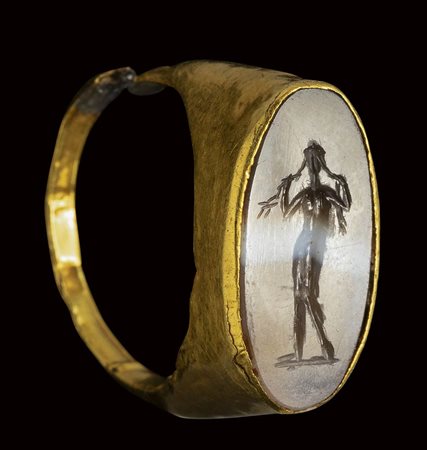
Lotto 47 A late hellenistic banded agate intaglio set in an ancient gold ring. Venus Anadyomene
3rd century B.C.
The divinity is standing, seen from the front, in her typical pose in the act of keeping her hair divided into two long braids. The subject is inspired by Greek statuary models from the hellenistic period. Attractive stone color. The gem is set in an elegant antique hollow gold ring. Brocken hoop.
Stone 9 x 18 mm; ring size 16 x 17 mm; 3,26 gr.
Provenance: Zurigo, Max Kopp coll. Born 1891.
-
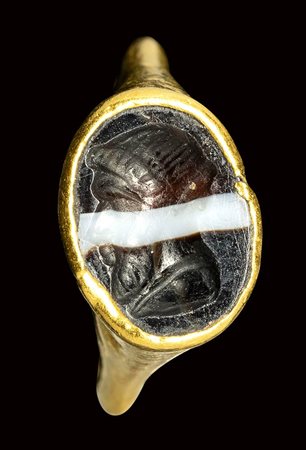
Lotto 48 A late hellenistic gold ring set with a banded agate intaglio. Bust of Herm.
2nd century B.C.
Plain hollowed hoop, expanding into oval bezel with oval banded agate intaglio: bust of an herm, turned right. The face is characterized by mature features, a beard, an straight short rose and full lips. Presence of globular elements.
Slight missing on the edge of the box-setting.
Stone 8 x 11 mm; ring size 12 x 14 mm; 2,64 gr.