
ASTA 107 - Glittica
-
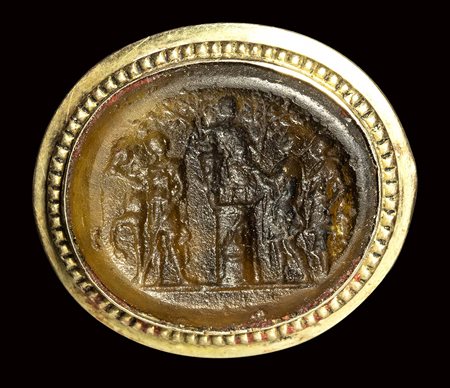
Lotto 361 A brownish glass impression set in a gilted metal frame. Votive scene.
18th - 19th century.
Votive scene composed in the center of an altar with a sculpture on top; on the right two soldiers armed with spears turn towards the idol; on the left, another soldier holds a horse by the bridle, always facing towards the center. Behind, some trees. Groundline. Wear marks.
17 x 19 x 5 mm. -
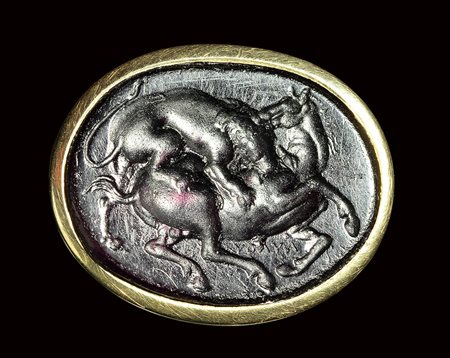
Lotto 362 A dark purple glass impression set in a signet gold ring. Lion with an horse.
19th century.
This Grand Tour Era glass impression is after a stone engraved by the famous Aulos in antiquity. The scene depicts a lion attacking a horse. The predator jumps onto his back and bites him on the shoulder ferociously. Below, the Greek signature. Slight signs of wear. In the Tassie there is the sulfur impression described as "A lion throwing a horse on the ground, after the bronze group in the Vatican".
Glass 16 x 20 mm; ring size 16,5 x 18 mm; 14,90 gr. -
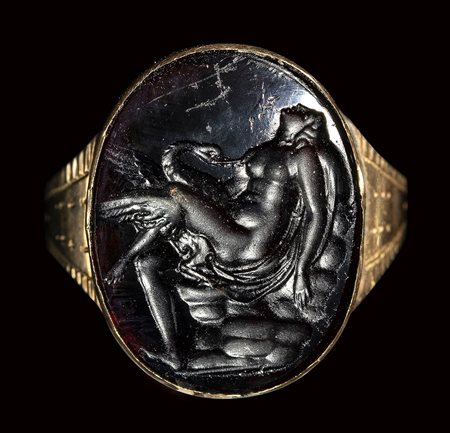
Lotto 363 A dark glass Tassie impression set in a gold ring. Leda and the Swan.
18th - 19th century.
Leda, naked, seated on her dress and rocks, her head thrown back, embracing the Zeus swan. The original intaglio was executed by Giovanni Pichler (Rollet 1874, 34, n. 135). Slight wear marks. Parallel: J. Boardman, The Marlborough Gems, p. 284, cast n. 683 (17).
Glass 15 x 19 mm; ring size 17 x 19 mm; 3,12 gr. -
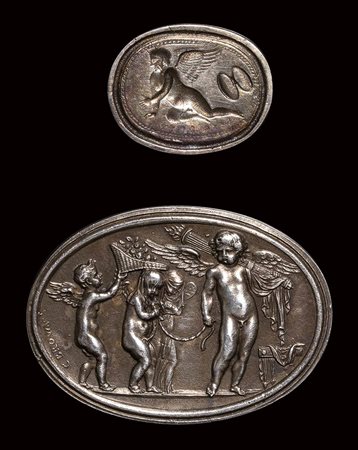
Lotto 364 A lot of two silver impressions. Marriage of Eros with Psyche- Winged erote.
19th century.
These fine toned impressions are taken after intaglios. The Eros with the shell is after a greek carnelian scaraboid intaglio (coll. Blacas, in Boardman 1970, fig. 529, signed in greek by Phyghillos; Paoletti glass cast n. 328, Tomo I); the large one shown the “The wedding of Eros and Psyche”, signed C. Brown; it is a version inspired by the original sardonyx cameo signed TRYPHON EPOIEI, Museum of Fine Arts, Boston: 99.101 (Beazley Archive, in Story-Maskelyne, M.H.: The Marlborough Gems (1870): no. 160; Boardman, J., Scarisbrick, D., Wagner C., Zwierlein-Diehl, E: The Marlborough Gems (2009): no. 1.
6x20x2 mm; 28x38x3 mm;27,85 gr.
-
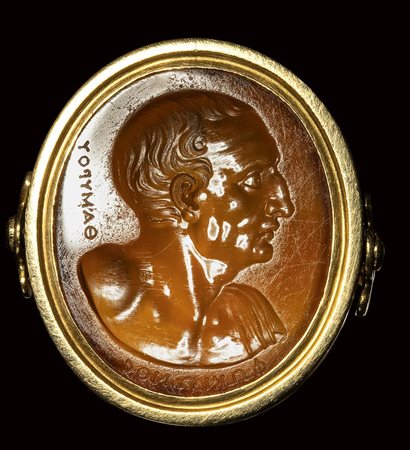
Lotto 365 A fine neoclassical Poniatowski carnelian intaglio signed Thamyros, set in a gold ring. Bust of Phocion.
19th century.
The Athenian general faces right, with a three-quarter bust and head in profile. Above the right shoulder, the signature: ΘΑΜΥΡΟΥ; under the bust: ΦΩΚΙΩΝΟΣ. The gem is set in the original gold swivel ring.
Provenance and literature: Catalogue des pierres gravées antiques de S.A. le Prince Stanislas Poniatowski ([1830?]-1833): VIII.1.44; Daktyliothek Poniatowski 1832, Antikensammlung Berlin: 310; Calandrelli Cat: 91.Christie’s, London: 1839-702.
Stone 16 x 19 mm; ring size 18 x 19 mm; 4,70 gr.
-
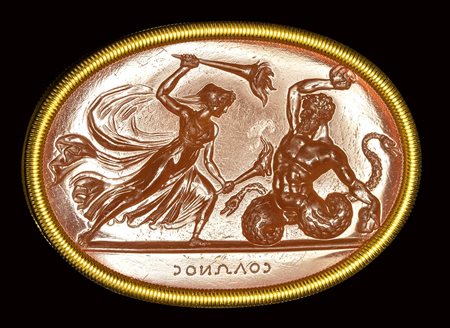
Lotto 366 A fine neoclassical Poniatowski carnelian intaglio signed Solonos, set in a gold frame. Diana Hecate killing a Titan.
19th century.
The deity advances to the right, ready to strike a titan with flaming torches to kill him. The deity is dressed in a robe and cloak that rises into the air, to express the speed and violence of the duel. The titan prepares to throw stones. Below the baseline, the signature: ΣΟΛΩΝΟΣ. The gem is mounted in a 19th century gold frame.
Catalogue des pierres gravées antiques de S.A. le Prince Stanislas Poniatowski ([1830?]-1833)
Provenance and literature: Catalogue des pierres gravées antiques de S.A. le Prince Stanislas Poniatowski ([1830?]-1833): I.303; Christie's, London: 1839-2165
Prendeville, J.: Explanatory catalogue of the proof-impressions of the antique gems possessed by the late Prince Poniatowski and now in the possession of John Tyrrell, Esq. (1841): 194; Daktyliothek Poniatowski 1832, Antikensammlung Berlin: 51. Gabriele Vangelli de Cresci, A MINIMA AD MAXIMA, p. 474
Stone 25 x 36 mm; mounting 28 x 39 mm; 10,59 gr.
-
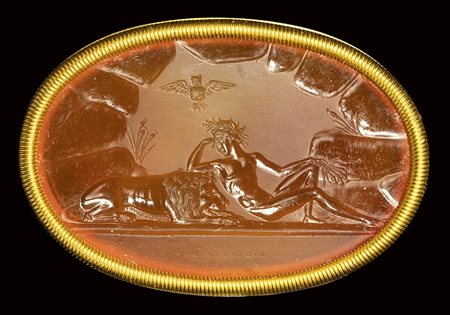
Lotto 367 A fine neoclassical Poniatowski carnelian intaglio signed Dioscourides, set in a gold frame. The Sleep with a lion.
19th century.
The personification of sleep, resting upon a couched lion. The animal is facing right, the young naked figure facing left. The scene is set inside a cave made from large rocks. An owl flies high, a symbol of the night. Below, the signature in greek letters: ΔΙΟΣΚΟΥΡΙΔΟΥ. Beautiful composition. The figures and the rocks are mirror polished with great skill. The gem is set in a 19th century gold frame.
Provenance and literature: Catalogue des pierres graves antiques de S.A. le Prince Stanislas Poniatowski ([1830?]-1833): II.196 Christie's, London: 1839-1841 Prendeville, J.: Explanatory catalogue of the proof-impressions of the antique gems possessed by the late Prince Poniatowski and now in the possession of John Tyrrell, Esq. (1841): 337. Gabriele Vangelli de Cresci, A MINIMA AD MAXIMA, p. 499
Stone 23,5 x 36,5 mm; mounting 27 x 39,5 mm; 10,17 gr.
-
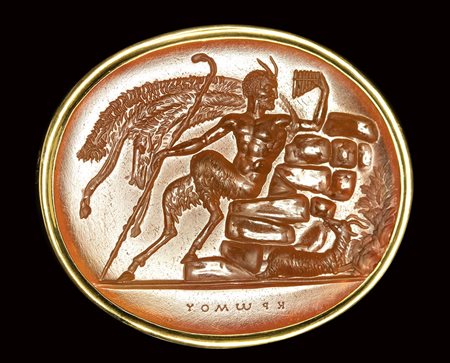
Lotto 368 A fine neoclassical Poniatowski carnelian intaglio signed Kromos, set in a gold brooch. Seated Pan.
19th century.
The figure is seated upon the rocks, with the body turned to the left and the head turned to the right, in profile. With his right hand he holds a long pedum (pastoral staff); with the left the pipe of reeds. A large goat fur is its coat, which elegantly rises into the air. Below, next to the rocks, some plants and a small lying goat. Ground line. Below, the signature: ΚΡΩΜΟΥ. The large gem is set in a 19th century gold brooch. Very fine execution.
Provenance and literature: Current Collection: Prendeville, J.: Explanatory catalogue of the proof-impressions of the antique gems possessed by the late Prince Poniatowski and now in the possession of John Tyrrell, Esq. (1841): 307 Previous Collections: Catalogue des pierres graves antiques de S.A. le Prince Stanislas Poniatowski ([1830?]-1833): II.147 Christie's, London: 1839-1575.
Stone 35 x 42 mm; mounting 38 x 45 mm; 18 gr.
-
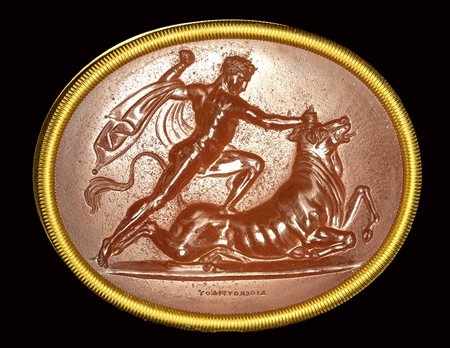
Lotto 369 A fine neoclassical Poniatowski carnelian intaglio signed Dioskourides, set in a gold frame. Milo killing the bull.
19th century.
Theseus capturing the bull of Marathon. The hero is unarmed facing right, holding the animal horn, which he has brought to the ground. Below, the signature in greek letters: ΔΙΟΣΚΟΥΡΙΔΟΥ. Great refinement in the execution of the anatomical details, mirror polished. The gem is set in a 19th century gold frame.
Provenance: Catalogue des pierres gravées antiques de S.A. le Prince Stanislas Poniatowski ([1830?]-1833): VIII.7.8 Daktyliothek Poniatowski 1832, Antikensammlung Berlin: 346 Christie's, London: 1839-2386 Prendeville, J.: Explanatory catalogue of the proof-impressions of the antique gems possessed by the late Prince Poniatowski and now in the possession of John Tyrrell, Esq. (1841): 1201
Stone 30 x 38 mm; mouting 34 x 42 mm; 14,52 gr.
-
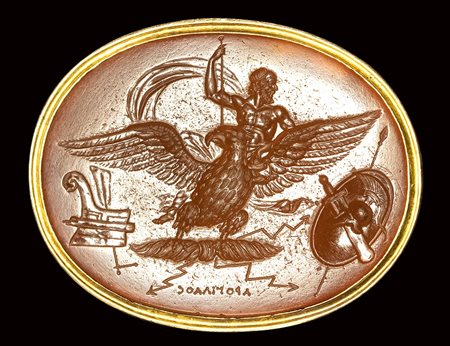
Lotto 370 A fine neoclassical Poniatowski carnelian intaglio signed Arogillos, set in a gold frame. Allegory of the universal power of Zeus.
19th century.
This gem is not listed in the Beazley Archive inventory of the Poniatowski gems. But, interestingly, there is only one with the inscription ΑΡΟΓΙΛΛΟΣ (ref. Christie’s, London: 1839-293 = Catalogue des pierres gravées antiques de S.A. le Prince Stanislas Poniatowski ([1830?]-1833): II.155): a carnelian intaglio described as “Nemesis receiving from Jupiter the Laws of the Universe”. Might it be that the 19th century catalogue misdescribed this gem? In the intaglio depicting the allegory of the universal power of Zeus, the divinity is seated on a flying eagle, with open wings: the animal holds lightning in its claws. Zeus is depicted frontally, with his head in profile to the right, while the eagle looks to the left; the god holds a scepter. On the sides, allegorical symbols of his universal power and law: A ship’s prow with rudder (sea); a panoply-type military emblema consisting of a shield, spear, sword and helmet (earth); The sky is symbolized by its epiphany on the eagle with lightning. Below, the signature in Greek. The gem is set in a 19th century gold mounting.
Provenance: Uk private collection, London. Probably from the Poniatowski collection.
Stone 24 x 31 mm; mounting 26 x 34 mm; 7, 35 gr.
-
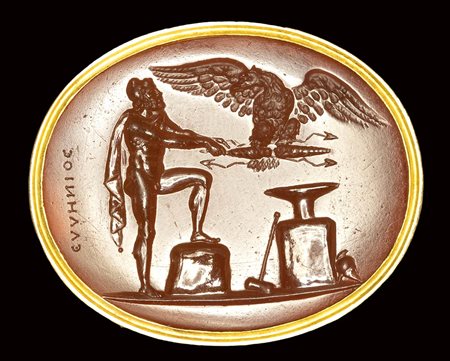
Lotto 371 A fine neoclassical Poniatowski carnelian intaglio signed Hellenios, set in a gold frame. Hephestus giving the thunderboalt to Zeus's eagle.
19th century.
The deity is facing right, in front of his anvil. With both hands he gives the lightning bolts to the eagle of Zeus. In the field, the signature: ΕΛΛΕΝΙΟΣ. The gem is set in a 19th century gold frame.
Provenance and literature: Catalogue des pierres graves antiques de S.A. le Prince Stanislas Poniatowski ([1830?]-1833): I.153. Christie's, London: 1839-67
Stone 25 x 30 mm; mounting 26 x 33 mm; 6.80 gr.
-

Lotto 372 A fine neoclassical Poniatowski carnelian intaglio signed Admon, set in a gold frame. Achilles and the metamorphosis of Cycnus.
19th century.
The hero strips Cycnus of his armor, which is transformed into a swan. Achilles faces left, holding the sword and helmet of Cycnus, flying off his armor. Extraordinary scene of metamorphosis from te Ovid’s Metamorphosis. In the field, the signature: ΑΔΜΟΝ.
The gem is set in a 19th gold frame.
Provenance and literature: Catalogue des pierres gravées antiques de S.A. le Prince Stanislas Poniatowski ([1830?]-1833): V.128. Christie's, London: 1839-473
Stone 22 x 30 mm; mounting 24,5 x 32,5 mm; 4,67 gr.