
ASTA 107 - Glittica
-
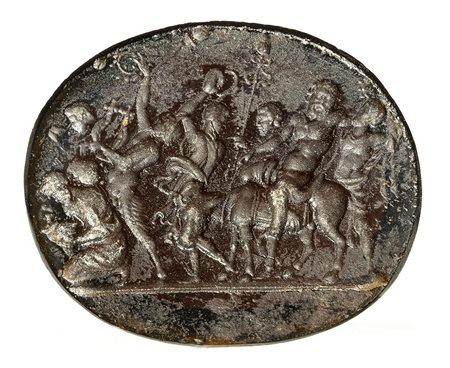
Lotto 349 A brownish glass impression. Bacchic scene.
18th - 19th century.
Scene of a Dionysian procession, consisting of satyrs, maenads and drunken silenus on a donkey. Signs of wear.
26 x 31 x 6 mm. -
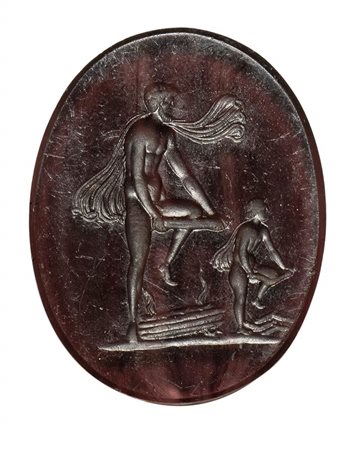
Lotto 350 A large light purple glass impression. Allegorical scene.
18th - 19th century.
Unusual scene composed of two characters in the act of breaking a log of wood with their knees (?). One is an adult, bearded with a face similar to an Antonine emperor; the younger figure can be identified with Eros. They both have a cloak. Below, a pile of burning wood. Scene to be identified, probably allegorical. Grand Tour Era.
35 x 45 x 5,5 mm. -
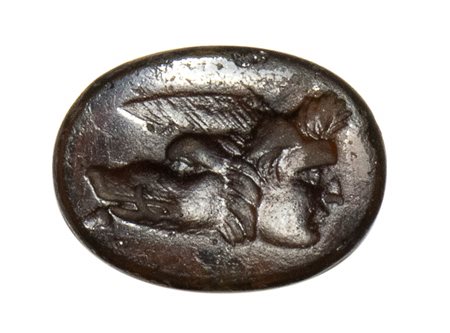
Lotto 351 A brownish glass impression. Gryllos.
19th century.
The hybrid creature consists of a boar head and a faun mask. Wear marks. Grand Tour Era.
10 x 14 x 3 mm. -
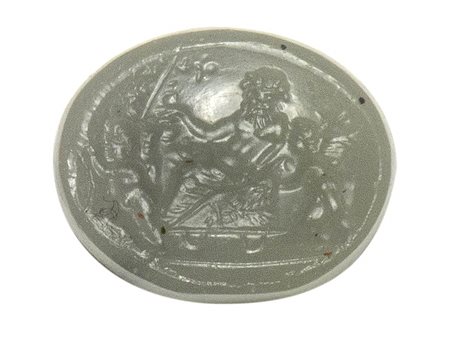
Lotto 352 A glass paste impression. Dyonisiac scene.
19th century.
A Silenus is seated on a small wreathed chariot which is propelled by an erote. Another winged erote precedes them. Vegetation on the background. Grand Tour era cast. Slight wear marks.
13 x 16 x 4 mm.
-
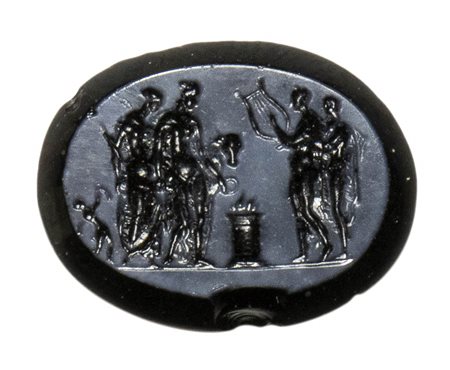
Lotto 353 A glass paste impression. Sacrifice scene.
19th century.
Sacrifice scene composed by four characters: two females and two males, an Erote and a Bull. In the center, a burning altar. Groundline. On the lower edge, light chips. Black and blue glass paste imitating the nicolo.
14 x 18 x 2 mm. -
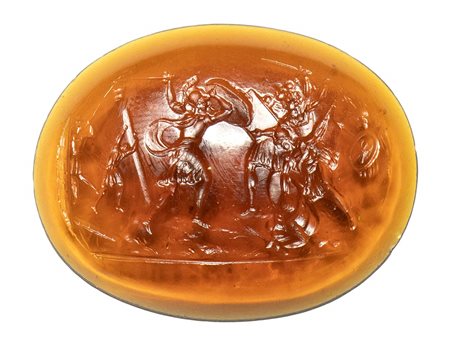
Lotto 354 A large orange glass impression. Battle scene.
19th century.
Numerous roman soldiers fight fiercely. A group of soldiers on the left seems to want to break through a passage with a wooden walkway, perhaps to access a city to be conquered. Only a brave soldier seems to want to defend this access to the death. Probably a scene from Roman "Exempla Virtutis". Grand Tour Era.
30 x 38 x 7 mm. -
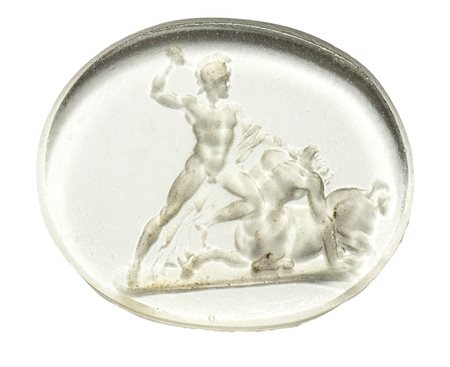
Lotto 355 A transparent glass impression. Theseus and the Centaur after Canova, by Pichler.
19th century.
This cast is taken from a sardonic intaglio engraved by Luigi Pichler, depicting Theseus fighting with the Centaur, inspired by Canova’s marble sculpture group (Vienna, Kunsthistorisches Museum). Grand Tour Era.
Parallel: L.P. P. Stefanelli, La Collezione Paoletti, vol. 2, p. 59 n. 380.
28 x 34 x 5 mm.
-
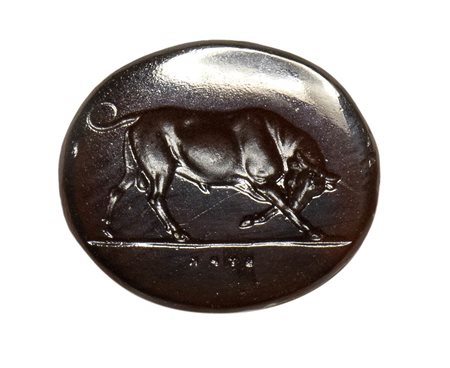
Lotto 356 A brownish glass impression. Bull.
19th century.
The mighty animal faces right, in the act of attacking. Groundline. Below, a signature. Grand Tour Era.
19 x 22 x 5 mm. -
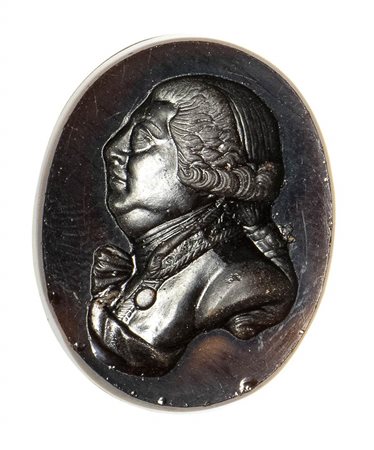
Lotto 357 A two layer glass impression. Portrait of king George III.
19th century.
Portrait facing left of the english sovereign George III (1738-1820). Glass composed of a brown layer on top of a white layer. Signs of wear. Grand Tour Era.
26 x 32 x 4 mm. -
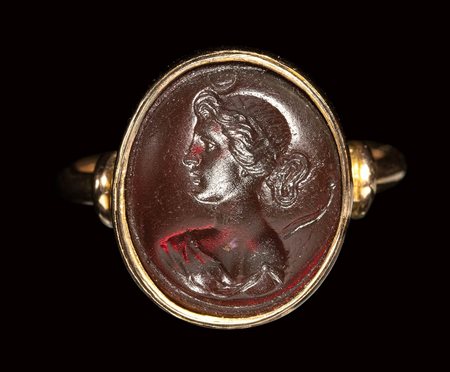
Lotto 358 A dark red glass intaglio set in a gold ring. Bust of Diana.
19th century.
The goddess of the hunt is facing left, with the bust covered by a tunic and the crescent moon on top of the head. Behind the shoulder, her bow. Subject executed with great stylistic elegance. Signs of wear.
Glass 12 x 15 mm; ring size 17 x 17,5 mm; 4,34 gr. -
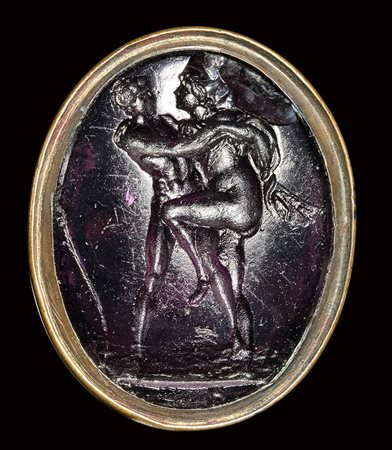
Lotto 359 A dark purple glass impression set in gilted metal fob seal. Hermaphrodite and Salmace.
18th - 19th century.
Naked Hermaphroditus, frontal and turned to the right, holding the nymph Salmace in his arms, naked and turned to the left; below, water and baseline. Chip on the edge and wear marks. The glass impression is taken from an intaglio attributable to Pichler. In the medals Cabinet of the Sforzesco castle in Milan there is a red sulfur taken from an intaglio with the same subject, signed Pichler. The subject is described in Ovid's Metamorphoses and in later times painted by the Carraccis. The intaglio by Pichler was inspired by a lost painting by Ludovico Carracci.
Parallel: G. Tassinari, Giovanni Pichler. Raccolta di impronte di intagli e di cammei del Gabinetto Numismatico e Medagliere delle Raccolte Artistiche del Castello Sforzesco di Milano, p. 169 ss.
Glass 19 x 25 mm; H. 31 mm; 8.04 gr.
-

Lotto 360 A polychrome glass paste impression set in a gold ring. The "Michelangelo seal".
18th - 19th century.
The scene is identified with the so-called Michelangelo’s Seal, representing the education of Bacchus. The reference model is a carnelian intaglio by Pier Maria di Pescia (Paris, BNF, Cabinet des Médailles). The glass of this impression has different colors as to simulate a natural agate. Very good condition. Grand Tour Era.
Glass 14 x 18 mm; ring size 17 x 18 mm; 6,18 gr.