
ASTA 107 - Glittica
-
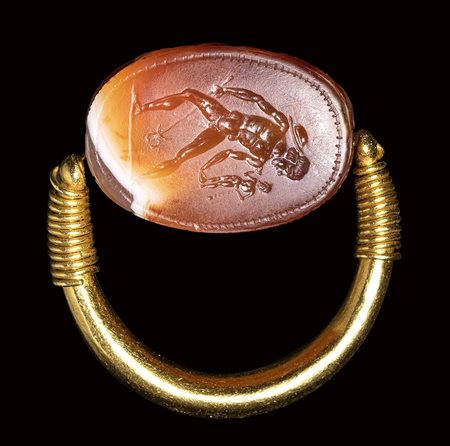
Lotto 25 A fine etruscan banded agate scarab intaglio set in a swivel gold ring. Hermes Psychopomp.
4th century B.C.
Hermes psychopomp moves to the left, but with the frontal torso and the head turned in profile backwards. The young god is naked and wears just the petasos resting on his shoulder and holds the kerikeion in his right hand; in his left hand he holds an idol depicting Hercules with a club (perhaps an allegory of souls towards the afterlife). Dotted frame. Groundline. This extraordinary representation is engraved on a scarab carved on an orange agate with equally extraordinary white stripes. On the back, in correspondence with the body of the insect, the two symmetrical white veins form an elegant V, perfectly centered. Signs of wear. Parallels: P. Zazoff, Etruskische skarabaen, 1968, n. 109. Cades, Gemme etrusche, 1b II 66. Furtwangler, AG. Taf. 16,54. AGDS, Band II, Staatliche Museen Preubischer Kulturbesitz Antikenabteilung, Berlin, taf. 50 n. 232. Cfr. Silver stater of Pheneus, Arcadia, 360-330 B.C.
scarab 15x22x8 mm; int diam 19x22mm; 14,56 gr.
Provenance: this scarab was mounted on a Castellani bracelet, in which the engraved part was covered and partially hidden by the frame. It is then reassembled as an old swivel ring. Uk private collection. -
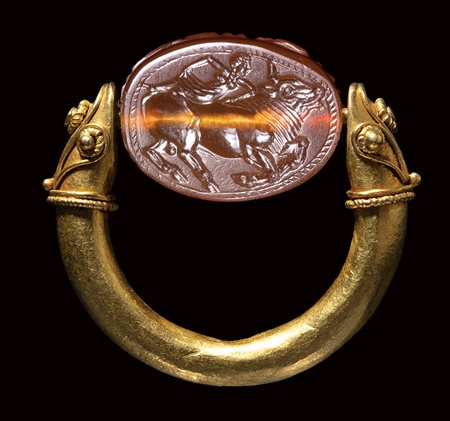
Lotto 26 An etruscan carnelian engraved scarab set in a gold swivel ring. Europa with Zeus as bull.
Late 5th-early 4th century B.C.
With large rounded hoop tapered at the endings, the shoulders adorned with filigree and twisted wires imitating a floral design. Revolving large carnelian scarab with well engraved details; hatched pattern on the lower part of the thorax. The underside engraved with a scene showing the rapt of Europa by Zeus as a bull. The powerful massive bull is running left with Europa on his back. The musculature and the anatomical details are well rendered meanwhile Europa representation is more stylized with globular elements. Cable border. The subject has been attested in various greek scarabs from the archaic and the Classical period. This one can be identify as an etruscan work inspired by the greek models.
Parallel: for a greek exemplar see in Beazley Archive, Oxford 1966.598., AGGems n° 305; for a similar iconography and style see Beazley Archive 2.I.A.115, Cades, T., Impronte Dell’instituto. J. Boardman, Archaic Greek Gems, n. 521-524. AGDS Berlin n. 211. AGKM (kunst, Wien) n. 39. G. M.A. Richter, Engraved gems of the greeks and etruscans. A history of greek art in miniature, n. 204.
Int diam 18x21 mm; scarab 14x18x9 mm; 10,49 gr.
Provenance: european private collection. The lot was purchased in the english art market, 1990s. -
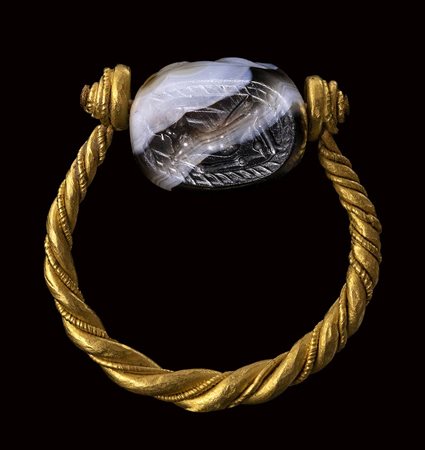
Lotto 27 An etruscan banded agate scarab engraved seal set in a gold swivel ring. Warrior (probably Achilles).
4th century B.C.
The hoop is composed of two thick plain wires spiral twisted together with a beaded wire, the ensemble tapering toward the circular loops at each end, where a wire is threaded through the perforation of the beetle. The slender beetle is well detailed with hatching on the lower edge of the thorax and upon the plinth. The underside is engraved with an helmeted warrior, holding shield and touching has heel pierced by an arrow (probably Achilles). Use of globular elements. Cable border. Slight wear marks.
Parallel: 4th century B.C., Villa Giulia museum, n°270, Cristofano, Martelli, oro degli etruschi,
Int diam 20 mm; seal 9 x 12 x 8 mm; 5,72 gr.
Provenance: U.K. private collection 1985. Formerly in Arthur Sambon (1867-1947) collection.
-
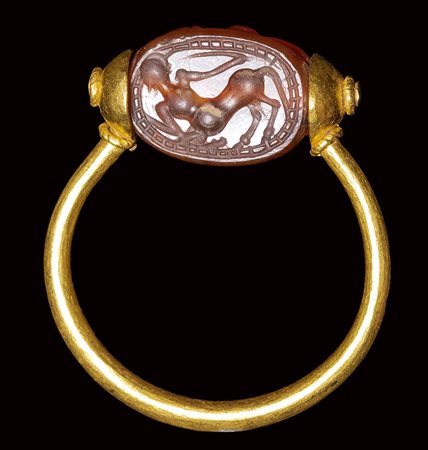
Lotto 28 An etruscan carnelian scarab set in a gold swivel ring. Centaur.
4th century B.C.
With plain rounded hoop bordered at the endings with twisted wire. Disks in the center fixed to the scarab by a transpiercing gold pin endings with twisted wire. The carnelian scarab is well detailed with hatching on the lower edge of the thorax and upon the plinth. The underside is engraved with a Centaur turned left. Use of globular elements for the head and the body. Cable border. Wear marks.
Int diam 21 mm; seal 9 x 13 x 6 mm; 6,09 gr.
Provenance: U.K. private collection 1985. Formerly in Arthur Sambon (1867-1947) collection.
-
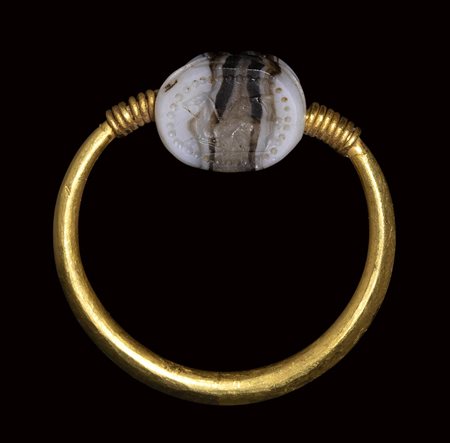
Lotto 29 An etruscan banded agate engraved scarab set in a gold swivel ring. Sea-horse.
Late 4th century B.C.
With plain rounded hoop ending with twisted wire on the shoulders. Revolving banded agate scarab with engraved design. The underside engraved with a sea horse turned left. Groundline. Dotted frame. Wear marks.
Int diam 18 mm; seal 6 x 9 x 5 mm; 2,60 gr.
Provenance: U.K. private collection 1985. Formerly in Arthur Sambon (1867-1947) collection.
-
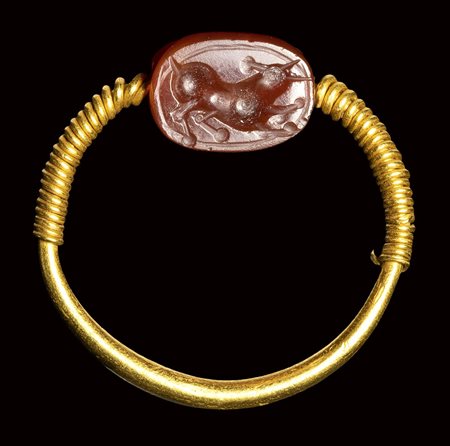
Lotto 30 An etruscan carnelian scarab intaglio set in a gold swivel ring. Bull.
3rd century B.C.
The animal is facing right, with its head turned back to the left. Use of globular elements (engraved with a drill). The gem is mounted in a gold swivel ring.
Stone 8 x 10 mm; ring size 15 x 19,5 mm circa; 3,04 gr.
Provenance: UK private collection. -
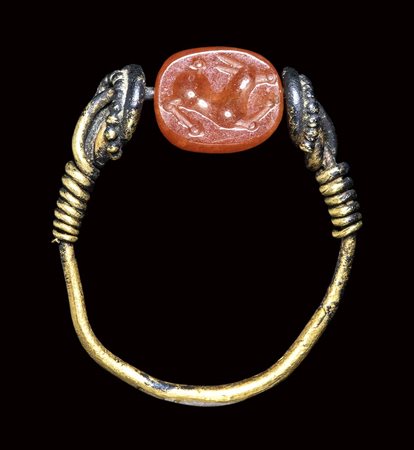
Lotto 31 A small etruscan carnelian scarab mounted in a gold ring. Antelope.
3rd century B.C.
The quadruped is running to the right. Use of globular elements. Wear marks. The scarab is mounted in a swivel ring with braided wire. Dark deposits.
int diam 13 mm; scarab 5x6x4 mm; 1,11 gr.
Provenance: UK private collection.
-
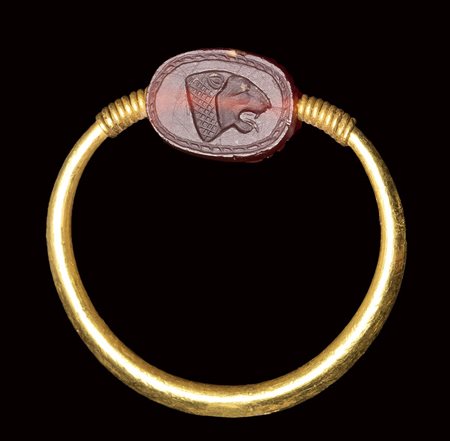
Lotto 32 A rare small Phoenician carnelian scarab set in a gold swivel ring. Lion head.
6th century B.C, circa 500 B.C.
Rounded hoop ending with twisted wire on the shoulders. Revolving carnelian scarab with engraved design. The back with naturalistic details. The underside engraved with a lion forepart turned right. His mane with hatched pattern. Cable border. The style and the iconography is typicall from the greek-phoenician orientalizing period.
Parallels: for similar sacarab with same design see Beazley archive Ashkelon. CSAPI no. 60. BL. III, Ibiza no. 139 (Barcelona 9388). BH. I, Paris, BN, Pauvert no. 50, from Etruria. Cornelian. Beaded border. Forepart., from Tharros. BH;PB. Faced by profile head of satyr. I, AG pl. 15.90. BH. As the last. III, Anecd pl. 26.B29. BH. V.
A.G. : Fürtwangler, A., Die antiken Gemmen, 1900; Anecd : Acquaro, E., Anecdote Tharrica, 1975
Int diam 20 mm; seal 7 x 9 x 5 mm; 2,79 gr.
Provenance: U.K. private collection 1985. Formerly in Arthur Sambon (1867-1947) collection. -
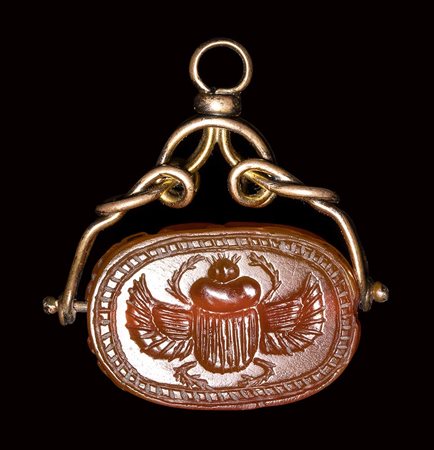
Lotto 33 A large etruscan carnelian engraved scarab mounted in a late 19th century gold seal. Winged scarab.
Early 5th century B.C.
The back well-detailed , the underside with engraved design: winged scarab. In frontal view with wide-spread wings with well-engraved details. Hatched border. Pierced lengthwise and mounted with a 19th gold seal composed of intertwined gold wires. Inspired from the archaic greek workshops. Parallel: Boardman, J., Archaic Greek Gems, 1968, n°148; J. Boardman, GGFR, n. 320 (Late Archaic). AGKM (Kunst, Wien) n. 9.
Scarab 15x23x12 mm ; total H 29 mm; 5,65 gr.
Provenance: the lot was purchased in the english art market 1990s.
-
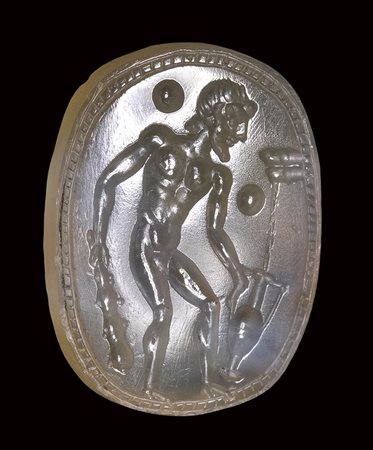
Lotto 34 An etruscan chalcedony intaglio. Hercules.
Late 4th - early 3rd century B.C.
Judging by the look of the back of the stone, it must have been an ancient scarab, then cut and flattened (probably due to an accident or a defect in the stone). The underside then use for the engraved design: Hercules with his club, collecting water from a fountain in an amphora. The hero is standing naked and turned left toward a source from which a fine jet of water flows into his amphora. In his right hand, the club. On either side of his shoulders, globes. Hatched border. Despite the reuse of the stone, the execution of the engraving figure shows great details and skills. The rendering volumes of the body as well as for the club and amphora, and the details of the face show the high quality of the intaglio. Use of globular elements. Parallels: J. Boardman, Intaglios and rings. Greek, Etruscan and Eastern from a private collection, n. 139-140, 150; P. Zazoff, ES, n. 66-67.
12x16x3 mm
-
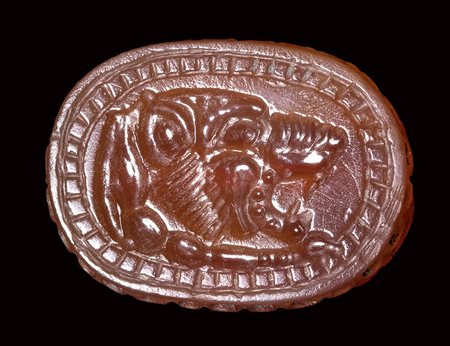
Lotto 35 An etruscan carnelian engraved scarab. Lion forepart.
Late 6th - early 5th century B.C.
The back with hatched pattern on the thorax and the legs, and v-shaped relief on the wings. The edge with vault frieze. The underside with engraved subject: a lion forepart turned right with an aggressive expression; the puckered muzzle, with the open mouth revealing its canines. The mane marked by incised lines. In the foreground, his right front paw. Use of globular elements for the jaw. Hatched border. Pierced lengthwise. Very nice polishing of the engraving and Wear marks on the surface of the stone. Traces of deposit. Rare. Inspired by greek coinage.
Parallel: for the subject see AGDS, Munchen, n. 138 (Greek Archaic).
Scarab 12x17x9 mm
Provenance: UK art market. -
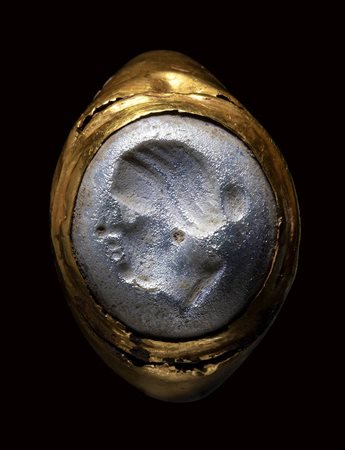
Lotto 36 A greek Hellenistic gold ring set with a glass intaglio. Female portrait.
2nd - 1st century B.C.
With hollowed rounded hoop, flatten within and extending in broader shoulders sloping inwards, to an oval box-setting with two bands of gold rising one above the other. Inset with a blue pale glass intaglio. Showing a head of a woman turned left. Her hair with long wavy locks tided back in a bun. Presence of globular elements for the earring, tin of the nose and chin. Missings and traces of deposits on the box-setting and the shoulders. Slight accident on the hoop. Nice conservation of the glass impression.
Parrallel: Marshall, F.H., 1968, n°385-386
int diam 18 mm; 12x13 mm; 4,38 gr.
Provenance: London, art market.