
ASTA 107 - Glittica
-
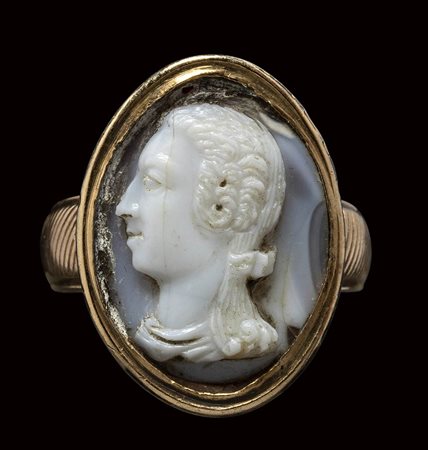
Lotto 337 An agate cameo set ina gold ring. Portrait of King Louis XV.
18th century.
Bust of King Louis XV of France (1710-1774), facing left. Minor deposit and wear to the surface. There is a small crack running vertically down the side of the head. Fill to the edges of the stone. There is a small chip to the lower edge of the torso. There is wear to the metal ring including an area of loss to the metal to the reverse. Published in Maximin Deloche, La bague en France à travers l'histoire, Paris 1929, n. 90.
Stone 13 x 18 mm; ring size 14 x 17 mm; 4,73 gr. -

Lotto 338 A carnelian intaglio set in a gold ring. Male portrait.
18th century.
The figure is facing left, with the head in profile and the bust in front. The shoulders are wrapped in a cloak with raised stitching. The pose and features are reminiscent in some aspects of the portraits of the English poet Lord Byron (1788-1824). This fine portrait is carved deeply into the gem, with great skill. Certainly it is to be identified with a character from the Grand Tour Era. Attractive stone color and slight wear marks.
Stone 16 x 19 mm; ring size 14 x 16,5 mm; 9,70 gr. -
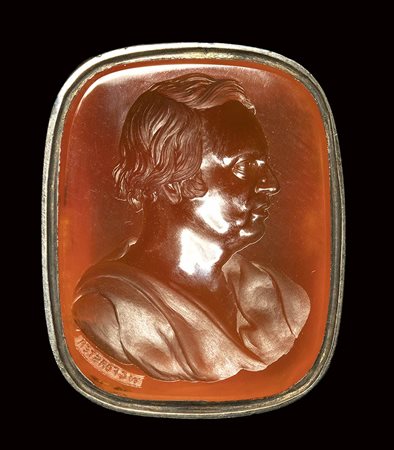
Lotto 339 An important carnelian intaglio set in a silver ring. Portrait of Dr. R. Carmichael by Forster.
19th century.
Important silver ring with a large square bezel, set with a carnelian intaglio bust of Dr. Carmichael facing right, signed W C FORSTER on a cartouche. Dr. Richard Carmichael (1779-1849) was a celebrated Irish surgeon and Professor of Anatomy. He had performed the first parotidectomy in Ireland in 1817 (without Anesthesia) and founded the Irish Medical Ass. in 1840. William Charles Foster (1816 - c. 1911) was the son of a gem engraver and lithographer called Thomas Forster (c. 1782-1869).
Published: Leonard Forrer, Biographical dictionary of medallist, London 1923, vol. VII p. 314.
Stone 21 x 27 mm; ring size 17 x 21 mm; 10,59 gr.
-
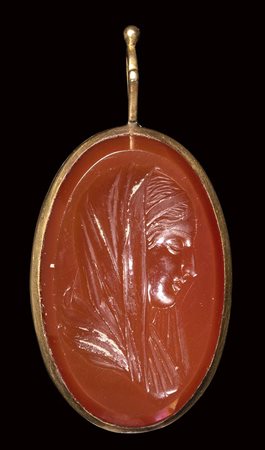
Lotto 340 A neoclassical carnelian intaglio set in a gold devotional pendant. Madonna with emblema.
19th century.
Bust of Madonna with veiled head, to the right. On the back of the gem: IHS surmounted by a cross; below three crossed arrows. The gem is mounted as a devotional pendant.
intaglio 15x25x6 mm; overall 18x35 mm; 6 gr. -
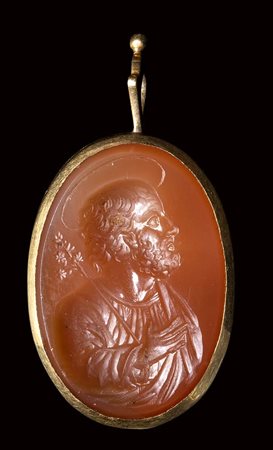
Lotto 341 A neoclassical carnelian intaglio set in a gold devotional pendant. Bust of Saint.
19th century.
The character is draped, bearded and facing right. The arm holds a sprig of flowers and has an open hand. Halo over the head. St. Dominic of Guzman (?). Refined execution. The stone is mounted as a devotional pendant.
intaglio 18x25x4 mm; overall 19x35 mm; 5,36 gr. -
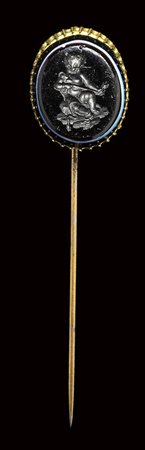
Lotto 342 A dark glass paste impression set in a gold stick pin. Hercules as a child killing the snakes
19th century.
The scene refers to a famous episode from the childhood of Hercules, who strangles the snakes. The infant is sitting on the rocks, killing a snake that clings to his arm, while another lies dead below. Three-layered glass, black and blue, imitating the nicolo. Slight wear marks.
Glass 18 x 21 mm; H. 80 mm; 7 gr. -
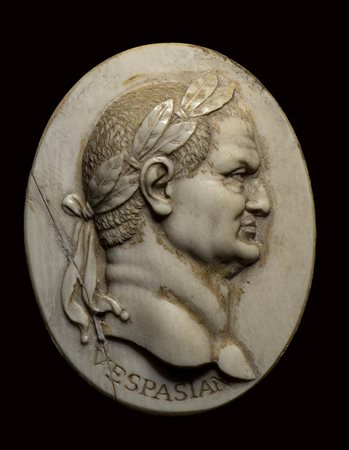
Lotto 343 A neoclassical ivory cameo. Bust of the emperor Vespasian.
18th - 19th century.
Bust of the Roman emperor Vespasian, laureated and in profile to the right. Under the shoulder, on the field, the inscription VESPASIAN. The cameo has a piece broken and rejoined. The portrait is part of the Twelve Caesars suite.
37x47x6 mm -
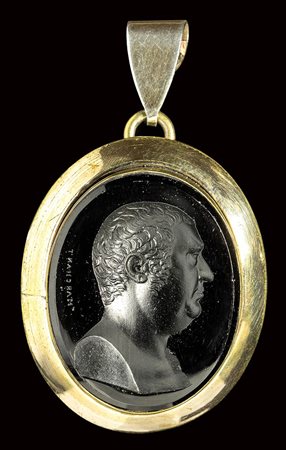
Lotto 344 A dark glass impression, set in a gold pendant. Portrait of Henry Fox signed Marchant.
19th century.
The character can be identified with the English politician Henry Fox, 1st Baron Holland (1705 – 1774) , due to his exact physiognomic resemblance. The character is facing right and has the bust depicted as for a sculpture. On the pitch, behind the neck: MARCHANT (Nathaniel Marchant RA (1739–1816) was one of the most important English gem engraver ). Very good condition.
Glass 21 x 27 mm; mounting 27,5 x 33 mm (max 45 mm); 11,71 gr. -
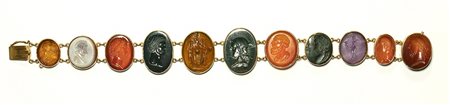
Lotto 345 Eleven intaglios set in a fine gold bracelet. Various subjects.
18th - 19th century.
From the left to the right: carnelian intaglio, portrait of philosopher (Socrates); agate intaglio, portrait of Newton; carnelian intaglio, head of Zeus; bloodstone intaglio, portrait of an Emperor; orange glass impression, seated Zeus; bloodstone, gryllos; carnelian intaglio, bust of a philosopher; green jasper intaglio, bust of a Muse with a theatrical mask; purple glass, Eros and Psyche; carnelian intaglio, head of an emperor; carnelian intaglio, bust of Zeus. The gems are engraved in a variety of materials, dating from 17th to 19th century. Attractive Edwardian gold bracelet; the intaglios are linked by a double-chain in the Renaissance style. Very good condition.
Stones min. 11 x 14 to max. 17 x 23 mm; Length 210 mm; 33,27 gr
-
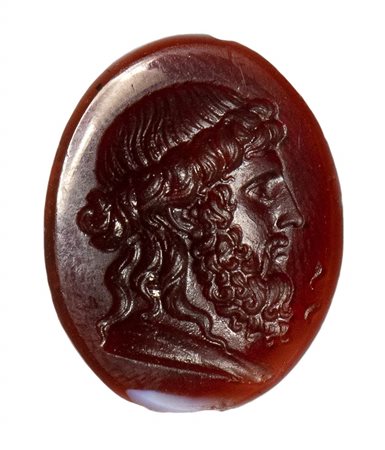
Lotto 346 A glass paste impression. Aesclepius.
19th century.
Bust of Asclepius, facing right. The glass paste is composed by two layers, red and white, imitating the agate. Small chips on the edge. Grand Tour Era production.
19 x 24 x 4 mm. -
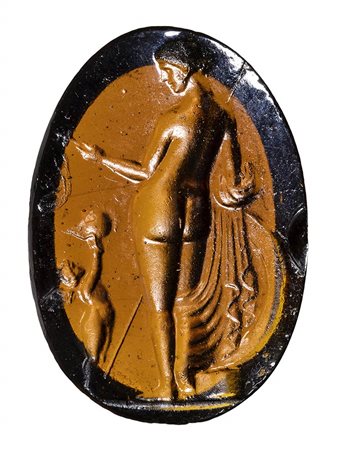
Lotto 347 A Grand Tour brownish glass impression. Venus Victrix.
19th century.
The scene depicts Venus Victrix with the weapons of Mars, seen from behind slightly in three quarters, and an Erote who hands him the helmet. The subject was also engraved by Giovanni Pichler during the neoclassical era. Brownish orange glass. Slight signs of wear.
21x30x5 mm -
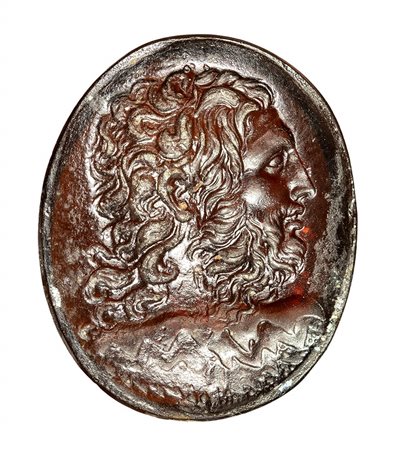
Lotto 348 A large brownish glass impression. Bust of Okeanos.
18th - 19th century.
The character faces right, and is characterized by long hair and a bust covered in marine scales. Wear marks.
26 x 32 x 6 mm.