
ASTA 107 - Glittica
-
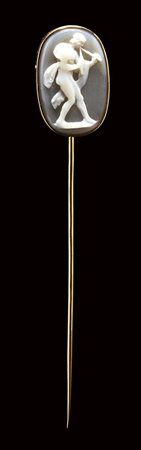
Lotto 325 An agate cameo set in a gold stick pin. Ephebus playing the flute.
18th - 19th century.
The young character is facing right, depicted naked, covered only by a fluttering drapery, while playing a double flute. The hairs are held by a tenia. Subject inspired by classical Greek models.
Stone 17 x 26 mm; H. 100 mm; 6,04 gr. -
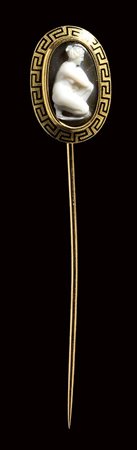
Lotto 326 A fine onyx cameo set in a gold and black enamel stick pin. Crouched Venus.
18th century.
The deity is depicted naked, crouching with one knee on the ground, coming out of the bathroom. The pose is inspired by a famous model from the hellenistic Greek era, also sculpted during the Roman empire. The cameo can be considered a 18th century french work, while the black enamel meander setting was made in the 19th century. Very similar to the type sculpted by Antoine Coysevox towards the end of the 17th century (marble in the Louvre, Paris).
Stone 11 x 18 mm; H. 83 mm; 6,16 gr. -
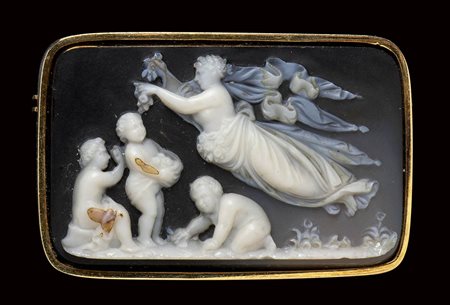
Lotto 327 A large agate cameo set in a gold brooch. Allegorical scene.
19th century.
The scene is composed of three putti and an allegorical personification of Abundance. The female figure is finely draped suspended in the air, in the act of offering fruits / flowers to a putto who collects them in a drapery. Next to it, another cherub collects flowers kneeling on the ground. Another erote is seated. The scene is inspired by neoclassical models. The details of the anatomy and of the garments (fluttering drapery) are engraved with great skill. The rectangular stone, a three layer agate, is mounted in a gold brooch.
cameo 24x38x6 mm; overall 27x42 mm; 15,08 gr. -
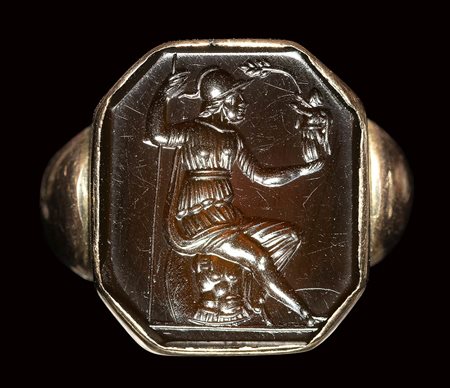
Lotto 328 An octagonal sard intaglio set in a gold ring. Athena.
18th - 19th century.
The deity is seated on a panoply (shield and armor), and is facing right. With his right hand she holds the spear, with the left she holds a winged victory offering her a laurel frond. Groundline. Interesting stylized Georgian intaglio. Very good condition.
Stone 15 x 19 mm; ring size 17 x 19 mm, 5,96 gr. -
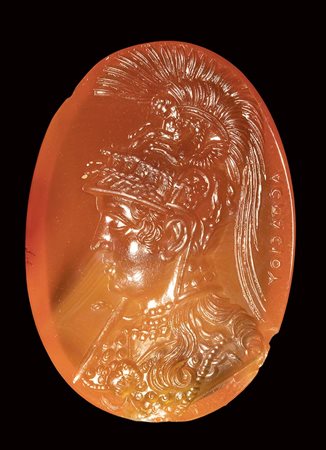
Lotto 329 A large carnelian intaglio signed Aspasios. Bust of Athena Parthenos.
18th century.
Bust of Athena Parthenos facing left. The effigy is certainly inspired by the famous ancient stone engraved with the same subject and signed by the roman gem engraver Aspasios (red jasper, Rome, Palazzo Massimo National Roman Museum). However, the physiognomic features of the face are not idealized but instead refer to an historical private portrait: the features of the profile recall Catherine II of Russia. The helmet, the hair, the gorgoneion are engraved with great technical mastery. The spear rests on the shoulder. In the field, the signature in Greek of Aspasios. Beautiful vivid color of the gem. Small chip on the edge.
25 x 35 x 6 mm. -
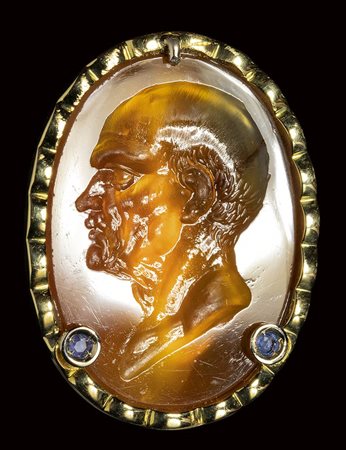
Lotto 330 A fine agate intaglio set in a gold brooch with precious stones. Male portrait.
Early 18th century (intaglio).
Portrait of a Roman general (Caio Mario?) in profile to the left. This portrait is characterized by an hard and strong-willed face expression, suited to military command. Its physiognomic and anatomical confor- mation are similar of some Roman military leader’s portraits of the late 1st century B.C. Large stone set in a beautiful modern mounting adorned by precious stone.
Stone 20 x 28 nmm; mounting 23 x 31 mm; 13,72 gr.
-
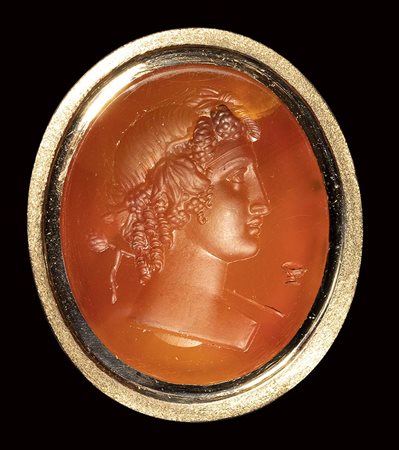
Lotto 331 A neoclassical carnelian intaglio set in a modern ring. Bust of a Bacchante.
19th century.
The bacchante is depicted in profile facing right, with a naked bust and hair adorned with bunches of grapes. In the background her attributes: the thyrsus and a small cup for wine. The profile is linear in the typical neoclassical style. Attractive color of the stone. The gem is set in an older gold frame from a seal readjusted into a modern ring. Very good condition.
Stone 17 x 21 mm; ring size diam 16 mm circa; 10,65 gr. -
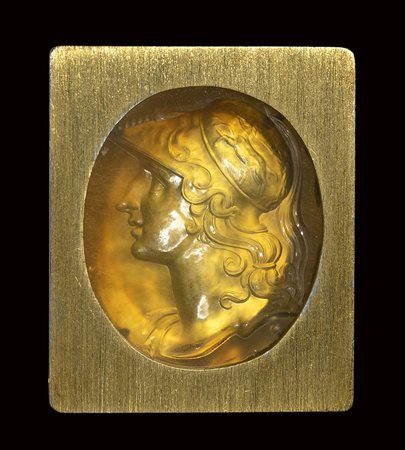
Lotto 332 A fine chalcedony intaglio set in a contemporary gold brooch with diamonds. Helmeted bust of Athena.
Early 18th century.
Head of Minerva, in profile to the left, with a finely decorated helmet with a dragon and a mask on the visor. The hair falling to the shoulder, engraved with great art. The profile is characterized by a slightly open mouth, inspired by hellenistic models. The gem is set in a contemporary gold jewel with diamonds. An almost identical intaglio, both in style and in subject, is in Florence, Palazzo Pitti (Museo degli Argenti), from the Collezioni Granducali. Probably these two gems were engraved by the same engraver. Le Gemme dei Medici al Museo degli Argenti. Cammei e Intagli nelle collezioni di Palazzo Pitti, p. 397, inv. Gemme del 1921 n. 217, GFSSPMF 297136 (Rock crystal intaglio set in a gold frame).
Stone 19 x 22 mm; mounting 25 x 30 mm; 19,92 gr. -

Lotto 333 A fine carnelian intaglio by Pichler. Head of Ceres.
18th - 19th century.
Head of Ceres, facing left, signed Pichler in greek. Chip with lack on the edge. The work can be attributed, as Paoletti refers for an almost identical intaglio, to Giuseppe Pichler: in the "Sessione 4, Opere di Giuseppe Pichler" in the Paoletti casts, there is a head of "Cerere Dea dell'Agricoltura", inv. MR 26760 n. 123 tomo V, with exactly the same head but with a draped bust (carnelian intaglio). Several others versions exist, all with variants. Giuseppe, alias Johann Joseph Pichler, was born in Rome in 1760. He was the son of the second wife of Antonio Pichler (1697-1779) and half-brother of the more famous Giovanni who initiated him into the family art. Very fine style. Parallel: L.P. B. Stefanelli, La Collezione Paoletti, vol. 2, p. 33 n. 123.
19 x 25 x 4 mm. -
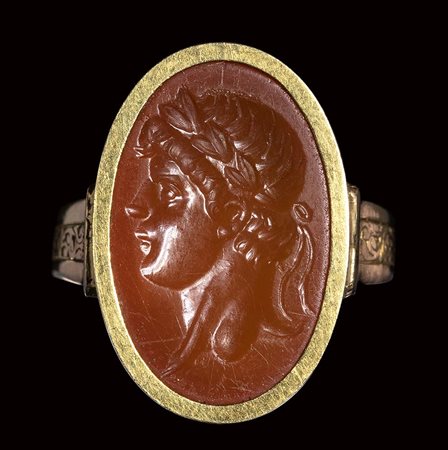
Lotto 334 A postclassical carnelian intaglio set in a gold ring. Portrait of an emperor.
18th century.
The intaglio shows the portrait of a young laureated emperor turned left. The features are soft with small rounded eye, a small aquiline nose and a semi-opened mouth. The rounded chin and cheek contrast with a muscular neck. The short forehead is surmounted by voluminous short hair framing the face and letting the ear uncovered. The laurel wreath is ending in the back with a knot and ribbons. Classical representation of a young roman emperor inspired by roman glyptics productions. The gold mounting with rounded hoop, chiseled foliages on the shoulders support and large oval gold box-setting (different gold ?). Gold mark.
int diam 17 mm; intaglio 11x18 mm; 3,79 gr.
-
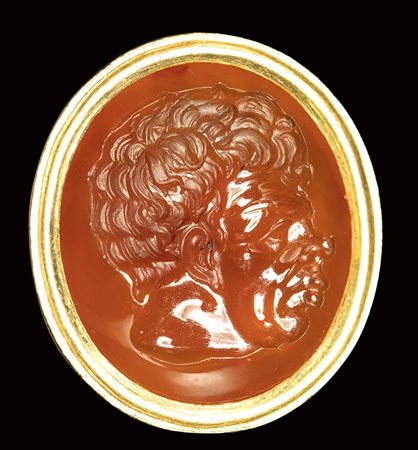
Lotto 335 A carnelian intaglio set in a gold fob seal. Male grotesque portrait.
Mid 18th century.
Male head facing right, characterized by realistic and almost grotesque features, perhaps a caricature. The typology of the portrait recurs with variations in the graphic production of Pier Leone Ghezzi, also known for his extraordinary caricatures. This gem is likely inspired by this mid-18th century repertoire. Fine style. Work expertly polished. Attractive deep red color of the stone, mounted as a seal. Very good condition.
Stone 17 x 20 mm; seal H. 25 mm; 5.76 gr. -
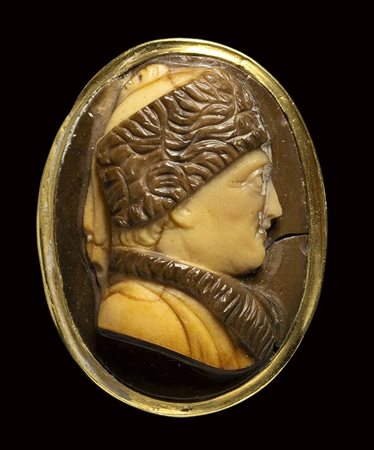
Lotto 336 An unusual agate cameo set in a gold ring. Historical portrait.
Late18th century.
The character is facing right, and is characterized by a large fur headdress and a dress equally fitted with fur in front. The engraver has sculpted the three layers of the stone with great skill, sculpting the fur in the brown part (as in reality). The stone is damaged in front of the profile and repaired (crack on the field and nose repaired). Due to the close iconography and physiognomy resemblance it could be the portrait of the french writer Jean Jacques Rousseau.
Stone 19 x 26 mm; ring size 18 x 20 mm;15,30 gr.