
ASTA 107 - Glittica
-
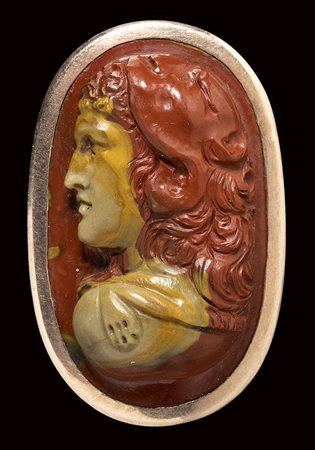
Lotto 313 A fine bicolor jasper cameo set in a gold frame. Bust of Hercules.
18th - 19th century.
The hero is depicted with the head in profile and the shoulder seen from behind, slightly in three-quarter. The head is covered by the leontea, which goes down to the back; the paw rests on his shoulder. The profile is marked, beardless. Exceptional use of the two colors of the stone; the yellow part is used strictly for the face, neck and shoulder of Hercules; his hair and the leontea are red. The cameo is mounted in a gold frame.
cameo 19x31x8 mm; overall 23x29 mm; 9,13 gr. -

Lotto 314 An important signed agate cameo set in a gold ring. Centaur with Cupid.
18th century.
This large hardstone cameo of the Centaur with Cupid (Allegory of the invincible strength of the Love) is engraved by Ludwig Friederich Walther (1757-1817), with his signature in Greek. The stone is mounted in a Georgian gold ring, c. 1780. Missing on the figure and a crack in the stone. This cameo can be identified as a gem which was commissioned by «the equerry von Crailsheim», i.e. the baron Alexander Hannibal von Crailsheim (c. 1740-1816), chamberlain at the Brandenburg-Ansbach court, personal master of the stable of the duke, and which he had set a ring, which became before 1793 the personal ring of an important member of the Hohenzollen family, Christian Friederich Karl Alexander (1736-1806), last margrave of Beyreuth and Ansbach. The margrave was a well-known amateur of horses and of love. About the career of the gem engraver Walther, the centaur cameo is one of his few gems attested in contemporary literature, documented by 1793 as one of his masterpiece. It seems that the material used for this gem is a rare type of fossilized wood, found from 1767 onwards in Rodach - north of Coburg- and exploited by the Walther family until it was exhausted in the late 18th century, became a stone, comparable to an agate. The motif of Centaur with Cupid is copied from a 2nd century A.D. (Hadrianic) marble statue (from Borghese coll. than to Louvre coll. in Paris). This subject was engraved twice by Giovanni Pichler, the last one carved before 1782.
Stone 20 x 25 mm; ring size 17 x 18 mm; 8,46 gr.
-
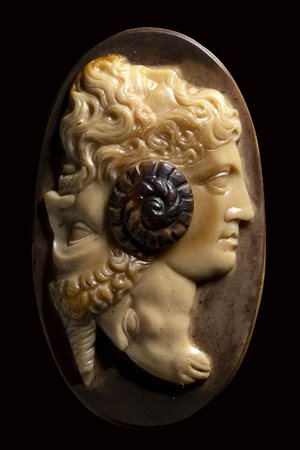
Lotto 315 A fine agate cameo. Gryllos.
18th century.
The hybrid creature is engraved on a three-layered agate, and is composed of: a youthful male face, a bearded male face, to which another bearded face is conjoined with a pointed horn (Poseidon?); to the three human heads is added a ram's head, whose horns are carved in the darker brown layer. Apotropaic iconography, inspired by roman and renaissance models. Beautiful execution.
20x33x7 mm -
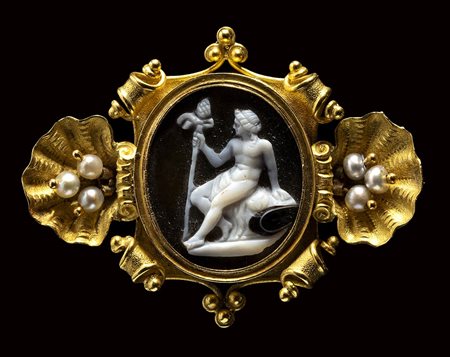
Lotto 316 A french onyx cameo set in a gold brooch with pearls. Dyonisus with tyrsus.
19th century.
The god is facing left, seated and holding a thyrsus with his right hand. Sardonyx cameo set in a french 18ct gold brooch, c. 1850s (“hibou” hallmark), set with natural pearls. The pearls might symbolize Aphrodite. Very good condition.
Stone 16 x 20 mm; mounting 31 x 42 mm; 8,30 gr.
-
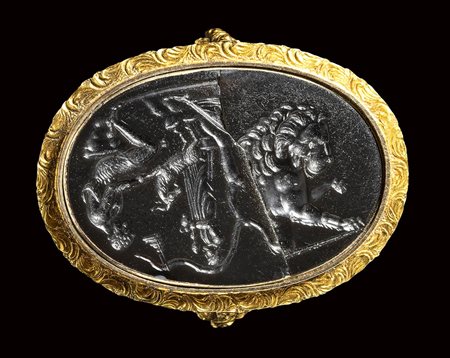
Lotto 317 An important Grand Tour sard intaglio (two fragments) set in a gold ring. Lion and Bacchic scene.
18th - 19th century.
Published: Dr. Archibald Billing, The science of Gems, Jewels, Coins and Medals, ancient and modern, revised edition London 1875, p. 81, figs.117-118&120: "Two of the best specimens that have been produced of forged fragments are in possession of Mr. R. Phillips, of Cockspur Street; these two are made out of one stone, - a dark brown Oriental sard; the engraver brocke it across, and on the larger portion made a most antique-looking intaglio (117), apparently thee worship of Pan, or some such subject, quite open to a controversy such as might have been sustained by Visconti; it really looks a highly respectable fragment of an antique. But the engraver, it would seem, thought it a pity that the other portion of such a fine stone should be left unemployed; so he made that into another antique fragment, with another subject; that is to say, the head, neck and fore quarter of a lion (118) passant, very well engraved; not a modern heraldic lion passant, but a real grumy-looking lion, from an arena, perhaps, of the Coliseum-it would pass for the fore-part of the group of Cybele riding on a Lion, which is a common antique subject (119); this fragment he antiquified more than the other; for whereas the one with the sacrifice is smooth on the back, the other with the lion has been much scratched. (120) is the absurd-looking impression when the two pieces are reunited. It is strange that, after their wanderings, they should have met again in the possession of any one connoisseur". Extraordinary specimen. Very good condition.
Stone 17 x 26 mm; ring size 17 x 21 mm; 6,13 gr. -
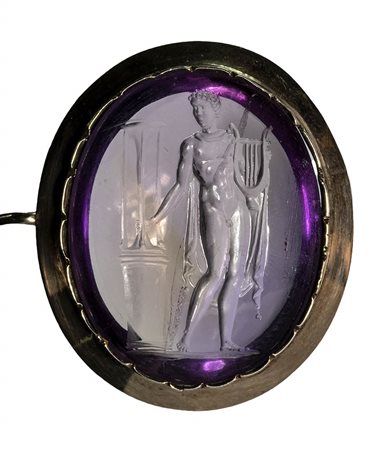
Lotto 318 A fine amethyst neoclassical intaglio set in a gold brooch. Apollo playing lyra.
First half of 19th century.
Apollo is standing, his body naked; his shoulders draped with a cloak. The face is turned in three quarters to the left while the body is slightly twisted to the right. It stands next to an altar / column with the tripod. With his left hand he holds the lyre, while with his right hand he caresses the tripod, perhaps as an allusion to his poetic and artistic superiority, certainly victorious. The intaglio is engraved on a beautiful amethyst of pure and luminous color, slightly convex. Although there are some variations, the model of inspiration must be identified with the splendid amethyst engraved with the same subject, preserved in Paris, Cabinet des Médailles. M.L. Vollenweider identifies it as a representation of Nero as Apollo, at the time when he had five-year celebrations, the Neronia, set up, with music and poetic competitions. A series of coins also represents Nero Citherede.
Parallel: "Cabinet des Médailles BNF- Database: inv. DdL.1625; MR.86 (Louvre) ; reg.Y.22320; Cfr. Vollenweider, M.-L.., Avisseau-Broustet, Mathilde. Camées et intailles, II, Les portraits romains du Cabinet des Médailles. Paris : Bibliothèque nationale de France, 2003, p.114-115, n°128.
Le trésor de Saint-Denis [cat.exp.]. Paris : RMN, 1991, p.288-289, n°63 D. Gaborit-Chopin et M.L. Vollenweider.
Montfaucon, B.. L'antiquité expliquée et représentée en figures. Paris : entre 1719 et 1724, t.I, pl.XLIX, n°3."
Stone 22 x 27 mm; mounting 26 x 30 mm; 7,53 gr.
-
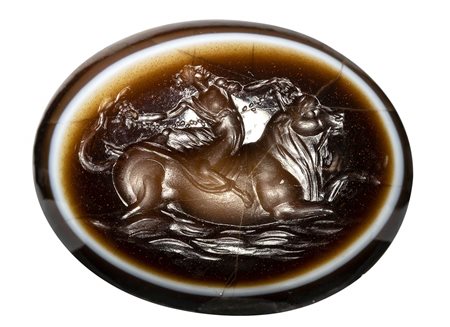
Lotto 319 A fine neoclassical bull's eye agate intaglio. The abduction of Europa.
19th century
The scene depicts the famous mythical episode in which Zeus in the guise of a bull kidnaps Europa, crossing the sea waves. Intaglio engraved with great technical skill, considering the convex surface of the stone. Very thin internal crack. Close to the Berini's manner.
Parallel: This is very close to another gem (engraved by Antonio Berini [1770-1861]), illustrated by Georg Lippold (Gemmen und Kameen des Altertums und der Neuzeit, Stuttgart s.d. [1922], pl. CXLIII-9). Its style is more free than that of the gem by Berini (Lucia Pirzio Biroli Stefanelli, La Collezione Paoletti. Stampi in vetro per impronte di intaglio e cammei, vol. II, Roma 2012, p. 291, no. VIII-98; p. 312 n. VIII-389; p. 316 n. VIII-452). The type was also treated by Brown (see Julia O. Kagan, Reznye kamni Vil'yama i Charlza Braunov, St. Petersburg 1976, p. 23, no. 3).
18 x 23 x 6 mm. -
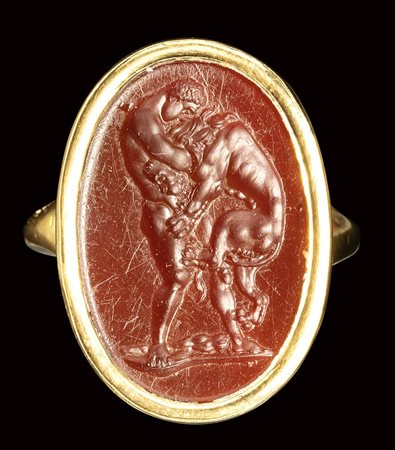
Lotto 320 A fine neoclassical carnelian intaglio set in a modern gold ring. Hercules fighting the Nemean Lion.
Late 18th - early 19th century.
The hero strangles the Nemean lion. His muscles are tense for the effort. The beast clings to Hercules, but its defeat is very close. Below, the club. Groundline formed by a ground portion. The work is performed with great skill and particular attention to the anatomical details deeply engraved. The model is certainly ancient, but this intaglio is to be considered neoclassical, close to the production of Pichler and Calandrelli. Both engravers in fact, produced intaglios with this exact depiction, after an ancient intaglio in nicolo, formerly in the Jenkins collection, then Poniatowski (print engraved by Thomas Worlidge, 1757, London British Museum, Dep. Prints and Drawings n. 1859.0709.889 A Pichler’s intaglio with the same subject (onyx, before 1787) is defined by sources as “from an ancient gem”; that Pichler’s work is signed Filemonos in Greek letters, as a pseudonym and “forgery” for the Grand Tour market. Calandrelli engraved the same subject, with minimal variations.
Parallels: L.P. B. Stefanelli, La Collezione Paoletti, vol. 2, p. 57 n. 359 (Tomo V); p. 66 n. 457 (tomo V); p. 209 n. 103 (Tomo VII). See also J. Boardman, J. Kagan, C. Wagner, Natter's Museum Britannicum, n. 260 (sard intaglio).
Stone 15 x 22 mm; ring size diam. 20 mm; 13.16 gr.
-
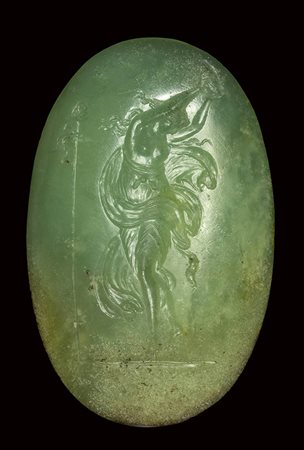
Lotto 321 A large jadeite neoclassical intaglio. Dancing Maenad.
Second half of 18th century.
The Bacchante is characterized by a naked bust, going to the left, with her head leaning towards right. The moving figure is wrapped in his fluttering robe, in the act of raising his arms to play the cymbals. A long tyrsus on her right side. Groundline. Large intaglio, masterfully engraved on a not common material. The subject is inspired by classic models. Parallels: Lucia Pirzio Biroli Stefanelli, La Collezione Paoletti. Stampi in vetro per impronte di intaglio e cammei, vol.II, Roma, 2012, p. 58 n. V-368 (violet glass Num.inv. MR72002, drawn from a carnelian intaglio ante 1782, portraying a dancer, engraved and signed by Pilcher. Subject drawn by a detail of the Trionfo di Bacco e Arianna by Annibale Carracci (1560-1609), Roma, Galleria Palazzo Farnese. Also called "bacchante" or "dancing timbrel-player". For any in-depth analysis see the above-mentioned sheet and Gabriella Tassinari, Giovanni Pilcher. Raccolta di impronte di intagli e di cammei del gabinetto numismatico e medagliere dellle raccolte artistiche del castello sforzesco di Milano (Dattiloteche1), Milan 2012, pp.357-358, no. III-20.
20 x 31 x 3 mm. -
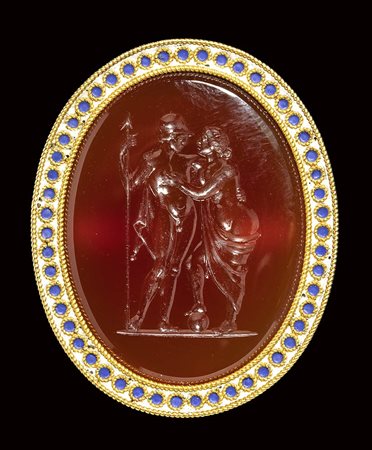
Lotto 322 A fine neoclassical carnelian intaglio set in an gold and enamel mounting . Mars and Venus.
19th century.
Venus is caressing the helmeted Mars, the god of the War, who wants to depart, armed with his spear. Several statuary groups depict “Venus detaining Mars from the Wars”, similar to that intaglio engraved in a deep red carnelian. The examples found in neoclassical art are after ancient roman versions. The marble group from Ostia (in the Museo Nazionale Romano), and the one in the Louvre are both roman copies after lost greek original, mixing the types of the Ares Borghese and of the Aphrodite of Capua. This intaglio could be a neoclassical version of earlier gems. Almost identical gems were cast by Tassie: three are inverted (n. 6514-6516), one is in the same direction but heads are further apart (n. 6517), one in green chalcedony (n. 6518) and a lost one is in jasper (n.6519). A terminus post-quem for the original design is given by the gem once owned by Claude de Boudaloue (d. 1715), possibly the one later copied by William Brown. This carnelian intaglio is set in an elegant cuff-button, 1860’s marked TIFFANY & CO 18ct on the reverse. The gold mount is bordered with twisted wirework, applied with opaque white enamel decorated with circular opaque royal blue enameled motif surrounded by twisted wirework. Tiffany & Co had a collection of antique gems in addition to its stock of contemporary examples.
Stone 18 x 24 mm; mounting 24 x 30 mm; 9,60 gr.
-

Lotto 323 A "magical eye" agate intaglio. Two figures with attributes.
18th century.
In the foreground, a naked female figure holding a scepter with snakes and a fluttering cloak; in the background, a naked, helmeted male figure advances with a spear. The male character wears military shoes (Mars?). Groundline. Allegorical scene, engraved in the center of an attractive magic eye on two-layered agate.
Diam. 20 mm circa x 6 mm. -

Lotto 324 A three-layered agate cameo set in a gold stick pin. Bust of Zeus.
17th - 18th century.
The deity faces right. The bearded figure is characterized by thick hair falling on the neck with long braids. Laurel wreath. Slight cracking on the surface and wear marks.
Stone 13 x 18 mm; H. 61 mm; 4,24 gr.