
ASTA 107 - Glittica
-
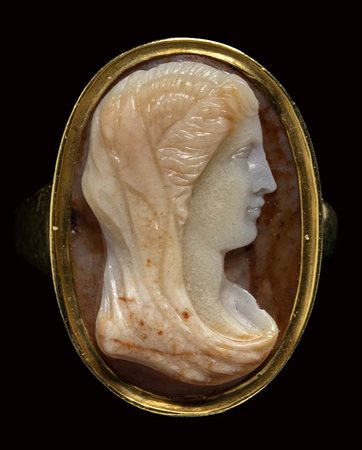
Lotto 301 A fine agate cameo set in a gold ring. Veiled bust
18th - 19th century.
Veiled female bust, facing right. Probably a Vestal, or an empress. Beautiful execution with refined and delicate details. Very good condition.
Stone 15 x 22 mm; ring size 16 x 18 mm; 12,27 gr. -
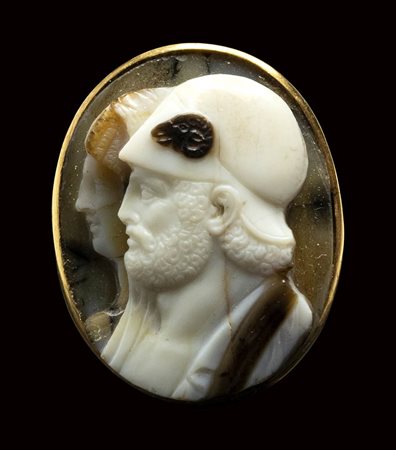
Lotto 302 A fine onyx cameo set in a gold ring. Conjoined busts of Pericles and Aspasia.
18th - 19th century.
The two busts are joined, facing to the left. In the foreground, the bearded and helmeted character, with his shoulders covered by a cloak, is identifiable with the athenian statesman Pericles. In the background, the bust of Aspasia. Wear marks and slight surface cracks in the stone. Interesting artistic use of the different colored layers of the agate.
Stone 23 x 28 mm; ring size 18 x 19mm; 11,20 gr. -
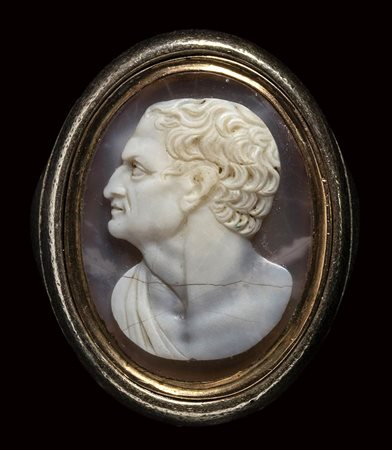
Lotto 303 A neoclassical agate cameo set in a silver ring. Bust of Phocion.
18th - 19th century.
The character is depicted with a frontal bust and the face in profile, facing left. Phocion was an Athenian politician, military leader, famous for his moral integrity. His iconography spread during the 18th - 19th century and it was engraved by different artists, with the same pose, as Girometti and Santarelli (cameo in agate, signed Girometti – in Greek letters, on antique market n. LU1203427973, referred to an ancient chalcographic engraving, titled: PHOCION ATHENIENSIS Dux Summus, Summus Orator - Cingoli apud Anton Maria Castiglionum). The stone is slightly cracked. Chip on the ear and wear marks. The cameo has a gold frame (probably was a seal), converted in a solid silver ring.
See: Lucia Pirzio Biroli Stefanelli, La collezione Paoletti (vol.2), cast n. 355 Tome V, drawer 6 n. inv. MR 26989 (cameo in agate-chalcedony signed by Pichler, called Lisimaco, Farnese collection, Naples, National Archaeological Museum; cast n. 33 Tome VI drawer n. 1, inv. MR 27237).
Stone 18 x 24 mm; ring size diam. 20 mm; 34,50 gr.
-
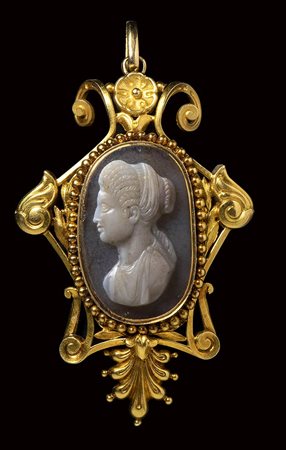
Lotto 304 A Grand Tour agate cameo set in a gold brooch. Bust of a matrona.
18th century.
Draped bust of matrona, facing left. The hairstyle is referable to the Flavian era. Probably a portrait of a roman empress or a princess (Julia Titi?). The cameo, engraved on a two-layer agate, is mounted in an elegant 19th century brooch, with a mixtilinear frame, decorated with floral and vegetal elements (palmette, rosette, leaves). Very good condition.
cameo 19x29x5 mm; overall 44x60 mm; 21,48 gr.
-
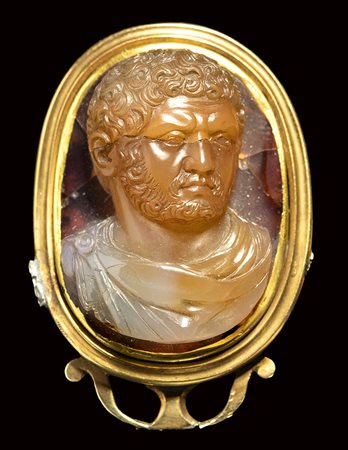
Lotto 305 A fine agate cameo set in a gold mounting. Bust of the emperor Caracalla.
18th century.
The emperor is depicted with the frontal torso and the face turned three-quarters to the right, in his typical pose with the neck in torsion. The sturdy shoulders are covered by a chlamys with a buckle. The beautiful execution reveals a great knowledge of the anatomical volumes. Beautiful variety of agate. The stone is broken in half but is still firm in its original setting. The gold frame is characterized by small lacks.
Stone 25 x 34; mounting 30 x 44 mm; 22,10 gr. -
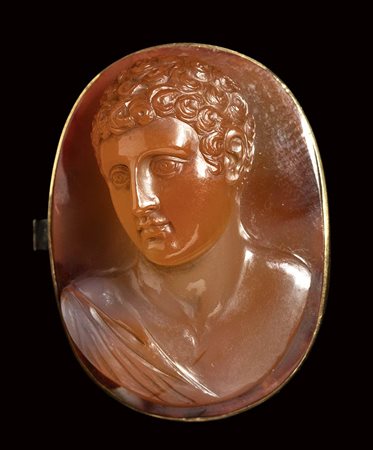
Lotto 306 A fine agate cameo set in a gold brooch. Bust of Hermes.
18th century.
The bust of the deity is depicted frontally, with only one shoulder covered by the cloak. The face is slightly reclined three-quarters, with the eyes in an expression of sweet melancholy. Refined execution, of great beauty. The stone is characterized by a mirror polish and intense color. The subject is inspired by the graeco-roman statuary models.
Stone 26 x 34 mm; 14,69 gr. -
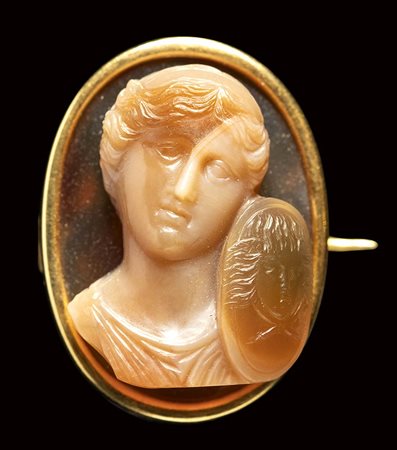
Lotto 307 An italian agate cameo set in a gold brooch. Female bust with a Medusa shield.
Early 19th century.
The divinity is presumably to be identified with Athena, characterized by her typical tunic and the hairs gathered, divided in the center of the forehead, usually covered by the helmet. Unusual is the presence of the shield attached to the face and bust of the figure; its size is smaller than usual but its allegorical and apotropaic meaning, with the Medusa mask, always remains important. Rare.
Stone 18 x 25 mm; 9,45 gr.
-
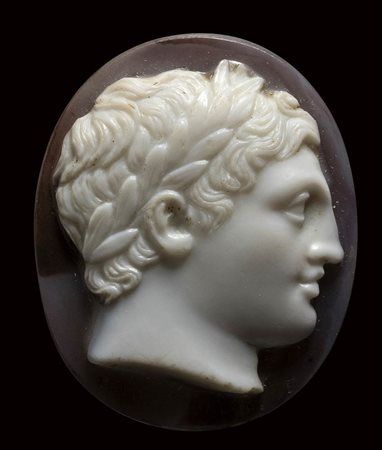
Lotto 308 A rare neoclassical onyx cameo signed by Teresa Talani. Head of Apollo.
Early 19th century.
Beautiful head of Apollo laureate facing right. The model is certainly the gold stater of Philip II (Macedonia, Amphipolis 340-328 B.C.). The cameo is signed TERESA TALANI F. Two layer agate. Beautiful execution. For comparison: Gabriella Tassinari, Teresa Talani, incisore di gemme in epoca napoleonica in LANX 18 (2014), pp. 48-128.
21 x 26 x 7 mm. -
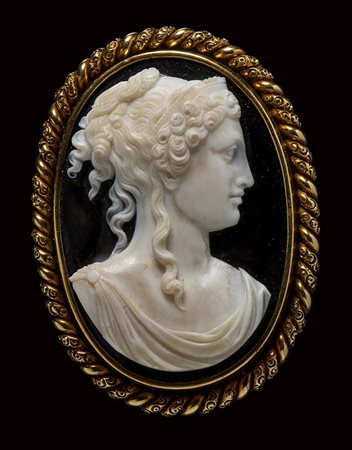
Lotto 309 A large neoclassical agate cameo set in a gold brooch. Female bust.
19th century.
The deity, probably Venus, has an almost frontal bust and a head in profile. The figure is characterized by a very thick and elaborate hair, finely engraved. This large agate, in two layers with a white effigy on a dark background, is mounted in a gold brooch with a twisted frame. The brooch closure mechanism is damaged.
cameo 34x50x12 mm; overall 45x60 mm; 67,48 gr. -
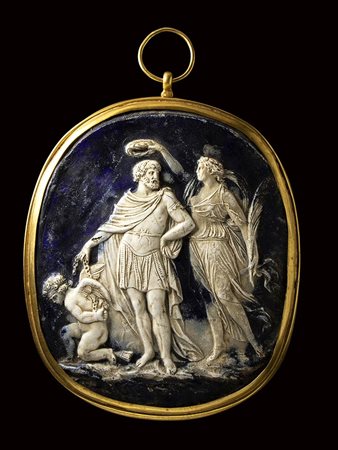
Lotto 310 A very large glass paste cameo plaque set in a gold frame. Allegorical scene.
18th - 19th century.
In the center, a standing male figure, with armor and cloak, facing left but with his head turned back to the right (Emperor, Mars?). With his right hand he holds Eros in chains, kneeling and captive. On the right side of the scene, a draped allegorical female figure crowns the male figure, and holds a palm branch, symbol of victory. The scene, probably taken from the repertoires of the Wedgwood manufacture (or similar), is an allegory of submissive love. The cameo is obtained using a two-layered glass paste: the figures are white, the field is dark blue. The work is mounted in a solid gold frame with a ring to hang it. Very decorative composition.
cameo 107x125x15 mm ; overall 170x122 mm
-
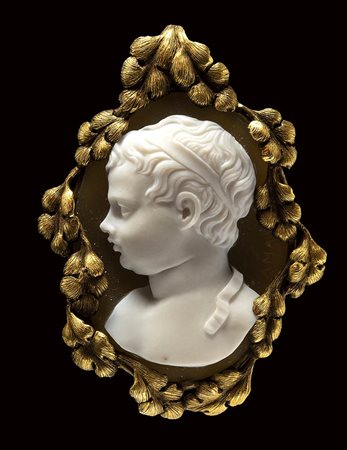
Lotto 311 A large agate cameo set in a gold brooch. Bust of a child signed Amastini
19th century.
Bust of a child, facing left, with the bust in three quarters and the face in profile.. The portrait is characterized by a very refined hair tied by a tenia as for the hellenistic princes. Beautiful execution of the anatomical details, with high and well-proportioned volumes. On the field, the signature AMASTINI, partially covered by this Victorian gold leaf frame. Probably Niccolò Amastini (born Rome 1780–1851).
Stone 32 x 42 mm; mounting 43 x 57 mm; 24,37 gr. -
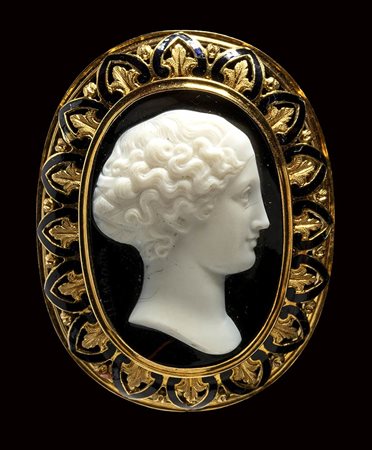
Lotto 312 A very fine onyx cameo set in a gold and enamel brooch. Female bust signed Girometti.
Early 19th century
Splendid female portrait, probably of a Muse, signed and engraved by Giuseppe Girometti (Italian, Rome 1780–1851 Rome). The figure is turned to the right, and is characterized by an extremely finely engraved hair, comparable to the best works of the Italian engraver. The profile is typically neoclassical and is characterized by a passage of the various volumes / anatomical details performed with great art. The two-layer stone is mounted in a precious 18k gold brooch decorated with chiseled palmettes and parts in dark blue enamel. Very good condition.
Cfr. Metropolitan Museum, inv. 40.20.39. Head of a maiden, sardonyx cameo by Giuseppe Girometti (Italian, Rome 1780–1851 Rome).
Stone 19 x 26 mm; mounting 29 x 37 mm; 11,28 gr.