
ASTA 107 - Glittica
-
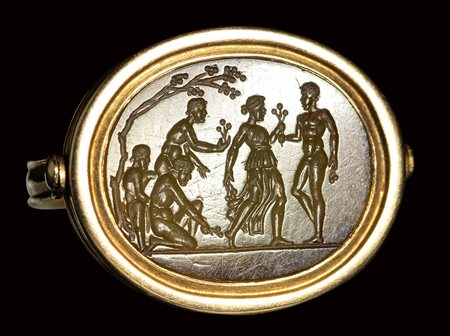
Lotto 289 A fine renaissance agate intaglio set in a swivel gold ring. Mythological scene with Triptolemus and Ceres.
17th century.
Interesting allegorical scene depicting Triptolemus who received poppy flowers from Ceres; these flowers, distributed to farmers, produce a sweet sleep and a quiet rest. The female figure is also interpreted as the Night. After an intaglio by Valerio Belli. The stone is set in a 18th century swivel ring. Very good condition. Parallels: L.P. P. Stefanelli, La Collezione Paoletti, vol. 1, p. 134 n. 198. After a model of Valerio Belli. Cfr. red jasper intaglio, Paris, BNF Cabinet des Médailles (Mariette 1750, I, tav. LX- Reinach 1895, tav. 88, 60. Valerio Belli Vincentino 2000, p. 359 n. 157, fig. p. 146. Cfr. Plaquette in Hermitage Museum, Saint Petesburg.
Stone 14 x 17 mm; ring size 17 x 20 mm; 4,70 gr.
-
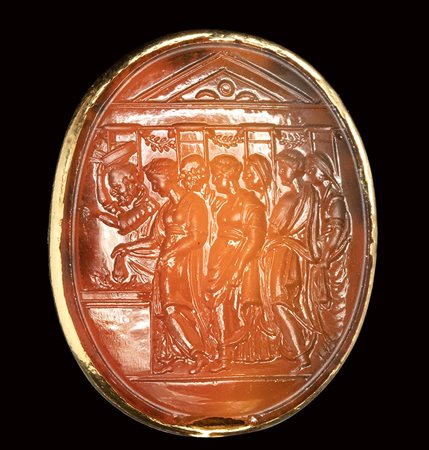
Lotto 290 A fine renaissance carnelian intaglio set in a gold seal fob. Sacrifice scene after Valerio Belli.
16th century.
The scene is composed of seven characters, all facing right, dressed in tunics and cloaks in the ancient roman style. The figures are towards an altar with burning flames proceeding a sacrifice. In the background, a tetrastyle temple with a tympanum and decorated with garlands. Some figures have a veiled head. After Valerio Belli, with variants. Wear marks. Chip on the edge, under the groud line. Cfr. Beazley Archive, TASSIE nn. 8993-8414; R. Gennaioli, Le Gemme dei Medici al Museo degli Argenti. Cammei e Intagli nelle collezioni di Palazzo Pitti, p. 365 n. 492; H. Burns, M. Collareta, D. Gasparotto, Valerio Belli Vicentino (1468c. - 1546), cat. n. 12-13-14-15 (Rock crystal and gold, Chatsworth, Duke of Devonshire coll; Rock crystal, Hermitage Museum, Saint-Petesburgh; Rock crystal, London, BM; cfr. bronze plaquettes).
Stone 19 x 23 mm; H. 27 mm; 10,48 gr. -
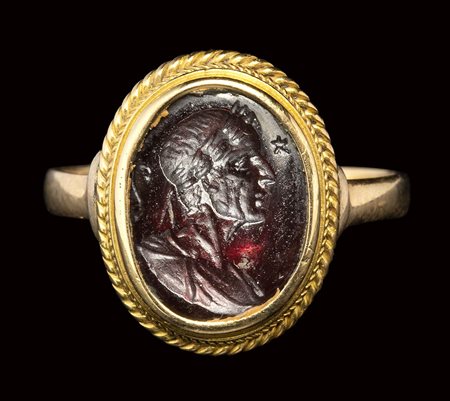
Lotto 291 A garnet intaglio set in later gold ring. Bust of Julius Caesar.
17th - 18th century.
The bust of the roman dictator faces right. On the head, a laurel wreath. The bust is draped. In the field, the lituus and a star, symbol of its apotheosis. The portrait is characterized by his typical aquiline profile, with realistic anatomical features. Slight signs of wear. The gem is mounted in a later gold ring, with a braided frame. Attractive color of the stone.
Stone 9 x 12 mm; ring size 17 x 17,5 mm; 3,27 gr. -
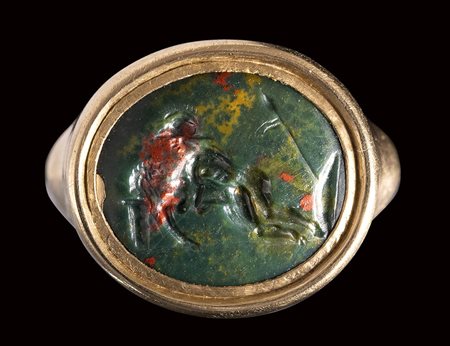
Lotto 292 A renaissance heliotrope intaglio set in a modern massive gold ring. Erotic scene.
17th century.
The scene shows an helmeted warrior taking a naked young woman from behind, their faces facing each other. In the field, shield and spear. Groundline. With rounded hoop extanding on broader shoulders into an oval bezel where the intaglio is inserted. Small gold integration on the edge of the stone. Parallels: for the subject and the scene, see Le gemme dei Medici al Museo degli Argenti. Cammei ed intagli nelle collezioni di Palazzo Pitti, n. 511 p. 374, erotic scene inspired by the Modi of Marcantonio Raimondi after the drawings of Giulio Romano.
Int diam 20 mm; intaglio 15x17 mm; 19 gr.
-
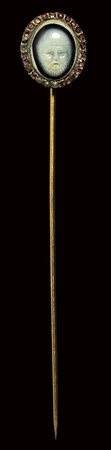
Lotto 293 Agate cameo set in a stick pin. Mask of an old character.
17th - 18th century.
Unusual three-layered onyx cameo, mounted on a gold stick pin and surrounded by small faceted garnets, partially missing. Facing head of a bearded man, wearing a skullcap.
Stone 9 x 12 mm; H. 80,5 mm; 3,19 gr. -
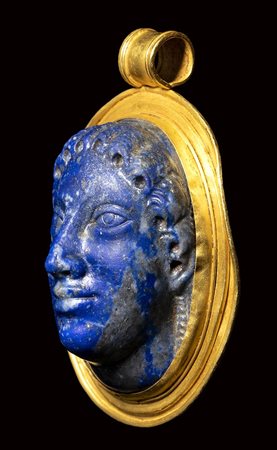
Lotto 294 A large postclassical lapis lazuli cameo set in a gold pendant. Head of Apollo.
19th century (?).
The face is frontal, with youthful features, characterized by large eyes with engraved iris, long linear nose, archaic smile. The hair is divided into curls and braids. For the iconography, probably Apollo, the subject seems to be inspired by the Etruscan art and by the Greek kouros. The stone shows ancient signs of wear and deposits. Probably a product of the late 19th century Etruscan revival. The cameo, characterized by a very protruding high relief, is mounted with a solid gold pendant. Edge of the frame slightly damaged.
cameo 35x49 mm; overall 48x71 mm; 82,24 gr. -
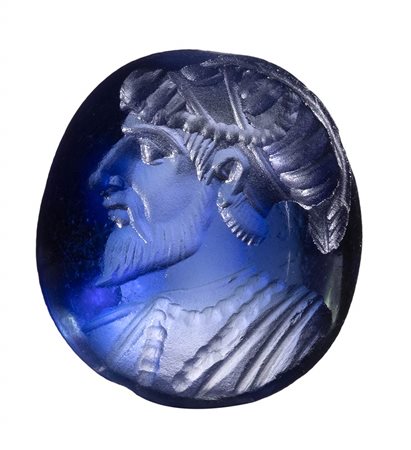
Lotto 295 A safavid blue sapphire intaglio. Bust of a ruler.
16th - 17th century
The male bust is presented facing left and characterized by well-engraved details; he wears an ornamented turban with jewels and a long feather covering a part of his hair. The face is framed by a long pointed beard. He wears an ornamented tunic with necklaces. Beautiful deep blue color.
9x10x4 mm
-
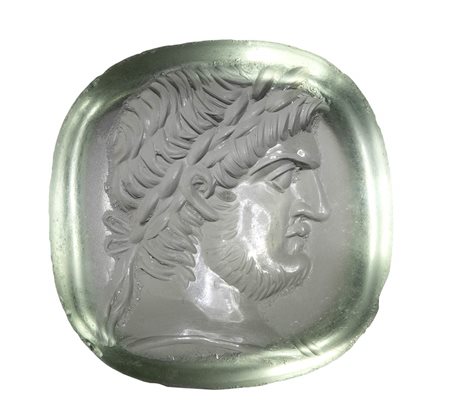
Lotto 296 A neoclassical beryl intaglio. Portrait of Nero.
19th century
The laureated emperor is facing right and characterized by strong features: severe gaze, frowning eyebrows, a straight nose, full lips. His face is framed by a short beard and hair made up of short wavy locks.
15x15x4 mm -
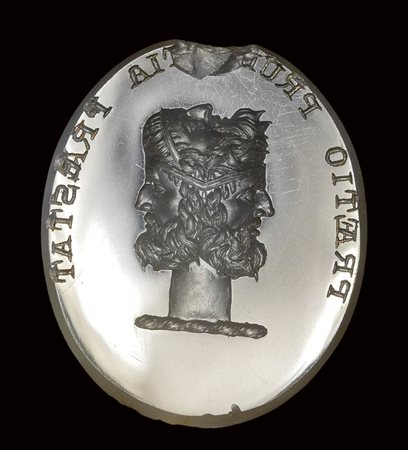
Lotto 297 A Georgian agate seal. Gryllos with a motto.
18th century.
The hybrid creature is composed by three bearded male heads conjoined over a broad neck, which rests on an intertwined ground line. All around, the motto with three latin words, a metaphor for prudence: "PRAETIO PRUDENTIA PRAESTAT" ("Prudence supplies a reward"). Chip at the top of the edge, above PRUDENTIA.
Stone bezel 18 x 23 mm; H. 35 mm; 6.70 gr. -
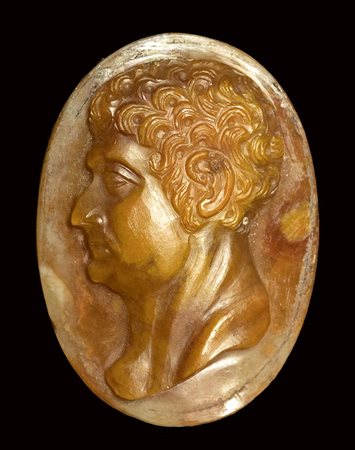
Lotto 298 A postclassical agate cameo. Male bust.
18th century
The young character is facing left and characterized by a muscular neck and thick curly hair. Inspired by classical models. The stone is engraved in high-relief. .
19 x 26 x 6,5 mm.
-
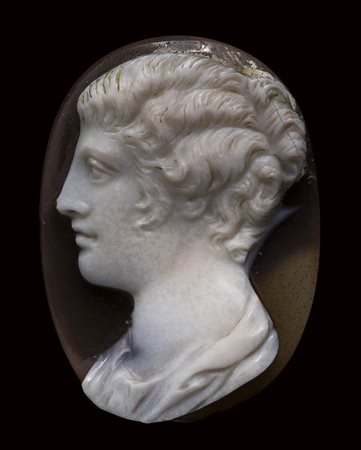
Lotto 299 A fine neoclassical agate cameo. Female bust.
18th century.
The female effigy faces left, and is characterized by a draped bust and refined hair. The typology of the portrait refers to the models of the early roman imperial age. Slight crack at the top of the gathered hair. Beautiful execution.
15x21x4 mm -
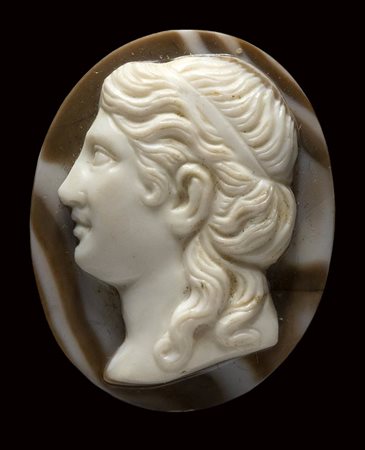
Lotto 300 A neoclassical onyx cameo. Female portrait.
Early 19th century.
The deity, probably Juno, is facing left, with long hair hanging over the shoulder and gathered in a headband. The background is characterized by beautiful white on brown zoning. Said to have been found "in excavations outside the walls of Rome".
20 x 25 x 6 mm.