
ASTA 107 - Glittica
-
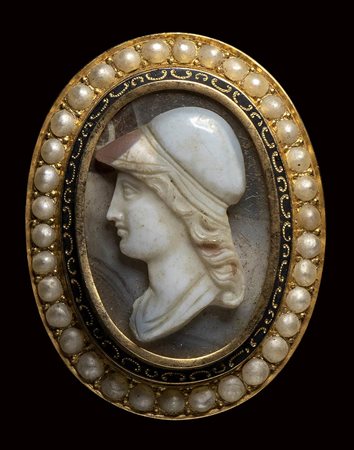
Lotto 277 An agate cameo set in a gold brooch with enamel and pearls. Portrait of Athena.
17th century.
The deity is helmeted and with a draped bust, facing left. Interesting variety of stone. The cameo is mounted in an elegant gold brooch with a frame embellished with pearls and a black enamel decoration. In the back, the closing pin is missing.
cameo 20x28x7 mm; overall 33x42 mm; 13,28 gr. -
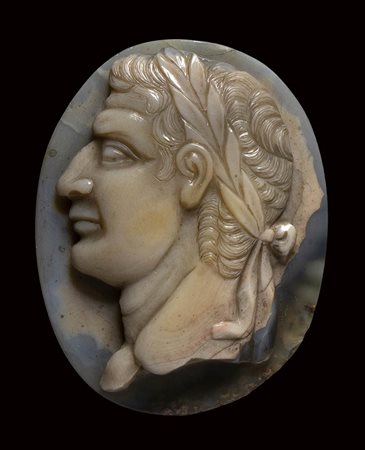
Lotto 278 A large late renaissance agate cameo. Bust of a roman emperor.
16th - 17th century
Portrait of a laureated emperor, inspired by the portraits of the Julio-Claudian Era. The features are executed in the typical late Renaissance style; finely chiseled hair. Interesting variety of agate-chalcedony, characterized by bluish parts and inclusions. Large size.
30x39x8 mm -
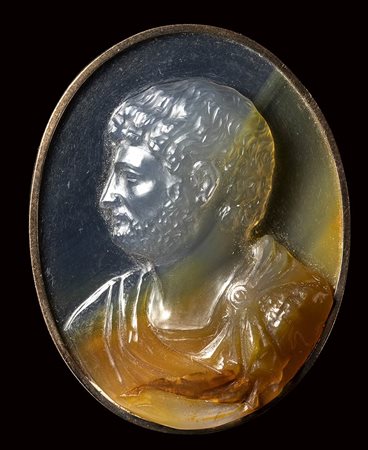
Lotto 279 A large agate cameo set in a silver frame. Bust of the emperor Hadrian.
17th - 18th century.
Exceptionally large italian agate cameo, probably 17th century, depicting the draped bust of the roman emperor Hadrian, facing left. Probably removed from a larger object (casket?). Beautiful variety of agate, from a brownish honey tone to the transparent tone.
42 x 53 x 12 mm; 21,95 gr.
-
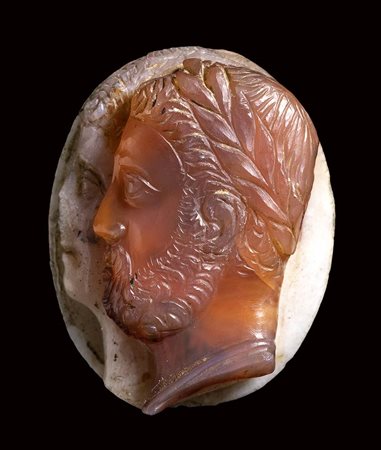
Lotto 280 An early renaissance agate cameo. Double portrait.
16th century.
In the foreground, a bearded and laureated male bust portrait, sculpted in the reddish layer of the agate; in the background, carved in the light layer, another portrait, partially damaged (lacks and chipped nose). The male character, for some details, is close to some engraved effigies depicting Cosimo I dei Medici. Interesting double portrait, to be identified. Wear marks.
20x25x3 mm -
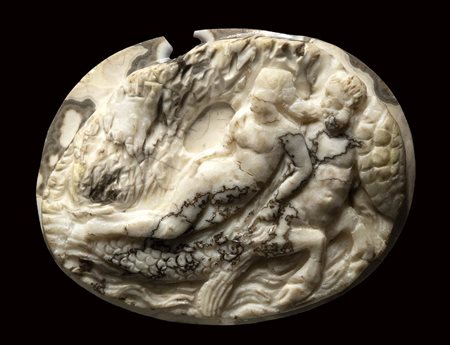
Lotto 281 A burnt agate cameo. Sea monster scene.
16th century.
This scene copies Das Meerwunder (The sea Monster) engraved c. 1498/1500 by Albrecht Durer, which shows a voluptuous naked middle-aged woman riding on the back of a male creature who is half man, half-fish. Fine depiction of the landscape, with the waves and the rocks of a cave. Tiny splinters/missing and the nose of the woman missing. Probably burnt. Rare. Parallels: Kagan, Western European Cameos in the Hermitage collection (1973) n. 57; Platz-Horster, Erhabene Bilder. Die Kameen in der Antikensammlung Berlin, Wiesbaden 2012, n. 376.
20 x 26 x 5 mm. -
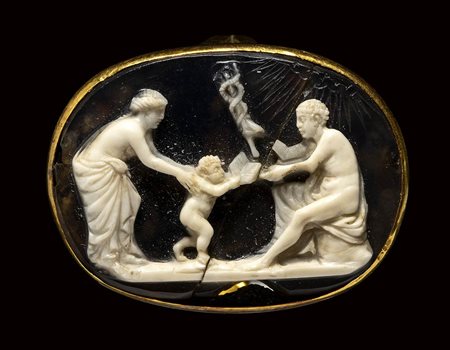
Lotto 282 A late renaissance agate cameo set in a gold ring. Mythological scene with Hermes.
Late 16th century (cameo).
A late Renaissance two layers cameo, later mounted in a gold ring, half broken. The scene depicts Eros, pushed by his mother Aphrodite, showing a book to a seated naked Hermes holding a caduceus (bare headed, bare footed non winged). The scene can be compared to a Krater by the Darius painter in the Boston M.F.A. Very unusually, there is a radiating sun engraved on the top right, a rare mixture of cameo and intaglio. The stone is broken in half, with a little missing (arm of Herms). Chipped on the edge.
Published: Christopher Cavey, Gems and Jewels, Fact & Fable, London 1992, p. 17 (as a Roman cameo).
Stone 18 x 25 mm; ring size diam. 19,5 mm; 4,55 gr.
-
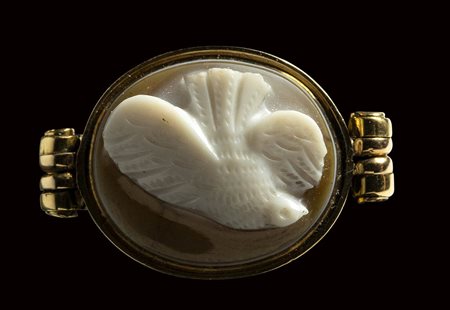
Lotto 283 A fine antique agate cameo set in a gold ring. Flying bird.
Probably 16th century (or ancient).
The bird is depicted flying, gliding downward. Lacks on the head and slight chipping on the tail and wing. The gold setting belonged to a necklace, converted into a ring. Published: Diana Scarisbrick, The Wellington Gems, London 1977 cat. n. 424.
Stone 15 x 18 mm; ring size 20 x 21 mm; 6,40 gr. -
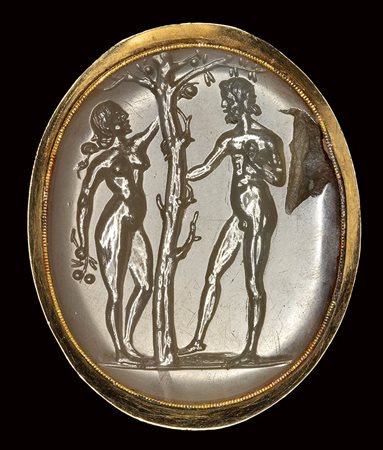
Lotto 284 A late renaissance agate intaglio set in a gold frame. Adam and Eve.
Late 16th century. Mounting 19th century.
Rare engraved depiction of the biblical episode with Adam and Eve. In the center, the tree with forbidden fruits; on the right, Adam extends his right arm towards Eve; Instead, she is on the left side in the act of picking the fruit from the tree with her left hand, while with her right hand she holds the fruit already picked. Original sin was done. Groundline. The style and anatomy are fully referable to a late Renaissance work. Rare subject of great interest. Lack on the edge. Later 19th century frame, with a 18 ct gold impression.
Stone 28 x 34 mm; mounting 32 x 38 mm; 7,50 gr. -
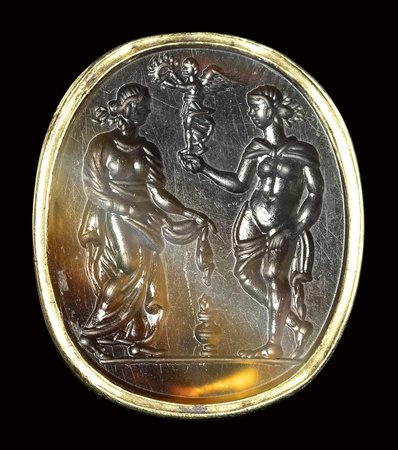
Lotto 285 A large agate intaglio set in a gold ring. Allegorical scene.
First half of 17th century.
The scene consists of two female figures. On the left, a draped figure holds his robe over a small burning urn in a votive attitude; on the right, a partially draped female figure holds a winged victory with a laurel wreath in her right hand. The scene seems to reveal a votive meaning, perhaps for a military victory. Attractive variegated stone color. Typical style of early 17th century. Italian atelier, probably north Italy (Bottega Cisalpina).
Stone 23 x 27 mm; ring size 16 x 19 mm; 10,64 gr. -
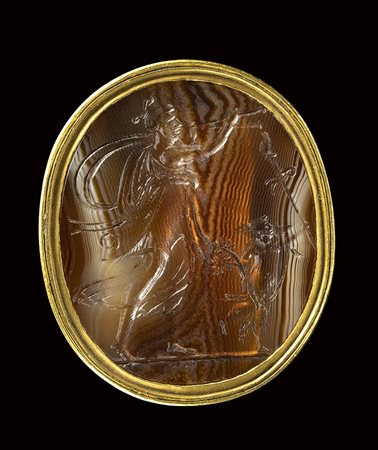
Lotto 286 A large banded agate intaglio set in a gold ring. Bacchante with Erote.
First half of 17th century.
A bacchante proceeds to the right, playing a double flute. His tunic and cloak rise with the wind, giving a great sense of dynamism to the scene. An erote precedes her, advancing with a long torch in his left hand, a laurel frond in his left. Allegorical scene, engraved in an extraordinary variety of striated agate. Northern Italian workshop, probably from a "Bottega cisalpina". Very good condition.
Stone 25 x 30 mm; ring size 19 x 21 mm; 24,37 gr. -
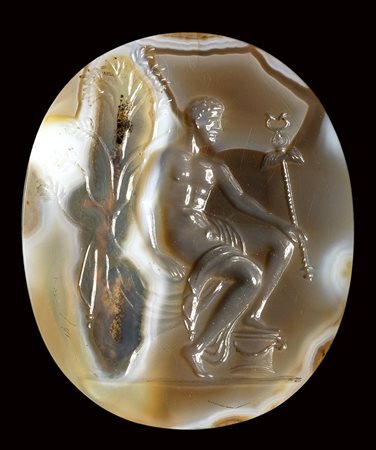
Lotto 287 A large late renaissance agate intaglio. Seated Mercury.
Early 17th century.
Interesting and unusual representation of Mercury seated, with attributes. The divinity is facing right, sitting on a base (?) from which a tree seems to be born (allegory of Nature?). The god is naked, partially covered by a cloak resting on his thighs and also on the tree. The left foot rests on a small votive altar adorned with a garland. With his left hand he holds the winged caduceus, his magical scepter. Groundline. The intaglio is made on a large and extraordinary variegated agate with inclusions.
33 x 40 x 4 mm. -
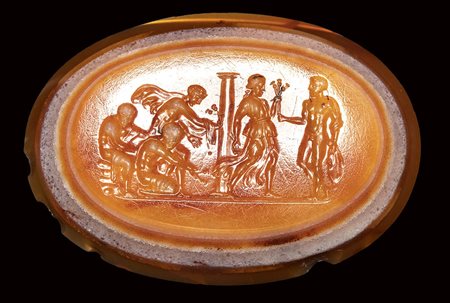
Lotto 288 A large renaissance agate intaglio. Mythological scene with Triptolemus and Ceres.
16th century.
Interesting allegorical scene depicting Triptolemus who received poppy flowers from Ceres; these flowers, distributed to farmers, produce a sweet sleep and a quiet rest. The female figure is also interpreted as the Night. After an intaglio by Valerio Belli. In this scene there is a column in the center, which divides the composition into two parts. On the left side, the farmers: one standing, one kneeling and one sitting, offering flowers. On the right, Ceres gives flowers to Triptolemus, who is depicted naked with a cloak. The work is executed on a beautiful, very large three-layered agate, with great technical and artistic mastery. Signs of wear. Parallels: L.P. P. Stefanelli, La Collezione Paoletti, vol. 1, p. 134 n. 198. After a model of Valerio Belli. Cfr. red jasper intaglio, Paris, BNF Cabinet des Médailles (Mariette 1750, I, tav. LX- Reinach 1895, tav. 88, 60. Valerio Belli Vincentino 2000, p. 359 n. 157, fig. p. 146. Cfr. Plaquette in Hermitage Museum, Saint Petersburg.
28 x 40 x 8 mm.