
ASTA 107 - Glittica
-
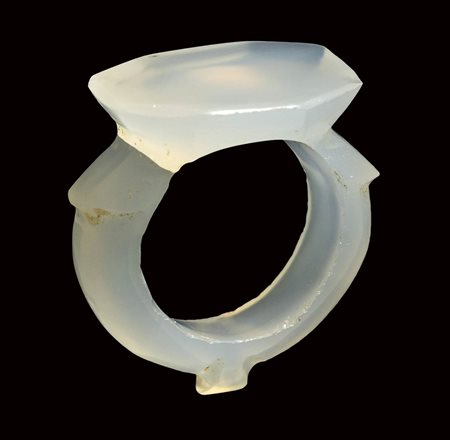
Lotto 265 An Islamic hololithic chalcedony seal ring.
12th - 14th century A.D. circa.
This hololithic ring of white-blue chalcedony has an octogonal bezel and a but narrowed neck that rises from epaulette shoulders. The ring has also a protruding back stud.
Other similars rings in agate and carnelian are referenced in Iran and Ottoman Empire until the 16th century.
Parallels: Wenzel, M. Ornament and amulet, The Nasser D. Khalili collection, n. 320-325, PP. 104-105
Bezel 12 x 20 mm; ring size diam. 15,5 mm; H. 26 mm. -
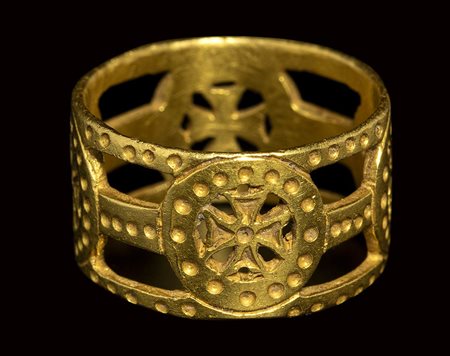
Lotto 266 After the antique open work gold ring in the byzantine style. Crosses.
19th - 20th century (?).
Ring composed of a broad hoop, the central part of which is formed by 4 repeated openwork cross design. On either side, is a band of plain gold with a series of small engraved dots.
11 mm band; ring size diam 17 mm circa; 7,75 gr. -

Lotto 267 A late roman octogonal gold ring with hunting scene.
3rd century A.D.
Octogonal hoop ring, without engraved, a hunting scene with dogs, snake, and hare.
The octagonal shape of the ring was also understood by the wearer to signal protection from evil. Ring was worn as a talisman. Rare.
8 mm band; ring size 20 mm circa; 9.75 gr. -
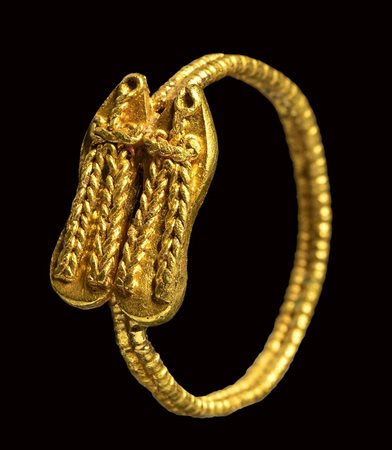
Lotto 268 A Fatimid gold filigree gold ring (Egypt or Syria). Two sandals.
10th - 11th century A.D.
Hoop composed of two trick beaded rods soldered side by side. The table modeled as two sandals with plaided laces. Gold sandals were found in the tub of the three foreign rives of Pharaoh Thutmosis III.
Reference: St Elie (de) Anastase Marie, « le culte rendu par les musulmans aux sandales de Mahomet », in Anthropos 5, 1910, pp.363-366.
Bezel 6 x 10 mm; ring size diam. 13 mm circa; 1,43 gr.
-
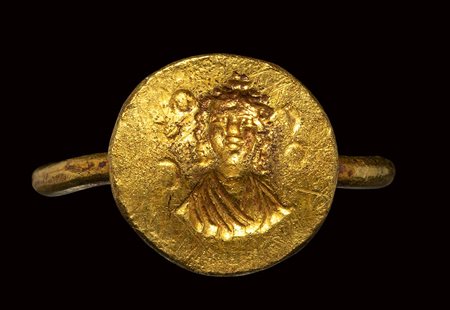
Lotto 269 A byzantine gold engraved ring. Frontal portrait bust.
6th - 7th century A.D.
With rounded hoop surmounted by a circular gold engraved bezel. The central character is presented in front and draped. Around, letters unreadable. Wear marks on the surface of the bezel. Traces of deposits on the hoop.
Parallel: Spier, J., Byzantium and the West : Jewelry in the first millenium, 2012, fig. 14D.2, 18
Bezel diam. 13 mm circa; ring size 16 x 18 mm; 6,13 gr. -
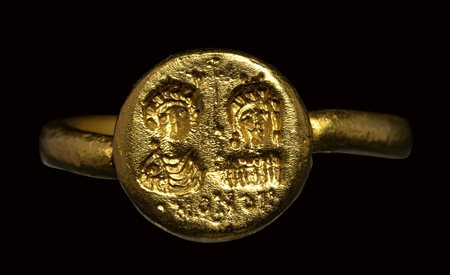
Lotto 270 An early Christian gold marriage ring. Two portraits.
5th century A.D.
With plain circular hoop, expanding into a circular massive bezel with engraved design; a double portrait with inscriptions (partial erased). A man on the left and a woman on the right in frontal view. On top, a cross (partially consumed). Below, an inscription rends OMONOIA (harmony).
Parallel: for two similar examples in the Dumbarton Oaks collection, Washington D.C., see A. Lazaridou, Transition to Christianity, Art of Late Antiquity, 3rd-7th Century AD, 2011, p. 110, nos 59 and 60, S. Zwain explains "OMONOIA is the most frequent inscription on marriage rings of this period.
Bezel diam. 12 mm; ring size 14 x 17 mm; 10,56 gr.
-
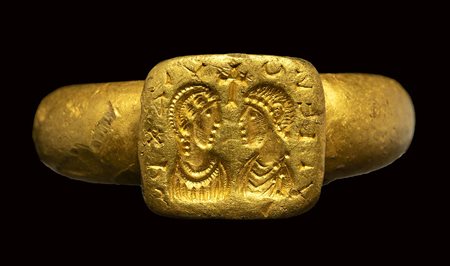
Lotto 271 A byzantine gold marriage ring. Two portraits.<br><br>4th - 5th century A.D. <br><br>With massive plain rounded hoop expands into a rectangular bezel with an engraved design; a double portrait with inscription (partial erased). A male and a female bust facing each other, between the christian cross. On each side, on the edge, inscriptions, probably some kind of benediction for the couple. Although partial erased, the inscriptions appears clearly in reverse, suggestions that the ring was intended for sealing. Two other features confirm that the ring was made as a seal; the chlamys won by the male has a brooch fastened on the left instead of right shoulder as was customary; and the bride appears on the left instead of on the right, the left side of the composition being reserved typically for the more important person.
This type of marriage ring originated in the fourth century was popular in the Roman Empire and the Byzantium. Its origin lies in Roman coinage dating from at least the third century, were the facing portrait symbolized solidarity and harmony. The addition of the cross adapted the model to Christianity, by suggestion that through the marriage the union was blessed by God.
Parallel: HINDMAN, S., FATONE, I., MANTOVA, A., Toward an Art History of Medieval Rings: A private collection, 2014, pp. 30-33; for a very similar ring see Washington D.C., Dumbarton Oaks Collection, 47,18.<br><br>11 x 12 mm; ring size 15,5 x 16,5 mm; 25,37 gr.
-
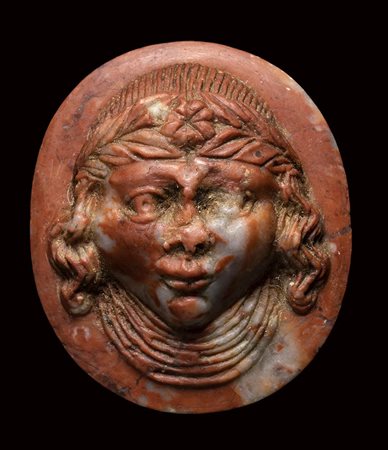
Lotto 272 A north italian medieval red marble cameo. Laureated male portrait.
11th century.
Frontal portrait of a noble young man with a laurel wreath adorned with a central rosette. The young prince is characterized by large eyes with engraved iris, high cheekbones, small chin and pronounced mouth, within a triangular face. The hair long and wavy and falls to the sides of the face. The neck is protected by drapery with very thin and refined folds. His left eye and nose are slightly chipped. Wear marks. Deposits. The back of the cameo is characterized by an engraved trace near the edge of a coeval setting (diadem? casket?). The work was sculpted on a fine specimen of fossiliferous red marble, identifiable with the "Veronese red marble" (Rosso di Verona) from the north italian regions. This material was used starting from the affirmation of the court of Frederick I as Emperor of the Holy Roman Empire (1155-1190). The peculiar choice of this material, the characteristic engraving style of the period, and the iconography of the character, suggest a possible identification with a member of the imperial family. Rare.
25x30x9 mm. -
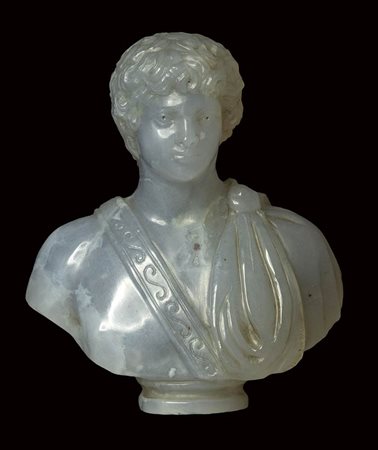
Lotto 273 A postclassical chalcedony bust of young Caracalla.
18th - 19th century (?).
Bust of Caracalla as a child, of the type created in 198 A.D. for the designation as Augustus. This bluish chalcedony bust is inspired after the white marble (198–204 A.D.) from the Vestals' House at the Roman Forum (early 3rd century A.D., National Roman Museum Baths of Diocletian). The model can be identified not only for the typical features of the young Caracalla, but also for the peculiar shoulder belt, with S-shaped motifs (parazonium), and the cloak with chlamys, resting on his shoulder. After the antique. Probably made during the Grand Tour Era. Very good condition. Old deposits. Slight wear marks.
H. 50 mm.
-
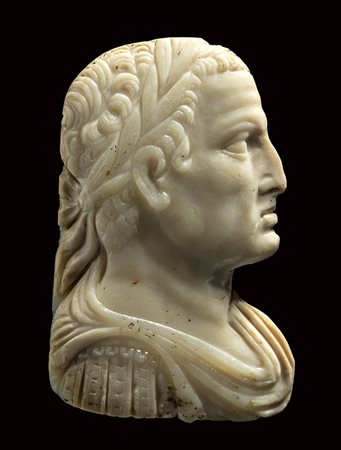
Lotto 274 A fine late renaissance onyx cameo with cutted edge. Draped bust of laureated emperor.
16th – 17th century
Probably the portrait of the roman emperor Galba. The armour is visible under the cloak. Good execution of the character's anatomy and great face expression. In ancient times, the field/edge of the cameo (bluish layer) was cut around the bust (white layer), creating a silhouette with only the portrait. Probably from a set of cameos depicting the twelve Caesars.
30 x 41 x 7 mm. -
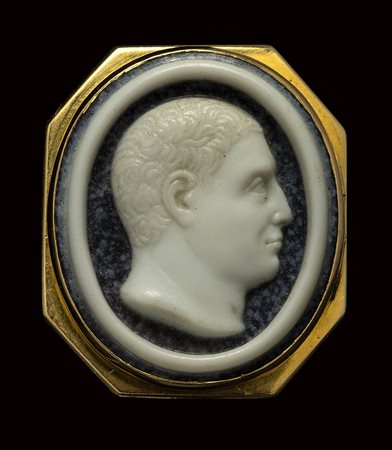
Lotto 275 A fine onyx cameo set in a gold ring. Male portrait.
16th - 17th century.
Male portrait facing right. Probably a private portrait inspired by ancient Roman republican models. The cameo is sculpted on a two-layer onyx, the head and the frame have been engraved both on the white layer. The background, darker and bluish spotted, turns orange when backlit. The stone is mounted in a ring with an openable octagonal bezel (interlocking closure). Interesting work. Rare type. Very good condition.
Stone 20 x 24 mm; ring size 16 x 20 mm; 8.22 gr. -
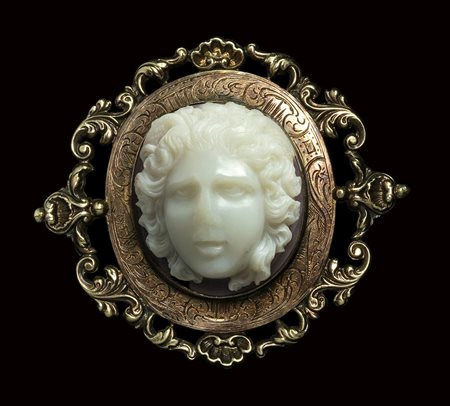
Lotto 276 A fine renaissance onyx cameo set in a gilded silver brooch. Head of Medusa.
16th century (cameo); 18th century (mounting).
Almost frontal head of Medusa, slightly in three-quarters to the left. The eyes are expressive with pupil engraved and a dramatic look; the mouth is slightly open, the forehead wrinkled, the hair wavy and engraved with great refinement. The head is sculpted in high relief, with mastery, on a two-layered agate. The whitish pink background is characterized by stripes. Beautiful Renaissance work inspired by hellenistic Greek art, set in a later chiseled and gilded silver brooch. The metal pin is missing in the backside. Chipping on the nose.
Stone 22 x 25 mm; mounting 42 x 48 mm; 16,30 gr.